Archive for Teams

Daily Prospect Notes: 4/17/19

These are notes on prospects from lead prospect analyst Eric Longenhagen. Read previous installments here.

Nicky Lopez, SS, Kansas City Royals
Level: Triple-A   Age: 24   Org Rank: 7   FV: 45
Line: 3-for-5, 2 HR, 2B, BB

Notes
In our recently-published Royals list, we openly wondered if we should be heavier on Lopez largely because A) he plays shortstop and B) his peripherals are excellent. Shortly after publication, an executive reached out to us and they agreed we should be more enthused about Lopez, who we currently have evaluated as a second-division regular. He’s struck out just once so far this year. We don’t expect Lopez to hit for much power (he’s little and hits the ball on the ground a lot), but he may do enough to be part of Kansas City’s rebuilding efforts.

Brusdar Graterol, RHP, Minnesota Twins
Level: Double-A   Age: 20   Org Rank: 3   FV: 50
Line: 7 IP, 1 H, 1 BB, 0 R, 8 K

Notes
After two semi-wild starts during which his stuff was still too good for opposing hitters to do anything with, Graterol was slightly more efficient and utterly dominant last night. He’s holding upper-90s heat late into games, and while his slider is more horizontally oriented than is ideal (vertical breaking balls are typically better at missing bats), Graterol’s has enough length to be a real problem for hitters anyway. He’s only 20 and carving up Double-A. If there’s a scenario in which Graterol sees the big leagues this year, it almost certainly involves a tight AL Central race and a start like the one he’s off to.

Jarred Kelenic, CF, Seattle Mariners
Level: Low-A   Age: 19   Org Rank: 3   FV: 50
Line: 4-for-4, 2 2B, SB, BB

Notes
After a rough first week, Kelenic has heated up and is hitting like one would hope the most advanced high school bat would hit during their first full pro season. Both he and Nolan Gorman are performing and seem on the fast track. Kelenic has also looked comfortable in center field. Big and muscular aleady at 19, there’s some thought Kelenic may eventually move to a corner, but if he races through the minors, he’ll get to the bigs before he slows down.

Oscar Gonzalez, OF, Cleveland Indians
Level: Hi-A   Age: 21   Org Rank: HM   FV: 35
Line: 2-for-5, HR, 2B

Notes
Perhaps the epitome of the high-risk hitting prospect, Gonzalez continues to hit for power despite employing one of the most swing-happy approaches in pro ball. He still hasn’t walked this year and has just three free passes dating back to last June. The realistic ceiling for a player like this is a Hunter Renfroe-y sort of player.

Dispatch from Chula Vista

I’m in Southern California to see Eastlake High School infielder Keoni Cavaco, perhaps the most signifiant pop-up prospect in this year’s draft. Though his swing is a little unorthodox and handsy, Cavaco has big raw power and speed (he homered to dead center yesterday, turned what would typically be a gap single into a double, stole a base) and maybe the best body in the draft. He mishandled a ball at third base (where he moved, from second, late in the game) and saw little defensive action beside that.

We have Cavaco at the back of the 45-FV tier in this year’s class. There can only be so much confidence in his bat because he wasn’t part of last summer’s big showcases, where he would have faced better pitching than he’s seeing now. On tools, and based on what teams had extra heat in to see him (Seattle, Cleveland, Arizona), we’ll likely slide him up a few spots on The Board. I may head back to see more of him today.

Brandon Hyde: A Day in the Life of a Big-League Manager

Brandon Hyde is slowing settling into a routine. As a first-year MLB manager, it’s one that includes a number of new responsibilities. The 45-year-old Baltimore Orioles skipper isn’t without experience — he’s served in a variety of different roles, most recently with the Cubs as Joe Maddon’s bench coach — but again, he’s never been at the helm of a big league team. What’s he’s experiencing is a whole new animal.

His day starts long before the first pitch is thrown, and it ends well after the last out is recorded. There are reports and video to go over. There are coaches and front office executives to consult with. There are players to cultivate relationships with. There is a lineup to put together. And as everyone in Hyde’s role knows, there is also the media.

Hyde discussed his daily routine prior to Saturday’s game at Fenway Park.

Brandon Hyde: “I get up, have coffee or tea, and read the news from the night before; I look through world events and sporting events. The baseball news I read is national, because I want to keep up with what’s happening throughout the game. From there I’ll usually try to hang out with my family for a couple of hours before I go to the ballpark. Or, if I’m on the road, I’ll do something like go out to the driving range. I’ll try to do something relaxing.

“I get to the park fairly early. For a night game, that’s around noon-ish, maybe 12:30-ish. The first thing I do is double-check the lineup, which has already been set. That happened the night before. Read the rest of this entry »


How Mariners’ Rule 5 Pick Brandon Brennan Is Like Max Scherzer

Rule 5 picks aren’t known to be guaranteed successes. Of course, there are the obvious exceptions, like Odubel Herrera, Marwin Gonzalez or Hector Rondon, but for every success, there’s a Tyler Goeddel, a Jabari Blash, a Taylor Featherston. Generally speaking, the Rule 5 Draft is a good way to ensure players aren’t buried on a roster, but in terms of long-term contributors, not much often comes of it.

With that said, let me introduce to you right-handed reliever Brandon Brennan. He was the 13th overall selection in the 2018 Rule 5 Draft by the Seattle Mariners, who were so interested in bringing him aboard that they made the pick even after missing out on signing him as a minor league free agent.

When the decision to draft Brennan was made, Mariners Vice President of Scouting Tom Allison expressed his enthusiasm to Greg Johns of MLB.com. “Opportunity is probably what he needs the most, and we have that to give him,” Allison said.

What I love most about this quote is how accurate it is four months later. Brennan not only made the Mariners’ Opening Day roster, but he’s been superb so far here in the early going, making the most of the opportunity that Allison said Seattle had to give. Granted, he’s made just nine appearances and pitched just 12.1 innings, but the results have been there. Brennan has pitched to a 0.73 ERA (one earned run allowed) and 2.57 FIP, with 13 strikeouts (29.6 K%) to just two walks (4.6 BB%) across the 44 batters he’s faced. Hitters are hitting just .143 (6-for-42) against him. Anecdotally, he’s been called “the Mariners’ best reliever this season.” Read the rest of this entry »


Pete Alonso Crushes the Ball

Pete Alonso, it should first be said, really isn’t a great defender. The Mets were quick to let everyone know this throughout 2018, when they didn’t call him up early in the year, when he won Defensive Player of the Month for the Mets’ Triple-A affiliate in July, and when they didn’t make him a September call-up in a completely lost season for the big league club. Seventeen games into his major league career, however, I can say one thing with certainty: I don’t care that he’s supposedly bad at defense. Alonso’s plate appearances are turning into appointment viewing, because he flat-out crushes the ball. I’m not talking garden-variety “boy, that large man can hit,” either. Alonso might not have the best strike-zone recognition, or the best general plate discipline, but when he makes contact, he’s doing damage like almost no one else in baseball.

If you want to understand how truly incredible Alonso’s start has been, you need to look past the WAR leaderboards. Heck, you need to look past the wRC+ leaderboards — like I said, his plate discipline is a work in progress. Alonso has a near-200 wRC+ with a 31% strikeout rate — the three players at the top of the wRC+ leaderboard check in at 11.5%, 8.6%, and 15.0%, respectively. No, the magic really starts when Alonso puts the ball in play, and I do mean magic. Take a look at the top 10 players in baseball in terms of barrels (a Statcast designation that basically means a ball that is tremendously likely to be an extra-base hit) per batted ball:

Barrels/Batted Ball (min. 25 BB)
Player Barrels/Batted Ball
Pete Alonso 31.6%
Gary Sanchez 31.3%
Joey Gallo 29.6%
Mike Trout 29.0%
Christian Walker 25.0%
J.D. Davis 23.3%
Franmil Reyes 23.1%
Anthony Rendon 22.9%
Willson Contreras 21.4%
Jay Bruce 21.1%

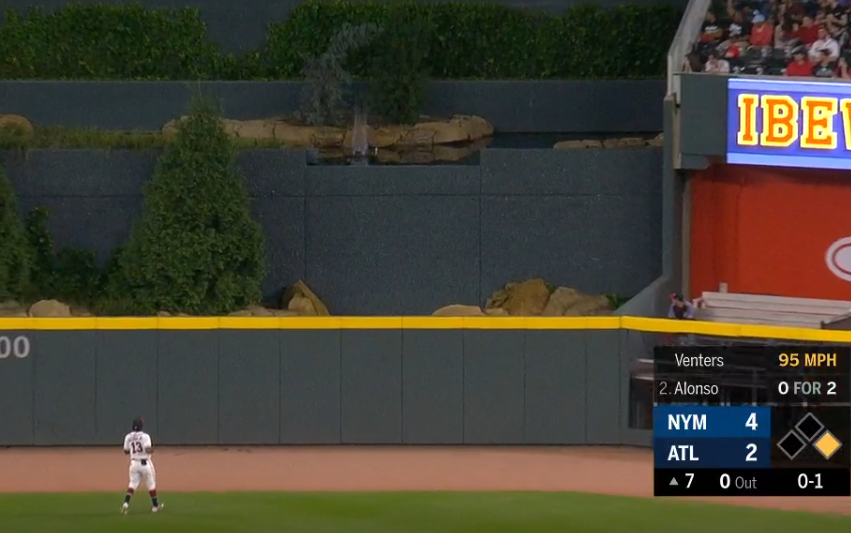
Think of it this way: about a third of the time that Alonso puts the ball in play, he’s hitting an absolute rocket. Just being on this list, let alone at the top of it, tells us something. This isn’t a list of guys who have lucked into some game power. It’s not a list you can get on just by taking some walks, like a wRC+ leaderboard — Alex Bregman might have had a nice 2018 at the plate, but it’s hard to fake hitting the ball this hard and this optimally (Bregman ended 76th in barrels per batted ball last year). This isn’t just home run power, either, though it’s certainly that — Alonso has six homers already, including a 118.3-mph, 454-foot missile off of Jonny Venters that had SunTrust Park looking like a water hazard at the Masters:


Read the rest of this entry »


What the 16-Game Mark Tells Us About Teams’ Futures

Early season performances are always tough to get a handle on, but on a team level, the 16-game mark is worthy of some note. In Baseball Prospectus’ 2012 book Extra Innings: More Baseball Between the Numbers (a book to which I contributed), Derek Carty — a name that should be familiar around here — found that at the 16-game mark, a team’s year-to-date record became as predictive as simply assuming they’ll finish at .500, as the largest possible sample of teams inevitably does. Through Monday, 19 teams have played at least 16 games, and 11 have played at least 17, which makes this a good time to take a closer look.

In his study, Carty examined non-strike seasons from 1962 through 2011, calculating the correlation between a team’s record after n games and its final record. After one game, for example, the correlation with teams’ final mark was just .12, while at the five-game mark it was .28, and at the 10-game mark, .42. The correlation reached .5 at the 16-game mark, rose to .52 at the 17-game mark, and so on. Carty made no mention of the likelihood of teams making the playoffs, though with changing postseason formats — including the introduction of a second Wild Card in each league starting in 2012, just when the book hit the streets — such information would be of limited utility.

To my knowledge, Carty hasn’t updated the study since publishing that, so we don’t know for sure that the 2012-18 period hasn’t altered his conclusion slightly. Since we’re not doing brain surgery here — just getting a preliminary read on where this season is heading for teams — it doesn’t matter a whole lot. I didn’t set out to re-create Carty’s study, but I did examine what 16-game performances from the two Wild Card era can tell us. Read the rest of this entry »


Yoan Moncada is Different

There are varying tactics when it comes to approaches at the plate. Getting ahead and waiting for the right pitch is one. Swinging at the first good pitch you see because you might not get another is a second. Protecting the plate when behind in the count comes up often. Hitters use some or all of that when they step up to bat, but Yoan Moncada’s patience last season ended up hurting what could have been a much better season. A more aggressive approach thus far has shown much better results this year as Moncada attempts to take the next step in his development.

Last season, Moncada has a walk rate of 10.3%, which is good, and a strikeout rate of 33.4%, which is bad. The only players at 23 years of age or younger to put up double-digit walk rates and a strikeout rate above 30% (which is going to limit how far back we go given the massive rise in strikeouts) are Kris Bryant (2015) and Joey Gallo (2017). Gallo hit 41 homers to make himself an offensively valuable player. Bryant was constantly making great contact when he did put the ball in play on his way to a Rookie of the Year campaign. Moncada hit the ball hard when he made contact, but not at the same level as Bryant, and ended with a 97 wRC+ on the year. Changes are necessary to improve on that mark, and it looks like Moncada may indeed be making them.

Last week at MLB.com, Mike Petriello also wrote about Moncada, noting just how terrible he was on two-strike pitches, notably pitches on the edge, which caused an absurdly high number of called third strikes.

That made the problem easy to diagnose, if not easy to solve. Don’t get to two strikes. But also, don’t get to two strikes being so desperate that you start expanding your zone and flailing at bad pitches.

We know this, because Moncada and the Sox spent a lot of time talking about it.

“As long as he maintains an aggressive approach within the strike zone, which he has been increasing,” Chicago manager Rick Renteria said to MLB.com in July, “he has a chance of having really good success obviously.”

“We made a plan,” Moncada said to MLB.com in December, referring to extensive offseason work with White Sox coaches. “Right now, I am in a better position to succeed and to be a better player next season. It was a very good experience, overall.”

“We ended up attacking the topic of his strike-zone approach,” Renteria said. “He has great ability to take pitches. That’s something that’s innate in him.”

Petriello noted that Moncada was being a bit more aggressive, particularly with the zone, and he was hitting the ball harder and striking out less, all good outcomes. Moncada has lowered his strikeout rate to 24% on the season, and while that might not necessarily represent a new skill level, even after 66 plate appearances it is enough to change our expectations considering last year’s 33% mark. Moncada’s walks have gone down to about 6%, but he is tearing the cover off the ball with a .242 ISO and a .395 BABIP, which has helped lead to a 152 wRC+. The decrease in walks isn’t great for Moncada, but the lowered strikeouts more than make up for that. Consider that when Moncada put the ball in play last season, he put up a 175 wRC+, one of the top 30 marks in the game. This year, he’s putting up a 227 wRC+ when he puts the ball in play, but he doesn’t need that to keep up to make a different to his overall line as we know that BABIP is going to come down some even if we reasonably expect him to post a high value. Read the rest of this entry »


Hot Starts to Believe In

T.S. Eliot once mused that April is the cruelest month, but for me, it’s the most curmudgeonly one. While baseball returning is always a good thing, a good portion of my April job is to (partially) crush the hopes and dreams of fans excited about hot starts from their favorite players. While stats don’t literally lie, April numbers, thanks to our old friend and scapegoat small sample size, only tell a little bit of the story of 2019. But as cautious as I try to be about jumping to conclusions in baseball’s first month, at least some of those torrid beginnings will contain more than the customary grain of truth. So let’s go out on that proverbial limb and try to guess which scorching Aprils represent something real.

Yoan Moncada

I’ve been burned before touching this hot stove, but there’s something so compelling about Moncada’s early-season performances as to once again disarm the skeptic in me. In 2018’s version of this piece, Moncada’s high exit velocity and his .267/.353/.524 April line had me believing that he had finally turned the corner, the one long-expected from a young, talented player with impressive physical tools.

As the narrator meme goes, he had not turned that corner. Moncada spent the next two months with an OPS that didn’t touch .600, and his final 2018 line represented no real improvement over his 2017.

Moncada is hitting the ball just as hard as he did last year, with his average exit velocity ranking sixth in baseball. But this time around, his performance is also coming with some significant progress in his contact statistics. Moncada’s profile has always been a bit weird in that he doesn’t seem to have a serious problem chasing bad pitches, certainly not as you would expect from a player who just led the league in strikeouts with the fourth-highest total in baseball history. But Moncada was in the top 20 in not swinging at pitches outside the zone.

In 2019, he’s been more aggressive, swinging at more bad and good pitches, but there hasn’t been a corresponding contact tradeoff, and he’s in fact making more contact overall, especially against good pitches. Given that one of the purposes of plate discipline is for hitters to actually hit the good pitch they eke out of the dude on the mound, I once again return to the ranks of the believers. Read the rest of this entry »


Here Are a Few Things About Matthew Boyd

Matthew Boyd has been around for a bit. He was drafted by the Blue Jays in the sixth round of the 2013 Draft out of Oregon State University. He made the majors with the team but was traded to the Tigers at the 2015 trade deadline along with Daniel Norris and Jairo Labourt in exchange for David Price. As a prospect, he wasn’t too highly regarded. While he was a regular on Carson Cistulli’s Fringe Five column, he wasn’t highly ranked. Baseball America, for instance, included him in their organizational rankings only once (he was the 29th prospect in the Jays system after the 2014 season); he received sporadic mention at Baseball Prospectus.

After splitting time between the majors and Triple-A in 2016 and 2017, 2018 showed some promise for Boyd. His strikeout rate went up and his walk rate went down. His home run rate also went up and while overall he took a step forward as a decent rotation guy for the Tigers, there was room to improve. As my friend Brandon Day over at Bless You Boys noted, Boyd showed an extreme home/road split, which is one pitfall of being a flyball pitcher whose tendencies can be masked by playing in the pitcher-friendly Comerica Park. Boyd himself wasn’t satisfied either. He spent his offseason basically finding every way he could to improve himself. He lost 15 pounds, maintained his muscle mass, and even did DNA-based testing to find out what works and doesn’t work for his body.

And so far in 2019, Boyd has been a strikeout machine. In three starts, Boyd has racked up 40.3% strikeout rate, the second highest rate the majors behind Blake Snell. Yes, there’s the obligatory small sample size warning here. Boyd will likely not keep that rate up for the rest of the season. But looking at the changes he’s made and how the hitters have responded to them, there are reasons to believe that he could be taking the next step as a pitcher. Read the rest of this entry »


Chris Archer, Kyle Crick, and Jameson Taillon Ruminate on Their Sliders

Pitchers learn and develop different pitches, and they do so at varying stages of their lives. It might be a curveball in high school, a cutter in college, or a changeup in A-ball. Sometimes the addition or refinement is a natural progression — graduating from Pitching 101 to advanced course work — and often it’s a matter of necessity. In order to get hitters out as the quality of competition improves, a pitcher needs to optimize his repertoire.

In this installment of the series, we’ll hear from three pitchers — Chris Archer, Kyle Crick, and Jameson Taillon — on how they learned and developed their sliders.

———

Chris Archer, Pittsburgh Pirates

“In [high school], I was dating this girl whose brother played in the minor leagues with the Red Sox. His name is David Penny. He had some shoulder issues and didn’t make it beyond Low-A, but he was a prominent figure, baseball-wise, in my hometown [Clayton, North Carolina]. He thought that I had the right arm slot for a slider — at the time I was only throwing a curveball — and taught it to me.

“When I got drafted, the Indians scrapped it. I didn’t throw one slider in 2006, ’07, or ’08. What happened was … it was interesting. First day, I was with the rookie-ball pitching coach, and he saw all four of my pitches. He was like, ‘OK, we need to develop your fastball command and your changeup.’ He said the only way to do that would be by eliminating one of my pitches, which would force me to throw the other ones. That particular bullpen, my curveball appeared to be better than my slider, so he said, ‘Curveball, fastball, changeup — that’s it.’ So for those three seasons, I was curveball-fastball-changeup. Read the rest of this entry »


Daily Prospect Notes: 4/15/19

These are notes on prospects from lead prospect analyst Eric Longenhagen. Read previous installments here.

Patrick Sandoval, LHP, Los Angeles Angels
Level: Double-A   Age: 22   Org Rank: 16   FV: 40
Line: 5 IP, 4 H, 2 BB, 0 R, 9 K

Notes
Acquired from Houston in exchange for Martin Maldonado last summer, Sandoval now has 45 strikeouts in 28.2 career innings at Double-A. He continues to work with middling fastball velocity but some mechanical elements help it to play better than 90-94. Houston got Sandoval to open his front side a little more, tilt his spine, and release the ball with a more vertical arm slot than he was using in high school. It’s a weirder look for hitters and creates more backspin and, therefore, more “rise” on his fastball. Sandoval also works heavily off his two secondary pitches, and his changeup may be better than we currently have it projected to be on The Board. The strike-throwing is still inconsistent start to start, but Sandoval is officially having upper-level success for a franchise that keeps having injury issues on the big league roster, so perhaps he should be included in the Canning/Suarez/Barria group of young hurlers who may help the Angels sooner than later.

Nate Pearson, RHP, Toronto Blue Jays
Level: Hi-A   Age: 22   Org Rank: 4   FV: 50
Line: 5 IP, 1 H, 0 BB, 0 R, 9 K

Notes
Pearson was removed from his previous start after just 27 pitches, so it was a relief to see him back and dominant five days later. Pearson’s future as a strike-thrower is hard to anticipate. He was wild last fall but he hadn’t pitched all year due to a fractured ulna, so that wildness could have just been due to rust. He threw 43 of 59 pitches for strikes yesterday, a sign he may actually be able to harness his alien stuff and find a way to start long-term. He may be on an innings limit this year, so unless the Jays expertly manicure his workload with a big league goal in mind (perhaps that two-inning outing last start is an indication of how they’ll handle Pearson throughout the year) it’s unlikely we see him in the big leagues until next year at least. It’s still too early to reposition Pearson in our rankings due to increased confidence that he’ll start, but yesterday’s outing, during which he sat 94-98 and touched 102, could soon be part of a body of evidence indicating we should.

Anderson Tejeda, SS, Texas Rangers
Level: Hi-A   Age: 20   Org Rank: 4   FV: 45+
Line: 2-for-5, 2 HR

Notes
These were Tejeda’s first two homers of the year. He’s back at Hi-A despite having success there last year, presumably so the Rangers can let Michael De Leon (who peaked as a teenager) get regular at-bats at Frisco for the third consecutive year. Tejeda is off to a strong start, and may force a promotion to Double-A (and into our Top 100) if he keeps it up for another few weeks.

Ljay Newsome, RHP, Seattle Mariners
Level: Hi-A   Age: 22   Org Rank: NR   FV: 35
Line: 6.2, 4 H, 0 BB, 0 R, 10 K

Notes
We touch base on players like Newsome when we write the org lists. He threw a lot of innings last year and he barely walked anyone, so we checked on the stuff to see if it cleared the bar to stick someone on the list at all. With Newsome, that had not been true. Despite all the strikes, his fastball has been in the mid-to-upper 80s basically since high school, and those guys typically max out as spot starters. Now, Newsome is different. He took part in an offseason velo program and now resides in the 91-94 mph range. He’s clearing his front side a little more, his two-seamer has more tail, he’s working up in the zone with his four-seamer more often, and is setting up his changeup better. Take the performance of a 22-year-old repeating Hi-A with a grain of salt, but know Newsome has grown and changed, and is off to a strong start.

A Weird Box Score
Tulsa pitchers combined to no-hit Arkansas into extra-innings last night, but still lost due to a slew of walks in the 10th inning. The Arkansas staff allowed five hits, but fewer total baserunners than Tulsa did, so in my opinion, justice was done.

Weekend Notes
I saw mostly amateur stuff over the weekend, as both Adley Rutchsmann and Andrew Vaughn (the top two prospects on our Draft Board) were in the state of Arizona. Neither did anything to merit a move in our rankings. The only surprising moment of my weekend was seeing a person in a Detroit Tigers polo operating an Edgertronic camera. To this point, I had only seen Houston employees training cameras like that on hitters.

We’ve begun experimenting with high speed video and while some of its applications (beyond just looking cool) are obvious, especially as it relates to pitching (who is spin efficient, who is not, ah, there’s also a two-seamer, etc), we’re curious if there are applications on the hitting side beyond just breaking down mechanics.