Sunday afternoon, Drew Rasmussen had everything working. For eight innings, his fastball/cutter combination kept Orioles batters off balance, with intermittent sliders only deepening their confusion. The first 24 Orioles to come to the plate walked away empty-handed. It took Rasmussen just 79 pitches to navigate those eight innings. He was on course for both a perfect game and a Maddux, and the Orioles looked unlikely to stop him.
They managed to break through. Jorge Mateo led off the ninth inning by lacing a double down the third base line. He advanced on a groundout, then scored on a wild pitch. Rasmussen didn’t even manage a complete game; after Brett Phillips reached on a dropped third strike, Kevin Cash went to the bullpen for the last two outs of the game. It wasn’t the crowning achievement for Rasmussen that it might have been, but this season has been a success nonetheless, and a near-perfecto presents a great excuse to examine what’s gone right.
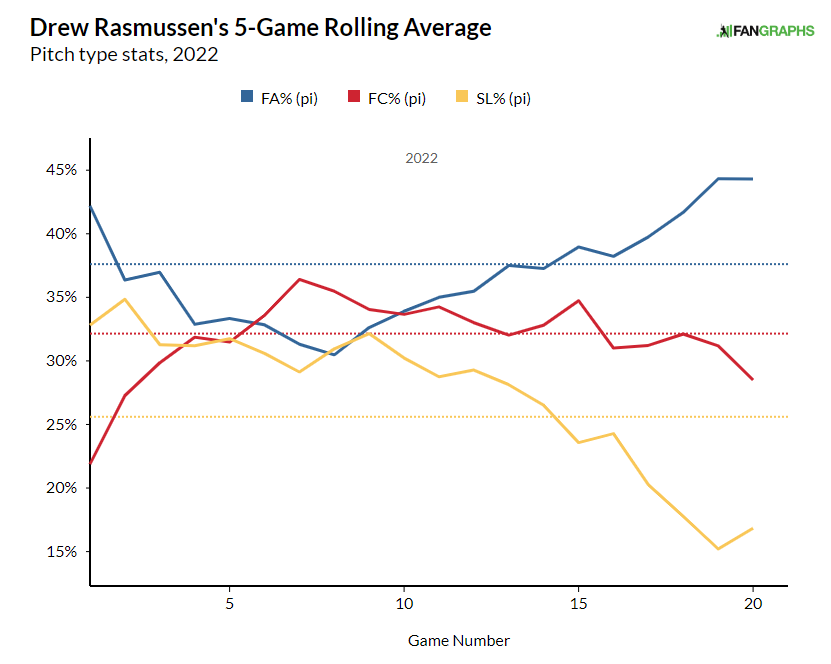
I last checked in on Rasmussen after his first start this season, when he adopted a new sweeping slider and threw it a ton. In 2021, he’d been a fastball-first pitcher with a slider that changed shape as he worked on it throughout the year. In 2022, he came out featuring the slider, with a new cutter to boot. Would 2022 be the year of the sweeper for Rasmussen?
As it turns out, not so much. His first few starts represented a local high in slider usage, and he’s been leaning on the pitch less and less since. He’s filled in that gap by going back to his high-octane fastball and by trusting that new cutter: Read the rest of this entry »
It’s the day after the trade deadline, which always means one thing: baseball writers begrudgingly cleaning up their gross, sparkling-water-can-filled workspaces. Oh, wait, actually it means two things: that, and a flood of “who won the trading deadline” articles.
This year, I’m going to do something slightly different. I won’t claim that I’ve re-invented the wheel, but I’ve always thought that those winner/loser columns are too deterministic and don’t leave enough room for nuance. I thought about listing each team that made a trade as a winner, with a “maybe” appended to indicate that we don’t know what will happen in the future; if you really want to know who won and who lost, check back in October… or maybe in October of 2025. I thought about making each team a “loser (maybe)” for the same reason. In the end, I settled on some broad archetypes. I’ll throw a subjective grade on how much I like the move, and also endeavor to explain the risks around each team’s deadline. You can find all of our deadline coverage here. Let’s get started. Read the rest of this entry »
Yesterday, the Rays traded C/INF Ford Proctor to the Giants for Triple-A reliever Jeremy Walker. The Rays appear to have been trying to clear 40-man space. The Rays have several players on the 60-day IL who don’t currently occupy a 40-man spot but will need to once they return, including Wander Franco, Manuel Margot, and Harold Ramírez, all of whom are likely to come off of the IL between now and the end of the season. Tampa could also potentially add more big leaguers before the deadline who would require 40-man space. The move was an opportunistic pounce by the Giants, who get a player I happen to like quite a bit.
Proctor was occupying a 40-man spot while hitting .213/.329/.306 at Triple-A Durham, and his strikeout rate has climbed significantly for the second straight year. He was a contact-oriented infielder at Rice and in the lower minors who the Rays moved behind the plate during the early stages of the pandemic. While he’s made huge strides on defense, he still has moments of ineptitude, whiffing on the occasional easy-to-receive pitch, or letting a blockable ball in the dirt get past him. For a convert who has just shy of two years experience wearing the tools of ignorance, Proctor looks pretty good even though he’s 25. Read the rest of this entry »
Ah, the trade deadline. It’s the best time of the year for baseball chaos, rumor-mongering reporting, and of course, the main event: a million trades featuring relievers you’ve heard of but don’t know a ton about. The difference between a blown lead in the seventh inning of a playoff game and an uneventful 4-2 win might be one of these unheralded arms. Heck, they could be a better option but still give up a three-run shot in a crushing loss. Or they could be a worse option! There are no guarantees in baseball. Still, here are some relievers who contending teams think enough of to trade for and plug into their bullpens.
Yankees Acquire Scott Effross Scott Effross wasn’t supposed to amount to anything in the big leagues. A 15th-round pick in the 2015 draft, he kicked around the Cubs system for years, frequently old for his level and rarely posting knockout numbers. Then in 2019, on the suggestion of pitching coach Ron Villone, he started throwing sidearm. Three years later, he’s carving through hitters in the majors.
“Carving” might undersell it. Since his 2021 debut, Effross has been one of the best relievers in the game. In 57.1 innings, he’s compiled a 2.98 ERA and 2.45 FIP. He’s striking out 29% of opposing batters and hardly walking anyone. With his new low arm slot, he’s adopted what I like to think of as the sidearmer’s basic arsenal: a sinker, a slider, and a break-glass-in-case-of-lefty changeup. Read the rest of this entry »
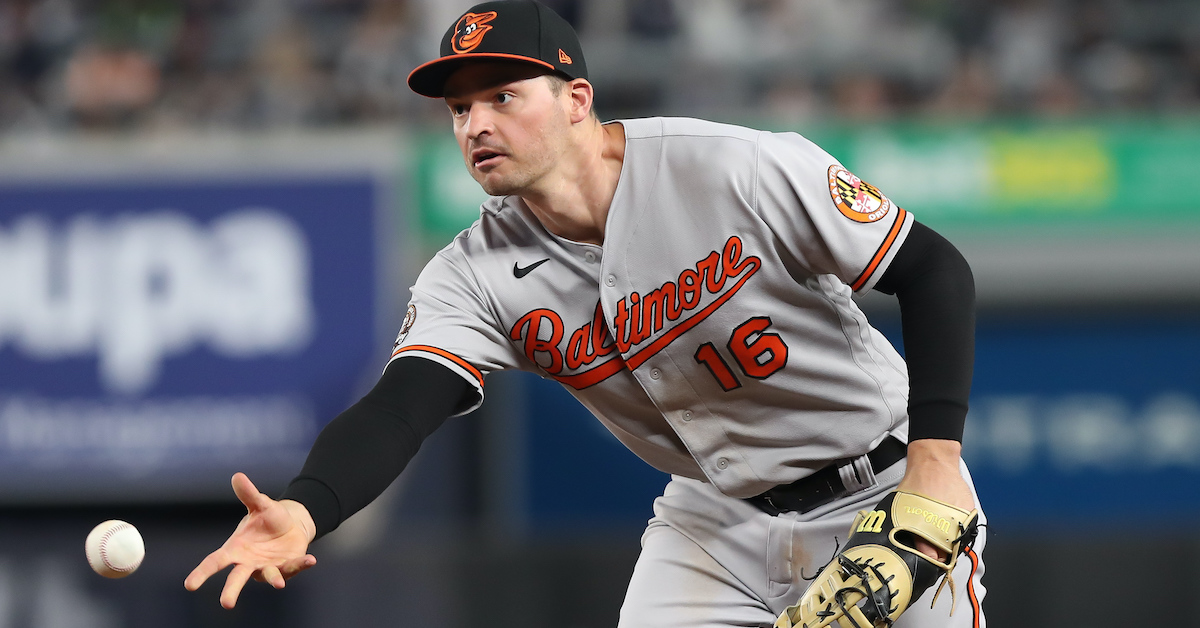
The Astros shook up their first base situation on Monday, acquiring 1B/DH Trey Mancini from the Orioles as part of a three-way trade that also included the Rays. Mancini, the longest-tenured player on Baltimore’s roster, was having a solid, if not spectacular, season, hitting .268/.347/.404 with 10 homers and 1.2 WAR in 92 games, with most of his playing time this season split between first base and designated hitter and an occasional appearance in a corner outfield role. He’ll be a free agent at the end of the season, though there is a $10 million mutual option. To land Mancini, the Astros sent outfielder Jose Siri to the Rays and pitcher Chayce McDermott to the O’s, with Tampa shipping pitcher Seth Johnson to Baltimore and Jayden Murray to Houston.
To look at this trade more easily, let’s separate it into three different transactions.
The Baltimore Orioles acquire pitchers Seth Johnson and Chayce McDermott for 1B/DH Trey Mancini
From a PR standpoint, there will likely be some sharp elbows thrown at the Orioles locally. Baltimore is having its first even marginally playoff-relevant season in a long while, and Mancini has been with the team through the entire process. As its veteran rebuild survivor, he played a similar role that Freddie Freeman did for the Braves while they went through their own painful renovations. His battle with colon cancer, diagnosed on his 28th birthday, and subsequent grand return after surgery and six months of chemotherapy only served to make him more beloved in town.
Basically, the on-field case for keeping Mancini and letting him walk at the end of the season involved a very “now” outlook for the team. It does make the Orioles a bit weaker over the next two months, but it’s only a major loss if you look at the consequences in a very binary fashion, in that Baltimore is in the wild card race with Mancini and out of it without him. Once you move past that, the calculus for whether a trade like this is a good idea comes out very differently. Read the rest of this entry »
With their outfield (and whole roster, really) hit hard by injuries, the Rays acquired 34-year-old left fielder David Peralta from the Diamondbacks for 19-year-old catching prospect Christian Cerda on Sunday. The Freight Train is hitting .248/.315/.457, good for a 109 wRC+, which is in line with his career norm (111 wRC+), even though the shape of his production has totally changed.
Before we get into how that came to be, though, let’s take a moment to appreciate Peralta’s remarkable path here. Originally a left-handed pitcher in the Cardinals organization, he was released amid shoulder issues and played outfield in Independent ball for a couple of years before signing with the Diamondbacks in 2013. It’s borderline offensive to cram that stretch of Peralta’s career into one sentence. Indy ball isn’t exactly glamorous, and Peralta was broke and worked at McDonalds while waiting for the Diamondbacks, who he knew wanted to sign him, to free up the minor league roster space to do so. After he finally signed, it took only about a year for him to reach the big leagues, and Peralta has had one hell of a now nine-year MLB career, during which he’s been one of the better left field defenders in baseball (and has one Gold Glove), won a Silver Slugger during his peak year in 2018 (.293/.352/.516 with 30 bombs), led the league in triples twice, and endured wrist and shoulder surgeries while becoming a cult hero in Arizona. From a baseball role standpoint, the Rays are getting a platoon stick (.268/.325/.496 versus righties this year) and plus defender in a corner spot, but Peralta also brings the parts of himself that helped him grind through injury and Indy ball. Read the rest of this entry »
While still focusing upon teams that meet the loose definition of contenders (a .500 record or Playoff Odds of at least 10%), and that have gotten about 0.6 WAR or less thus far — which prorates to 1.0 WAR over a full season — this year I have incorporated our Depth Charts’ rest-of-season WAR projections into the equation for an additional perspective. Sometimes that may suggest that the team will clear the bar by a significant margin, but even so, I’ve included them here because the team’s performance at that spot is worth a look.
As noted previously, some of these situations are more dire than others, particularly when taken in the context of the rest of their roster. I don’t expect every team to go out and track down an upgrade before the August 2 deadline, and in this batch in particular, I don’t get the sense that any of these teams have these positions atop their shopping lists. With catchers, framing and the less-quantifiable aspects of knowing a pitching staff make it easier for teams to talk themselves out of changing things up unless an injury situation has compromised their depth.
All statistics in this article are through July 26, though team won-loss records and Playoff Odds are through July 27.
2022 Replacement-Level Killers: Catcher
Team
AVG
OBP
SLG
wRC+
Bat
BsR
Fld
WAR
ROS WAR
Tot WAR
Cardinals
.195
.251
.252
47
-22.2
-3.5
-1.8
-0.8
0.7
-0.1
Astros
.166
.235
.312
57
-17.2
-2.3
-4.0
-0.5
0.6
0.1
Guardians
.176
.267
.267
55
-17.4
-2.7
2.7
0.1
0.8
0.9
Mets
.199
.245
.266
50
-20.3
-3.7
6.4
0.2
0.9
1.1
Red Sox
.251
.307
.373
89
-5.0
-8.6
-1.9
0.4
1.1
1.5
Rays
.205
.226
.346
63
-15.2
-0.6
0.9
0.4
1.3
1.7
Statistics through July 26. ROS = Rest-of-season WAR, via our Depth Charts.
Cardinals
Yadier Molina may be a future Hall of Famer, but his final major league season hasn’t gone smoothly. The 39-year-old backstop reported late to spring training due to personal reasons, then hit just .213/.225/.294 (46 wRC+) in 138 plate appearances before landing on the injured list with right knee inflammation in mid-June. With the team’s permission, he soon returned to his native Puerto Rico, a move that did not escape the notice of his teammates, who value his presence and leadership even when he’s not able to play up to his previous standards. Molina finally began a rehab assignment on Monday.
In Molina’s absence, the Cardinals have started Andrew Knizner behind the plate 51 times, and he’s reminded them that even by the standards of backup catchers, he leaves something to be desired. The 27-year-old has hit .199/.291/.248 (64 wRC+) and is 5.5 runs below average in our framing metric; his WARs have now been in the red for all four of his major league seasons, with a total of -1.7 in just 443 PA. Baseball Prospectus’ comprehensive defensive metrics put him 5.2 runs below average for his framing, blocking, and throwing as well. His backup, Austin Romine, owns a 47 wRC+ while catching for four teams over the past three seasons; his most notable accomplishment as a Cardinal is in joining Paul Goldschmidt and Nolan Arenado among the ranks of unvaccinated players who were unable to travel to Canada for this week’s two-game series against the Blue Jays.
Back in June, St. Louis gave a look to Molina’s heir apparent, Iván Herrera, who entered the season at no. 75 on our Top 100 Prospects list and has hit .295/.385/.432 at Triple-A. The 22-year-old Panamanian has a plus arm and potentially a plus hit tool as well as average raw power; his framing is below average and his receiving average. He was called up to replace Romine for the Toronto series but did not play.
With the trade market not offering a lot of obvious solutions (an intradivision trade for Willson Contreras probably isn’t an option), the Cardinals, who have gone just 24–26 in June and July but are still entrenched in the second Wild Card spot, would probably be better off pairing Molina with Herrera than Knizner or Romine. One possible option is Oakland’s Sean Murphy, who will be arbitration eligible for the first time this winter and who placed 37th on our Trade Value list; he could pair with Herrera for the next year or two and still be dealt while having club control remaining. Read the rest of this entry »
Again, the focus of this series remains on teams that meet the loose definition of contenders (a .500 record or Playoff Odds of at least 10%), and that have gotten about 0.6 WAR or less thus far, which prorates to 1.0 WAR over a full season. With most contenders reasonably well-situated at third base, I’ve loosened the criteria a bit for reasons that will become clear. As noted previously, some of these situations are more dire than others, particularly when taken in the context of the rest of their roster. I don’t expect every team on these lists to upgrade before the August 2 deadline, and I’m less concerned with the solutions – many of which have more moving parts involved than a single trade — than the problems.
2022 Replacement-Level Killers: Third Base
Team
AVG
OBP
SLG
wRC+
Bat
BsR
Fld
WAR
ROS WAR
Tot WAR
Twins
.265
.312
.436
110
4.5
-5.3
-7.7
0.6
1.2
1.8
Phillies
.266
.306
.382
90
-4.5
0.0
-3.0
0.8
1.1
1.9
Statistics through July 26. ROS = Rest-of-season WAR, via our Depth Charts.
The trade deadline is nearly here and once again, team behavior will be affected by 40-man roster dynamics. Teams with an especially high number of currently-rostered players under contract for 2023 and prospects who need to be added to the 40-man in the offseason have what is often called a 40-man “crunch,” “overage,” or need to “churn.” This means the team has incentive to clear its overflow of players by either packaging several to acquire just one in return, or by trading for something the club can keep — international pool space, comp picks, or, more typically, younger players whose 40-man clocks are further from midnight — rather than do nothing and later lose some of those players to waivers or in the Rule 5 Draft. Teams can take care of this issue with transactions between the end of the season and the 40-man roster deadline in November, but a contending team with a crunch has more incentive to do something before the trade deadline so the results of those deals can bolster the club’s ability to reach the postseason.
In an effort to see whose depth might influence trade behavior, I assess teams’ 40-man futures every year. This exercise is done by using the RosterResource Depth Chart pages to examine current 40-man situations, subtracting pending free agents using the Team Payroll tab, and then weighing the December 2022 Rule 5 eligible prospects (or players who became eligible in past seasons and are having a strong year) to see which clubs have the biggest crunch coming. I then make an educated guess about which of those orgs might behave differently in the trade market as a result.
Some quick rules about 40-man rosters. Almost none of them contain exactly 40 players in-season because teams can add a player to the 40 to replace one who is on the 60-day injured list. In the offseason, teams don’t get extra spots for injured players and have to get down to 40 precisely, so if they want to keep some of their injury fill-ins, they have to cut someone else from the 40-man to make room. Read the rest of this entry »
The Rays’ injury tally continued to climb over the weekend as the team added two key parts of its lineup — shortstop Wander Franco and center fielder Kevin Kiermaier — to the injured list. Not to be outdone by the hitters, pitcher Jeffrey Springs joined them after his first game back from a family emergency. If the season ended today, the Rays would be the American League’s second Wild Card team, but five other clubs, including the blazing hot Orioles, are within five games.
#Rays Franco looks to be headed for hamate surgery, Kiermaier is sidelined again with left hip problems as injuries continue to mount https://t.co/JxJD3gZO9A
Franco’s injury is the most concerning, both in terms of its severity and the resulting loss of production. The team’s franchise player broke his hamate bone on Saturday in the first inning against the Reds while fouling off a 100 mph Hunter Greene fastball. While having a fastball explosive enough to indirectly break bones probably adds to the flame-thrower’s mystique, for Franco, it’s a massive setback, one that comes just a couple of weeks after missing a month with a quad injury. With an expected recovery in the six-to-eight week range, it’s unlikely the Rays will have their shortstop back in the lineup much before September, and any significant setback could end his season.
Year-in and year-out, Tampa prides itself on having one of the deepest rosters in baseball, but replacing Franco is a tall order. Indeed, a few weeks ago, ZiPS actually projected him as the AL player who would be the sixth-hardest to replace due to a theoretical season-ending injury. With a .260/.308/.396 line over 58 games (good for a 104 wRC+), his production has been down compared to his rookie season, but would be considered a massive achievement for any other 21-year-old shortstop. He projected as a five-win player coming into the season, and his play so far hasn’t changed that much; all of our projection systems here anticipated at least a 120 wRC+ the rest of the way, and Franco was underperforming the peripheral estimates of both Statcast’s xStats and ZiPS’ zStats. Read the rest of this entry »