Archive for Trade

Andrew Cashner and Theoretical Home Run Shenanigans

The Boston Red Sox and the Baltimore Orioles completed a trade over the weekend, with Baltimore sending pitcher Andrew Cashner to Boston in return for center fielder Elio Prado and third baseman Noelberth Romero.

At 28-65, the Orioles appear likely to be eliminated from the playoff race sometime in August. Andrew Cashner is a free agent at the end of the season, and even if Baltimore had a less implausible shot at the playoffs, it makes a lot of sense to get something in return for the right-hander while the getting is good. In this case, the getting is two very deep dives into the Red Sox organization. Prado and Romero are both 17 year-olds out of Venezuela. Neither player is anywhere near the top of the prospect radar at this point. To grab a couple of lottery picks, the Orioles agreed to pay half of Cashner’s salary to the Red Sox, a figure just a bit under $2 million. If either prospect works out, it won’t be a new experience for Cashner, who has been swapped for Anthony Rizzo and Luis Castillo in previous trades.

Cashner has had a decent season on paper, but the Orioles’ return suggests that there is a good deal of skepticism surrounding his 3.83 ERA and 4.25 FIP. The bump in Cashner’s peripherals in 2019 is at least enough for ZiPS to think of him as a one-win player. That’s par for the course for a fifth starter, and it just so happens that’s exactly what the Red Sox were in the market for. It isn’t something that will show up well in playoff projections, but remember that teams can no longer pick up major league-caliber fourth and fifth starter types in August, which means that teams ought to take more care to prepare for emergencies now. And pitchers famously have lots of emergencies. Brian Johnson is currently out due to an intestinal issue, and given that he’s been out for weeks, it seems to be something a good bit more serious than overindulging in spicy chili. He has thrown a couple of bullpens, but his trip to the IL creates some uncertainty, which isn’t a good state of being for a contending team. And Cashner is likely a safer below-average pitcher than Hector Velazquez. Read the rest of this entry »


A’s Make Homer Bailey an Unexpected Deadline Upgrade

Homer Bailey woke up Sunday morning expecting to start a game between two teams going nowhere, but instead discovered that he would be joining a playoff chase. Kansas City shipped the righty to the Oakland A’s in exchange for 23-year-old shortstop Kevin Merrell.

Bailey, 33, has been a cromulent arm for KC this season, with a 4.80 ERA and 4.47 FIP in 90 innings. His 1.1 WAR is his best figure since 2014, while his 8.10 K/9 is his best mark since 2013.

Merrell, the 33rd overall pick back in 2017, ranked 20th on Eric and Kiley’s list of Oakland’s top farmhands before the season. Speed is Merrell’s calling card, but his 80-grade wheels haven’t had much chance to shine this year in Double-A, as he’s sporting a meager .246/.292/.339 line in 82 games.

Oakland will be Bailey’s fourth organization in the last eight months. After a 12-year stint with the Reds, he was shipped to the Dodgers in a seven-player swap that sent Yasiel Puig, Matt Kemp, Alex Wood and Kyle Farmer to Cincinnati in return for prospects Jeter Downs and Josiah Gray. Bailey’s inclusion in the deal was motivated entirely by finances, however, as the $22.45 million he was owed in 2019 was a close match with the $21.75 million owed to Kemp; the structure of Bailey’s contract made it more luxury tax-friendly to the Dodgers. One day after the trade was completed, Bailey was released by Los Angeles, and in February, he signed a minor league contract with the Royals.

While he rarely lived up to his billing as a top prospect, Bailey was a pretty good starter early in the decade, when he accrued 6.3 WAR from 2012-13 while throwing more than 200 innings each year. The Reds rewarded Bailey, then 27, with a six-year, $105 million contract extension. Twenty-three starts into what appeared to be another good season in 2014, he was shut down with an arm injury. He underwent Tommy John surgery, made just a combined eight starts from 2015-16, and in parts of four seasons following his injury, held a 6.25 ERA and 5.13 FIP in 231.2 innings.

It isn’t difficult to see why two playoff aspirants didn’t have room for Bailey. Just seven months later, however, another win-now team was willing to part with a top-20 prospect to add him to their rotation. What changed?

Well, for one, it’s always been somewhat difficult to differentiate between Good Bailey and Bad Bailey. His average fastball velocity in 2012 was 93.2 mph. In 2018, it was 93.0 mph. His chase rate in 2013 was 34.5%. In 2018, it was 33.0%. His swinging strike rate, pitch usage, and ground ball rates were consistent as well. And yet he’d gone from a solid No. 2 starter to nearly unemployed.

Bailey’s numbers in many of those areas haven’t changed much this season, either. His average four-seamer is 92.8 mph. His chase rate is just a couple ticks lower than last season. His groundball rate is up three points, and his swinging strike rate has climbed modestly as well.

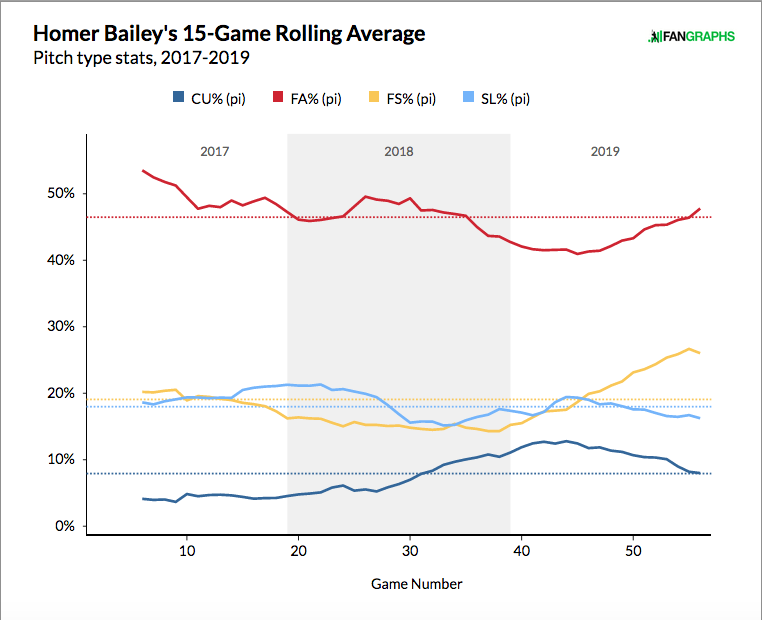
There is, however, one big difference in Bailey’s repertoire. His career fastball percentage sits around 60%. In years after his surgery, it was 55%. This year, it’s down to 49.3%. His slider percentage, 17% a year ago, is down more than four points. Those missing fastballs and sliders have turned into splitters:

Bailey’s thrown his splitter on 27.3% of his offerings in 2019, more than eight points higher than any other season of his career. It’s a great pitch for him to lean on: According to Statcast, opponents have just a .195 xBA .250 xSLG against the split, and their actual numbers aren’t exceeding those estimates by much. Of the five pitches Bailey has used in 2019, three of them have an xwOBA above .350. Finding a pitch as reliable as the splitter has been vital for him, and as he’s thrown it more, he’s been more effective. In his last five starts, he’s thrown 29 innings and posted a 2.48 ERA.

That was good enough for Oakland to add him to its starting rotation. The A’s have weathered Frankie Montas’ suspension well, but they still need rotation help. Montas had a 2.70 ERA and 2.9 WAR in 90 innings before receiving an 80-game suspension on June 21. Since then, Oakland starters have accumulated 1.7 WAR, good for seventh-best in baseball, though their 4.85 xFIP suggests they’ve been a bit fortunate.

Mike Fiers, Brett Anderson and Chris Bassitt have been serviceable starters, but all three are outperforming their FIPs by a wide gap. Tanner Anderson and Daniel Mengden are passable options, but the rotation is clearly Oakland’s weakest part of the roster. Critically, Oakland’s internal prospective reinforcements all have question marks. Jharel Cotton and Sean Manaea are on track to rejoin the team in August, but they’re both returning from serious injuries: Manaea hasn’t pitched this year and Cotton has been out since 2017. The two top pitching prospects in the organization in A.J. Puk and Jesus Luzardo, meanwhile, have thrown only a handful of innings this season, and probably aren’t realistic options to contribute down the stretch. The A’s need an arm or two, and they got a cheap one in Bailey.

Because the Dodgers are paying $22.45 million in salary owed to Bailey for the 2019 season, Oakland is on the hook for just the remaining $250,000. As far as prospect cost, a top-20 prospect isn’t nothing, but Merrell has a long road ahead of him. As Eric and Kiley wrote back in March, a move to the outfield is likely in his future, and there isn’t much power at all in his bat. His speed makes him interesting, but he’ll need to take a big step forward to profile as a regular.

That’s all that it cost to bring Bailey to Oakland, an organization that has done well with similarly beleaguered pitchers recently. Last June, they signed Edwin Jackson — a pitcher who hadn’t posted an ERA under 5.00 since 2015 — and watched him spin 92 innings of 3.33 ERA ball the rest of the year. They also coaxed 110 splendid innings out of Trevor Cahill’s oft-injured and sporadically-effective right arm. The A’s have been a good home for pitchers who once seemed over the hill, and perhaps Bailey will continue the pattern. Just seven months ago, he was a cast-off. But in Kansas City, he showed he wasn’t done. Now, in Oakland, he can show how much more he has left.


Yankees Acquire Edwin, Continue to Stockpile Power

Edwin Encarnacion is 36 years old now, but age hasn’t stopped him from mashing baseballs. Among qualified American League hitters, he ranks 12th in wRC+ (139), leads the league in home runs (21), and is fourth in isolated power (.290). He’s accrued 1.7 WAR, which is pretty good at this point of the season, especially given his subpar defense. Of course, nobody is employing Encarnacion for his glove.

When Seattle acquired Encarnacion this past offseason, everybody knew he’d be traded sooner rather than later. The Mariners are in the midst of a rebuild and are reportedly “trying to trade everyone” before the July 31 deadline. Encarnacion, with his age and contract, was an obvious candidate to be moved.

It only took until the middle of June for the Mariners to find a suitor. The Yankees now employ Edwin Encarnacion.

Yankees Get:

  • 1B/3B/DH Edwin Encarnacion (though it’s likely he’ll primarily be a DH)

Mariners Get:

Let’s touch on the Mariners’ return first before talking about the big parrot in the room. Juan Then was actually a Mariners farmhand two years ago. The Yankees acquired Then (and minor league hurler JP Sears) during the 2017-18 offseason in exchange for Nick Rumbelow.

Then is only 19 years old and he’s still in rookie ball. Prior to this season, Eric Longenhagen and Kiley McDaniel ranked Then as the No. 31 prospect in New York’s system, noting that he is “advanced for his age” but has “middling stuff and physical projection.” It’s worth noting that Then seems to have developed a better fastball in the Yankees system. But again, it’s awfully hard to project a 19-year-old who hasn’t reached full-season ball. We know he’s a young arm of some promise, but the delta in his potential outcomes is very wide.

As an interesting side note, reports suggest that the Mariners chose to deal Encarnacion to the Yankees because New York was willing to absorb more money than other interested clubs. By prioritizing salary flexibility, Seattle’s move is somewhat reminiscent of how the Marlins handled the Giancarlo Stanton trade, in which the Yankees gave up significantly less player value to bring in another slugger because they were able to take on big money. It’s not ideal for rebuilding teams to prioritize monetary value over player return on transactions, but it is what it is. Money is a big part of how organizations operate, and sometimes you’re going to see deals like that. Read the rest of this entry »


Bruce Not-So-Almighty Heads to Philly

Jerry Dipoto broke a nearly two-week trade drought over the weekend, sending outfielder Jay Bruce and everyone’s favorite player, cash considerations, to the Philadelphia Phillies. In return, the Mariners received 1B/3B/OF prospect Jake Scheiner.

As with most Mariners, Bruce started the season with impressive power numbers, hitting seven home runs in the team’s first 13 games. There was a period earlier this season when home runs represented seven of Bruce’s nine hits, an unusual balance even for a one-dimensional power hitter in these home run-filled times. As a fan of unusual baseballings, I will cheerfully admit that I was kind of hoping for that to continue. At one point in April, Bruce held a .204/.298/.673 line. To put that into perspective, only four seasons in history among qualified batters have featured a SLG-OBP difference greater than 300 points.

Largest SLG/OBP Differences
Year Player Team SLG-OBP
2001 Barry Bonds Giants .348
1921 Babe Ruth Yankees .334
1920 Babe Ruth Yankees .316
2001 Sammy Sosa Cubs .300
1994 Jeff Bagwell Astros .299
2019 Christian Yelich Brewers .294
2019 Joc Pederson Dodgers .293
1927 Lou Gehrig Yankees .291
1995 Albert Belle Indians .289
1994 Matt Williams Giants .288
1927 Babe Ruth Yankees .286
2019 Josh Bell Pirates .286
1930 Al Simmons Athletics .285
1998 Mark McGwire Cardinals .282
1932 Jimmie Foxx Athletics .280

Bruce’s flirtation with a 400-point difference early was way more fun to me than the usual “Joe So-and-So is on pace for 324 homers!” stuff. A race to topple Mark Reynolds for Mendoza Line-superiority in home runs (32) and slugging percentage (.433) could have been my song of the summer. Unfortunately, Bruce’s homer-pace slackened and he started hitting the occasional single. That has been enough to turn his 2019 into a more typical “middling power hitter” tune.

While I don’t think that anyone believed the Mariners were even close to being the best team in baseball — save for a couple of excited Mariners fans in my Twitter timeline — a 13-2 start gave Seattle some hope for a more interesting summer than expected. After all, this is a team that was forecasted to be on the dull side, but more blandly mediocre than unfathomably terrible. The best recent comparison would be the 2014 Milwaukee Brewers, another team that just wasn’t very good, but after a blazing 20-7 start and a 6 1/2 game lead, had enough of a cushion to be relevant into late summer.

Instead, Seattle unwound their hot start with impressive speed. Since the 13-2 start, the team’s gone 12-35, essentially ending any potential for a shocking run at the AL West title. To find a worse 47-game run for the Mariners, you have to look back to 1980, during the Dark Times of Seattle history. Bruce Bochte led the team in homers that year, crushing…uh…13 dingers, and the starting shortstop was the actual Mario Mendoza.

Once the 2019 version of the team was out of contention, the question became when Seattle would start selling rather than if. Bruce was always one of the best bets to go quickly if another team needed his services, not having been acquired by Seattle because of any burning desire to have him on the roster but as a balancing act to make the money in the Edwin Diaz–Robinson Canó trade satisfy both sides of the transaction. The Mariners may not have planned to give Daniel Vogelbach a serious look, but the Kyle Seager injury had a domino effect on the roster, sending Ryon Healy to third and Bruce and Edwin Encarnacion to first, opening up a spot for Vogelbach. The early demotion of Mallex Smith resulted in Mitch Haniger playing center field with more regularity, and that defensive combination allowed the team to fit Vogelbach, Bruce, Encarnacion, and Healy into the lineup simultaneously.

That gave the Mariners a lot of homers, but it turned out to be a not-so-good development for the team’s fielding. Through Monday morning, the Mariners are last in the majors in DRS (-50 runs) and UZR (-35 runs). Amusingly, Ichiro still leads M’s outfielders in UZR, at 0.2 in 10 innings.

Once everyone started shuffling back to their proper positions, Bruce was demoted to a semi-platoon role. He now follows another veteran acquired as salary makeweight from the Mets trade, Anthony Swarzak, out of town.

Bruce is a better fit with what the Phillies need. While the team’s left-handed hitters have combined for a wRC+ of 98 in 2019, it’s largely because of the existence of Bryce Harper. Odúbel Herrera’s arrest for domestic violence and uncertain return left the team in search for some left-handed hitting outside of Harper, and an extra outfielder. Ideally, Nick Williams would have been the best option to get increased playing time, but he has had an abysmal 2019, hitting .159/.205/.232 with a single homer as a part-timer. One can argue, probably correctly, that Williams likely has higher upside than Bruce, but things have changed in Philadelphia in the last couple of years. A team in contention and a rebuilding team ought to look at risk in different ways.

Bruce will likely continue in the semi-platoon role, as a fourth-outfielder who spells the regulars and plays a corner against a tougher righty when Scott Kingery isn’t in the lineup. Citizens Bank is a place where Bruce’s power, his only real remaining strength at this point, will shine. He is no longer the young semi-star he was in his early days with the Reds, but at this point of Bruce’s career, nobody’s really expecting that anymore. As a role player for the Phillies, Bruce will do his part to help the team hang onto first place.


The Giants Get a New Best Outfielder

The Toronto Blue Jays, in yet another sign that their slightly announced rebuild is continuing, are sending Kevin Pillar to the San Francisco Giants in return for three players. Heading to the land of colorful currency and milk distressingly sold in bags in return are relief pitcher Derek Law, former-Pirate-prospect-turned-useful-utility-guy Alen Hanson, and minor league pitcher Juan De Paula.

With free agency arriving after the 2020 season and the Blue Jays unlikely to go anywhere positive before then, it was only a matter of time until Pillar was traded to someone in need of outfield help. And when looking up “someone in need of outfield help” in a very odd dictionary, you might see a picture of the San Francisco Giants. If you checked out our positional power rankings last week — and you will be quizzed on those — you’d see the Giants ranking 30th, 27th, and 28th in the outfield, from left to right.

The Giants outfield has been a problem for awhile, and the winter before last, the team attempted to solve it by seriously going after all three Marlins outfielders, Giancarlo Stanton, Christian Yelich, and Marcell Ozuna, and after missing out on two of the three, picked up Andrew McCutchen as a stopgap option. This winter, on the other hand, with little desire to increase payroll, the Giants decided to collect 17 outfielders each worth about 0.5 WAR and somehow combine them into some form of Eldritch abomination undulating its way to a three-WAR season while hopefully consuming the souls of various Dodgers as a side benefit and then maybe things would be alright.

Narrator: Things were not alright. Read the rest of this entry »


Twins, Angels Swap Very Different Fringe Prospects

There was a minor trade on Tuesday night as the Angels acquired recently DFA’d righty John Curtiss from Minnesota for 18-year-old Dominican infielder Daniel Ozoria.

The Curtiss addition is the latest of many examples of relief pitcher diffusion happening on the fringe of the Angels 40-man roster. Since November, the Angels have been part of eleven transactions involving relief pitchers, either via trade, waiver claim, or DFA. The likes of Austin Brice, Parker Bridwell, Luke Farrell, and Dillon Peters have been on and off the roster, sometimes more than once (Bridwell, who was DFA’d for Curtiss, has now been DFA’d three times since this offseason), as the Angels try to patch holes in their bullpen for free.

Curtiss, who is 25, has thrown an unsatisfying handful of innings during each of the last two seasons, totaling 15 big league frames. He throws hard, 92-96 with the occasional 7 or 8, and can really spin a power, mid-80s slider (he averaged 2600 rpm in 2018). His command backpedaled last season and is the biggest thing standing between Curtiss and a steady middle relief gig. Perhaps the change of scenery will be good for him.

Ozoria spent his second professional season as a 17-year-old in the AZL, and at times he looked like he could have used a second pass at the DSL. Listed at 5-foot-9, 135 pounds, Ozoria struggled with the pace and comparably mature athletes of Arizona. He does have interesting tools, though, and played hard throughout a tough summer on a team that was really struggling. He’s an above-average runner and athlete. Though not a polished, instinctive defender, he has good range and hands, and enough arm for the left side of the infield.

Because Ozoria so lacks present strength, he needs to take max-effort, full-body hacks just to swing the bat hard, and sometimes things can get out of control. His swing also has some length, but I’m not sure it matters as much for hitters this size, because their levers aren’t. Much of Ozoria’s offensive potential just depends on how much growing he has left to do. He’s small enough that I believe that were he a high school prospect, scouts would rather he go to college to get a better idea of how his body might mature than sign him now. The realistic upside is probably a utility infielder, and even that depends on significant growth that may not materialize, but Ozoria is so uncommonly young for a pro prospect that it’s fair to like the things he can already do and project heavily on the stuff he can’t. He will likely spend all of 2019 in Fort Myers and is probably four or five years away from the big leagues.


Russell Martin Fetches Two Fringe Prospects

In a trade that sent Russell Martin back to Los Angeles, the Blue Jays acquired two interesting, but drastically different, prospects in teenage second baseman Ronny Brito and Double-A righty Andrew Sopko.

Sopko is the more likely of the two to wear a major league uniform, as his skills are constantly desired among teams seeking to build starting pitching depth at Double and Triple-A in the event of big league injuries. He’s an efficient strike-thrower with spot starter’s stuff; a fastball that resides in the 88-92 range, an average changeup that flashes above, and a slurvy breaking ball with enough depth that it will be an issue for hitters who struggle to square up break.

Pitchers with this kind of stuff are typically found at the very back of the rotation or waiting to pick up a start due to injury. The frequency with which pitchers get hurt makes teams’ 6th-8th starters very important, as they may have to make meaningful starts at some point during the year. Sopko projects to be a very competent version of this.

Brito is more boom or bust. After dealing with injury and struggling badly throughout his first full pro season, Brito had a monster year in the offense-friendly Pioneer League, slashing .288/.352/.489 with 11 homers in 53 games at age 19.

While the dizzying elevations of the Pioneer League drastically inflate offensive performance, Brito does have legitimate, above-average raw power, and he’s capable of hitting balls out to all fields, even as a teenager, something not typical of middle infield prospects.

What eyeball scouts are skeptical of, though, is Brito’s bat. He’s free-swinging and prone to the strike out. His swing has gone through several iterations — a leg kick was implemented and then uninstalled for a while last fall, for one — and all of this mechanical variability makes it harder to evaluate Brito as a hitter. But a lack of plate discipline makes Brito’s contact profile high risk, even if there’s natural feel for contact here once his swing gets dialed in.

He has a chance to stay at second base, but he hasn’t really improved there since signing, and some scouts think his defense has actively gone backwards as his frame has thickened. His body is also pretty much maxed out, so he’s not likely to grow into much more power as he ages, though he already has enough to profile at any infield spot provided he becomes a competent defender and takes better at-bats. If that stuff comes, Brito will be an everyday player, but scout-to-scout optimism for improvement is highly variable.


Cleveland and New York Choose Their Catchers

Earlier this winter, the New York Mets were looking to upgrade their catching situation. The team was dissatisfied with Travis d’Arnaud, Kevin Plawecki, and Tomas Nido as the frontline options, and after rumors of a J.T. Realmuto trade, the team ended up signing Wilson Ramos to give them four, major league-caliber catchers. Cleveland has moved in the opposite direction. The team traded top prospect Francisco Mejia to San Diego for Brad Hand and Adam Cimber over the summer to aid their bullpen. Then, when winter began, Cleveland moved Yan Gomes to the Nationals to save money. That left Cleveland with the ultra-light hitting Roberto Perez and the all-or-nothing Eric Haase, whose projections lean more toward the “nothing” side than the “all.” That made the two teams pretty good trading partners, and this is the result:

Cleveland receives:

  • C Kevin Plawecki

New York receives:

Read the rest of this entry »


Mets Acquire J.D. Davis at Steep Price

On Sunday, the Mets continued an active weekend of trades designed to add bench-quality pieces to their big league roster, sending several low-level minor leaguers to Houston for power-hitting corner bat J.D. Davis. Here’s the whole deal:

The Mets get:

J.D. Davis, 3B/1B/OF
Cody Bohanek, INF

The Astros get:

Luis Santana, 2B
Ross Adolph, CF
Scott Manea, C

Davis is talented — he has plus-plus raw power, a plus-plus arm, and can play several positions, though none especially well — but it’s hard to see how he fits in New York without taking playing time from players who have greater long-term potential and might also be just as good as Davis is right now. He doesn’t complement Todd Frazier or Peter Alonso — the two players projected to start for the Mets at Davis’ primary positions — in any way. Like Frazier and Alonso, Davis hits right-handed and isn’t a good infield defender.

He does have experience in the outfield corners, an area where the Mets need warm bodies, so perhaps we’ll see Davis used as a platoon or situational corner outfielder as a means of getting him at-bats against left-handed pitching. Davis hit .348/.419/.583 against southpaws last year and .344/.401/.800 in 2017, with most of that production coming at Triple-A Fresno. He could get some starts against lefties in situations where the Mets can hide him on defense. They could mix him with Juan Lagares or Keon Broxton depending on if the game state dictates a need for offense or defense, which might move Michael Conforto or Brandon Nimmo to center field once in a while.

This assumes Davis, who turns 26 in April, can hit big league pitching, something he hasn’t done in a fairly limited sample; he owns a .194/.260/.321 line in 181 career big league plate appearances. Houston, an organization at the forefront at understanding how to implement swing changes, doesn’t seem to have been able to alter Davis’ batted ball profile in a way that would enable him to start showing his raw power in games. A power-hitting platoon outcome seems reasonable to hope for, though Davis’ true talent level is probably closer to a defensively-limited bench bat, one that’s easier to roster in the American League and isn’t a great fit on this Mets roster as it’s currently composed.

Cody Bohanek, also acquired by the Mets, is an interesting, late-blooming athletic flier who is probably just an org guy. He played safety and corner at Marist High School in Chicago and had college football aspirations until the University of Illinois-Chicago gave him the opportunity to play baseball. Two-sport, cold weather prospects are apt to improve later than their warm weather peers who play more baseball, and that’s what happened with Bohanek, who had a statistical breakout as a senior and impressed scouts at NCAA Regionals. He was a 30th round senior sign in 2017.

Bohanek split 2018 between Low and Hi-A. He walked a lot and has a proficient, versatile infield glove. He may be a bench infielder at peak and the two-sport, small school, cold weather pedigree makes him slightly mysterious and interesting.

I like Houston’s end of this deal. Tyler White, who lifts the ball consistently and has a track record of hitting for power against big league pitching, made Davis offensively redundant in Houston, as the team didn’t seem interested in exploring a two-way role for Davis, who closed in college. They add three up-the-middle defenders who have performed statistically. The best of them is 19-year-old Dominican second baseman Luis Santana, who is coming off a domestic debut at advanced rookie-level Kingsport where he hit .348/.446/.471 with more walks than strikeouts.

A stocky, curvaceous 5-foot-8, Santana crowds the plate so much that he’s practically straddling it, and his idiosyncratic, low-ball swing enables him to impact pitches that cross the plate beneath his chest as he leans over it. It’s weird, but it works, and Santana looks like he’s going to be a plus hitter who also has a discerning eye for the strike zone, and whose plate crowding gets him hit by pitches so often that it actually matters. Santana has been hit in 4% of his 611 career plate appearances, which is nearly twice the career rate of active big league HBP leader Shin-Soo Choo (132 HBP, 1.9%) who became the active leader when Chase Utley (204 HBP, 2.5%) retired.

Athletically, Santana fits at second and third base. His body is pretty maxed out and he’s not likely to grow into sizable raw power, but he runs well, has infield-worthy hands and an average arm. The combination of his defensive profile and promising feel to hit make him a very intriguing prospect. He was slated to be the 10th ranked Mets prospect on our upcoming list as a 40+ FV player, and I think he’s the best individual talent involved in this deal.

The Astros also received Scott Manea and Ross Adolph. Adolph,22, is an interesting small-school sleeper who hit .322/.445/.654 as a junior at Toledo, then signed for $125,000 as a 2018 12th rounder. He continued to rake at short-season Brooklyn after signing, hitting .276/.348/.509 and swiping 14 bases (on 17 attempts) in 60 games.

He’s an above-average runner with good instincts in center field, and there’s a chance he can stay there. He could be a 50 bat with gap power who is playable in center, which would make him at least a viable big league fourth outfielder. He was going to be a prominent part of the Mets prospect lists’ honorable mention section. We whiffed on him pre-draft, but our sources who saw him in pro ball raved and I’m very interested to see how he hits in full-season ball next year because I think the industry’s error bars on small school bats are pretty large due to the quality of pitching they face.

Manea, 23, was drafted by Seattle out of high school but didn’t sign. He transferred to St. Petersburg College in Florida after his freshman year at NC State, but wasn’t drafted after his sophomore year despite being eligible. He had a good summer for the Wachusett Dirt Dawgs of the Futures Collegiate Baseball League and was eligible to sign as an undrafted free agent, which he did with the Mets in late July of 2016.

He’s a heavy-bodied catcher with power who hit .261/.368/.432 at Low-A Columbia last year. Manea’s a below-average receiver who lets his target sag as his pitcher starts to deliver the ball home, which means he has to come back to that spot with his glove, creating a lot of unnecessary movement that isn’t great for stealing strikes. He’s also a well-below average athlete and thrower, so he probably can’t catch.

The Astros have, in several instances, traded players on the periphery of their big league roster (Teoscar Hernandez, David Paulino, Ramon Laureano, etc.) for prospects, and this is another example. I understand the Mets desire to add high-probability contributors to their big league roster, even if they’re low-impact players, but moving a prospect like Santana for the kind of role player readily available on the open market feels short-sighted.


Mets Trade Three Prospects for Keon Broxton’s Defense

On Saturday, the Brewers and Mets continued to reshape their outfields, making a four-player swap headlined by dynamic outfield defender Keon Broxton. Here’s the deal:

Mets get:

Keon Broxton, CF

Brewers get:

Bobby Wahl, RHP
Adam Hill, RHP
Felix Valerio, 2B

Almost by default, Broxton tentatively slots in as the Mets’ starting center fielder, between Michael Conforto and Brandon Nimmo. There’s a stark lack of outfield depth on New York’s 40-man; Jay Bruce was traded, the org isn’t expecting much from Yoenis Cespedes next season as he recovers from surgery to remove bone spurs from both heels, and Juan Lagares provides very little on offense and is injury prone. Since 2014, he has endured a strained hamstring, an intercostal strain, several thumb injuries, an oblique strain, and a plantar plate tear. In 2018, he was shut down for the year in May due to toe surgery and has only played seven Dominican Winter League games this offseason.

As far as others on the 40-man are concerned, T.J. Rivera and Dom Smith have each played some left field, while Jeff McNeil, who turns 27 in April, has started just five pro games in the outfield. It’s debatable as to whether any of them are actually playable out there. It is not debatable that Broxton, who is an elite defender at all three outfield spots, is simply better than all of them.

Set to turn 29 in May, Broxton’s growth as a player has likely concluded. He struggled badly with strikeouts as a prospect and was traded straight up for cash before being part of a two-player package for half-year big league performer and fringe 40-man talent Jason Rogers. That deal landed him in Milwaukee, where Broxton improved enough in his late-twenties to be rostered as defensive ace and pinch runner.

The strikeout issues remain (his career strikeout rate is 36%), and Broxton’s propensity to whiff undercuts his offensive production enough to make him a bench-quality player, albeit a good one because of the defense. Ideally, he’s not your everyday center fielder, but it’s reasonable to project him as one right now because of the dearth of other outfielders on the Mets roster.

Broxton and Lagares seem, on the surface, like odd bedfellows for a platoon because they’re each right-handed. It’s possible a timeshare might help keep Lagares healthy, or that the two complement one another in harder-to-see ways. For instance, a quick examination of their heats maps on the site shows that Broxton does his damage on pitches middle-in, while Lagares thrives on pitches down-and-in. They could be platooned in accordance with where the opposing starter likes to work. That’s probably not a different enough offensive profile for this type of thinking to matter, but maybe their skill sets with mesh with each other in some other way we can’t see. Or perhaps the Mets will keep an open mind about further upgrading in center field.

From Milwaukee’s perspective, Lorenzo Cain’s defense made Broxton’s best skill redundant in a crowded outfield picture that now projects to see more action from Eric Thames, Ben Gamel, and Tyrone Taylor, who is a sleeper breakout candidate due to a recent swing change that might have altered his power output.

From the Mets, the Brewers receive another immediately relevant relief piece in Wahl, who will likely compete for an opening day bullpen spot in the spring. He was part of the two-player package Oakland sent to the Mets for Jeurys Familia last summer. Wahl, who turns 27 in March, has thrown just 12 career big league innings at this age mostly because he missed extended development time to multiple surgeries, including one in 2017 to remedy thoracic outlet syndrome.

His stuff was back last year. Wahl’s fastball sits in the mid-90s and will touch 99. He has a four-pitch mix but works primarily with the fastball and a power, mid-80s breaking ball that has bat-missing vertical action. A firm cutter and changeup are also folded in on occasion. Wahl has set-up man stuff but below average command and more significant injury risk than most pitching prospects.

The Brewers also acquired Adam Hill, the Mets’ 2018 fourth round pick out of the University of South Carolina. Hill was dominant during the first four starts of his junior year, but his control disappeared once the Gamecocks began conference play. He struggled to throw strikes for two months leading up to the draft and fell to the fourth round.

Hill does have good stuff. He’ll sit 90-94 and his big, 6-foot-6 frame and lower arm slot combine to create a unique look for hitters. His slider breaks late and has good length when located to Hill’s arm side, and his changeup has good action because of his lower arm slot. His limited command probably relegates Hill to the bullpen eventually, but he has No. 4 or 5 starter stuff if he can develop better control in his mid-20s, which sometimes happens to pitchers this size.

Finally, the Brewers also acquired 18-year-old Dominican second baseman Felix Valerio, who hit .319/.409/.433 in the DSL during his first pro season. Valerio is a skills-over-tools type of prospect who is more polished than most of his peers. He has promising feel for contact and is athletically viable at second base but at 5-foot-7 and 165 pounds, he’s less likely to grow into more impressive physical tools than someone with some length and room on their frame. Players like this either hit enough to play second base every day, or don’t and end up as org guys. Valerio walked more than he struck out last year, and those types of peripheral indicators can offer great evidence to support a case that a player will indeed hit enough to play every day, but not when we’re talking about DSL stats. Still, league sources indicated to me that this was not the first time Valerio’s name has come up in trade talks, so it seems that other teams besides Milwaukee have had interest in him.

All three players have been added to the Brewers prospect rankings on The Board. Wahl and Hill are in the 40 Future Value tier, while Valerio will be added to the Others of Note section of the team’s long form writeup.