Archive for Yankees

Elegy for ’18 – New York Yankees

The Yankees may not have won the World Series in 2018, but they’re set up for a long run of success.
(Photo: Arturo Pardavila III)

Until three of the team’s four postseason starters got knocked out early by the eventual-champion Red Sox, the 2018 Yankees had a successful season. Giancarlo Stanton’s first season in New York may have been a disappointment relative to his MVP 2017, and the rotation required some midseason triage, but the team managed their first hundred-win season since 2009. And thankfully, they did not lose in the wild card game and thus highlight the weirdness in baseball design of combining wild cards with an unbalanced schedule.

The Setup

The early part of the 2017 offseason was wrapped up in the grand hunt for Giancarlo Stanton, a player far more interesting than nearly every free agent actually available for signing. After a number of false starts and mystery teams and trade clauses not-waived, the Yankees came out on top in the race for not-Michael. And unusually when picking up a superstar, it was actually better than simply signing a comparable player in free agency, with the Yankees able to shed Starlin Castro’s salary and only lose two prospects (only one, Jorge Guzman, was a top 10 prospect for the Marlins according to our very own Eric Longenhagen and Kiley McDaniel).

The obsession with the luxury tax ensnared several of the larger-payroll teams over the 2017-2018 winter, and the Yankees were one of the chief actors in this little mini-play. We can argue endlessly about whether the current luxury tax system is well-designed (it isn’t) or whether it serves as a soft salary cap (it does), but it is the system in place and staying under the threshold for a year in order to “reset” the penalty rate provides a tremendous financial motivation to go cheap in the short-term.

The desire to reset the luxury tax penalty heading into an offseason in which Manny Machado, Bryce Harper, and possibly Clayton Kershaw were set to hit free agency was strong, and both of New York’s other significant offseason trades reflected this urge. Chase Headley, a perfectly average third baseman for the Yankees, enough to make him a much better signing than rival Boston’s similar deal with Pablo Sandoval, was sent packing to San Diego in a pure salary dump; the Yankees gave the Padres Bryan Mitchell as compensation for taking Headley’s contract. Any notion that this wasn’t a move designed to trim payroll, that the Padres just really wanted Headley, is undermined by the fact that his new-old team gave him nine starts before sending him to the unemployment line, where Headley spent the rest of 2019.

A three-way trade with the Diamondbacks and Rays netted the Yankees Brandon Drury, who was basically brought in to fill the Headley role of a stopgap until Gleyber Torres or Miguel Andujar; he was made as expendable as a secondary henchman objecting to the antagonist’s devious plot in a James Bond film by the second week of the season.

The Yankees spent all of $14 million on one-year contracts for CC Sabathia and Neil Walker, a far cry from a decade prior, when they guaranteed more than $800 million in contracts after the 2007 and 2008 seasons. Only 2015-2016, when the team’s biggest signing was Chris Denorfia, was quieter.

The Projection

The ZiPS projection system pegged the Yankees as two games better than the Red Sox, with just under a 60% chance of winning the division. ZiPS expected the AL East division title to essentially be yet another Yankees-Red Sox battle, with only a 4% chance of one of The Others of surprising enough to take the division. ZiPS was confident about the Yankees’ offense, seeing most of the unknown as a matter how quickly Andujar and Torres would have full-time jobs and how effectively the Yankees would continue to yank Jacoby Ellsbury’s playing time. The bullpen was projected to be the best bullpen that ZiPS ever projected. The computer’s main worry was the back of the rotation, which the computer did not see as very deep should something happened to one of Sabathia, Sonny Gray, or Jordan Montgomery.

The Results

Oddly enough for a team that won 100 games, it felt like the Yankees had more than their fair share of disappointments. Some of the fears about the rotation came to pass; Gray’s command was a tire fire in the first half and Montgomery’s season — and most, if not all, of 2019 — ended in June with Tommy John surgery. Neither Domingo German or Luis Cessa proved to be ready for a rotation spot on a win-now team, and the surprising Jonathan Loaisiga was yanked from the rotation with shoulder pain, leaving the team with obvious back-rotation holes going into the trade deadline.

Unlike a team like the Giants, who could never have made a significant midseason addition without going over the luxury tax threshold (they only had a $300,000 cushion at one point), the Yankees left themselves some space to make move that would require them taking on salary. It was enough space that the team was able to add Lance Lynn and J.A. Happ for the stretch run, and pick up Zach Britton from the Orioles to make a deep bullpen even deeper. None of these moves ended up changing the team’s postseason fate, as New York fell short in the contest for the division, but they might have if the team had gone deeper into the playoffs than they actually did.

As projected by ZiPS, the team set a new all-time record for team home runs in a season with 267, though to be honest, that result wasn’t particularly surprising. But even the second-ranked scoring offense in the AL has some plans go awry. Gary Sanchez, who had established himself as a star-level catcher in his first 1 1/2 seasons in the majors, lost a hundred points of batting average, finishing at .186/.291/.406 (he was Rob Deer-like in that he still was worth 1.4 WAR in 89 games). Further marring his season was the charge that he lacked hustle, which, combined with a groin injury, led to weeks of conspiracy theory about his health status.

Stanton also has to be considered at least a mild disappointment, dropping to 38 home runs and a 127 wRC+ from 59 and 159 his final year with the Marlins. Now, it would be greedy to focus too much on this dip — complaining about a 4.2 WAR player is a high class problem to have — but the fact remains that the Yankees did not get as much from their newly acquired star as they would have liked to see. Greg Bird managed to stay healthy for the second-half of the year, but also managed to stay around replacement level, resulting in him mostly losing his job to Luke Voit.

Those disappointments, even when combined with the Brett Gardner starting to show his age, turned out not to really matter. Aaron Hicks can rightly be described as a legitimate All-Star, which still seems a little strange to 2016 Dan, but that’s the world we’re in now. Andujar and Torres finished second and third in the Rookie of the Year voting (I would have flipped them given Andujar’s poor defense). Aaron Judge’s regression toward the mean indicated his mean was pretty damn high.

One interesting note is that ZiPS never actually knocked the Yankees down behind the Red Sox in projections. Even with the eight-game cushion at the end of the season, ZiPS still saw the Yankees as a sliver better than the Red Sox, though you wouldn’t have known it from their four-game playoff series.

What Comes Next?

In the early offseason, the Yankees have played the “Golly gee, I don’t know, the root cellar needs a’fixin’ and I’m not sure we have the money for those big city fancies with grandpa’s water on the knee” card publicly when it comes to the cream of this year’s free agent crop. This is hardly unusual this winter; most of the big spending teams, including the Red Sox, Dodgers, and Cubs, have all been mumbling this storyline with only a few variations on the theme. Only the Phillies, with their talk of “stupid money” have really broken ranks.

That’s not to say the team has done nothing, but the moves they’ve made have largely been keeping the band together. Gardner and Sabathia, two primary remaining holdovers from the team’s prior core, will return in 2019 on one-year deals. Happ, who stabilized the back of the rotation in late summer, returns in that role for two more years.

The team also made one of the bigger trades this winter, picking up James Paxton from the rebuilding Seattle Mariners for a package led by Justus Sheffield. With a rotation that now looks like Luis SeverinoMasahiro Tanaka-Paxton-Happ-Sabathia in 2019, I think at least when it comes to the pitching, the Yankees will have a quiet rest of their offseason.

Otherwise, I’m not so sure that the impression the team has given of only dipping their toes into free agency is just posturing. Ten years ago, I’d have cried total bull, but with even large-market teams seeming generally less interested in splashing cash than they have been at any point I can remember as a baseball fan (I’m 40), I’m not really sure right now. Bryce Harper or Manny Machado ought to be a fit, as would someone like Brian Dozier to fill-in at second with Torres presumably at short while Didi Gregorius recovers from surgery, but I just don’t know if the team’s hinted lack of interest is genuine or not.

There’s a bit of a prisoner’s dilemma going on with the Red Sox and Yankees, both teams that ought to be in the top three in MLB in 2019, in that both of them spending $200 million might not advantage either over a scenario in which both spend very little. What actually happens is one of the most interesting questions remaining this winter. The Yankees will be a very good team in 2019, but I’m quite unsure how much they’ll open up their ceiling this offseason.

ZiPS Projection – Giancarlo Stanton

How much will Stanton bounce-back from a weak-ish 2019? How beneficial would it be for him to opt out after 2020? How high can he get in the all-time home run rankings? These are questions, naturally, for the ZiPS-o-matic 5000.

No, I’m not actually calling it that.

ZiPS Projections – Giancarlo Stanton
Year BA OBP SLG AB R H 2B 3B HR RBI BB SO SB OPS+ DR WAR
2019 .255 .344 .557 564 98 144 27 1 47 121 72 198 4 135 5 4.6
2020 .254 .344 .563 544 96 138 28 1 46 119 72 195 3 137 5 4.5
2021 .251 .343 .550 533 92 134 28 1 43 113 71 187 3 133 5 4.1
2022 .255 .346 .555 517 90 132 27 1 42 111 68 174 3 135 4 4.1
2023 .249 .341 .538 498 84 124 25 1 39 102 66 165 3 130 4 3.6
2024 .245 .335 .510 478 76 117 23 1 34 92 61 152 3 122 3 2.9
2025 .240 .326 .482 454 69 109 21 1 29 81 55 137 3 112 3 2.1
2026 .235 .317 .452 429 60 101 19 1 24 71 48 120 2 103 2 1.3
2027 .230 .306 .421 378 49 87 16 1 18 57 38 96 2 92 2 0.6
2028 .222 .290 .381 257 30 57 9 1 10 34 23 59 1 78 1 -0.1

ZiPS is more negative on Stanton than I had expected. It isn’t thrilled by his step backwards in plate discipline from 2017, now seeing Stanton with a higher chance at going down that “old player skills” career path than establishing a high-enough level for a more graceful decline phase. A lot of players who didn’t age particularly well have crept up in his similarity group, with names like Rudy York, Jack Clark, Jay Buhner, Richie Sexson, and Boog Powell all in the top ten. That gets Stanton up to 637 home runs, but like Pujols, has him petering out before he seriously gets into the Ruth/Aaron/Bonds battle.


JAWS and the 2019 Hall of Fame Ballot: Roger Clemens

The following article is part of Jay Jaffe’s ongoing look at the candidates on the BBWAA 2019 Hall of Fame ballot. Originally written for the 2013 election at SI.com, it has been updated to reflect recent voting results as well as additional research. For a detailed introduction to this year’s ballot, and other candidates in the series, use the tool above; an introduction to JAWS can be found here. For a tentative schedule, and a chance to fill out a Hall of Fame ballot for our crowdsourcing project, see here. All WAR figures refer to the Baseball-Reference version unless otherwise indicated.

Roger Clemens has a reasonable claim as the greatest pitcher of all time. Cy Young, Christy Mathewson, Walter Johnson, and Grover Cleveland Alexander spent all or most of their careers in the dead-ball era, before the home run was a real threat, and pitched while the color line was still in effect, barring some of the game’s most talented players from participating. Sandy Koufax and Tom Seaver pitched when scoring levels were much lower and pitchers held a greater advantage. Koufax and 2015 inductees Randy Johnson and Pedro Martinez didn’t sustain their greatness for nearly as long. Greg Maddux didn’t dominate hitters to nearly the same extent.

Clemens, meanwhile, spent 24 years in the majors and racked up a record seven Cy Young awards, not to mention an MVP award. He won 354 games, led his leagues in the Triple Crown categories (wins, strikeouts and ERA) a total of 16 times, and helped his teams to six pennants and a pair of world championships.

Alas, whatever claim “The Rocket” may have on such an exalted title is clouded by suspicions that he used performance-enhancing drugs. When those suspicions came to light in the Mitchell Report in 2007, Clemens took the otherwise unprecedented step of challenging the findings during a Congressional hearing, but nearly painted himself into a legal corner; he was subject to a high-profile trial for six counts of perjury, obstruction of justice, and making false statements to Congress. After a mistrial in 2011, he was acquitted on all counts the following year. But despite the verdicts, the specter of PEDs won’t leave Clemens’ case anytime soon, even given that in March 2015, he settled the defamation lawsuit filed by former personal trainer Brian McNamee for an unspecified amount.

Amid the ongoing Hall of Fame-related debates over hitters connected to PEDs — most prominently Barry Bonds, Mark McGwire, and Sammy Sosa — it’s worth remembering that the chemical arms race involved pitchers as well, leveling the playing field a lot more than some critics of the aforementioned sluggers would admit. The voters certainly haven’t forgotten that when it comes to Clemens, whose share of the vote has approximated that of Bonds. Clemens debuted with 37.6% of the vote in 2013 and only in 2016 began making significant headway, climbing to 45.2% thanks largely to the Hall’s purge of voters more than 10 years removed from covering the game. Like Bonds, he surged above 50% — a historically significant marker towards future election — in 2017, benefiting from voters rethinking their positions in the wake of the election of Bud Selig. The former commissioner’s roles in the late-1980s collusion scandal and in presiding over the proliferation of PEDs within the game dwarf the impact of individual PED users and call into question the so-called “character clause.”

Clemens’ march towards Cooperstown stalled somewhat last year even as he climbed 3.2 percentage points to 57.3%. Whether or not the open letter from Hall of Fame Vice Chairman Joe Morgan pleading to voters not to honor players connected to steroids had an impact, the end result was another year run off the clock. He still has a shot at reaching 75% before his eligibility runs out in 2022, but he needs to regain momentum.

2019 BBWAA Candidate: Roger Clemens
Pitcher Career WAR Peak WAR JAWS
Roger Clemens 139.6 66.0 102.8
Avg. HOF SP 73.9 50.3 62.1
W-L SO ERA ERA+
354-184 4,672 3.12 143
SOURCE: Baseball-Reference

Read the rest of this entry »


JAWS and the 2019 Hall of Fame Ballot: Andy Pettitte

The following article is part of Jay Jaffe’s ongoing look at the candidates on the BBWAA 2019 Hall of Fame ballot. For a detailed introduction to this year’s ballot, and other candidates in the series, use the tool above; an introduction to JAWS can be found here. For a tentative schedule and a chance to fill out a Hall of Fame ballot for our crowdsourcing project, see here. All WAR figures refer to the Baseball-Reference version unless otherwise indicated.

As much as Derek Jeter, Jorge Posada, Mariano Rivera, and Bernie Williams, Andy Pettitte was a pillar of the Joe Torre-era Yankees dynasty. The tall Texan lefty played such a vital role on 13 pinstriped playoff teams and seven pennant winners — plus another trip to the World Series during his three-year run Houston — that he holds several major postseason records. In fact, no pitcher ever started more potential series clinchers, both in the World Series and the postseason as a whole.

For as important as Pettitte was to the “Core Four” (Williams always gets the short end of the stick on that one) that anchored five championships from 1996 to 2009, he seldom made a case as one of the game’s top pitchers. High win totals driven by excellent offensive support helped him finish in the top five of his leagues’ Cy Young voting four times, but only three times did he place among the top 10 in ERA or WAR, and he never ranked higher than sixth in strikeouts. He made just three All-Star teams.

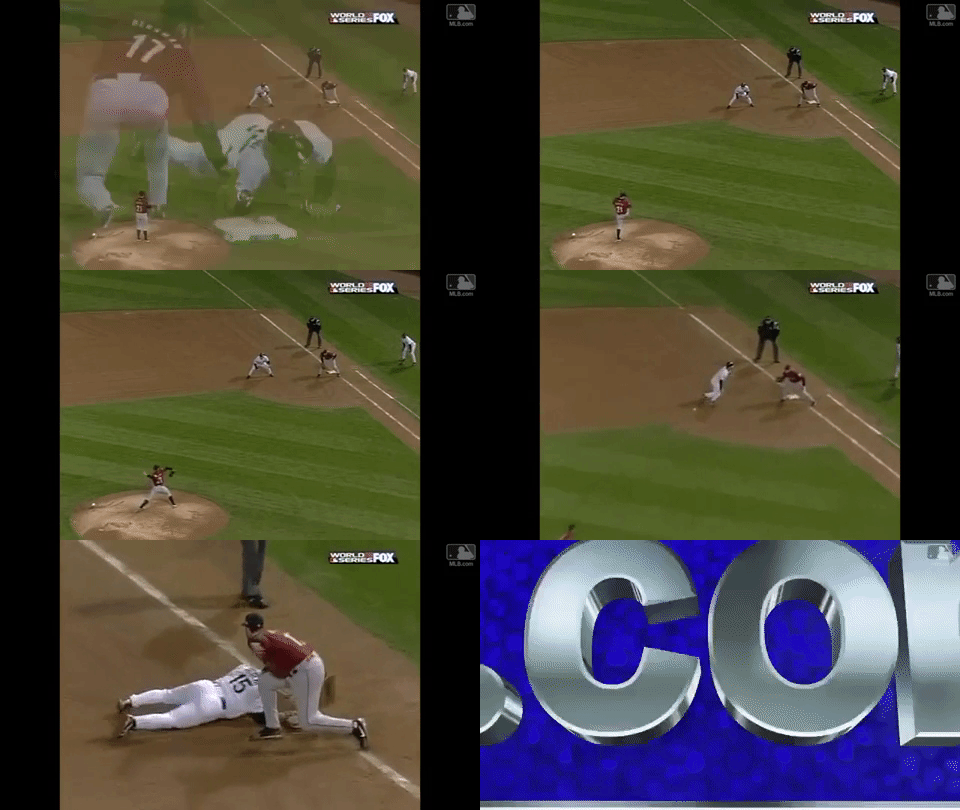
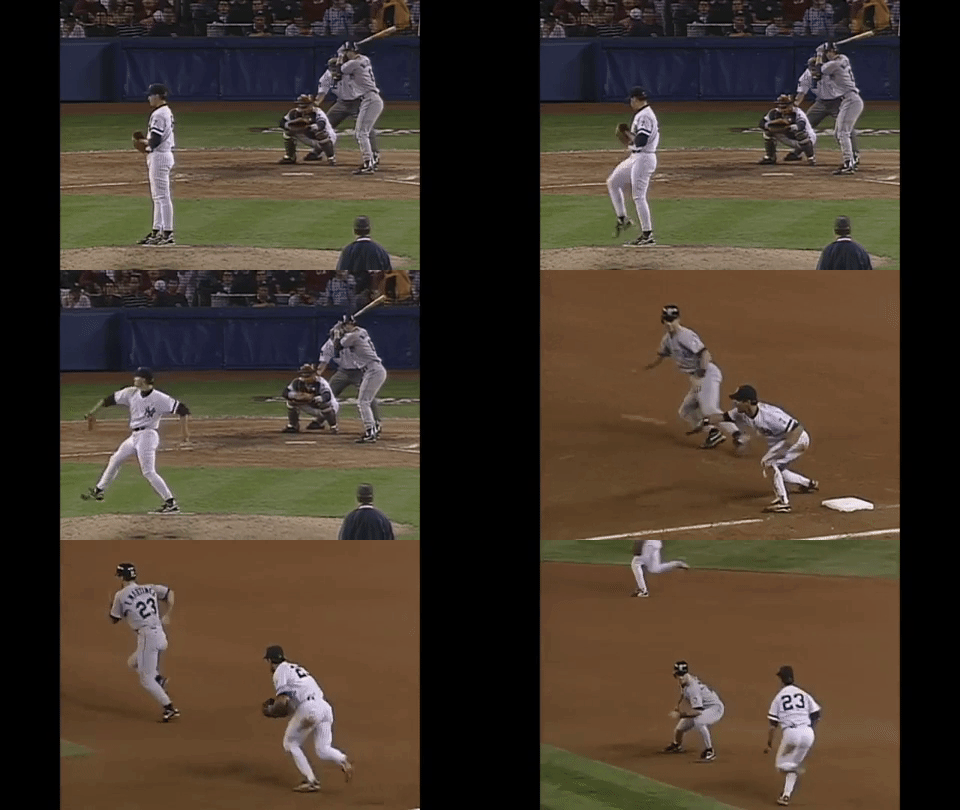
Indeed, Pettitte was more plow horse than racehorse. A sinker- and cutter-driven groundballer whose pickoff move was legendary, he was a championship-level innings-eater, a grinder (his word) rather than a dominator, a pitcher whose strong work ethic, mental preparation, and focus — visually exemplified by his peering in for the sign from the catcher with eyes barely visible underneath the brim of his cap — compensated for his lack of dazzling stuff. Ten times he made at least 32 starts, a mark that’s tied for seventh in the post-1994 strike era. His total of 10 200-inning seasons is tied for fourth in that same span, and his 12 seasons of qualifying for the ERA title with an ERA+ of 100 or better is tied for second. He had his ups and downs in the postseason, but only once during his 18-year career (2004, when he underwent season-ending elbow surgery) was he unavailable to pitch once his team made the playoffs.

On a ballot with two multi-Cy Young winners (Roger Clemens and Roy Halladay) as well as two other starters (Mike Mussina and Curt Schilling) who were better at preventing runs and racking up strikeouts — and also had plenty of postseason success — Pettitte would appear to be a long shot for Cooperstown. And that’s before factoring in his 2007 inclusion in the Mitchell Report for having used human growth hormone to recover from an elbow injury. Thanks to his championship rings and his high win total, he’ll probably receive enough support to persist on the ballot nonetheless.

About those wins: Regular readers know that I generally avoid dwelling upon pitcher win totals, because in this increasingly specialized era, they owe as much to adequate offensive, defensive, and bullpen support as they do to a pitcher’s own performance. While one needn’t know how many wins Pettitte amassed in a season or a career to appreciate his true value, those totals have affected the popular perception of his career.

2019 BBWAA Candidate: Andy Pettitte
Pitcher Career WAR Peak WAR JAWS
Andy Pettitte 60.2 34.1 47.2
Avg. HOF SP 73.9 50.3 62.1
W-L SO ERA ERA+
256-153 2,448 3.85 117
SOURCE: Baseball-Reference

Read the rest of this entry »


Yankees Appear to Snag J.A. Happ in Shrinking Market

Rumors swirled on Wednesday morning that the New York Yankees had reached an agreement to re-sign J.A. Happ, but that deal was walked back as the two teams couldn’t quite come together. As the parties kept getting closer, alternatives continued to come off the board, with Charlie Morton signing with the Rays and Lance Lynn headed to Texas. All of this was set against the backdrop of a warmer-than-expected market for starting pitching, which had already seen Patrick Corbin get a sixth year on his deal with the Nationals and Nate Eovaldi receive a guarantee of $68 million from the Red Sox. The cause of the holdup between Happ and the Yankees was likely the years of the contract, as Happ wanted three and the Yankees wanted to pay for two. The result the two sides seem to have come to is a two-year, $34 million contract with a $17 million option vesting for Happ if he reaches 27 starts or 165 innings in 2020, providing the Yankees with significant protection against potentially paying an ineffective 38-year-old. The deal has yet to be officially announced.

Happ returning to the Bronx wasn’t a foregone conclusion, as there appears to have been significant interest in the lefty, and for good reason. Over the last four years, Happ has been a consistently above-average pitcher, grabbing about three wins and 170 innings every year. In our free agent rankings, Eric Longenhagen discussed how Happ has been able to perform well through his mid-30s.

Greater use of a sinker to complement his changeup has facilitated his ascent from 1.0 WAR back-end starter to 3.0 WAR mid-rotation innings-eater. Happ’s size and length create discomfort for opposing lefties, and he has been able to dominate them (left-handed opponents slashed .171/.239/.248 against Happ last year) without a good breaking ball. Instead, Happ makes unusually frequent use of his fastball (throwing 73% of the time, roughly 20 points higher than the league-average mark for starters), which is firmer now than it was in his mid-20s.

Every team could use the three wins and 30 starts the Yankees can expect from Happ in 2019. The potential issue, though, isn’t so much next season as it is the ones that come after it. The Yankees didn’t want to guarantee that third year and that reticence is justified. The lefty turned 36 years old in October. A three-year contract would take him through his age-38 season. Over the last decade, only six pitchers have produced even four wins and 400 innings in their age-36 to age-38 seasons, with CC Sabathia likely to join that group in 2019. Here is how those pitchers, along with Happ, fared in their age-32 to age-35 seasons. Read the rest of this entry »


2018 Rule 5 Draft Scouting Reports

The major-league phase of Thursday’s Rule 5 Draft began with its annual roll call of clubs confirming the number of players currently on their 40-man rosters and ended with a total of 14 players being added to new big-league clubs. Dan Szymborski offered ZiPS projections here for the players taken earlier today. Below are brief scouting reports on the players selected, with some notes provided by Kiley McDaniel.

But, first: Our annual refresher on the Rule 5 Draft’s complex rules. Players who signed their first pro contract at age 18 or younger are eligible for selection after five years of minor-league service if their parent club has not yet added them to the team’s 40-man roster. For players who signed at age 19 or older, the timeline is four years. Teams with the worst win/loss record from the previous season pick first, and those that select a player must not only (a) pay said player’s former club $100,000, but also (b) keep the player on their 25-man active roster throughout the entirety of the following season (with a couple of exceptions, mostly involving the disabled list). If a selected player doesn’t make his new team’s active roster, he is offered back to his former team for half of the initial fee. After the player’s first year on the roster, he can be optioned back to the minor leagues.

These rules typically limit the talent pool to middle-relief prospects or position players with one-dimensional skillsets, though sometimes it involves more talented prospects who aren’t remotely ready for the majors. This creates an environment where selections are made based more on fit and team need than just talent, but teams find solid big-league role players in the Rule 5 every year and occasionally scoop up an eventual star. Let’s dive into the scouting reports on this year’s group.

First Round

1. Baltimore Orioles
Richie Martin, SS (from A’s) – Martin was a 2015 first rounder out of the University of Florida, drafted as an athletic shortstop with some pop who was still raw as a baseball player. Martin had really struggled to hit in pro ball until 2018, when he repeated Double-A and slashed .300/.368/.439.

He has average raw power but hits the ball on the ground too often to get to any of it in games. Houston has been adept at altering their players’ swings, so perhaps the new Orioles regime can coax more in-game pop from Martin, who is a perfectly fine defensive shortstop. He should compete with incumbent Orioles Breyvic Valera and Jonathan Villar, as well as fellow Rule 5 acquisition Drew Jackson, for middle infield playing time. But unless there’s a significant swing change here, Martin really only projects as a middle infield utility man.

2. Kansas City Royals
Sam McWilliams, RHP (from Rays) – McWilliams was an overslot eighth rounder in 2014 and was traded from Philadelphia to Arizona for Jeremy Hellickson in the fall of 2015. He was then sent from Arizona to Tampa Bay as one of the players to be named later in the three-team trade that sent Steven Souza to Arizona. McWilliams is pretty raw for a 23-year-old. He spent two years in the Midwest League and posted a 5.02 ERA at Double-A when the Rays pushed him there after the trade.

He has a big fastball, sitting mostly 93-94 but topping out at 97. He’ll flash an occasional plus slider but it’s a rather inconsistent pitch. The industry thought McWilliams had a chance to grow into a backend rotation arm because his stuff is quite good, but he has a much better chance of sticking as a reliever right now.

3. Chicago White Sox (Traded to Rangers)
Jordan Romano, RHP (from Blue Jays) – Romano is a 25-year-old righty who spent 2018 at Double-A. He’s a strike-throwing righty with a fastball in the 91-93 range and he has an average slider and changeup, both of which reside in the 80-84 range. His command is advanced enough that both of his secondaries play up a little bit. He likely profiles as a fifth starter or rotation depth, but the Rangers current pitching situation is quite precarious and Romano may just end up sticking around to eat innings with the hope that he sticks as a backend starter or swingman when they’re competitive once again.

4. Miami Marlins
Riley Ferrell, RHP (from Astros)- Ferrell was a dominant college closer at TCU and was consistently 93-97 with a plus slider there. He continued to pitch well in pro ball until a shoulder aneurysm derailed his 2016 season. Ferrell needed surgery that transplanted a vein from his groin into his shoulder in order to repair it, and the industry worried at the time that the injury threatened his career. His stuff is back and Ferrell is at least a big league ready middle reliever with a chance to be a set-up man.

5. Detroit Tigers
Reed Garrett, RHP (from Rangers)
Garrett’s velo spiked when he moved to the bullpen in 2017 and he now sits in the mid-90s, touches 99 and has two good breaking balls, including a curveball that has a plus-plus spin rate. He also has an average changeup. He’s a fair bet to carve out a bullpen role on a rebuilding Tigers team.

6. San Diego Padres
No Pick (full 40-man)

7. Cincinnati Reds
Connor Joe, 3B (from Dodgers) – The Reds will be Joe’s fourth team in two years as he has been shuttled around from Pittsburgh (which drafted him) to Atlanta (for Sean Rodriguez) to the Dodgers (for cash) during that time. Now 26, Joe spent 2018 split between Double and Triple-A. He’s a swing changer who began lifting the ball more once he joined Los Angeles. Joe is limited on defense to first and third base, and he’s not very good at third. He has seen a little bit of time in the outfield corners and realistically projects as a four-corners bench bat who provides patience and newfound in-game pop.

8. Texas Rangers (Traded to Royals)
Chris Ellis, RHP (from Cardinals)- Ellis, 26, spent 2018 split between Double and Triple-A. One could argue he has simply been lost amid St. Louis’ surfeit of upper-level pitching but his stuff — a low-90s sinker up to 94 and an average slider — did not compel us to include him in our Cardinals farm system write up. The Royals took Brad Keller, who has a similar kind of repertoire but better pure stuff, and got more out of him than I anticipated, so perhaps that will happen with Ellis.

9. San Francisco Giants
Travis Bergen, LHP (from Blue Jays)- Bergen looked like a lefty specialist in college but the Blue Jays have normalized the way he strides toward home, and his delivery has become more platoon-neutral in pro ball. He has a fringy, low-90s fastball but has two good secondaries in his upper-70s curveball and tumbling mid-80s change. So long as he pitches heavily off of those two offerings, he could lock down a bullpen role.

10. Toronto Blue Jays
Elvis Luciano, RHP (from Royals)- Luciano turns 19 in February and was the youngest player selected in the Rule 5 by a pretty wide margin. He was acquired by Kansas City in the trade that sent Jon Jay to Arizona. Though he’ll touch 96, Luciano’s fastball sits in the 90-94 range and he has scattershot command of it, especially late in starts. His frame is less projectable than the typical teenager so there may not be much more velo coming as he ages, but he has arm strength and an above-average breaking ball, so there’s a chance he makes the Jays roster in a relief role. He has no. 4 starter upside if his below-average changeup and command progress. If he makes the opening day roster, he’ll be the first player born in the 2000s to play in the big leagues.

11. New York Mets
Kyle Dowdy, RHP (from Indians)
Dowdy’s nomadic college career took him from Hawaii to Orange Coast College and finally to Houston, where he redshirted for a year due to injury. He was drafted by Detroit and then included as a throw-in in the Leonys Martin trade to Cleveland. He’s a reliever with a four-pitch mix headlined by an above-average curveball that pairs pretty well with a fastball that lives in the top part of the strike zone but doesn’t really spin. He also has a mid-80s slider and changeup that are fringy and exist to give hitters a little different look. He could stick in the Mets bullpen.

12. Minnesota Twins
No Pick (full 40-man)

13. Philadelphia Phillies (Traded to Orioles)
Drew Jackson, SS (from Dodgers)- Jackson is a plus runner with a plus-plus arm and average defensive hands and actions at shortstop. He’s not a great hitter but the Dodgers were at least able to cleanse Jackson of the Stanford swing and incorporate more lift into his cut. He had a 55% ground ball rate with Seattle in 2016 but that mark was 40% with Los Angeles last year. He also started seeing reps in center field last season. He projects as a multi-positional utility man.

14. Los Angeles Angels
No Pick (team passed)

15. Arizona Diamondbacks
Nick Green, RHP (from Yankees)- Green has the highest present ranking on The Board as a 45 FV, and we think he’s a near-ready backend starter. Arizona lacks pitching depth, so Green has a pretty solid chance to make the club out of spring training. He induces a lot of ground balls (65% GB% in 2018) with a low-90s sinker and also has a plus curveball.

16. Washington Nationals
No Pick (team passed)

17. Pittsburgh Pirates
No Pick (team passed)

18. St. Louis Cardinals
No Pick (full 40-man)

19. Seattle Mariners
Brandon Brennan, RHP (from Rockies)- Brennan is a 27-year-old reliever with a mid-90s sinker that will touch 97. He has an average slider that relies heavily on it’s velocity more than movement to be effective. The real bat-misser here is the changeup, which has more than 10 mph of separation from Brennan’s fastball and dying fade.

20. Atlanta Braves
No Pick (team passed)

21. Tampa Bay Rays
No Pick (full 40-man)

22. Colorado Rockies
No Pick (team passed)

23. Cleveland Indians
No Pick (team passed)

24. Los Angeles Dodgers
No Pick (full 40-man)

25. Chicago Cubs
No Pick (team passed)

26. Milwaukee Brewers
No Pick (team passed)

27. Oakland Athletics
No Pick (team passed)

28. New York Yankees
No Pick (full 40-man)

29. Houston Astros
No Pick (team passed)

30. Boston Red Sox
No Pick (team passed)

Second Round

San Francisco Giants
Drew Ferguson, OF- Ferguson is a hitterish tweener outfielder with a good combination of bat-to-ball skills and plate discipline. He has a very short, compact stroke that enables him to punch lines drives to his pull side and he’s tough to beat with velocity. Ferguson doesn’t really run well enough to play center field and lacks the power for a corner, so his likely ceiling is that of a bench outfielder.


Miguel Andujar Is Available

A rumor surfaced last night that a three-team trade might be brewing between the Mets, Yankees, and Marlins. According to Ken Rosenthal, J.T. Realmuto would head to the Mets with Noah Syndergaard going to the Yankees. While Realmuto might not fill the Mets’ biggest need, the Marlins catcher is a really good player who would provide a sizable upgrade over the options they have on the roster. For the Yankees, getting another ace-level pitcher in Syndergaard would help them to continue building their rotation after missing out on Patrick Corbin. As for the Marlins, they are obviously looking to get younger as they try to rebuild for the future. The player who might be headed to Miami? That would be Miguel Andujar.

The Yankees third baseman is coming off a very good rookie campaign, during which he batted .297/.328/.527 for a 128 wRC+. Andujar features a contact-heavy approach that limits walks and strikeouts. In the Yankees’ Top 27 Prospects write-up last year, this what Kiley McDaniel and Eric Longenhagen had to say about Andujar, who they ranked as the 14th-best prospect in baseball heading into the 2018 season.

Andujar has tantalized scouts since early in his pro career with a strong, athletic frame and flashy tools that are above average to plus across the board. He was largely seen as potential, even passed over by all 30 teams in the Rule 5 Draft following the 2015 season. He broke out in a huge way in 2017, reaching a critical mass of adjustments and maturity that showed up in the counting stats.

Andujar has cut down on his swing-and-miss while also lifting the ball more and hitting it with more authority, an obviously rare and desirable combination when you’re already working with a toolsy prospect who was always young for his level.

Andujar lived up to that report last season, and as a batter, he was a top ten third basemen in baseball. With five seasons left of team control, Andujar is a young, cheap potential star. As to why the Yankees might move him, Andujar was very bad on defense last year, 16 runs below average on defense by UZR and -25 by DRS. He should probably not be playing third base. I asked Longenhagen what position Andujar should be playing, and he said he would move him to right field. Andujar has a great arm and above-average sprint speed, so a move to the outfield might showcase his skills better than the hot corner does, but the Yankees already have a full outfield. First base might waste Andujar’s arm and some of his issues in the field might not be alleviated by moving across the diamond. Trading Andujar to help the rotation would also free up a spot to potentially sign Manny Machado.

Putting Andujar in right field limits his ceiling, as an average third baseman with his batting line last season would have been a 4-plus win player. Even slightly below average defense in right field would put Andujar in the three-win range, meaning the bat would need to take another step forward to compensate. That step forward is a possibility for a player who is just 23 years old, especially if he improves his walk rate a little and his strikeouts come down closer to his minor league numbers. That’s still an All-Star level player in right field. Even if the Yankees are making Andujar available, it shouldn’t be seen a huge slight to Andujar. He’s a good player now, and has the potential to be better.


JAWS and the 2019 Hall of Fame Ballot: Gary Sheffield

The following article is part of Jay Jaffe’s ongoing look at the candidates on the BBWAA 2019 Hall of Fame ballot. Originally written for the 2015 election at SI.com, it has been updated to reflect recent voting results as well as additional research. For a detailed introduction to this year’s ballot, and other candidates in the series, use the tool above; an introduction to JAWS can be found here. For a tentative schedule and a chance to fill out a Hall of Fame ballot for our crowdsourcing project, see here. All WAR figures refer to the Baseball-Reference version unless otherwise indicated.

Wherever Gary Sheffield went, he made noise, both with his bat and his voice. For the better part of two decades, he ranked among the game’s most dangerous hitters, a slugger with a keen batting eye and a penchant for contact that belied his quick, violent swing. For even longer than that, he was one of the game’s most outspoken players, unafraid to speak up when he felt he was being wronged and unwilling to endure a situation that wasn’t to his liking. He was a polarizing player, and hardly one for the faint of heart.

At the plate, Sheffield was viscerally impressive like few others. With his bat twitching back and forth like the tail of a tiger waiting to pounce, he was pure menace in the batter’s box. He won a batting title, launched over 500 home runs — 14 seasons with at least 20 and eight with at least 30 — and put many a third base coach in peril with some of the most terrifying foul balls anyone has ever seen. For as violent as his swing may have been, it was hardly wild; not until his late thirties did he strike out more than 80 times in a season, and in his prime, he walked far more often than he struck out.

Off the field, Bill James once referred to Sheffield as “an urban legend in his own mind.” Sheffield found controversy before he ever reached the majors through his connection to his uncle, Dwight Gooden. He was drafted and developed by the Brewers, who had no idea how to handle such a volatile player and wound up doing far more harm than good. Small wonder then that from the time he was sent down midway through his rookie season after being accused of faking an injury, he was mistrustful of team management and wanted out. And when he wanted out — of Milwaukee, Los Angeles, or New York — he let you know it, and if a bridge had to burn, so be it; it was Festivus every day for Sheffield, who was always willing to air his grievances.

Later in his career, Sheffield became entangled in the BALCO performance enhancing drug scandal through his relationship with Barry Bonds — a relationship that by all accounts crumbled before he found himself in even deeper water. For all of the drama that surrounded Sheffield, and for all of his rage and outrageousness, he never burned out the way his uncle did, nor did he have trouble finding work.

Even in the context of the high-scoring era in which he played, Sheffield’s offensive numbers look to be Hall of Fame caliber, but voters have found plenty of reasons to overlook him, whether it’s his tangential connection to PEDs, his gift for finding controversy, his poor defensive metrics, or the crowd on the ballot. In his 2015 debut, he received just 11.7% of the vote, and in three years since, he’s actually lost a bit of ground, getting 11.1% in 2018. At this point, he’s more likely to fall off the ballot before his eligibility window expires than he is to reach 75% — a fate that, I must admit, surprises me.

2019 BBWAA Candidate: Gary Sheffield
Player Career WAR Peak WAR JAWS
Gary Sheffield 60.5 38.0 49.3
Avg. HOF RF 72.7 42.9 57.8
H HR AVG/OBP/SLG OPS+
2,689 509 .292/.393/.514 140
SOURCE: Baseball-Reference

Read the rest of this entry »


JAWS and the 2019 Hall of Fame Ballot: Mike Mussina

The following article is part of Jay Jaffe’s ongoing look at the candidates on the BBWAA 2019 Hall of Fame ballot. Originally written for the 2014 election at SI.com, it has been updated to reflect recent voting results as well as additional research, and was expanded for inclusion in The Cooperstown Casebook, published in 2017 by Thomas Dunne Books. For a detailed introduction to this year’s ballot, and other candidates in the series, use the tool above; an introduction to JAWS can be found here. For a tentative schedule and a chance to fill out a Hall of Fame ballot for our crowdsourcing project, see here. All WAR figures refer to the Baseball-Reference version unless otherwise indicated.

Unlike 2014 Hall of Fame honorees Greg Maddux and Tom Glavine or 2015 honoree Randy Johnson, Mike Mussina didn’t reach 300 wins in his career. Nor did he ever win a Cy Young award, in part because a teammate practically stole one out of his hands on the basis of superior run support. For as well as he pitched in October, his teams never won a World Series, because even the best relievers sometimes falter, to say nothing of what happens to the rest of them.

Though lacking in those marquee accomplishments, Mussina nonetheless strung together an exceptional 18 year career spent entirely in the crucible of the American League East, with its high-offense ballparks and high-pressure atmosphere. A cerebral pitcher with an expansive arsenal that featured a 93-mph fastball and a signature knuckle-curve — and at times as many as five other pitches — he not only missed bats with regularity but also had pinpoint control.

In a prime that coincided with those of the aforementioned pitchers — as well as 2015 inductees Pedro Martinez and John Smoltz and ballotmates Roger Clemens, Roy Halladay, and Curt Schilling — “Moose” never led the AL in either strikeouts or ERA, but he ranked in the league’s top five six times in the former category and seven times in the latter. He earned All-Star honors five times and received Cy Young votes in eight separate seasons across a 10-year span, at one point finishing in the top five four times in five years. He even did a better job of preventing runs in the postseason than he did in the regular season, though it wasn’t enough to put his teams over the top.

Read the rest of this entry »


Making a Robinson Cano Trade Work

As we get closer to deals for Manny Machado and Bryce Harper, the time has come for warnings about mega-deals gone bad. You know about Albert Pujols, Chris Davis, Miguel Cabrera, and Jacoby Ellsbury as prime examples of why guaranteeing big money long-term to players on the wrong side of 30 is a bad idea. Robinson Cano’s current contract is not one of those examples. There were alarm bells when Cano signed his 10-year, $240 million contract with the Mariners five years ago, but he has more than held up his end of the contract by averaging more than four wins per season. If Cano hits his projections next year and continues a normal age-related decline, he could easily live up to the $240 million contract he signed.

Over the past five seasons, the Mariners have paid Cano just over $108 million and Cano, in turn, has delivered 20.7 WAR. According to our values at the bottom of Cano’s player page, his play has been worth around $160 million. He’s currently projected by Steamer for three wins next season. With standard aging curves, here is what Cano’s production and value are expected to be over the next five years.

Robinson Cano’s Contract Estimate — 5 yr / $81.1 M
Year Age WAR $/WAR Est. Contract
2019 36 3.0 $9.0 M $27.0 M
2020 37 2.5 $9.5 M $23.6 M
2021 38 1.8 $9.9 M $17.4 M
2022 39 1.0 $10.4 M $10.4 M
2023 40 0.3 $10.9 M $2.7 M
Totals 8.5 $81.1 M

Assumptions

Value: $9M/WAR with 5.0% inflation (for first 5 years)
Aging Curve: +0.25 WAR/yr (18-27), 0 WAR/yr (28-30), -0.5 WAR/yr (31-37), -0.75 WAR/yr (> 37)

Read the rest of this entry »


JAWS and the 2019 Hall of Fame Ballot: Mariano Rivera

The following article is the first part of Jay Jaffe’s ongoing look at the candidates on the BBWAA 2018 Hall of Fame ballot. It has been adapted from The Cooperstown Casebook, published in 2017 by Thomas Dunne Books. For a detailed introduction to this year’s ballot, and other candidates in the series, use the tool above; an introduction to JAWS can be found here. For a tentative schedule and a chance to fill out a Hall of Fame ballot for our crowdsourcing project, see here. All WAR figures refer to the Baseball-Reference version unless otherwise indicated.

Nobody closed the door like Mariano Rivera. The wiry, unflappable Panamanian not only set the all-time record for saves (652), he prevented runs at a greater clip relative to his league than any other pitcher. Yet neither of those accomplishments capture his brilliance in October. During Rivera’s 19-year-career, the Yankees missed the playoffs just twice, and for all of his regular season dominance, he was even better when the stakes were the highest, helping the Yankees to five championships. He was the last man standing on the mound an unprecedented four times, securing the final outs of the World Series in 1998, 1999, 2000 and 2009.

Rivera did all of this while relying almost exclusively on one pitch, a cut fastball discovered almost by accident in 1997, his first year as closer. Even when batters knew what was coming — and at speeds as high as 98 mph in his younger days, it was coming fast — they could rarely predict its sideways movement well enough to make hard contact. If they connected at all, they often broke their bats. Teammates and opponents marveled at the success of the pitch, while writers placed it in the pantheon of great signature offerings, alongside Nolan Ryan’s fastball, Roger Clemens’ splitter, Sandy Koufax’s curve, Steve Carlton’s slider, Pedro Martinez’s changeup, and Hoyt Wilhelm’s knuckleball.

Debates have long raged over how to value relievers and determine their fitness for the Hall of Fame, no small task given that just six are enshrined, as much for their roles in shifting the paradigm for closers as for the numbers they racked up. Yet Rivera’s case shuts those debates down like they’re opponents trailing by three runs in the ninth inning of a playoff game. He’s so far ahead of the field on so many levels that one could argue he’s the lone reliever outside the Hall worthy of entry, and as the top newcomer on the 2019 ballot, he’ll likely become just the second reliever to gain first-ballot entry, after Dennis Eckersley (2004).

Read the rest of this entry »