2019 ZiPS Projections – Los Angeles Dodgers

After having typically appeared in the hallowed pages of Baseball Think Factory, Dan Szymborski’s ZiPS projections have now been released at FanGraphs for more than half a decade. The exercise continues this offseason. Below are the projections for the Los Angeles Dodgers.

Batters

Overall, the Dodgers still project as being among the best teams in baseball, but something feels curiously unsatisfying about the team’s offseason. The team appears to be shuffling the outfield again, but is the Cody Bellinger/A.J. Pollock/Guy in CF While A.J. Pollock is Injured/Maybe Alex Verdugo configuration really any better than the Bellinger/Joc Pederson/Yasiel Puig option — while still having Alex Wood and Kyle Farmer but not the Reds prospects — would have been? Maybe it is, maybe it isn’t. Pollock is a better player than Pederson, but riskier given his health history, and ZiPS has always been slightly underwhelmed by Verdugo. Given the team’s positional flexibility and their theoretical pocketbook, this depth chart could still change considerably over the next month; despite the tea leaves suggesting they’re out on Bryce Harper, I remain less than 100% convinced.

One wonders how much of Los Angeles’ apparent lack of interest in a big name isn’t a matter of feeling miserly, but is simply a reflection of the state of the NL West, which looks a lot less dangerous for the reigning champs than last year. Barring big changes, Arizona’s in a mostly-rebuilding phase, the Giants probably saw their last real opportunity to compete with their current core end last summer, and only part of San Diego’s prospect crop will be reaped this year, though a move for Manny Machado or J.T. Realmuto could accelerate the Padres’ timeline. That just leaves the Rockies, who while improved with Daniel Murphy at first, are unlikely to get quite as much awesomeness from their best players as they received in 2018. Colorado’s the biggest threat to the Dodgers in the division, but they’re also a passive team apparently content with their holes.

ZiPS is sold on Max Muncy, in large part due to his velocity data, the magnitude of his 2018 breakout, and the fact that his translated 2017 performance of .264/.351/.420 was more-than-adequate. That’s enough to effectively counteract his disappointing prior major league performance and meh-minus minor league translations of .218/.317/.346 and .219/.282/.359. In the end, ZiPS sees a lot more downside risk in Muncy’s batting average than his power, power being a difficult trick to fake.

Pitchers
Clayton Kershaw’s projection has to be the best OMG THAT’S HORRIBLE projection that ZiPS has ever spat out. The fact is, he’s missed time due to injury in four of the last five seasons and while no individual injury has been of the severe variety — the sort where ligaments are replaced or shoulders reconstructed — there’s evidence that he’s just not at the same level as he was from 2013-2016. ZiPS is still projecting him to be a star, but you can’t ignore his continued velocity decline and the loss of 20% of his strikeouts. That was enough to drop his yearly top comp from Sandy Koufax to “only” Tom Glavine. A brief aside: Kershaw was actually slightly easier to make contact against in 2018 than the average pitcher, which is really weird.

The bottom-line WAR projections aren’t generally in the stratosphere for the Dodgers, but that’s in large part due to the fact that the pitching staff has a checkered health record and ZiPS is only projecting Kershaw to qualify for the rate stat leaderboard. What the Dodgers don’t have in health they’ve been forced to make up for in depth, and of the pitchers on the 40-man roster, ZiPS projects a shocking 15 to have a league-average ERA or better (when adjusting for park, of course). Just on the major league roster, ZiPS sees both Caleb Ferguson and Ross Stripling as perfectly adequate fallback options if (when?) the rotation starts making DL trips.

I believe that Kenley Jansen is the first player to get a top comp of a prime Mariano Rivera (a few have gotten him as a minor-league starter). Seems kinda poetic given Jansen’s cutter, which ZiPS doesn’t actually know about, though he’s unlikely to retire as the best reliever in major league history. From a comp standpoint, a team shouldn’t be able to complain too much when a quarter of their pitching staff has Hall of Famers — easy ones rather than guys that just happened to be Frankie Frisch’s teammates — as their top comparisons.

Bench and Prospects

ZiPS doesn’t see the Dodger farm system as being as strong as it did in the last few years, but there’s still a lot of future major league value here. ZiPS isn’t on the Alex Verdugo star bandwagon, but at least sees him as an above-average starter in his prime, and the projections for Keibert Ruiz are of a similar level of quality. ZiPS thinks that both Dustin May and Dennis Santana wouldn’t embarrass themselves if dragooned into duty on the major league roster, and even Yadier Alvarez, a pitching prospect who a set of algorithms ought to have issues properly appreciating, gets a projection in the same zip code as league-average. ZiPS thinks that both Will Smith and Gavin Lux will be league-average regulars, but sees a significant quality dropoff after that pair. That’s not including Jeter Downs, who will get a projection for ZiPS Top 100 list, but I avoid giving official seasonal projections for players who’ve only played in the Midwest League outside of rookie ball unless I’m forced to by circumstance.

One pedantic note for 2019: for the WAR graphic, I’m using FanGraphs’ depth chart playing time, not the playing time ZiPS spits out, so there will be occasional differences in WAR totals.
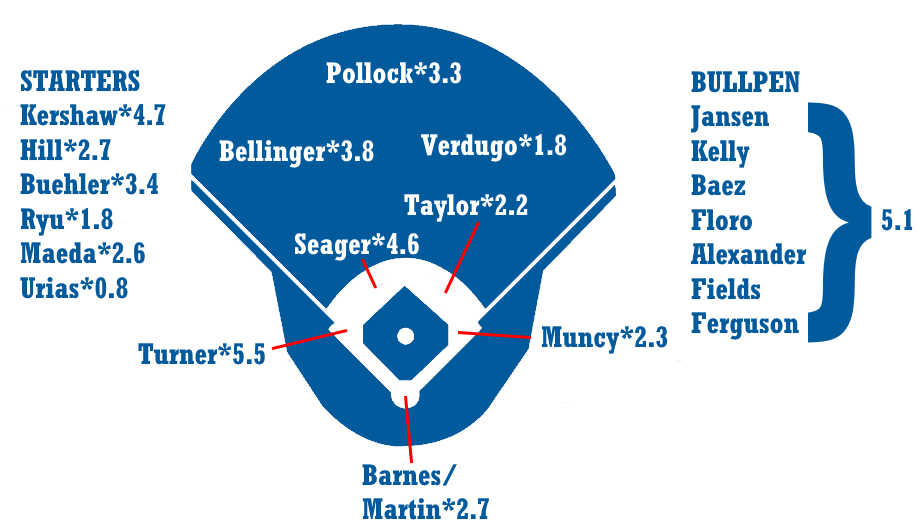
Ballpark graphic courtesy Eephus League. Depth charts constructed by way of those listed here at site.

Batters – Counting Stats
Player B Age PO G AB R H 2B 3B HR RBI BB SO SB CS
Manny Machado R 26 SS 156 618 88 174 36 2 34 112 60 110 11 3
Cody Bellinger L 23 1B 156 545 92 147 29 6 34 101 73 149 14 2
Corey Seager L 25 SS 129 499 72 140 32 3 17 77 47 111 4 1
Justin Turner R 34 3B 118 409 60 119 27 1 15 63 46 64 4 1
A.J. Pollock R 31 CF 114 425 65 112 24 4 16 57 32 90 16 4
Chris Taylor R 28 SS 148 523 76 130 30 7 15 63 50 154 13 7
Joc Pederson R 27 CF 136 386 62 92 24 2 22 62 56 108 3 5
Max Muncy L 28 1B 131 385 63 94 18 2 23 66 64 124 3 1
Keibert Ruiz B 20 C 107 407 47 107 19 1 10 45 22 57 0 1
Alex Verdugo L 23 CF 138 474 59 130 25 2 11 50 40 67 8 3
Kiké Hernandez R 27 CF 145 361 55 89 19 2 16 48 44 87 3 0
Russell Martin R 36 C 94 314 44 67 11 0 12 40 48 92 1 3
Austin Barnes R 29 C 102 262 38 63 13 1 5 30 37 65 7 2
Will D. Smith R 24 C 88 327 39 64 14 1 12 39 31 122 4 1
David Freese R 36 3B 111 335 39 82 14 1 10 50 31 97 0 0
Gavin Lux L 21 SS 120 493 61 117 20 7 13 53 44 125 11 10
DJ Peters R 23 CF 133 517 65 103 21 4 23 66 40 235 1 3
Matt Beaty L 26 1B 101 388 45 101 21 1 7 44 25 68 2 2
Chase Utley L 40 2B 94 203 24 46 12 2 3 20 19 41 4 1
Andrew Toles R 27 LF 95 327 40 82 18 2 7 39 15 76 7 5
Jake Peter L 26 2B 117 426 46 96 16 2 8 41 30 126 6 4
Rob Segedin R 30 1B 85 282 37 68 13 2 9 41 21 69 1 1
Rocky Gale R 31 C 98 324 29 72 13 2 3 29 15 65 1 1
Angelo Mora B 26 2B 105 370 36 87 16 4 6 40 20 94 4 3
Edwin Rios L 25 3B 109 406 47 95 22 1 13 54 22 144 1 2
Travis Taijeron R 30 RF 116 397 50 84 21 2 16 55 41 165 1 2
Connor Wong R 23 C 100 383 46 80 15 1 15 46 27 158 5 3
Paulo Orlando R 33 RF 106 369 39 87 17 2 7 36 13 86 4 1
Josh Thole L 32 C 34 98 8 19 3 0 1 6 9 23 1 0
Shane Peterson L 31 LF 120 390 42 91 21 3 9 49 23 114 3 0
Zach McKinstry L 24 2B 94 325 35 67 12 3 4 27 32 103 3 3
Jeren Kendall L 23 CF 110 438 42 84 13 5 10 36 35 181 22 17
Cameron Perkins R 28 1B 108 389 44 93 23 2 9 48 21 77 6 3
Tyler Goeddel R 26 LF 99 322 35 70 11 3 5 30 27 89 7 3
Cristian Santana R 22 3B 128 536 56 123 19 1 18 68 15 163 1 2
Zach Reks L 25 LF 84 297 31 69 10 2 4 24 24 99 5 4
Errol Robinson R 24 SS 107 417 44 91 15 2 7 36 29 127 14 6
Kyle Garlick R 27 RF 110 407 47 85 20 2 17 54 21 160 2 0
Omar Estevez R 21 SS 133 538 57 111 26 2 11 53 33 171 2 2
Michael Ahmed R 27 3B 86 298 32 57 10 2 7 27 28 122 4 4
Logan Landon R 26 LF 108 381 41 80 15 1 10 38 25 131 14 4

Batters – Rate Stats
Player BA OBP SLG OPS+ ISO BABIP RC/27 Def WAR No. 1 Comp
Manny Machado .282 .344 .511 128 .230 .295 6.7 -4 5.3 Adrian Beltre
Cody Bellinger .270 .357 .532 137 .262 .312 7.2 4 4.8 Johnny Callison
Corey Seager .281 .346 .459 116 .178 .332 6.0 3 4.0 Troy Tulowitzki
Justin Turner .291 .376 .472 128 .181 .315 6.8 3 4.0 George Kell
A.J. Pollock .264 .320 .452 106 .188 .301 5.5 3 2.7 Jackie Brandt
Chris Taylor .249 .320 .419 98 .170 .325 4.8 -2 2.4 Robby Thompson
Joc Pederson .238 .342 .482 120 .244 .273 5.7 -5 2.3 Jon Nunnally
Max Muncy .244 .355 .481 124 .236 .298 6.1 -3 2.1 Johnny Briggs
Keibert Ruiz .263 .308 .388 88 .125 .285 4.3 3 1.8 Mike Lieberthal
Alex Verdugo .274 .332 .405 99 .131 .301 5.1 -4 1.7 Nick Markakis
Kiké Hernandez .247 .328 .443 107 .197 .283 5.3 -3 1.7 Scott Hairston
Russell Martin .213 .329 .363 88 .150 .262 3.9 1 1.5 Rick Dempsey
Austin Barnes .240 .344 .355 91 .115 .302 4.5 1 1.4 Al Lopez
Will D. Smith .196 .277 .355 70 .159 .269 3.4 7 1.3 Rick Wilkins
David Freese .245 .324 .382 91 .137 .316 4.4 1 1.2 Tony Graffanino
Gavin Lux .237 .301 .385 85 .148 .293 3.9 -3 1.1 D’Angelo Jimenez
DJ Peters .199 .272 .389 77 .190 .309 3.5 -2 0.4 Brent Clevlen
Matt Beaty .260 .310 .374 84 .113 .300 4.2 3 0.3 Tommy Gregg
Chase Utley .227 .310 .350 79 .123 .270 3.9 -1 0.3 Craig Counsell
Andrew Toles .251 .288 .382 80 .131 .307 3.9 4 0.3 Rod Allen
Jake Peter .225 .281 .329 65 .103 .301 3.2 5 0.3 Mendy Lopez
Rob Segedin .241 .298 .397 86 .156 .289 4.2 1 0.2 Marlin McPhail
Rocky Gale .222 .261 .302 52 .080 .270 2.7 6 0.1 Izzy Molina
Angelo Mora .235 .275 .349 68 .114 .300 3.3 1 0.0 Juan Melo
Edwin Rios .234 .278 .389 78 .155 .329 3.7 -4 -0.1 Roy Howell
Travis Taijeron .212 .295 .395 85 .184 .315 3.9 -5 -0.2 Dustan Mohr
Connor Wong .209 .271 .371 72 .162 .310 3.4 -9 -0.3 Bob Geren
Paulo Orlando .236 .268 .350 66 .114 .290 3.4 4 -0.3 Dave Augustine
Josh Thole .194 .266 .255 43 .061 .243 2.4 -2 -0.4 Charlie Greene
Shane Peterson .233 .280 .372 75 .138 .307 3.7 -2 -0.4 Jalal Leach
Zach McKinstry .206 .288 .298 60 .092 .289 2.8 -1 -0.4 Abel Nieves
Jeren Kendall .192 .253 .313 52 .121 .300 2.4 8 -0.4 Jimmy White
Cameron Perkins .239 .285 .378 78 .139 .277 3.8 -2 -0.5 Virgil Chevalier
Tyler Goeddel .217 .287 .317 64 .099 .285 3.2 0 -0.6 Casey Craig
Cristian Santana .229 .252 .369 66 .140 .296 3.2 -3 -0.7 Matthew Moses
Zach Reks .232 .291 .320 66 .088 .335 3.2 -1 -0.7 Angelo Cuevas
Errol Robinson .218 .271 .314 58 .096 .297 3.0 -5 -0.7 Brian Bixler
Kyle Garlick .209 .253 .393 72 .184 .296 3.5 -3 -0.8 Brian McFall
Omar Estevez .206 .255 .323 56 .117 .281 2.8 -2 -0.9 Ricky Magdaleno
Michael Ahmed .191 .266 .309 55 .117 .296 2.6 -3 -1.0 Frank Kremblas
Logan Landon .210 .261 .333 60 .123 .292 3.1 -3 -1.2 Juan Piniella

Pitchers – Counting Stats
Player T Age W L ERA G GS IP H ER HR BB SO
Clayton Kershaw L 31 11 6 2.91 26 26 164.0 138 53 18 27 170
Walker Buehler R 24 9 6 3.31 28 27 141.3 118 52 16 46 163
Kenta Maeda R 31 12 8 3.63 36 24 143.7 131 58 17 43 149
Rich Hill L 39 9 7 3.81 22 22 115.7 98 49 17 40 128
Caleb Ferguson L 22 8 6 3.53 39 9 109.7 99 43 10 48 115
Ross Stripling R 29 7 6 3.92 32 17 105.7 105 46 16 25 103
Kenley Jansen R 31 3 2 2.95 64 0 64.0 50 21 9 15 81
Hyun-jin Ryu L 32 6 5 3.89 17 17 88.0 89 38 14 21 82
Dustin May R 21 7 7 4.45 24 24 131.3 142 65 19 35 96
Scott Alexander L 29 3 2 3.61 67 0 67.3 63 27 5 26 57
Ryan Madson R 38 4 3 3.28 52 0 49.3 44 18 5 13 50
Joe Kelly R 31 3 2 3.56 65 0 60.7 51 24 4 29 64
Dennis Santana R 23 5 5 4.24 18 16 87.0 83 41 11 35 87
Yadier Alvarez R 23 3 3 4.43 21 14 67.0 62 33 6 45 65
Daniel Corcino R 28 4 4 4.55 29 16 95.0 94 48 13 43 87
Pedro Baez R 31 4 3 3.72 59 0 58.0 51 24 7 22 62
Josh Sborz R 25 4 3 3.72 55 0 58.0 51 24 5 27 61
Joe Broussard R 28 5 4 3.84 53 0 65.7 63 28 8 22 63
Zach McAllister R 31 3 2 3.79 49 0 54.7 53 23 7 16 54
Josh Fields R 33 2 2 3.75 53 0 48.0 45 20 6 14 47
Mitchell White R 24 6 6 4.68 22 22 98.0 102 51 13 43 78
Brock Stewart R 27 4 4 4.70 26 20 103.3 108 54 17 35 87
Tony Cingrani L 29 2 1 3.66 45 0 39.3 32 16 5 17 50
JT Chargois R 28 3 3 3.97 50 0 45.3 41 20 4 24 45
Tony Gonsolin R 25 6 6 4.87 26 26 118.3 123 64 20 53 103
John Axford R 36 3 2 3.94 46 0 48.0 44 21 4 23 47
Dylan Floro R 28 4 4 4.28 52 0 67.3 72 32 9 18 48
Julio Urias L 22 1 1 4.25 12 9 36.0 33 17 5 16 38
Shea Spitzbarth R 24 4 4 4.24 43 0 68.0 63 32 10 31 74
Kevin Quackenbush R 30 3 3 4.18 55 0 56.0 54 26 8 20 53
Daniel Hudson R 32 3 3 4.18 53 0 51.7 48 24 6 24 52
Logan Bawcom R 30 6 7 5.08 25 14 85.0 91 48 13 38 62
Logan Salow L 24 4 4 4.32 39 0 50.0 48 24 6 26 49
Nolan Long R 25 4 4 4.41 46 0 63.3 58 31 8 39 69
C.C. Lee R 32 2 2 4.31 27 0 31.3 29 15 5 12 34
Adam McCreery L 26 3 3 4.58 41 0 55.0 48 28 4 45 59
Logan Ondrusek R 34 2 2 4.42 38 0 38.7 38 19 6 15 36
Yimi Garcia R 28 2 2 4.43 42 0 40.7 43 20 8 7 37
Adam Liberatore L 32 3 3 4.54 38 0 33.7 33 17 5 14 30
Zach Neal R 30 5 6 5.28 29 15 105.7 123 62 21 16 56
Erik Goeddel R 30 2 2 4.69 46 0 48.0 45 25 8 23 52
Marshall Kasowski R 24 2 2 4.71 42 0 49.7 37 26 5 50 72
Ben Holmes L 27 3 4 5.22 25 10 70.7 76 41 11 35 54
Jaime Schultz R 28 4 5 5.36 41 11 80.7 74 48 16 53 97
Tyler Pill R 29 5 7 5.36 22 17 99.0 114 59 18 32 61
Parker Curry R 25 6 8 5.26 38 10 87.3 95 51 16 40 75
Andre Scrubb R 24 4 5 5.05 38 0 57.0 55 32 6 46 52
Dylan Baker R 27 3 5 5.67 30 1 33.3 38 21 6 17 20
Justin de Fratus R 31 5 8 5.70 24 18 109.0 131 69 23 30 63

Pitchers – Rate Stats
Player TBF K/9 BB/9 HR/9 BABIP ERA+ ERA- FIP WAR No. 1 Comp
Clayton Kershaw 648 9.33 1.48 0.99 .278 139 72 3.03 4.1 Tom Glavine
Walker Buehler 586 10.38 2.93 1.02 .288 122 82 3.44 2.9 John Smoltz
Kenta Maeda 601 9.33 2.69 1.06 .295 115 87 3.64 2.8 Mark Gubicza
Rich Hill 486 9.96 3.11 1.32 .276 109 92 4.09 2.0 Al Leiter
Caleb Ferguson 475 9.44 3.94 0.82 .301 114 88 3.72 1.8 Terry Forster
Ross Stripling 442 8.77 2.13 1.36 .301 103 97 3.94 1.4 Gil Heredia
Kenley Jansen 255 11.39 2.11 1.27 .277 137 73 3.24 1.4 Mariano Rivera
Hyun-jin Ryu 370 8.39 2.15 1.43 .299 104 96 4.14 1.2 Zane Smith
Dustin May 569 6.58 2.40 1.30 .299 91 110 4.55 1.1 Rick Wise
Scott Alexander 288 7.62 3.48 0.67 .293 115 87 3.67 1.0 Harry Perkowski
Ryan Madson 205 9.12 2.37 0.91 .291 127 79 3.41 0.9 Todd Jones
Joe Kelly 261 9.49 4.30 0.59 .292 117 86 3.48 0.9 Jim Hughes
Dennis Santana 378 9.00 3.62 1.14 .300 95 105 4.17 0.9 Denny Bautista
Yadier Alvarez 307 8.73 6.04 0.81 .299 94 106 4.57 0.6 J.R. Richard
Daniel Corcino 420 8.24 4.07 1.23 .298 89 113 4.61 0.6 Johnny Klippstein
Pedro Baez 244 9.62 3.41 1.09 .289 108 92 3.77 0.6 Mike DeJean
Josh Sborz 251 9.47 4.19 0.78 .297 108 92 3.72 0.6 Clay Bryant
Joe Broussard 280 8.63 3.02 1.10 .299 105 95 3.96 0.6 Joe Grahe
Zach McAllister 231 8.89 2.63 1.15 .303 110 91 3.83 0.6 Danny Patterson
Josh Fields 201 8.81 2.63 1.13 .293 111 90 3.75 0.5 Terry Leach
Mitchell White 437 7.16 3.95 1.19 .299 86 116 4.75 0.5 Ed Wojna
Brock Stewart 450 7.58 3.05 1.48 .297 86 117 4.77 0.5 Mickey Callaway
Tony Cingrani 167 11.44 3.89 1.14 .290 110 91 3.71 0.4 Yorkis Perez
JT Chargois 201 8.93 4.76 0.79 .296 105 95 4.10 0.4 George Smith
Tony Gonsolin 529 7.83 4.03 1.52 .298 83 121 5.13 0.4 Tom Griffin
John Axford 210 8.81 4.31 0.75 .299 102 98 3.84 0.4 Turk Lown
Dylan Floro 289 6.42 2.41 1.20 .297 97 103 4.35 0.4 Tom Morgan
Julio Urias 156 9.50 4.00 1.25 .292 95 105 4.26 0.3 Trevor Wilson
Shea Spitzbarth 298 9.79 4.10 1.32 .296 95 105 4.43 0.3 Anthony Chavez
Kevin Quackenbush 239 8.52 3.21 1.29 .293 97 104 4.24 0.3 Jose Silva
Daniel Hudson 226 9.06 4.18 1.05 .298 96 104 4.21 0.3 Marc Wilkins
Logan Bawcom 381 6.56 4.02 1.38 .295 82 122 5.16 0.2 Blue Moon Odom
Logan Salow 224 8.82 4.68 1.08 .300 93 107 4.49 0.2 Mike Murphy
Nolan Long 287 9.81 5.54 1.14 .299 92 109 4.65 0.1 Anthony Chavez
C.C. Lee 135 9.77 3.45 1.44 .293 94 107 4.39 0.1 Jason Childers
Adam McCreery 257 9.65 7.36 0.65 .301 91 110 4.57 0.1 Clay Bryant
Logan Ondrusek 167 8.38 3.49 1.40 .294 91 110 4.55 0.1 Ricky Barlow
Yimi Garcia 171 8.19 1.55 1.77 .299 91 110 4.55 0.1 Jeff Tam
Adam Liberatore 148 8.02 3.74 1.34 .289 89 113 4.72 0.0 Mike Venafro
Zach Neal 452 4.77 1.36 1.79 .288 79 127 5.27 0.0 Tim McClaskey
Erik Goeddel 211 9.75 4.31 1.50 .294 86 116 4.71 0.0 Mike Cook
Marshall Kasowski 236 13.05 9.06 0.91 .302 86 117 4.76 -0.1 Rafael Pimentel
Ben Holmes 322 6.88 4.46 1.40 .298 77 129 5.30 -0.1 Wade Blasingame
Jaime Schultz 369 10.82 5.91 1.79 .293 78 129 5.48 -0.2 Leslie Brea
Tyler Pill 441 5.55 2.91 1.64 .296 75 133 5.43 -0.3 Don August
Parker Curry 396 7.73 4.12 1.65 .304 77 130 5.36 -0.3 David Potts
Andre Scrubb 271 8.21 7.26 0.95 .299 80 125 5.27 -0.3 Lloyd Allen
Dylan Baker 154 5.40 4.59 1.62 .294 73 136 6.00 -0.3 Tom Dukes
Justin de Fratus 486 5.20 2.48 1.90 .298 71 141 5.76 -0.7 Allen Davis

Disclaimer: ZiPS projections are computer-based projections of performance. Performances have not been allocated to predicted playing time in the majors — many of the players listed above are unlikely to play in the majors at all in 2019. ZiPS is projecting equivalent production — a .240 ZiPS projection may end up being .280 in AAA or .300 in AA, for example. Whether or not a player will play is one of many non-statistical factors one has to take into account when predicting the future.

Players are listed with their most recent teams, unless I have made a mistake. This is very possible, as a lot of minor-league signings go generally unreported in the offseason.

ZiPS’ projections are based on the American League having a 4.29 ERA and the National League having a 4.15 ERA.

Players who are expected to be out due to injury are still projected. More information is always better than less information, and a computer isn’t the tool that should project the injury status of, for example, a pitcher who has had Tommy John surgery.

Both hitters and pitchers are ranked by projected zWAR — which is to say, WAR values as calculated by me, Dan Szymborski, whose surname is spelled with a z. WAR values might differ slightly from those which appear in full release of ZiPS. Finally, I will advise anyone against — and might karate chop anyone guilty of — merely adding up WAR totals on a depth chart to produce projected team WAR.


Meg Rowley FanGraphs Chat – 1/29/19

2:00
Meg Rowley: Hello, and welcome to the chat!

2:00
Well-Beered Englishman: If every team in the MLB offered you identical $300M contracts, which team/city would you choose, and why?

2:02
Meg Rowley: The following represents a list of places I personally would not mind living. It is not a list meant to denigrate any other city, or your preferences for them. But:

2:03
Meg Rowley: 1) Seattle 2) Denver 3) San Diego 4) Phoenix

2:03
Gaslamp Gary: How much of an upgrade at 3B would Moustaksa be compared to Machado? I  mean, either one would be an obvious upgrade. But is Mous THAT much worse, considering the price?

2:06
Meg Rowley: These projections are early (they don’t yet fold in ZiPS) but Machado is projected for 5.1 wins; Moustakas is projected for 2.7. Kiley’s estimated AAV for Machado was $31 million; Moustakas was $22. Granted, that deal would be much shorter, but you know who would be a really big help on a very good, young Padres team? Manny Machado.

Read the rest of this entry »


Rangers Do More Things

Do you have a slightly used, not that expensive free agent who might make a positive contribution to a ballclub in the 2019 season? Maybe a backup catcher known for handling pitchers well? A starting pitcher with a recent history of Tommy John surgery? An older reliever with a little success last season? What about an aging utility infielder who can’t seem to get any good offers? If so, the Texas Rangers are interested. In a busy offseason, the Rangers have added Jeff Mathis, Lance Lynn, Shelby Miller, Edinson Volquez, Jesse Chavez, and Asdrubal Cabrera in free agency, and Drew Smyly in a trade with the Cubs, for a combined total under $60 million, with half that total going to Lynn. The team is continuing down the same road with relievers, inking the soon-to-be 35-year-old Shawn Kelley to a one year deal worth $2.5 million, per Jeff Passan.

It’s pretty clear the Rangers aren’t aiming to compete for a division title next season. Even after adding Kelley, the Rangers projected payroll is around $113 million, more than $50 million less than it was just two seasons ago. In what is pretty clearly a transition year, Texas has amassed a cadre of players with very low floors and middle of the road ceilings. The team doesn’t need Smyly, Volquez, and Miller to work out, but if one of them did, they might have a decent player to trade at the deadline in exchange for some prospects that can help in the future. Relievers always have some value at the deadline. In fact, the team just traded the recently signed Jesse Chavez when he was on their club in July, receiving Tyler Thomas in return. The Rangers aren’t likely to get much from Tyler Thomas, but if you can acquire enough similar players, some of them are bound to work out. That brings us to Kelley.

In 2015 and 2016, Kelley was a solid reliever for the Padres and Nationals, putting up a 2.78 FIP, a 2.55 ERA, and striking out a third of the batters he faced while walking just 6% of hitters. The 2017 season didn’t go so well. Kelley missed time with lower back problems, a strained right trapezius, and bone chips in his right elbow. He only pitched 26 innings, but gave up 12 homers and both his ERA and FIP were around eight.

Last season, Kelley gave up three homers in his first eight appearances, but was mostly fine all year. From May through the end of the season, Kelley had a 3.30 FIP and 2.72 ERA. His strikeouts and velocity were down a bit, but he his fastball/slider combination got the job done. The Nationals traded him to the A’s at the deadline for international bonus pool money after Kelley lost his temper during a blowout win in an otherwise lost season. The A’s had little problem with Kelley as the righty posted an ERA and FIP both in the low-twos.

Kelley could be the valuable reliever he’s been for most of his career and net the team a prospect at the deadline. Or he might be the less-good, hurt reliever from 2017. Either way, the Rangers aren’t taking a lot of risk to find out if Kelley can still get outs.


Let’s Fix MLB’s Salary Arbitration System: Evidence and Admissibility

Perhaps the most commonly discussed issue with the current arbitration system is the pervasiveness of traditional metrics, like home runs and runs batted in, over more advanced metrics like WAR and wRC+. Last time, we talked about how arbitrators use those metrics, and how they have slowly begun to garner greater acceptance as part of arbitration decisions, despite misgivings from agents some agents about whether or not they are properly understood or used by arbitrators. This time, we’re going to explore in greater detail the metrics and evidence itself – and see where there might be a possibility for improvement.

The Collective Bargaining Agreement provides a fairly straightforward list of criteria arbitrators are allowed to consider when ruling on a player’s salary.

The criteria will be the quality of the Player’s contribution to his Club during the past season (including but not limited to his overall performance, special qualities of leadership and public appeal), the length and consistency of his career contribution, the record of the Player’s past compensation, comparative baseball salaries . . ., the existence of any physical or mental defects on the part of the Player, and the recent performance record of the Club including but not limited to its League standing and attendance as an indication of public acceptance . . . . Except as set forth in subsections 10(b) and 10(c) below, any evidence may be submitted which is relevant to the above criteria, and the arbitration panel shall assign such weight to the evidence as shall appear appropriate under the circumstances. The arbitration panel shall, except for a Player with five or more years of Major League service, give particular attention, for comparative salary purposes, to the contracts of Players with Major League service not exceeding one annual service group above the Player’s annual service group. This shall not limit the ability of a Player or his representative, because of special accomplishment, to argue the equal relevance of salaries of Players without regard to service, and the arbitration panel shall give whatever weight to such argument as is deemed appropriate.

Helpfully, the CBA also gives us evidentiary rules outlining what criteria is not admissible:

(i) The financial position of the Player and the Club;

(ii) Press comments, testimonials or similar material bearing on the performance of either the Player or the Club, except that recognized annual Player awards for playing excellence shall not be excluded;

(iii) Offers made by either Player or Club prior to arbitration;

(iv) The cost to the parties of their representatives, attorneys, etc.;

(v) Salaries in other sports or occupations.

Here’s further detail on what can be used:

Only publicly available statistics shall be admissible. For purposes of this provision, publicly available statistics shall include data available through subscription-only websites (e.g., Baseball Prospectus). Statistics and data generated through the use of performance technology, wearable technology, or “STATCAST”, whether publicly available or not, shall not be admissible.

Read the rest of this entry »


Whit Merrifield and Royals Seek Safety

There aren’t many candidates for best player on the Kansas City Royals. Salvador Perez is a holdover from the team’s run to consecutive World Series’, including one title. Adalberto Mondesi has just 500 plate appearances across three seasons, but he showed considerable promise last season with 14 homers, 32 steals, and a 114 wRC+ in just half a season. The third candidate, and the subject of this post, is Whit Merrifield. The Royals second baseman has been the club’s best player over the past two seasons by putting eight wins, with the only other players above four (Lorenzo Cain and Eric Hosmer) not even on the team a season ago. Merrifield was a late bloomer, not playing a full season until he was 29 years old in 2017, and that makes him an unusual contract extension candidate, but he and the Royals reached a reasonable deal to buy out his remaining arbitration years.

At first glance, the terms of the deal look incredibly slight for Merrifield, getting just $16.25 million guaranteed with $2 million in performance bonuses, per Jon Morosi. With a second straight slow winter for free agents and Manny Machado and Bryce Harper unable to get the long-term deals they desire so far, seeing an All-Star second baseman coming off a very good season settle for such a small guarantee screams out as another piece of evidence of owners getting the better of players. However, that’s not really the case here due to Merrifield’s age and service time.

Merrifield got a late start to his major league career due to a slow crawl up the minors. He was solid in his first full minor league season, posting an average line in High-A back in 2011, and when he repeated the league in 2012, he was roughly the same player and then struggled in a brief promotion to Double-A. The next season he was the same roughly average player at Double-A. He then tore through Double-A in 2014 and held his own in Triple-A, getting to the cusp of the majors, but he took a step back the following season back in Triple-A, entering the 2016 campaign at 27 years old without a callup.

Finally making the big leagues, Merrifield proved to be an above-average player thanks to decent defense, great baserunning, and a roughly average bat. He broke out last season, increasing his walk rate, posting slightly-below-average power numbers with a great BABIP on his way to a 120 wRC+. His 45 steals in 55 tries plus good running -numbers on balls in play added another seven runs above average, resulting in a five-win season. His projections next season are closer to three wins, but there is little doubt that Merrifield is a good, solid player who will help the Royals win more games than they would have without him.

Unfortunately for Merrifield, he enters the 2019 season with just two-and-a-half seasons in the bigs. He’s not yet eligible for arbitration, and he won’t be eligible for free agency until after the 2022 season. Players with Merrifield’s service time and good track records in the big leagues are often approached about contract extensions. They are looking at one more season at the league-minimum salary, and teams take advantage of that lack of security by offering players millions of dollars. In exchange for that security, teams generally insist on a year or two of the player’s free agent seasons at a discounted rate. Those seasons often become massive bargains as players push out their free agent seasons and teams don’t have to pay for any of the player’s decline seasons. Whit Merrifield presents an interesting case.

When Merrifield hits free agency for the first time, he will be 34 years old. While the Royals certainly like Merrifield for his on-field contributions now, he’s not likely to be the same player at 34 that he is right now. Those free agent years might not be particularly valuable for the Royals, which lessens the club’s interest in guaranteeing money for those years. They might be interested in an option year, but that makes less sense for Merrifield. Security makes sense for Merrifield as opposed to playing out this season and then going to arbitration, where he might get around $4 million if he puts together a solid campaign. If he keeps playing well, he might get $6 million or $7 million in 2021, and then $10 million or $12 million in 2022. Going year-to-year in arbitration probably gets him around $20 million or so if he keeps playing well.

In the end, Merrifield gets his security and the Royals take a 20% discount on the likely outcome. This deal is reminiscent of the one the Twins signed Brian Dozier to four years ago. That contract paid Dozier $20 million over four seasons. Value-wise, Dozier had similar numbers to Merrifield with 7.4 WAR over the previous two years and a 4.5 WAR season just prior to signing the extension. Because Dozier had numbers that pay in arbitration, namely homers, he was likely to receive more money in arbitration than Merrifield. Dozier was also two years younger, making a decline less likely. It was important to Dozier at that time to be able to hit free agency now as opposed to a few years from now. A disappointing 2018 season meant just a one-year deal for Dozier, although if he had kept playing at his 2014-2017 level, he would have been able to cash in on free agency, even in this slow market.

Merrifield’s contract is just an update of the Dozier contract, where teams get some cost certainty and a discount in the arbitration years while the player gets security and doesn’t give up any free agent seasons. These contracts don’t happen often because there is little incentive for the team compared to most of the guarantees they offer to players before they hit arbitration. If the players want security, the cost is generally a free agent year or two. Merrifield’s late age compared to his service time peers created an opportunity for the Royals and their second baseman to reach a deal, and given these factors, it is a pretty reasonable one for both sides.


Estrada, Strickland Will Try To Bounce Back Out West

On Thursday, word broke that the Mariners had signed 30-year-old righty Hunter Strickland to a one-year , $1.3 million deal with incentives totaling about the same for games pitched and finished. On Friday afternoon, the Mariners’ division-mates in Oakland announced a deal of their own, for one year and for $4 million, with 35-year-old Marco Estrada. Both pitchers are 2019 bounce-back candidates, and both will spend at least a portion of 2019 in the AL West. Let’s discuss.

Given the terms of his deal, it seems reasonable to assume that the Mariners hope Strickland will be able to step into the ninth-inning role recently vacated by Edwin Díaz, perhaps in concert with Cory Gearren or Anthony Swarzak, or perhaps all by his lonesome, depending on how things shake out in spring training. That kind of uncertainty is the natural consequence of entering 2019 with a bullpen that’s lost Díaz, James Pazos, Juan Nicaso, and Alex Colomé to trade this winter and seems unlikely to welcome free agents Nick Vincent, Zach Duke, and Adam Warren back to Seattle. Seattle had an excellent bullpen in 2018 but doesn’t, in any meaningful sense, have that bullpen any more. Strickland is one of the new guard, here to carry the M’s over the water into the next phase of their rebuild.

Which makes the question of whether Strickland will be any good in 2019 something of an irrelevance to the Mariners’ long-term plans — if he’s good, he can be traded midseason; if he’s bad, it’s “just” $1.3 million — although it presumably remains of considerable importance to Strickland himself. For my money, I’d bet against renewed success in 2019. After routinely sitting in the low triple-digits with his four-fastball during his first three years in the majors (2014-2016), Strickland’s mean velocity on the pitch has dropped to 95.7 miles per hour, and his whiff percentage on the pitch has dropped from its high of 18% in 2015 to 8% last year. Those fundamentals have generated poor results across the board:

Hunter Strickland Had a Bad Year
Year IP K% BB% ERA FIP
2014-17 180.2 23.7% 7.9% 2.64 3.15
2018 45.1 18.4% 10.4% 3.97 4.42

It’s hard to know what precisely brought on Strickland’s decline, but given that fastballs don’t usually get faster with age and that Strickland’s particular fastball is already getting beaten up at 95-96 miles per hour, it’s hard to be too sanguine about his future. Then again, given the contract he signed and the Mariners’ current insistence on trading away all their best players, there really is very little downside to this deal for Seattle. Just maybe reinforce the clubhouse doors.

There’s far more reason to be optimistic about the A’s bounce-back candidate, Estrada, despite the fact that his 2018 was if anything even worse than Strickland’s (the 5.64 ERA and 1.82 HR/9 are the figures that jump out at you most immediately). For one thing, Estrada has never really relied on his velocity to generate outs and so last year’s mile-per-hour slide from 90.1 to 89.0 on the fastball isn’t really something to worry about — in fact, it puts him right around where he was in 2016, when he put up a 3.48 ERA over 176 innings for the Blue Jays. For another, Estrada’s game has always been up in the zone and so (a) bad years like 2018 were always going to happen from time to time and (b) you don’t have to wish for too much positive regression on the HR/9 to get him back into a range (say, 2016’s 1.18, or his career 1.41 mark) where you know he can have success.

In Oakland, Estrada will join Mike Fiers, who re-signed with the club in December, and holdovers/questionable starting pitchers Daniel Mengden, Chris Bassitt, and Frankie Montas in an A’s rotation that will be held together by hope and duct tape until Jharel Cotton (Tommy John), A.J. Puk (also Tommy John), and Sean Manaea (shoulder surgery) return to the field at some point mid-season (and maybe Jesús Luzardo comes up at some point). Given the circumstances, and the budget to which the club has decided to hew, Estrada is exactly the kind of guy you’d want to see the A’s sign: healthy (he’s never had an arm injury we know about), inexpensive, and a plausible candidate for solid numbers in 2019. If he’s good in the early going next year, he can slot in at the back end of a rotation that has a reasonable shot at the Wild Card if everything goes right. If he’s terrible, chances are the A’s are too, and — again — it’s just $4 million. Even for the A’s, that’s manageable — their 2018 payroll was $66 million and their commitments for 2019 total just $69 million so far. What could go wrong?


Closing the Floodgates: the Next Five Years of BBWAA Hall of Fame Elections

Save for the actual inductions of this year’s six honorees — the late Roy Halladay, Edgar Martinez, Mike Mussina, and Mr Unanimity, Mariano Rivera, elected by the BBWAA last week and Harold Baines and Lee Smith by the Today’s Game Era Committee last month — the Hall of Fame circus is leaving town, at least until the July 19-22 induction weekend in Cooperstown. Before it departs, however, it’s time engage in my sixth annual attempt to gaze into the crystal ball to see what the next five elections will hold.

Admittedly, this is an exercise requiring some amount of imagination and speculation, though it is grounded in my research into the candidates and the history and mechanics of the voting. Having said that, the past half-decade of changes to the process raises the question of how valuable that history is, at least as a road map. As a response to the logjam of qualified candidates, the Hall’s own truncation of candidacies from 15 years to 10 — less to clean up the ballots than to move the intractable debate over PED-related candidates out of the spotlight — and its rejection of any variation from the long-standing 10-slot rule, the writers have responded by setting and breaking records for slots used per ballot, and for ballots filled to the max. As a result, the BBWAA has elected 20 players over the last six years, five more than in any other six-year stretch in voting history. We’ve had three quartets elected over the past five years, compared to two (plus the original 1936 quintet) over the previous 78 years.

Read the rest of this entry »


Dan Szymborski FanGraphs Chat – 1/28/19

11:59
Avatar Dan Szymborski: OH GOD WE’RE LIVE PANIC TIME

11:59
Matt: Will there be a zips top 100 prospect list like in previous years?

11:59
Avatar Dan Szymborski: Yup

11:59
Robby: Do you buy that Kris Bryant is actually fully healthy? Shoulder injuries are scary

12:00
Avatar Dan Szymborski: Shoulder injuries are! If forced to guess, I’d guess that he was fullly healthy, but not yet full strength

12:00
Avatar Dan Szymborski: If that makes sense.

Read the rest of this entry »


2019 ZiPS Projections – Detroit Tigers

After having typically appeared in the hallowed pages of Baseball Think Factory, Dan Szymborski’s ZiPS projections have now been released at FanGraphs for more than half a decade. The exercise continues this offseason. Below are the projections for the Detroit Tigers.

Batters

2014 sure seems a long time ago when you look at these offensive projections, doesn’t it? What’s especially troubling when you consider them is that as a whole is there just isn’t all that much upside. It wasn’t so long ago that Miguel Cabrera was hitting at an All-Star level, but the reality is that he’s only played in 168 games over the last two seasons and hit an un-Miggy-like .260/.344/.410. It’s good news of a sort that his back wasn’t one of the injury culprits in 2018, but for a 36-year-old (in April) still just a year removed from having two herniated discs, I may be searching for good news.

Nicholas Castellanos has developed into a very good hitter, but like his predecessor, J.D. Martinez, he’s one who really shouldn’t play the field. It was a good idea to give Castellanos a chance in the outfield, but it turns out he’s not much better as an outfielder than he was as a third baseman. If the Tigers want to win a few more games in 2019, I’d just stick him at designated hitter. That is, assuming he’s not traded in the next few weeks as he hopes. Castellanos is likely the only player on the roster who ought to be a trade target; Cabrera’s contract makes him unmovable without eating an obscene amount of cash and the Tigers shouldn’t deal Jeimer Candelario.

Otherwise, the amount of offensive talent, with the exception of Castellanos and Candelario, is almost shockingly scant. With Jose Iglesias not counting since he’s a free agent, minor-league defensive wizard Jake Rogers projects as the fourth-most valuable Tiger given a whole season of play. It’s unusual for a replacement-level offensive player to project so well. ZiPS projected the Marlins and Orioles to have, respectively, nine and 10 position players in their organizations worth 0.6 WAR or better, a murderers’ row compared to Detroit’s four.

ZiPS could, of course, be wrong. The Steamer projections are far more positive. If you’re a fan of the Tigers, that’s the system you’re hoping will be right this year, at least when it comes to the starting lineup.

Pitchers

This is a bit of a flip from the batters, in that ZiPS likes the pitching more than Steamer does. Now, the top-end projections in the rotation don’t even sniff at All-Star level, but there’s a lot more of interest here than there is with the hitters. ZiPS projects a rebound season from Michael Fulmer, but one in which he looks like a solid No. 2 starter rather than the ace the Tigers believed they had after his 3.06 ERA, AL Rookie of the Year debut in 2016. Rating Fulmer’s abilities too highly is what made Detroit so reluctant to trade him absent an enormous return, and I still believe they’ll come to regret it. Don’t get me wrong, Fulmer still has trade value, but as a good-not-great pitcher who still hasn’t proven to be much of a workhorse, the Tigers would get less now than they would have after 2016 or 2017.

There’s a bit of a trap here for Detroit. With Matt Moore, Tyson Ross, and Jordan Zimmermann under contract, to go along with Fulmer and Matt Boyd, the Tigers could very well start the season without any of the mildly interesting prospects and hangers-ons they have haunting Comerica Park roaming the field. I’m not even talking about the organization’s top four or five pitching prospects, which seem to be some combination of Casey Mize, Franklin Perez, Matt Manning, Beau Burrows, and Alex Faedo (stay-tuned to Kiley McDaniel and Eric Longenhagen for more on this than this brief little writeup). I’m talking about Daniel Norris; the Tigers really need to figure out whether or not he is a bust rather than let another rebuilding team do so. I’m talking about exploring Blaine Hardy’s potential as a starter more. Matt Hall isn’t a top prospect, but his curve keeps getting batters out as he moves up the ladder and he was excellent in 10 starts for Triple-A Toledo. Even an extended look at a non-prospect like Spencer Turnbull strikes me as more productive than the current rotation plan; there’s little flip potential in Moore, Ross and Zimmermann.

You don’t find Corey Klubers or Dallas Keuchels without taking chances on lesser prospects and non-prospects. Being able to get an extended look at these kinds of players is one of the advantages a rebuilding team has over contenders.

Bench and Prospects

The general hope is that the pitching will largely take care of itself. There’s a lot of truth to this; if two of the five pitching prospects named in the last section are good major leaguers, the Tigers are a long way towards becoming contenders again. The chances of building an offense from the minor leagues, on the other hand, look quite low, even if, for the sake of argument, we accept that Christin Stewart meets Steamer’s significantly higher expectations. Daz Cameron has very high variance in the projections, enough to make him a far better prospect than one would initially think from his fairly ugly 2019 projection, but after that, the quality drops off tremendously. Now, a projection system doesn’t really have much to say — yet — about players with limited professional experience like Kody Clemens or Parker Meadows, but every team has several prospects they can say that about. Detroit needs some real wins from the position players or when the pitching is playoff-ready, they’ll likely have to write some big checks to assemble a lineup to match.

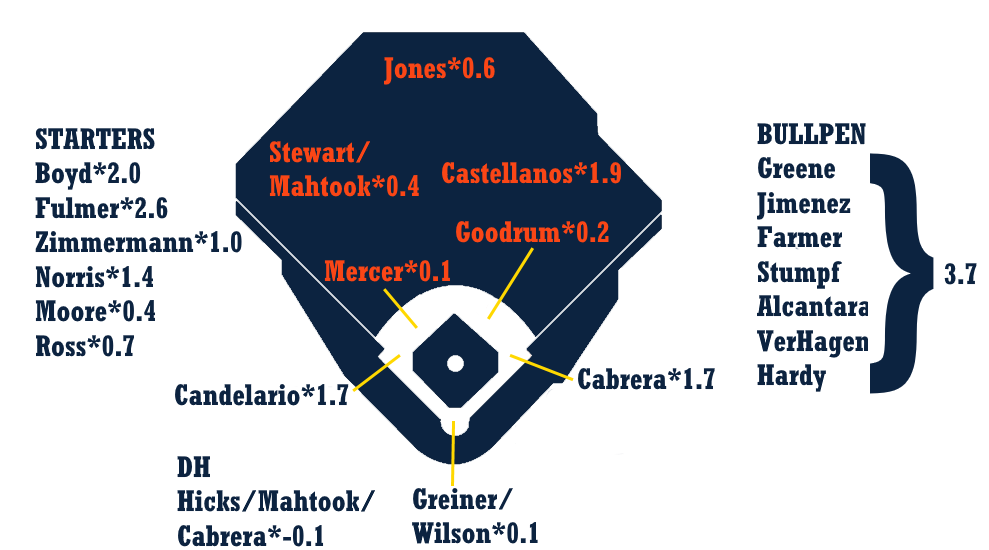
One pedantic note for 2019: for the WAR graphic, I’m using FanGraphs’ depth chart playing time, not the playing time ZiPS spits out, so there will be occasional differences in WAR totals.

Ballpark graphic courtesy Eephus League. Depth charts constructed by way of those listed here at site.

Batters – Counting Stats
Player B Age PO G AB R H 2B 3B HR RBI BB SO SB CS
Nicholas Castellanos R 27 RF 156 596 72 165 38 6 27 91 45 151 2 3
Jeimer Candelario B 25 3B 146 540 72 127 33 3 17 62 59 151 2 1
Miguel Cabrera R 36 1B 106 389 47 107 20 1 15 58 52 86 0 1
Jose Iglesias R 29 SS 131 458 50 121 27 2 5 42 22 53 12 6
Jake Rogers R 24 C 99 372 44 74 15 2 12 43 32 126 6 4
JaCoby Jones R 27 CF 128 451 53 93 20 4 12 43 30 165 14 5
Christin Stewart L 25 LF 135 500 68 116 23 3 23 76 55 151 1 1
Kaleb Cowart B 27 3B 128 438 51 100 25 3 10 49 34 118 11 3
Ronny Rodriguez R 27 SS 124 467 52 118 21 3 14 55 18 101 8 6
Gordon Beckham R 32 2B 114 371 41 87 18 1 7 37 31 63 3 2
John Hicks R 29 C 94 323 37 77 15 1 9 36 19 90 3 2
Grayson Greiner R 26 C 86 296 30 61 13 1 7 31 28 92 0 0
Niko Goodrum B 27 2B 123 435 52 100 22 3 14 50 36 135 12 5
Willi Castro B 22 SS 134 524 58 126 24 3 10 45 26 126 16 7
Jordy Mercer R 32 SS 126 432 45 105 21 2 8 45 37 87 2 1
Hector Sanchez B 29 C 55 152 18 36 8 0 6 23 10 38 0 0
Mikie Mahtook R 29 LF 128 445 52 102 19 5 14 52 30 125 7 3
Dustin Peterson R 24 LF 115 440 47 100 24 1 10 46 31 116 2 1
Kade Scivicque R 26 C 89 329 33 75 13 1 6 29 18 73 0 0
Brandon Dixon R 27 1B 121 391 45 88 20 2 14 47 23 137 10 4
Edwin Espinal R 25 1B 115 416 42 100 19 0 8 41 27 82 0 0
Chad Huffman R 34 1B 93 309 39 68 15 2 11 36 29 86 2 1
Bobby Wilson R 36 C 63 189 17 36 7 0 4 20 13 54 0 0
Jacob Robson L 24 CF 116 460 54 104 21 3 9 42 45 147 12 8
Kody Eaves L 25 3B 103 372 39 74 16 3 8 35 31 121 5 4
Jason Krizan L 30 2B 112 410 45 97 19 2 8 41 36 68 4 3
Dawel Lugo R 24 2B 148 593 60 148 26 4 8 54 18 88 7 3
Harold Castro L 25 3B 116 413 38 100 14 2 3 27 10 80 8 6
Pete Kozma R 31 SS 126 347 32 67 16 1 2 23 19 79 6 3
Victor Martinez B 40 DH 111 399 29 100 16 0 7 45 28 50 0 0
Troy Montgomery L 24 CF 102 368 41 79 12 3 5 29 41 106 10 8
Daz Cameron R 22 CF 129 498 56 110 23 6 9 48 38 152 20 13
Sergio Alcantara B 22 SS 126 486 46 111 16 3 2 29 34 108 9 8
Cam Gibson L 25 LF 112 404 44 78 12 4 10 38 35 133 13 8
Josh Lester L 24 1B 121 462 51 100 22 3 14 53 35 131 2 1
Jarrod Saltalamacchia B 34 C 71 210 20 32 7 1 6 21 24 91 1 0
Victor Reyes L 24 LF 133 416 51 101 15 5 3 30 16 89 14 5
Brady Policelli R 24 C 98 358 34 71 16 3 7 30 22 100 12 9
Derek Hill R 23 CF 100 352 33 66 9 3 4 25 27 125 24 12
Daniel Woodrow L 24 RF 96 371 36 86 13 2 2 25 24 93 15 10
Will Maddox L 27 2B 108 430 40 101 14 2 3 30 19 93 8 8

Batters – Rate Stats
Player BA OBP SLG OPS+ ISO BABIP RC/27 Def WAR No. 1 Comp
Nicholas Castellanos .277 .330 .497 120 .220 .330 6.0 -9 1.9 Mike Brown
Jeimer Candelario .235 .315 .402 93 .167 .296 4.5 2 1.7 Kory Casto
Miguel Cabrera .275 .361 .447 118 .172 .319 6.0 0 1.5 Pedro Guerrero
Jose Iglesias .264 .305 .365 81 .100 .290 4.1 5 1.3 Gary DiSarcina
Jake Rogers .199 .269 .347 65 .148 .265 3.1 8 0.7 Danny Ardoin
JaCoby Jones .206 .265 .348 64 .142 .296 3.2 10 0.5 Jason Robertson
Christin Stewart .232 .314 .428 98 .196 .285 4.7 -5 0.5 Kevin Barker
Kaleb Cowart .228 .285 .368 75 .139 .290 3.8 3 0.5 Mike Turgeon
Ronny Rodriguez .253 .281 .400 82 .148 .295 4.0 -3 0.4 Ronny Cedeno
Gordon Beckham .235 .298 .345 74 .111 .266 3.6 3 0.4 Mike Bordick
John Hicks .238 .281 .375 76 .136 .304 3.7 -1 0.3 Damian Miller
Grayson Greiner .206 .274 .328 63 .122 .274 3.1 4 0.3 Matt Garrick
Niko Goodrum .230 .292 .391 83 .161 .301 4.0 -5 0.2 Sean Berry
Willi Castro .240 .281 .355 71 .115 .299 3.6 0 0.2 Greg Gagne
Jordy Mercer .243 .307 .356 80 .113 .288 3.9 -3 0.1 Charlie Hayes
Hector Sanchez .237 .287 .408 85 .171 .278 4.1 -3 0.1 Joe Oliver
Mikie Mahtook .229 .287 .389 81 .160 .288 3.9 2 0.0 Nick Gorneault
Dustin Peterson .227 .284 .355 72 .127 .287 3.5 6 -0.1 Ken Weislak
Kade Scivicque .228 .275 .328 63 .100 .276 3.2 0 -0.2 Gary Bennett
Brandon Dixon .225 .271 .394 77 .169 .308 3.8 4 -0.2 Pat Rooney
Edwin Espinal .240 .289 .344 71 .103 .282 3.5 7 -0.3 Jeremy West
Chad Huffman .220 .302 .388 85 .168 .269 4.1 -4 -0.4 Reed Secrist
Bobby Wilson .190 .244 .291 44 .101 .244 2.4 1 -0.4 Tony Pena
Jacob Robson .226 .296 .343 73 .117 .313 3.5 -5 -0.5 Andy Tomberlin
Kody Eaves .199 .263 .323 58 .124 .272 2.8 4 -0.5 Jim Mason
Jason Krizan .237 .296 .351 75 .115 .266 3.6 -7 -0.5 Chuck Hiller
Dawel Lugo .250 .273 .347 67 .098 .282 3.4 -1 -0.6 Steven Singleton
Harold Castro .242 .261 .308 54 .065 .294 2.8 6 -0.7 Scott Candelaria
Pete Kozma .193 .240 .262 36 .069 .244 2.1 8 -0.7 Ray Oyler
Victor Martinez .251 .302 .343 75 .093 .272 3.7 0 -0.7 Ray Knight
Troy Montgomery .215 .295 .304 64 .090 .288 2.9 -2 -0.7 Mark Budzinski
Daz Cameron .221 .284 .345 70 .124 .300 3.3 -5 -0.8 Michael Saunders
Sergio Alcantara .228 .279 .286 54 .058 .290 2.6 2 -0.8 Eddy Martinez
Cam Gibson .193 .262 .317 56 .124 .261 2.7 7 -0.9 Duane Singleton
Josh Lester .216 .273 .368 72 .152 .271 3.5 2 -0.9 Kevin Reimer
Jarrod Saltalamacchia .152 .241 .281 41 .129 .230 2.2 -4 -1.0 George Mitterwald
Victor Reyes .243 .272 .325 61 .082 .302 3.2 1 -1.2 Nathan Haynes
Brady Policelli .198 .252 .318 53 .120 .255 2.5 -5 -1.2 Jon Aceves
Derek Hill .188 .250 .264 40 .077 .278 2.2 1 -1.4 Yuber Rodriguez
Daniel Woodrow .232 .279 .294 56 .062 .304 2.7 1 -1.5 Brent Bish
Will Maddox .235 .270 .298 54 .063 .293 2.6 -6 -1.9 Freddie Benavides

Pitchers – Counting Stats
Player T Age W L ERA G GS IP H ER HR BB SO
Michael Fulmer R 26 9 8 4.04 26 26 142.7 140 64 17 41 113
Matt Boyd L 28 10 10 4.47 30 30 159.0 160 79 23 50 136
Blaine Hardy L 32 5 4 3.84 42 11 84.3 85 36 9 23 66
Daniel Norris L 26 7 6 4.40 24 21 106.3 108 52 13 45 99
Drew VerHagen R 28 6 5 4.24 47 11 93.3 93 44 10 35 76
Joe Jimenez R 24 5 3 3.50 68 0 61.7 54 24 5 23 70
Spencer Turnbull R 26 7 7 4.77 25 24 117.0 121 62 13 55 90
Matt Manning R 21 7 7 4.66 22 22 102.3 100 53 10 64 92
Matt Hall L 25 6 6 4.75 36 17 115.7 118 61 14 57 99
Tyson Ross R 32 7 7 4.68 25 20 117.3 121 61 13 53 88
Jordan Zimmermann R 33 7 8 4.83 24 24 126.7 142 68 22 29 92
Beau Burrows R 22 8 10 5.02 26 26 123.7 134 69 17 57 91
Tyler Alexander L 24 7 8 5.07 26 24 138.3 169 78 24 24 74
Alex Wilson R 32 3 2 3.88 57 0 58.0 59 25 6 14 37
Shane Greene R 30 5 4 4.09 64 0 61.7 59 28 7 22 59
Matt Moore L 30 7 8 5.06 33 19 126.3 139 71 19 47 99
Warwick Saupold R 29 5 5 4.79 42 9 88.3 99 47 10 36 54
Louis Coleman R 33 3 2 4.14 54 0 54.3 53 25 5 26 46
Zac Reininger R 26 3 3 4.33 55 0 70.7 74 34 8 25 53
Zac Houston R 24 1 1 4.15 44 0 52.0 43 24 5 32 62
Gregory Soto L 24 7 8 5.18 24 23 104.3 106 60 7 85 78
John Schreiber R 25 5 4 4.19 46 0 53.7 53 25 6 20 43
Joe Navilhon R 25 5 4 4.31 35 1 54.3 56 26 8 14 46
Anthony Castro R 24 6 8 5.21 24 22 112.3 126 65 12 61 65
Francisco Liriano L 35 7 9 5.06 26 23 121.0 125 68 18 61 102
Alex Faedo R 23 7 8 5.23 24 24 108.3 127 63 18 40 71
Buck Farmer R 28 4 4 4.50 70 1 72.0 73 36 9 34 60
Victor Alcantara R 26 4 4 4.56 56 1 75.0 79 38 8 33 53
Kyle Funkhouser R 25 4 6 5.16 18 18 83.7 90 48 12 45 66
Caleb Thielbar L 32 4 3 4.20 37 0 45.0 48 21 5 12 30
Logan Shore R 24 4 5 5.20 18 18 88.3 104 51 15 23 52
Daniel Stumpf L 28 3 3 4.35 62 0 51.7 53 25 7 18 46
Kevin Comer R 26 3 3 4.58 47 1 57.0 59 29 7 26 48
Reed Garrett R 26 3 3 4.50 46 0 50.0 52 25 5 24 40
A.J. Ladwig R 26 7 10 5.43 25 23 126.0 158 76 23 24 66
Eduardo Jimenez R 24 3 3 4.64 41 0 52.3 55 27 5 25 36
Nick Ramirez L 29 6 7 4.66 43 1 65.7 71 34 6 33 40
Eduardo Paredes R 24 1 1 4.76 54 0 64.3 67 34 8 28 49
Kevin Chapman L 31 2 2 4.69 35 0 40.3 41 21 4 22 35
Franklin Perez R 21 3 4 5.37 14 13 53.7 61 32 8 25 33
Chris S. Smith R 30 3 4 4.86 44 0 50.0 53 27 9 18 44
Johnny Barbato R 26 2 2 5.02 44 2 52.0 56 29 8 24 42
Josh Smoker L 30 2 3 4.89 53 0 57.0 61 31 9 25 51
Jacob Turner R 28 4 6 5.38 30 16 102.0 119 61 15 42 59
Christian Binford R 26 5 7 5.62 22 16 107.3 132 67 20 28 58
Kurt Spomer R 29 2 3 5.36 38 0 45.3 53 27 6 19 22
Paul Voelker R 26 4 5 5.52 44 1 58.7 65 36 11 25 45
Jose Manuel Fernandez L 26 3 4 5.52 55 0 62.0 64 38 9 40 50
Ryan Carpenter L 28 6 9 5.73 23 21 113.0 135 72 25 31 83
Nick Tepesch R 30 4 6 6.10 21 16 90.0 112 61 18 31 41
Phillippe Aumont R 30 2 4 6.44 26 5 50.3 55 36 11 36 43
Spenser Watkins R 26 6 9 6.19 24 17 104.7 126 72 20 51 62
Sandy Baez R 25 4 7 6.50 34 16 101.0 122 73 23 50 67

Pitchers – Rate Stats
Player TBF K/9 BB/9 HR/9 BABIP ERA+ ERA- FIP WAR No. 1 Comp
Michael Fulmer 605 7.13 2.59 1.07 .288 105 95 4.12 2.1 Chien-Ming Wang
Matt Boyd 683 7.70 2.83 1.30 .294 98 102 4.41 1.9 Chris Hammond
Blaine Hardy 357 7.04 2.45 0.96 .296 114 88 3.86 1.5 Lee Guetterman
Daniel Norris 469 8.38 3.81 1.10 .308 100 100 4.26 1.3 Brandon Claussen
Drew VerHagen 405 7.33 3.38 0.96 .296 103 97 4.17 1.2 Greg Booker
Joe Jimenez 261 10.22 3.36 0.73 .306 125 80 3.20 1.1 Josh Wahpepah
Spencer Turnbull 525 6.92 4.23 1.00 .300 92 109 4.65 1.1 Jaime Cocanower
Matt Manning 471 8.09 5.63 0.88 .302 94 106 4.70 1.1 Dick Ruthven
Matt Hall 521 7.70 4.44 1.09 .302 92 108 4.67 1.0 Bryan Clark
Tyson Ross 524 6.75 4.07 1.00 .298 91 110 4.62 0.9 Ray Moore
Jordan Zimmermann 545 6.54 2.06 1.56 .302 88 114 4.74 0.8 Mickey Weston
Beau Burrows 559 6.62 4.15 1.24 .302 87 115 5.02 0.8 Justin Sturge
Tyler Alexander 603 4.81 1.56 1.56 .306 86 116 5.01 0.8 Bobby Livingston
Alex Wilson 244 5.74 2.17 0.93 .286 113 89 4.05 0.8 Jim Brosnan
Shane Greene 265 8.61 3.21 1.02 .299 107 93 3.93 0.7 Chad Paronto
Matt Moore 560 7.05 3.35 1.35 .308 87 115 4.77 0.6 Jeff Musselman
Warwick Saupold 399 5.50 3.67 1.02 .304 91 109 4.83 0.6 Ed Klieman
Louis Coleman 242 7.62 4.31 0.83 .298 106 95 4.31 0.5 Ted Abernathy
Zac Reininger 308 6.75 3.18 1.02 .300 101 99 4.27 0.5 Jack Cassel
Zac Houston 232 10.73 5.54 0.87 .295 105 95 4.09 0.5 Brad Voyles
Gregory Soto 503 6.73 7.33 0.60 .304 85 118 5.17 0.5 Derek Thompson
John Schreiber 233 7.21 3.35 1.01 .292 105 96 4.29 0.5 Willie Mueller
Joe Navilhon 232 7.62 2.32 1.33 .298 102 98 4.31 0.5 John Doherty
Anthony Castro 522 5.21 4.89 0.96 .302 84 119 5.20 0.5 Rick Berg
Francisco Liriano 545 7.59 4.54 1.34 .298 84 119 5.03 0.5 Tommy Byrne
Alex Faedo 489 5.90 3.32 1.50 .308 84 119 5.27 0.4 Zach McClellan
Buck Farmer 321 7.50 4.25 1.13 .298 97 103 4.65 0.4 Joe Hudson
Victor Alcantara 335 6.36 3.96 0.96 .300 96 104 4.60 0.4 Hal Reniff
Kyle Funkhouser 385 7.10 4.84 1.29 .304 85 118 5.23 0.4 Rick Berg
Caleb Thielbar 193 6.00 2.40 1.00 .299 104 96 4.19 0.4 Erasmo Ramirez
Logan Shore 390 5.30 2.34 1.53 .302 84 119 5.13 0.4 Nate Cornejo
Daniel Stumpf 224 8.01 3.14 1.22 .305 101 99 4.29 0.4 John Cummings
Kevin Comer 255 7.58 4.11 1.11 .304 96 105 4.59 0.3 Mike Gardner
Reed Garrett 225 7.20 4.32 0.90 .307 94 106 4.47 0.3 Joe Hudson
A.J. Ladwig 557 4.71 1.71 1.64 .310 81 124 5.24 0.2 Heath Totten
Eduardo Jimenez 236 6.19 4.30 0.86 .299 94 106 4.62 0.2 Gary Ross
Nick Ramirez 300 5.48 4.52 0.82 .300 91 110 4.81 0.2 Jim Roland
Eduardo Paredes 287 6.85 3.92 1.12 .298 92 109 4.74 0.2 Joe Davenport
Kevin Chapman 183 7.81 4.91 0.89 .308 93 107 4.49 0.1 Randy Choate
Franklin Perez 246 5.53 4.19 1.34 .299 82 122 5.42 0.1 Jesus Silva
Chris S. Smith 220 7.92 3.24 1.62 .301 90 111 4.99 0.1 Steve Mintz
Johnny Barbato 235 7.27 4.15 1.38 .304 87 115 5.09 0.1 Casey Daigle
Josh Smoker 256 8.05 3.95 1.42 .310 87 115 4.89 0.0 Carmen Cali
Jacob Turner 464 5.21 3.71 1.32 .303 79 127 5.29 0.0 Galen Cisco
Christian Binford 479 4.86 2.35 1.68 .305 78 128 5.44 -0.1 Bill King
Kurt Spomer 207 4.37 3.77 1.19 .299 82 122 5.36 -0.2 Gary Wagner
Paul Voelker 265 6.90 3.84 1.69 .298 79 126 5.49 -0.3 Richie Barker
Jose Manuel Fernandez 288 7.26 5.81 1.31 .296 79 126 5.50 -0.4 Dean Brueggemann
Ryan Carpenter 502 6.61 2.47 1.99 .308 74 135 5.54 -0.4 Scott Downs
Nick Tepesch 410 4.10 3.10 1.80 .298 72 139 6.04 -0.5 Jason Roach
Phillippe Aumont 241 7.69 6.44 1.97 .297 66 152 6.61 -0.7 Chris Hook
Spenser Watkins 489 5.33 4.39 1.72 .304 71 141 6.11 -0.7 Mark Woodyard
Sandy Baez 474 5.97 4.46 2.05 .303 67 148 6.48 -1.1 R.A. Dickey

Disclaimer: ZiPS projections are computer-based projections of performance. Performances have not been allocated to predicted playing time in the majors — many of the players listed above are unlikely to play in the majors at all in 2019. ZiPS is projecting equivalent production — a .240 ZiPS projection may end up being .280 in AAA or .300 in AA, for example. Whether or not a player will play is one of many non-statistical factors one has to take into account when predicting the future.

Players are listed with their most recent teams, unless I have made a mistake. This is very possible, as a lot of minor-league signings go generally unreported in the offseason.

ZiPS’ projections are based on the American League having a 4.29 ERA and the National League having a 4.15 ERA.

Players who are expected to be out due to injury are still projected. More information is always better than less information, and a computer isn’t the tool that should project the injury status of, for example, a pitcher who has had Tommy John surgery.

Both hitters and pitchers are ranked by projected zWAR — which is to say, WAR values as calculated by me, Dan Szymborski, whose surname is spelled with a z. WAR values might differ slightly from those which appear in full release of ZiPS. Finally, I will advise anyone against — and might karate chop anyone guilty of — merely adding up WAR totals on a depth chart to produce projected team WAR.


New York and Cleveland Pay for Some of What They Need

Last Friday afternoon, Ken Rosenthal of the Athletic reported that the Mets were in agreement with 31-year-old lefty Justin Wilson, lately of the Cubs, on a two-year deal later reported to be approximately $10 million over the life of the contract. A few minutes later, the Indians announced that they’d re-signed a lefty of their own — 37-year-old Óliver Pérez — to a one-year contract worth $2.5 million, with a 2020 option worth $2.75 million that will vest if he reaches 55 appearances in 2019. With Pérez and Wilson under contract for 2019, the lefty relief market is down to Jake Diekman and a handful of folks projected for zero WAR in 2019. Let’s talk about the two that signed this week, and what we can expect from them.

Wilson is probably the higher-upside of the two, though bouts of inconsistency mean he’s not a lock to repeat the .188/.301/.342 line he held lefties to in 2018. A strong start to the 2017 season, in which he threw 40 innings for the Tigers, striking out 55 and walking just 16, led to a mid-season trade to a Cubs team hunting for a second straight division title. They didn’t quite get what they were after: Wilson walked 19 in just under 18 innings of work, struck out just 25, and visibly lost manager Joe Maddon’s confidence down the stretch — after a three-run, two-walk, one-out appearance on September 2nd, Wilson appeared just once again for the next 10 days, and was entrusted with just 5.1 more innings the rest of the season. Wilson’s wild ways continued into the early part of 2018 but seemed to improve as the season wore on, and he finished the year with a 3.41 full-season ERA, even as his Cubs mark (5.09) fell well below his then-career 3.30.

Wilson has always been a pitcher the spin rate guys love — see his acquisition by Chicago in mid-2017, for example — and nothing in his recent performance suggests the raw stuff that’s so impressed scouts and spreadsheet-wranglers alike has gone anywhere. He has, if anything, become even more reliant on his four-seam fastball than ever (he threw it nearly three-quarters of the time in 2018, mostly at the expense of his sinker) and given its 82nd-percentile spin rate that seems as reasonable a strategy as any. Batters were slightly more successful against that pitch in 2018 than they were in previous years (familiarity breeds contempt, I suppose) but much less successful against Wilson’s breaking pitches than before, suggesting a successful ability to pick his spots and disrupt timing effectively.

In New York, Wilson will join new acquisition Edwin Díaz, a re-signed Jeurys Familia, and holdovers Robert Gsellman, Seth Lugo, and Drew Smith for what should be a vastly improved Mets ‘pen. The Mets were fairly terrible in relief in 2018 — their 4.96 ERA was second only to the Marlins for worst in the National League, and their FIP was worst outright — and they were heavily right-handed, getting just 62.1 inning out of southpaws in 2018, 42.2 of which came from the departing Jerry Blevins. Whatever else can be said about Justin Wilson, I think we can fairly say he is a better relief pitcher than Jerry Blevins, and his addition will give Mickey Callaway a strong seventh-inning option before heading to Familia in the eighth and Díaz in the ninth.

Pérez, meanwhile, is back in business after it appeared, even just a year ago, that his big-league career might be over. He started 2018 on a minor-league deal with the Yankees, showed enough to sign on with Cleveland on a big-league deal after a June 1 release from Scranton, and promptly posted a 36% strikeout rate and 1.39 ERA over 32 innings for Terry Francona’s squad. Most impressively, after spending a career mostly more effective against lefties than against righties, Pérez absolutely dominated right-handed hitters in 2018, holding them to a minuscule .138 wOBA (lefties posted a .213 mark). It’s hard to say precisely what changed for Pérez, but my money would be on his increased use of a newly-improved slider (up to 49 percent usage after sitting in the low 40s for most of his career) and a move away from a fading fastball.

If Wilson is a sensible move in the middle of a somewhat puzzling offseason for the Mets, Pérez is a sensible move in the middle of a straightforward, if disappointingly stingy, offseason for Cleveland. The bullpen could certainly use some help — it was nearly as bad as the Mets’ last year — but Pérez will at best help the ‘pen stand pat in 2019 rather than move forward, and he is (somewhat incredibly) the first major-league free agent acquisition of the offseason for Mike Chernoff. Ideally, we’d see Cleveland pick up a few more relievers off the market — all they cost is money — and perhaps spin off some of the leftover pieces for replacements for the departing Michael Brantley and the traded Edwin Encarnación and Yan Gomes. The plan instead seems to be to reduce payroll while hoping the departures don’t weaken the team enough to fall behind the rest of the Central. That isn’t likely, but seize the moment this approach is not.

Still, Pérez is a good pitcher and Cleveland needs a few of those. He had a terrific season in 2018 and there is reason to believe, despite his 16 seasons in the major leagues, that he has more left in the tank. He’ll be best served if the front office goes out and gets more arms to take some of the strain off of, say, him and Brad Hand, but if he pitches like he did last year, he’ll be useful anyway. Wilson, too, will probably be in the best position to succeed if the Mets go out and find another lefty reliever to take some of the load off (Diekman is of course still available) but has enough of an ability to get righties out that he should be a contributor. In an offseason that has been remarkably bereft of teams going out and getting players they need by paying money for their services, Cleveland and New York have done just that, even if these signings would ideally be part of a larger plan to spend money on good players at positions of need.