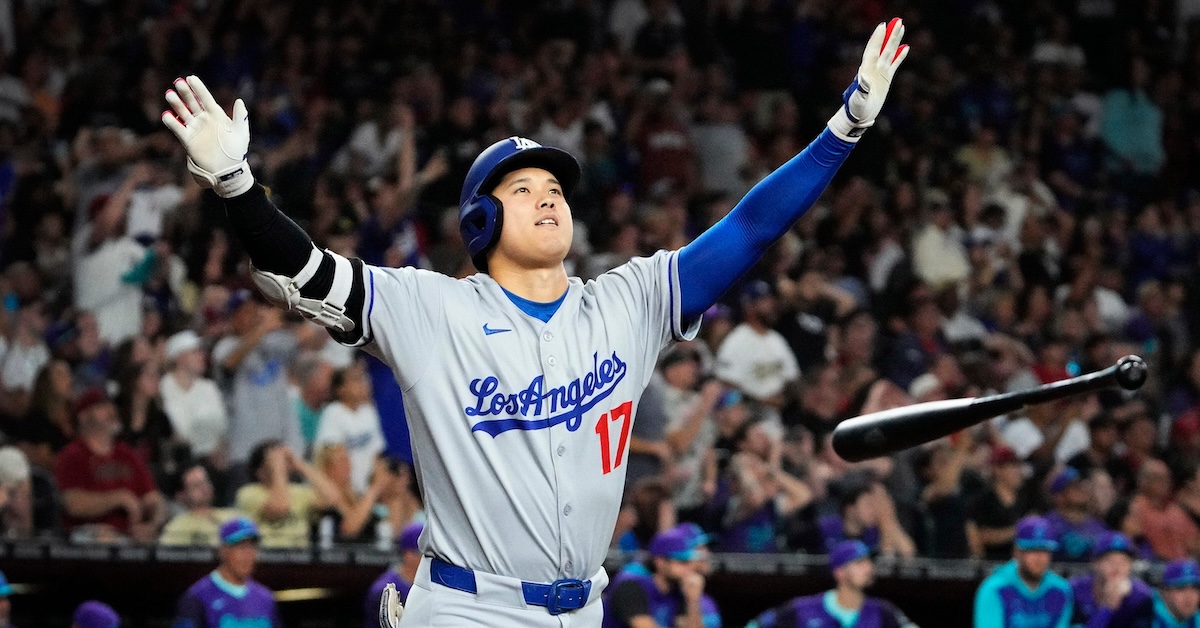
Shutting down the Dodgers offense has been one of the toughest assignments in baseball this October. A series of great opposing pitchers, including Cy Young candidates aplenty, surrendered 27 runs in their first four playoff games. Sure, the Los Angeles pitching has been great too, but you can score on the Dodgers. The difficulty has been with stopping their unending procession of base-clearing prowess.
The Phillies seemed to be well suited to stopping the Dodgers, but that was before Los Angeles won the first two games in Philadelphia. Even worse, the Dodgers sent ace Yoshinobu Yamamoto to the mound, so limiting the offense figured to be even more important than normal. That’s too much work for one starter, so Rob Thomson turned to Aaron Nola and Ranger Suárez looking for a tandem performance. As it turned out, that decision was inspired. Along with two Schwarbombs, the Nola-Suárez piggyback propelled the Phillies to an 8-2 win at Dodger Stadium and postponed elimination for at least one more night.
Nola has had a rough year. He missed three months with injury, and looked much diminished when he did pitch en route to posting the worst single-season ERA (6.01) and FIP (4.58) marks of his long, decorated career. He wasn’t in this game for a long time, but he was in it for a good time. He came out absolutely jacked, with his velocity up two to three ticks and a snapping knuckle-curveball that hearkened back to his form of a few years ago. It didn’t click right away – Shohei Ohtani scorched a line drive for an out and then Mookie Betts tripled – but Nola buckled down, blew away Teoscar Hernández with a beautiful curve, and escaped the inning unscathed. He kept it going through a perfect second, perhaps as far as he was ever expected to go. Read the rest of this entry »
NEW YORK — Ernie Clement simply wore out Yankees pitchers during the Division Series. After collecting three hits in Game 2 — including a two-run homer off Max Fried that opened the scoring — in a Blue Jays win, then four more hits in their Game 3 defeat, the 29-year-old infielder sparked rallies in Game 4 with a pair of singles that led to the go-ahead run in the fifth inning and then two more runs in the seventh, helping Toronto break the game open. Backed by opener Louis Varland and seven other relievers who combined to hold the Yankees to six hits and two runs, the Blue Jays bounced their AL East rivals with a 5-2 victory in Game 4.
While Vladimir Guerrero Jr. (.529/.550/1.059) and Daulton Varsho (.438/.471/1.000) were the Blue Jays’ heaviest hitters in the series, combining for five homers and 13 RBI, Clement — who spent time at all four infield positions this year and started games at both second and third base in this series — hit .643/.625/.929 himself while scoring and driving in five runs apiece. Though he showed a wide platoon split during the regular season, producing a 146 wRC+ (.326/.351/.549) against lefties and 75 wRC+ (.254/.295/.327) against righties, both of his Game 4 singles were off fireballing righty Cam Schlittler, who was very good if not nearly as dominant as he had been against the Red Sox in the Wild Card Series finale.
“I think Ernie Clement has made everyone aware of how good he is,” said manager John Schneider after the game. “It’s been like that the whole year for the bottom part of our lineup. You try to navigate it to where guys can put the ball in play, guys can get on base for guys at the top. Read the rest of this entry »
The Cubs stayed alive in the National League Division Series on Wednesday, narrowly beating the Brewers in a 4-3 Game 3 squeaker. Neither starting pitcher went long, with both teams needing to go relatively deep into their bullpens to finish out the contest; a combined 10 relievers were used.
Carlos Zambrano threw out the ceremonial first pitch, 13 years after his final game in the majors — Big Z’s former teammate, Rich Hill, appeared for the Royals in 2025 and is older than him — but things got off to an inauspicious start for the Cubs after that, as a lazy curve from starter Jameson Taillon was far less lazily lashed down the first base line into right field for a Christian Yelich double. After a Jackson Chourio groundout, Taillon lost the strike zone a bit, walking Brice Turang to put runners on first and second for William Contreras. Contreras hit an infield single to load the bases. Of course, that’s burying the lede a bit, but you couldn’t see that I was making the air quotes gesture with my fingers while I was writing that sentence. The “infield single” was anything but; it was a popup on the infield that Michael Busch lost in the sun while his sunglasses remained unused on his cap. Both Carson Kelly and Nico Hoerner ran over, but they weren’t in time to salvage the play. Dansby Swanson ran over as well, which became a problem when Kelly picked up the ball but had nobody to actually throw to for an attempted forceout of Turang. Read the rest of this entry »
Maybe the three runs the Tigers scored in the ninth inning of their Game 3 blowout loss weren’t so inconsequential after all. Maybe they were a sign of better things to come on Wednesday. Facing elimination, Detroit’s bats woke up in a big way in Game 4 en route to a 9-3 victory. That sends the American League Division Series back to Seattle on Friday for a decisive Game 5, allowing Tarik Skubal one more chance to beat the Mariners for good.
Consider this: Through the first three games of the ALDS, the Mariners had hit more home runs than the Tigers had extra-base hits. Kerry Carpenter hit a home run in Game 1, the team’s lone long ball to that point, and Spencer Torkelson and Gleyber Torres each had a pair of doubles, but that was it. Granted, three of those extra-base hits drove in runs, and two of them tied the game — the Tigers made the most of their limited opportunities — but Seattle had been absolutely outslugging Detroit:
Tigers Hitters, Through ALDS Game 3
Player
H
RBI
WPA
wOBA
xwOBA
wRC+
Gleyber Torres
4
0
0.03
0.382
0.372
147
Spencer Torkelson
2
4
0.39
0.299
0.337
90
Colt Keith
1
0
-0.05
0.225
0.370
39
Kerry Carpenter
1
3
0.00
0.210
0.405
29
Riley Greene
2
0
-0.15
0.147
0.117
-14
Zach McKinstry
1
1
0.10
0.131
0.145
-25
Indeed, outside of Carpenter’s clutch home run, a pair of two-run doubles from Torkelson, and four hits off the bat of Torres, the Tigers offense had been conspicuously absent during the series. Even after their mini-rally in the ninth on Tuesday, Detroit was batting .165 and slugging .233 as a team entering Game 4. On the other hand, Seattle was slugging .423 even while batting just .212 through three games. That narrative completely flipped on Wednesday. The Tigers collected seven extra-base hits (three home runs and four doubles), while the Mariners could only muster one. Torkelson, Torres, Zach McKinstry, and Javier Báez each had multiple hits, and Jahmai Jones had a huge pinch-hit double in the decisive fifth inning.
And as they have all series long, home runs defined the shape of Game 4. Riley Greene had been mostly bottled up during the ALDS; he had collected just two hits through the first three games of the series. His first extra-base hit against Seattle was a 454-foot blast to give the Tigers a 4-3 lead in the sixth inning. After hitting 36 homers during the regular season, his go-ahead home run was the first of his postseason career and broke open the floodgates for the Tigers. For his part, Báez hit his first postseason home run since the 2017 NLCS, a two-run shot, later in the inning. Then in the seventh, Torres continued his hot hitting by launching an opposite field solo shot to extend the Tigers’ lead, making it 8-3.
The game hadn’t started off so lopsided. As they have in each game of the series, the Mariners got on the board first, scoring a run in each of the second, fourth, and fifth innings. With a 3-0 lead halfway through the ballgame, things were looking pretty encouraging for the Mariners. They’ll likely look back on Wednesday and be haunted by some pretty big missed opportunities to put the game away early. In the fourth, Seattle loaded the bases with no outs, but wound up pushing just one run across after a double play and a pop out squelched the threat. The next inning, the first two batters reached, earning the team another run, but the Mariners couldn’t keep the rally going.
Things turned in the bottom half of that inning. Torkelson led off with a single, and after a fielder’s choice, Dillon Dingler drove in the Tigers’ first run with a double. That chased Bryce Miller from the game, and Mariners manager Dan Wilson went with trustworthy lefty Gabe Speier to face the bottom of Detroit’s lineup. Jones, pinch-hitting for Parker Meadows, ripped the first pitch he saw down the left field line to drive in Dingler, and Báez tied the game with a single up the middle in the next at-bat. Speier came back out in the sixth inning to face Greene, but the Tigers left fielder turned on a hanging slider and deposited it in the right field stands. From there, the flood gates opened. The Tigers scored three more in the sixth, capped off by Báez’s home run off Eduard Bazardo, and they added insurance runs in the seventh and eighth.
For Seattle, it’s a pretty concerning shift from what had been a fairly dominant bullpen through three games. Even when you include the three runs allowed by Caleb Ferguson in the ninth inning of Game 3, Mariners relievers had put up a 3.38 ERA and a 1.71 FIP in 13.1 innings during the ALDS — their ERA drops to 1.35 if you ignore those garbage time runs. The Tigers have also scored all of their runs in this series in the fifth inning or later, putting even more pressure on the Mariners’ relief corps.
The runs Speier and Bazardo allowed in Game 4 were their first of the series, and you have to wonder if familiarity is starting to work against Seattle’s ‘pen. Bazardo has appeared in all four games, while Speier has now gotten some high-leverage work in three of the four games, including facing Carpenter and Greene three times apiece. Because Detroit’s most dangerous hitters are left-handed, Speier will almost certainly be called on to work in Game 5 on Friday, and thanks to Ferguson’s struggles on Tuesday — he’s the only other lefty in Seattle’s bullpen — Speier seems like the most critical piece of the pitching puzzle for Wilson and the Mariners.
The Tigers turned to Game 1 starter Troy Melton to shut down the Mariners bats once they had tied it up in the fifth. Melton worked around some trouble in the sixth, getting Randy Arozarena to fly out to center after allowing two two-out baserunners. The right-hander carved through the heart of the Mariners order on seven pitches in the seventh, then erased a leadoff baserunner in the eighth with a made-to-order double play, again only needing seven pitches to set the M’s down in order; he has to have Tigers manager A.J. Hinch feeling really good should the team need a fireman to quell a late rally from the Mariners on Friday. Will Vest closed the door with a 1-2-3 ninth.
While Detroit’s starter for the decisive Game 5 isn’t in question, Seattle’s is still unsettled. Both George Kirby and Luis Castillo could start Friday’s game on normal rest, and both looked pretty good in their earlier starts this series. Ultimately, it’ll come down to who Wilson trusts more to work through the Tigers’ lineup twice, with whoever doesn’t make the start likely available out of the bullpen anyway. I should mention that between the two, Kirby is the only one who has made a relief appearance during his big league career, closing out Game 2 of the 2022 Wild Card series against the Blue Jays.
No matter who starts for the Mariners on Friday, this was the exact scenario they were hoping to avoid. Allowing Skubal two opportunities to affect the outcome of the series is a very dangerous proposition, even if Seattle has beaten him three times this year. Tempting fate a fourth time tips the scales toward Detroit; our ZiPS game-by-game odds currently give the Tigers a 54% chance of advancing to the ALCS (assuming a Kirby start for Seattle). That’s a percentage Mariners fans are well acquainted with.
NEW YORK — The ovation that Devin Williams received from the crowd of 47,399 at Yankee Stadium as he departed in the eighth inning on Tuesday night after recording five crucial outs — his longest outing in more than two years — did not go unnoticed. “It’s nice to feel appreciated sometimes. It was definitely a lot better than what I’ve heard for much of the year,” said the 31-year-old righty in the wake of the Yankees’ dramatic 9-6 comeback victory over the Blue Jays in Game 3 of the American League Division Series. Acquired from Milwaukee last December, the two-time All-Star was supposed to serve as the closer of the defending AL champions, but early struggles bumped him out of that role, and he was booed vociferously. Over the past month, he’s tried to salvage his season, and with the Yankees in danger of being swept by their division rivals, he was one of five relievers who held the Blue Jays scoreless over the final 6 2/3 innings while the Bronx Bombers bashed out eight unanswered runs, six of them against Toronto’s bullpen.
When starter Carlos Rodón left Game 3 with one out in the third inning, the Yankees trailed 6-1 and appeared perilously close to being eliminated. They quickly clawed their way back against a wobbly Shane Bieber, however, chasing the Blue Jays’ starter with two outs in the third with the score 6-3. From there, a unit that was torched for 14 runs in 10 1/3 innings in Games 1 and 2 in Toronto won the battle of the bullpens. While Fernando Cruz, Camilo Doval, Tim Hill, Williams, and David Bednar quieted an offense that had been humming on all cylinders, four straight Blue Jays relievers allowed runs, with Louis Varland serving up both Aaron Judge’s game-tying three-run homer in the fourth inning and Jazz Chisholm Jr.’s go-ahead solo shot in the fifth. Now, while the Yankees will call upon Wild Card Series hero Cam Schlittler to start Thursday’s Game 4, the Blue Jays — gulp — counter with a bullpen game started by Varland, a development that could help send this series back to Toronto.
“That’s just what’s on the table,” said Williams of the bullpen’s collective mindset given the situation when Rodón departed. “We really don’t have any other option but to put up zeros and give our guys a chance to take the lead.” Read the rest of this entry »
The projection system OOPSY made its major league debut this year. So how did it do?
OOPSY’s methodology mirrors that of the other FanGraphs projection systems, with a few twists — most notably, the inclusion of bat speed for hitters and Stuff+ for pitchers. Projection systems are comprised of many different components, however, including aging curves, major league equivalencies to account for minor league and foreign league performance, recency weights, regression to the mean, league run environment, and park factors. There are many ways for projection systems to stand out or lag behind their peers beyond just the inclusion of a particular variable like bat speed. Projection systems are comprised of hundreds of small methodological decisions. Given the sum total of the decisions that went into OOPSY, did it hold its own in 2025 relative to its more established peers?
To review the projections, this article follows industry best practices as outlined by Tom Tango, MLBAM’s senior data architect. I have conducted this review process for pitchers before, as my pitching projections have been featured by Eno Sarris in The Athletic since 2023, but this was my first year publishing a full set of hitting projections. This review focuses on wOBA for hitters and wOBA against for pitchers (an alternative to ERA, further defined below). These metrics are typically the focus of projection system reviews, the most important hitting and pitching rate statistics for projection systems to get right from a “real-life” perspective. Both are catch-all rate statistics that measure, respectively, a player’s offensive and pitching value. The various component projections, e.g., K% and BB%, feed into these catch-all metrics. Read the rest of this entry »
NEW YORK — Aaron Judge didn’t deserve the rumblings. After he struck out with the bases loaded on Saturday in Game 1 of the ALDS against the Blue Jays, Yankee fans started to grumble that maybe he just didn’t have it in the postseason. It’s true that he’d struggled in 2020 and 2022, but Judge had excelled in the playoffs earlier in his career, and he came into Game 3 of the ALDS on Tuesday night with a career postseason wRC+ of 116. He hit three home runs during the Yankees’ World Series run just last year, including a game-tying shot in Game 3 of the ALCS.
On Tuesday night, with a performance that would be eye-opening if it had come from just about any other player in baseball, Judge pushed his batting average in the 2025 postseason to an even .500. He went 3-for-4 with an intentional walk and a couple of great plays in right field, and for the rumblers and grumblers with short memories, he launched a mammoth, game-tying, season-saving, signature home run, pulling the Yankees back from the abyss and into Game 4 with a 9-6 victory over the Blue Jays. Read the rest of this entry »
Brad Keller and Drew Pomeranz have been bullpen stalwarts for the Chicago Cubs this season. The former made a club-high 68 appearances during the regular season and pitched to a 2.07 ERA and a 2.94 FIP over 69 2/3 innings, while the latter toed the rubber 57 times and put up a 2.17 ERA and a 3.36 FIP over 49 2/3 innings. Working primarily in setup roles, the right-left duo combined for six wins, four saves, and 39 holds. Not bad for a pair of hurlers who were essentially reclamation projects when they reported to spring training.
Now with his fourth team in the past three seasons, Keller was 9-22 with a 5.05 ERA from 2022 to 2024. Moreover, one year ago, he lost all four decisions while logging a 5.44 ERA. As for Pomeranz’s recent numbers… well, there weren’t any. Hampered by multiple arm injuries, the southpaw hadn’t taken the mound in a big league game since August 2021. At age 36, he had quite possibly reached the end of the road.
Keller’s path has included injury-related speed bumps as well. Most notable was the righty being diagnosed with Thoracic Outlet Syndrome, which required him to go under the knife after the 2023 season. Read the rest of this entry »
Water falling from the skies over Comerica Park delayed the start of a pivotal ALDS Game 3 between the Tigers and the Mariners by close to three hours. Once things dried out, Seattle’s batters rained on Detroit’s parade. Eugenio Suárez, J.P. Crawford, and Cal Raleigh all homered, and that was more than enough to support the pitching of Logan Gilbert and four Mariners relievers. When all was said and done, Seattle had an 8-4 win and a 2-1 edge in the best-of-five series.
The game started with a successful challenge. Randy Arozarena was initially ruled safe after Gleyber Torres threw to first to field a comebacker that glanced off of Jack Flaherty’s glove, but replay review reversed the call. Seattle’s leadoff hitter was out by an eyelash. A few swings later, Detroit’s starter had retired the side on just eight pitches. It was to be his only easy inning.
The Mariners made the right-hander work in the second. Josh Naylor had an 11-pitch at-bat, finally grounding out on Flaherty’s first changeup of the evening. Three other batters saw six pitches apiece. Suárez walked, Jorge Polanco and Dominic Canzone fanned, and Flaherty walked off the mound having thrown 29 in the frame, and 37 overall. It was apparent early that the Tigers bullpen would be well-worked by game’s end.
A Dillon Dingler single gave Detroit a runner in the bottom half, but as had happened in the first, Gilbert ended the mini-threat with a strikeout, leaving a Tiger stranded. Never really in trouble over the course of his outing, the tall right-hander nonetheless squelched every semblance of a Detroit rally. Read the rest of this entry »
Megan Mendoza/The Republic/USA TODAY NETWORK via Imagn Images
The 33rd Arizona Fall League season opened last night with a single game in Scottsdale. There are future stars in the Fall League every year, as well as many more workmanlike players who are competing for a 40-man roster spot on next year’s club. It’s a wonderful league for teams to develop and scout prospects because of the cross section of talent it tends to include (there are usually lots of good position player prospects), its timing (which allows players who were injured during the regular season to catch up on reps), and its structure (which allows for six weeks of steady looks). Teams almost always take the AFL seriously and send players here who they want to see more of, or who they want to test. Being on the roster is, on its own, a flare. It’s an indication that a player is worth paying attention to from a scouting standpoint even if I didn’t know the guy’s name until I saw a roster.
Previewing this league with prospects’ scouting reports risks putting the cart before the horse because the scouting part has yet to happen. I want to give you the reports I already have, to play the hits and make sure you have Kevin McGonigle and Josue De Paula reports and tool grades in front of you (don’t worry, you will), but a huge part of the pro scouting exercise that is the Arizona Fall League is mining for the deeper cut prospects, and I can’t tell you who those guys are going to be just yet. But I can show you the initial steps I take to prepare to go to the field and try to systematically unearth these guys, give you the tools to do so on your own, and, in the process, let know you who it is I’m most curious and excited to learn more about for the next six weeks. Read the rest of this entry »