Mike Stanley was C.J. Nitkowsk’s biggest nemesis. In seven career plate appearances versus the now-Atlanta Braves broadcaster, Stanley homered twice, hammered a double, and walked four times. That added up to a 4.333 OPS. Of the 592 batters Nitkowski faced over 10 big-league seasons, no one was more injurious to his stat sheet.
Somewhat surprisingly, the pair of gophers — one at Tiger Stadium in 1996, the other at Fenway Park in 2000 — aren’t what the southpaw most remembers about his matchups with the slugging catcher/first baseman. What stands out is the two-bagger.
“I have a story about Mike Stanley,” explained Nitkowski, who made 336 MLB appearances, 213 of them with Detroit, while pitching for eight teams from 1995-2005. “As a kid who grew up in New York and was a Yankees fan, I always knew who he was. He was a Yankee when I was in high school. When I got drafted and went down to Orlando for my first spring training [with the Cincinnati Reds in 1995] — I went early to get out of the cold — I was working out with Chad Mottola, who is now the hitting coach for the Rays. He was my first roommate in professional baseball.
“Chad lived down there,” continued Nitkowski. “Mike Stanley happened to live in the same neighborhood, and they worked out together once in awhile, so I met him. I was 21 or 22 years old, so it was a big deal. You meet a big-leaguer and are trying to play it cool — you’re a professional now — but it was Mike Stanley. That’s cool. I thought it was kind of a big deal. I got to know him a little bit.”
Fast forward to August 12, 2000. Stanley was playing for the Oakland Athletics, while Nitkowski was pitching in relief for the Tigers. A request was made in the dugout during the sixth inning. Read the rest of this entry »
The most important thing to know about the initial proposals for baseball’s next collective bargaining agreement is that they were designed to be rejected. It’s the end of May, meaning we still have a little more than six months to go before the current CBA expires at 11:59 p.m. ET on December 1. That’s when the owners are expected to lock out the players and initiate the game’s second work stoppage of the 2020s, but if the last CBA negotiation is any indication of how this one will play out, it’ll take at least another month and a half from then for bargaining to begin in earnest.
The purpose of the initial proposals released this week, by the MLB Players Association on Wednesday and MLB on Thursday, was to set the starting line from where each will slowly, but inevitably, concede ground. We likely won’t see much movement for a while, but once the owners and players start inching toward one another, they’ll point to their proposals from this week as evidence of their efforts to make a deal. Theoretically, in a labor negotiation, you want to set your starting point far from where you want to end up, so that you can abandon some of what you were asking for and still end up with a favorable agreement. So just because, in the words of Ben Clemens, “opposing sides aren’t speaking the same language” right now doesn’t mean we’re any more or less likely to miss games next season. That said, it also doesn’t mean that there’s nothing for us to learn from the proposals. Rather, as Ben explains, “these early offers are revealing of what each side cares about most. The specific numbers quoted are unlikely to survive multiple rounds of bargaining, but the concepts and structures that each side favors at this stage could tell us a lot about what an eventual compromise looks like.” In his piece from Friday, which you can find here, Ben does a great job of laying out everything you need to know about the start of bargaining. You should definitely check that out.
That’s the last we’ll talk about baseball labor in this week’s mailbag. Instead, we’ll be answering your questions on overlooked MVP candidates, how different baseball would be without Tommy John surgery, and which pitchers actually benefit from throwing first-pitch strikes. Before we do, I’d like to remind you that this mailbag is exclusive to FanGraphs Members. If you aren’t yet a Member and would like to keep reading, you can sign up for a Membership here. It’s the best way to both experience the site and support our staff, and it comes with a bunch of other great benefits. Also, if you’d like to ask a question for an upcoming mailbag, send me an email at mailbag@fangraphs.com. Read the rest of this entry »
This is a free preview of a paid episode. To hear more, please visit our Patreon.
Ben Lindbergh and Meg Rowley banter about the Enhanced Games and whether they would watch a baseball league where PEDS were explicitly permitted, Abner Uribe’s crotch-chop suspension, and (34:40) the most disappointing and surprising (in a positive way) teams of 2026, then (55:37) answer emails about raising a girl who likes baseball, how a salary cap would affect prices for fans, home runs on the first pitch of the game, the Hall of Fame prospects of Kenley Jansen, Craig Kimbrel, and Aroldis Chapman, the most players appearing in a game against their former team, and how to evaluate whether a team’s player development was responsible for a player’s success or failure.
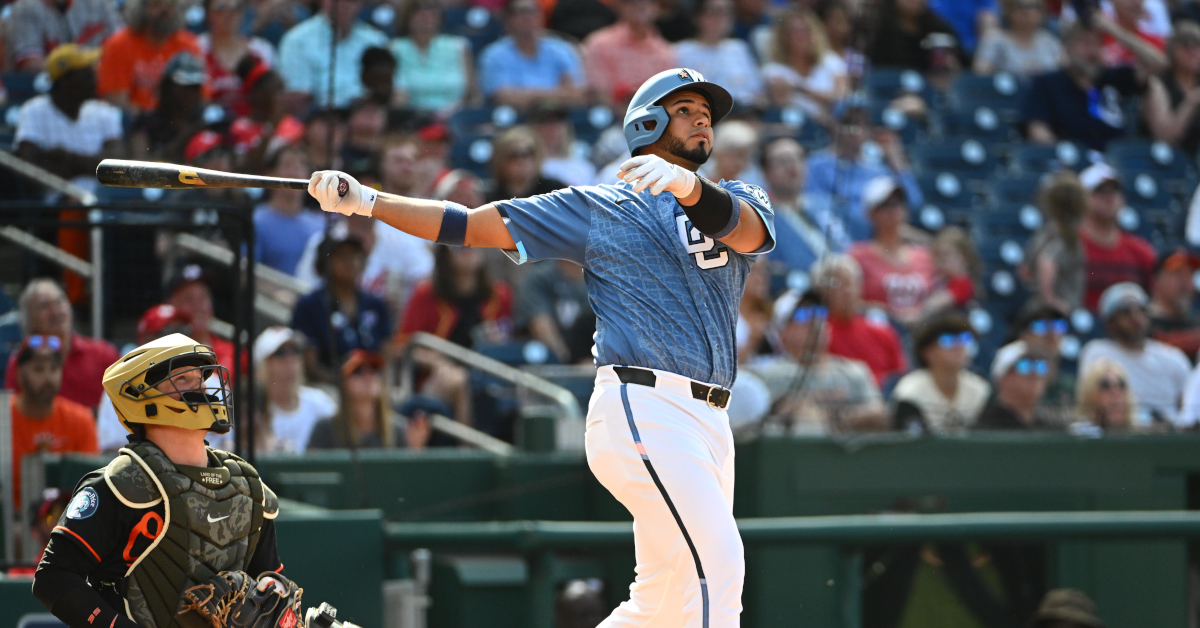
A long time ago, Keibert Ruiz was one of the top catching prospects in baseball. He was so highly regarded that he was a significant piece of the Nationals’ return in the Max Scherzer and Trea Turner trade with the Dodgers in 2021. After a solid first full season in Washington the following year, he signed an eight-year extension worth $50 million in March 2023. Unfortunately, that’s when the bottom fell out. Over the last three years, Ruiz has been the worst qualified position player in baseball, “accumulating” -1.9 WAR.
When the Nationals acquired Harry Ford in a trade with the Mariners this offseason, it was fair to wonder if Ruiz’s days as the team’s primary backstop were numbered. He had been a disaster both at the plate and behind it. His 79 wRC+ over the last three years was a hair higher than Patrick Bailey’s 76 mark, but instead of offsetting that offensive futility with elite defense, Ruiz was the worst defensive catcher in baseball. It’s shocking, then, to see that he has so completely turned things around this year; he’s already accrued 0.8 WAR and has been the 11th-most valuable catcher in baseball in just 34 games.
Let’s tackle the most surprising development first: All of a sudden, Ruiz is providing positive value behind the plate. Among the 53 catchers who caught at least 1,000 innings over the last three years, Ruiz was the second-worst framer, the second worst at throwing out base stealers, and the sixth-worst blocker. This year, he’s added two runs via framing and has been a slightly above-average blocker. His throwing hasn’t improved all that much according to Statcast, but he also hasn’t been challenged very often, so that area of defense hasn’t really affected his overall defensive value.
Last year, Ruiz suffered two concussions within a few weeks of each other. The first came on June 23, when an errant foul ball hit him in the head while he was sitting in the dugout. The second came just a week and a half later — and just two days after he had been activated off the 7-day concussion IL — when a foul tip struck him in the mask. He attempted to return to play in September, but he was shut down from his rehab assignment after his concussion symptoms returned. In an effort to reduce his risk behind the plate, the Nationals had Ruiz adjust his stance so that he’s now crouching lower to the ground:
In the picture above, you can see that at the pitcher’s release, Ruiz’s back isn’t as upright and his head is a little lower to the ground. The team thought that a lower stance would allow more foul tips to fly over his head instead of into his mask. That might have been the intended goal of the new position, but the effect on Ruiz’s ability to receive pitches has transformed his defensive metrics. If we look at Statcast’s detailed framing data, over the last three years, Ruiz had really struggled to receive both low pitches and pitches to his right:
Keibert Ruiz, Catcher Framing Runs
Year
Pitches
Framing Runs, Top Zone
Framing Runs, Bottom Zone
Framing Runs, Left Zone
Framing Runs, Right Zone
Total Framing Runs
2023
9444
3
-12
1
-2
-12
2024
8091
1
-5
2
-2
-3
2025
4942
-1
-5
1
-3
-9
2026
2427
1
0
-1
2
2
Source: Baseball Savant
It’s reasonable to think that sitting lower in his stance has helped him to frame those low pitches much more effectively. What’s even more surprising is that the right-hand side of the plate is now his strongest framing zone. In addition to benefiting his receiving, a lower crouch has probably helped him block errant pitches that he might not have been able to get to previously.
Going from being one of the worst defensive catchers in baseball to an above-average one is a tremendous improvement on its own, but Ruiz has also taken a step forward as a hitter. Ruiz got off to a familiar slow start at the plate this year; though May 6, he was running a .182/.203/.303 slash line, with a hugely disappointing 37 wRC+. As Spencer Nusbaum of The Athletic reported on Thursday, Ruiz met with the Nationals coaching staff on May 7 to build a plan for improvement. That same day, he smacked a pair of doubles and a home run. Over his last 11 games, he’s collected 16 hits, seven doubles, and three home runs, raising his season line to .262/.277/.486 (109 wRC+). The plan seems to have worked.
Two things keyed this offensive outburst. First, Ruiz is being more selective when it comes to which pitches to swing at, and second, he’s swinging to do damage when he gets a good pitch to hit. Here’s how manager Blake Butera put it in an interview with Jessica Camerato of MLB.com:
“That’s the one thing with Keibert is, he can cover a lot of pitches but he can also hit the ball really hard. And it’s really hard to hit pitches hard when you’re swinging at everything and just making contact. So one thing we put on him was, shrink the zone a little bit, trust your hand-eye coordination, even if that means taking some borderline pitches that are strikes. Wait until you get a good pitch to hit. Then he’s doing the work from there.”
Throughout his career, Ruiz has displayed excellent bat-to-ball skills and a fantastic ability to cover the entire plate; it’s the reason his career strikeout rate is just 11.1%. But his aggressiveness and propensity to put the ball in play is also why his career walk rate is just 4.7%. With a new selective approach in mind, Ruiz has cut his overall swing rate to 47.5%, a five point drop from where it’s been in the recent past. He’s given up nearly all of those swings on pitches located in the zone; his chase rate is essentially unchanged, but his zone swing rate is down nearly 10 points.
Despite that increased selectivity, he’s still making contact just as often, only now that contact has a little more oomph behind it. Ruiz has significantly improved his contact quality, and most of the improvement has come as a right-handed hitter. Throughout his career, he’s run a neutral platoon split as a switch-hitter, but his underlying batted ball metrics were significantly worse from the right side despite the results indicating otherwise:
Keibert Ruiz, Batted Ball Peripherals
As Left-Handed Hitter
Year
BatSpd*
Ideal Atk Angle
Hard Hit%
Barrel%
Pull AIR%
xwOBAcon
wOBA
2022-25
67.1
56.1%
27.2%
2.9%
24.5%
0.334
0.304
2026
68.3
56.6%
38.0%
4.0%
39.6%
0.265
0.299
As Right-Handed Hitter
Year
BatSpd*
Ideal Atk Angle
Hard Hit%
Barrel%
Pull AIR%
xwOBAcon
wOBA
2022-25
64.8
54.4%
23.4%
2.1%
19.7%
0.281
0.291
2026
67.0
67.7%
47.2%
13.9%
35.9%
0.332
0.458
Source: Baseball Savant
*Bat tracking data limited to 2024–26
This year, Ruiz is doing a ton more damage against left-handed pitching. He’s increased his bat speed from the right side by more than two ticks and has seen huge improvements in every meaningful batted ball metric. He’s also seen a jump in batted ball quality from the left side, albeit a smaller one. That growth appears to stem from his intent at the plate. He’s seeking good pitches to hit and is looking to drive them in the air to the pull side. His pull rate is all the way up to 67.4%, the largest increase of any batter this year, and he’s elevating his contact a lot more often as well. The results over the last few weeks speak for themselves.
For now, Ruiz is still splitting time behind the plate with Drew Millas. He has started a little over half of the Nationals’ games this season and just 11 of the 20 games since the fateful meeting that set him on this course. Millas was a well-regarded catching prospect in his own right not too long ago, but he hasn’t exactly impressed during parts of four seasons in the big leagues. He’s currently running a 41 wRC+ with adequate defense behind the plate. And Ford isn’t knocking on the door of the big leagues, either; the young catcher has mustered just a 74 wRC+ in Triple-A this year. If Ruiz continues bashing the ball and is able to keep up the good work defensively, it wouldn’t be surprising to see him reclaim his role as the team’s everyday catcher in short order.
With their plan for improvement in place, the Nationals have to be thrilled to see such positive results so quickly from Ruiz. I’m sure there will be bumps in the future — we’re talking about just 43 plate appearances since he made these changes to his approach — but with the support of the coaching staff, Ruiz appears to have been set on a path to success.
Spencer Strider had a fascinating first inning at Fenway Park on Tuesday. The Atlanta Braves right-hander threw 10 pitches in the frame, and it took him just five to retire the final three batters he faced. The first two batters were another story entirely. Jarren Duran walloped the second of Strider’s offerings over the right field fence, and Ceddanne Rafaela followed by depositing his fifth bullet over the Green Monster. The Red Sox led 2-0 before he had recorded an out.
What was that inning like for Strider? Wanting to find out, I approached him the next day to see if he’d be amenable to a pitch-by-pitch revisiting of what had happened. We’d had such a conversation back in his rookie season, albeit under far different circumstances: He’d fanned the side on 11 pitches in his lone inning of work.
Strider was happy to oblige, so I began by asking him if his game plan differed from 11 days prior, when he’d started against the Red Sox in Atlanta.
“There was some variation,” the righty replied. “I walked Duran to lead off the game in the previous outing, and I felt like some of that was a game-plan thing where we wanted to go with the heater; the walk was a lot of arm-side heaters. For my stuff, and kind of my mechanics, we wanted to target the glove side and get ahead [on Tuesday]. And I did, although I kind of pulled it down a little bit more than we were trying to do. Then we went back to it, as was the plan, and I kind of threw it in the same spot. The down-and-in heater to lefties isn’t a spot where you want to go, especially when they’re sitting heater. Maybe he pops it up or grounds out. Maybe he takes it again. Instead, he hit a homer. Big league hitters do that.”
Eric A Longenhagen: Good morning from Tempe on a gorgeous Friday, I’m excited to overeat baseball today. I’ve got Squeeze Play on but the Kentucky/Wake game is the big one starting shortly, so if you have to pick one I suggest that.
12:05
YardGoat: Hey Eric, do you have a prediction for who makes it to Omaha?
12:09
Eric A Longenhagen: Last week I mentioned Georgia Tech, UCLA, Auburn. Auburn’s path was made easier by the way the brackets shook out. If I’m looking for a deeper seed to sneak in it’s coming from the Chapel Hill and Lincoln regionals.
12:10
Justin Krupp: Have you seen Luis Hernandez in person this year or heard anything from scouts to lend context (good or bad) to what hes done so far this year?
12:12
Eric A Longenhagen: Yeah, like six times. I like him, I don’t think he has the enormous physical tools of a guy who we eventually rank 3rd or anything like that. He’s a skilled, smaller player who gets a lot out of his body because of how well he rotates.
12:13
Eric A Longenhagen: Do they not have velos in Morgantown? Lemme crack the trackman real quick…
When I announced my intention to write about Antonio Senzatela, Jon Becker burst into my Slack DMs like the Kool-Aid Man to demand I use a Penn and Teller-based headline. Credit where due: It was a great idea.
You know what’s not traditionally a good idea? Writing about Antonio Senzatela.
The rigorous study of baseball empirics has made us all smarter and better, but there are a few things I miss about the old days. Foremost among them is Nichols’ Law of Catcher Defense, an old pre-sabermetrics axiom which states the following: A catcher’s defensive reputation is inversely proportional to his offensive abilities. Read the rest of this entry »
Hello. While on paternity leave, I kept a journal about baseball and my daughter, who is not named Derek Jr., but who will henceforth be referred to as Derek Jr. This is the second installment of that series. You can read all of the entries here.
April 17
Like any new parents, my wife and I spend a lot of time staring at our baby and talking about how beautiful she is. Of course we do. Evolution has programmed us to be completely overwhelmed by the baby’s beauty so that we don’t leave her on the doorstep of the nearest convent when we get fed up with the wailing and the sleepless nights and the relentless, unceasing, never-ending pooping. It has worked. We are ensorcelled. Derek Jr.’s future is wimple-free. But I’m starting to think it has hit my wife harder.
I say this because she has started to insist that Derek Jr. is “an objectively beautiful baby.” Objectively beautiful. You’re familiar with beauty, right? The thing that is, famously, in the eye of the beholder? Apparently one beholder knows better. It’s not enough that she thinks the baby is beautiful, and that everyone tells her all day long how beautiful the baby is. She now needs it to be proven empirically.
I used the word “insist” earlier because I have been pushing back ever so slightly on this one. I spend a whole lot of time analyzing players or trends, and it requires rooting out biases and confounding variables. Call me crazy, but I’m picking up on a possible conflict of interest here. I’m not prepared to get in a fight over this, but I have gently pointed out that the fact that my wife is throwing around the word “objectively” here is — objectively — hilarious. Read the rest of this entry »
It’s May 29, roughly two full months into the regular season, which means, given the year, that it’s time for everyone’s favorite pastime: parsing competing proposals for a new collective bargaining agreement. Wednesday, the MLBPA released its firstproposal for a new agreement. Thursday, MLB followed suit with a proposal of its own. Both are best thought of as opening offers, likely to be heavily modified as the negotiations heat up ahead of the existing agreement’s December 1 expiration. But that doesn’t mean that they’re meaningless. I think these early offers are revealing of what each side cares about most. The specific numbers quoted are unlikely to survive multiple rounds of bargaining, but the concepts and structures that each side favors at this stage could tell us a lot about what an eventual compromise looks like. So without getting too bogged down in the details, let’s peruse both proposals and try to tease out what each side is trying to accomplish.
The MLBPA’s Proposal
The players’ first salvo focuses on two things: revenue sharing and early-career pay. Revenue sharing is going to be a key point of discussion in this negotiation. The league has raised competitive balance concerns for years, and it’s clear that there’s public interest in leveling the playing field. Collectively bargained labor agreements don’t solely play out in the court of public opinion, but making the sport more interesting and marketable is a benefit for both sides, so a more balanced system of distributing revenue seems like a clear path towards sustaining the game’s recent growth.
The central piece of the MLBPA revenue sharing proposal is a redistribution of TV money. Currently, teams share a flat 48% of all local revenue, TV included. The MLBPA proposal would change that significantly. In their framework, the first $50 million from each team’s local TV contract, and two-thirds of the amount above $50 million, would be pooled centrally, along with all national TV revenue. Read the rest of this entry »
Ben Lindbergh and Meg Rowley discuss the initial CBA proposals by the MLBPA and MLB: some specific points of departure and alignment, whether we really learned anything about what each side wants or the likelihood of lost games, and what the rhetoric and rebuttals say about the PR battle to come. Then (50:08) they banter about whether baseball broadcasts could ever get good enough to endanger attendance, why ABS challenge rates haven’t closely correlated with batter quality, a difference between what fans and neutral spectators tend to enjoy about teams, whether ace-type starting-pitcher seasons are making a partial comeback, a threat to baserunners and bat-dog employment, and a mid-start stretching-related mishap.




 Sponsor Us on Patreon
 Give a Gift Subscription
 Effectively Wild Subreddit
 Effectively Wild Wiki
 Apple Podcasts Feed
 Spotify Feed
 YouTube Playlist
 Facebook Group
 Bluesky Account
 Twitter Account
 Get Our Merch!