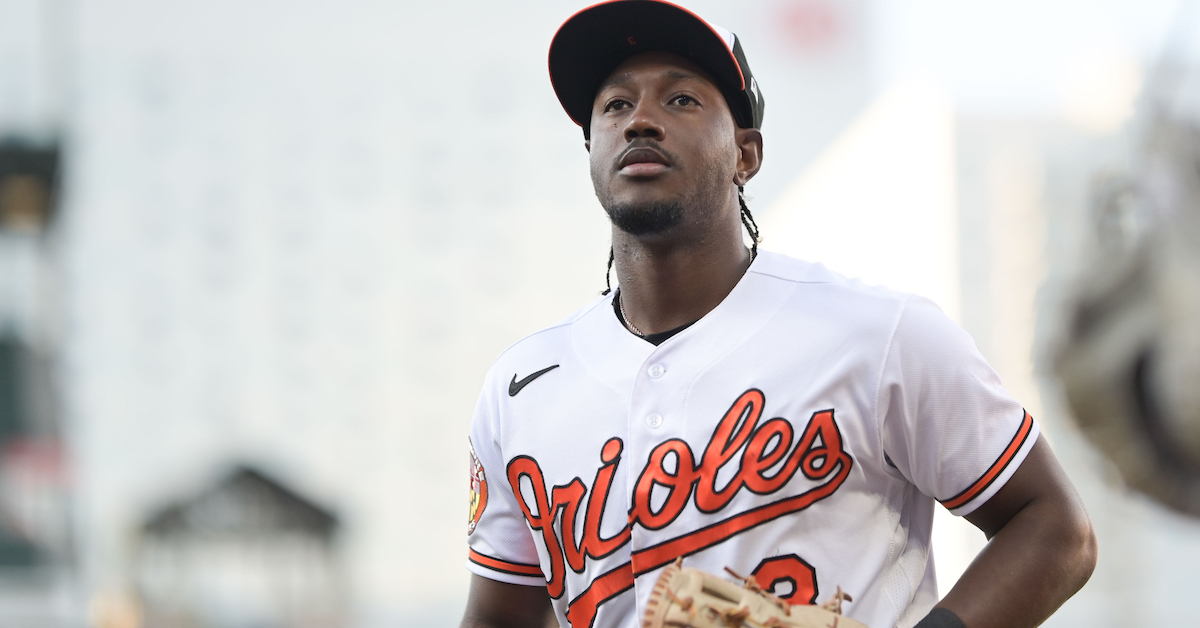
Well, shoot. After grounding out to shortstop in the second inning of Wednesday night’s game against the Nationals, Jorge Mateo was removed due to hip discomfort. The Baltimore shortstop is officially day-to-day, and Rotowire reports that he seems to have avoided a serious injury, but the timing still stinks. Mateo is on the hottest streak of his short career: After 16 games, he has a 192 wRC+ and 1.1 WAR, tying him for third and fourth in baseball, respectively. Naturally, he wasn’t going to be able to keep this up for a whole season; he has a .378 BABIP, and his wOBA exceeds his xwOBA by 59 points. It’s April 20, and the regression monster is laying in wait right for him right now.
But that’s part of what makes his hot start so fun. This is Jorge Mateo! The light-hitting, glove-first speedster. He was a fun player when he was just stealing bases, making jump throws from the hole, and trying to beat out infield hits. All of a sudden he’s got a .638 slugging percentage. In the last 16 games, he’s raised his career wRC+ by 9%. Obviously, I’m going to examine whether any of this looks sustainable, but first let’s take a moment to enjoy what we’re seeing while spring is in the world. Read the rest of this entry »
What an absolute rocket. With a 118.2 mph exit velocity, Jake Burger’s three-run dinger was the second-hardest hit ball of the season so far. Harder than anything that’s come off the bat of Aaron Judge or Yordan Alvarez in 2023. Hard enough that this ball went 417 feet with just a 21 degree launch angle. That’s not the launch angle of your standard-issue ballistic arc moon shot. Anyone who watched La Fleche Wallonne on Wednesday can tell you it’s possible to ride a bicycle up a 21-degree incline.
But that’s just the kind of week Burger’s been having. Since being recalled to the majors on April 6, Burger has eight hits. Seven of them have gone for extra bases, and five of those have been home runs. Of those five home runs, four have come in the past six days. Back in the day, the only way to display that much power in Chicago was to tilt a presidential election for John F. Kennedy.
It was not always ordained to be so. With a couple weeks to go in spring training, I asked Burger what he thought of his prospects for making the Opening Day roster. He came into camp facing entrenched starters at basically every position he’s capable of playing; if he was competing for anything, it was a spot on the bench. But with Luis Robert Jr., Eloy Jiménez, and Yoán Moncada at the WBC, he got all the playing time he could ask for in camp.
“I’ve been in basically every game,” he said. “I’m fortunate to be in that position and to be able to compete for a job. Take it day by day and just be myself. The rest will take care of itself.”
It’s the kind of answer that would make Crash Davis stand up and applaud, but Burger gave it with conspicuous confidence for someone whose major league career has been anything but a sure thing.
In 2017, Burger was the no. 11 overall pick out of Missouri State, where he played with future big leaguers Matt Hall and Dylan Coleman, fellow first-round pick Jon Harris, and a pitcher named Trey Turner. (Not to be confused with Phillies shortstop Trea Turner, former Virginia Tech wide receiver Tré Turner, or five-time Pro Bowl offensive guard Trai Turner.) Burger was one of the best mid-major hitters in the country over three years in Springfield, boasting back-to-back seasons of hitting at least .300/.400/.600 with at least 20 home runs as a sophomore and junior. He figured to rise through the minors quickly.
But four days into Cactus League play in his second pro season, Burger tore his Achilles tendon. Ten weeks later he tore it again. He missed all of 2019 with a heel injury, then all of 2020 due to the pandemic canceling minor league play. Concerns about Burger’s long-term suitability for third base were not alleviated when his ankles and feet betrayed him, and few young hitters can survive going three seasons without playing a competitive game.
In the meantime, the White Sox were stocking up on competitors for playing time. Moncada moved from second base to third base in 2019. Jiménez and Robert established themselves as big league regulars in the outfield, and Chicago spent top 10 picks on Andrew Vaughn and Zack Collins, a college catcher who profiled as a future first baseman or DH. When Burger did finally make it to the majors, he got hurt again, this time breaking his wrist in July.
Burger missed out on the Opening Day roster, but he didn’t have to wait long in the minors. Within a week, Jiménez tweaked a hamstring and went on the IL, and when he was ready to return, Moncada went on the IL himself with a back injury. Now, Burger is not only on the roster, he’s Chicago’s starting third baseman.
But even after the opportunity to play opened up, Burger wasn’t going to make much headway striking out 30% of the time. He was good at the plate when healthy — a 113 wRC+ in 183 PA last season — but not enough to force a more established player out of the lineup.
“Cutting down the strikeouts and working on bat-to-ball skills was a big factor in this offseason,” he said. “If I can consistently make contact, the ball is going to jump.”
In addition to making some mechanical changes, Burger also tried to refine his pitch selection. He said he wanted to lay off low pitches — even strikes — that he was more likely to ground out than hit hard in the air. Burger can hit the ball hard, as his home run off Falter would indicate, but it’s easiest for him when the pitch is either at belt-level or up in the zone and away. Pitches low in the zone have traditionally caused him problems:
Despite this, last season he swung at about two-thirds of pitches in the lowest third of the strike zone. That low-middle sector, with a 71% swing rate, netted Burger a contact rate of 79% but a slugging percentage of just .222 on the balls he did manage to put in play. He said his goal this past offseason was to work on “creating a floor in the strike zone.”
So how did he do that? Cool gadgets.
“I use WIN virtual reality, which is pretty cool,” he said. That system involves a bat sensor and a VR headset, which allows him to simulate at-bats off any pitcher in baseball. “Also, my training facility in Nashville has been huge, using an iPitch machine, and you can put in any pitch in the major leagues.”
It’s not the real thing, but it’s close enough for someone who’s finally catching up after three seasons on the shelf. It’s a small sample, but through Wednesday’s games, it appears that Burger’s time on the holodeck has paid off:
If this is a genuine reinvention for Burger and not just small sample noise, it comes at an interesting time. It’s been more than half a decade since the White Sox blew up the talented and cost-controlled core of Chris Sale, Adam Eaton, and José Quintana. And after back-to-back playoff appearances in 2020 and 2021 generated a grand total of zero advancements to the second round, the Sox look like they’re going backward.
Until now, it looked like Burger was just one in a line of homegrown players who failed to live up to (admittedly astronomical) expectations. And he might still be that. We’ll see. But that core is now in what should be its prime — including Burger, who turned 27 two weeks ago — and there are still open questions about Vaughn’s power and Jiménez’s ability to stay on the field, among other shortcomings across the roster. Soon, it might be time to tear it all down again, whether Burger keeps homering four times a week or not.
Below is an analysis of the prospects in the farm system of the Atlanta Braves. Scouting reports were compiled with information provided by industry sources as well as our own observations. This is the third year we’re delineating between two anticipated relief roles, the abbreviations for which you’ll see in the “position” column below: MIRP for multi-inning relief pitchers, and SIRP for single-inning relief pitchers. The ETAs listed generally correspond to the year a player has to be added to the 40-man roster to avoid being made eligible for the Rule 5 draft. Manual adjustments are made where they seem appropriate, but we use that as a rule of thumb.
A quick overview of what FV (Future Value) means can be found here. A much deeper overview can be found here.
All of the ranked prospects below also appear on The Board, a resource the site offers featuring sortable scouting information for every organization. It has more details (and updated TrackMan data from various sources) than this article and integrates every team’s list so readers can compare prospects across farm systems. It can be found here. Read the rest of this entry »
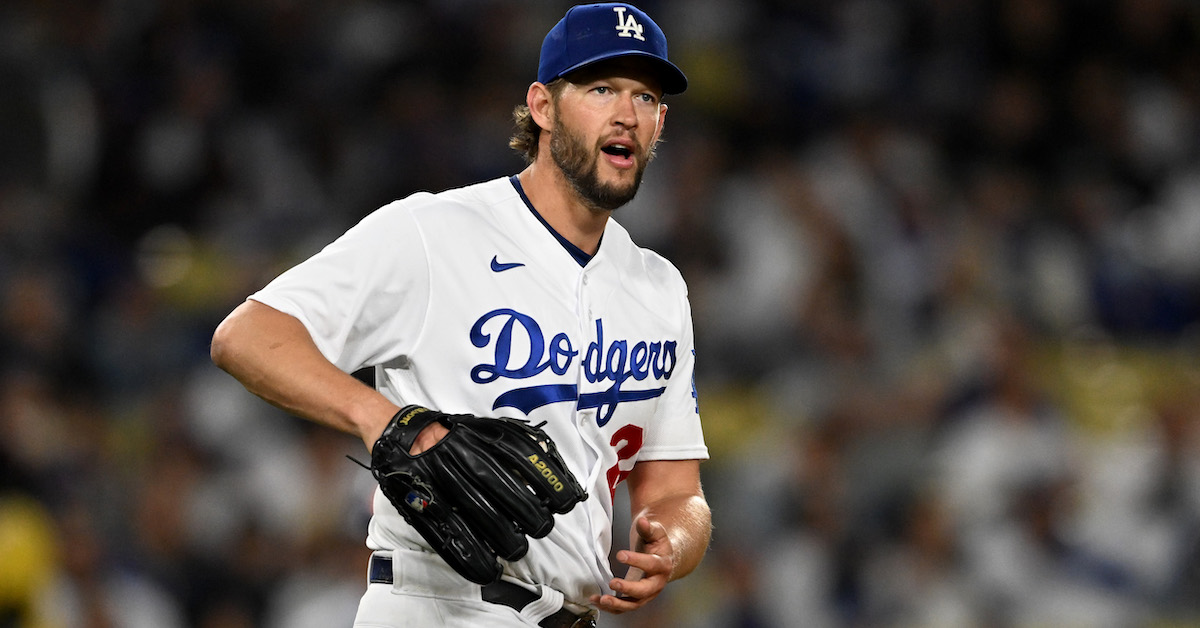
Clayton Kershaw didn’t need his 200th career win to burnish his Hall of Fame credentials, but on Tuesday night at Dodger Stadium, in his first start with the milestone within reach, he secured it in brilliant fashion. In an outing bookended by his pitching out of jams, Kershaw tossed seven scoreless innings against the Mets, a team he has utterly dominated throughout his career.
In securing the milestone, Kershaw joined Justin Verlander (244 wins), Zack Greinke (223), and Max Scherzer (203) among active pitchers, and Hall of Famers Don Sutton and Don Drysdale as those who won at least their first 200 games as Dodgers. He became the 121st pitcher in major league history to reach the plateau, and just the 13th to do so entirely with one team:
Before we go further, it’s time for the usual caveat about pitcher wins: Regular readers know that I generally avoid dwelling upon the stat, because in this increasingly specialized era, they owe as much to adequate offensive, defensive, and bullpen support as they do to a pitcher’s own performance. While one doesn’t need to know how many wins a pitcher amassed in a season or a career to appreciate his true value — and single-season totals in particular can be wildly misleading — those totals do affect the popular perceptions of their careers and still carry a certain cachet among players. Read the rest of this entry »
Tucker Davidson is looking to establish himself as a Los Angeles Angel. Acquired by the Anaheim-based AL club at last year’s trade deadline in the deal that sent Raisel Iglesias to Atlanta, Davidson is doing so with an approach heavily influenced by analytics. An admitted pitching nerd, the 27-year-old left-hander is well-versed in the metrics, and he’s using them to improve his craft.
He’s off to a solid start this season. Currently pitching out of the bullpen — the bulk of his professional experience has been as a starter — Davidson has a 2.53 ERA and a 2.48 FIP over four appearances comprising 10-and-two-thirds innings. His ledger includes both a win and a save.
Davidson sat down to talk pitching when the Angels visited Fenway Park this past weekend.
———
David Laurila: You’re a pitching nerd. How did that come about?
Tucker Davidson: “I kind of fell into it — how the ball moves, and the whole analytical part — around 2015-2016 when I was in college and first getting drafted. I was interested in why my fastball didn’t spin a bunch, but I could still throw four-seams and get swings and misses up in the zone. I wondered why I couldn’t make a two-seam sink much. Why is my slider good? It was basically a ‘Why is that?’ Read the rest of this entry »
Previously on MLB:Drive to Survive, the first part of this three-part series on growing engagement with the sport via content beyond live games: we enumerated a few of the different types of supplementary media the league and teams might use to awaken interest in dormant fans and highlighted the potential benefits of doing so based on what has worked well for other sports. Since executing a game plan is just as important as the game plan itself, here in Part II, the conversation will shift to what makes supporting content effective.
For every individual, different aspects of sports resonate and keep them returning game after game. In a 2022 Ted Talk, Kate Fagan argued that the many things that give sports their gravity organize themselves into one of two categories: stakes and storylines. “This is what burns at the center of sports. In the Olympics, we have all agreed: a gold medal matters. Same with the World Cup. And now paired with these agreed-upon stakes, we also have even deeper storytelling. Which is how we end up teary-eyed after a three-and-a-half minute NBC vignette about a Romanian gymnast.”
Content designed to drive interest in a sport needs to tell a story and emphasize the stakes. Compelling stories contain developed and dynamic characters, several coats of conflict, and settings with character arcs of their own. Good stories are crafted with precision; they make us feel, contain universal truths, teach us things we didn’t know and didn’t realize we were missing. They meet us where we are. Read the rest of this entry »
Vladimir Guerrero Jr. is a force of nature. He’s one of the best hitters in baseball, and in a very obvious way: he scalds the baseball to all fields and hits a bunch of home runs. Last year was a down year, and he still left the yard 32 times. He perennially records some of the hardest-hit batted balls in the game. When you think about a prototypical first baseman, Guerrero’s combination of power and hit tool is probably what you’re picturing.
One of the impressive parts of Guerrero’s career has been his ability to limit strikeouts while still getting to his power. See, low strikeout rates aren’t an inherently great thing. If you don’t strike out very often but don’t do any damage when you put the ball in play, you’re not really making a good trade. Adam Frazier is a good example of this type of hitter. He struck out just 12.1% of the time last year, but posted an 81 wRC+ anyway because when he did make contact, it was generally weak. You can probably conjure a picture of this type of hitter on your favorite team. You love that they never give away an at-bat, but hate that they never take matters into their own hands and park one in the seats or smack one off the power alley wall.
Guerrero doesn’t suffer from that problem. He struck out just 16.4% of the time in 2022, but when he made contact, he wasn’t Fraziering it up out there. Let’s get that in numbers: in his career, Frazier is batting .317 with a .456 slugging percentage when he ends a plate appearance with a batted ball, good for a .327 wOBA. Guerrero is hitting .351 with a .616 slugging percentage, which works out to a .403 wOBA. One of these things is not like the other. That’s why low strikeout rates are great statistical markers for power hitters and yet broadly uninteresting in the population as a whole. What you do with those extra balls in play matters a ton, as Michael Baumann covered yesterday, and with far more Pitbull references than I could even think up. Read the rest of this entry »
Ben Lindbergh and Meg Rowley banter about whether a remedy for former Yankees slugger Moose Skowron might help current Yankees slugger Giancarlo Stanton, Cody Bellinger’s rebound and ovation violation, Domingo Germán’s sticky start, Juan Soto’s pitch-clock problem, Bryce Harper, hitting machines, and the future of minor-league rehab stints, whether Yandy Díaz’s “Ground Beef” nickname no longer applies, the reduced drag of the baseball and the overall offensive environment this season, the Atlantic League’s new experimental rules, the rules about rundowns on third pickoff attempts, a few injuries, extensions, and call-ups, the Marlins’ mediocrity despite their trades for top pitchers, Anthony Bass’s viral popcorn complaint, and more. Then (1:29:19) they do a Meet a Major Leaguer segment on Hobie Harris and Hogan Harris, check in on the Sean Murphy/Esteury Ruiz/William Contreras trade, and close with a Past Blast (1:50:06) from 1995 and a few follow-ups.
The Twins and Pablo López agreed on Monday to a four-year contract extension worth $73.5 million, ensuring that the team’s newest starting pitcher will stay in the Twin Cities through the 2027 season. López has been dynamite in his first four starts for Minnesota, allowing only five total runs and holding the current league crown in strikeouts, edging out Gerrit Cole and Jacob deGrom.
It’s not a surprise to find out the Twins are big fans of López. Otherwise, they would not have traded three years of a cost-controlled Luis Arraez, who is coming off a batting average title, a Silver Slugger award, and an All-Star appearance, in order to acquire his services. The extension would have made sense on the day of the trade; it makes even more sense with the very real chance that López has found another gear. Read the rest of this entry »
Jay Jaffe: Good afternoon, folks! Welcome to another edition of my weekly chat.
2:02
Jay Jaffe: I just went live an hour ago with my deep dive into the news that a Salt Lake City-based group has thrown its hat in the ring to bring an expansion franchise to the city where I grew up — a possibility I was immediately dismissive of last week. https://blogs.fangraphs.com/salt-lake-citys-bid-for-a-major-league-exp…
Anthony: What the heck is going on with Alek Manoah? He’s been brutal so far after being great last year.
2:08
Jay Jaffe: Good question. I haven’t seen much of him but I notice that his velocity is down a bit, and he’s getting hit very hard (7.43 xERA, woof). A quick look at his Stuff+ data shows that the scores for both his fastball and slider have particularly receded, (103 to 98 on the former, 111 to 101 for the latter,), with his overall Stuff+ and Pitching+ (including location) falling from 100 to 94. Velocity, shape, movement, I’m not sure what’s up but I’d guess he’s got some mechanical issues to iron out.








 Sponsor Us on Patreon
 Facebook Group
 Twitter Account
 EW Subreddit
 Effectively Wild Wiki
 iTunes Feed
 Get Our Merch!

 Jay Jaffe