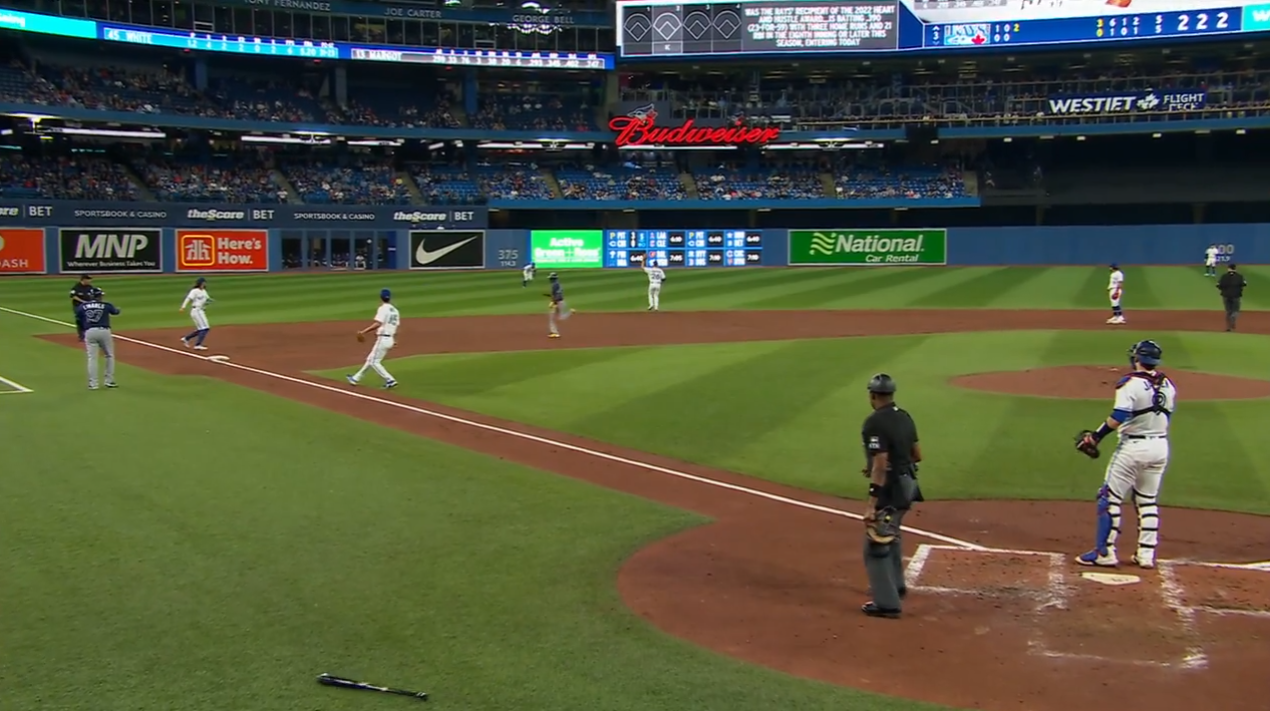
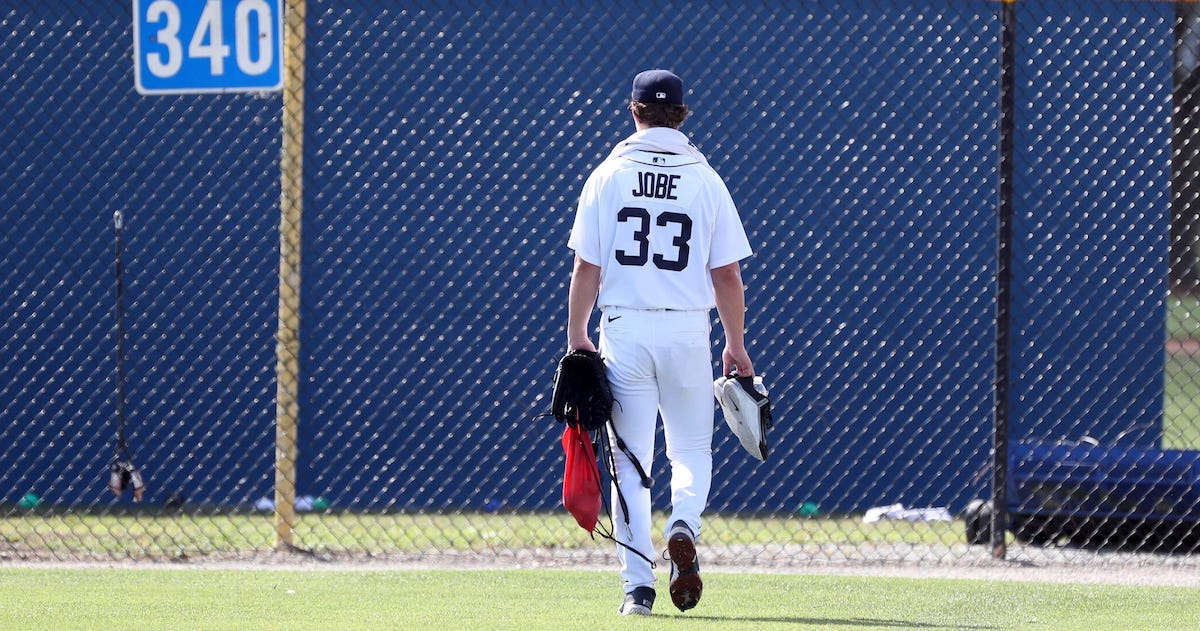
Jackson Jobe has a bright future. Currently first in our Detroit Tigers prospect rankings, the 20-year-old right-hander is coming off a first full professional season during which he logged a 3.94 ERA and 81 strikeouts in 77-and-a-third innings spent between Low-A Lakeland and High-A West Michigan. Drafted third overall last year out of Oklahoma City’s Heritage Hall High School, he pairs an array of plus offerings with elite athleticism. What’s more, according to our own Eric Longenhagen, the 6-foot-2, 210-pound Jobe “would have been a Day Two pick as a position player.”
Jobe discussed his early-career development, as well as the pitches in his power arsenal, at the conclusion of the Midwest League season.
———
David Laurila: Along with pitching, you showed a lot of promise as a position player. At what point did it become clear that your future was on the mound?
Jackson Jobe: “I’ve always pitched a little bit. Growing up, I always had a good arm — obviously, you’ve got to have a good arm to play shortstop — but I want to say it was my junior year. My junior year spring was COVID, so I only got one outing before our whole season got banged. At that point, I just kept training. Then summer came around, and they were still doing some of the showcases.
“Perfect Game had a showcase — I want to say it was PG National — and I got invited there to play shortstop and pitch a few innings. I ended up throwing really well. It kind of just clicked, I guess. I threw harder than I’d ever done before. The slider was good. From that point forward, my phone was blowing up with agents and scouts. That was kind of the beginning for me as far as pitching goes.” Read the rest of this entry »
Jon Berti is a player of immense historical import, and you’ll never guess why.
No, that’s wrong. If you know anything about Jon Berti, you probably know exactly why he’s a player of immense historical import. Berti has actually put together a pretty nice all-around season: He can play anywhere and while he’s hitting for basically zero power, his .344 OBP makes him quite a valuable player for the Miami Marlins.
But more to the point: He’s extremely fast, with 96th-percentile sprint speed according to Baseball Savant, and he’s determined to get his money’s worth from this physical gift. Despite being limited to just 83 games by a bout of COVID in May and a groin strain in July, Berti has stolen 34 bases. A quick run through Berti’s event log reveals that he has been on first or second with nobody on the base ahead of him 97 times this season, and on 38 of those occasions he’s decided to keep running as far as his little legs will carry him, plus four more pickoffs that don’t count toward his caught stealing total.
That kind of aggressiveness is admirable, but distressingly rare. Berti, despite only playing in a little more than half his team’s games, is leading the majors in stolen bases. If he finishes the season with fewer than 40 steals, it will be the lowest majors-leading stolen base total of any full season since 1958. Read the rest of this entry »
The Tampa Bay Rays are looking for an experienced Ruby on Rails Developer to help the Baseball Systems department build the best software and analytics solutions in all of Major League Baseball.
What is Baseball Systems?
As part of Baseball Operations, our team builds the innovative tools that our players, coaches, analysts, scouts and front office personnel use to do their jobs, make decisions, and win ballgames.
Our team consists of several data engineers, backend developers and frontend developers and coordinators.
Every line of code we write — and feature we ship — has a direct impact on the field, helping us compete for the postseason year after year.
Working within the most innovative and collaborative front office in MLB, your ideas will be welcomed and heard.
We are looking for someone who:
is an experienced Ruby on Rails developer.
is proficient creating front-end views using HTML, CSS and Javascript. Don’t worry, we have designers who make things look great!
has experience with relational databases.
is familiar with Git version control software.
It’s not required, but would be awesome if you:
have experience with one of the popular front-end Javascript frameworks. We use Vue.
are proficient in a language other than Ruby. We use several different languages depending on the task.
are familiar with NoSql databases like Redis or Elasticsearch.
have an understanding of baseball.
have an interest in sabermetrics and statistical modeling.
What will you do each day?
Build new features or maintain existing features in our proprietary software application.
Identify and correct bugs quickly.
Document code and support procedures thoroughly.
Meet with Baseball Operations staff that have requested a new feature to gather requirements and help with feature planning.
Train non-technical users on new features or applications.
You might take half a day off from time to time to watch a baseball game.
Help our data engineering team ingest data from new data sources.
Why work for the Rays?
A top notch development environment with a company provided laptop, Github Enterprise, frictionless CI/CD, bug tracking, top project management and documentation software, and automated testing to minimize bugs to keep you focused on new features.
Opportunities to choose and work with new technology. We strongly believe in choosing the right tool for the job even if it isn’t part of our current stack.
Exceptional benefits including:
health, vision and dental coverage at VERY competitive rates.
an enhanced 401k where the company contributes even if you don’t!
free tickets to baseball and soccer games (We also own the Tampa Bay Rowdies) for you, your friends and family.
flexible PTO options and monthly paid volunteer opportunities.
generous family planning assistance and parental leave.
annual continuing education assistance.
healthy and free lunch right in the office.
in-office yoga and many other other wellness benefits.
You’ll be working with some of the sharpest minds in all of baseball.
You are a good teammate and like working with other driven and caring teammates.
Your office is in a baseball stadium! Or your office can be remote, your choice!
We are an organization that prides itself on coaching others so please apply even if you don’t meet every one of the requirements above.
Our Interview Process
A ~30 minute phone call to get to know each other and discuss the position in more detail.
In some cases, we have a second ~30 minute phone call with one of our recruiting staff.
A small take-home coding project. We don’t do coding tests or coding on a whiteboard.
Two or three small panel interviews. In addition to covering technical skills, you will also meet other members of Baseball Operations you’d be collaborating with.
Make a decision!
All offers contingent on a satisfactory background check.
Statement: All applicants for employment are required to be fully vaccinated against COVID-19 prior to commencing employment. Applicants who receive a conditional offer of employment will be required to produce proof of vaccination status prior to their first day of employment. Applicants with qualifying disabilities or bona fide religious objections, or who are pregnant, may be exempted from this requirement or otherwise accommodated if they are unable to be vaccinated.
Acknowledgement by applyingI understand that if offered a role and by accepting a role with the Tampa Bay Rays or Rowdies, I will be participating in COVID-19 community risk mitigation practices.
We are an equal opportunity employer and all qualified applicants will receive consideration for employment without regard to race, color, religion, national origin, sex, sexual orientation, age, disability, gender identity, marital or veteran status, or any other protected class.
Job Questions:
In addition to your resume and cover letter, please describe your level of Ruby on Rails experience in 100 words or less.
Ben Lindbergh and Meg Rowley talk (4:09) to baseball agent and attorney Scott Boras, the founder, owner, and president of the Boras Corporation (as if you didn’t know who Scott Boras was), about his busiest days, his process for brainstorming metaphors, similes, and puns, his fondness for nautical analogies, other wordplay-related matters, the CBA, his agency’s evolving use of analytics and player-improvement techniques, the unionization of minor leaguers and the conditions he faced as a minor league player, exploiting loopholes, his origin story as a negotiator, whether he’d give it all up to have been a big leaguer, and more. Then (51:45) Ben and Meg discuss Boras’s career and Stat Blast (1:08:30) about Shohei Ohtani’s hitting on days when he pitches, plus (1:30:45) a double Past Blast from 1903.
Oh, the things you find when perusing the leaderboards. While collecting data to discuss the decline in Jeremy Peña’s plate discipline, I went down a rabbit hole of player performances since May. As tends to happen, one thing led to another, and I ended up running my Cy Young predictor using only data since the start of May. Near the top of each league were pitchers whose presence surprised me even though I already knew both to be excellent. Each of them is on a borderline contender that is now very likely to make the playoffs, and each survives in the majors by relying on command rather than throwing 100-mph smoke. That’s right, I’m talking about Aaron Nola and Shane Bieber. Let’s examine each, starting with Nola, the top National League pitcher in my Cy Young predictor since May.
The Phillies look nearly certain to play postseason baseball. With a probability that is now over 90% by both FanGraphs’ and ZiPS’ reckoning, the Phils are on target to make the playoffs for the first time since 2011. While there have been runs that teased contention in past years, the Phillies have always seemed to end up floating somewhere around .500. But despite Zack Wheeler and Bryce Harper missing parts of the season, Nick Castellanos disappointing, and a defense that just begs for a Yackety Sax soundtrack, the team stands at 79-61. And while he’s obviously not the only player to have contributed to the club’s record, Nola’s impressive run makes him one of the key figures of the 2022 campaign. Read the rest of this entry »
The Josh Hadertrade isn’t the only deadline deal that has yielded less-than-rewarding results thus far for the Padres. Juan Soto hasn’t been as bad as Hader at his worst (the closer has lately righted the ship), but after a good start for his new team, he’s fallen into a deep slump. As the Padres battle to hold onto the third NL Wild Card spot, his struggles are worth a closer look.
When he was acquired from the Nationals in an eight-player blockbuster on August 2, Soto was in the midst of a solid-but-not-great season by his own high standards. While his 151 wRC+ was only four points off his career mark, his .246/.408/.485 line was far below his typical slash stats (.291/.427/.538) — not enough to be a dealbreaker or to rate as a significant long-term concern, but notable nonetheless. That said, the Padres’ right field mess made my Replacement Level Killers list, and an on-base percentage above .400 will cover a multitude of sins.
Soto debuted with the Padres on August 3, going 1-for-3 with a pair of walks in a 9–1 rout of the Rockies. He continued to hit well (.286/.438/.460 from August 3 to 21), but on August 23, he was scratched from the lineup with what the Padres called “left mid-back tightness.” Via MLB.com’s AJ Cassavell, “His back flared up while he was swinging in the batting cage shortly before first pitch. During the game, Soto took further swings in the cage, hoping he might get a chance to pinch-hit, but he wasn’t able to.”
Soto didn’t play again until August 27, though he missed just three games thanks to a schedule that bracketed a two-game series against the Guardians with off days on either side. Upon returning, he collected hits in his first two plate appearances against the Royals’ Daniel Lynch, and the next night homered off Anthony Misiewicz. But in the 13 games since then, he’s gone 3-for-42, all singles, and didn’t collect an RBI until Tuesday night. He’s walked 12 times during that stretch and was hit by a pitch — causing him to leave a September 7 game with a right shoulder contusion, which may be a contributing factor here — en route to a .120/.313/.180 post-injury performance. In all, his six hits over a 15-game span is the second-lowest total of his major league career; he had five hits in 15 games in two overlapping stretches in September 2019.
Is the slump as bad as it looks? My assumption going into this investigation was “probably not,” given that even with his return against the Royals, we’re talking about a total of 64 plate appearances and even fewer batted ball events. With the caveat that this is some small sample spelunking, it’s worth noting that since his absence, Soto has pretty much matched his Statcast stats for the first four and a half months of the season, which is to say that he’s hit the ball as hard, more or less:
Juan Soto Statcast Splits
Split
BBE
EV
LA
Barrel%
HardHit%
AVG
xBA
SLG
xSLG
wOBA
xwOBA
Through Aug. 21
333
90.8
8.8
12.6%
47.1%
.252
.273
.481
.527
.391
.415
Since Aug. 27
44
90.4
16.4
9.1%
47.7%
.120
.234
.180
.377
.253
.357
Soto has produced a similar average exit velo and hard-hit rate and a slightly lower barrel rate (the difference in the smaller sample amounts to falling about two barrels short), but very different expected and actual outcomes. Note the difference in average launch angle; Soto generally ranks among the game’s top power hitters despite the fact that he hits the ball on the ground about half the time (career 48.6% groundball rate) and has an average launch angle below 10 degrees. In fact, since his debut in 2018, he’s one of four players with a slugging percentage above .500 (.528) and an average launch angle below 10 degrees (8.4); the other three — Eloy Jiménez, Vladimir Guerrero Jr., and Christian Yelich — all have SLGs in the .507–.510 range with angles in the 5.9–8.3 degree range. If Soto is averaging 16.4 degrees even for a stretch of time, something is probably off. Read the rest of this entry »
Sheesh. It’s been exactly one game since our last update on Aaron Judge’s pursuit of hitting 60, 61, and 62 home runs. At that point, Judge seemed more likely than not to eclipse Roger Maris‘ 61-homer mark, though only marginally. But after two home runs last night against the Red Sox, the pace is heating up again. Now, my simulation model thinks Judge is extremely likely to surpass Maris:
Odds of Various Aaron Judge Milestone HR Totals
Feat
Odds on 9/12
Odds on 9/14
60+ Homers
84.4%
96.8%
61+ Homers
71.8%
90.9%
62+ Homers
56.8%
80.8%
If that feels like a huge jump in odds to you, you’re in good company. If you think about it for a bit, though, it’s not so crazy. Judge has played 138 games this year and hit 57 homers. That’s a pace of less than half a home run per game, and still wildly impressive. Two in one game is always unlikely, though; it’s Judge’s 10th time doing it this year, for example. The finish line is getting close now; with 20 games to accrue five homers, one more barrage could put him over the top. Read the rest of this entry »
We should know better by now than to doubt the Guardians. Every year it seems like they shed at least one important player, and every year (not literally every year, but most years) they scheme, finesse, and otherwise inveigle their way back to the playoffs. This year, Cleveland’s position players are playing great defense and striking out less than any lineup in the league. On the other side of the ball, Cleveland — and stop me if you’ve heard this one before — has managed to cultivate depth by developing talented starters internally.
During the month of August, when Cleveland asserted control over the AL Central for the first time, Quantrill made six starts, pitched at least six innings each time, and posted a total ERA of 2.13. Bieber and McKenzie get most of the credit for the Guardians’ run prevention success, and deservedly so. But in this age of inch-perfect 98-mph two-seamers and strikeout rates in the 30% range, Quantrill is a throwback: an effective pitch-to-contact innings-eater. That he belongs to a little-celebrated archetype of player does not diminish his value to a team that’s operated all year with little room for error. Read the rest of this entry »
Jackson Wolf has unique characteristics. No. 22 on our updated San Diego Padres prospect rankings as a 35+ FV, the 23-year-old southpaw not only stands 6-foot-7 and features a deceptive delivery, his changeup grip is among the most unusual in the game. Drafted in the fourth round last year out of West Virginia University, he was described by Eric Longenhagen as “a funky, low-ish slot lefty with uncommon athleticism and flexibility… [with] arms-and-legs deception.”
A native of Gahanna, Ohio, Wolf made all but one of his 24 appearances with the High-A Fort Wayne TinCaps this season, logging a 4.21 ERA and 4.32 FIP with 95 hits allowed and 139 strikeouts in 142 innings. He sat down to discuss his repertoire, and the outlier properties that come with it, earlier this summer.
———
David Laurila: Let’s start with how you self-identify as a pitcher. How do you get guys out?
Jackson Wolf: “I actually just had this conversation with one of our coordinators. Finding my identity is something we’ve addressed this year, and getting outs isn’t going to come from blowing fastballs by guys. It’s going to come from using my movement, and from using my weird motion and leverage — kind of my deception — to get hitters uncomfortable and off-balance.” Read the rest of this entry »
When Randy Arozarena burst onto the national stage, he did so as the best hitter in baseball. For one postseason, he channeled peak Joe DiMaggio, hitting a ludicrous .377/.442/.831 in the 2020 playoffs. He was no slouch in the playoffs last year either, posting a .333/.474/.600 line, albeit in just four games. If you follow baseball in October, you probably think of Arozarena as a bruising power hitter. During the regular season, though, he’s something else entirely.
That’s not to say he’s a bad hitter. In fact, he’s put together an excellent 2022 line by cutting down on strikeouts. He’s been solid at the plate for three straight years now. He boasts a 133 wRC+ since the start of the 2020 season, a top 25 mark among all hitters over that timeframe, sandwiched between some guys you probably think are comfortably better than him: Corey Seager and Will Smith.
That’s great, and fine, but that’s not what I want to talk about. Arozarena is good in a conventional way in the batter’s box. He’s wild, and perhaps kind of bad, on the basepaths. It’s an absolute blast. Observe.
In the first game of yesterday’s doubleheader against the Blue Jays, Arozarena was busy early. In the first inning, he grounded into a force out, but beat out the double play relay throw to keep the inning alive and score a run. Arozarena is obviously fast; when you watch him you can’t help thinking of a defensive back in the open field. He’s compact and explosive; when he hustles down the line, you can almost hear the footsteps coming.
In the third inning, Arozarena delivered another RBI groundout, ho hum. That’s when things got interesting. With two outs and Manuel Margot at the plate, Arozarena got the itch to run. He gets that itch a lot; he’s attempted 39 steals this year and succeeded on 29 of them. I wouldn’t call his base-stealing instincts great, but I would call them voracious. In fact, he’d already scratched that itch in this very game, stealing second in the first inning without a throw.
But if one steal is good, two is better. Arozarena doesn’t so much steal on the pitcher as on the general disbelief that he can be stopped. A man on first and two outs? It’s a classic base-stealing opportunity, a situation where you only need to be successful 70% of the time to break even. Say no more – it was go time for Arozarena. Even a hidden ball trick attempt couldn’t stop him:
On 1-0, Arozarena took off and stole second easily:
Or did he? Home plate umpire Ramon De Jesus didn’t think so:
Margot inadvertently made contact with Danny Jansen on his backswing, as you can clearly see from a reverse angle:
Easy call, if you’re a veritable encyclopedia of baseball rules like De Jesus. If a batter inadvertently makes contact with a catcher on his backswing, the stolen base attempt simply doesn’t count; the runner has to go back to first, but the result of the pitch counts. You don’t see that one every day, but it seems like a pretty fair rule.
Not that there was any suspense about whether Arozarena was running, but now it was doubly obvious. Mitch White threw over to first before his next pitch, and Arozarena giggled a bit at Vladimir Guerrero Jr., who actually threw the ball back to White this time:
After bluffing a steal on 1-1 (he stopped after a bad jump), Arozarena was yet again on the move, and yet again easily safe:
But, uh, you’re not gonna believe it:
Yep, another clear case of inadvertent interference on Margot’s backswing. I don’t know if I’ve seen two of those calls all year, let alone two in the same at-bat. What could Arozarena do but sulk back to first?
Honestly, I’d GIF the entire at-bat if I could. The Jays and Rays should keep cameras on Arozarena and Guerrero at first base; every time the broadcast panned there, they were bantering back and forth, presumably about how ridiculous the situation was. Arozarena is a ton of fun to watch, particularly on the basepaths, and he was in fine form yesterday. But that wasn’t even the best part of this particular time on base.
When Margot put a ball in play, it stopped being a stolen base opportunity, and instead became an opportunity to get a head of steam and make something happen on the basepaths. Arozarena loves to do nothing else more – and that’s much to his detriment. He’s made 12 outs on the basepaths this year, the third-highest mark in the majors (Jose Altuve has 15, Yandy Díaz 14). Despite his blinding speed, he’s among the worst in the game by UBR, our measure of how many runs a player has added or lost based on their non-stealing baserunning. That’s basically tied with Alejandro Kirk, who isn’t exactly known for being fleet footed. The Rays are on course for a historical tally of outs made on the basepaths, thanks in no small part to Arozarena and Díaz.
And those outs add up. Making an out on the bases every once in a while is unavoidable, but Arozarena racks them up in bunches. He’s a gambler with unshakeable faith in his speed, but major league outfielders are pretty dang good. Still, you don’t steal home in a playoff game if you’re not pushing the envelope. Rays fans surely fret about the extra outs, but there’s no denying the adrenaline rush he produces every time he tries.
Margot gave him another chance to shine, shooting a hard-hit ball off of Matt Chapman and into left field. Since Arozarena was running on the pitch, there was no doubt he’d reach third base. But he went one further:
Wait, uh, what? I’ve seen a lot of baseball in my day, but I can’t think of any runners scoring from first on a single since Enos Slaughter’s famous mad dash (and that was ruled a double). This wasn’t even a particularly deep hit; Teoscar Hernández was in shallow left field when he fielded the ball.
My favorite part of this play is that Arozarena wasn’t even running hard the whole time:
That’s not to say he was loafing; he played it by the book until he reached third. There’s no reason to sharply round second on a grounder there, so he was pulling in safely. When the ball kicked into the outfield, he took third base, again without needing to kick it into high gear.
That’s a by-the-numbers play by a fast baserunner. Then, Arozarena channeled vroom vroom guy. Look at where he was when Hernández fielded the ball:
I don’t even know what to think about this. This isn’t just that Arozarena knows he’s fast. He could be peak Cool Papa Bell and not cover that much ground before a throw made it home. He wasn’t even running at full speed there; he was throttling down to stop at third.
That deceleration didn’t last long. When Hernández didn’t immediately throw to a relay man but instead started jogging in, Arozarena mashed the turbo button. He went from a slow jog to a sprint, catching Hernández off guard.
It still shouldn’t have mattered. Hernández was in shallow left field, with the ball in his hands, when Arozarena touched third base. This isn’t about testing a fielder’s arm; I don’t think there’s any outfielder in the major leagues who couldn’t make that throw if they knew they were going home with the ball, particularly now that Khris Davis plays for the Wild Health Genomes of the Atlantic League.
This was outright picking on the frailties of the human brain. Major league players are great athletes, masters of their craft, but thousands upon thousands of hours spent playing baseball builds pattern recognition, pattern recognition that Arozarena weaponized on this play (which I’ll just note wasn’t scored an error). When Hernández fielded that ball, he knew the play was over. One look at the runners – Arozarena decelerating into third, Margot cooling his heels at first – told him all he needed to know. This play was over; no need to come up throwing and risk an error.
You can see it in the way he fields the ball. No one in the stadium was expecting that play to require a full-effort throw, Hernández included:
I love it. I love everything about it. I wish every baserunner behaved more like this. I don’t mean getting thrown out on the basepaths, though to be honest I’m in for the occasional light-hearted TOOTBLAN. I’m talking about the combination of speed, belief, and guile that led to Arozarena creating a run out of thin air. That wasn’t a run-scoring opportunity. Usain Bolt wouldn’t have scored there. Plenty of runners wouldn’t have scored from second there.
In fact, I love this play so much that I’m going to break down Arozarena’s mad dash into three parts. First, the attempted steal and realization that the ball is in play:
That’s pretty standard. I think he had the base stolen pretty easily, and when he saw a grounder to third base, he correctly throttled down at second. When the ball kicked away from Chapman, the next read was automatic, something that every fast player in the majors does instinctively:
Again, easy. After an initial acceleration, he realized there wouldn’t be a competitive play at third base and did what every runner does in his situation: ease off. With the advantage of starting in motion, any baserunner in the majors would likely reach third there. But what happened next was pure genius, and it’s more fun in an isolation view of Arozarena. Even as he was decelerating into third, he made up his mind that he was going to pick on Hernández:
He had eyes on Hernández fielding the ball. When he turned his head away, he had made up his mind: he was going to hope Hernández made a bad throw from a tough position, coasting towards second and throwing halfway across his body. I’m honestly not even sure it was much of a gamble; Arozarena had time to peek back and see the throw, and was still close enough to third that he could have made it back safely if the throw was on line.
That’s something you don’t see every day, because if you saw it every day it wouldn’t work. You can’t subvert expectations for fun and profit if you’re always doing it; those expectations would change. This was a sublime moment, but it was just a moment: Arozarena also makes plenty of overly-aggressive attempts at extra bases that end in disaster.
On this day, though, he was perfect, and his speed and derring-do accounted for two RBIs and a run in a 4-2 Tampa Bay victory. But all that running takes a toll. After two successful stolen bases that got called back, two pickoff throws, a bluffed steal, a foul ball on a steal attempt, and that trip around the bases, Arozarena was gassed:
Who could blame him? That’s a lot of running, and a lot of thinking on his feet while doing it.
Baserunning doesn’t always work out this well for Randy Arozarena. It almost never works out this well, in fact. Even counting this play, he’s been an atrocious baserunner this year. But I don’t really care because that was a blast. I audibly gasped when I saw this play developing in real time. He couldn’t score from there, could he? How could he even think about trying to score from there? Then, of course, he went and did it. More audible gasps in baseball. More audacious baserunning decisions. More Randy Arozarena, please.





 Sponsor Us on Patreon
 Subscribe to Stathead
 Facebook Group
 Twitter Account
 EW Subreddit
 Effectively Wild Wiki
 iTunes Feed
 Get Our Merch!