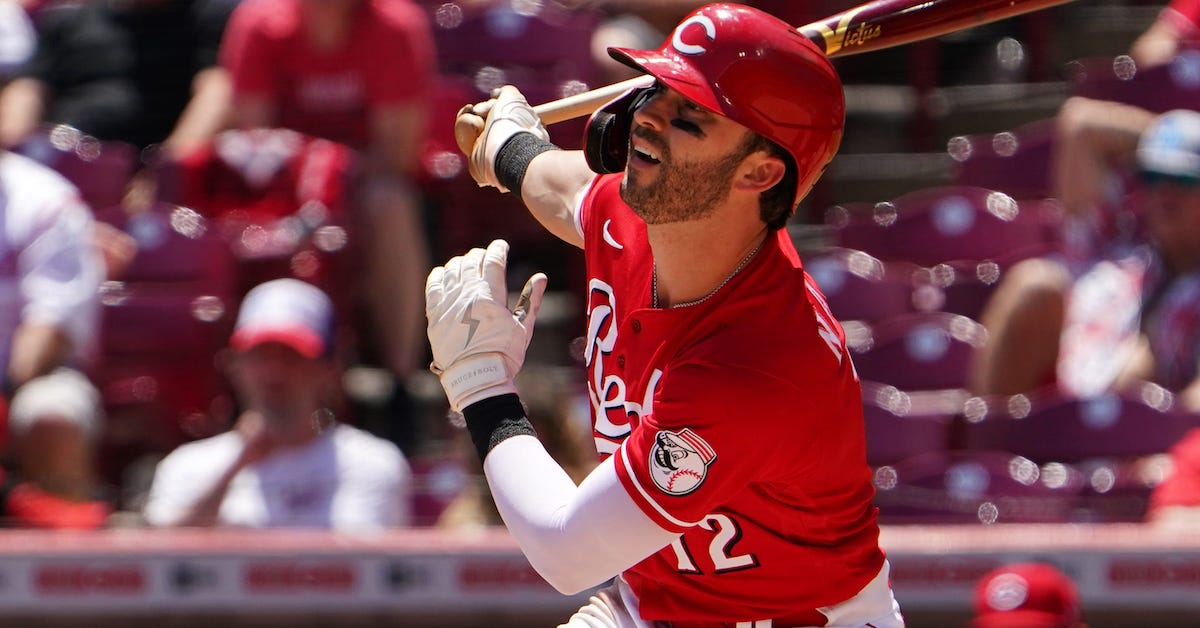
In a platoon role for the Reds, Naquin was hitting .246/.305/.444 overall and .264/.333/.472 against right-handed pitching, playing right field almost exclusively. Both lefty-hitting reserve outfielders, Naquin and Travis Jankowski, are suddenly redundant on the Mets’ bench, which might mean they move on from the latter. Jankowski has just nine hits all year, none since May (he was injured for a stretch), and had been reduced to a rare defensive replacement and frequent pinch runner leading up to the trade. Naquin isn’t as fast as Jankowski nor as good a defender, but he has one of the better throwing arms in baseball and can be a specific sort of defensive replacement of his own (aka a sac fly sniper) and provide meaningfully more with the bat than his fellow 2012 first-rounder. Brandon Nimmo’s center field defense is such that Jankowski rarely represents a meaningful upgrade at his most capable, valuable position. A skillset like Naquin’s is a puzzle piece that fits more snuggly with righty-hitting corner mainstays Starling Marte and Mark Canha, though Jankowski is out of options and was DFA’d shortly after publication of this piece. Read the rest of this entry »
The trade deadline is nearly here and once again, team behavior will be affected by 40-man roster dynamics. Teams with an especially high number of currently-rostered players under contract for 2023 and prospects who need to be added to the 40-man in the offseason have what is often called a 40-man “crunch,” “overage,” or need to “churn.” This means the team has incentive to clear its overflow of players by either packaging several to acquire just one in return, or by trading for something the club can keep — international pool space, comp picks, or, more typically, younger players whose 40-man clocks are further from midnight — rather than do nothing and later lose some of those players to waivers or in the Rule 5 Draft. Teams can take care of this issue with transactions between the end of the season and the 40-man roster deadline in November, but a contending team with a crunch has more incentive to do something before the trade deadline so the results of those deals can bolster the club’s ability to reach the postseason.
In an effort to see whose depth might influence trade behavior, I assess teams’ 40-man futures every year. This exercise is done by using the RosterResource Depth Chart pages to examine current 40-man situations, subtracting pending free agents using the Team Payroll tab, and then weighing the December 2022 Rule 5 eligible prospects (or players who became eligible in past seasons and are having a strong year) to see which clubs have the biggest crunch coming. I then make an educated guess about which of those orgs might behave differently in the trade market as a result.
Some quick rules about 40-man rosters. Almost none of them contain exactly 40 players in-season because teams can add a player to the 40 to replace one who is on the 60-day injured list. In the offseason, teams don’t get extra spots for injured players and have to get down to 40 precisely, so if they want to keep some of their injury fill-ins, they have to cut someone else from the 40-man to make room. Read the rest of this entry »
Jay Jaffe: Good afternoon, folks, and welcome to another edition of my Friday chat. I’m back from a great weekend in Cooperstown, where I survived the 7-man induction ceremony in the blistering heat and got to do some cool stuff like go to the BBWAA party for Lifetime Achievement Award winner Tim Kurkjian at the Otesaga Resort Hotel, the Saturday evening cocktail party in the Hall of Fame plaque gallery, and the party the White Sox threw on behalf of Minnie Miñoso.
2:03
Jay Jaffe: I’ve been writing up a storm since returning, with just one entry to go in my annual Replacement Level Killers series, highlighting the biggest lineup holes on contenders. The corner outfielder installment just went up a little while ago https://blogs.fangraphs.com/the-2022-replacement-level-killers-left-fi…
2:05
Jay Jaffe: With the trade deadline just 4 days away, i see no shortage of questions in the queue about potential trades. I’ll get to some but i’m not going to dwell upon too many because I’m not somebody who has a deep knowledge of prospects and farm systems.
2:06
Bill: Likelihood of Soto landing spots by percentage?
2:09
Jay Jaffe: Based on multiple reports it appears that the Padres and Cardinals are the two teams way out in front of the pack because of their mixes of controllable young major leaguers and high-ceiling prospects. I’d say that while it’s possible that no trade goes down, we’re looking at a 47.6289% chance of the Padres getting him (that’s an exact figure, btw), about a 31.4858333% chance of the Cardinals getting him, the Dodgers at 4.97367%, the Yankees at 3%, and then the rest of the field making up the remainder.
2:12
T: Do you think Strider and Harris would be enough to headline an Ohtani trade? And would you think about it if you were the Braves?
While still focusing upon teams that meet the loose definition of contenders (a .500 record or Playoff Odds of at least 10%), and that have gotten about 0.6 WAR or less thus far — which prorates to 1.0 WAR over a full season — this year I have incorporated our Depth Charts’ rest-of-season WAR projections into the equation for an additional perspective. Sometimes that may suggest that the team will clear the bar by a significant margin, but even so, I’ve included them here because the team’s performance at that spot is worth a look.
As noted previously, some of these situations are more dire than others, particularly when taken in the context of the rest of their roster. Interestingly enough, four of the six teams below the WAR cutoff for right field also make the list for left field: two of them because they’re far below, and the other two because they’re just a hair above, and we might as well acknowledge those situations within this context. As such, I’ve used the rankings of the right fielders to determine the order of the capsules; those that also cover left field include an asterisk. I don’t expect every team here to go out and track down upgrades before the August 2 deadline.
All statistics in this article are through July 27, though team won-loss records and Playoff Odds are through July 28.
2022 Replacement-Level Killers: Left Field
Team
AVG
OBP
SLG
wRC+
Bat
BsR
Fld
WAR
ROS WAR
Tot WAR
Braves
.219
.264
.428
88
-5.8
0.1
-5.1
-0.2
0.5
0.3
White Sox
.247
.291
.387
92
-3.6
0.1
-6.3
-0.2
1.0
0.8
Cardinals
.244
.302
.387
97
-1.6
-0.7
-1.5
0.7
1.4
2.1
Red Sox
.266
.310
.386
91
-4.2
-0.4
2.3
0.7
0.7
1.4
Statistics through July 27. ROS = Rest-of-season WAR, via our Depth Charts.
2022 Replacement-Level Killers: Right Field
Team
AVG
OBP
SLG
wRC+
Bat
BsR
Fld
WAR
ROS WAR
Tot WAR
Phillies
.227
.278
.350
75
-12.4
-2.4
-8.8
-1.4
0.6
-0.8
Red Sox
.198
.262
.320
61
-17.5
-0.6
-0.2
-1.1
0.6
-0.5
Braves
.217
.295
.374
86
-6.7
2.4
-6.7
-0.1
1.8
1.7
White Sox
.260
.323
.381
102
0.8
-0.5
-7.0
0.1
0.7
0.8
Padres
.233
.288
.326
76
-10.7
2.1
1.8
0.2
0.6
0.8
Cardinals
.229
.313
.351
93
-3.5
2.0
-3.1
0.5
1.1
1.6
Statistics through July 27. ROS = Rest-of-season WAR, via our Depth Charts.
Phillies
Bryce Harper was the National League’s Most Valuable Player last year, but he’s been limited to just 64 games overall and eight in right field due to a torn ulnar collateral ligament in his right (throwing) arm and a fractured left thumb. The UCL injury limited him to designated hitter duty, but he continued to rake (.318/.385/.599, 167 wRC+ overall) until an errant fastball from Blake Snellhit him on June 25. He underwent surgery to implant pins to help heal the thumb, but as of Monday, doctors decided that he hadn’t progressed enough to have them removed; he’ll be reevaluated next Monday. Once Harper is cleared, he’ll likely need at least a couple of weeks to ramp up and complete a rehab assignment. If there’s good news, it’s that he has also been undergoing treatment on his elbow (he had a platelet-rich plasma injection in May) and plans to test his ability to throw once the pins are out.
Harper’s move to DH meant that Kyle Schwarber and Nick Castellanos, the two defensively challenged sluggers whom the Phillies signed to big free-agent deals, had to play in the same outfield on most days; thus far, Schwarber has started in left field 89 times and Castellanos in right 84 times. The former has hit for a 119 wRC+ and leads the NL with 31 homers, but the latter has been terrible, batting just .246/.291/.365 (83 wRC+) with eight homers as well as [puts on protective goggles] -6.7 UZR, -7 RAA, and -12 DRS in 723.2 innings in right field. His -1.4 WAR is tied with Robinson Canó for last in the majors among position players. Ouch.
As NBC Sports’ Corey Seidman noted, pitchers have attacked Castellanos with low-and-away breaking balls that he has been unable to lay off. He owns a career-worst 45% chase rate (7.2 points above his career mark) and a corresponding career-high 57.8% swing rate, a combination that fits the pattern of a player pressing. Additionally, he has a career-high 42.7% groundball rate, about six points above his norm, and his .245 xwOBA on pitches outside of the zone is 33 points below his norm; his .103 xwOBA on low-and-away breaking pitches is an 81-point drop from last year and is 36 points below his norm. His overall Statcast numbers (87.8 mph average exit velocity, 7.1% barrel rate, 33.8% hard-hit rate, .299 xwOBA) are all career worsts, as is his 17.5% swinging-strike rate.
If you’ve been reading this series, you know that the Phillies have already made the list at shortstop, third base, and center field. More than likely they’re just going to gut it out here, hoping that either Harper can return to the field or Castellanos can get back on track. Read the rest of this entry »
Earlier today, Jake Mailhot broke down how two unheralded members of the Mariners’ relief corps have contributed to the team’s recent surge. Indeed, a lot has gone right for Seattle, but one area that has not been talked about as often is the catcher situation. In our preseason positional power rankings, the team ranked 16th at the position — not bad, but not great, either. So far, in real life, the Mariners are 14th. That’s not much of a difference, so you’d be inclined to think things have gone according to plan.
What Mariners fans would tell you is that Tom Murphy has been hurt, and Luis Torrens has been hurt and ineffective. Enter Cal Raleigh, who’s taken up the catching mantle all by himself, hitting .211/.288/.474 en route to a 117 wRC+ as of this writing. But it’s not a breakout many anticipated, nor did it come easy. In his first taste of the show last season, Raleigh hit for a mere 47 wRC+ in 148 plate appearances, then struggled to begin this season, ultimately getting sent down to Triple-A to recuperate. After rejoining the big league squad on May 7, however, Raleigh hasn’t looked back, providing big knocks for an aspiring squad ever since.
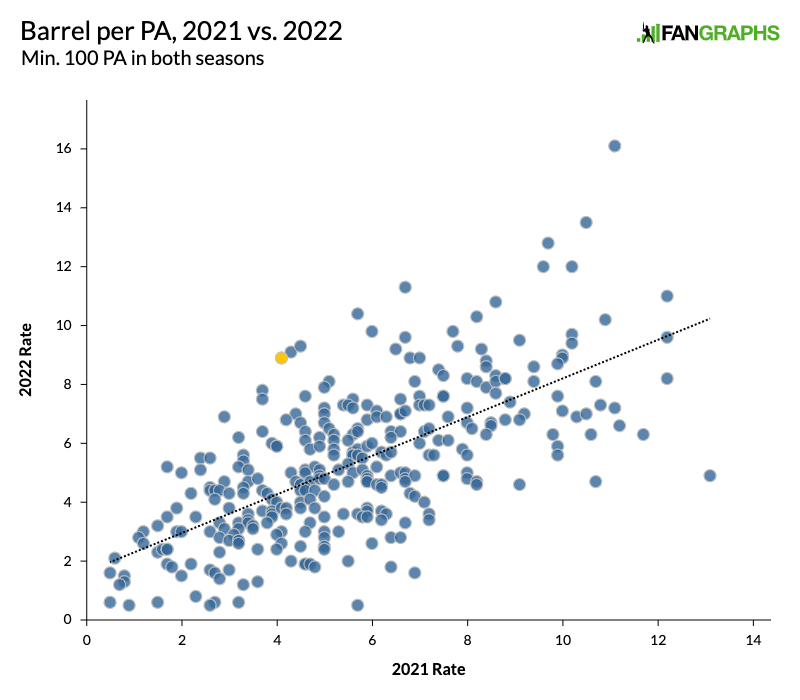
How did Raleigh pull it off? Like so many others before him, he simply started hitting the ball harder — shocking, I know. He has always possessed an uppercut swing, but mediocre exit velocities in his debut year meant his fly balls turned into outs, not extra-base hits. Now, he is supplementing those high launch angles with power. If we look at Barrels per plate appearances, which accounts for the fact that a per-batted ball basis tends to gloss over strikeout issues, Raleigh is one of the league’s most improved hitters. He’s highlighted below in yellow:
Among the 319 hitters in this plot, Raleigh ranks second in barrel per plate appearance gain, behind only Aaron Judge and tied with Rob Refsnyder and Christian Walker, represented by the points snuggled up to his right. Because barrel rates are reliable pretty quickly and stay consistent year-to-year, we can trust that major rises (and falls) aren’t just flukes. And evidently, Raleigh has made a couple tangible adjustments. During his seven-game stint in Tacoma, teammate Mitch Haniger told the young catcher he should hunt for the fastball, as that was the pitch he could handle. Given that only the best of the best can handle several ranges of velocity and movement, it seems like solid advice; not everyone can be Freddie Freeman. Read the rest of this entry »
On this edition of FanGraphs Audio, Ben Clemens is joined by Eric Longenhagen for an extended conversation about this week’s Trade Value Series, next week’s trade deadline, and more.
Eric tells us about his trip to Los Angeles, including seeing the All-Star Game, the Futures Game, and the amateur draft, before Ben shares what it was like to do the Trade Value Series on his own for the first time. We hear how difficult the apples-to-oranges rankings can be, especially when you have players like Oneil Cruz with unpredictable futures or guys who are true unicorns like Shohei Ohtani. The duo also discuss surplus value, Sandy Alcantara growing into his amazing control, Ketel Marte getting too strong for his hamstrings, Mookie Betts’ specific form of athleticism (and contract structure), how modern Shane Bieber looks on the mound vs. his results, how teams with looming 40-man crunch might approach the deadline, and much more.
To purchase a FanGraphs membership for yourself or as a gift, click here.
To donate to FanGraphs and help us keep things running, click here.
Don’t hesitate to direct pod-related correspondence to @dhhiggins on Twitter.
On June 20, the Mariners designated Sergio Romo for assignment. They had just finished an 11-game homestand where they had gone 2–9, and their record had dipped to a season-low 10 games under .500. The next day, Seattle beat Oakland, 8–2, and has gone 24–6 since then, pushing its way into the middle of the AL Wild Card race. Romo wasn’t the only (or main) reason why Seattle had struggled up to that point in the season, but his 8.16 ERA and -0.7 WAR certainly didn’t help either. He does provide a convenient inflection point, though, to talk about how critical the Mariners’ bullpen has been to their play over the past month.
Here’s a table showing how Seattle’s relief corps performance before and after Romo’s departure:
Mariners Bullpen
Time period
IP
K%
BB%
HR/9
ERA
FIP
Shutdowns
Meltdowns
Before 6/20
226
25.50%
7.60%
1.43
4.18
4.17
42
44
MLB Rank
27
6
4
30
19
24
29
26
After 6/20
105.2
29.20%
9.40%
0.68
1.87
3.01
40
11
MLB Rank
23
2
17
3
1
1
4
2
Stats through 7/27
Earlier this season, Mariners relievers had trouble converting an excellent strikeout-to-walk ratio into consistent success. Romo was the worst offender, but Diego Castillo (5.25), Andrés Muñoz (4.50), Drew Steckenrider (5.65), Anthony Misiewicz (4.61), and Matthew Festa (4.35) all had ERAs over four through June 19. Their biggest problem as a group was an outsized home run rate that pushed their FIP up to 4.17 even though their xFIP sat at 3.83. Along with Romo, the Mariners also found ways to get Steckenrider and Misiewicz off their roster, replacing the latter with Ryan Borucki in a trade on June 4 and designating the former for assignment on June 11. All told, Seattle churned through 18 different relievers to start the season, three of whom are no longer with the organization and another seven who were shuttled back to the minors.
A couple of those relievers who struggled early on in the season have been key members of the Mariners’ turnaround. Muñoz went 17 straight appearances without allowing a run before giving up two in last night’s game against the Astros. Castillo and Festa have both been lights out, with ERAs of 1.42 and 1.13, respectively, since June 20. But the one constant has been Paul Sewald. An unknown reliever prior to last year, he improved the shape of both his fastball and slider last year to become one of Seattle’s most valuable relievers. He hasn’t been quite as good this year; after approaching a strikeout rate of 40% last year, that’s fallen to just above 30% this year — still elite but not as dominant. Thankfully, he has a whole corps of relievers behind him who are now putting together fantastic seasons, with a few of them boasting repertoires that curiously look similar to Sewald’s. Read the rest of this entry »
As is tradition at FanGraphs, we’re using the lead-up to next week’s trade deadline to take stock of the top 50 players in baseball by trade value. For a more detailed introduction to this year’s exercise, as well as a look at the players who fell just short of the top 50, be sure to read the Introduction and Honorable Mentions piece, which can be found in the widget above.
For those of you who have been reading the Trade Value Series the last few seasons, the format should look familiar. For every player, you’ll see a table with the player’s projected five-year WAR from 2023-2027, courtesy of Dan Szymborski’s ZiPS projections. The table will also include the player’s guaranteed money, if any, the year through which their team has contractual control of them, last year’s rank (if applicable), and then projections, contract status, and age for each individual season through 2027, if the player is under contract or team control for those seasons. Last year’s rank includes a link to the relevant 2021 post. Thanks are due to Sean Dolinar for his help in creating the tables in these posts. At the bottom of the page, there is a grid showing all of the players who have been ranked up to this point.
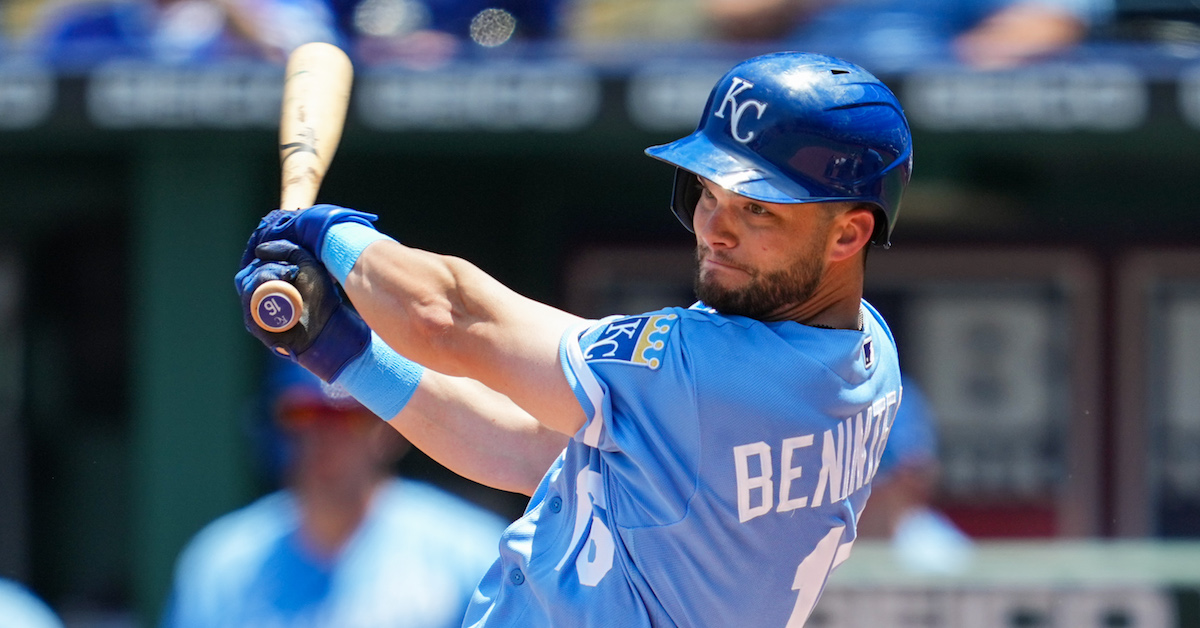
The New York Yankees added outfield help on Wednesday night, closing a deal with the Kansas City Royals to acquire outfielder Andrew Benintendi in return for three lower-level pitching prospects. Coming off his first career All-Star appearance, Benintendi is having what is easily his best season since 2018, fortunate timing for him given that he’ll hit free agency for the first time this fall. In 93 games for the Royals, Benintendi has hit .320/.387/.398 for a career-best 126 wRC+, and his 2 WAR already makes 2022 his second-best full season.
It would be hard to argue that much has gone wrong for the Bronx Bombers in 2022 — even after a month of .500 ball, the Yankees remain on a 108-win pace. But I doubt anyone would claim that Joey Gallo’s annus horribilis is what they had in mind when they sent four prospects to the Rangers for him and Joely Rodríguez almost exactly a year ago. Over his time in New York, Gallo has hit .160/.293/.371, good for an 89 wRC+ and 0.9 WAR. While that’s a pretty robust line for a .160 average, secondary skills can only go so far. There was an argument to be made that Gallo’s lousy stint at the end of 2021 was a BABIP-related blip, but this year, his approach at the plate has completely fallen apart. Always a brutally poor contact hitter, Gallo has to be selective to survive, and in what might be him reacting to his poor August/September last year, he’s been aggressive at the plate in a bad way. How bad? He’s been about 80% more likely to swing at an out-of-zone pitch than he was in 2021 — not a great approach when you miss as often as Gallo does. Even his exit velocity numbers have dropped off the charts. Gallo’s not officially gone yet, but I’d be astonished if he’s Benintendi’s teammate for more than a few days. Read the rest of this entry »


 Jay Jaffe