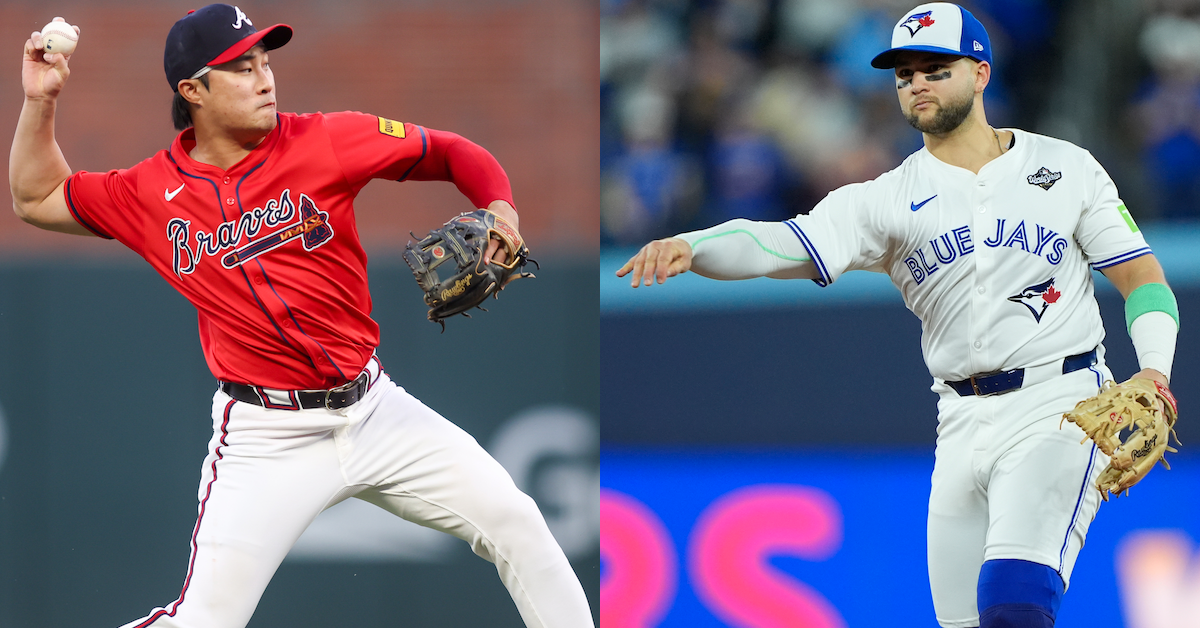
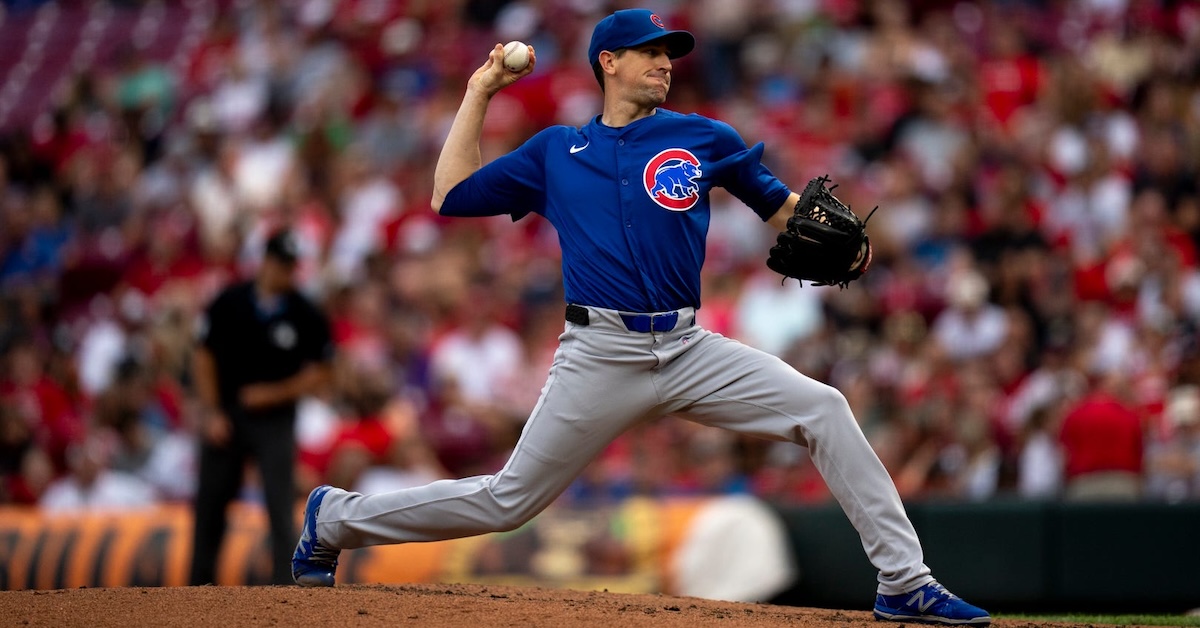
Kyle Hendricks announced his retirement as the GM Meetings were getting underway earlier this week, which presented a good opportunity to get learned perspectives on how “The Professor” pitched effectively at baseball’s highest level despite a fastball that rarely exceeded 90 mph. Moreover, it provided a chance to ask if teams should be trying to develop more pitchers like Hendricks, rather than focusing so heavily on power arms.
Three executives at the just-completed meetings struck me as likely to have especially good insight into those subjects. Here is what they had to say about both the Dartmouth College product, and how difficult it is to develop pitchers who can succeed in the way that he did.
———
JED HOYER — CHICAGO CUBS
Hendricks spent 11 of his 12 seasons with the Chicago Cubs, all with Hoyer serving as the team’s general manager or president of baseball operations. The first question I posed to the longtime exec was this: To what extent can, or should, teams try to develop more pitchers like Hendricks?
“That’s a great question,” replied Hoyer. “I think you’ll wait a long time before you get the next Kyle Hendricks. His command was exceptional. His changeup was exceptional. If you go back and look at his strikeout rates — I don’t know exactly when it fell down a little bit — but I would say that for six, seven years of his career, he wasn’t a power pitcher in terms of strikeout rates, but he wasn’t a finesse pitcher either. Along with not walking guys, he struck guys out. He just did it in a different way. Read the rest of this entry »
For the 22nd consecutive season, the ZiPS projection system is unleashing a full set of prognostications. For more information on the ZiPS projections, please consult this year’s introduction, as well as MLB’s glossary entry. The team order is selected by lot, and the next team up is the Athletics.
Batters
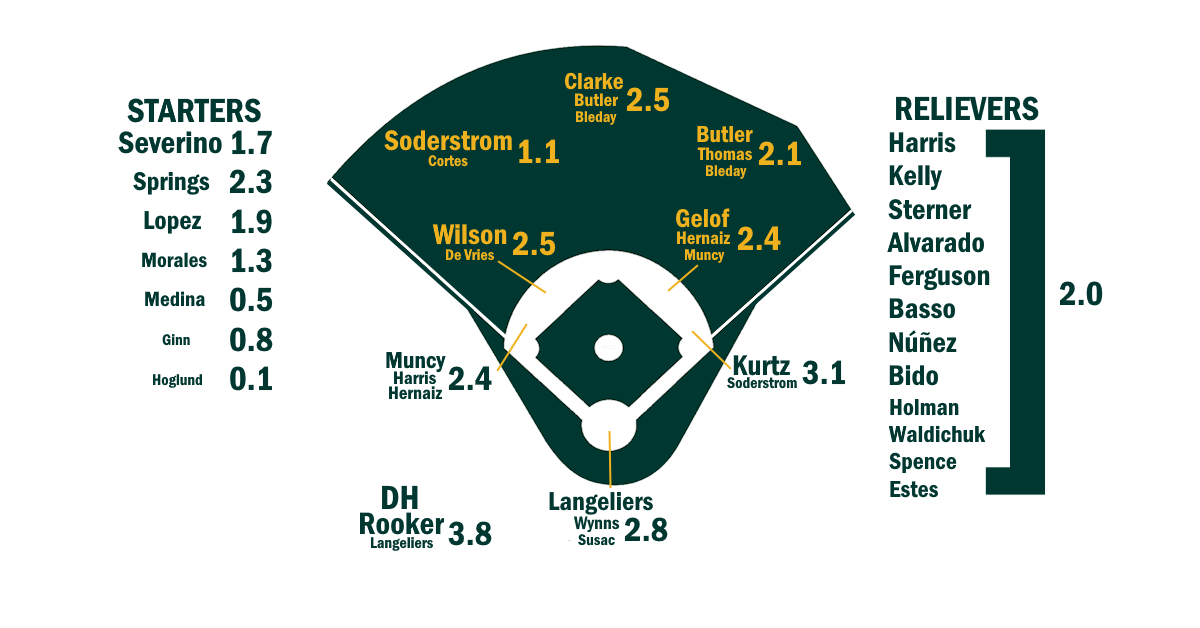
The A’s lineup has made great strides over the last few years, the difference between this graphic and the one from two years ago is nearly night and day. Now, there is no megastar at the top of the WAR stack, but the A’s are pretty solid in most places, aren’t truly abysmal anywhere, and have decent depth options all over the diamond. While this is still far from an elite run creation machine, there’s enough quality surrounding Nick Kurtz and Brent Rooker that this is the type of lineup that could pull its weight in a playoff contention scenario. Even some of the lesser positions like the Max Muncy-led third base amalgamation or the mix-and-match assortment in center field at least project to somewhere around average.
If there’s a disappointment in the projections, it might be Jacob Wilson, for whom ZiPS sees quite a bit of regression coming in 2026. A big part of it is that Wilson’s approach of excellent contact/soft hitting has a fairly poor developmental history in recent decades, and players of this type, if they become too “see ball, hit ball” can fall off quickly like David Fletcher or Luis Arraez. Just like plate discipline should be a means to an end, so should ultra-high contact.
ZiPS also remains a Tyler Soderstrom skeptic and just isn’t as in love with Lawrence Butler as other projection systems have been.
When I talk about the depth, I’m not just being nice; there are a lot of projections for players in the high minors that suggest that they could be fill-in candidates without completely embarrassing anybody. Joshua Kuroda-Grauer might be one of the most interesting. He’s hardly a household name, but the method I use to estimate defense from hit-location data absolutely loves him, and he has the makings of a really solid pairing with Wilson up the middle. The projections also think that Leo De Vries is just a year or two from being a legitimate major league starter. Also in good news for a lineup on a John Fisher-owned team, none of the key players are nearing big free agency paydays that the A’s simply would not match. These guys should be around for a while.
Pitchers
The pitching staff is considerably less impressive than the offense, but even this group has much better projections overall than it did a year ago. Before this past season, I mused that the A’s had kind of lost their knack for developing an endless stream of moderately competent, soft-tossing fourth starters, and it was hurting their chances at getting out of the bottom of the AL West. There are still no aces on the team or, really, any no. 2 starters, but ZiPS thinks the A’s now have a boatload of 90-100 ERA+ starting pitchers, and a few of them (like Luis Medina and Luis Morales) have actual fastballs that they can use to retire major league hitters. What a concept!
I’m not sure that Luis Severino will still be on the roster three months from now, let alone the beginning of August, given his feelings about the stadium situation and potential value for a contending club, but Jeffrey Springs and Jacob Lopez are acceptable mid-rotation starters, and the team has a number of useful fallback options, such as J.T. Ginn and Henry Baez. ZiPS still holds out some hope on Mitch Spence, and is really in on Gage Jump, who has a decent shot in the projections to be the best A’s pitcher 18 months from now.
A Mason Miller-less bullpen is definitely an emoji sad face. While ZiPS sees the pen as a decidedly below-average group, there are far fewer negative WAR projections here than there were last offseason, and the top four of Hogan Harris, Michael Kelly, Justin Sterner, and Elvis Alvarado projects out as…fine…ish. But the bullpen will be a larger worry when the team gets closer to contention.
So, where do the A’s look to be right now? Probably slightly better than the 76 wins they finished with in 2025. But an awful lot would have to go right with the pitching to make this team anything but the fringiest of wild card contenders in 2026. I mean, sure, the A’s could sign Dylan Cease and/or Ranger Suárez, but we all know they’re not actually going to do that. On the bright side, at least these A’s are probably going to be Sacramento’s best major league baseball team ever.
Ballpark graphic courtesy Eephus League. Depth charts constructed by way of those listed here. Size of player names is very roughly proportional to Depth Chart playing time. The final team projections may differ considerably from our Depth Chart playing time.
Players are listed with their most recent teams wherever possible. This includes players who are unsigned or have retired, players who will miss 2026 due to injury, and players who were released in 2025. So yes, if you see Joe Schmoe, who quit baseball back in August to form a Ambient Math-Rock Trip-Hop Yacht Metal band that only performs in abandoned malls, he’s still listed here intentionally. ZiPS is assuming a league with an ERA of 4.16.
Hitters are ranked by zWAR, which is to say, WAR values as calculated by me, Dan Szymborski, whose surname is spelled with a z. WAR values might differ slightly from those that appear in the full release of ZiPS. Finally, I will advise anyone against — and might karate chop anyone guilty of — merely adding up WAR totals on a depth chart to produce projected team WAR. It is important to remember that ZiPS is agnostic about playing time, and has no information about, for example, how quickly a team will call up a prospect or what veteran has fallen into disfavor.
As always, incorrect projections are either caused by misinformation, a non-pragmatic reality, or by the skillful sabotage of our friend and former editor. You can, however, still get mad at me on Twitter or on Bluesky. This last is, however, not an actual requirement.
We’re less than a month from the Winter Meetings and the Rule 5 Draft, which means it’s a good time to evaluate every team’s 40-man roster situation. This is the time of year when teams have one final chance to protect Rule 5 eligible players by placing them on the 40-man. Eligibility is determined by a mix of how long a player has been with their parent organization and how young they were when they signed: Players who signed at 18 or younger must be added to the 40-man within five seasons, while everyone else must be added within four. RosterResource monitors Rule 5 eligibility, if you’re curious to see the lay of the land.
During the season, teams can free up roster space by placing an injured player on the 60-day IL. In the offseason, teams don’t get extra slots for injured players, which tends to put pressure on the back of the roster. The Diamondbacks are a good example of how space can tighten quickly, as they’ve currently got six pitchers battling long-term injuries occupying a spot. You may have noticed a flurry of moves immediately following the World Series, with many teams outrighting players off the 40-man in order to make room for all the guys who were on the IL.
Below, I’ve assessed every National League team’s 40-man roster situation (Eric will sort through the American League tomorrow). Some teams, like the Braves, have plenty of roster space, and thus a lot of flexibility in adding whoever they like. Others, like the Cardinals and Marlins, will face some tough choices as they seek to balance protecting interesting prospects with retaining players already on the roster, as well as finding room for prospective additions via trade or free agency. Some clubs don’t have many impact players to add, while others may need to protect a half-dozen or so guys. I’ve tried to identify which players are most likely to be added, which guys on the 40-man are vulnerable to getting lopped off in a roster crunch, and who could be moved in a deal to free up roster space. Let’s dig in. Read the rest of this entry »
This is the time of year when people start telling me that my job must be so hard now that there’s no baseball to write about. It happens every offseason. I always protest. While it’s true that without major league games to watch, one particularly fun and fruitful source of article ideas has dried up, I actually love writing in November. The truth about who was dealing with an injury all year starts trickling out. The free agent market is shaping up. General managers are hinting at their plans. Scott Boras is unveiling a fresh batch of the worst puns imaginable. I get to dig into my notes app, where I’ve been stashing weirdideas for a rainy day. More importantly, it’s a great time to reflect on the season that was. Everything is still somewhat fresh in your mind, but you’re working with a full season’s worth of numbers. You don’t have to worry that a player’s going to dive into the world’s worst slump the moment after you write about their hot streak. You can write about players who perhaps aren’t changing the course of the season, but are interesting in their own way. It’s a great time to check the leaderboards for a surprise.
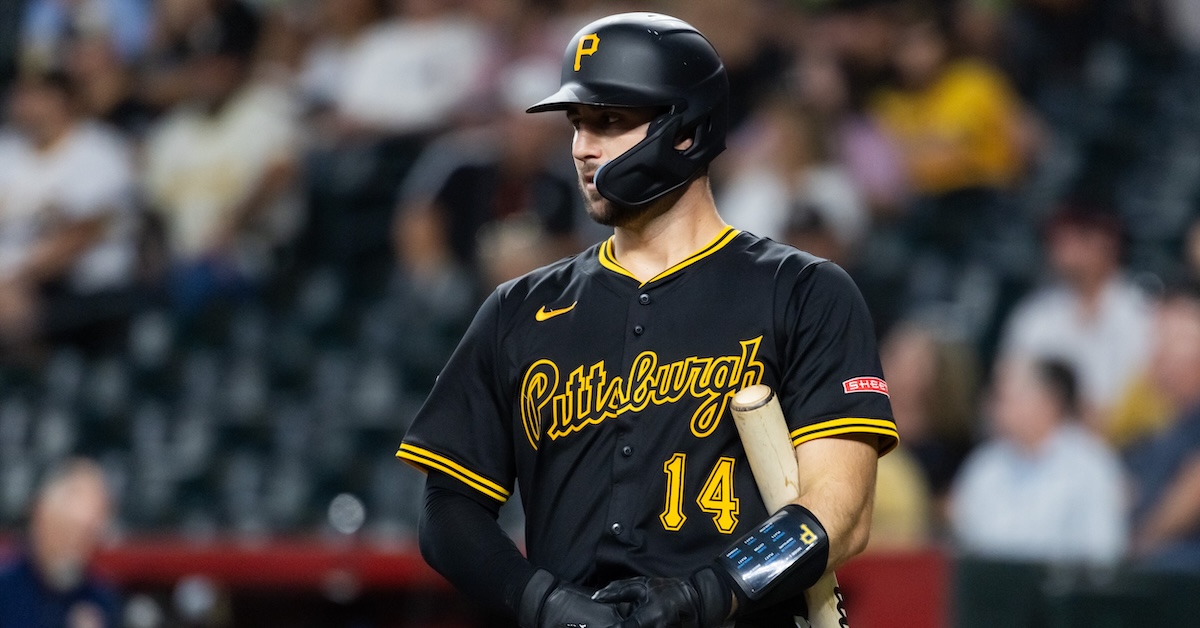
Today’s surprise appeared on the SEAGER leaderboard. That’s Robert Orr’s metric for SElective AGression, and players find their way to the top by swinging at hittable pitches and laying off bad ones. Corey Seager, forever on brand, finished the season in second place (and first in an unpublished updated version). Aaron Judge and Ronald Acuña Jr. finished first and fourth, respectively, which makes plenty of sense since they finished first and fourth in walk rate and also mashed the ball. It was third place that held the name that surprised me: Joey Bart. The 6-foot-3, 235-pound Bart has seen his numbers turn around a bit in the past two seasons. Because he’s a catcher who splits time, his numbers represent a smaller sample with more room for fluctuation, but it was still eye-opening to see him in that kind of company.
Once a Johnny Bench Award winner at Georgia Tech, the second overall pick in the 2018 draft, and the heir apparent to Buster Posey, Bart debuted in San Francisco during the shortened 2020 season and struggled with injuries and underperformance from the get-go. Over 162 games from 2020 to 2023, he batted .219 with just 11 home runs. To that point in his career, his wRC+ in the minors was 123, compared to 77 in the majors. In April 2024, after Bart had exhausted his minor league options and Patrick Bailey had impressed in his own 2023 debut, the Giants traded Bart to the Pirates. Our preseason projections saw him putting up below-average numbers both at the plate and behind it. Instead, he had a career year. Splitting time with Yasmani Grandal and 2021 first overall pick Henry Davis, Bart ran a 121 wRC+, the fourth-highest mark among catchers with at least 200 plate appearances. He bested his career total with 13 home runs. Read the rest of this entry »
For the 22nd consecutive season, the ZiPS projection system is unleashing a full set of prognostications. For more information on the ZiPS projections, please consult this year’s introduction, as well as MLB’s glossary entry. The team order is selected by lot, and the first team up is the Philadelphia Phillies.
Batters
The Phillies offense kept right on rolling for another season, once again scoring nearly 800 runs, and finishing with a wRC+ of 109, the team’s best total during this era. As expected, Philadelphia’s rotation was terrific, but the offense contributed more than its fair share to the team’s 96 wins, the second most in baseball.
There are worries lurking on the horizon, however. Trea Turner had what was certainly his best season in Philadelphia, but he’s entering his mid-30s, a very dangerous time for a middle infielder. I was actually surprised to see the drop-off in the ZiPS projection for Turner, but noticed that Steamer was basically projecting the same thing. Also entering his mid-30s is Bryce Harper, who has solidified his chances of a plaque in Cooperstown, but appears to now be off his peak years. Kyle Schwarber and J.T. Realmuto are free agents, and I think both stand a real chance of returning to Philadelphia, though both are also entering the likely decline phases of their careers; indeed, Realmuto probably already has. Read the rest of this entry »
Shortstop is one of the hardest positions on the diamond to fill, especially if you want anything resembling useful offensive production from the position. Nevertheless, it has been one place where help is usually available on the free agent market.
In the four full offseasons that either straddled or succeeded the last lockout, eight different teams have signed a free agent shortstop to a contract worth $140 million or more. This includes the Rangers, who did it twice in the same winter. Read the rest of this entry »
The General Managers Meetings are currently taking place in Las Vegas, and as always, FanGraphs is on hand to report on what the executives have to say. We’ll hear from a number of them this week, beginning with a trio of National League execs, Matt Arnold of the Brewers, Paul DePodesta of the Rockies, and Chaim Bloom of the Cardinals.
———
MATT ARNOLD — MILWAUKEE BREWERS
Brewers hitters had both a low strikeout rate and a relatively high walk rate this season; they ranked top five in both metrics. How was that achieved, and to what extent was it a focus?
“I think it was achieved by Murph letting people know, ‘You better put the ball in play and you better not chase,’” Arnold replied, crediting National League Manager of the Year Pat Murphy. “He’s relentless about that. Those are good things that we were able to execute this year, and it’s easier said than done. It starts with the players buying in and Murph enforcing that in the dugout, making sure our guys have that as a focus: the ball-strike, the ball in play. Having those types of skills in your pocket can lead to better at-bats and better outcomes.”
Needless to say, it’s not all Murphy. Milwaukee’s hitting coaches play a role as well.
“It’s a combination of all of them,” Arnold agreed. “Our coaches do a really good job of that. They want our guys to focus on getting a good pitch to hit, and again, while it’s easier said than done, we’ve done a good job of that. We try to focus on it as much as we can in our [minor league system] Marrying your scouting and player development is also super important. We try to communicate it with both of them.”
Jackson Chourio had a perfectly acceptable 20.5% strikeout rate, but also a 5.1% walk rate that ranked lowest on the team. How does he take the next steps to better fit that mold?
“He’s so young, and so athletic, and so talented,” Arnold said of the team’s 21-year-old phenom. “He’s got every ingredient to do it. He’s already doing it at a pretty high level. Whatever he does beyond this is even more special. The sky is the limit for this kid.”
———
PAUL DEPODESTA — COLORADO ROCKIES
Colorado’s new top executive is inheriting a team whose hitters had both a high strikeout rate (second-worst in the majors) and a low slugging percentage (tied for sixth worst). If he had to pick one or the other, which is more in need of improvement?
“I would say it’s not the combo we want,” said DePodesta, stating the obvious. “And it won’t ultimately be one or the other. I said earlier what we want our identity to be, in Colorado especially, but… put it this way: If that’s a dial from one to the other, it’s not necessarily going to be one or the other. We need to find the right combination for us.”
Following up, I asked the well-traveled exec if he has an idea of which direction that combination might trend.
“I do, but I probably won’t share it,” he replied. “For us, it’s how we go about scouting and developing, or even setting up a major league roster. So yeah, ultimately it will be proprietary, what we feel is going to work well for us.”
And then there is the organization’s longest-standing question: What is the best way to pitch effectively in Colorado? Is there an actual answer to be found?
“We’ll find out,” DePodesta said. “I’m encouraged. There have been plenty of successful teams in Colorado. When I was in San Diego in 2007, 2008, 2009, and obviously the teams that Buddy [Black] had in 2017 and 2018, those teams were very successful. There were teams that had winning records on the road.
“My approach, at least as of today, is that I know it’s not impossible,” he added. “It’s been done. Are there things we have to consider that other teams don’t? Probably so. Are there adjustments we’re going to have to make that will look a little different than everybody else? Probably yes, but I’m confident that it’s not impossible. We’re going to figure something out.”
One more follow-up seemed in order. Given the Rockies’ reputation of lagging behind other organizations in terms of analytics, are there maybe things that have been overlooked?
“That I don’t know,” said DePodesta, who has spent the last decade working in the NFL as the chief strategy officer of the Cleveland Browns. “I’m looking forward to diving in deeper to the organization and figuring out all the things they have tried. I have a handful of ideas right now, but I would imagine they’re pretty naïve. Coors Field has been around since 1995 [and] they’ve tried a lot of things. I don’t have to reinvent the wheel. I want to understand what all of those things were and what they felt worked, and what didn’t. I don’t want to try things a second time if they’ve already tried them.”
———
CHAIM BLOOM — ST. LOUIS CARDINALS
Cardinals pitchers didn’t strike out a lot of batters this year; they were second worst in the majors. How much of a concern is that?
“It’s definitely a concern,” replied Bloom, who succeeded John Mozeliak as St. Louis’ president of baseball operations at the conclusion of the regular season. “It’s not the only thing that matters, but it does matter. Having stuff that can beat people in the strike zone, that can miss bats — both in and out of the strike zone — is really important. It’s hard to have an elite staff without being able to do that. It’s not something you want to chase at the expense of throwing strikes — you’re not trying to put people in positions where they can’t succeed, or stay healthy — but it’s super important.”
How close is Liam Doyle to helping out in that respect?
“He’ll tell us that as the season unfolds,” Bloom said of the 21-year-old southpaw whom the Cardinals drafted fifth overall this year out of the University of Tennessee. “We gave him a little taste of [pro ball] at the end; he got his feet wet a little bit. Obviously, a first full season will tell you a lot. A first full season in and of itself is a big developmental step for guys, because they haven’t been asked to pitch that regularly for that long. But he came in and showed everything you want to see. He got after his work. He showed openness, a desire to get better, a willingness to listen. There is obviously some work to do before we can call him a big leaguer, but we’re really happy with the pitcher we got.
“The player will move himself,” added Bloom. “The player tells you where he should be. If you try to force something that’s not there, you usually end up paying a price. You might end up picking the pieces up from that for quite some time. When a player is ready and you give him that opportunity, he can carry it. It’s really just what the game is telling us, letting the player’s performance and his progress on the mound carry the day.”
Balls in play are less of an issue when you have a strong defense, which St. Louis largely had in 2025. Just how strong depends on the numbers you favor. I asked Bloom if he could explain how the Cardinals led all teams in Outs Above Average, yet were well below average in Defensive Runs Saved.
“That is a bigger conversation than one we could have here today,” Bloom said. “There are some differences between those metrics, some differences in [how they] get calculated that might disproportionally help or hurt certain types of players. Sometimes those things… they usually will even out year over year. I’ve seen specific players where that might not be the case, because of certain things that the player does or doesn’t do well that some metrics favor — or don’t — but typically over the course of time, they tend to [even out].”
What does it say about the 2025 Cardinals specifically?
“I’d be hesitant to draw too much of a big picture about specific players or player seasons,” Bloom responded. “If it persists over two or three years, then we can look at it as a trend and see if there is something underlying.”
The Pirates Why
The Pittsburgh Pirates are a storied franchise in Major League Baseball who are reinventing themselves on every level. Boldly and relentlessly pursuing excellence by:
purposefully developing a player and people-centered culture;
deeply connecting with our fans, partners, and colleagues;
passionately creating lifetime memories for generations of families and friends; and
meaningfully impacting our communities and the game of baseball.
At the Pirates, we believe in the power of a diverse workforce and strive to create an inclusive culture centered in Passion, Innovation, Respect, Accountability, Teamwork, Empathy, and Service.
Job Summary
The Strategy team with the Pittsburgh Pirates exists to give the Major League coaching staff the information and tools they need to make elite in-game decisions. The group’s analysts translate information into clear, actionable plans that support both daily competition and long-term player growth.
The Baseball Strategy team will be considering applicants at both the Analyst and Senior Analyst level. In this role, you’ll work alongside Major League coaches and staff, helping turn information into on-field impact. Your work will include elements of game preparation, in-game strategy support, post-game review, skill development, and ongoing tool or process improvement.
Responsibilities:
Partner with Major League coaches to identify and create competitive advantages.
Translate data, video, and player information into clear, usable insights that influence in-game decisions.
Build and maintain workflows, tools, and processes that streamline information delivery.
Collaborate across department, including R&D and Player Development, to connect insights from multiple sources.
Communicate findings clearly and efficiently, tailoring information to a variety of audiences.
Qualifications
Required:
Authorized to work lawfully in the United States.
Demonstrated ability to synthesize complex information into actionable recommendations.
Proven ability to manage multiple projects and meet tight deadlines in a fast-paced setting.
Excellent communication and relationship-building skills.
Strong knowledge of modern baseball research and technologies.
Programming language proficiencies:
General purpose programming (Python or R)
Relational databases (SQL)
Ability and desire to learn other programming languages as needed.
Desired:
Software development experience (Javascript or Typescript)
Experience visualizing data with a Javascript library like d3.js
Experience working with coaches, analysts, or player development staff in a high-performance environment.
Demonstrated baseball or other sports analytics research work product.
Equal Opportunity Employer
The Pittsburgh Pirates are an equal opportunity employer. All qualified applicants will receive consideration for employment without regard to race, color, religion, sex, national origin, disability status, protected veteran status or any other characteristic protected by law.


 Dan Szymborski