Who was the Nationals’ best player in 2022? Before you try to answer, I should acknowledge that this is not a fair question to ask. For starters, it’s a trick question. More importantly, you haven’t been watching the Nationals. You’ve been doing the best you can to avoid even thinking about the Nationals. That’s called self-care, and I commend you for it. Even the Nationals’ general manager called it “a daily grind to come here and lose baseball games.” He also called trading Juan Soto a “courageous move by ownership,” so maybe don’t listen to him.
Regardless, go ahead and give it a shot! Keibert Ruiz would be a reasonable guess. The promising young catcher posted 1.7 WAR this season. You could also be forgiven for going with Joey Meneses, who put up 1.5 WAR in just 228 plate appearances since his promotion in August. Read the rest of this entry »
Department: Baseball Operations Location: St. Louis, MO, USA Reports To: SRVPGM – Senior VP/General Manager
Summary of Responsibilities:
The St. Louis Cardinals are currently seeking candidates for a Baseball Operations Fellow position for 2023. This Fellowship is a one-year opportunity. At the end of the Fellowship, the Cardinals and the Fellow will jointly determine if there is an appropriate opportunity for full-time employment with the Cardinals. Fellows will not return in the same position in 2024. The Fellow will report directly to the Manager of Video Operations and will work on projects at the direction of senior leadership from the Baseball Development, Domestic & International scouting, Player Development, and Performance departments. Additional training may be provided in topics from scouting to analytics depending on the needs of the team and the Fellow’s interest.
The ideal candidate will have demonstrated a strong work ethic, the ability to learn and adapt to new processes, and a passion for baseball. The Fellowship will provide such a candidate with a broad range of experiences across Baseball Operations and the possibility of permanent employment.
The Baseball Operations Fellow position is a full-time position including salary, health insurance, and benefits
This position is from early 2023 through the end of the calendar year
This position is in St. Louis, MO and will require relocation<
The St. Louis Cardinals are committed to building an inclusive organization where we have a diverse workforce as well as a culture where employees feel they belong and contribute their unique abilities to the team. This Fellowship is dedicated to continuously building a diverse staff, and we strongly encourage candidates who are members of historically marginalized groups, which may include, but are not limited to persons of color, LGBTQIA+, gender, veterans, and persons with disabilities, to apply. If you meet any of the qualifications listed below we welcome you to apply, or to reach out to us at hrinfo@cardinals.com for more information.
Essential Functions of the job:
Assisting in the video capture and processing of domestic amateur, international amateur, and affiliated and unaffiliated professional baseball games
Assisting Baseball Development and other groups within Baseball Operations with data collection and entry for analysis
Communicate effectively with Baseball Operations staff and complete ad-hoc requests as needed
Education and Experience:
Current college senior or postgraduate
Strong interest in and understanding of baseball/softball
Excellent written and verbal communication skills
Strong organizational skills
Aptitude and comfortability with Microsoft Excel and Google G-Suite (e.g. Docs, Sheets, Slides)
Proficient with computers, iPads, and other electronic devices
Ability to work weekdays, nights, weekends, and holidays
Department: Baseball Operations Location: USA Reports To: SRVPGM – Senior VP/General Manager
Summary of Responsibilities:
St. Louis Cardinals are currently seeking candidates for this position to be located at each of our domestic minor league affiliates and our Dominican Republic Academy. The Minor League Affiliate Fellow will manage all aspects of video and technology at these locations in supporting the minor league coaching staff (manager, hitting coach, and pitching coach). The data collected from video and technology will be utilized to provide feedback to players for development.
Pre-game this position will manage distribution, set up and usage of all baseball & sport science technology; during the game this position will manage technology resources for the minor league coaches from the dugout. Post-game this position will ensure all data and video collected from the day is available for reporting & analysis; create reports for players and coaches as required. This position will work directly with the Video & Technology Team and reports to the relevant minor league manager for day-to-day responsibilities at the affiliate.
The ideal candidate will have demonstrated a strong work ethic and impressive intellect. The position is a seasonal job for the 2023 season only, but may lead to full-time employment in Player Development, Scouting, or elsewhere within Baseball Operations.
The Minor League Affiliate Fellow position is considered a full-time position including salary, health insurance, benefits, housing stipend and meal money during road trips.
Essential Functions of the Job:
Manage baseball & sport science technology and video capture at the affiliate (e.g. Trackman, Blast Motion, Edgertronic Camera, Polar, Whoop, etc.).
During the game, depending on staff needs:
Manage in-game capture of technology and video from the dugout
Quality assurance of the video and data collected for analyses
Communicate any implementation issues to Technology Specialist / Technology Integration Coordinator that are not remediated through initial troubleshooting
Attend Spring Training and travel with assigned minor league team on the road
Education and Experience:
Postgraduate or college senior available to start work during Spring Training
Proven ability to use and troubleshoot baseball or sport science technology (like pairing portable trackman to an Edgertronic camera, syncing wearable technology to a mobile device, etc.)
Familiar with and/or demonstrate the willingness to learn technology such as Blast Motion, Trackman, and video integration
Ability to communicate effectively and efficiently
Proficient with computers, iPads, and other electronics
Ability to work weekdays, nights, weekends and holidays
Ben Lindbergh and Meg Rowley banter about Ben’s efforts to get the new dictionary definition for “ghost runner” changed, how to watch the playoffs when one has cut the cord, Meg’s Rookie of the Year voting deliberations, the underrated Jeff McNeil, the two teams whose per-game attendance declined this season, MLB’s problem gambling PSAs, a DraftKings ad, and more, plus Stat Blasts (56:12) about the worst best players on a team, the change in the percentages of players who make the playoffs and the World Series in their careers, and Mike Trout’s emoji and exclamation point use on Twitter, followed by a Past Blast (1:28:25) from 1912.
With the playoff matchups set, we welcome one half of Céspedes Family BBQ to the show as we look ahead to the newly expanded postseason.
First, Michael Baumann welcomes Jake Mintz, one half of Céspedes Family BBQ, writer at Fox Sports, and co-host of the Baseball Bar-B-Cast on SiriusXM, to the show. The pair begin by talking about their passion for competitive cycling, but quickly move on to October baseball. The Mariners and Phillies have ended their droughts, but Philadelphia manager Rob “Thomper” Thomson is still getting his name mispronounced. We hear the duo’s thoughts on that, Aaron Judge‘s quest for 62, the red-hot Braves passing the Mets down the stretch, Charlie Morton’s inability to retire, the politics of steroids, and returning to the world of podcasting. [3:58]
After that, Ben Clemens and Dan Szymborski get together to discuss Baumann’s proposal for league expansion as well as the legend of Joey Meneses, who might already be the Nationals’ best player. We also get the pair’s thoughts on whether the Tigers will be ready to compete before the Royals, whether the Marlins will be back in the playoffs before the Nationals, and how the effects of the balanced schedule and division rivalries compare to getting bored of The Borg. [37:07]
To purchase a FanGraphs membership for yourself or as a gift, click here.
To donate to FanGraphs and help us keep things running, click here.
Don’t hesitate to direct pod-related correspondence to @dhhiggins on Twitter.
The life of any top prospect is filled with pressure, but for Jarred Kelenic, that pressure might have been even greater than usual. Being the marquee prospect in a blockbuster trade must put extra weight on a player’s shoulders. For a time, it looked like the Mariners had pulled one over on the New York Mets. Kelenic was ranked fourth overall entering the 2021 season as a 60 FV prospect, and was viewed as one of the first in a wave of young players meant to save the Seattle Mariners from a protracted playoff drought. But the discourse around the trade that sent him to Seattle — in which he, Jay Bruce, Gerson Bautista, Justin Dunn and Anthony Swarzak went to the Mariners while Robinson Canó, Edwin Díaz, and $20 million went to the Mets — has flipped. Kelenic has struggled in his time in the majors, while Díaz has struck out half the batters he’s faced in 2022. Sometimes prospects get the chance to adjust to the big leagues in relative quiet, but Kelenic’s first 400 plate appearances have come with a high level of scrutiny, and his struggles have forced us to reconsider his ceiling as a hitter.
Yet Kelenic has recently made some strides. In 2021, he was bad against breaking balls, posting a .214 wOBA against them. Jumping ahead to 2022, Kelenic’s issues with breaking balls became even more apparent. In the season’s early going, his wOBA fell even further, down to .093. That’s not a passable mark for a quality big league hitter, and Kelenic was sent down in the middle of May. After a few months in the minors, he got another chance in August, but he had barely finished his cup of coffee before being optioned again. Read the rest of this entry »
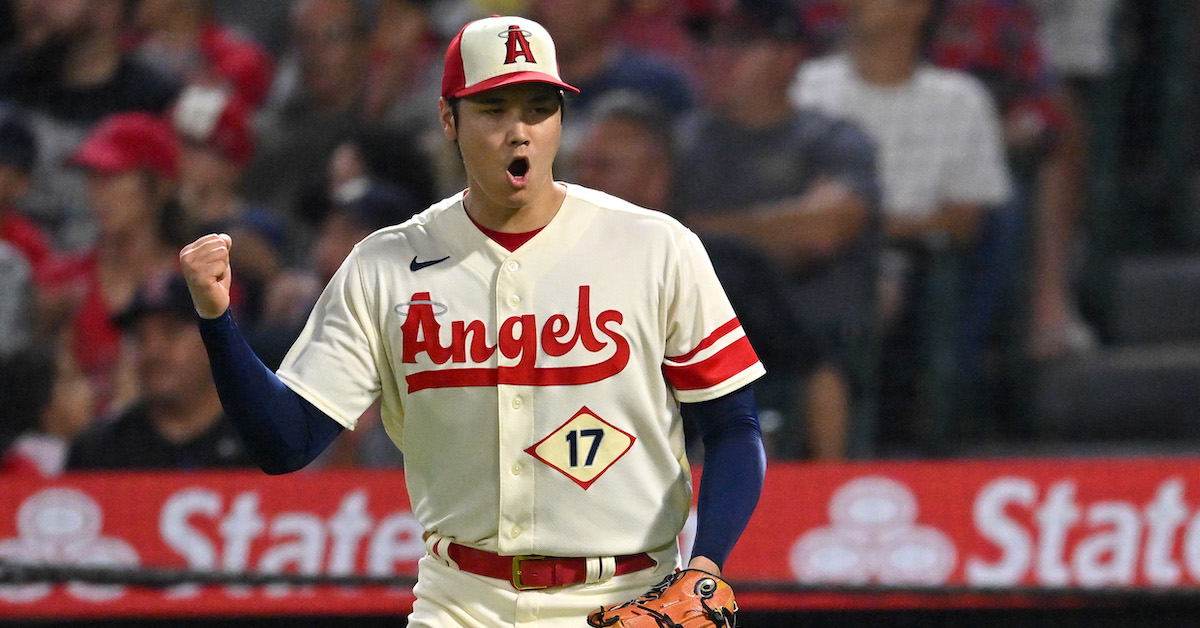
Shohei Ohtani is one of the best pitchers in baseball and one of the best hitters in baseball. That’s the first thing everyone thinks when his name comes up, and it always will be. He pitches and hits! How could you talk about anything other than that?
While that’s true, it’s leaving out something important. Ohtani is fascinating not just because he’s a two-way player, but because he’s completely overhauled his pitching approach in the middle of his best season yet. When Ohtani threw eight two-hit innings in his latest start, he hardly resembled the pitcher he was in 2021 – or even early in 2022.
When Ohtani pitched and hit his way to the American League MVP award last year (my colleague Jay Jaffe recently covered his quest to defend that title), he did so with a garden-variety pitch mix. He relied most on his four-seam fastball and complemented it with two plus secondaries, a slider and a splitter. He mixed in the occasional cutter and curveball, but mostly stuck with his best three offerings. It’s a classic pairing: fastball, breaking ball, offspeed pitch. It worked because all three pitches are excellent; if you had a 100 mph fastball, a fall-off-the-table splitter, and a biting slider, you’d probably do the same.
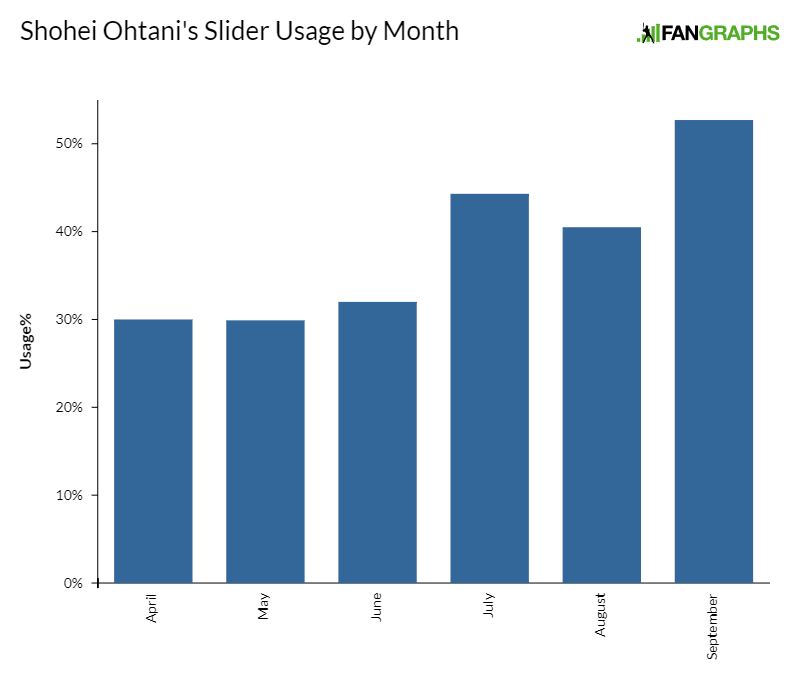
Over the offseason, though, Ohtani overhauled his slider. He came out this season throwing it harder and more frequently. In his third start of the year, he flirted with perfection against a loaded Astros lineup, and from that point on, he was a slider-first pitcher. Look at his slider usage by month this year and marvel:
Everybody loves a shiny new tool. A new tool holds the promise of a better future. “This new spatula,” we say to ourselves, “will transport us to a world of fluffier pancakes.” “Loved ones,” we say to our loved ones, “this cordless drill is going to revolutionize the way we drill holes into things, if and when we decide to start drilling holes into things.”
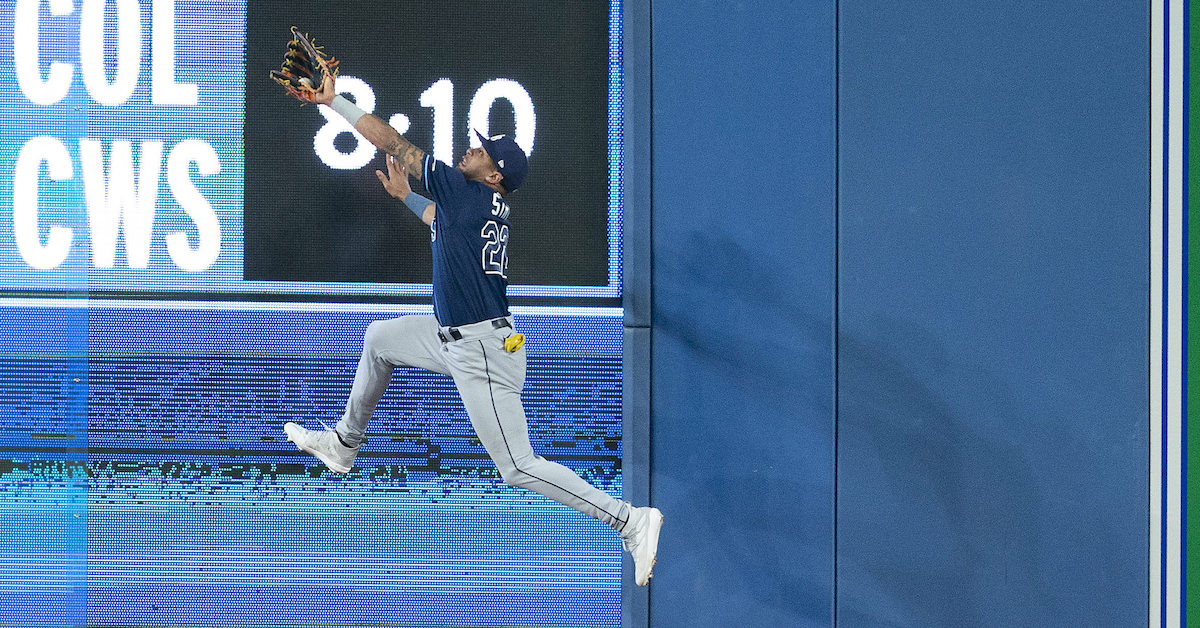
Statcast’s Outfielder Jump Leaderboard is very shiny. For balls with a catch probability of 90% or lower, it lists every player’s average in several categories. Playing with this leaderboard, I envisioned a bright new future. A future where I could definitively tell anyone unfortunate enough to be within earshot whether it’s more important to get a good jump on a ball or take a good route to it.
Predictably, I broke the tool immediately. Or at least, I thought I did. What I noticed was that the players who took good routes tended to be, well, bad. They had worse reactions, bursts, and Outs Above Average. Most damningly, they counted among their number one Kyle Schwarber. That made me curious. Read the rest of this entry »
Ben Lindbergh and Meg Rowley banter about the Braves’ first sacrifice bunt of the season, Meg’s gratitude for the effect Mariners fandom has had on her life, the Orioles’ status as impressive also-rans, Atlanta overtaking the Mets, how to assess an MLB season, and the playoff field being set. They also react in real time to Aaron Judge’s 62nd home run and discuss Jon Berti stealing his 40th base, the latest Astros leadership turmoil, and a dismaying dictionary addition, followed by a Past Blast from 1911. Then (46:33) they talk to Jordan Shusterman of Céspedes Family BBQ and Fox Sports about witnessing Cal Raleigh’s drought-ending homer in person, the nickname “Big Dumper,” Jordan’s journey as a Mariners fan (and Meg’s reaction to the team clinching), the potential end of playoff droughts, and more, plus postscript updates and followups.
For a moment, it seemed like Aaron Judge might not reach 62 home runs. After hitting his 61st in Toronto last Wednesday, he fell into what counts as a slump for him these days: four games, two hits, and a handful of walks. After feeling inevitable for most of September, 62 suddenly felt tenuous.
What a foolish sentiment. Judge, as we’ve seen all year, is a home run machine. He’s an offensive machine, in fact, blowing away the rest of the league with the kind of performance not seen since Barry Bonds in his prime. Unlike most single-season home run chases, Judge’s season isn’t defined by a single round number. His offensive greatness is so robust, so all-encompassing, that treating this accomplishment as the crowning achievement of his season is unfair.
The single-season home run record in major league baseball is 73. It was set in 2001, by Barry Bonds. Sixty-one has a ring to it, of course, because it was the record for so long. It was also the American League and Yankee record, two marks that feel weighty even if they aren’t quite as impressive as “best of all time.” Plenty of the fanfare around Judge comes from the sheer rarity of seeing so many homers, but plenty also comes from the fact that some fans would prefer to ignore everything that happened from 1998 to 2001 and make the record 61 again.
I’m giving you permission to tune all of that out. Sixty-two home runs is cool regardless of what the all-time record is. Only six players have ever accomplished the feat of hitting 60 home runs, and you know all of their names: Bonds, Mark McGwire, Sammy Sosa, Roger Maris, Babe Ruth, and now Judge. That alone is mind-blowing; baseball has been around an impossibly long time, through periods of high and low scoring, and yet only six players have ever cracked 60 home runs in a year throughout it all.
Does that mean hitting 62 is anti-climactic? I’ll leave that interpretation up to you. But more so than any one increment – would it be special at 63? 65? – I’m impressed by how handily Judge has lapped the league today. Is it cool to pass Maris? Undoubtedly. If nothing else, now Judge’s future offspring can traipse around the country and opine about someone else’s homers hit in the far-off future. More pressingly, though, Judge has left the rest of baseball behind in a way not seen for many years.
Home runs aren’t hit in a vacuum. The majors go through home run droughts and booms for myriad reasons, including pitcher talent, park dimensions, pitching style, and baseball composition. It’s hard to say whether 2022 Judge or 1961 Maris hit under easier conditions, but one way to look at it is to consider how many home runs separate the major league leader from their closest challenger at the end of each season. By that standard, Judge is in impressive company. Here are the top 11 seasons (including a 10th place tie) by home run gap since the dawn of the 20th century:
First, yeah, that Babe Ruth guy was pretty good. Since the 1920s and ’30s, though, no one has done what Judge is doing. The only player to come close was Willie Mays, not exactly shabby company. Last year, Shohei Ohtani won an MVP by playing the way people think Babe Ruth did – pitching and hitting. This year, Judge is likely going to win an MVP by playing like Ruth actually did: with a ludicrous string of home runs that makes everyone else playing look like a weakling by comparison.
Even without that gap between Judge and Kyle Schwarber, though, this season would be an all-timer. The great arrow of baseball time points inexorably towards more uniformity and more talent. It’s a professional game; even the up-and-down bullpen arms and utility infielders of today work year-round at their craft, honing their bodies and minds in pursuit of fame and riches. In a sport where we measure success relative to a league baseline, that means it’s harder than ever to stand out.
This arc of progress isn’t some new phenomenon. Stephen Jay Gould, the late and celebrated biologist, wrote about it in 1986, though he framed it in terms of the extinction of .400 hitters. Standing out from the field simply gets harder with every generation because even the lesser lights of baseball now search for every possible edge.
To wit: wRC+, our marquee offensive statistic here at FanGraphs, considers a player’s production relative to his peers. A 150 wRC+ has no fixed statistical translation. It merely means that a player’s overall batting line is 50% better than the league as a whole. Judge’s mark – 208 heading into today’s action – means that he’s 108% better than the overall league.
In Ruth’s day, when dinosaurs walked the earth and many of baseball’s best players weren’t allowed to play in the same league as him, a 200 wRC+ wasn’t particularly uncommon. But as competition increased, players lapped the rest of the field less often. Ruth and Ted Williams each had career wRC+ marks that approached 200. Since 1972, though, there have only been nine individual seasons that eclipsed 200:
Jeff Bagwell, Frank Thomas, and Juan Soto all accomplished their feats in shortened seasons. Bonds – well, he’s Barry Bonds. That just leaves Judge and McGwire out of the last half-century. Heck, order every season by wRC+ and exclude Bonds, and that gives Judge the best single season relative to his peers since Williams (223) and Mickey Mantle (217) posted similarly absurd seasons in 1957.
If I had my druthers, that’s how Judge’s season would be remembered. Sixty-two home runs is neat, and I’m glad he got there. A 16-homer lead on the field is spectacular, the stuff that only long-forgotten icons of the game have ever even dreamed of. But putting together an offensive season that blows away the rest of the league to this degree, at a time when his peers are as good as they are? Goodness gracious. We probably won’t see another season like Aaron Judge’s 2022 in our lifetimes. Let’s appreciate it.
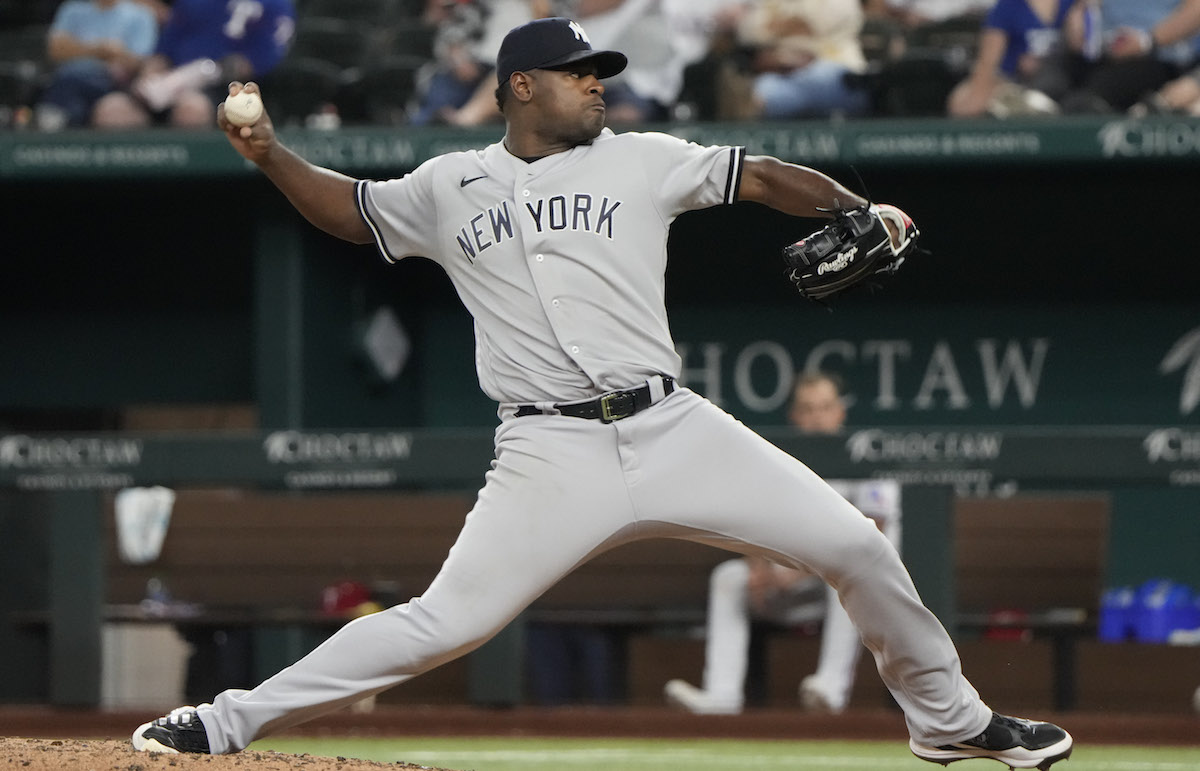
All eyes were on Aaron Judge as he took the pursuit of his 62nd home run to Globe Life Field Monday night (the slugger went homerless), but it was Luis Severino who stole the show. In his third start back following a 10-week absence due to a strained latissimus dorsi, Severino threw seven no-hit innings before his pitch count forced him from the game. The Rangers did collect two hits in the eighth inning, but Severino’s outing offered the Yankees some reassurance regarding the oft-injured 28-year-old righty as the postseason approaches.
Facing the Rangers — a team that had already lost 92 games and that entered Monday ranked 10th in the American League both in batting average (.239) and wRC+ (98, tied with the Guardians) — Severino allowed just one baserunner. He retired the first seven batters he faced before walking Josh Smith, who was immediately erased via a 101-mph double play groundball off the bat of Bubba Thompson. Only once after the third inning did Severino even yield a hard-hit ball, a 99-mph fourth-inning drive by Corey Seager that had a .480 expected batting average based on its exit velocity and 25-degree launch angle (but not its direction). None of the 12 other batted balls he allowed had an xBA higher than .340. Read the rest of this entry »




 Sponsor Us on Patreon
 Subscribe to Stathead
 Facebook Group
 Twitter Account
 EW Subreddit
 Effectively Wild Wiki
 iTunes Feed
 Get Our Merch!