Primary Purpose
The Cleveland Guardians Fellowship program is designed to accelerate the pace of development and impact for people interested in working for our organization. Fellowship roles are focused on solving complex challenges, which involve developing innovative approaches, tools, and techniques to meaningfully drive the organization forward. Fellows will be exposed to work across multiple departments and have access to and be encouraged to use a suite of internal, proprietary resources.
The Cleveland Guardians Fellowship program is all about fostering your growth and making an impact within our organization. As a fellow, you’ll take on real challenges and come up with creative solutions that help move us forward. You’ll get to work with different departments across the organization, gaining hands-on experience and using some of our exclusive, in-house tools. It’s a great chance to dive in, learn, and make a difference!
We are seeking Fellows to join our Baseball Technology department. Each Fellow will work full-time with one of our minor league affiliates (Columbus, Akron, Lake County, Lynchburg, and Arizona Complex) and report to the Baseball Technology, Player Development, and Baseball Operations departments. Fellows will be expected to manage the collection of multiple data streams and operate as a resource for both coaches and players. This position will include travel to away games.
We’re looking for someone who’s curious, creative, and open to new ideas—someone who loves working in a team setting. You should be comfortable communicating with others, building solid relationships, and explaining complex ideas in a way anyone can understand. You’ll also have the opportunity to take the initiative and perform research in the area of your choosing that helps push forward the Guardians’ approach to player development.
Operate and maintain bat/ball tracking systems and emerging sports science technologies.
Manage pre-game, in-game, and post-game video processes.
Manage the corresponding data and video collection process and assist with interpretation & distribution.
Assist the Information Systems team with Baseball Technology related troubleshooting and support.
Coaching Staff Support:
Support Minor League field staff with Advance Scouting Process.
Assist affiliate staff with various administrative tasks (i.e. daily scheduling, team travel).
Assist Minor League field staff with pre-game activities.
Baseball Development and Analysis:
Collaborate with coaching staff, Player Development, and Baseball Operations to monitor player goals and player progress.
Perform ad hoc research and analysis, both at the request of staff and independently.
Communicate findings and insights to Minor League Coaches, Players, and Player Development and Baseball Operations Departments.
Education & Experience At the Cleveland Guardians, we are all about creating an environment that brings out the best in everyone. It is a big part of who we are, how we compete, and how we make an impact in our community. We want every employee to feel like they truly belong here.
We also know that people sometimes hesitate to apply for jobs unless they check every single box on the qualifications list. We are looking for the best person for the job, and we know that you might bring skills and experiences that are not exactly listed but could be a huge asset to our team. So, if this role excites you, we encourage you to apply, even if you do not meet every single qualification.
Bachelor’s degree or Prior Professional Experience.
Demonstrated passion for at least one of baseball technology, scouting, baseball analytics, sports science, hitting or pitching analysis and/or biomechanics, strength and conditioning, motor learning, or other baseball/softball related field.
Job Skills
Organization: Ability to create, maintain and execute a schedule effectively.
Work Ethic: A relentless drive to collect more and better information.
Passion: Demonstrate a clear passion for the game, teammates, the organization, and learning.
Resourcefulness: Utilize organizational resources to develop and understand organizational philosophies.
Strategic Thinking: Employ a problem-solving mindset and strategic thinking.
Time Management: Ability to prioritize in a fast-paced environment.
Collaboration: Partner with staff and players and exhibit excellent written and verbal communication skills.
Preferred Experience
While we are looking for a variety of diverse skill sets for this role, we know that past Fellows who have thrived in this role possessed certain skills that are best aligned to the game of baseball. If you have demonstrated experience with any of the following, you may be better positioned to thrive in this role.
Conversational Spanish or better a plus.
Experience with video editing software a plus.
Experience with SQL and statistical software (i.e. R, Python, Stata, SAS) a plus.
Proficiency with Microsoft Office.
Working knowledge of advanced baseball statistics and publicly available research.
About Us:
In Baseball Technology, our shared goal is to identify and develop diverse players and front office teammates who contribute to our mission. By working together effectively and collaboratively, we create a family atmosphere that supports learning as we strive for excellence in everything we do. We believe that we will achieve our goals by making evidence-based decisions and creating environments that support our people and empower them to learn.
DEPARTMENT: Pro Acquisitions – Baseball Operations ORGANIZATION: Chicago Cubs REPORTS TO: Vice President, Pro Acquisitions LOCATION: Arizona or Florida FLSA STATUS: Exempt
BEING PART OF THE TEAM
Our business is a team sport that began on a field with baseballs and bats and has evolved into one of the most recognizable brands in sports and entertainment through Cubs baseball and live events. Our success is driven by our people, who work to create and inspire change in an engaging, collaborative and inclusive environment. As a team, we continue to build a culture on and off the field that delivers unforgettable experiences for one another, our fans and community. In support of that effort, we expect associates to work primarily in our office. Are you ready to be part of it?
OUR STORY
THE CHICAGO CUBS FRANCHISE The Chicago Cubs franchise, a charter member of Major League Baseball’s National League since 1876, has won the National League pennant 17 times and was the first team to win back-to-back World Series titles in the 1907 and 1908 seasons. In 2016, the Chicago Cubs made history again when the team won its first World Series in 108 years, ending the longest championship drought in North American sports. Known for its ivy-covered outfield walls, hand-operated scoreboard and famous Marquee, iconic Wrigley Field has been the home of the Chicago Cubs since 1916 and is the second oldest ballpark in Major League Baseball. In 2009, the Ricketts family assumed ownership of the Chicago Cubs and established three main goals for the organization: Win the World Series, Preserve and Improve Wrigley Field, and Be a Good Neighbor.
HOW YOU’LL CONTRIBUTE:
The Pro Acquisition Specialist plays a key role in supporting the organization’s player evaluation and acquisition processes. The Specialist must be local to or willing to relocate to Florida or Arizona and will focus on live scouting coverage of players, producing high-quality written reports, capturing high-speed video, and contributing to the organization’s understanding of player value. The Specialist will also be tasked with ad hoc video reports. In the offseason, the Specialist will attend workouts in the assigned region and will also be expected to conduct or assist with ad hoc research projects to enhance player evaluation frameworks and decision-making processes.
This role requires strong scouting instincts, proficiency with analytical methods, and the ability to synthesize information into actionable recommendations. The position is ideal for someone passionate about player evaluation who can balance traditional scouting with modern analytical approaches.
THE DAY-TO-DAY:
Provide in-person scouting coverage of players during the season, producing timely and detailed reports on player skills, performance, and projection.
Capture high-speed video of players at games and workouts.
Complete video scouting reports as assigned.
Attend offseason workouts in assigned region.
Build and maintain relationships with league personnel, coaches, and other contacts in assigned region.
Conduct offseason project work, which may include research and other initiatives to support player acquisition.
Contribute to the continuous improvement of scouting workflows, evaluation methods, and decision support processes.
WHAT YOU’LL BRING:
Strong written and verbal communication skills with the ability to produce clear, detailed scouting reports.
Demonstrated understanding of fundamental scouting principles and current baseball analytics research.
Ability to integrate scouting insights with data-driven analysis to enhance player evaluations.
Proficiency in SQL, R, and/or Python for data manipulation and research.
Excellent organizational skills and attention to detail, with the ability to balance live coverage demands and offseason project work.
Passion for talent evaluation, baseball operations/analytics, and learning.
WHAT SETS YOU APART:
Previous experience with in-person player evaluation.
Experience with statistical analysis; prior baseball research is a plus.
Knowledge of current trends in baseball industry and Major League Rules.
Familiarity with professional and amateur baseball player pool and independent baseball facility landscape.
Understanding of current player development best practices.
TOTAL REWARDS:
Paid time off: Personal, Sick, Vacation Time
401K Plan Employee Contribution & Employer Match
Company Vehicle and Gas Card
Benefit Plans: Medical, Dental, Vision & Life Insurance
Health & Wellness engagement & programming
Variety partnership discounts
Tuition Reimbursement
The Chicago Cubs and its affiliates embrace diversity and are committed to building a team that represents all communities. We hold ourselves accountable to include new and different voices in our organization. Everyone is welcome here, and we celebrate what makes each of us unique.
Response Expectations:
Due to the overwhelming number of applications we receive, we unfortunately may not be able to respond in person to each applicant. However, we can assure you that you will receive an email confirmation when you apply as well as additional email notifications whether you are selected to move forward for the position or not. Please note, we keep all resumes on file and will contact you should we wish to schedule an interview with you.
The Chicago Cubs and its affiliates are an Equal Opportunity Employer committed to inclusion and employing a diverse workforce. All applicants will receive consideration without regard to race, color, religion, sex, national origin, age, sexual orientation, gender identity, gender expression, veteran status, disability, or other legally protected characteristics.
Perform thorough research analysis on Mets players to help staff build and maintain individual Player Plans
Transform internal data and model results into actionable information that enhances both in-game and player performance strategy
Monitor and report on in-season performance trends, delivering key insights to coaches and leadership
Develop systems that allow staff to efficiently come to conclusions consistent with organizational philosophy
Drive growth of Mets coaches through continued education
Provide feedback to the rest of Baseball Analytics and Baseball Systems on reports, models, and tools that impact player analysis
As time permits, analysts will be assigned additional coding and/or statistical modeling projects related to the position
Ad hoc requests from Baseball Analytics in line with these job responsibilities
Work with other analysts to help improve each other’s coding abilities and quantitative abilities
POSITION REQUIREMENTS
Bachelor’s degree in a quantitative field or equivalent experience
Significant experience in R, Python, or similar, as well as proficiency in SQL
Fluency in Spanish is a plus
Domestic travel required throughout the length of the position
Must be able to work unconventional hours
APPLICATION QUESTIONS
To apply for this position, please respond to the questions below and upload your answers as a PDF file alongside the resume. Please limit responses to 200 words.
Who is an upcoming MLB free agent that you feel is undervalued and why?
When evaluating outfield defense, which metric(s) would you use and why?
The above information is intended to describe the general nature, type, and level of work to be performed. The information is not intended to be an exhaustive or complete list of all responsibilities, duties, and skills required for this position. Nothing in this job description restricts management’s right to assign or reassign duties and responsibilities to this job at any time. The individual selected may perform other related duties as assigned or requested.
The New York Mets value the unique qualities individuals with various backgrounds and experiences can offer the organization. Our continued success depends heavily on the quality of our workforce. The Organization is committed to providing employees with the opportunity to develop to their fullest potential.
Hourly Rate: $20 – $25
For technical reasons, we strongly advise to not use an .edu email address when applying. Thank you very much.
Job Description:
Summary:
The Player Optimization Associate Analyst will be responsible for building tools to identify and aid implementation of optimization and improvement strategies for both internal and external players.
Essential Duties & Responsibilities:
Analyze new data sources and their potential to explain baseball performance
Collaborate with Biomechanics and Performance teams to analyze players’ physical capabilities
Present research and tools to coaches to aid implementation of optimization strategies
Systematically identify internal and external players with room for optimization
Work with Data Science team to understand how players’ capacity to improve impacts their value
Perform research that explains how players are able to express skills on the field
Expand the organization’s understanding of how players can improve relative to expectations
Requirements:
Creativity and curiosity regarding the game of baseball
Ability to collaborate and work within and across teams
Strong verbal and written communication skills
Demonstrated ability to manage multiple projects simultaneously and execute tasks under time constraints
Knowledge of baseball technology, including but not limited to KinaTrax, Blast Motion, Hawk-Eye, and force plates
Interest in public baseball research
Experience in R, Python, or similar programming languages, and proficiency in SQL
Statistical modeling experience. Experience in Biomechanics is a plus
Must be able to work unconventional hours
APPLICATION QUESTIONS
To apply for this position, please respond to the questions below and upload your answers as a PDF file alongside the resume. Please limit responses to 200 words.
When trying to understand how fast a player should be able to swing a bat, what information would you seek and why?
When evaluating outfield defense, which metric(s) would you use and why?
When looking at how much a pitcher can improve, what information would you consider?
The above information is intended to describe the general nature, type, and level of work to be performed. The information is not intended to be an exhaustive or complete list of all responsibilities, duties, and skills required for this position. Nothing in this job description restricts management’s right to assign or reassign duties and responsibilities to this job at any time. The individual selected may perform other related duties as assigned or requested.
The New York Mets value the unique qualities individuals with various backgrounds and experiences can offer the organization. Our continued success depends heavily on the quality of our workforce. The Organization is committed to providing employees with the opportunity to develop to their fullest potential.
Hourly Rate: $20 – $25
For technical reasons, we strongly advise to not use an .edu email address when applying. Thank you very much.
Location: Citi Field – Queens, New York
Job Description:
Summary:
The New York Mets are seeking an intern in our Baseball Analytics Department for the summer of 2026. During the summer, the Intern will build, test, and present statistical models to inform the decision-making of our Baseball Operations department. This position requires strong background in complex statistics and data analytics, as well as the ability to communicate statistical model details and findings to both a technical and non-technical audience. Prior experience in or knowledge of baseball is a plus, but is not required.
Essential Duties & Responsibilities:
Build statistical models to answer a wide variety of baseball-related questions affecting the operations of the organization using advanced knowledge of statistics and data analytics and exercising appropriate discretion and judgment regarding development of statistical models
Interpret data and report conclusions drawn from their analyses
Present model outputs in an effective way, both for technical and non-technical audiences
Communicate well with both the Baseball Analytics team as well as other Baseball Operations personnel to understand the parameters of any particular research project
Qualifications:
Pursuing a degree in statistics or a related field
Professional experience in a quantitative position is a plus
Strong background in a wide variety of statistical techniques
Strong proficiency in R or Python
Strong communication skills
Ability to work cooperatively with others
The above information is intended to describe the general nature, type, and level of work to be performed. The information is not intended to be an exhaustive or complete list of all responsibilities, duties, and skills required for this position. Nothing in this job description restricts management’s right to assign or reassign duties and responsibilities to this job at any time. The individual selected may perform other related duties as assigned or requested.
The New York Mets value the unique qualities individuals with various backgrounds and experiences can offer the organization. Our continued success depends heavily on the quality of our workforce. The Organization is committed to providing employees with the opportunity to develop to their fullest potential.
Hourly Rate: $20 – $25
For technical reasons, we strongly advise to not use an .edu email address when applying. Thank you very much.
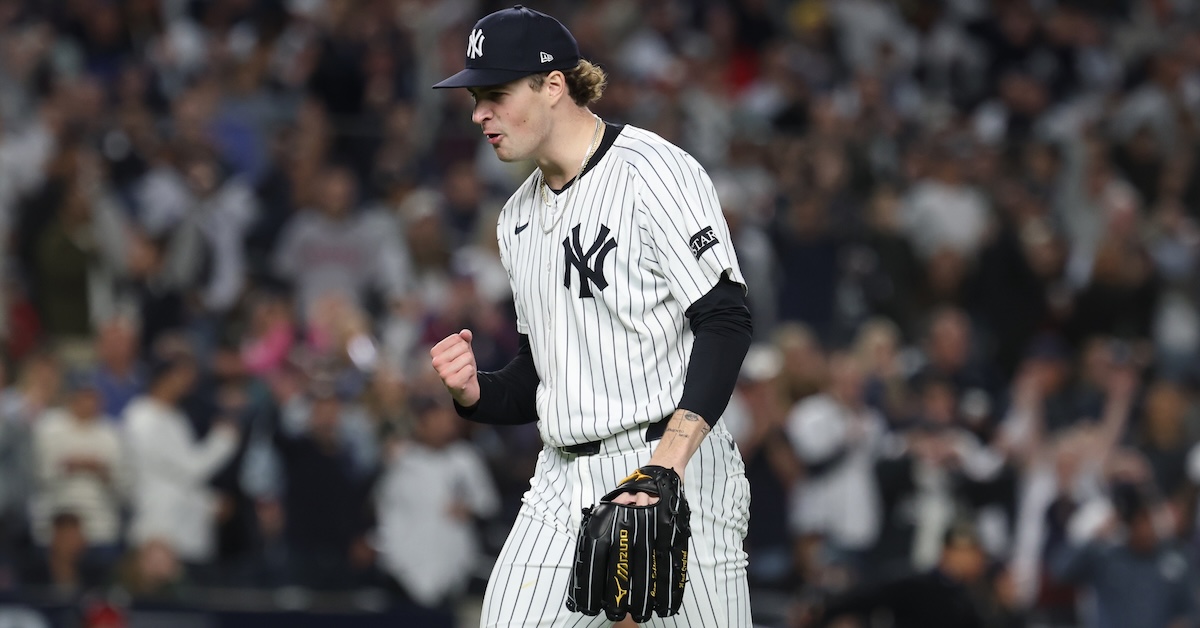
NEW YORK — In just the second winner-take-all postseason matchup started by two rookies — in one of the sport’s most storied rivalries, no less — 24-year-old Yankees righty Cam Schlittler utterly dominated the Red Sox lineup on Thursday, striking out 12 without a walk while scattering just five hits over eight scoreless innings. His opposite number, 23-year-old lefty Connelly Early, matched Schlittler zero for zero through the first three frames, making up with deception what he lacked in velocity, at least relative to the New York starter. Alas, a mistake by the Red Sox defense opened the door to trouble in the fourth inning, as five of the first six Yankees reached base en route to a 4-0 lead. Boston manager Alex Cora, who pulled starter Brayan Bello after 28 pitches in Game 2, left Early to throw 33 pitches in the fourth inning alone. That outburst was more than enough, as the Yankees eliminated the Red Sox from the postseason for the first time since 2003, when current manager Aaron Boone hit a walk-off home run off Tim Wakefield.
This was the sixth time the two AL East rivals squared off in the postseason, with the Red Sox riding a series winning streak that included the 2004 American League Championship Series, the 2018 AL Division Series, and the 2021 AL Wild Card Game. The only other time two rookie starters met in a winner-take-all game was in Game 7 of the 2020 NLCS, when the Dodgers’ Dustin May and the Braves’ Ian Anderson went head to head, though May pitched just one inning and Anderson three, and neither figured in the decision.
The two starters in this one began the season in Double-A, and didn’t figure to contribute substantially this season. Schlittler joined a banged-up Yankees rotation on July 9 and pitched brilliantly during the second half, overpowering batters with a four-seam fastball that averaged 98.0 mph as well as an effective cutter. He posted a 2.96 ERA and 3.74 FIP with a 27.6% strikeout rate in 14 starts, and was an easy choice for Boone to start Game 3 following Max Fried and Carlos Rodón. By contrast, Early only debuted on September 9, and pitched brilliantly (2.33 ERA, 0.91 FIP) but might not have made the postseason roster — or at least would not have started — had Lucas Giolito not been sidelined by elbow trouble. While Garrett Crochet’s 7 2/3 innings in Game 1 required Cora to use only closer Aroldis Chapman in relief, the manager didn’t like what he saw from Bello in Game 2 and pulled him with one out in the third, leaving him to call upon six relievers, one of whom (Garrett Whitlock) threw a season-high 47 pitches and gave up the winning run. Read the rest of this entry »
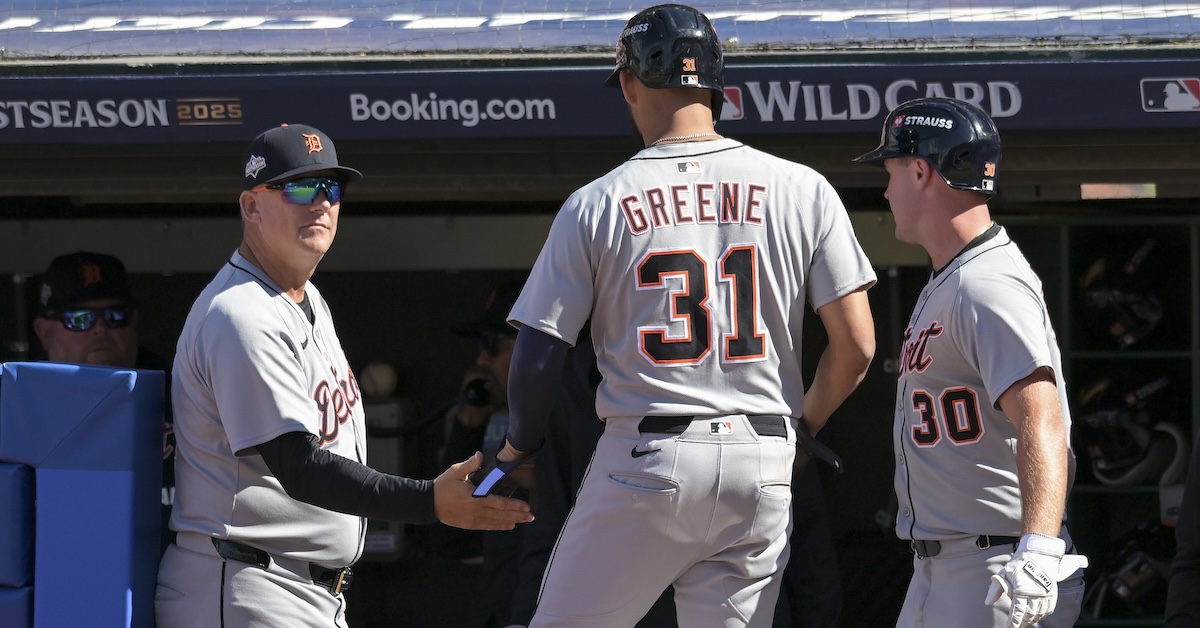
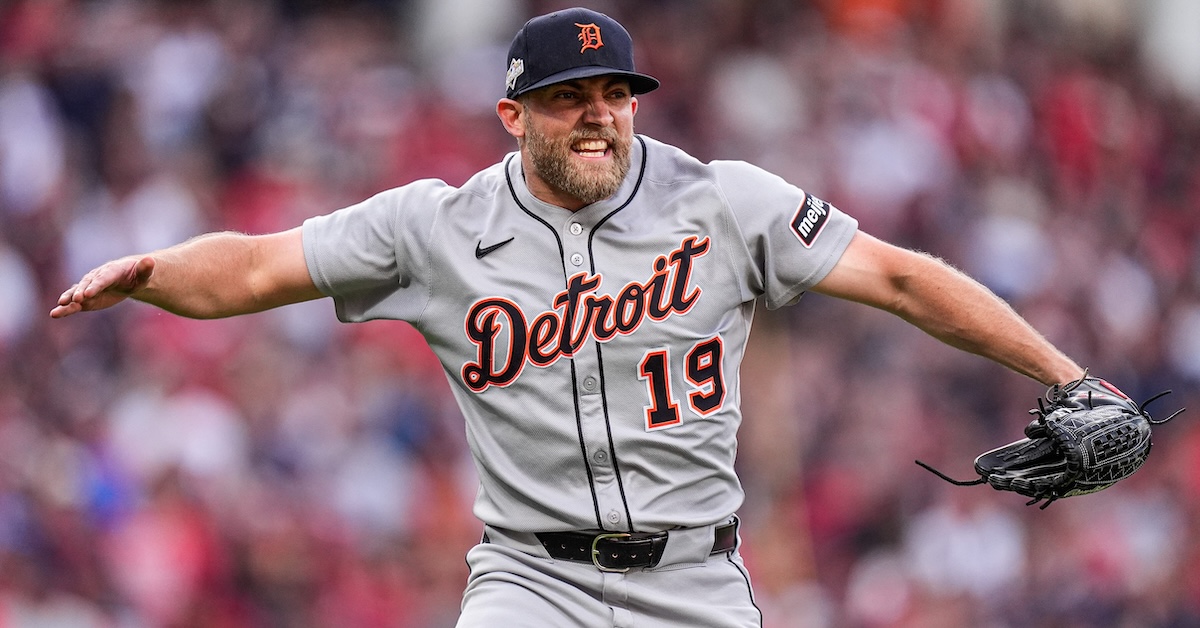
Nobody likes a quick exit from the playoffs, but a brief October cameo would have been an especial humiliation for the 2025 Detroit Tigers. After spending much of the season fighting for the league’s best record, and collecting a 14-game divisional lead at one point, the Tigers went nine games under .500 in the second half. Not only was that bad enough to throw away the division title, Detroit nearly missed the playoffs altogether, only squeezing in thanks to a tiebreak advantage over the Houston Astros. So Thursday’s 6-3 win in Game 3 of the Wild Card series must come as a relief, especially given the measure of revenge that comes with beating Cleveland.
Jack Flaherty got the call in Game 3, his first playoff appearance for the Tigers. There had to be some trepidation about Flaherty, given that his last quality start came back in mid-August. While his 4 2/3 innings of work were short on highlight moments, and he allowed three 100 mph liners that fortunately found leather instead of grass or dirt, Flaherty confined the hits to two-out rallies, leaving Cleveland little room for any bunting or other little-ball shenanigans until the fourth inning. A George Valera double and a José Ramírez single got the Guardians on the board in the fourth, but the danger ended when J-Ram was caught stealing and Chase DeLauter hit into a double play. Flaherty did at least avoid angering the cruel deity that governs predictions; last offseason, he famously said that the Tigers would have defeated the Guardians in last year’s playoffs if he hadn’t been traded to the Dodgers at the deadline. Read the rest of this entry »
Ben Lindbergh brings on Hannah Keyser and Zach Crizer of The Bandwagon to banter in a hopefully not-immediately-dated way about the first two days of playoff action, including the Dodgers dispatching the Reds, Dave Roberts using “Strategy,” Aaron Boone’s perceived mismanaging, the flamethrowing Mason Miller and a playoff-pitch-speed conundrum, and more, plus conversation about how teams with byes are trying to stay ready, the league’s many managerial openings, whether running the Rockies is a good gig, the Rafael Devers trade in retrospect, and the best teams to bandwagon, followed (1:33:54) by a postscript.
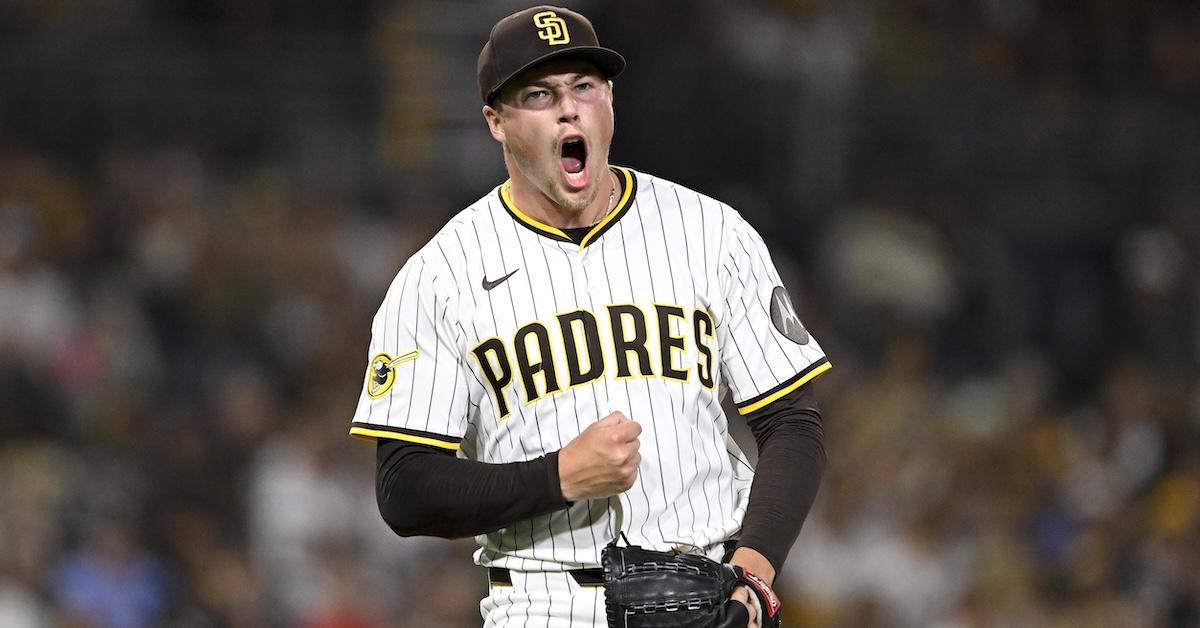
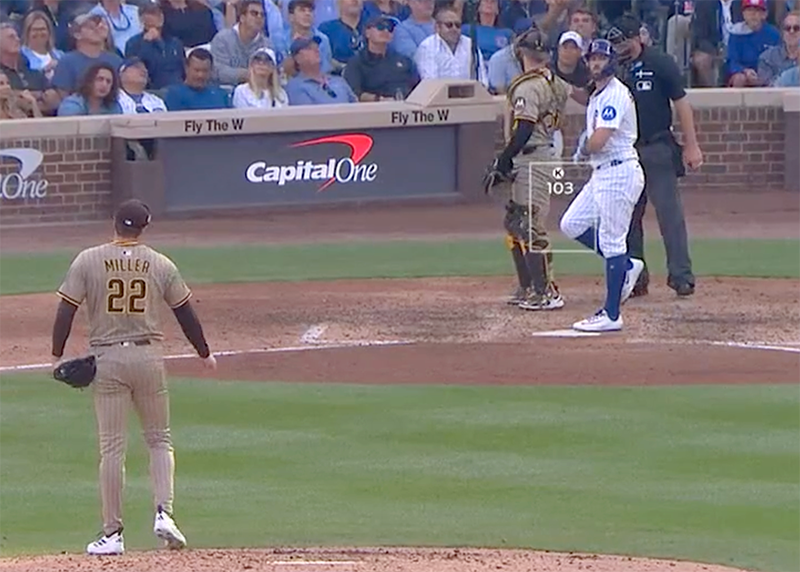
It’s been six days since Mason Miller let somebody hit the baseball. Actually, that’s not quite true. Until the right-hander caught Michael Busch with a literal back-foot slider in the eighth-inning of yesterday’s Wild Card matchup between the Padres and the Cubs, it had indeed been five days, three relief appearances, and 11 batters since anybody came to the plate against Miller and did something other than strike out. However, six of those 11 victims managed to get their bats on the ball. Three of them did it twice. It’s just that over the past week, nobody has been able to figure out how to square up one of Miller’s disappearing sliders or 102 mph fastballs – yes, his four-seamer has averaged 102 mph over the last three outings – well enough to achieve so much as a tapper back to the mound. Busch’s unfortunate foot snapped the streak at 11, but it did nothing to look Miller look more hittable.
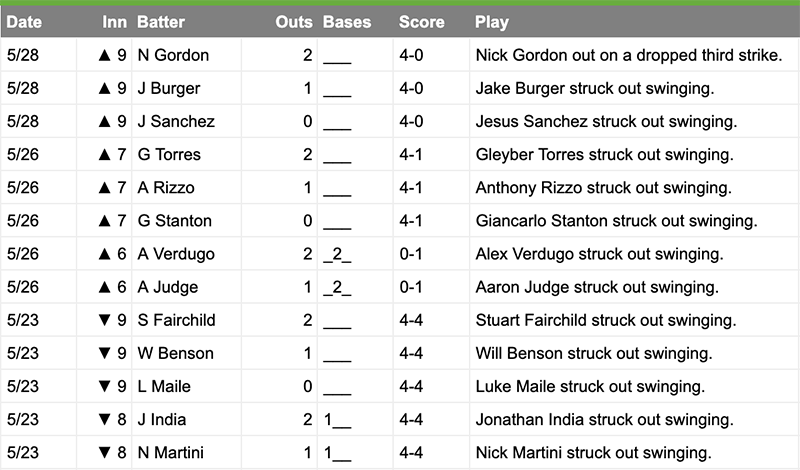
In a fun twist, the all-time record for consecutive strikeouts (or at least since 1961, when full play-by-play data became available) belongs to Miller’s teammate Jeremiah Estrada. Estrada struck out a 13 straight batters across three appearances just last May. In fact, he struck all 13 of them out swinging.
That’s a pleasurably tidy play log. Estrada’s streak only ended because, when he entered the game on May 31 against the Royals, manager Mike Schildt intentionally walked the first batter he faced.
Anytime Miller is on the mound, the general feeling among spectators is astonishment that anyone ever manages to put the ball in play. He just threw an immaculate inning. Since his debut in 2023, Miller has allowed just 0.55 hits per inning, the lowest rate among all 473 pitchers who have thrown at least 100 innings. And now, following a 2025 season in which his 45.2% whiff rate ranked second among all pitchers, Miller has ascended to a higher plane. His whiff rate over the past three games has rocketed up to an absurd 61.9%.
Now that the streak has run its course, it’s time to celebrate the six marvels who managed to connect with one of his pitches, no matter how inconsequential the contact. We’ll count down, from the weakest contact to the strongest, starting with Moisés Ballesteros getting the smallest amount of baseball possible it’s possible to get. You can just hear the sound of the foul tip before the ball hits the glove.
Honestly, it’s impressive that Ballesteros got enough of this pitch to make a sound at all. This is a 102.6 mph fastball well above the strike zone. It came in at a height of 3.76 feet, and this season, Miller ran a whiff rate of 55.9% on fastballs 3.7 feet or higher. Even pitchers who don’t throw 102 lean on four-seamers above the zone because it’s so hard for batters both to lay off it and to hit it. This pitch is why we care about vertical approach angle. This pitch is why we’ll never forget the climax of A League of their Own. The pitch to Ballesteros technically went down as a whiff because Statcast counts foul tips for strike three as whiffs rather than fouls, but we don’t have to take that away from him. He gently brushed the baseball, and for that we honor him.
Next up is Dansby Swanson, who got a tiny bit more of the pitch and a whole lot more of catcher Freddy Fermin.
You may think Miller fooled Swanson with a 2-2 slider away, and he may well have done so. It’s also equally possible that Swanson really was trying to keep an eye out for the slider. It’s just that when you know you might see 104 up above the strike zone, trying to look for the slider and actually staying back long enough to be on time for it are two very different propositions. The shortstop was just able to slow down enough to throw the bat head at the ball. It was a great accomplishment, and because of it, Fermin will surely hold a lifelong grudge.
Here’s another two-strike slider that just barely avoided ending up as strike three. Ahead 1-2, Miller missed high and inside to Seiya Suzuki, and this shows you why pitchers tend to think hard in, soft away.
Batters need to catch the ball much further in front of the plate when it’s on the inside, so the fact that Suzuki was way out in front of this pitch didn’t hurt him too much. He still caught the smallest piece of it – so small that he barely kept it from sticking in the catcher’s mitt – but at least he caught that piece with the barrel of his bat. Did he barrel this pitch up? Absolutely not. Did he strike out anyway on the very next pitch? You bet he did.
We’re done with the foul tips now. Up next, we have a group of four regular-looking foul balls. These ones stretch back to Miller’s last regular season appearance against the Diamondbacks on September 27, and they’re all just fastballs that nobody could catch up to.
This is why pitching coaches tell pitchers aim for the middle of the zone and dare batters to hit it, and this is the benefit of throwing harder than just about anyone who has ever lived. Miller didn’t necessarily fool anybody here. They were geared up for the fastball and they got it. It was just too much to handle. Swanson, Connor Kaiser, Carson Kelly, and even contact maven Geraldo Perdomo are doing all they can just to slap this ball into the seats on the opposite side and live to see another pitch. Swanson took a robust hack and looked out to the mound as if to say, “I’m on to you, Mason Miller.”
He was not, in fact, onto Miller, but you can see why this foul felt like a victory.
Now we’re into the really impressive fouls. Here’s Kelly again, very nearly keeping the ball in the field of play!
Kelly is out ahead of a slider on the inside corner here, and he sends a weak popup to the right side that just drifts out of play despite Luis Arraez’s heroic efforts to reel it in. Seriously, Arraez tossed himself over a thick concrete barrier. He must have ended up with a serious bruise, and he took his frustration out on the netting. I wrote about this exact kind of batted ball back in May. Normally when you’re ahead of a pitch, you hit it to the pull side, but sometimes you’re so far ahead that you have to drop your bat head to slow down. At that point, you can’t help but pop it up the other way. If Kelly had been above the ball, he would have hit a weak grounder to the left side – or, more likely, fouled it straight down and off his own foot – but since he was underneath it, he came just a few feet (or one gust of wind) from achieving the impossible dream of facing Mason Miller and coming away with a weak popout.
Last up is Geraldo Perdomo, long one of the best hitters in baseball when it comes to making contact, and more recently, somehow one of the best hitters in baseball, period. Here’s Perdomo genuinely rifling a slider to the pull side.
This ball came off the bat at 100 mph. Perdomo was still way out in front of it. It was probably foul by a good 25 feet at the moment it passed first base. Still, that’s the best contact anyone has made against Miller in nearly a week. Perdomo would go on to strike out like all the others, but he can take pride in knowing that he’s the last player ever to actually hit the ball hard off Miller.
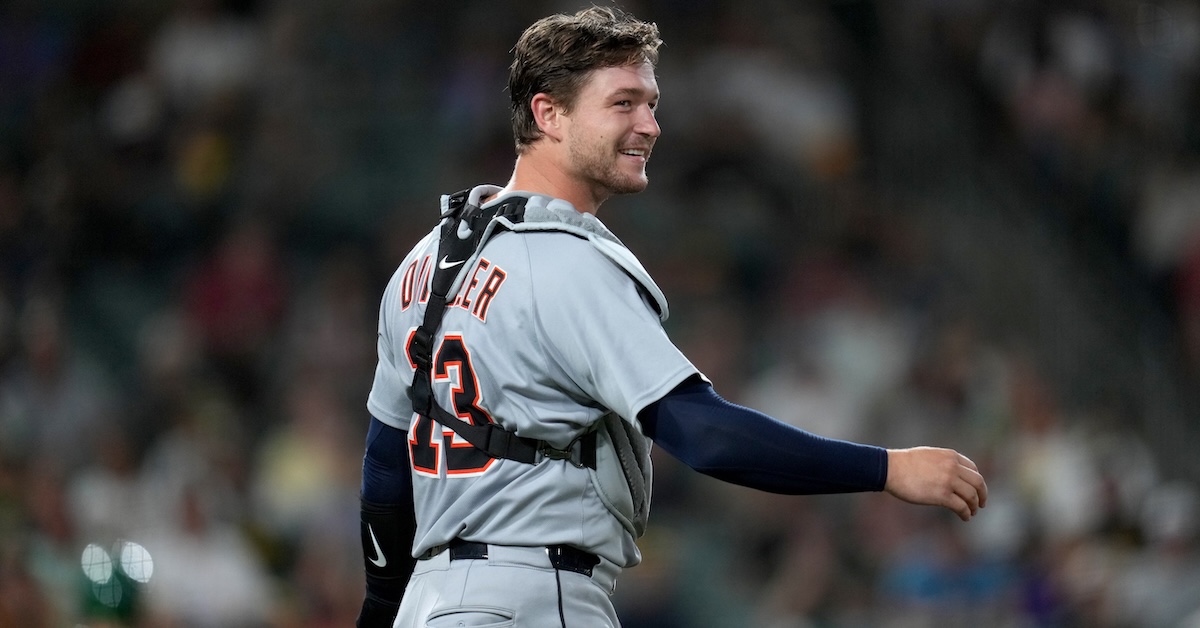
Dillon Dingler is developing into one of baseball’s better catchers. Playing in his first full big league season, the 27-year-old Detroit Tigers backstop banged out 13 home runs while slashing .278/.327/.425 with a 109 wRC+ over 469 plate appearances. Moreover, he was worth six DRS and posted well-above-average framing numbers. His 4.1 WAR ranked third best among junior circuit catchers.
Dingler’s defensive chops extend to his game-calling, which is done in collaboration with Detroit’s pitching group. Preparation is a team strength — last year’s pitching chaos didn’t succeed by accident — and not just because pitching coach Chris Fetter is widely regarded as an adept game-planner. The entire coaching staff is thorough, and so too is the former Ohio State Buckeye, who squatted behind the dish in 115 games this season. (Dingler also filled in at the DH position from time to time.)
The pregame pitcher meetings that precede every game was on my mind when I sat down with Dingler on the final day of the regular season. I was primarily interested in learning how the Tigers go about them, including just what role the catchers play in the dissemination of information. What I found out is that the Tigers — ditto Dingler himself — differ somewhat from most other teams. Not having both catchers in the room, which is the common practice, is an example.
“We do it as the starting catcher, the pitcher, our catching coach, Ryan Sanko, Chris Fetter, and [assistant pitching coach] Robin Lund,” explained Dingler. “That’s pretty much it. It’s usually a smaller group.”
On Wednesday afternoon, I briefly thought that A.J. Hinch had lost his mind. I really don’t know how else to explain it. With runners on the corners and one out in the top of the seventh inning of Game 2 of the Wild Card Series between the Tigers and the Guardians — which Cleveland won, 6-1 — Detroit had Riley Greene, its best hitter, at the plate with a chance to break a 1-1 tie. The Guardians went to the bullpen, bringing in lefty Tim Herrin. Herrin, a 6-foot-6 curveball specialist, figured to be a tough matchup for Greene; he’s been lights out against same-handed batters throughout his career. But then Hinch made a surprising call to the bench. He pulled Greene back and pinch-hit with Jahmai Jones – and now here I am writing this article.
Jones had one key thing going for him here: Like Inigo Montoya, he is not left-handed. He’s also hit lefties much better than righties in his brief major league career, and in his minor league career, too. Greene, on the other hand, is a poor left-on-left hitter. So you can at least see where Hinch’s decision was coming from. I want to give this kind of shocking decision the full consideration it deserves before just laughing it out of the building – after all, what if it was the right call? So let’s do all the math to get an idea of what Hinch was giving up, and what he was getting.
To model pitcher-against-batter outcomes, I first took projections for both players, the granular ones that consider specific outcomes. I also calculated platoon splits for each player by taking their observed career splits and regressing them toward league average based on sample size. I put those two projections – hitter and pitcher – into a modified log5 formula and used it to predict the likelihood of each possible outcome of a plate appearance. Then I applied those outcomes to the game state when Greene’s spot came up in the lineup.
That’s a lot of explanation jammed into one paragraph, so I think an example is in order. Let’s say that the Jones-Herrin confrontation results in a single 25% of the time, a deep fly ball 25% of the time, a strikeout 25% of the time, and a walk 25% of the time. Those are nowhere near reasonable, of course, but just an example. A single would mean runners on first and second (at least) and a 2-1 lead, for a win probability of 73.4%. A deep sacrifice fly? That would get the Tigers to 66.6%. A strikeout? 50.1%. Walk? 65.7%. Average those four probabilities, and the Tigers come out with a 64% chance of winning the game. There are more than four possible outcomes, of course, but this process is how I turn outcomes into win probabilities. Read the rest of this entry »
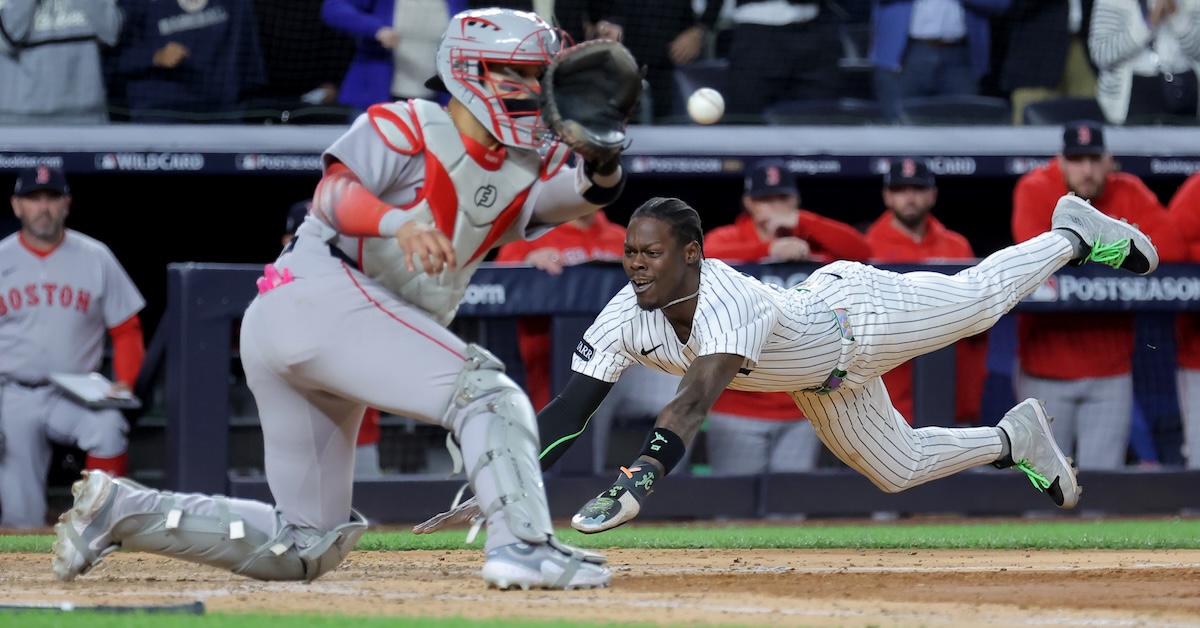
NEW YORK — Jazz Chisholm Jr. was not a happy camper on Tuesday night. Despite a 31-homer, 31-steal season that included a solid showing against left-handed pitching, he spent the first seven innings of the Wild Card Series opener against the Red Sox on the bench instead of facing lefty Garrett Crochet. After the Yankees’ 3-1 loss, he was left muttering almost inaudibly at his locker with his back to reporters — a surreal scene. Back in the lineup on Wednesday night against righty Brayan Bello, Chisholm went 0-for-3 but made huge contributions on both sides of the ball, with two standout defensive plays and an eighth-inning walk that turned into the decisive run when he motored home from first base on Austin Wells’ long go-ahead single. The Yankees’ 4-3 win kept their season alive, pushing the series to Game 3.
Despite hitting a respectable .248/.322/.411 (106 wRC+) against lefties this year (compared to .240/.336/.508, 134 wRC+ against righties), Chisholm sat on Tuesday night in favor of righty Amed Rosario — who played just one game at second base after being acquired from the Nationals on July 26 — apparently on the basis of Rosario’s owning a 6-for-9 career line with two extra-base hits against Crochet entering play Tuesday. Rosario went hitless in three plate appearances against the Boston ace before yielding to Chisholm in the eighth inning; Chisholm flied out with the bases loaded in the ninth against Aroldis Chapman.
Manager Aaron Boone wasn’t worried that Chisholm’s disappointment at being left out of the lineup would carry over into Game 2. “I don’t need him to put a happy face on,” Boone said Wednesday afternoon. “I need him to go out and play his butt off for us tonight. That’s what I expect to happen.” Read the rest of this entry »




 Sponsor Us on Patreon
 Give a Gift Subscription
 Effectively Wild Subreddit
 Effectively Wild Wiki
 Apple Podcasts Feed
 Spotify Feed
 YouTube Playlist
 Facebook Group
 Bluesky Account
 Twitter Account
 Get Our Merch!