

Ben Clemens FanGraphs Chat – 6/8/20
by Ben Clemens

June 8, 2020
At this point, it shouldn’t surprise anyone to hear that Major League Baseball is highly adept at saving money on the backs of people without a seat at the table. Amateur players often bear the brunt of those machinations, and without a real voice in the collective bargaining process, they’ve seen their negotiating rights and earning potential limited by bonus pools, restrictions on major league contracts, and shrinking negotiation windows. Sometimes, these measures have seemed almost gratuitous, like when the Phillies, unable to sign Ben Wetzler in 2014, decided to report him to the NCAA for having legal representation.
The March agreement between MLB and the Major League Baseball Players Association on how to resume the season (and what to do if there isn’t one) cut the amateur draft to the bone. The draft was reduced from 40 rounds to a maximum of 20 (MLB later settled on the minimum of five), slot values remained at their 2019 levels, signing bonus payments were deferred to July 2021 and 2022, with a maximum of $100,000 due to each player in 2020, and undrafted players had their bonuses capped at $20,000 (previously, players could receive $125,000 without it counting against a team’s draft pool).
The question is: What kind of talent will this cost baseball long-term? Baseball’s draft is an uncertain exercise compared to the NBA’s or the NFL’s. While those leagues have their own share of undrafted stars — in much shorter drafts — baseball has a long history of franchise stalwarts who weren’t in the top 300, 600, or even 800 players taken.
With the bonus restrictions on undrafted players, baseball is sure to lose a piece of its future. Many of these players will still end up in baseball eventually, but with only minuscule bonuses, which many players desperately need to justify seeking baseball careers because of the anemic minor league salaries, a lot of players will not. Read the rest of this entry »
On Wednesday and Thursday, Major League Baseball will hold a drastically abbreviated version of its annual amateur draft. As part of the pandemic-related agreement the players and owners hashed out in late March, this year’s draft will be just five rounds. With the contraction of the minor leagues looming, it’s quite likely that future drafts will be considerably more abridged than the 40 rounds they’ve been since 2012, if not necessarily this short.
Had such conditions been in effect prior to this year, numerous quality major league players would have gone undrafted. While some might have still developed after being signed as free agents, it’s entirely likely that many would have slipped through the cracks, never making a dent in the professional ranks, let alone reaching and thriving in the majors.
What follows here and in Part 2 tomorrow is a round-by-round look at the best players drafted in each round beyond the fifth since the amateur draft was instituted in 1965. With the database help of Ben Clemens, we’ve assembled top-five WAR rankings for rounds six through 25, and I’ve attempted to summarize the career highlights of each player in concise fashion (hat-tip to Baseball America’s Ultimate Draft Book for some of the tidbits on why draftees slipped to later rounds). Additionally, I’ve highlighted one active player who may or may not have cracked the leaderboard yet, but who’s noteworthy, as well as two Hall of Fame relievers who didn’t make their respective leaderboards. Read the rest of this entry »
Below is my second 2020 mock draft. The first pass can be found here and is suggested reading as context for the top 13 or so picks. The full 2020 Draft Board can be found here.
Teams’ boards are entirely built now, and the focus of orgs and scouts has shifted toward assessing the signability of individual prospects so there aren’t high stakes mathematical puzzle pieces being smashed together on the fly on Wednesday. The higher a player is ranked, the more likely it is that someone higher up on a team’s organizational ladder is the one talking to the advisor. Some medical reviews are also underway.
I’ll do one more mock for Wednesday morning and, if necessary, a mock of just names with teams just ahead of the draft.
1. Detroit Tigers- Spencer Torkelson, 1B, Arizona State
No change up top, as the overwhelming industry sense remains that Tork goes here. If something unexpected occurs and negotiations break down, I’d have Lacy the favorite to go based on Detroit’s tendencies. Read the rest of this entry »
The NPB season is currently slated to start on June 19th, with hopes of playing a 120-game schedule followed by a condensed playoff docket. The 120 isn’t arbitrary. Per the league’s bylaws, that’s the number required for a season to be considered official. In a normal year, each NPB team plays 143 games.
The MLB season? That remains an unanswered question. It is also an angst-inducing question. As everyone reading this knows all too well, there may not even be a season.
Frank Herrmann knows baseball on both sides of the planet.The Harvard-educated hurler is heading into his fourth NPB season after playing professionally stateside from 2006-2016. As you might expect, he’s monitoring not only what’s happening in Japan, but also what’s happening back home.
“The schedule alignment here is essentially the opposite of what is being proposed by MLB clubs, who want fewer regular season games with longer playoffs,” Herrmann told me via email from Chiba, Japan. “Like most things, the motivation in both cases is money. NPB doesn’t have the lucrative TV deals that MLB does. Japanese teams rely heavily on ticket sales, merchandise, and concessions to generate income and offset salaries. There have been discussions to incrementally allow fans into games starting as soon as July 10. More regular season home gates for each team, stretching into mid-November, affords teams the best chance to cover losses.”
Salary structures and legal language weigh heavily into that equation. As Herrmann pointed out, high-end salaries in Japan are “more in the $7-8 million a year range, as opposed to the $30Ms in MLB.” Moreover, NPB contracts differ from those in MLB in that they “lack a specific clause for national emergencies, therefore players have been receiving their full salaries since February.” Herrmann expects NPB will add such a clause once the season is completed. Read the rest of this entry »
Here, take a look at Clayton Kershaw throwing a 3-0 pitch in 2018:
Pretty straightforward, huh? Okay, now take a look at the same situation in 2019:
Can you spot the difference between the two? I’ll save you some time — I can’t either.
Not very interesting, right? Well, that’s not really what we’re here for. You see, Kershaw’s behavior when he throws a strike on 3-0 doesn’t look very different. In 2019, however, his overall 3-0 strike-throwing changed greatly. Was it real? Was it a fluke? Does it tell us something deeper about Kershaw? Let’s investigate. Read the rest of this entry »
This is the latest installment of a series in which the FanGraphs staff rounds up the latest developments regarding the COVID-19 virus’ effect on baseball.
There’s more work to be done before the NBA’s tentative July 31 return date, but team owners officially officially approved the pending proposal for the league’s restart. The vote 29-1 in favor, with only the Portland Trail Blazers voting nay because of a disagreement on the structure, and clears the NBA’s next steps: finalizing the COVID-19 safety requirements and getting the final approval of the players. To mitigate the difficulties of traveling in the midst of the pandemic, the games will be played at Disney World at the ESPN Wide World of Sports Complex.
The players will be having a virtual meeting Friday afternoon, but the NBA and the NBPA have consistently kept an open dialogue about the status of the season and what a return would look like.
After an agreement between owners and players on this very subject, the NHL officially announced what the league’s playoffs will look like. After five-game qualifiers, teams will play seven-game series, with teams being re-seeded after every round instead of bracketed. An official start date has not been set, but this clears one of the remaining hurdles for the NHL to return to play, along with the NBA. What remains for the NHL is to finalize agreements for training camps, game protocols, and game hubs, the last as the NHL is unlikely to take the same “one location” tack the NBA is. Read the rest of this entry »
| 12:02 |
: Morning. Abbreviated chat today, but I’ll try to move fast to get to a ton of questions.
|
| 12:02 |
: After the draft and the Cubs and A’s lists, what do you see yourself doing for the next year without a minor league season? Any fun projects in the works that you normally wouldn’t have had the time for?
|
| 12:03 |
: Yeah, my hope is to make some structural changes to the board, do some research with all this TM data I’ve collected and publish those pieces, etc. Mostly tho I need a break after the draft.
|
| 12:03 |
: Do you plan to update your draft board again prior to Wednesday?
|
| 12:03 |
: I’ll brush it up this weekend and Monday morning it’ll be final.
|
| 12:04 |
: Hancock or Meyer?
|
If you were one of the enthusiastic baseball fans who got an early start on tuning into ESPN’s first several broadcasts of the Korean Baseball Organization, there’s a good chance you’re already somewhat familiar with the Samsung Lions. The network carried their games four times in their first week of coverage, and the Lions spent a good amount of that time losing. A 4-0 loss to the NC Dinos on KBO Opening Day quickly turned into a three-game sweep, during which the Lions were outscored 16-5. They bounced back with two series wins against the Kia Tigers and Kiwoom Heroes, but that was undone by a stretch of seven losses in eight games, which set the Lions’ record back to 5-12.
The sluggish start was an unwelcome one for an organization that went from winning four straight Korean Series championships from 2011-14 to missing the playoffs entirely in each of the last four seasons. With a 60-83-1 record in 2019, the Lions are coming off the second-worst season by win percentage in the history of the franchise. Fortunately for them, however, the last couple of weeks have seen them trending in a much better direction. They’ve won seven of their last 10 games, including two series victories against the Dinos and Twins — the top two teams in the KBO by record. And the difference in that turnaround has been the team’s starting rotation.
Through the Lions’ first 17 games, they allowed 106 runs, the second-highest total in the KBO. During their 7-3 run, they’ve allowed just 43 — the second-fewest in that time frame. That’s a significant improvement, and the team’s starters have been the driving force behind it. In fact, the rotation was already beginning to turn the corner two full weeks ago. Here’s a breakdown of the team’s starter and reliever splits from the first 13 games, compared to their last 14:
| Game Range | Starter ERA | Bullpen ERA |
|---|---|---|
| 1-13 | 6.75 | 3.67 |
| 14-27 | 2.95 | 5.85 |
We seem to be faced with the prospect of a 50-game season in 2020. Getting 50 games is better than getting no baseball at all, but one of the great joys of the sport is seeing Mike Trout, the game’s best player, play baseball three times that often every year. Since the start of the 2012 season, Mike Trout has played in 1,159 games, an average of 145 games per year. During that time, he’s put up 72.7 WAR, an average of 9.1 WAR per season. On a per-50-game basis, Mike Trout has been worth 3.1 WAR, roughly equivalent to the marks put up by Manny Machado and Brian Anderson in 2019.
In 50 games, Mike Trout does what above average ballplayers do over the course of the entire season. To provide some context for Trout’s prowess, here’s a graph showing Trout’s rolling 50-game wRC+ average over the course of his career:
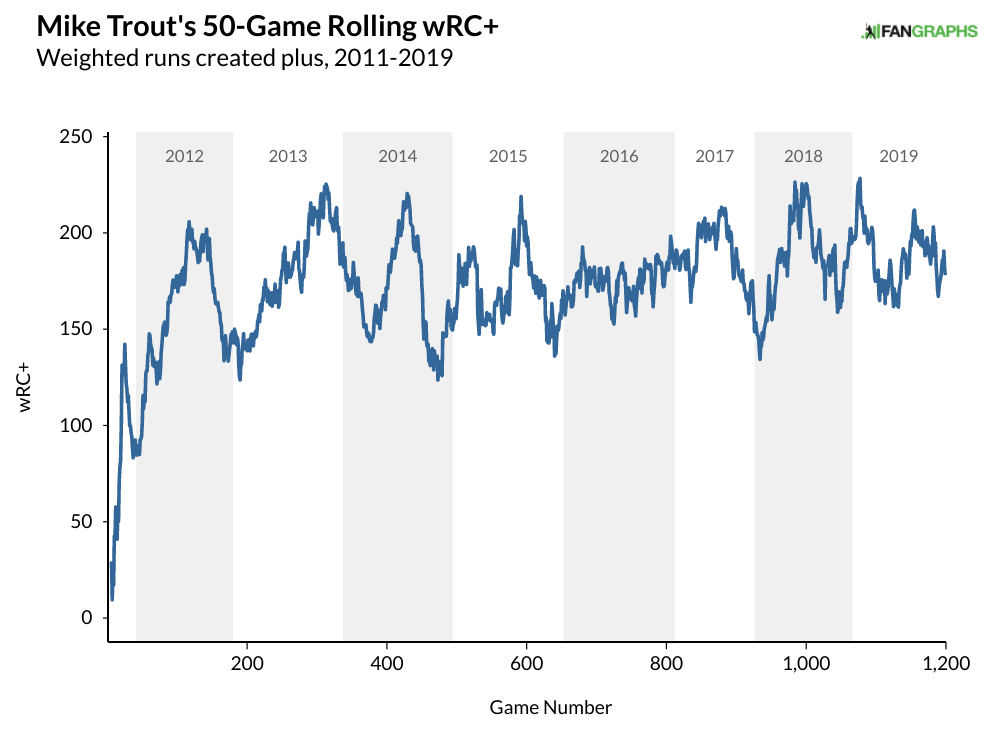
Remember that rough stretch Trout had near the end of 2014, where for a period of 50 games, his wRC+ was only 124? What struggles he must have been having. Or near the beginning of the 2018 season, when his rough patch carried over from 2017 and his wRC+ was a measly 134 over his previous 50 games? During his eight-plus years in the majors, Trout has spent more time with a 50-game rolling wRC+ above 200 than he has below 150. Read the rest of this entry »