
Arizona Diamondbacks Top Prospect Ryan Waldschmidt Is a Student of the Art of Hitting
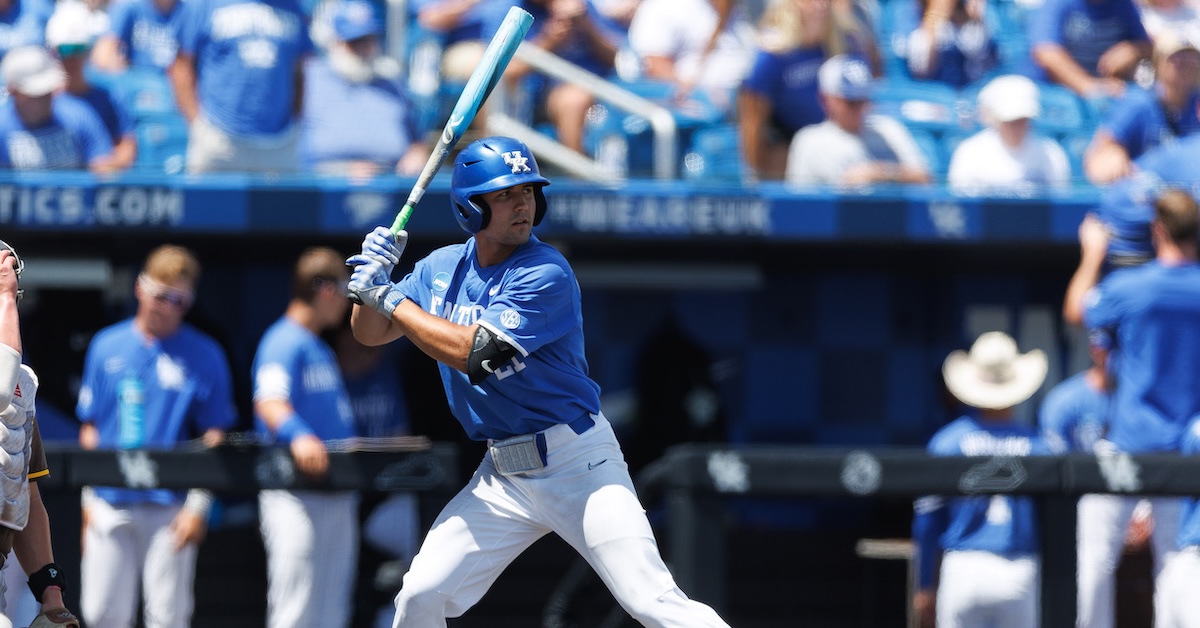
Ryan Waldschmidt is ranked 35th on our newly-released 2026 Top 100 Prospects list, and his right-handed stroke is a big reason why. Along with assigning him a 50 FV, our prospect team wrote that the 23-year-old outfielder in the Arizona Diamondbacks system “does just about everything you want at the plate and he looks the part of a bat-first future regular in the box.” Drafted 31st overall in 2024 out of the University of Kentucky, Waldschmidt is coming off of a 2025 season in which he put up a .289/.419/.473 slash line with 18 home runs and a 142 wRC+ between High-A Hillsboro and Double-A Amarillo.
The way he goes about his craft differs somewhat from his contemporaries. Waldschmidt’s setup is unorthodox, and his swing isn’t exactly what you would draw up in the lab. When it comes to mechanics, the 6-foot-2, 215-pound Sarasota native isn’t a poster child for the science of hitting, but rather an advocate of the art of hitting. Fitting a paint-by-numbers mold isn’t his goal, squaring up baseballs is — and that’s precisely what he does. As evidenced by his track record and presence in the top half of our Top 100, Waldschmidt’s way works just fine.
Waldschmidt discussed his atypical hitting profile earlier this month.
———
David Laurila: Your hitting mechanics have been described as “low maintenance.” What does that mean to you, and how long have your mechanics been in place?
Ryan Waldschmidt: “Throughout my whole entire life, I’ve had a pretty similar variation of what I do now. I mean, there was a time when I was younger that I had a little bit of a pick-it-up, put-it-back-down stride. Once I got to college… my freshman year, I even had a stride at Charleston Southern. Then once I got to Kentucky [as a sophomore] is when I kind of tapped into the no-stride from my setup.
“To me, low maintenance means simple. In a game that’s very hard, and very hard to be consistent at, there are a lot of things that have to go right. In my brain, for that to click, it means that I should be as simple as possible and limit the moving parts. I want to limit everything that happens prior to the swing — just do a couple of things that I know I can control, that I can be close to perfect with, to get me in a position to consistently put up good swings and just swing at pitches that I’m looking for. In a game that’s very complicated, making things as simple as possible is very important.”
Laurila: I’ve read that you have a steep bat path, resulting in your swing being in and out of the zone quickly. Do you feel that’s accurate?
Waldschmidt: “For me, it’s about knowing how your body moves. I mean, everyone moves differently. I think that when you see an unorthodox setup into a different type of swing, a lot of people instantly think, ‘This is wrong,’ or ‘That can’t be right.’ When I have good timing, I feel like my bat path is good.
“A lot of times, someone can be late on a swing and you’re like, ‘Oh, that was a bad swing,’ or ‘His bat path is off; he has a steep swing.’ But it could honestly just be one pitch that you were swinging at. Your timing was off, so you had to do something out of the ordinary to try to hit the ball. So I think it’s very scenario-based. There are times when everyone is a little bit steep, when everyone has a little bit of a downward path. There are also times when everyone has a perfect swing.
“For me, it’s about being as consistent as possible. I agree that I have more of an upward path, but that’s just how my body moves. For me to try to change my body composition, change how my body moves… I don’t think that’s the right answer. I think the right answer is figuring out what you’re good at. You design a plan for every time you step in the box, for every pitcher you’re facing, that goes to your strengths. You play off of that. It’s not about trying to cookie-cutter your swing to look like everybody else’s, to make sure that you’re getting a perfect bat path, that you have a stride and a weight transfer. There are people who think there is a certain way to hit — all good hitters have to hit this way — and I’m just not a firm believer in that.”
Laurila: Would “in and out of the zone quickly” not be a concern? Hitters and hitting coaches often preach keeping bat in the zone as long as possible.
Waldschmidt: “I think part of it goes to how I set up, and how I swing. I don’t have much of a weight transfer, and I don’t necessarily move towards the pitcher and have my bat turning instantly, trying to keep it all the way through as long as possible. But I think that term, being in and out, can be misunderstood at times.
“I’m swinging to be on time. I feel like I have great bat-to-ball. I feel like I have great pitch recognition and know where the pitch is going. So for me, it’s kind of a correlation between being in and out of the zone, and just being on time and hitting the ball. A lot of people train to have this long… I wouldn’t say long, but rather a flat path through the zone.
“I love to practice hitting on time. When you’re on time, there’s not much more to it than getting into the zone where the ball is going and making quality contact. I agree that there are people who have better bat paths — I’m not saying that mine is perfect — but that just goes into the type of hitter you are.”
Laurila: A December 2024 report said that you have big-time bat speed. This past December, I saw one that said you “don’t have crazy bad speed.” Which report do you think is more accurate?
Waldschmidt: “I think I have good bat speed. I don’t think it would be possible for me to hit some of these pitchers, and do what I do, if I didn’t. It wouldn’t be possible for me to put up exit velo numbers, and hit the ball as hard as I do, without good bat speed. I mean, I probably have one of the most simple swings in baseball, but I’m still able to hit the ball just as hard as anyone else.
“Everyone has a different perspective on everything, and I think some people are going to really love what you do, and some people are going to dislike what you do. The only thing that really matters is, do you understand why you do the things that you do? I understand everything I do as a hitter. I think that is why I’m able to have success. At the end of the day, that’s really the only thing that matters.”
Laurila: One more thing I’ve read that caught my attention was this: “It’s a power-and-OBP-over-hit skill set.” Do you agree with that, or do you see yourself more as hitter who is able to produce some power?
Waldschmidt: “I would agree with how you put it. I’m a hitter who has power. I’m not a power hitter who hits sometimes, I’m a hitter first, and I’ll run into power. Like I said earlier, I believe that I have very good bat-to-ball skills. If you look into how I get pitched, and everything that goes into that, I think it’s a bigger picture than just looking at a stat sheet. The pitches that I get to hit, and the pitches that I take for strikes… the numbers don’t necessarily tell the entire story.
“I walked almost identically to the amount of time I struck out last year. I don’t think someone who lacks bat-to-ball skills would be able to do such a thing, and to hit for average as well as power. My whole approach is based on finding quality contact, on barreling line drives. That’s it. I’m looking to go gap to gap, hitting line drives. The power comes by accident. I’m a hitter first.”
Laurila: Any final thoughts on hitting?
Waldschmidt: “I think there are a lot of times where guys are trying to look the part. It’s something where you’re trying to look so perfect, and do everything so perfect, that you forget that it’s baseball. The pitcher is throwing you a pitch that has 20 inches of movement on it, so sometimes your perfect swing needs to get thrown out the window. You’ve just got to hit the baseball. That’s a big factor that a lot of people forget.”
David Laurila grew up in Michigan's Upper Peninsula and now writes about baseball from his home in Cambridge, Mass. He authored the Prospectus Q&A series at Baseball Prospectus from December 2006-May 2011 before being claimed off waivers by FanGraphs. He can be followed on Twitter @DavidLaurilaQA.
I am highly amused by the fact that the next great diamondback hitter is potentially a guy with an unorthodox set up named “schmidt”.