
Daylight Guys: Prospects We Disagree About
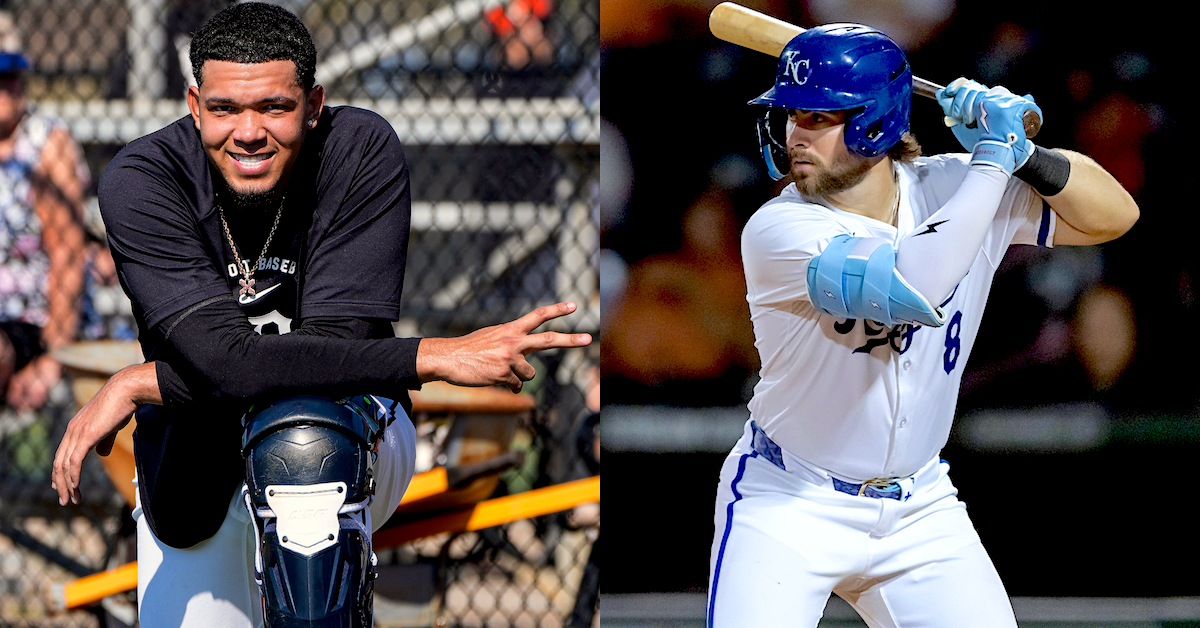
No two scouts or evaluators are going to agree on everything, and we’re no exception. We get asked all the time about who liked which player more, or who was more lukewarm on this guy versus that one — not to mention the steady stream of “Outlet A ranked Player B here, but you had him there, what gives?” questions that populate our chats. These are especially compelling and relevant inquiries this time of year, because inevitably we had to resolve a degree of disagreement as we compiled our list of the Top 100 prospects in baseball.
This year, we’ve decided to address those questions head on. Throughout our list-building process, we came to similar, or similar enough, conclusions about most players. Oftentimes Eric was a tick higher on one player here, or Brendan the high man there, and usually a quick back and forth was enough to bridge any gaps. In a couple cases though, we didn’t reach consensus. There were a handful of players that Brendan was happy to rank, but Eric would have preferred to leave off, and vice versa. We think offering a peek into those discussions will prove insightful for readers. These back and forths highlight the types of players who are generally more difficult to evaluate, as well as the metrics and scouting practices that guide decision-making when you have to make a call one way or the other. Through it all, we hope you’ll arrive at a conclusion that most scouts and analysts eventually reach: That spirited debate is a healthy part of the evaluative process, and disagreements without clean resolution are occasionally the cost of doing business in an uncertain world.
Kendry Chourio, RHP, Kansas City Royals
Brendan: Let’s start with a pitcher who ultimately didn’t make our list. I never caught Kendry Chourio live, but I adored his stuff when I put on the tape. He throws hard, I see a path to a plus curve and changeup, and he’s advanced for someone who played all of last season as a 17-year-old. The Royals rightly promoted him off of the Dominican complex, and then he dominated in Arizona to the point that he actually wound up in Low-A down the stretch. And you can see why: For his age, his ability to command the ball and execute his secondaries stands out immediately. His line – 51.1 innings, 63 strikeouts, 0.95 WHIP, just five walks – was incredible. I think we both agree that there are a lot of good things going on here. Can you elaborate on why you were still a little skeptical of him when it came time to build the list?
Eric: I agree Chourio is advanced, both in terms of how complete his repertoire is for his age, and his ability to execute each of his pitches. In the 10 years I’ve been doing this, there hasn’t been a pitcher I can recall who has climbed from the DSL to Low-A in their debut season at age 17. Even guys who sign when they’re older tend to stay in the D.R. for their entire first season for signing bonus tax purposes. But promotions on their own are not really evidence of anything. And the other pieces of Chourio’s profile — he’s an undersized righty with a violent delivery — I have seen many times before. Deivi Garcia, Luis Patiño, Anderson Espinoza, Carson Fulmer, Marcos Diplán, Eric Pardinho… there are a lot of guys with exciting three-pitch mixes at this age who don’t sustain it. For a pitcher with Chourio’s stature to thrive as a big league starter would be exceptional. Sonny Gray and Marcus Stroman, two guys with much cleaner deliveries than Chourio, did it. But mostly it’s big, strong dudes, and/or players whose deliveries are beautifully fluid. If I’m going to grade an 18-year-old pitcher irresponsibly, it’s going to be a gigantic Eury Pérez type, or at least someone more prototypical looking, like Seth Hernandez or Matthew Liberatore, and even those types of young pitchers are risky propositions simply because, well, they’re young pitchers. One need only look at any draft list from the past to see what the attrition rate is when you play Russian Roulette with your UCL every fifth day. And this is all before we even get to some of the specific nits to pick in Chourio’s stuff, namely the shape and angle of his fastball.
Brendan: The thing is, the attrition on the back of Top 100 lists is really high. It’s just a fact that the average outcome for the guys we rank in the 80s or 90s on these lists is a short, mostly ineffectual career. And so while I see the demographic risk, in a spot on the rankings where we’re taking shots, I’d rather bet on the guys with the traits I like most. And fastball shape aside, there’s a lot of good here. He may get hurt; pitchers often do, and shorter, smaller ones are even more vulnerable. But some of those types also burn very brightly, even if it’s for a short time.
Lazaro Montes, OF, Seattle Mariners
Brendan: Lazaro Montes is an interesting daylight case because we actually don’t disagree on him that much. We both see 70 raw power, and he’s obviously bringing it into games. Defensively, we’ve both been pleasantly surprised that as he’s worked himself into better shape, he’s also turned himself into a passable outfielder — which was no guarantee two or three years ago. On the other side, there’s obvious swing and miss risk. The divergence here isn’t what kind of player he is, but rather how aggressive we want to be with a boom-bust bat.
Eric: You’re right that our evaluations of Montes are basically the same, and where we differ is in our interpretation in how to value where he is on the prospect continuum. My hangups lie in his contact rate, which was 62% in 2025. There wasn’t a single qualified big league hitter whose contact rate was under 67.6% last season. Now, some of the most productive major league hitters (including Ohtani and Judge) have a contact rate in that area, but they hit the ball so hard that not only are they accessing power, but their hit tool ends up playing way better than their pure contact rate because hard-hit contact is much more likely to fall in for a hit.
Is Montes one of these guys? I don’t think so. The players I described (and some of the high-whiff hitters we have on the list, like Bryce Eldridge) can access their power all over the zone. They whiff a ton, but they’re also a threat to do damage against basically any pitch because they move the barrel around well enough to connect with pitches all over the zone. Montes, conversely, is vulnerable to elevated fastballs because of his length, and he swings underneath them over and over and over. If opposing pitchers execute to this location, they get him out. This is a hitter who I think big league pitchers are going to be able to solve. I’d still be worried about this even if Montes’ contact rate were closer to 70%, but again it’s about 10% worse than the bottom of the big league leaderboard.
Blake Mitchell, C, Kansas City Royals
Brendan: For the most part, our looks at the catchers tracked pretty nicely. But there are two at the bottom of the list who sparked some of the most significant disagreements we had throughout the process. Maybe we can start with Blake Mitchell, who I’ve been fond of since Kansas City drafted him.
I see a good athlete who has gotten a lot better behind the plate. I see the potential for plus impact. And I’m willing to give him a pass on some rough numbers at the plate last year because we know that a broken hamate (Mitchell broke his back in the spring of 2025) is the kind of injury that can linger for a year and sap a guy’s power. Is the lost year giving you more pause than it’s giving me, or are there other factors behind your initial hesitance to put him on the Top 100?
Eric: I see a player whose build basically is what it was when he was a high school junior — which isn’t Blake’s fault, it’s just how things have panned out. But I also see a player who still really struggles to block pitches in the dirt (though his receiving has improved, I’ll give you that), and whose underlying contact issues are even worse than his career 30% strikeout rate already insinuate them to be. Mitchell’s miss rate against fastballs in 2025 was a whopping 35%, essentially the miss rate a 70-grade fastball would produce. He really struggles to cover the up-and-away portion of the zone, and this has been a problem for him for a while. His strikeout rate has been 30% or so, a red flag area for any prospect, for his entire career.
Brendan: It’s not just the receiving: His caught-stealing rate jumped from 14% to 31% last year. And those two areas are far more important to me than the blocking.
The strikeouts worry me, though I’m willing to excuse some of the fastball miss as a product of the hand; bat speed and power go down when you return from a hamate break, and that doesn’t just affect homers. But I also think Mitchell’s big strikeout totals are the product of a pretty good approach. He’s going to punch out, but he’s going to walk, too. And the way he hits — connected swing, some manipulation in the path, above-average bat speed, can use the whole field, tends to put the ball in the air, decent approach, strong hard-hit rate when he connects — just makes me want to stay on him and give him every shot to grow into a productive hitter.
While we’re talking about catchers with disappointing numbers in 2025, we might as well touch on the other guy now…
Thayron Liranzo, C, Detroit Tigers
Eric: Prospect development often isn’t linear. Guys hit skids and speed bumps all the time, sometimes just because they need a beat to adjust to the quality of play at a new level. Sometimes they’re playing through injury. Catching is punishing. When a catcher has an awful year, like Thayron Liranzo did in 2025, I wonder if something like this has occurred. In Liranzo’s case, he was not only dealing with injury but also several off-the-field personal matters, including family issues back home and the death of his longtime trainer, whom he regarded as a father figure, as well as starting a whole season in a new org and conducting spring training in a new place. He’s a college-aged kid whose life was flipped upside down; it’s not shocking he struggled to adjust. And unlike Mitchell, Liranzo has actually had seasons in which his strikeouts have been in an okay area.
Brendan: I’ll say this at the outset: Learning that there was a shoulder injury behind the dip in production was the exact kind of thing I wanted to hear, because Liranzo was actually pretty good for a couple months in the middle of the season. It takes the edge off the data and the visual evals of the last couple months when you know he was playing through something pretty significant.
That said, there were things that gave me pause even before the injury. For me, Liranzo is tracking like a below-average catcher defensively. He’s a fair framer, and he does well with pitches low in the zone. He tends to show his work, though, and the excess movement is a round-down trait despite the wrist strength. He’s a slow mover otherwise, which shows up in long transfers and inconsistent throwing mechanics, limiting the utility of his plus arm strength.
At the plate, it’s a long swing and a grooved path — he was mostly a mistake hitter last year. Some degree of patience is required for switch-hitters and catchers, and especially switch-hitters who are also catchers. But I don’t see much hit skill yet to go with all the power, and think there’s a risk he’s pretty one-dimensional. And now you have the weight loss; he’s reportedly down 35 pounds this spring. What effect is that going to have? It could be a positive, helping him be more nimble. But it may also have ramifications for his power and ability to withstand the rigors of the job. Ultimately, I’m comfortable ranking him, but it felt appropriate to slide him toward the back of the list.
Eric: You’re definitely making a little bit of my argument for me as a way of pre-empting it — that this is a switch-hitting catcher, both demos that deserve a long developmental runway — so I’ll do a little of the same for yours. This whole thing about him losing 30 pounds, I’m not sure whether that is good. I want it to be, and it’s evidence Thayron is coachable and motivated to improve, but I was inclined to project on him in part because he was such an enormous, physical dude. Tyler Flowers breaks late, Evan Gattis breaks late. Big, physical guys who, over time, can weather the burden of the position while retaining power at the plate. I’ve seen Liranzo do some nice things on defense, but I agree his look on tape late in 2025 was bad. His projection was always more of a slow burn even though he’s already on the 40-man. In my mind, Liranzo has been a guy who I expected to be in the mix more in, say, 2028, when he’ll still only be 24 at the start of that season. I do think he’s just a mistake hitter, but with enough power, that’s enough at catcher. His profile is now really dependent on how he develops as a defender with this new physique.
When we watch the video of Chourio, what should we be looking for that makes it violent?
I’m not a scout. But what I see when I look at him is:
Choppy arm action, almost short-arming itWeird cadence to the delivery. Starts slow and has an arm-heavy burst at the end to get the pitch out. Not a very fluid overall motion
These things probably influence the other. The fact that he’s a little more upright makes him rely on arm strength more than leg drive, which speeds up the arm action to get more juice and leaves the overall delivery looking less balanced and fluid.
Looks to me like both his legs are ahead of a more regular leg/torso coordination, which is kind of what you want for more hip rotation. Could be that it’s something he just picked up.
The batting like arm trajectory with the 5/8 slot and the torso lean is not really what you would teach but it works for some I guess. But apart from mechanics the big thing with the torso lean is you can sniff out a fastball fairly easily.
My overall takeaway from this thread is that I would be a godawful scout
See right after he plants his landing foot, where he reaches out and stabs a guy?
He does stab a lot
Ah yes the Ugueth Urbina delivery
He was quite literally throwing gas
TOO SOON!!
I’ll take Liranzo as a guy who should still be on the Top 100 and the other three as guys who i wouldn’t put on it.
Everyone is talking about how Liranzo had such a bad year but catching is hard so guys take longer and the bar for offense there is super low.
He wasn’t old for the level.
He was apparently dealing with an injury and a death of a father figure.
There’s a lot of mitigating factors. And then I look at his “bad year” and he had a 97 wRC+ and I just don’t agree that this is something to worry a lot about! That’s not that bad.
Wrist or shoulder injuries are always one of those things that you have to give a hitter and * for if there production suddenly takes a different shape. Blake Mitchell on the other hand has had about the same wiff rate in healthy seasons. Though I would give him a mulligan in terms of his loss of power. Ultimately they are still both FV 50s so there isn’t a whole lot that separates them from the back of the top 100 list.
RE: Mitchell
I just don’t think a player who can’t hit fastballs two years in is a Top 100 prospect. With his receiving still in progress I don’t see it.
If you can’t hit fastballs your best shot to being a major league contributor is to pitch.
The optimistic case is something like “Nolan Jones at catcher” but Nolan Jones never was this bad at making contact.
I’m not a scout but saw him for a week in the Fall League and it wasn’t pretty. But I’m the same guy who got sucked into Lewis Brinson after watching him for a week so what do I know? Mitchell just looked overmatched almost every at bat.
He’s still a prospect but I can’t see giving him more than a 45. He’s like a guy you signed out of Latin America and now he’s a 17 year old in the DSL. There’s just nothing there aside from projecting that he had a shot to get better.
There are a lot of catchers that I think are in the same bucket as Blake Mitchell, like Omar Alfonso, Ramon Ramirez, and Walker Janek.
If the Royals find a team that views him as an FV50 I would definitely check in to see if there is an everyday second baseman or center fielder they can trade for.
LOVED this article, really great insights into your individual preferences and strategies and what you are looking for when scouting.
It’s important to note that one area where they didn’t disagree was around the power of love.
Huey Lewis knows all about it
Mitchell broke his back in the spring of 2025
was like “holy crap” for a second until I realized that “his” referred back to “hamate”
Phrasing!
How important will framing be in the future? I think it’s going to be less of priority in the future with the league slowly moving towards automated strike zones.
People have been saying that for the last decade or so…and I expect them to be saying it for another 5-10 years, at the very least.
You know the ABS system is going to be used THIS YEAR, right?
Someone’s ears were burning 🤣.
I’m quite aware that teams will be able to challenge 2 ball-strike calls per game this year, yes.
Are you aware of how many pitches are thrown per game?
This is a very cool article format. I’d like to see this come back next year too. Very interesting to read about the process to arrive at a conclusion rather than just getting the conclusion.
I wonder how much Liranzo *actually* weighs. He is currently listed at 195 here. Last year he looked like he was 260ish, if not more. I would be very surprised if he was sub 200.
I’m kind of shocked that a guy like Lazaro Montes gets into the top 100 when he has very obvious flaws like a high K rate and low contact rates to overcome if he wants to be a viable big league power bat. But Joshua Baez made huge adjustments to overcome those same flaws last year and arguably now has significantly more upside and a better chance to realize it, yet he doesn’t even get close to top 100 status.
Baez got a 45+ grade, that is awfully close to top 100 status!
Both of those guys probably got a half-grade bump from where Eric has them due to contact questions. Brendan is definitely higher on Montes and a few weeks ago Eric said that Baez was more of a 40+ for him.
Caissie’s another guy who definitely got a bump from Brendan’s perspective.
Eric said in the chat that he doesn’t think Baez is close at all. I’m kind of shocked at how out his on Baez to be honest.