Archive for 2021 Positional Power Rankings

2021 Positional Power Rankings: Summary

Over the past week and a half, we’ve published our annual season preview, ranking the league’s players by position and team based on a blend of our projections (a 50/50 split between ZiPS and Steamer) and our manually maintained playing time estimates courtesy of Jason Martinez. The result is a document that rivals The Power Broker for length, though we’ve endeavored to make it more easily digestible. If you happen to have missed any of those installments, you can use the handy navigation widget above to catch up.

Today, I’m going to summarize the results. We’ll look at some tables and pick out a few interesting tidbits in a moment, but first, it’s important to remember that this exercise captures a snapshot of how we project teams to perform now. Teams aren’t static. Since we’ve published our rankings, Eloy Jiménez ruptured his left pectoral tendon and underwent surgery; Luke Voit will miss time with a partial meniscus tear. The Angels reworked their bullpen on Monday. The Rangers announced that Rougned Odor won’t make the Opening Day roster and will be designated for assignment. Players will tweak elbows and hamstrings, lose playing time due to underperformance, and get traded.

That’s why we maintain a Team WAR Totals page, which lists projected positional WAR by team and updates regularly throughout the season as we learn more about who is likely to take the field every day and what shape they’ll be in when they do. Don’t be alarmed: The WAR numbers you see there may vary from what you see on the positional power rankings, mostly because those figures are aware of the injuries and transactions that have altered our playing time estimates since the rankings went live. The Z-Scores I include later use the WAR from the Team WAR Totals page as well. It’s a valuable resource I recommend bookmarking. Read the rest of this entry »


2021 Positional Power Rankings: Bullpen (No. 1-15)

Earlier today, Eric Longenhagen previewed baseball’s lesser bullpens. Now, Dan Szymborski takes a look at the relief corps projected to be the league’s best.

Over the last 10 to 15 years, there have been gradual changes to how bullpens are built and deployed. Clubs are more willing than ever to admit that their closer is simply the best pitcher on their roster rather than one blessed with magical abilities, able to secure the final outs of a game where lesser men would fail. Closers are still a fairly big deal, mind you, but the trend of late has been to talk more about bullpens in terms of the entire unit, rather than just the closer and his backing band. As such, that’s how we rank them. There’s not a lot of turnover this year, with 11 of the top 15 teams from last season returning.

It will be interesting to see what effects the shortened 2020 season has on bullpen usage in 2021. By the time we get to October, it will have been two years since any pitcher threw 200 innings, and teams are likely going to protect their starters more than usual this season. Nobody really knows what the long-term effects will be of throwing pitchers into a 162-game marathon after a weird, shortened sprint season, one that featured two spring trainings set three months apart. Tommy John surgery may have a high success rate these days, but that doesn’t mean anyone wants to flirt with it.

We sometimes pooh-pooh the value of bullpens because of their volatility, but the fact is, the share of innings thrown by relievers has steadily increased over the last half-century, with their proportion of innings going from just over a quarter in the mid-70s to nearly half last year.

Forty-four percent of innings in 2020 were thrown by relievers and there’s no reason to expect a sudden reversal in 2021. It’s not outside the realm of possibility that 20 years from now, there’s no actual distinction between starters and relievers, with those classifications largely considered a relic. That’s still speculative, but for now, even if a reliever can’t match the value of a Jacob deGrom, bullpens have a very real effect on who makes the playoffs and who pops bubbly in late October. Read the rest of this entry »

2021 Positional Power Rankings: Bullpen (No. 16-30)

Yesterday, we analyzed the league’s rotations from bottom to top with the help of Paul Sporer and Ben Clemens. Today, we turn our attention to the bullpens, starting with those toward the back of the rankings.

There are some positions for which a cleaner, wider gap exists between the top teams and the bottom, where we can more definitively say that some teams are better than others. For instance, it’s clear the best center field situation belongs to the Angels because of Mike Trout, and that the Mets belong at or near the top of the shortstop hierarchy because of Francisco Lindor. Relief pitching is not one of these positions. Sure, we have the bullpens ranked, and you can see their statistical projections above and below, but be sure also to notice the margins here and recall that projections are even messier this year because we’re coming off of a shortened season. Plus, relievers are generally volatile. Read the rest of this entry »

2021 Positional Power Rankings: Starting Rotation (No. 1-15)

Earlier today, Paul Sporer assessed the game’s weaker rotations. Now, Ben Clemens turns his attention to the aces.

The top of the NL West is also the top of our starting pitching rankings. The Padres lost deadline acquisition Mike Clevinger before the postseason even ended, but they recovered by adding three marquee pitchers via trade. The Dodgers countered by adding Trevor Bauer in free agency, and it’s no surprise that those two teams sit atop this list. The New York teams have their aces, the Nationals have their big three, and plenty of other squads mix depth with upside, but none of them could quite match the two California teams’ projections.

That’s not to say that no one else can run out a string of aces. The Yankees have injury issues, but they’ll be able to line up Cy Young winners on consecutive nights. The Mets have Noah Syndergaard waiting in the wings, and the Nationals won a World Series in exactly that manner only two years ago. Pitchers are nastier than ever, and this list is a testament to that fact: there are interesting arms and potential aces on every team in the top 15. That makes it harder than ever to reach the top of our list, but it’s no shade to the teams further down; they’re good, but the Padres and Dodgers are better. Read the rest of this entry »


2021 Positional Power Rankings: Starting Rotation (No. 16-30)

Earlier today, Meg Rowley closed out the position players with an examination of the game’s designated hitters. Now we turn our attention to pitching. First up? Paul Sporer on the bottom half the league’s rotations.

The American League is firmly projected to have worse starting pitching than the National League, with nine of the 15 lowest-ranked teams AL squads and a deficit of 20 projected WAR. This group contains four legitimate playoff contenders in the AL, including the 2020 pennant-winning Rays. In fact, the Rays are one of three 2020 division winners on this list. Two of my favorite breakout rotations are also in the bottom half; I think at least one of them will break into the top half by season’s end. For instance, the Tigers’ trio of mega prospects could push them well beyond their projections if things coalesce quickly for them. Which rotation do you have exceeding expectations from this list? Read the rest of this entry »


2021 Positional Power Rankings: Designated Hitter

Last week, the FanGraphs staff took you through most of the league’s position players. Now, before we turn our attention to pitching, Meg Rowley examines the state of the designated hitter.

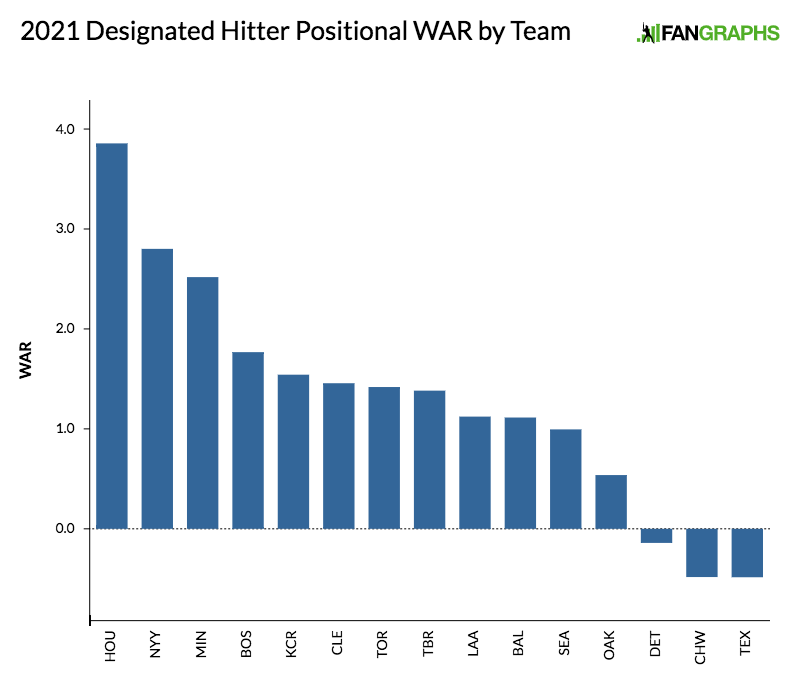
If these rankings prove anything, it’s just how rare it is for teams to have a truly designated designated hitter anymore. Some still look to a single bopper, and many of those clubs are at the top of these rankings. The Astros, Yankees, and Twins still figure prominently; Yordan Alvarez, Giancarlo Stanton, and Nelson Cruz will do that for you. But for about half of the squads here, DH plate appearances are a group project, with the position often serving as a means of giving otherwise-capable fielders a day off.

It’s not totally old hat in 2021. Interesting young guys like Andrew Vaughn and Ty France could outperform their modest projections, and Shohei Ohtani is his own wild card. Still, with three clubs projected in the red and several more clustered around 1 to 1.5 wins, the DH bats have swooned. Perhaps a universal DH will shake things up, but I suspect we’ll see more of the same when the NL finally puts pitcher hitting to bed — a collection of good-hitting catchers, erstwhile first basemen, outfielders who need a breather, aging vets, and a few elite bats carrying the load. Read the rest of this entry »


2021 Positional Power Rankings: Right Field

Yesterday, Kevin Goldstein and Brendan Gawlowski reviewed the state of things in left and center field across the majors. Today, Jay Jaffe turns his attention to right fielders.

It’s not the happiest inevitability to contemplate, but there will come a day in the future when Mike Trout will no longer be the best player in baseball. When that day comes — and we’re not saying it’s tomorrow, or even in 2021 — there’s a very good chance that one of the game’s top three right fielders will be the player who claims the crown.

Mookie Betts already outdid Trout for the 2018 AL MVP award with a single-season WAR (10.4) slightly higher than anything our Halo’d hero has mustered (a max of 10.2 in 2013), and he’s only heading into his age-28 season, having already done the Trout-like thing of surpassing the average Hall of Famer’s seven-year peak in WAR at his position. What’s more, Betts has now played a central role in two championships, having helped the Dodgers get over the hump in 2020’s pandemic-shortened season thanks in large part to his October heroics at the plate, on the basepaths, and in the field.

If it’s not Betts who dethrones Trout, it may very well be 22-year-old Juan Soto, a new convert to the position whose production to date and projection going forward both place him in the midst of inner-circle Hall of Famers. And if not Soto, then perhaps 23-year-old Ronald Acuña Jr., whose speed makes him a threat to become just the fifth member of the 40-homer, 40-steal club. A year ago, Dan Szymborski projected Acuña as the most likely heir to Trout’s title, though today Soto might be the one, with Fernando Tatis Jr. perhaps elbowing his way into the picture as well.

As a group, right fielders outproduced all other positions in wRC+ for the first time in the history of our splits (which go back to 2002) in 2019, with a 108 wRC+. In the pandemic-shortened season, with Cody Bellinger and Christian Yelich having switched positions, the group “slipped” to 106, five points below that of first basemen, but even so, good players having big years such as Michael Conforto and Bryce Harper, late bloomers like Mike Yastrzemski and Teoscar Hernández, and on-the-rebound players such as Wil Myers and Jason Heyward helped to uphold the position’s high standard for offense. Moves by Soto and Kyle Tucker, the maturation of Dylan Carlson and the return of Mitch Haniger should help keep that going, even if not all of the pandemic’s top producers can replicate last year’s punch. Read the rest of this entry »


2021 Positional Power Rankings: Center Field

This morning, Kevin Goldstein kicked off the outfield rankings in left. Now we shift our attention to center field, home to the game’s best player.

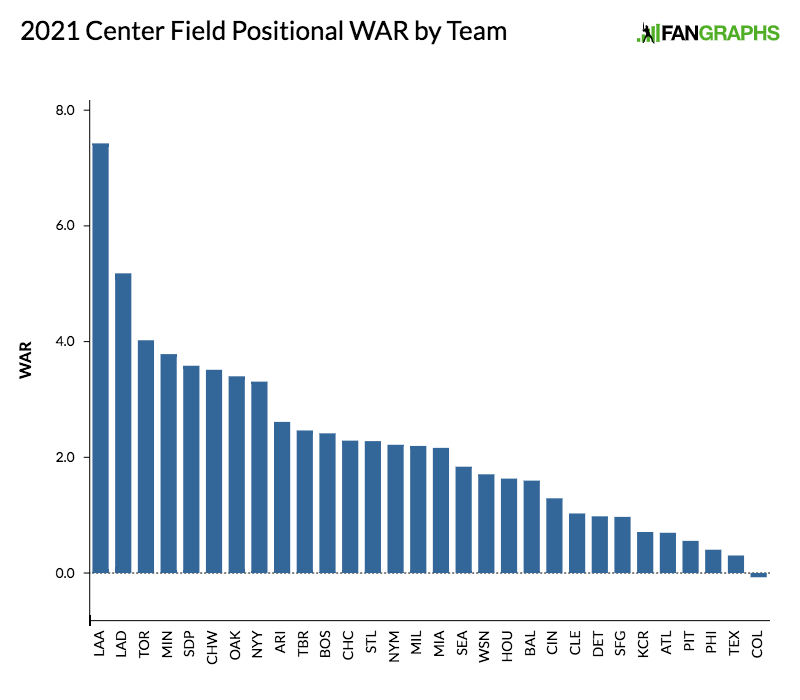
What a fun time for center fielders. We still have Trout, but there are only a couple of genuine stars after him. Instead, a changing of the guard is afoot. Luis Robert, Ramón Laureano, Trent Grisham, Kyle Lewis, Cristian Pache. All of those players could conceivably headline our list in future years, and we get to spend 2021 learning who will take the jump. At the same time, a handful of veterans have remained productive into their 30s, headlined by Aaron Hicks, Starling Marte, and Lorenzo Cain. There are a ton of plausible All-Stars here and quite a few players who probably won’t be back for next year’s edition.

As you might expect, our rankings get very jumbled in the middle. Marte and Lewis rank 16th and 17th, for instance, and I wouldn’t have batted an eyelash if they were 10 spots higher. These are not anyone’s personal rankings, but rather a projection based on ZiPS, Steamer, and our playing time estimates. Go ahead and disagree with the list; you won’t be alone. Read the rest of this entry »


2021 Positional Power Rankings: Left Field

Yesterday, Jay Jaffe and Ben Clemens wrapped up the infield with analysis of the game’s catchers and shortstops. Today, we shift to the outfield. First up? Kevin Goldstein takes a look at baseball’s left fielders.

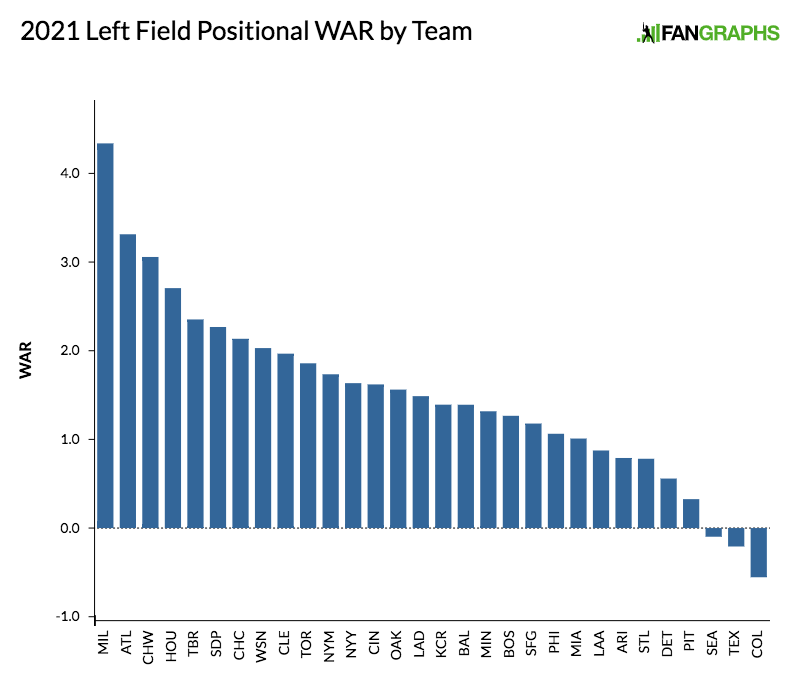
When Meg Rowley handed out the assignments for Positional Power Rankings a couple of weeks ago, I was happy to see I’d gotten left fielders. “Great, I get to write about the boppers,” I said to nobody in particular. Then I put together my 30 blurbs and was left wondering, where have all the boppers gone? Scroll down these rankings and look at the primary player listed for each team. How many of these guys actually scare you when they step in the box? Five? I’ll accept an answer up to six. That’s 20% at the most, and for an offensively-oriented position, that just doesn’t feel right. Before we got out of the top 10, we’re already talking about platoon players and guys who just got non-tendered. There’s plenty of offense in baseball, but it sure isn’t in left field.

Instead, the position is something of an island of misfit toys: Players with some offensive pluses who can’t defend and are therefore put at the least-demanding position. Declining veterans. Guys getting a second chance or who are close to running out of chances. It’s become a bit of a dumping ground on big-league rosters, and perhaps the prolonged indecision surrounding whether we’d see a universal designated hitter in 2021 played a role in how we ended up here, but it’s a surprising dearth of talent nonetheless. Read the rest of this entry »


2021 Positional Power Rankings: Shortstop

This morning, Jay Jaffe surveyed the league’s catchers. Now, Ben Clemens offers an assessment of the game’s shortstops.

Shortstop is the position where power rankings feel most unfair. It’s absolutely loaded with talent, to the point where the 26th-ranked Athletics have the same WAR projection at shortstop (1.5 WAR) as the 15th-ranked Dodgers do in left field. It’s crowded at the top — Fernando Tatis Jr. is a phenomenal headliner, and you wouldn’t be wrong to call any of the top 10 players at the position a star.

You might wonder whether the depth of the position makes each individual shortstop less valuable. After all, it’s less valuable to upgrade from 1.5 to 4.5 WAR than it is to upgrade from 0 to 4.5. You’d be wrong, though. The high defensive demands on the position mean that displaced shortstops can handle second base or center field — they can handle third as well, but third base is similarly deep with athletic hitters. Additionally, every team wants more shortstops, so acquiring a new shortstop allows you to trade your old one — sometimes in the same transaction, as we saw when the Mets traded Amed Rosario and Andrés Giménez for Francisco Lindor this offseason. So if your team is low on these power rankings, don’t fret. Or, well, do fret, but it’s not the shortstop’s fault. Teams put a lot of their best players at short, which makes it a difficult place to measure up. Read the rest of this entry »