Archive for Astros

The Nationals’ Catching Quandary

In a World Series that has been notable for its lack of drama — one lead change in five games, and the largest average margin of victory in at least a decade, as Tony Wolfe discoveredKurt Suzuki owns the biggest swing of the bat. The 36-year-old backstop’s seventh-inning home run off Justin Verlander in Game 2, which broke a 2-2 tie, produced the highest WPA of any single play thus far, at least by our measures. Suzuki has been sidelined since the middle of Game 3 due to a right hip flexor strain, and at this writing, it’s not clear yet whether he will be able to help Stephen Strasburg and the Nationals in their quest to stave off elimination.

On Monday, Suzuki participated in on-field workouts and told reporters that he had been potentially available in an emergency during the two games that he missed, and that his condition was improving: “It feels better, obviously. I got some treatment and stuff like that, and it’s progressing… Going to do some stuff today and we’ll figure out more tonight after we get into Houston about tomorrow. Everything is looking good so far.”

Though he was behind the plate for just 17 of Strasburg’s 33 starts during the regular season — a situation that owed something to a bout of right elbow inflammation that limited the catcher to five September starts, only one of which was paired with Strasburg — Suzuki has caught all four of the 31-year-old righty’s postseason turns. The results have been stellar, as Strasburg has delivered a 2.16 ERA with 36 strikeouts and two walks in 25 innings. Suzuki’s contributions with the bat during that run have been few and far between; he went hitless in 16 plate appearances during the Division Series, was 0-for-17 in 21 PA for the postseason by the time he collected a single off Jack Flaherty in NLCS Game 3, and is batting just .100/.229/.200 in 35 PA this October.

Other aches and pains may be contributing to his struggles; he needed x-rays on his left hand as well as concussion tests after being hit on the wrist and then on the noggin by a single Walker Buehler pitch in Game 5 of the Division Series. Nonetheless, he’s done the heavy lifting behind the plate for the Nationals, starting 10 the team’s 15 postseason games and eight of their 10 wins. Read the rest of this entry »


Jose Urquidy Might Have an Adjustment to Make

Editor’s note: Michael has previously written at Pitcher List and Baseball Prospectus, as well as his own site, Pitcher Giffer, and serves as the site manager for Bucs Dugout. You may also have seen his nifty pitch GIFs at ESPN. He’ll be contributing to FanGraphs a few times a week. We’re excited to welcome him.

Down two games to one to the Washington Nationals, with their season potentially hanging in the balance, the Houston Astros turned to rookie pitcher Jose Urquidy in Game 4 in an attempt to pull the World Series even. Not much was known or expected from the 24-year-old righty who made his post-All-Star break major league debut in July. To say Urquidy rose to the occasion on Saturday is a bit of an understatement. He kept the Nationals offense in check, throwing five innings with no runs allowed on two hits, no walks, and four strikeouts.

Urquidy spent one month with the team, was sent back down to the minor leagues in August, then returned in September. He continued to strike out hitters at a high rate, minimized his walks, and was able to deflate his ERA by four runs. He made two starts in four appearances, pitching a total of 11 innings, and allowed just one earned run off of four hits and two walks with a 2.76 FIP.

Could Urquidy develop into a front-line starter for the Astros in 2020? It’s possible, but he has an adjustment (or two) that will need to be made if he hopes to maintain his efficiency long term.

Urquidy was a relatively unheralded prospect; he currently sits at 19th in the Astros system on THE BOARD. Eric Longenhagen and Kiley McDaniel described him as having plus command, describing him at the time of their report as a “spot-starter type” but also noting there is a “chance that he actually has 7 command and is something more than that.” (That command is especially important given the diversity of arm slots from which he throws his pitches, but more on that in a moment.) With his future value rated at 40, it’s hard to imagine the rookie having the kind of outing he did on Saturday. Sure, you can point to the results of his seven starts and two relief appearances in 2019. During that stretch of 41 innings, Urquidi posted a 3.68 FIP, a 24% strikeout rate, and 4.2% walk rate. While that sounds great, it’s hardly enough data to infer future performance.

Below are the three main pitches Urquidy relies on– the fastball, changeup, and slider. He produces good movement, but notice how the fastball and changeup (sitting in the middle) arm slots are fairly close, but the slider is not:

A more drastic example appears below (with the curveball included):

Allow Brooks Baseball to show how disjointed they actually are, with Urquidy’s regular and postseason release points:

Read the rest of this entry »


Why Has the World Series Felt Boring?

Game 4 of the World Series started like gangbusters for the Houston Astros in Washington. A game-opening strikeout by Patrick Corbin against George Springer was followed with four straight singles, producing two runs to give Houston the first lead of the night. Corbin was able to leave the bases loaded in the top of the first to keep his side in the game, but when his pitcher opponent Jose Urquidy took the mound in the bottom half of the inning, he made quick work of the Nationals, inducing two foul pop-ups and stranding Anthony Rendon after his two-out single.

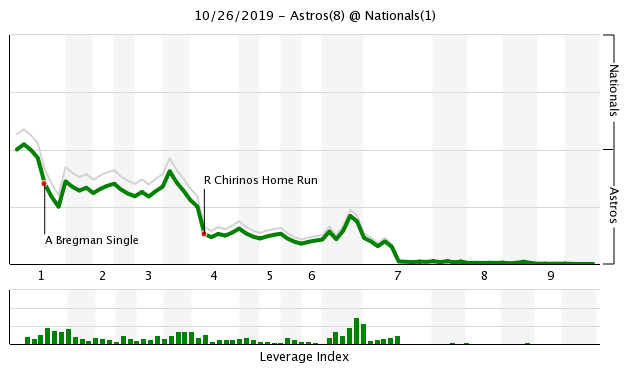
The rest of the game carried on, well, pretty much exactly like that. Each starter traded scoreless innings in the second and third innings, but then the Astros added on with a two-run homer by Robinson Chirinos in the fourth. Washington put up some fight by loading the bases with one out in the bottom of the sixth to bring Juan Soto up representing the tying run, but all Soto could do was bring in a single run with an otherwise harmless groundout. The Astros got their own bases-loaded opportunity the very next inning, and they didn’t miss it, with Alex Bregman crushing a grand slam to put the game out of reach. Houston got a lead early, and aside from a fleeting moment or two, never really seemed in danger of losing it, eventually tacking on enough insurance to make the Nationals’ final few at-bats little more than a formality. Here’s what the win probability chart looked like from that game:

After the fourth batter of the night, Washington’s win probability was never higher than 40%. After the sixth inning, it was never better than 15%. All told, it looked like a typical one-sided baseball game. There’s nothing wrong with that on its face, but when stacked up next to the other four games that have taken place in this World Series, there’s been a troubling trend. According to our calculations, the loser of Game 1, Houston, never had better than a 36.5% chance to win that game after the fifth inning. In Game 2, Houston’s odds of winning were below 2% entering the eighth. Washington’s highest odds of winning after the fifth inning of Game 3 were just 24.5%, and its odds of winning Game 5 after the fourth inning were never better than 13.2%. Read the rest of this entry »


When Should Teams Press the Advantage?

When the Nationals took an early lead in the World Series, there was a popular cry for the team to knock the Astros out while they could. Expend resources you were planning on saving for later in the series, turn Patrick Corbin into a reliever, maybe bring back some starters on short rest: what does it matter if you hurt your chances of winning Game 7, the thinking goes, if Game 7 never happens?

A softer version of this came up as the Cardinals walloped the Braves in Game 5 of the NLDS. The game was already decided. Why not pull Jack Flaherty so that he could pitch Games 1 and 5 of the NLCS rather than Games 3 and 7? It’s not an identical situation, but it relies on the same logic: earlier games happen more often, so get your pitchers into those.

Tomorrow night, there will be yet another version of this discussion. The Astros are a win away from ending the series. If the game goes into extra innings, say, or Justin Verlander gets knocked around but the offense keeps the team in it, would Houston use Zack Greinke in an attempt to end things right then and there? And should they?

While these questions are similar, they’re not identical. Does this reallocation of win probability matter? The answer, as it often is, is “it depends.” I believe the answers to these three questions are “not much,” “not at all,” and “more than you’d think,” respectively, and I’ll attempt to lay out why I think that is the case here.
Read the rest of this entry »


Road Warriors Again: Astros Take Third Straight in Washington

So much for home field advantage. The visitors won for the fifth straight time in this World Series, which means that after losing the first two games of this series to the Nationals, the Astros are up three games to two. They took advantage of Max Scherzer being scratched from his rematch with Gerrit Cole due to neck spasms, tagging emergency starter Joe Ross with a pair of two-run homers. That was more than enough run support for a dominant Cole, though Houston’s lineup tacked on three more runs in the late innings and won 7-1. During the three games in Washington, they walloped the Nationals by a combined 19-3 score, and they’re now one win away from their second championship in three seasons.

A few quick thoughts on the game, which also featured a shaky strike zone from home plate umpire Lance Barksdale, a pair of flashers behind home plate that distracted Cole, and a visit from Donald Trump that did not go as well as the president envisioned…

Pain in the Neck

The character of Sunday night’s Game 5 changed significantly before a single pitch was thrown. Three and a half hours before game time, the Nationals announced that Scherzer, who had allowed two runs in five innings in Game 1 opposite Cole, had been scratched due to spasms and nerve irritation in his right trapezius, problems for which he had begun undergoing treatment on Friday. Though he had been able to play catch on Saturday, Scherzer had woken up on Sunday in intense pain, and “completely couldn’t get out of bed… I had to basically fall out of bed and pick myself up with my left arm,” as he said during a pregame media session during which his pain and immobility were quite apparent.

“I’m as disappointed as I possibly can be not to be able to pitch tonight,” he said. “I’ve pitched through so much crap in my career that would be easy to pitch through at this point. This is literally impossible to do anything with.” He received a cortisone shot in the hopes of being available for a Game 7, if there is one. Read the rest of this entry »


Scherzer Scratched From Game 5 Start

Fresh from the unpleasant surprise department, the Washington National announced Sunday afternoon that Max Scherzer would be scratched from his Game 5 start. Scherzer has suffered neck pain in recent days and in the words of Nationals GM Mike Rizzo, is in “ungodly pain.” In for Game 5 is Joe Ross, whose only appearance so far this postseason was when he threw two shutout innings of relief in Washington’s Game 3 loss to Houston.

Considering that at times this postseason Scherzer has looked as if he would have to be dragged from the mound by a full SWAT team, I would imagine there’s not a great deal of hyperbole involved in the description of his pain. The Silver Hammer’s replacement, Joe Ross, fared well in 2019 when used as a starter, allowing a 3.02 ERA and 3.86 FIP in nine starts, all in the second half of the season. Ross, who once assisted shortstop Trea Turner in making the Wil Myers three-way trade look like a disaster for the non-Washington teams, has otherwise had his career waylaid by injuries.

The larger question, of course, is just what this means for Washington’s bottom-line playoff odds. Initially coming into Game 5, ZiPS projected the Astros to have a 61%-39% edge to win the series. But what scenario are we exactly projecting now? The answer depends on what actually happens with Scherzer’s injury, which is speculation at this point.

Ross’ start is essentially forced by the Nationals’ relief corps. Washington doesn’t have the arms to make a bonafide bullpen game a palatable scenario to the team, and with Austin Voth off the roster, they can’t start him without ruling another pitcher out due to injury. In any case, the Nats certainly don’t want to rule out Scherzer’s return unless they absolutely have to, and one would imagine the league looking very closely at the situation if Fernando Rodney or Tanner Rainey were to “suddenly” suffer injuries that necessitated them being replaced on the roster.

For the ZiPS World Series probabilities, I’m going with the happy scenario for now: Ross starts tonight, with Stephen Strasburg going in Game 6, and Scherzer left for a return in a possible Game 7. If you look at the probabilities right now, you’ll actually see the Nationals’ championship probability get a small bump to a 40%/60% deficit. ZiPS is a noted Aníbal Sánchez skeptic, and projects Ross as a minor improvement, by about two-tenths of a run per nine innings.

That, of course, doesn’t mean that this is welcome news for the Nationals, only that it’s beneficial in one very specific scenario, one the Nationals are far from guaranteed to see. To get an idea of the probabilities in some of the scenarios that are far uglier for the Nats, I re-ran the probabilities with a few of the possibilities, and condensed them into one pretty little chart!

ZiPS World Series Probabilities, Scherzer Scenarios
Scenarios Nats Championship
Scherzer pitching in Game 5 as intended, Scherzer-Strasburg-Sánchez 39%
Scherzer Game 7, pitching normally, Ross-Strasburg-Scherzer 40%
Scherzer Game 7, ERA 10% worse than projection, Ross-Strasburg-Scherzer 38%
Scherzer Game 7, ERA 30% worse than projection, Ross-Strasburg-Scherzer 36%
Ross-Strasburg-Sánchez, Scherzer healthy enough for 2 relief innings Game 7 37%
Ross-Strasburg-Sánchez, Scherzer out for playoffs 35%
Ross-Strasburg-Voth, Scherzer out for playoffs, Sánchez to bullpen 37%

Losing Scherzer for the rest of the World Series would be the worst-case scenario for the Nationals, but not one that dooms them. People tend to drastically overrate the dependability of a great starter’s excellence or a lousy starter’s ineptitude in an individual game. As terrific as Scherzer is, even in his best season, he was “only” worth 0.23 WAR per start, and was “just” 0.17 WAR better than the average pitcher. You want your best pitchers in the actual games, but even without Scherzer, who wins the series will come down to a lot more than his attendance.


Houston Takes Back the Driver’s Seat in Game 4 Shellacking

The Houston Astros evened up the World Series in convincing fashion Saturday night, defeating the Washington Nationals 8-1 in a game that was only in doubt for a few, relatively brief moments. With this win, the Astros reset the World Series into a best-of-three in which they have home-field advantage. By forcing a Game 6, regardless of the outcome of tonight’s Game 5, Houston guarantees that their last game of the year will be in front of their fans.

If there’s one thing that no one should be surprised about, it’s baseball’s ability to surprise. If you were talking to a friend who hasn’t been following the World Series, and told them a tale of a clutch Astros starter throwing five shutout innings on the sport’s biggest stage, they might think you were referring to the team’s 225-win, future Hall of Famer. Or maybe the Cy Young favorite who went undefeated for most of the season, or at least the ace pitcher picked up from the Diamondbacks in a blockbuster July trade.

Your friend in this theoretical may be extraordinarily well-informed and name Jose Urquidy, but three months ago, few would have expected Urquidy to be Houston’s firewall to prevent the team from falling to a 3-1 World Series deficit. The 24-year-old rookie not only isn’t an established veteran; he can’t even claim to be a phenom prospect making good on unlimited potential. Urquidy was barely on the prospect radar (he is currently 19th in the org on THE BOARD), a pitcher with a decent fastball and changeup, and good command, but little dazzle and an injury-shortened minor league career.

With their rotation ranking fourth in baseball in WAR, the Astros didn’t envision having fourth-starter questions in the playoffs. The acquisition of Zack Greinke appeared to make Wade Miley one of the game’s best fourth starters, completing the team’s playoff rotation. But Houston also didn’t envision that Miley, who sported an ERA under three as late as August, struggling immensely down the stretch. Miley pitched himself out of the rotation and then the playoffs entirely, leaving the Astros with something of a situation. A fourth starter wasn’t needed in the ALDS with its ample off-days, and any awkwardness in the ALCS was compensated for by the fact that the Yankees had the same worry. Read the rest of this entry »


Astros Take Game 3 from Aníbal Sánchez and the Nationals 4-1

In a technical sense, Game 3 wasn’t a must-win for the Astros. In a practical sense, the odds of Houston winning four straight games against the Nationals are under 10%. The Astros needed the win, and they got it with a 4-1 victory. For those purists of the game who enjoy pitchers batting, Game 3 of the World Series highlighted one of the big differences in strategy between the American and National Leagues: pitchers as hitters.

Greinke’s Bunt

The first potentially important pitcher plate appearance occurred in the top of the second inning. Zack Greinke came to bat with one out and runners on first and third. Greinke’s season wRC+ of 123 doesn’t really represent his true hitting talent, but his career 60 wRC+ also understates his value in this situation. Greinke got down a successful bunt and advanced the runner to second, but the Astros’ win expectancy went down about five percentage points. If Greinke had done nothing, it would have only gone down a single percentage point more. While a double play would have dropped the win expectancy by about 10 percentage points, a sac fly would have moved the Astros up four percentage points, while a single would have moved them up six.

Greinke’s career wRC+ indicates he isn’t a particularly good hitter, but it’s mostly due to his inability to walk or hit for power. With a .225 lifetime average, he hits a decent number of singles, which is what the Astros needed in this situation. With a runner already on third, moving a single runner to second doesn’t help much when there are two outs. The expected situation is a Greinke out, which drops win expectancy by six. The bunt is only one percentage point so we’re really dealing with the chances of a double play versus the chances of a single. Given the large bump from a single compared to the expected out, versus the small drop from the bunt to a double play, the double play would have to have been much more likely than the single to make bunting the right choice. That isn’t in the case here, particularly with Aníbal Sánchez giving up a bunch of loud contact in the first few innings. George Springer followed the bunt with a groundball out to keep the game at a one-run deficit for the Nationals. Read the rest of this entry »


Houston, We Might Need a Fourth Starter

The great starting pitching of these two teams was the headlining feature heading into this edition of the World Series. The matchup of two historically good rotations promised a fiercely competitive series with runs at an even higher premium than they already are in the postseason. We are two games in and the Astros’ two best starters have allowed a combined nine runs while the bullpen has allowed an additional eight. It’s been an ugly start for the Houston pitching staff.

The Astros will hand the ball to Zack Greinke in Game 3 while the Nationals counter with Aníbal Sánchez. ZiPS gives the Astros an overwhelming 58.3% chance to claw their way back into the series in Game 3. After his relief appearance in Game 1, Patrick Corbin draws the start on Saturday in Game 4. While Sánchez doesn’t approach the level of the Nats’ top three starters, his presence on the roster gives them the flexibility to rest their best pitchers should the series stretch longer than five games. And to Sánchez’s credit, he held the Cardinals scoreless and nearly hitless in his Game 1 start in the NLCS.

After Greinke, the Astros’ plan is a little less clear. When Houston needed to call on a fourth starter in the ALCS, they instead leaned on their bullpen, using seven different pitchers in the deciding Game 6. At that point in the series, they held a 3-2 advantage over the Yankees and were coming off an off day in the schedule. If they had lost Game 6, they had a rested Justin Verlander and Gerrit Cole available for Game 7. They don’t have that luxury in the World Series. Read the rest of this entry »


Fielding the Yordan Alvarez Decision

As the World Series shifts to Washington, the Astros already find themselves in a two-games-to-none hole, and now they have to contend with another loss, namely that of the designated hitter slot. While Yordan Alvarez hasn’t been able to replicate the impressive regular season showing that’s made him the presumptive favorite to win AL Rookie of the Year honors, he’s shown signs of emerging from a slump by getting on base a team-high five times in the series’ first two games. Given his defensive limitations, playing him in the field is no trivial concern, but the Astros — whose offense in October has rarely resembled the juggernaut it was during the regular season — probably need his bat more than they do a better outfield defense.

In Thursday’s media session, manager A.J. Hinch conceded that he was wrestling with the problem:

I do like the at-bats he’s had specifically in the last game or two. The balance of where to play defense, where to keep your weapons on the bench, playing a National League game where you anticipate a few pinch-hits, having some resources on the bench in order for a big at-bat. I put Tucker in that at-bat yesterday with first and second with Strasburg at the end of his outing.

I’m weighing all of that. This is a really big left field, and I’m taking that into consideration… I can probably talk myself in and out of every scenario. I don’t think we play all three games here without him seeing the outfield. I’m not sure that will be tomorrow. Right now I’m kind of leaning against it. But I’ll make that decision when I have to.

Since arriving in the majors in early June, Alvarez has been one of the game’s most productive hitters. From his debut on June 9 — during which he homered off Dylan Bundy, the first of nine longballs in his initial 12 games — to the end of the season, his 178 wRC+ (via a .313/.412/.655 line) was virtually tied with Nelson Cruz for third in the majors, behind only Ketel Marte (183) and Alex Bregman (182); his slugging percentage ranked fourth in that span, his on-base percentage fifth, his 27 homers tied for 10th, and his 3.8 WAR tied for 11th — and that’s with the positional adjustment penalty that comes with regular DH duty. Read the rest of this entry »