Archive for Astros

You’re Gosh Darn Right We’ve Got More Intentional Walks

I thought that with the advent of the World Series, the intentional walk beat was probably done for. The Astros famously didn’t intentionally walk anyone all year, and Dave Martinez seems to use intentional walks sparingly, albeit at wild times — his intentional walk of Max Muncy was one of the worst of the playoffs.

Imagine my surprise, then, when both managers intentionally walked players last night. The Nationals are always a threat to do that, sure, but the Astros?? If the Astros are intentionally walking someone, you know it’s serious. Let’s dive in.

First, the Nats walk. This one was a classic spot — Yordan Alvarez was at the plate in the sixth with a man on second in a tie game. With Carlos Correa on deck, it’s not as though it got a lot easier, but intentionally walking someone with first base open to switch the platoon matchup is a tactic as old as time.

Being as old as time doesn’t mean a tactic is good, though. Intentionally walking someone with only one out is almost never a good decision — there are just so many ways the inning can go wrong. Indeed, the walk bumped Houston’s win percentage from 60.5% to 62.8%. That 2.3% of a win is a lot to give up with a walk — could it possibly be worth it?

Alvarez has only a tiny platoon split, but with so few plate appearances, he looks like a basically average hitter when it comes to the platoon advantage after regressing his stats. He’s a good hitter overall, though, regardless of handedness. How good of a hitter? Well, Depth Charts doesn’t quite buy the hype; it projects him as a .363 wOBA hitter overall, which works out to .372 against righties. Pretty solid, if not quite Alvarez’s .437 wOBA against righties this year.

How about Correa? He’s a good hitter in his own right; a .355 wOBA per our projections. After applying platoon splits, that works out to .350 against righties. This decision doesn’t look merited unless Strasburg has huge platoon splits — and he emphatically does not. Strasburg has a huge sample of split-less pitching — so much of one, in fact, that even after regressing his line, he’s hardly worse against lefties than righties. Overall, he projects to allow a .278 wOBA to righties and .282 to lefties — basically a scratch. Read the rest of this entry »


Even a Homer Can’t Offset Bregman’s Bad Night and Bad Luck

With one swing of the bat, it appeared that Alex Bregman and the Astros had turned a corner. In the bottom of the first inning of a World Series Game 2 in which his team already trailed the Nationals 2-0, the 25-year-old third baseman pounced on a poorly located Stephen Strasburg changeup, sending it into the Crawford Boxes for a game-tying home run. The shot offered the promise of a fresh start — the superstar snapping his slump, and the powerhouse club washing away the memory of its opening night loss, if not the unending debacle that is the team’s handling of the Brandon Taubman case.

The rest of the night did not go so well, either for the Astros, who only managed to score a single run more, or for Bregman, who did not collect another hit and whose suddenly shaky defense figured prominently in a six-run seventh inning rally by the Nationals. The Astros now trail the Nationals two games to none as the series heads to Washington, and Bregman, whose play during the regular season might well garner him the AL MVP award, is still among the Astros whose offensive output this postseason has left something to be desired.

Bregman spent the past six months as merely the AL’s best player this side of Mike Trout, and thanks to the combination of his durability and versatility — he played 156 games overall, including 65 at shortstop while Carlos Correa was on the shelf — as well as the Astros’ success relative to the Angels, he may take home MVP honors. In his fourth major league season, he set across-the-board career bests with a .296/.423/.592 line, a 168 wRC+, 41 homers, an 8.5 WAR. Among AL qualifiers, his on-base percentage, wRC+, and WAR all ranked second, his slugging percentage and home run total third; he also led the league with 119 walks. While he started the postseason on a tear, hitting .353/.450/.647 with a homer in 20 PA against the Rays during the Division Series, he slipped to .167/.423/.222 in the ALCS against the Yankees, walking a series-high seven times but doing little else.

In Tuesday night’s World Series opener, Bregman went 0-for-4 with three strikeouts, two against Max Scherzer and one against Sean Doolittle, plus a walk against control-challenged Tanner Rainey. “I’ve got to be better,” he told reporters after the game. “Starts with me. I was horrible all night.” Read the rest of this entry »


Nationals Take 2-0 Series Lead as a Little Bit of History Repeats

I had a recap half-written in my head after six innings of last night’s pivotal Game 2. It focused, as expected, on the pitching matchup of Stephen Strasburg and Justin Verlander; on how, perhaps more unexpectedly, both struggled in the first inning, each giving up two runs; and how they both settled, despite a tight strike zone and a steady stream of baserunners, into the familiar, soothing rhythms of solid-but-not-dominant pitching performances. (There was a little meditation, too, on the already-iconic Verlander leg throw.) Strasburg struck out seven, and Verlander, with his six, cleared the record for the most postseason punch outs of all time.

In the sixth, Verlander pitched his first clean inning of the game, and Strasburg escaped unscathed from a Yuli Gurriel double and an intentional walk of Yordan Alvarez. Through six, and the two teams were knotted at 2-2; Strasburg, with 114 pitches, was surely done for the night, and Verlander would just as surely be coming in for the top of the seventh.

As the broadcast faded to commercial, I settled into my nest of blankets. I know what this game is, I thought, like someone who doesn’t know what’s about to hit them.

***

The seventh inning, for whatever reason, always carries with it a sort of mystique. It’s the time when you rush to grab your last beers, when everyone stretches and you hear the creaking of your sad, aging joints, when the strange little ritual of “Take Me Out to the Ballgame” is performed. It doesn’t have quite the tension of the eighth and ninth, but the mood is clearly distinct from, say, the fifth; if you’re at the game, you’re probably a little tired, a little out of it, getting a little chilly. On midsummer nights, it’s around the time the sun fades away. And ever since I witnessed the life-changing devil magic of the Jose Bautista Bat Flip Inning, I’ve been unable to stop myself from paying a little more attention when the seventh rolls around. It’s usually normal, just another inning in another baseball game. But you never know. You never know when the fabric of the game will begin to rip — or when it might be rent asunder. Read the rest of this entry »


A Pair of World Series Homers Puts the Nationals on the Right Track

In 1911, the city of Houston finished construction on a $5 million train station that overshot its original budget by $4 million. The city had been so jacked up to build this thing that they had swatted the home of a former Houston mayor and a prominent synagogue out of the way to get it up.

When people had grown bored and disgusted by trains in the mid-70s, Union Station was abandoned for a shiny new Amtrak facility. But instead of knocking it down or blowing it up, as the city had done with the buildings that had been in Union Station’s way initially, it was granted immortality by the National Park Service on the National Register of Historic Places.

When the Astros started muttering about getting a new stadium in 1995, and were actually threatening to leave Houston and become the new Washington franchise against which they are currently playing in the World Series, it was eventually determined that Union Station would make the perfect starting point for construction of their new facility.

Given the historic choo-choo depot that now serves as its main concourse, it makes sense that Minute Maid Park would incorporate a train into the ballpark’s home run celebrations. The train is piloted at 2.5 mph but still has an emergency brake, just in case of a horrifying accident occurring at a speed that many doctors consider an ideal pace for walking.

Juan Soto, who you may have heard is only 20 years old and already has three home runs in the postseason, went up to meet that train last night, bashing a home run to a part of Minute Maid Park where baseballs aren’t supposed to go. In the top of the fourth inning, he sent a Gerrit Cole fastball onto the unlit track of the silent Astros train, and the two inanimate objects became a pair of unwitting companions for the remainder of the game.

Read the rest of this entry »


Nationals Beat Astros 5-4, and Baseball Saves Baseball

It’s been a great postseason. But…

Baseball fans have been treated to an excellent month of ballgames. The NL Wildcard was an instant classic, and three matchups in the divisional round went the distance. Washington pitched historically well in the NCLS, and on the other side of the bracket, two of the best teams in baseball battled in an entertaining war of attrition, a back and forth set that climaxed with José Altuve’s walk-off homer in Game 6. Thus far, we’ve been spoiled.

But you’d be forgiven for thinking it hasn’t felt that way. As baseball reaches its annual crescendo, the sport’s collective focus has often drifted away from the games on the field. The partial un-juicing of the ball emerged as a dominant storyline early in the postseason, right alongside the usual complaints about extended commercial breaks and out-of-touch announcers blathering on far-flung networks. Then, as the league championships kicked off, ESPN’s T.J. Quinn released a disturbing piece detailing how Angels team employees not only failed to intervene on Tyler Skaggs‘ drug use but actually abetted it in his final days. Reading the news, you may well conclude that the league itself has lost the ability to sway the narrative in a way that reflects positively on the enterprise.

Unfortunately, the pattern continued; Game 1 of the World Series began under a cloud of a different sort. In the aftermath of Houston’s dramatic, exuberant ALCS win over the Yankees, assistant general manager Brandon Taubman used the occasion to rub salt in a wound. With three women reporters standing nearby, Taubman, cigar in hand, loudly and repeatedly directed a message their way: “Thank God we got Osuna! I’m so [expletive] glad we got Osuna!”

On the surface, it’s a curious message: Altuve only had to save the day because closer Roberto Osuna had coughed up a ninth-inning lead. The context, however, is damning. Osuna is only an Astro because the club was able to acquire him on the cheap while he served a suspension for domestic violence. One of the women in question has previously come under fire from Taubman for the timing of her Osuna-related tweets. That she was wearing a purple anti-domestic violence bracelet at the time adds a jolt of nastiness to already reprehensible behavior.

By now you know the details of what followed. How Sports Illustrated’s Stephanie Apstein reported the news; that Houston vehemently denied the incident took place, and questioned Apstein’s credibility, when multiple other journalists from other outlets corroborated Apstein’s account; and the Astros’ late and inadequate walk-back of their initial statement. On a day when we should have been celebrating the best of baseball, hyping up Gerrit Cole and Max Scherzer, we were instead left to grapple with the worst symptoms of its culture. As the Washington Post’s Barry Svulga succinctly summed it up: “It’s infuriating it’s 2019, and it’s the World Series, and we even need to be having this conversation. But clearly we do.”

In the end, baseball itself rescued the day. It wasn’t so much that a great game made us forget all that transpired in the previous 48 hours — as if anyone with a Twitter feed possibly could have anyway. No, a game cannot simply toss us an escape rope, and we shouldn’t want to move on so soon: Three women were wronged in an incident symptomatic of a broader problem; basic decency demands that we ask baseball to better itself.

What a game can do is remind us why we care in the first place, why we’re bothering with reading and listening and talking about these problems within baseball’s ecosystem instead of anywhere else. For all that was wrong in the last few days, baseball reminded us of its virtues, of why we choose to spend our leisure time in this imperfect space. Read the rest of this entry »


Astros’ Advantage Against Breaking Balls Could Be Key

Strong pitching — aided, perhaps, by a less lively baseball — has been the predominant story of this postseason, and given the pair of rotations lined up for the the World Series, it may well continue to be. The Nationals’ Max Scherzer and the Astros’ Justin Verlander and Zack Greinke own five Cy Young awards between them, and all are likely bound for the Hall of Fame someday. If Verlander doesn’t win this year’s AL Cy Young award, teammate Gerrit Cole quite likely will, and both Scherzer and his teammate Stephen Strasburg are contenders for the NL award (though they may take a back seat to Jacob deGrom). Oh, and if that’s not enough talent, the Nationals’ Patrick Corbin, who signed last winter’s largest free agent contract, and Aníbal Sánchez, who took a no-hitter into the eighth inning of the NLCS opener against the Cardinals, are here as well. As Craig Edwards wrote, this is one of the greatest pairings of rotations for the Fall Classic since at least 1947.

With that out of the way, a few additional thoughts about pitching, starting and otherwise, as Game 1 approaches.

Breaking Stuff Could Be the Key

As with the ALCS against the Yankees, the Astros appear to have an edge on the Nationals when it comes to matching up against certain pitch types. In terms of pitchers’ wOBAs allowed, the two teams are actually very close except for one pitch type:

Pitcher wOBA Allowed by Pitch Type
Pitch FF FF 95+ FT/SI CU SL CH
Astros .346 .298 .343 .257 .221 .252
Nationals .349 .295 .374 .267 .237 .241
MLB Avg .359 .324 .361 .281 .278 .290
SOURCE: Baseball Savant

This will be a series of hellacious sliders, given that the Astros and Nationals ranked first and second in terms of lowest wOBAs allowed on the pitch; good luck hitting those of Verlander (.164, the majors’ lowest mark), Scherzer (.169, second-lowest), Corbin (.202, sixth-lowest), or Cole (.224, 13th-lowest). Likewise, the Nationals had the majors’ second-lowest mark and the Astros the fourth-lowest on changeups, with Strasburg (an MLB-low .190), Greinke (.224, fifth-lowest), Sánchez (.271, 23rd-lowest), and Scherzer (.286, 28th-lowest) the ones to watch out for. Greinke was the majors’ best when it came to curves (.179), with Strasburg (.202, fifth) and Verlander (.222, sixth) near the head of the class. Read the rest of this entry »


The Greatest World Series Game 1 Matchup Happens Tonight

A year ago, Chris Sale and Clayton Kershaw took the mound in the opening game of the World Series. As far as pitching matchups go, those names might have made for the greatest Game 1 of all time. Sale was coming off another great season, with a FIP and ERA both around two, having amassed roughly 14 WAR over the previous two seasons combined. Kershaw has been the most dominating pitcher of his era, winning three Cy Young Awards with another three top-three finishes plus an MVP. Of course, that version of Kershaw wasn’t pitching last season, dimming the true battle of aces wattage and putting it more in the middle tier of World Series opener pitching matchups. That’s not the case tonight, as Gerrit Cole and Max Scherzer make for what is arguably the greatest Game 1 pitching matchup in World Series history.

Max Scherzer has won two of the last three Cy Young awards and finished in second place last season. He was a favorite for the award in the first half as his 5.7 WAR essentially lapped the field, but injury trouble forced him to take some time off and he wasn’t as sharp on return. He still finished the season with a 35% strikeout rate, a 5% walk rate, a 2.92 ERA, 2.45 FIP, and 6.5 WAR, the last of which was second to only Jacob deGrom in the NL and fourth in baseball behind Gerrit Cole and Lance Lynn. Scherzer has begun to shrug off the late-season donwturn and in the last two rounds of the playoffs, he has pitched 15 innings, struck out 21, walked just five and given up just a single run. His velocity has trended up in the postseason and he’s pitching with eight days rest.

As for Gerrit Cole, he topped all pitchers with 7.4 WAR this season; since the start of 2018, only deGrom and Scherzer have more than Cole’s 13.4 WAR. He’s returned to ace status after a great 2015 season, with injuries slowing him down in 2016 and ’17. He deserves to win the Cy Young award as he heads to free agency, and he has had a brilliant postseason up to this point with 22.2 innings, 32 strikeouts, and just one run in three starts. We have arguably the best pitcher in baseball right now going up against the best pitcher in baseball over the last three (and maybe up to eight) years.

Looking only at single-season WAR, the duo is impressive for the first game of the World Series. Look at the scatter plot below, which shows all matchups for World Series openers since 1947:
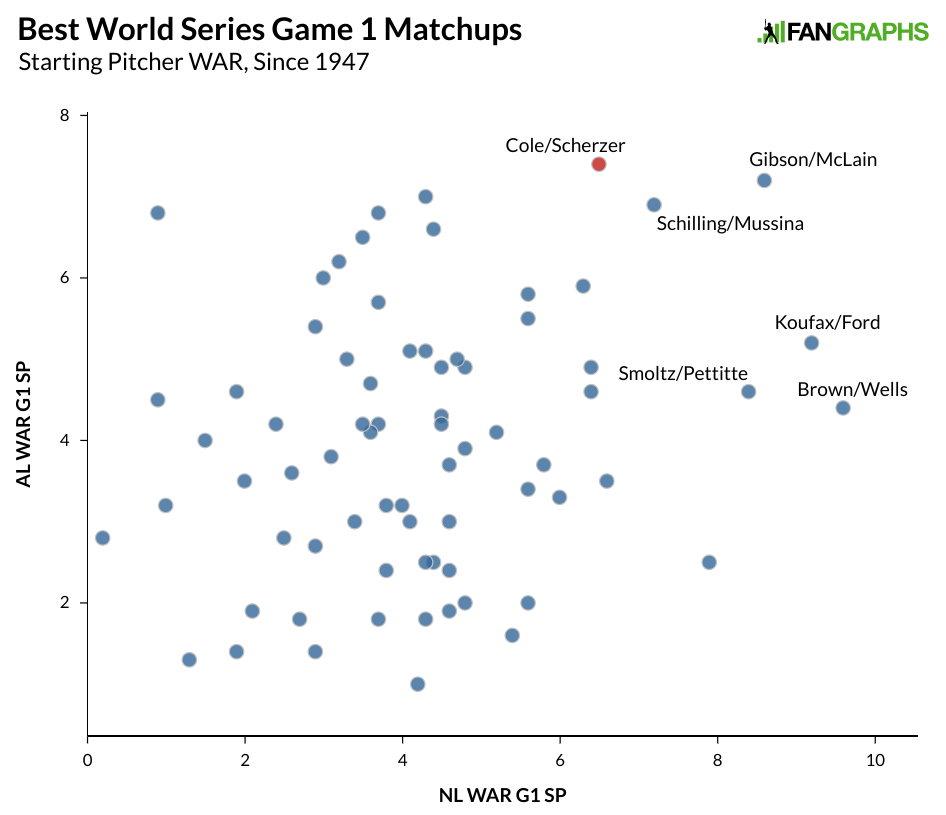
Cole has the highest WAR for an American League starter in Game 1 of the World Series since at least 1947. Before that, Smoky Joe Wood put up 7.6 WAR for the Red Sox in 1912, while Lefty Grove had 8.3 WAR for the A’s in 1930, and Hal Newhouser’s 8.2 WAR paced the Tigers in 1945. Those are the only pitchers with better seasons in the American League to start Game 1 of the World Series. Scherzer’s 6.5 WAR ranks eighth among the 72 NL Game 1 starting pitchers since 1947. On average, or using geometric mean to avoid one really good starting pitcher skewing the matchup, tonight’s game is very close to the top, but not quite the best:

Best World Series Game 1 Matchups
Season NL WSG1 SP NL WAR G1 SP AL WSG1 AL WAR G1 SP AVG WAR GEO MEAN WAR
1968 Bob Gibson 8.6 Denny McLain 7.2 7.9 7.9
2001 Curt Schilling 7.2 Mike Mussina 6.9 7.1 7.0
2019 Max Scherzer 6.5 Gerrit Cole 7.4 7.0 6.9
1963 Sandy Koufax 9.2 Whitey Ford 5.2 7.2 6.9
1998 Kevin Brown 9.6 David Wells 4.4 7.0 6.5
1996 John Smoltz 8.4 Andy Pettitte 4.6 6.5 6.2
2009 Cliff Lee 6.3 CC Sabathia 5.9 6.1 6.1
1961 Jim O’Toole 5.6 Whitey Ford 5.8 5.7 5.7
1962 Billy O’Dell 6.4 Whitey Ford 4.9 5.7 5.6
1974 Andy Messersmith 5.6 Ken Holtzman 5.5 5.6 5.5
2010 Tim Lincecum 4.3 Cliff Lee 7 5.7 5.5
1985 John Tudor 6.4 Danny Jackson 4.6 5.5 5.4
1969 Tom Seaver 4.4 Mike Cuellar 6.6 5.5 5.4
1964 Ray Sadecki 3.7 Whitey Ford 6.8 5.3 5.0
2011 Chris Carpenter 4.8 C.J. Wilson 4.9 4.9 4.8
1973 Jon Matlack 4.7 Ken Holtzman 5 4.9 4.8
2013 Adam Wainwright 6.6 Jon Lester 3.5 5.1 4.8
2018 Clayton Kershaw 3.5 Chris Sale 6.5 5.0 4.8
1990 Jose Rijo 4.5 Dave Stewart 4.9 4.7 4.7
2016 Jon Lester 4.3 Corey Kluber 5.1 4.7 4.7
1983 John Denny 5.8 Scott McGregor 3.7 4.8 4.6
1948 Johnny Sain 5.2 Bob Feller 4.1 4.7 4.6
2007 Jeff Francis 3.7 Josh Beckett 5.7 4.7 4.6
1988 Tim Belcher 4.1 Dave Stewart 5.1 4.6 4.6
1970 Gary Nolan 3.2 Jim Palmer 6.2 4.7 4.5

The Year of the Pitcher back in 1968 wasn’t just some clever name. It really was a year of incredible pitching. Nobody doubts Gibson’s greatness. He averaged more than 5 WAR per season before 1968 and then put up another 18.6 WAR in the two seasons following that historic 1968 campaign. Denny McLain, on the other hand, had put up a total of two wins the previous two seasons, and after a seven-win 1969 season was replacement level as a gambling suspension and arm trouble caused his lackluster rest-of-career.

As for the second-highest matchup, Schilling hadn’t been as good in his last few years with the Phillies but his time with the Diamondbacks coincided with a resurgence. Mussina’s 2001 season was the high point in a nine-year run that saw the Hall of Famer average 5.6 WAR per season. Just below Scherzer and Cole are Koufax and Ford, two Hall of Famers in the middle of their great careers. To provide some balance to the numbers above and find great seasons with some notion of staying power, I weighted the World Series season at 50% and the previous two seasons at 25% each:

Best World Series Game 1 Matchups
Year NL WSG1 SP 3-YR AVG WAR AL WSG1 3-YR AVG WAR GEO MEAN 1-YR WAR Weighted 3-YR GEO MEAN AVG
2019 Max Scherzer 6.8 Gerrit Cole 5.6 6.9 6.4
1963 Sandy Koufax 7.1 Whitey Ford 5.3 6.9 6.3
2010 Tim Lincecum 6.3 Cliff Lee 6.8 5.5 6.3
2001 Curt Schilling 5 Mike Mussina 6.4 7.0 6.0
1998 Kevin Brown 7.6 David Wells 4.1 6.5 5.8
2009 Cliff Lee 4.4 CC Sabathia 6.5 6.1 5.5
1948 Johnny Sain 5.1 Bob Feller 6.2 4.6 5.4
1968 Bob Gibson 6.3 Denny McLain 3.1 7.9 5.3
2018 Clayton Kershaw 4.6 Chris Sale 6.4 4.8 5.3
2016 Jon Lester 4.8 Corey Kluber 5.9 4.7 5.2
Since 1945

Tonight’s game narrowly edges the Koufax-Ford matchup from 1963 as well as the Cliff Lee-Tim Lincecum battle, as the latter was coming off back-to-back Cy Youngs in 2008 and 2009 before a solid 2010 season. If in-season WAR is the sole determining factor in the matchup, then the Gibson-McLain battle is still number one with Schilling and Mussina in 2001 second, and tonight’s game coming in third. If you want to consider what happened in-season most, but provide a little more weight to fairly recent performances, there hasn’t been a better Game 1 matchup in at least 70 years.


Should the Nationals Duck Gerrit Cole?

It will come as no surprise to you that the Nationals are underdogs in the World Series. Projection systems might vary in their exact view of the series (ZiPS has the Astros as around 60% favorites, while our top-down model has them closer to 70% and betting odds tab them somewhere in between), but every system agrees that Houston is out in front.

It’s simple logic, when you’re an underdog, that increased variance is good for you. You probably can’t beat Magnus Carlsen at chess; he’s the best player in the world, and you’re someone reading this baseball blog. You have a far better chance of beating whoever the best poker player in the world is in a single hand — there’s far more variance involved.

So to maximize their chances of winning the World Series, the Nationals should be looking for ways to increase variance. Some of that will be straightforward — they should be more willing to play the infield in to prevent runs, more willing to issue intentional walks that risk a big inning but come with a higher chance of escaping unscathed, and more willing to play for the win in the ninth inning, even if it means increasing the chances of losing on the spot.

For the most part, baseball doesn’t offer many ways to increase variance. You can’t tell your pitcher to go out there and throw in a way that will either allow six or zero runs, and you can’t tell your batters to either score in bunches or not at all. While I was brainstorming variance-increasing ideas, though, a friend suggested something interesting. What if the Nationals could tinker with their projected starters to create more lopsided matchups? Read the rest of this entry »


Greatest World Series Rotations of All Time

Between Max Scherzer, Stephen Strasburg, and Patrick Corbin on the Nationals and Justin Verlander, Gerrit Cole, and Zack Greinke on the Astros, six of the top 13 pitchers by WAR will be starting in the first three games of the World Series.

2019 Pitching WAR Leaders
Name IP ERA FIP WAR
Gerrit Cole 212.1 2.50 2.64 7.4
Jacob deGrom 204 2.43 2.67 7.0
Lance Lynn 208.1 3.67 3.13 6.8
Max Scherzer 172.1 2.92 2.45 6.5
Justin Verlander 223 2.58 3.27 6.4
Charlie Morton 194.2 3.05 2.81 6.1
Stephen Strasburg 209 3.32 3.25 5.7
Shane Bieber 214.1 3.28 3.32 5.6
Zack Greinke 208.2 2.93 3.22 5.4
Lucas Giolito 176.2 3.41 3.43 5.1
Walker Buehler 182.1 3.26 3.01 5.0
Hyun-Jin Ryu 182.2 2.32 3.10 4.8
Patrick Corbin 202 3.25 3.49 4.8
Jack Flaherty 196.1 2.75 3.46 4.7
Zack Wheeler 195.1 3.96 3.48 4.7
Orange = Astros
Blue = Nationals

That’s a staggering amount of good pitching packed into just one series. Even if both teams use a fourth starter, 75%-87% of all starters in the World Series will come from the list above. That has to be the best collection of present pitching talent in a World Series, right? Let’s test it out. Read the rest of this entry »


Jose Altuve Has Gotten His Groove Back

With one swing of his bat on a hanging slider from Aroldis Chapman, José Altuve untied Game 6 of the ALCS and sent the Astros to their second World Series in three years. In doing so, he joined some select company, becoming the fifth player in 50 years worth of League Championship Series to hit a pennant-winning walk-off home run, after current Yankees manager Aaron Boone (2003 against the Red Sox) as well as the Yankees’ Chris Chambliss (1976 against the Royals), the Tigers’ Magglio Ordonez (2006 against the A’s), and the Giants’ Travis Ishikawa (2014 against the Cardinals).

Altuve’s shot had an air of inevitability about it. While he has been surpassed by Alex Bregman as the team’s top position player — the two-year WAR totals for the pair are 16.1 for Bregman, 8.4 for Altuve — even at just 29 years old, he’s become something an elder statesman as well as a leader. He’s the longest-tenured Astro, having debuted in 2011, when the team was still in the National League and before Jeff Luhnow was general manager. His first three seasons featured a combined total of 324 losses, and while he was spared the first half of 2011 (he debuted on July 20), that’s a lot of losing for one person to endure, regardless of how one feels about the team’s choice of rebuilding strategies. Now he’s been part of teams that have won a combined total of 311 games over the past three years. Read the rest of this entry »