Archive for COVID-19

Finding the Sweet Spot in the MLB Season Proposal Chaos

Three weeks ago, Jeff Passan of ESPN reported a proposal for starting the 2020 season that involved all 30 teams playing in Arizona, using Chase Field, Cactus League parks, and other area facilities. It was the first thing resembling an actual plan to be connected to MLB decision-makers, and predictably, it was full of holes. After wide-ranging skepticism and a league-issued statement of, “Alright, let’s all just take it easy,” the Arizona plan ceded ground a few days later in favor of a new proposal that explored using teams’ spring training facilities in Arizona and Florida, completely re-arranging the divisions to do so. Right on schedule, another state was added to the mix last week, when CBS Sports reported that Texas was being discussed as a potential third site for games.

Finally, MLB’s newest reported plan was brought to light on Tuesday, and it is far and away the most ambitious yet. According to USA Today’s Bob Nightengale, MLB is now discussing a proposal that would allow the season to open in late June or early July, with all 30 teams playing in their home stadiums, without fans in attendance. What would make this possible, MLB hopes, is a complete rebuilding of divisions, eliminating the AL/NL structure to construct three, 10-team geography-based divisions.

The details of this plan, and ones like it, are important in as much as they provide a window into MLB’s top officials’ thinking right now. But as we’ve seen in recent weeks, they can also change dramatically from one iteration to the next. That’s understandable, given how quickly conditions on the ground can change, and how much we still don’t know about how soon and how widely testing will be available, when states and municipalities will lift their stay-at-home orders, and when a vaccine will be developed and mass-produced. The more time MLB takes to finalize a plan, as Passan and The Athletic’s Ken Rosenthal noted in columns earlier this week, the more information they’ll have at their disposal. No matter how many reports we read now, it will almost certainly be weeks before anything concrete is established by MLB and the MLBPA. Read the rest of this entry »


COVID-19 Roundup: Baseball in July?

This is the latest installment of a series in which the FanGraphs staff rounds up the latest developments regarding the COVID-19 virus’ effect on baseball.

MLB Floats More Plans For Opening the Season

Another day, another new idea for restructuring the 2020 season surfaces. On April 28, Bob Nightengale of USA Today reported a new variation on some of the plans we’ve already heard, this one set to take effect no later than July 2:

MLB is considering a three-division, 10-team plan in which teams play only within their division – a concept gaining support among owners and executives. It would abolish the traditional American and National Leagues, and realign the divisions based on geography.

The plan, pending approval of medical experts and providing that COVID-19 testing is available to the public, would eliminate the need for players to be in isolation and allow them to still play at their home ballparks while severely reducing travel.

The report goes on to suggest that some at MLB even envision having “several thousand fans” in attendance when playoff season rolls around — a playoff season that would be extended, given the divisional reorganization.

Read the rest of this entry »


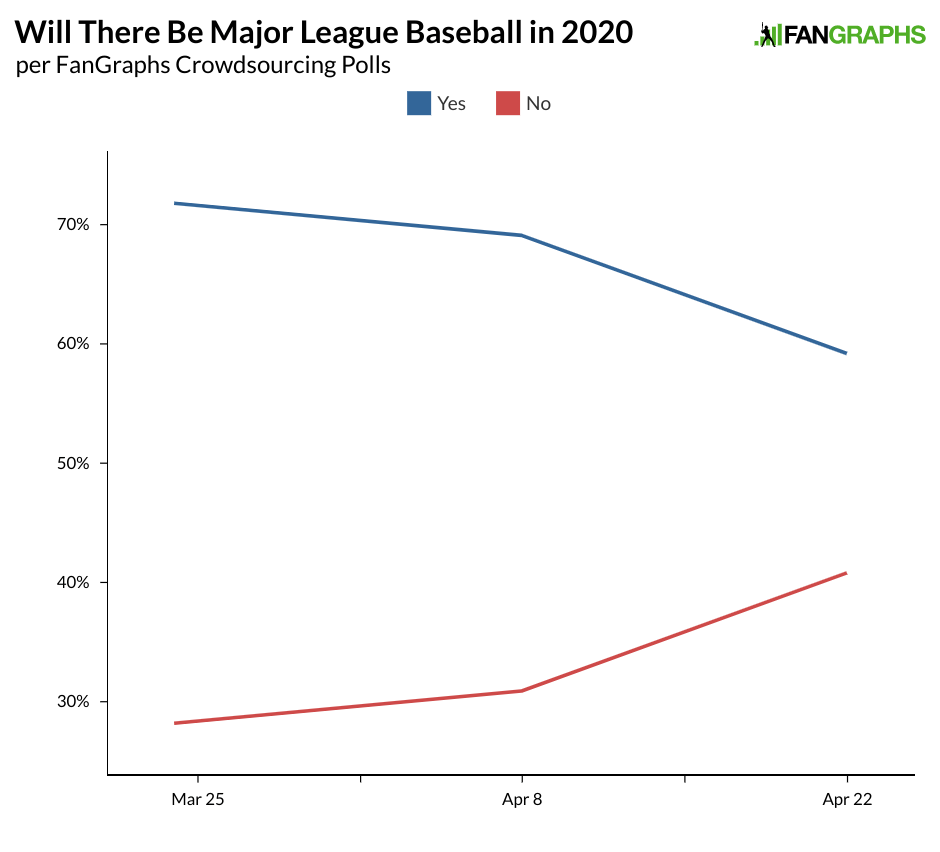
What the 2020 Season Will Look Like: Crowdsource Results Round 3

Last week, readers answered the survey questions regarding what the upcoming season will look like that I have posed several times since the end of March. In late March, nearly 72% of respondents believed some sort of major league baseball would be played this year. That number dipped slightly two weeks ago, and with another 1,500 or so votes, the confidence level has dropped further.

This is how the results look over time:

Fewer readers believe major league baseball will be played this season, but a majority still fall on the optimistic side of the fence. As for how many games will be played… Read the rest of this entry »


COVID-19 Roundup: College Summer Leagues Respond To Crisis

This is the latest installment of a series in which the FanGraphs staff rounds up the latest developments regarding the COVID-19 virus’ effect on baseball.

Cape Cod Baseball League Cancels Season

The Cape Cod Baseball League announced Friday that its executive committee voted unanimously to cancel its 2020 season, which was originally scheduled to open on June 13.

“Following CDC guidelines and medical recommendations, the league determined it would be impossible to guarantee the safety of players, coaches, umpires, host families, volunteers and fans during this unprecedented health crisis,” the league said in its announcement.

The Cape Cod Baseball League is the second in the National Alliance of Summer College Baseball to cancel its season, following a similar decision by the Valley Baseball League in Virginia that was made earlier this month. In addition to cancelled seasons, stay-at-home mandates issued by individual states have pushed back the season-openers of the Northwoods League and the Hamptons League, while the Cal Ripken Collegiate Summer League made the proactive decision to delay the season until July 1. In the Great Lakes Summer Collegiate League, there is still a plan to proceed with the season as scheduled, but three teams have already stated that they won’t be able to operate this year. Read the rest of this entry »


Remembering Steve Dalkowski, Perhaps the Fastest Pitcher Ever

You know the legend of Steve Dalkowski even if you don’t know his name. He’s the fireballer who can summon nearly unthinkable velocity, but has no idea where his pitch will go. His pitches strike terror into the heart of any batter who dares face him, but he’s a victim of that lack of control, both on and off the field, and it prevents him from taking full advantage of his considerable talent. That, in a nutshell, was Dalkowski, who spent nine years in the minor leagues (1957-65) putting up astronomical strikeout and walk totals, coming tantalizingly close to pitching in the majors only to get injured, then fading away due to alcoholism and spiraling downward even further. Dalkowski, who later sobered up but spent the past 26 years in an assisted living facility, died of the novel coronavirus in New Britain, Connecticut on April 19 at the age of 80.

Ron Shelton, who while playing in the Orioles’ system a few years after Dalkowski heard the tales of bus drivers and groundskeepers, used the pitcher as inspiration for the character Nuke LaLoosh in his 1988 movie, Bull Durham. In 2009, Shelton called him “the hardest thrower who ever lived.” Earl Weaver, who saw the likes of Sandy Koufax, Nolan Ryan, and Sam McDowell, concurred, saying, “Dalko threw harder than all of ‘em.”

“It’s the gift from the gods — the arm, the power — that this little guy could throw it through a wall, literally, or back Ted Williams out of there,” wrote Shelton. “That is what haunts us. He had it all and didn’t know it. That’s why Steve Dalkowski stays in our minds. In his sport, he had the equivalent of Michelangelo’s gift but could never finish a painting.”

In 1970, Sports Illustrated’s Pat Jordan (himself a control-challenged former minor league pitcher) told the story of Williams stepping into the cage when Dalkowski was throwing batting practice:

After a few minutes Williams picked up a bat and stepped into the cage. Reporters and players moved quickly closer to see this classic confrontation. Williams took three level, disciplined practice swings, cocked his bat, and motioned with his head for Dalkowski to deliver the ball. Dalkowski went into his spare pump, his right leg rising a few inches off the ground, his left arm pulling back and then flicking out from the side of his body like an attacking cobra. The ball did not rip through the air like most fastballs, but seemed to appear suddenly and silently in the catcher’s glove. Read the rest of this entry »


COVID-19 Roundup: Lay Off the Bleach!

This is the latest installment of a series in which the FanGraphs staff rounds up the latest developments regarding the COVID-19 virus’ effect on baseball.

Preliminary results from a recent study of antibody tests among New York City residents revealed that 13.9% of tested people came back positive for COVID-19 antibodies. That’s good news in a couple of ways. It’s another test that suggests that, at least preliminarily, the actual fatality rate may be lower than the observed case fatality rate (CFR). This happened with H1N1 in 2009, which also saw the estimated fatality rate, post-outbreak, come far below the observed CFR.

It also suggests the health care system might be able to continue to treat patients, if not in ideal fashion, at least avoiding the worst of experiences of countries like Italy, though reports of the experiences of front-line health care workers across the US, and particularly in places like New York City, serve as a grim a reminder of why it is so important to stay home.

What it means for the return of activities like organized baseball, however, remains to be seen, as such a return is obviously far more dependent on widely available tests for current infection and a decline in fatalities and hospital resource usage in states like Arizona and Florida.

And please, do not inject yourself with bleach or Lysol, whatever the president says!

MLB The Show is MLB The Show

Perhaps one of the only businesses thriving right now, at least of those that don’t make toilet paper, is Sony Interactive Entertainment San Diego, the developers of MLB The Show 20 for the PlayStation 4. Without much real baseball, you’ve seen a lot more exposure for the game than I can ever remember. We now have major league players streaming games against each other live, with ESPN and other networks set to broadcast select games from the MLB The Show Players League. The first broadcast was last night, with the next one coming Sunday night.

Korean Baseball Organization, ESPN at an Impasse

One of the bits of news that excited me last week was the prospect of seeing more KBO games broadcast live in the United States. If you haven’t watched one of their broadcasts before, the energy and excitement the crowds bring is quite refreshing, even if you do not speak the language (I don’t). What comes across is a league in which fun appears to be the priority, a sometimes sharp contrast with what is often an over-serious sport here. Theme songs, chants, bat flips — anything goes!

So it was disappointing to hear that there were hiccups in ESPN’s attempts to broadcast KBO games in the United States to help fill the programming void. Unfortunately, the catch appears to be that ESPN wanted the rights to the games for free. KBO baseball is established in South Korea and while a whole new audience is tempting, it’s a business and a league that is far beyond the point of needing to “work for exposure.”

COVID-19 Outbreak in Venezuela

While individual major league players have largely been spared from the effects of COVID-19 (though not always their family members), not everyone in baseball has been so fortunate. In Nueva Esparta, a small state consisting of three islands off the northern coast of Venezuela, there have been 93 reported cases of COVID-19, 83 of which are connected to the Roberto Vahlis academy. This makes up nearly a third of Venezuela’s reported coronavirus cases. The Phillies signed an outfielder, Yhoswar Garcia, out of the academy just last month.

More Teams Extend Benefits

In Wednesday’s COVID-19 roundup from my colleague Tony Wolfe, there was a handy-dandy reference chart of which teams have extended non-player employee salaries and for how long. Since Wednesday, the Texas Rangers have reiterated that there would be no layoffs or furloughs until at least the end of May. The Mets are at least formulating a plan for June and beyond, past their previous May 31 commitment. And the Pirates extending their employment guarantee to May 31 also just missed our publication time.

NHL Moves Closer to Reboot

There’s safety in numbers (well, maybe not), and MLB now has more company when it comes to leagues trying to find creative ways to continue their suspended seasons. The NHL is exploring their own version of baseball’s Arizona/Florida solution. The NHL initially tried exploring a neutral site plan, but found the logistics too difficult to overcome, so the current plan under consideration involves a number of regional “hubs” at which teams would play.

How Taiwan Restarted Baseball

This isn’t really new news in itself, but there was a highly detailed piece describing the steps that Taiwan needed to take in order to make starting the season practical. It’s going to take a lot more to get baseball going than just confining players to hotels. Hygiene will be especially important, and could present a challenge for a sport known for so much spitting and licking of hands.


COVID-19 Roundup: MiLB Reportedly Willing To Concede Loss of Teams

This is the latest installment of a series in which the FanGraphs staff rounds up the latest developments regarding the COVID-19 virus’ effect on baseball.

MiLB Is Closer to Accepting Contraction in Wake of Pandemic

Small baseball communities around the country were delivered a bit of a gut punch on Tuesday, when Baseball America’s J.J. Cooper reported that Minor League Baseball is nearing an agreement with Major League Baseball that would result in the loss of 40 affiliated teams. The Associated Press put out a similar report Tuesday, while Minor League Baseball itself released the following statement.

The statement seems intended to temper public reaction, though it doesn’t exactly reaffirm MiLB’s commitment to keeping the total number of affiliated teams at 160 (MLB’s proposal would reduce the number to 120). MLB’s proposal was first introduced back in October, with the league claiming it would help teams boost minor leaguers’ pay, as well as improve their quality of life by reducing travel distances and guaranteeing higher-quality facilities. Public reaction to the plan, however, decried it for what it more appeared to be — a money-saving move for the league and the owners. But advancing that goal would result in far fewer players having a place in affiliated professional baseball, not to mention the millions of Americans who would find themselves without reasonable in-person access to the sport itself, as Meg Rowley and Ben Clemens wrote about for this site in November.

But the entire professional baseball landscape looks much different now than it did a few months ago. The impact of the lost revenues of months, and possibly an entire season, of baseball is making itself felt at the major league level. The circumstances are much more dire for minor league teams, which are suddenly under threat of extinction not only from the commissioner’s office but the COVID-19 pandemic as well. As a new Professional Baseball Agreement is negotiated, MiLB could place enough value in insuring the long-term security of existing teams that it is willing to accept contraction for those on the chopping block. Read the rest of this entry »


Sorting Out Who’s Hu In Taiwanese Baseball is a Welcome Challenge

Hu? The name took me back, and even more than a decade later, accounted for a substantial percentage of what I knew about Taiwanese players in the professional ranks. Circa 2008, Chin-Lung Hu was considered a Top 100 prospect by both Baseball America (no. 55) and Baseball Prospectus (no. 32), and the third-best prospect on the Dodgers behind Clayton Kershaw, who panned out, and Andy LaRoche, who did not. I’d written about him a couple of times for the Baseball Prospectus annuals, noting that his acrobatic fielding conjured up comparisons to Omar Vizquel and forecast for future Gold Gloves as well as the bat speed to hit .300 at the major league level. A dozen years later, here he was, halfway around the globe and fresh off a milestone and a bit of history: his 1,000th hit in the Taiwan-based Chinese Professional Baseball League — due to the COVID-19 pandemic, the only professional baseball league currently playing its regular season, albeit to empty ballparks — and with the fewest games played (704) to reach that mark to boot.

Alas, I had actually missed the momentous knock, but caught up with it on Twitter a short while after via the Eleven Sports Taiwan account, which was streaming an English-language broadcast of Saturday’s game between the Rakuten Monkeys and the Fubon Guardians (Hu’s team). The Guardians had been on the short end of a 12-2 rout in the eighth inning when Hu, who had gone 0-for-4 in pursuit of hit number 1,000, singled just to the right of second base, plating a run.

An inning and maybe 45 minutes later — shortly after 9:30 AM in Brooklyn, where I had my 3 1/2-year-old daughter in my lap as we peered at a foreign but recognizable version of the national pastime — the announcers were still talking about Hu’s hit, because he was up again in what was now a 12-5 game. With men on first and second and two outs, he grounded into a potential game-ending double play, but the second baseman’s throw had pulled the shortstop well off the bag, and Hu beat the throw to first. The Guardians’ manager actually challenged the call via instant replay but was denied. The inning continued, and the game eventually ended 12-9, still a win for the undefeated (4-0) Monkeys.

My appetite had been whetted, to say the least. Read the rest of this entry »


The 2020 Schedule Meets the Chopping Block

Life isn’t fair, as it continually reminds us, but we try to keep sports as far from the harsh light of reality as we can. The New York Yankees and Tampa Bay Rays certainly don’t start in the same place when creating a roster, but when those players are on the field, everybody has to play by the same rules. Whether you’re facing Gerrit Cole or whatever fifth starter the Baltimore Orioles Mad-Libbed onto the roster, you have to get actual hits, score actual runs, and make actual Statcast-blessed defensive plays.

It’s extraordinarily difficult to keep the schedules teams face fair. Ideally, we’d want every team to face the same strength of schedule. With complete discretion over the design of the season, that’s still a nearly impossible task, without knowing which teams will be the best and worst ones ahead of time. And it becomes definitely impossible with unbalanced division schedules, series played mostly in three or four-game chunks, and a need to avoid having teams travel thousands of miles every day, like some character in the final season of Game of Thrones.

And even if you avoid all these things using some dark magics from the Necronomicon or Carson Cistulli’s personal notes, you’re still bound by the laws of the physical universe. Teams can’t play themselves, so even if every team played every other team the same number of games each season, the Yankees get a bonus by not having to play the Yankees, while Orioles’ hitters never get the opportunity to feast on Orioles pitching. Read the rest of this entry »


COVID 19 Roundup: Team Employees’ Contracts Suspended

This is the latest installment of a series in which the FanGraphs staff rounds up the latest developments regarding the COVID-19 virus’ effect on baseball.

Baseball Invokes UEC Contract Provisions

Per a report by Ken Rosenthal, Major League Baseball will invoke a force majeure provision in the Uniform Employee Contract signed by all non-player personnel on May 1. The provision allows for the suspension of contracts in extraordinary circumstances. The provision has been available to teams since the declaration of a national state of emergency on March 13, but until now hadn’t been used.

The consequences of this decision aren’t yet known. Teams could do anything from leaving everything exactly as-is to furloughing all of their non-player workers, though healthcare benefits will remain the same. Still, even if teams don’t immediately act, it’s a tough situation for workers, including front office personnel, coaches, and scouts, who must now face the prospect of reduced salary or even unemployment while planning for an uncertain season. (Non-player personnel are not unionized.)

The Braves, Giants, and Phillies have already committed to paying their employees until May 31. Other teams will surely follow suit. But it’s hard to read this move as anything other than a bargaining chip for teams. With the specter of unemployment looming over them, employees might be more amenable to changing the terms of their contracts. The Players’ Association has already reached an agreement with MLB on salary changes in the event of a shortened season, and it appears that non-player employees may soon need to do the same. Read the rest of this entry »