Opening weekend of the WPBL’s inaugural season is officially in the record books. Around 5,200 fans happily crowded into a wet and windy Robin Roberts Stadium in Springfield, Illinois on Saturday for the privilege of being able to say they were present for the league’s first pitch. A rain delay lasting just over an hour prolonged the suspense that had been building since the league was first announced early last year, but women are used to waiting their turn.
With the season now underway, I’ll be recapping each week’s action by highlighting the most notable players, moments, and anything else I deem worthy of further commentary. For each edition of the recap, I will re-license the naming rights to this list of highlights to whichever team I feel has won the week. And how does a team win the week? Well, unlike actual wins and losses in baseball, this type of win is purely subjective and will operate under the time-honored tradition of making it up as we go along.
Along with the list of highlights, the Unforced Errors list will discuss the more confounding aspects of the prior week because good faith criticism is a necessary component of continuing progress. And to round things out, we’ll touch on the Historic Firsts of Lesser Renown. The league’s momentous firsts will obviously get their shine, but there’s something to be said for the more strange and mundane firsts, the smaller day-to-day occurrences that make a new league feel familiar and complete. Think of these firsts as the knickknacks on a shelf that make a new house feel like a home. Baseball fans won’t really feel settled into their new league until the first time a player on their favorite team commits a TOOTBLAN. Read the rest of this entry »
Kevin Gausman has been a fan favorite for most of his 14 big league seasons, and for good reason. Now a Chicago Cub after Sunday’s swap with the Toronto Blue Jays, the 35-year-old right-hander has not only performed well on the field, he is widely regarded as both a good teammate and an all-around nice guy. With that reputation in mind, and the trade deadline fast approaching, I broached the subject of fandom with him at Fenway Park in the final week of July.
I began by asking about his boyhood allegiances.
“I was more a fan of players than teams,” replied Gausman, who was born and raised in the Denver area. “I wouldn’t say I was a huge Rockies fan — I was more fair-weather — although when I was in high school, they did go to the World Series. Even so, I was more a fan of the Cargos [Carlos González], the Tulos [Troy Tulowitzki], and guys like Todd Helton and Ubaldo Jiménez. It wasn’t so much, ‘This is my favorite team.’ I didn’t have that. I did have my favorite uniforms, which is kind of funny looking back. I always liked the old Blue Jays uniforms.” Read the rest of this entry »
Every year, baseball teams cram a whole season of trade activity and rumors into about four days of mayhem. This year was no exception, and there was an even bigger prize than normal. The best player available at the deadline isn’t always one of the best players in baseball; it’s often merely the best player nearing free agency on a team that isn’t competing. But this year, one of the best few pitchers on the planet fell into that category, and a broad cast of would-be contenders saw opportunities to add some juice to their rosters too. This isn’t a comprehensive list. Give me another few weeks, and I’ll have more nuanced opinions about everyone’s actions. But one day after the sound and the fury, here are the trends that most stood out to me.
Winner: The Dodgers
Duh. They got Tarik Skubal. Analysis doesn’t always have to be complicated. The Dodgers gave up two Top 100 prospects in the deal, but they’re accumulating top prospects through good drafting and development faster than they can spend them in trades and major league playing time, so that’s not a huge cost. They even get the ancillary benefit of preventing their opponents from trading for Skubal, which is non-neglible.
The Dodgers have made three big acquisitions in the past year: Skubal, Kyle Tucker, and Edwin Díaz. That’s the top available starter, hitter, and reliever (in expectation, at least) over that time period, whether in free agency or trade. The Dodgers know that they’re good now, and they’re pressing the advantage at every turn. That killer instinct puts them in great position to add a third straight championship. Not that they’re favorites, because the baseball playoffs are fueled by randomness, but they’re about as favored as it’s possible to be. Read the rest of this entry »
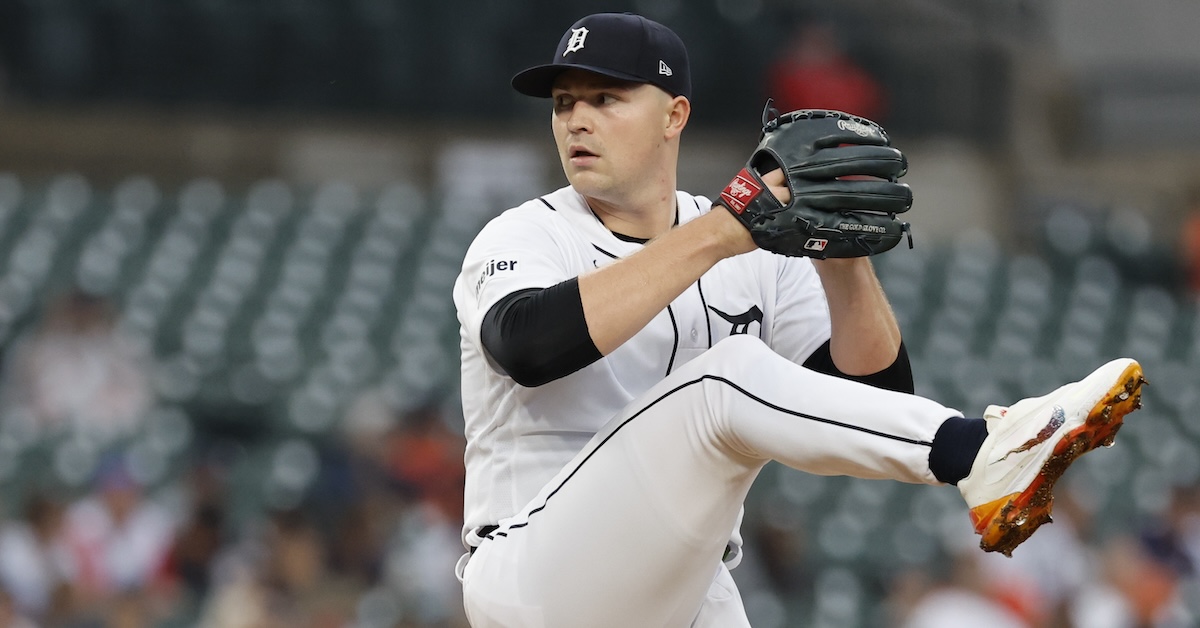
The Padres got the second-best pitcher traded by the Tigers at the deadline.
On Monday, Casey Mize was traded from Detroit to San Diego in exchange for pitching prospects Kash Mayfield and Jackson Wolf. The Padres also got minor league infielder Gage Workman in the deal.
Mize has been exceptional in 2026… when healthy. He’s posted a 2.70 ERA and 2.58 FIP in 86 2/3 innings. His 2.9 WAR is already a career best. He’s thrown strikes, missed bats, and kept the ball in the ballpark. He looks very much like the pitcher the Tigers were hoping to get when they drafted him first overall way back in 2018.
Unfortunately, Mize has also looked like the pitcher the Tigers ultimately got — or didn’t get — since his debut. He missed a few weeks in May with an adductor strain, and a few more weeks in June with adductor inflammation. Those trips to the injured list were the fifth and sixth of his career. He missed most of 2022 and all of 2023 while recovering from Tommy John surgery, and missed time with less significant hamstring injuries in 2024 and 2025. Mize exits Detroit having thrown just 526 2/3 innings over 105 outings spread across seven years; he’ll be a free agent this offseason. Read the rest of this entry »
Taylor Ward walked his way back across the country.
In a trade on Monday ahead of the 6 PM ET deadline, the Orioles sent Ward to the Mariners in exchange for Alex Hoppe and two minor league pitchers, Brock Moore and Harrison Kreiling. Ward leads the American League in walks (second in the majors only to James Wood) and satisfies Seattle’s need for a right-handed bat to even out a lopsided lineup. Baltimore in turn gets a trio of work-in-progress arms to aid in what appears to be a bit of a reset.
Ward has completely reinvented himself at the plate in 2026 after being traded to Baltimore over the offseason. For years in Anaheim, the outfielder profiled as a three-true-outcomes hitter, mixing slug-and-whiff with a discerning eye to produce at an unspectacular, but above-average clip. Last year, he mashed 36 homers and struck out 26.4% of the time, good for a 117 wRC+.
This year, Ward has an identical 117 wRC+ but has gotten there in a fundamentally different way. His walk rate has leapt from an already strong 11.3% last year to 17.2% this year — fourth best in the majors. He also cut his strikeout rate to 20%, giving him one of the best BB/K ratios in the majors at 0.84. The tradeoff has been a massive drop in ISO, to a career-low .100. A year after slugging 36 homers, Ward is pacing for 10.
Back in June, Ben Clemens wrote a great piece outlining the how and why for Ward’s changes in 2026. The how is he’s simply stopped swinging. Ward has always had a great eye, but this year he’s combined it with an aggressive form of discipline. His 34.3% swing rate is among the lowest in the league. He doesn’t swing at balls (15.3% is the lowest in the majors), and he doesn’t swing at strikes (51.8% is second lowest). He doesn’t swing when ahead in counts or behind. He doesn’t swing at the slow and bendy stuff, and he doesn’t even swing at middle-middle fastballs. Pitchers have yet to figure out how to throw him strikes consistently, and Ward has forced them into deep counts that have generally worked in his favor.
The why is Ward is swinging much slower this year. His 68.4-mph average bat speed ranks in the bottom 10% of the majors and is down from an already-slow 69.5-mph average swing last year — one of the largest drops of 2026. As Ben notes, this slower swing has meant being later on fastballs and less likely to pull the ball in the air. That’s capped Ward’s power potential and forced him toward this new, extreme approach. It’s not all bad, though. This slower swing has kept Ward from whiffing, and his 5.9% swinging strike rate is a career low, helping him spoil pitches in those deep counts. He’s also squaring up the ball at a career-best 34.2% of swings. He’s hitting a lot more high-quality low line drives to all fields and supplementing his walks with a .310 BABIP (compared to .257 in 2025).
Ward is an ideal fit for the Mariners. Their lineup has been mediocre in 2026, with a 101 wRC+ a year after finishing second in the majors with a 113 wRC+. While they’ve hit better and worse depending on the month (definitively “worse” the last six weeks), they’ve always struggled to hit lefties. Their 91 wRC+ against southpaws is 25th in the majors. They seemed to identify this as a weakness in the offseason, bringing in one of the game’s great lefty mashers in Rob Refsnyder. But Refsnyder has a 33 wRC+ and -1.0 WAR this year while battling a pair of knee injuries. Between that performance, the cratering of Cal Raleigh, and a generally lefty-heavy lineup, the Mariners have been highly susceptible to aggressive bullpening from opposing managers. More than a few teams have reworked their pitcher schedules to force the Mariners onto the weak side of their platoon.
Enter Ward: He has a 141 wRC+ against lefties this year and a 130 wRC+ for his career. He’s walked in 20.3% of his plate appearances against lefties in 2026 while only striking out in 18.8% of them. He’s not limited to a strict platoon, with a 108 wRC+ against righties both this year and for his career. This gives the Mariners an ideal mix of an everyday bat while also someone they can slot into the top of their lineup — likely the very top of their lineup — against lefties.
It’s not quite clear where Ward will play defensively. He’s been a left fielder exclusively since 2022, but the Mariners already have Randy Arozarena playing left in the midst of a career-best season, and they have Dominic Canzone in right, also having a career year. Neither is particularly good defensively, though Ward doesn’t represent a clear upgrade himself, with -1 OAA in 2026 and -3 OAA going back to last year. My sense is Ward will do a good amount of DHing while occasionally spelling Arozarena and Canzone in the corners.
With this trade, the Mariners are signaling that the 2026 season is not lost yet, which wasn’t quite clear after they dealt starting pitcher Luis Castillo to the White Sox over the weekend. “Disappointing” is an understatement for their season to date, one they began as arguable favorites in the American League. They’ve reached the deadline at 55-58, having already fired a hitting coach and with fans clamoring for more heads to fall.
Still, they remain just three back in the league’s worst division and two back of the Wild Card. I wrote just last week that the Rangers had taken over the top odds to win the AL West, then proceeded to get swept over the weekend by the Astros, who have snatched the top odds for themselves. Neither team is too formidable, with the Astros having one of the worst pitching staffs in the league and the Rangers displaying a more general mediocrity. The Mariners have far and away the best Pythagorean record in the division at a mere +3 run differential. A week or two of hot play is all it would take to make them favorites again. That seems likelier now with Ward in the lineup.
Hoppe is the most imminently relevant pitcher in the deal. He’s posted a 5.79 ERA as a rookie out of the Seattle bullpen this year while bouncing back and forth between Triple-A. There is some clear upside, as he has a 2.88 FIP with a solid 27.6% strikeout rate, and he’s also allowing just 0.64 HR/9. He throws a four-seamer that averages 97.9 mph and an impressive, biting slider that’s generated whiffs on 41% of swings this year. At 6-foot-6 with over the top arm action, Hoppe often looks the part of a future bullpen ace, even if his command has limited him to a fringe big leaguer thus far.
Moore, 26, is a righty reliever who dominated Single-A hitters this year with a 58.2% strikeout rate and a 5.5% walk rate in 16 innings. Since being promoted to Double-A, however, his long-standing issues with command have returned, now with a less impressive 33.7% strikeout rate and a 16.3% walk rate. Brendan Gawlowski noted Moore’s boom-or-bust potential in our Mariners Top 25 Prospects List this year:
“Moore touches triple digits and his slider flashes plus, but he’s a stiff athlete with a big head whack and bigger control problems.”
Kreiling, 24, was a 17th-round pick by the Mariners out of Nebraska in 2024, and he underwent Tommy John surgery before making an appearance professionally. He returned to the field this year and has made four starts, with 16 strikeouts and one walk in 10 2/3 innings. His fastball sits between 94-96 mph from a clean, moderate-effort but repeatable delivery. He also throws a cutter, a changeup, and a projectable slider. Brendan notes that Kreiling, who went unranked on the preseason prospects list, will likely receive a 35+ grade in the future, though he profiles as a reliever going forward.
It’s an ultimately a fine deal for a decent rental bat. The Mariners help even out their lineup while dealing from their strength of fringy arms with great stuff. And the Orioles get some fringy arms who could help them now and later.
The Chicago White Sox are in a position to buy at the deadline for the first time in Chris Getz’s three seasons as GM. And Getz sure is getting his money’s worth. First Luis Castillo, then Huascar Brazobán, and now an outfielder: Brenton Doyle, late of the Colorado Rockies.
Doyle, 28, is not so much a unique player as the most extreme sustainable version of the all-glove/no-bat center field archetype. He’s making $3.1 million this year as a first-year arbitration guy, and he’s under team control through 2029. Getz parted with quite a bit to get him: right-handed pitcher Mason Adams and shortstop prospect Carlos Vielma.
Doyle was a fourth-round pick out of Division II Shepherd University; he’s that school’s only big leaguer in the past 50 years, but the name fits because he plays center field like a border collie. From Doyle’s debut in 2023 to the end of last season, he led all outfielders in FRV with 44. Pete Crow-Armstrong, Jacob Young, and Ceddanne Rafaela have been better on a per-inning basis, but that’s the kind of rarefied air Doyle has been playing in. Read the rest of this entry »
Tarik Skubal is a Dodger! Adley Rutschman is about to wear red socks! The Pirates have a whole new bullpen! The 2026 trade deadline has come and gone, and it saw a few blockbusters and more than a few surprises. To help you keep track of all the activity, I’ve rounded up all of our deadline pieces in one place. You’ll find the broader summary preview pieces listed first, followed by links to RotoGraphs’ Fantasy Impact Trade Tracker, useful site tools, and of course, a team-by-team listing of the transaction breakdowns that involve your favorite squad, either as buyers or sellers. I’ll update the roundup as more deadline analysis goes live.
All of the pieces linked below took time and resources to produce. If you enjoy our coverage of the trade deadline and are in a position to do so, we hope you’ll sign up for a FanGraphs Membership. It’s the best way to both support our work and experience the site, and comes with a ton of great benefits. Now, on to the roundup! Read the rest of this entry »
A year after a massive deadline sell, the Twins have turned into tepid buyers.
First, on Thursday, they acquired lefty reliever A.J. Minter in a swap with the Mets; then, the next night, they traded with the Orioles for righty starter Dean Kremer. Neither deal is Earth shattering on its own, but together the trades underscore Minnesota’s surprising position with two months left to play in 2026. The team enters Sunday’s rubber match against the Mariners at 56-56, just three games behind the White Sox in the AL Central and tied with the Guardians for the final Wild Card spot.
Minter gives some length to the shallow Twins bullpen. The group has a 4.87 ERA — fifth worst in the majors this year. He joins the team with a 2.35 ERA in 23 innings and figures to see plenty of medium- and high-leverage opportunities, as the lefty counterpart to righties Andrew Morris and Yoendrys Gómez in the late innings. Read the rest of this entry »
What has Tarik Skubal been thinking about lately? The obvious answer is where he will be playing once the trade deadline passes, but that wasn’t how I posed the question to him a few weeks ago. What I was interested in were his thoughts on pitching as a whole.
“The evolution of the fastball,” replied Skubal, whom the Detroit Tigers dealt to the Los Angeles Dodgers late last night for a package of prospects. “What is a fastball and how guys pitch. In today’s game, more than ever, guys have two versions of the fastball. Maybe three. The cutter is still a fastball in my eyes, so cut-fastball, sinker, four-seamer. Lance Lynn was the guy who did it when I was first in the big leagues. He threw three fastballs. Now you see Cam Schlittler doing it, others guys doing it. The development of fastball offerings: just how much different it is now versus, say, 10 years ago? That’s something I would be interested to see.”
I dug up that info — more specifically, my colleague Jon Becker unearthed it for me — and we’ll get to that in a moment. First let’s hear more of what the always-insightful southpaw had to say.
“I think you almost have to have two different fastballs now, just to give them different looks,” Skubal told me. “Hitters are so good at covering one fastball, and if you give them two, that’s tough on them. I feel like that transition — multiple fastballs — is happening a lot right now.”
Skubal, whose arsenal is sans a cutter but includes an elite changeup, has thrown his four-seamer at a 36.5% clip this season, and his sinker at a 19.8% clip. The lesser used of his two fastballs isn’t great in a vacuum, but that doesn’t mean it isn’t an important weapon in his arsenal. Read the rest of this entry »
Spencer Strider made a big splash entering the majors, finishing second in the NL Rookie of the Year voting in 2022 to his teammate Michael Harris II. In just 131 2/3 innings that season, Strider struck out 202 batters against only seven homers allowed, for a sterling 2.67 ERA, an even better 1.83 FIP, and 4.9 WAR. He showed it wasn’t a fluke the following season, making the NL All-Star team and doing enough to pop up on more than two-thirds of the Cy Young ballots.
But two starts into his 2024 campaign, his velocity was down and he reported elbow pain, and that was that for his year, prematurely ended by an internal brace procedure. Since then, he hasn’t been the same pitcher. Now out again with an elbow ailment, MLB.com’s Mark Bowman gives credence to the talk that Strider won’t return in 2026, at least as a starting pitcher. I’ve heard the same insider buzz myself, but Mark has way better Braves sources than I do.
So what happens for Strider now? What does his projection look like after an injury-shortened 2026, and how would his numbers look if he were converted to the bullpen full time? Read the rest of this entry »