Archive for Daily Graphings

Red Sox Sign Chris Martin, Strike Zone Artist

Chris Martin
Jayne Kamin-Oncea-USA TODAY Sports

Move over, Jacob deGrom; this was the best free-agent deal of last week:

I kid, but only sort of! Obviously, deGrom is a phenomenal pitcher. The Rangers did well to court him. And this isn’t me advocating for the importance of “surplus value” or whatever vague finance jargon gets thrown around these days. I just really like Chris Martin, and I also think the Red Sox got a ton of bang for their buck for signing him.

There are also things not to like about Martin, at least on the surface. If people objected to a 35-year-old first baseman getting three years, imagine their discomfort at the sight of a 36-year-old reliever getting two years. His fastball velocity is pedestrian by modern standards, his pitch movement data isn’t eye-popping, and he doesn’t throw from an unorthodox angle to compensate. In 2021, Martin’s strikeout rate plummeted to 18%, and it’s worrisome to think he could return to such a dramatic low. When the risks are lined up like this, a two-year pact comes off as unappealing. Read the rest of this entry »


Open Market Musings

Jose Abreu
Kamil Krzaczynski-USA TODAY Sports

I don’t bring this up very often, but before I wrote here, I had a job trading interest rates. I won’t bore you with the technical details, but I’ve been drawing on that experience a lot recently in thinking about how teams operate when signing free agents, so I thought I’d lay out my recent thoughts here. None of this is quite fully formed yet, but I think I’m on the way there, and I’d love to hear some feedback and see if I can better formulate my point as a result.

Speaking broadly, there are two main ways to get a return on your investment in finance. First, you could lean into the efficiency of the market. You’ve probably never heard of most of the companies that do this: Virtu, DRW, Jump, Hudson River, Susquehanna, Two Sigma. They’re all major players with virtually no broader name recognition. They’re broadly considered “high-frequency traders,” which means they buy and sell an absolutely massive number of stocks and bonds every day, trying to make a tiny profit on each one.

This is the “efficient market” you learned about if you took an economics class in college. If you’re trying to buy one share of a stock and I’m trying to sell one, a high-frequency trader will hope to sell to you at $100.00, buy from me at $99.99, and pocket the penny of difference. Do that a billion times, and pretty soon you’re talking about real money. It’s more complex than that — obviously, given the amount of brain and computing power all of these companies exert — but you can broadly think of them as profiting because there’s a well-accepted price for any given security at any given time, which means they can make money off of tiny deviations from that fair price. Read the rest of this entry »

Leading the League in Bruises: Assembling a HBP-Happy Lineup

© Gregory Fisher-USA TODAY Sports

Baseball’s Winter Meetings are in full swing! Now is time to make some trades. Now is the time to sign some free agents. You and I are going to put together a team. What should our team look like? Don’t worry. I’ve already decided for us.

In 2022, Mets batters got hit by 112 pitches, setting a new single-season major league record. Ever since they broke the record, I’ve been wondering how many HBP a team could rack up if they made it their sole mission. That’s our challenge.

We’ll be building our roster using Steamer projections for the 2023 season, and we’ll assemble a lineup with the goal of obliterating the Mets’ record. We’re going to get hit often and we’re going to get hit with style. To get us in the spirit of the enterprise, I’ve named our new team the Cooperstown Contusions. Before you ask, yes, our mascot will be an anthropomorphic bruise:

Read the rest of this entry »


Sunday Notes: Rebuffing Criticism, Bill Schmidt Likes The Rockies’ Direction

The Colorado Rockies have received their fair share of criticism since winning 91 games and earning a Wild Card berth in 2018. Four losing seasons have played a part in that, but so too have some questionable decisions, financial and otherwise. Four months ago — and he’s no lone wolf in having offered such a critique — my colleague Dan Szymborski called Colorado “The worst-run organization in baseball.”

My own coverage of the club, which has focused primarily on players, prospects, and coaches, has included neither criticism nor compliment. Which isn’t to say I’m not intrigued by brickbats thrown. I am, which led me to approach Colorado GM Bill Schmidt to get his perspective on some of what has been said about the team he’s been with for two-plus decades.

The first thing I asked Schmidt about was the October decision to fire hitting coach Dave Magadan and replace him with Hensley “Bam Bam” Meulens, who’d previously worked with the San Francisco Giants and, this past season, the New York Yankees.

“They’re different people with different experiences.” said Schmidt, a longtime scout who replaced Jeff Bridich (initially on an interim basis) as Colorado’s GM in May 2021. “Hensley had a lot of success with the Giants. There are certain things… I’ll let him talk about the certain things he believes in, but he and Bags were different types of players who have different ideas of what they consider important.”

Bringing “Bam Bam” on board is notable in part because he’s an outsider; the Rockies have often been called an insular organization. Schmidt bristled when asked about that claim. as well as about accusations that the team he leads lacks direction. Read the rest of this entry »


Rangers Add deGrom in Free Agency Shocker

© Brad Mills-USA TODAY Sports

Let’s get the specifics out of the way first, so we can all gasp and react together. Jacob deGrom is now a Texas Ranger, after he signed a five-year, $185 million deal with a conditional option for a sixth year, as Jeff Passan first reported:

Alright, now that we’ve got that written down: gasp! I have to say, I didn’t see this coming. Earlier this week, I described deGrom as the one pitcher I’d want on the mound if humanity was going to play a single baseball game against an alien society to determine the fate of the world. Simply put, he’s the best doing it right now when he’s available.

His opponents next year won’t be aliens. In fact, they’ll be the ones who feel like they’re facing an extra-terrestrial, because the way deGrom pitches doesn’t resemble any other starter. He pumps 100 mph fastballs and hits the edges of the strike zone with frankly inhuman precision. The velocity understates how good his fastball is. Even the location understates how good his fastball is. He also induces tremendous vertical break on the ball, and his delivery means that his fastball crosses the plate at a comically shallow angle. I wouldn’t trust any characteristic-based pitching model that didn’t grade deGrom’s fastball as an 80 – it’s as good as it gets. Read the rest of this entry »


J.J. Picollo Addresses the Royals’ New Direction

J.J. Picollo
Jay Biggerstaff-USA TODAY Sports

The Kansas City Royals have made forward-thinking changes in recent months, most notably in the managerial chair and at the highest level of their front office. The latter preceded the former, with J.J. Picollo taking over from Dayton Moore as the team’s top decision-maker in late September. Six weeks later, Picollo hired Matt Quatraro, who had been the bench coach for the Tampa Bay Rays, to replace Mike Matheny as manager.

Another impactful decision was announced this week. In want of a more-analytically-minded pitching coach, Picollo brought on board Brian Sweeney to fill the role that had been held by Cal Eldred. Previously the bullpen coach for the Cleveland Guardians, a team with a well-earned reputation as a pitcher development machine, Sweeney is seemingly a perfect fit for a Kansas City club looking to move away from a reputation of its own. Long seen as an old school organization, the Royals are, by all appearances, becoming more progressive.

Picollo, who now holds the title Executive Vice President and General Manager, talked about the team’s new direction during last month’s GM Meetings.

———

David Laurila: You’ve addressed this previously, but it’s nonetheless the best way for us to start: Given that you worked alongside Dayton Moore for many years, what will differ philosophically with you in charge?

J.J. Picollo: “Culturally and fundamentally, there will be a lot of similarities, because it’s just baseball and how you run an organization. That said, we want to be a little more open-minded to different ways of improving our roster, and utilizing our roster. Player acquisition… a lot has been made about being transactional, but I think that can be overstated. When you’re transactional, you’re just trying to make your team better. If it makes our team better, then we’ll be transactional.

“More than anything, hiring Matt Quatraro, with the way he thinks… he’ll be creative. I think that will be developmentally healthy, especially for our younger players.”

Laurila: How does he think? Actually, let me phrase the question this way: What did he say during the interview process that sold you on hiring him?

Picollo: “A lot, but more than anything, he was able to communicate what his thoughts were. You could just see, in some of the exercises we went through… for instance, how he would put lineups together. Obviously, a lot of that is based on matchups and how you want to use matchups. Also, the idea of using our bench was very clear; it’s something he’s not going to be afraid to do. Another was putting pitchers in situations where they can succeed yet develop at the same time. He was able to explain his processes really well.” Read the rest of this entry »


Alek Manoah’s Steamer Projection Is a Feature, Not a Bug

© Nick Turchiaro-USA TODAY Sports

For the most part, projection systems fall in line with public perceptions of players. Yordan Alvarez is going to be very good next season, but Raimel Tapia won’t be. Shohei Ohtani is the eighth wonder of the world, and so on. But once in a while, they produce a head-scratcher that becomes the subject of debate. This leads to a lot of takes, some of them good but many of them bad. The worst are variations of “Projection X thinks poorly of Player Y, whom I like, and therefore it must be illegitimate.” They’re sometimes funny to read, though they’re mostly annoying because they stem from a fundamental misunderstanding of what projection systems are trying to achieve.

Let’s cut to the chase. The reason I’m writing about this is because Steamer projects Alek Manoah, who placed third in Cy Young voting and served as the Blue Jays’ ace, to put up a 4.09 ERA next season. That seems outlandish, even with the knowledge that projection systems are conservative by design. Manoah isn’t just a one-season wonder. His excellence extends back to his rookie campaign in 2021, and his sophomore effort seemed like a natural progression. The narrative is there: A great starter blossoms into a phenomenal one. Asserting that Manoah will go from an ERA in the low 2.00s to one in the low 4.00s is more or less a rebuke of it.

Of course, Steamer doesn’t think Manoah will land precisely on a 4.09 ERA – more on that later – but considering it’s the expected middle outcome, the shock is understandable. And while I’m not here to endorse it, I do want to point out that it’s not an indication the system is broken, or holds a grudge against your favorite player. You have your reasons, and so does Steamer. Read the rest of this entry »


Who Got Lucky in the Outfield?

Mookie Betts
Michael McLoone-USA TODAY Sports

You might want to buckle up. This is an article about small sample sizes, so there’s a statistically significant chance that things are about to get rowdy. It was supposed to be an article about which outfielders are better or worse than you’d expect them to be based on their sprint speed.

Just for fun, here’s the chart I started with. I turned Outs Above Average into a rate stat I’ll call OAA/150. It’s a player’s OAA per 1,350 innings, or 150 games. (I tried several other metrics, dividing by chances instead of innings, and working with UZR and DRS range metrics. This worked best for my purposes.) The sample is 544 outfielder seasons in which the fielder had at least 50 chances on balls with a catch probability below 96% (hereafter known as starred chances). I’ve labeled the two players who stood out the most in either direction in 2022.

Daulton Varsho good, Andrew Vaughn catastrophically bad. No surprise there, but I love charts like this, thick at the bottom and thin toward the top. They show how many paths there are to each outcome. Speed is a big component of OAA; the correlation coefficient of the two is 0.54. But outfielders also need to get good jumps, make plays at the wall, and be able to run down balls in all directions. There are lots of different combinations of skills that can land you in the bottom or middle of the chart. To get to the top, you need to be good at all of them. You also need to be lucky. Read the rest of this entry »


Nelson Cruz Has 13th-Percentile Sprint Speed. Can He Outrun Time?

Nelson Cruz
Ray Acevedo-USA TODAY Sports

The youths are everywhere you turn — loitering at the mall, hanging around in parking lots, playing catcher for the Mets. I’m serious: On September 30, Francisco Álvarez became the first person born after 9/11 to appear in an MLB game. The iPod is older than Álvarez. And it gets worse; there’s a pretty good chance that Andrew Painter, who was born in April 2003, will pitch significant innings for the Phillies next year.

This trend of increasingly younger people being allowed to play professional baseball is troubling to say the least. But it is only a trend, and not a universal dictate. There are a select few graybeards left in the game trying to hold back the tide. If a GM wants to hand a few million dollars to a player who’s too old to spend it all on vape pens and ring lights, there is an option on the free-agent market. A man who’s not only old enough to buy cigarettes, but who was also old enough to buy cigarettes back when they cost $3 a pack. A man so old the Grim Reaper followed him around for a while until he told the Grim Reaper to get off his lawn. An active player who, years after the retirement of Eric Young, Jr., played in the majors alongside Eric Young, Sr.

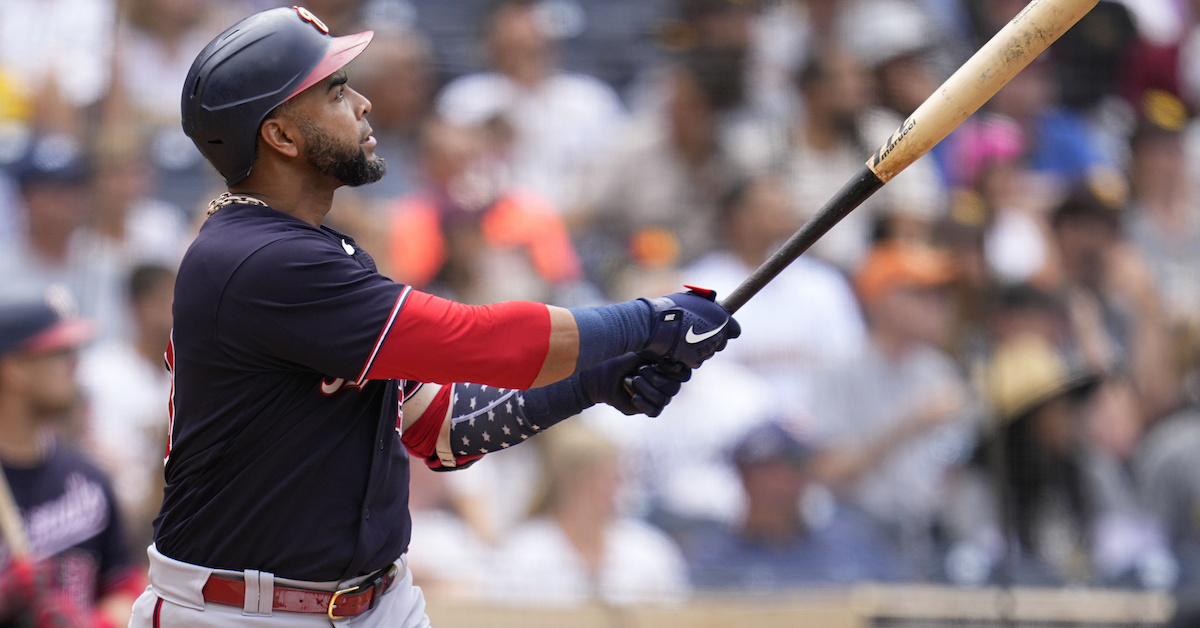
That’s right: Nelson Cruz. A man who straddles the line between Gen-X and Millennial like the Colossus of Rhodes. At 42 years old, he is the oldest position player on the market. And despite nods at retirement — next spring, he’ll be the GM of the Dominican Republic national team at the World Baseball Classic rather than its DH — Cruz wants to play in the big leagues in 2023. Read the rest of this entry »


Meatballs, With a Chance of Clouting

© Kevin Sousa-USA TODAY Sports

“He made a mistake, and Trout made him pay.” No doubt you’ve heard some version of that sentence countless times. Maybe the announcers called it a hanging slider, or a meatball, or any number of other ways of describing a poor pitch. But what exactly does it mean, and how can you know one when you see one?

I’ve discussed that question with my colleagues frequently, but we’ve never come up with a satisfactory answer because the pitches that get classified as mistakes aren’t always intuitive. Sometimes a pitcher hits the inside edge of the zone, only for a hitter sitting on just such a pitch to unload on it. Sometimes a backup slider ties up the opposing hitter. There’s bias to these observations, too: You’re far more likely to remember a pitch that gets clobbered for a home run than one that merely results in a take or a loud foul.

I still don’t have a definitive answer. I did, however, make an attempt at answering one very specific form of the question. One pitch that really does feel like a mistake, regardless of intent and irrespective of circumstance, is a backup slider over the heart of the plate. Spin a slider wrong, and it morphs into a cement mixer, turning over sideways without movement. Leave one of those middle middle, and the result is a slow and centrally located bat magnet. Read the rest of this entry »