Archive for Daily Graphings

The Twins Search for Gold on the Waiver Wire

While championship retrospectives are still being read and written, the rest of baseball is gearing up for the offseason. Immediately following the World Series, there’s always a flurry of activity as players come off the 60-day injured list, and teams get their 40-man rosters in order and begin the long process of building for next season. During these initial days of the offseason, the waiver wire is flooded with players who were removed from their team’s roster. With so many players shuffling around, these minor moves can get swept under the rug pretty quickly. After all, it’s unlikely a waiver claim in November will have much of an effect on a team’s fortunes next season. But sometimes the waiver wire holds a piece of true gold amidst all the pyrite.

Last year, the Rays claimed Oliver Drake from the Twins on November 1. It was the fourth time Drake had been claimed off waivers, with the Twins his seventh team in 2018. He was later designated for assignment three times that offseason, claimed by another team, and then traded back to the Rays in early January. That’s not exactly the ideal blueprint for how these waiver wire claims should go, but Drake’s performance during the 2019 season was as good as the Rays could have hoped for (3.87 FIP, 0.5 WAR).

The Twins are hoping to uncover their own piece of treasure in Matt Wisler. Claimed off waivers from the Mariners, Wisler certainly looks the part of roster chaff. A former top prospect, he was included in the first big Craig Kimbrel trade before he could make his debut with his original team, the Padres. He struggled in the Braves rotation for a couple of years before getting moved to the bullpen in 2017, and has bounced around the league the last two seasons, from Atlanta to Cincinnati in 2018, then back to San Diego in 2019, and finally to Seattle. Since making the transition to relief work, he’s posted an ugly 5.89 ERA and a 4.63 FIP across 123.2 innings, accumulating 0.4 WAR in three seasons.

Besides his long-forgotten prospect pedigree, Wisler looks exactly like the kind of depth that gets shuffled around in November before getting buried on the depth chart once the offseason begins in earnest. But digging below the surface reveals the potential for gold. Since 2017, Wisler has increased his strikeout rate at each stop in the majors, from 14.4% with the Braves to 30.5% with the Mariners. His ability to prevent runs hasn’t benefited from all those extra strikeouts, but it gives him an intriguing foundation that could be honed with a little development. Read the rest of this entry »
Was Hyun-Jin Ryu’s Changeup the Most Effective of 2019?

What actually makes a pitch effective? Is it the ability to induce whiffs or draw weak contact on a regular basis? Both? Are those factors actually the result of the pitch itself or the way others in a repertoire set it up? How about its movement? Can that alone make a pitch great?

Changeups and sliders are both interesting pitches, sliders in particular because there are so many variations. And changeups can be thrown with a variety of grips, making them all behave in different ways. The circle change, the Vulcan change, the “Fosh” change, the three-finger and split change — the list goes on.

Luis Castillo, Kyle Hendricks, Mike Minor, and Zack Greinke are a few pitchers who possess a great changeup. But there is another you might not think of in the same breath who deserves the same level of recognition. One that Pitch Info rated as having the most effective changeup in baseball through the 2019 season, namely former Los Angeles Dodgers starter and current free agent Hyun-Jin Ryu.

Before we dive into Ryu’s changeup, let’s go over what having an “effective” changeup, per Pitch Info, entails.

This evaluation of effectiveness comes from our Pitch Type Linear Weights (or ‘Pitch Values’), which attempt to measure how successful a pitcher (or hitter) has been with (or against) a particular pitch. Did batters regularly hit the pitch for productive outcomes, or does it tend to create outs? There is no real predictive value in these ratings. Instead, they are a reflection of what happened over the course of the season, which makes this stat particularly useful here.

A bit of caution, as there is some missing context here. If a pitcher throws a highly-graded pitch, it doesn’t always mean that it’s been strong across the board. A pitcher could have other pitches that make the pitch in question better. For example, maybe he has a dynamite fastball and a breaking pitch that, when thrown before or after the heater, regularly keeps the hitter off-balance and produces favorable results. Is it because of the pitch itself (in this case, the changeup) or is it an after-effect of the fastball? Is Ryu’s changeup elite because it’s a good pitch on its own, or because his fastballs complement it well? Read the rest of this entry »


Chapman Chooses Another Year in Pinstripes

Aroldis Chapman, most recently seen allowing a home run to José Altuve that sent the Astros to the World Series, has reportedly signed a contract extension with the Yankees that will keep him in New York through the 2022 season. The deal, as reported, adds one year and $18 million onto the two years and $30 million that were left on Chapman’s previous contract, and answers the question — open since that Altuve home run — of whether Chapman would exercise the opt out in his contract and become a free agent this offseason.

Last week, Jon Heyman reported that Chapman, 32, planned to exercise his opt-out in the event he was unable to reach a deal with the Yankees for an additional year. That move would almost certainly have resulted in the Yankees extending Chapman a qualifying offer (this year set at $17.8 million), Chapman declining to sign at that price, and Chapman and his agent subsequently seeking a deal that involved the signing team giving up a draft pick.

Having no doubt watched the Craig Kimbrel experience play out last offseason, and presumably wanting no part of it, it makes sense that Chapman would pursue an extension in New York rather than test free agency with a QO hanging around his neck. This is now the second time the left-hander has chosen to return to New York (the first time, when he signed his current contract, came in 2016) and this extension guarantees him three more years in the city he calls home — not to mention a worry-free winter.

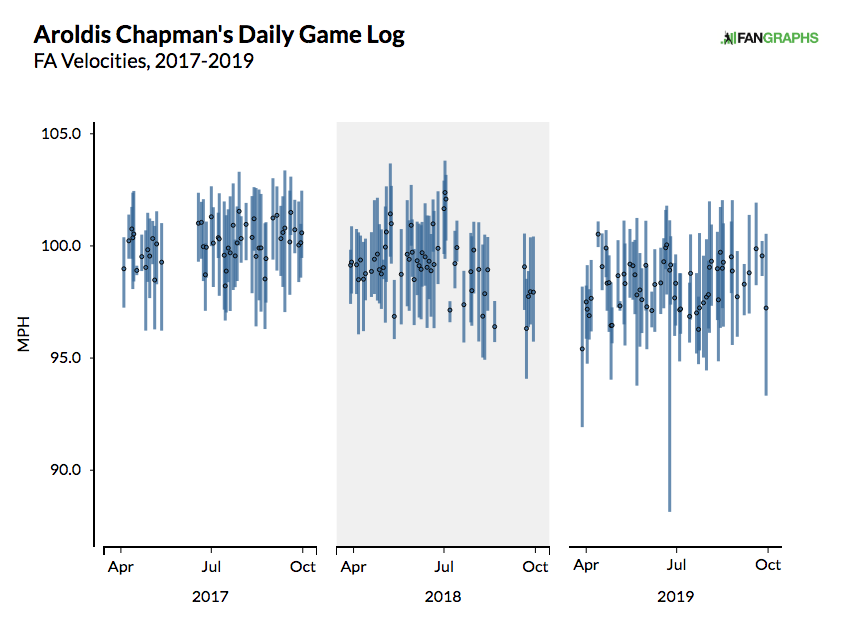
The Yankees benefit too. Retaining Chapman means that their excellent 2019 relief corps can return mostly intact, and in particular that Zack Britton, Adam Ottavino, Tommy Kahnle, and Chad Green can return to the roles they played last season, and are presumably comfortable with (that’s especially true for Britton, who for obvious reasons threw in many of the same sorts of situations as Chapman). That’s not to discount Chapman’s contributions on their own terms, as they were excellent last year (a 2.28 FIP and a 36.2% strikeout rate over 57 innings pitched) despite modest declines in fastball velocity that began in the middle of 2018 and persisted in 2019:

It’s hard to know what to make of Chapman’s velocity decline or what it augurs for his future effectiveness. As far as I can tell, the conventional wisdom on relievers is that they’re good until they’re not, except for elite relievers, who are good for longer until they’re not. Chapman definitely falls into the latter category, and as Ben Clemen’s wrote earlier this year, he’s already demonstrated success in moving somewhat away from his fastball in favor of sliders inside the strike zone. Since Ben wrote that piece, Chapman has gravitated even more towards his slider, throwing it 31.1% of the time in 2019 against 19.7% two years ago and 19.3% on his career.

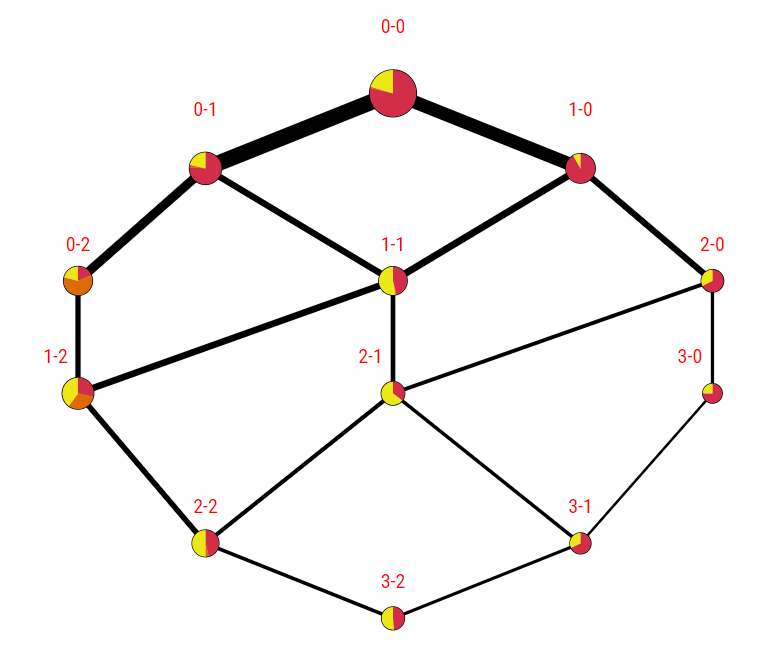
Perhaps most promisingly, Chapman has demonstrated a willingness to use that slider in most instances with the count even or behind, saving his fastball only for the first strike of the sequence (in the chart below, courtesy of Baseball Savant, his fastball is in red, his slider in yellow, and his little-used sinker in orange). That sinker only appears with two strikes and fewer than two balls, when Chapman uses it to try to generate swings and misses.

All in all, although I wouldn’t personally want to be on the hook today for paying a generic 35-year-old reliever $18 million in 2022, I think this is the right move for the Yankees, whose owners are significantly richer than I. Chapman has convincingly demonstrated that he is anything but a generic reliever, and finalizing their bullpen this early in the offseason gives New York the cost certainty they need to pursue other, Gerrit Cole-shaped projects. What’s more — and this is where it gets icky — the Yankees have clearly already decided that they’re comfortable with Chapman’s history and past suspension under the league’s domestic violence policy (Hal Steinbrenner, their owner, was quoted in 2017, not long after Chapman signed his first deal with New York, as saying of the incident, “Sooner or later, we forget, right?“).

Any other team that signed Chapman — save perhaps the Cubs — would no doubt have deservedly tarnished their reputation for doing so. For the Yankees, that decision was made three years ago, though that stretch hasn’t dimmed our memories quite like Steinbrenner thought, or perhaps hoped, it would.

With Chapman’s new contract will likely come ripple effects downstream in the relief market. Will Harris, Will Smith, Daniel Hudson, and Dellin Betances (not to mention Drew Pomeranz, Chris Martin, and Jake Diekman) are all available this offseason, and probably happy to see Chapman return to a team already rife with relief arms. There aren’t quite as many sure bets on the market this offseason as there were, perhaps, a year ago, when Kimbrel, Britton, Cody Allen, Jeurys Familia, Kelvin Herrera, Andrew Miller, Joakim Soria, David Robertson, and Ottavino were all available. But there are still enough that the teams most in the market will find plenty to consider this winter.


The Free-Agency Analysis FanGraphs Doesn’t Want You to Read, 2019 Edition

Last year, I wrote a post-length intro for our marathon Top 50 Free Agent list, which Carson Cistulli demanded I spin off into its own piece of scorching hot free agency takes. Like last year, I still have extra buzz that didn’t fit into today’s Top 50 post, and while Meg Rowley is less insistent on brevity than Carson was before her, she made the same request, so here it comes, at the molten lava temperatures that you prefer.

First, some bullet-pointed thoughts on specific teams likely to be active, as well as various player markets:

  • There’s some buzz that the White Sox will be active for veteran help, particularly on short-term deals with lower guarantees. After getting under the luxury tax, the Dodgers seem poised to spend, with multiple sources tying them to Rendon, while the two top pitchers on the market (Cole, Strasburg) are SoCal natives. The Yankees had the third-best record and third-best run differential in baseball, but seem a player or two short and weren’t able to stay under the luxury tax to reset the penalties; they seem likely to spend in this area again. Philadelphia seems primed to spend again this offseason to help get past Washington and Atlanta. Speaking of which, Atlanta has a stable of young players to fill in the back of the roster, but needs a couple frontline types from the top 10 of the list to raise their upside. Cincinnati, San Diego, and the Mets all seem to be focused on a playoff run in 2020, which could result in them making moves more aggressively this winter than other teams with similar talent.
  • Last year, Dallas Keuchel, Craig Kimbrel, and Mike Moustakas were among the free agents most-squeezed in terms of the deal they eventually got vs. the deal they wanted/deserved. Keuchel and Moustakas are back on the market and I rounded down a bit on their projected deals in the Top 50 since they’re still the same players, but a year older, though Keuchel has now rid himself of a qualifying offer and its accompanying draft pick compensation. Players over 30 who seem unlikely to post 3 WAR or more simply aren’t what most clubs are looking for on a multi-year deal, especially when the most successful clubs seem to be finding two-win players between the couch cushions, or in the second and third tier of their prospect lists.
  • Teams want impact, durability, and youth when paying premium prices over a long term, and in this market, only Gerrit Cole and Anthony Rendon clearly possess all three attributes. The two profiles next-closest to that are guys who ended up moving up the board a bit throughout the process: Yasmani Grandal and Marcell Ozuna. They are entering their age-30 and age-29 seasons, respectively, with Grandal offering outstanding performance at a premium position, while Ozuna has youth, tools, and upside along with a pretty solid track record. I’d expect both to get four-year deals, which are increasingly rare below $100 million.
  • Read the rest of this entry »


2020 Top 50 Free Agents

Welcome to FanGraphs’ top-50 free-agent rankings. Dave Cameron had previously been responsible for this annual post; I took the reins last year. I’m back leading the charge again, with some assistance from my colleagues.

In what follows, I’ve provided contract estimates and rankings of the winter’s top free agents, along with market-focused breakdowns for the top-25 players. As for why I’ve provided commentary on only the top 25, you can decide for yourself whether it’s because my take on No. 49 Eric Sogard was too hot for the internet, or because all of the players just kind of seemed the same to me by that point. Meanwhile, a combination of Ben Clemens, Craig Edwards, Brendan Gawlowski, Jay Jaffe, Eric Longenhagen, Rachael McDaniel, and Dan Szymborski have supplied the more player-focused breakdowns, which are designed to provide some context for each player at this moment in his career.

Note that players are ranked in the order in which I prefer them, in terms of the overall guaranteed money I’d spend on them. Usually, this is very similar to the order of the overall contract values as both the crowd and I have projected. But in some instances, that’s not the case. I explain my rationale where relevant.

The main theme that I hit upon multiple times in my comments below is the continued evolution of free agency: how hard teams compete with one another in the market, how quickly players sign, the types of player helped or hurt by the changing landscape, and the methods agents use to position their clients, and the deals they eventually sign. If you’re interested in more notes and rumors, I’ll have a corresponding post up to that end shortly, but I didn’t want to make you scroll any further.

Now let’s get to the list.

– Kiley McDaniel Read the rest of this entry »


Sunday Notes: Cutter Heavy, Josh Osich Doesn’t Bury His Head in the Sand

Josh Osich doesn’t bury his head in the sand when a change is in order. Compared to most hurlers, the 31-year-old southpaw has been chameleon-like in terms of his pitch usage. He’s switched teams, as well. Originally in the Giants organization, Osich spent 2019 with the White Sox, and just this past week he was claimed off waivers by the Red Sox.

Intrigued by what I saw in his pitch-type column, I asked the former Oregon State Beaver for the reasons behind all the ebbs and flows of his offerings.

“If the scouting report is the same every year, they know what you’re going to be throwing,” Osich said this summer. “It’s always nice to change things up, so that they don’t know what’s coming. In 2016, I was sinker-heavy. The year before that, I was fastball-changeup-cutter; it was more of a mix. In 2018, there were probably a few more changeups. This year I’ve been cutter-heavy.”

Very cutter-heavy. Roughly two out of every three pitches Osich threw in 2019 were classified as cutters. Might that not be contradictory to his “they don’t know what’s coming” comment? Read the rest of this entry »


The $17.8 Million Question

Do you think the end of the baseball season results in a nice vacation for front offices? Poppycock! Horsefeathers! Archaic 19th Century Declaration of Shock! Hundreds of players will be able to offer their services on the open market after the post-postseason quiet period ends in a few days. With those free agency entrants comes a significant decision for teams: whether to extend qualifying offers to their departing free agents. And unlike paying your water, electric, or taco bill, it’s an actual choice that has to be made.

For those who don’t have the qualifying offer rules committed to memory, a refresher is in order. If a free agent spent the entire season on one team’s roster and has never before received a qualifying offer, his team can choose to extend to him a qualifying offer in order to receive draft pick compensation should he elect to sign with another team.

If a team makes a free agent a qualifying offer and received revenue sharing, they get a pick after the first round of the draft if the player is guaranteed at least $50 million by his new team. If they did not receive revenue sharing, their comp picks comes after the second round. If the team did not receive revenue sharing and did not exceed the luxury tax, they get a post-round two pick no matter the free agent’s new contract. The increasingly rare number of teams that exceed the soft salary cap luxury tax threshold pick after round four.

The qualifying offer is a one-year deal equivalent to the average of the salary of the top 125 highest-paid players in baseball. For the first time ever, the qualifying offer went down this year as owners realize that not paying for stuff is a lot more fun than paying for stuff, even if it doesn’t always result in winning baseball games.

The decision to make a free agent a qualifying offer has real consequences for players and teams, sometimes disastrous ones. The Cleveland Indians let Michael Brantley walk scot-free after the 2018 season, unwilling to risk “having to” sign a player coming off a 3.5 WAR season to a reasonably priced one-year contract. Brantley was worth 4.2 WAR in 2019; the Indians were patching holes in their outfield the entire season. Cleveland finished three games behind the Wild Card road team, the Tampa Bay Rays, so you can do the math there. Read the rest of this entry »


Why Gerrit Cole Never Came Into Game 7 of the World Series

Yesterday, I wrote about the decisions A.J. Hinch and the Astros made in Game 7 of the World Series. Zack Greinke started the inning, gave up a one-out homer to Anthony Rendon that cut the Astros’ lead to 2-1, and then walked Juan Soto. At that point, Hinch opted to take Greinke out and bring in Will Harris; Howie Kendrick proceeded to hit a two-run homer to give the Nationals a lead they would never relinquish. In my piece, I argued that Hinch should have left Greinke in to finish the seventh, but before I got there, I discussed whether Greinke should have started the inning to begin with, and the team’s bizarre handling of Gerrit Cole as a potential reliever:

That leaves Gerrit Cole. It’s not clear why Cole was only going to be available for the ninth inning if Houston got the lead. He was warming earlier in the game. He was pitching on two days rest, so it’s possible he was only going to be available for an inning, and it seems reasonable to want to put him in at the start of an inning so he can be better prepared for it, but having him only available in the ninth to close out a World Series win is an odd choice and makes one wonder if the decision wasn’t entirely baseball-related. In any event, if Cole could have only gone one inning and needed to start it, then sticking with Greinke to start the seventh was completely reasonable.

We now have some answers, though they cause more questions.

Read the rest of this entry »


The 2019 Astros Join a List of Great Failures

The list of baseball’s winningest teams is one that any franchise would want to be on, but if we take that list and remove the World Series champions, it becomes something of a bummer. Everyone remembers the 2001 Mariners more for what they didn’t do than what they did. It’s not clear how history will remember the 2019 Astros. It seems likely this club will simply get tossed in with the 2017 team that did win it all, taking some of the sting away from not being able to claim a second championship this season. Though perhaps difficult for Houston and its fans right now, we should remember just how great this team was. There’s a reason the Astros’ World Series odds were so high for so long, and it’s because they put together a roster that, over the course of the regular season and much of the postseason, was a lot better than everyone else.

The table below feels almost obligatory, but here’s a list of the teams to win least 105 games, with how their seasons finished:

Teams with the Most Wins in a Season
Season Team W Result
2001 Mariners 116 Lost ALCS
1906 Cubs 115 Lost World Series
1998 Yankees 114 Won World Series
1954 Indians 111 Lost World Series
1927 Yankees 110 Won World Series
1909 Pirates 110 Won World Series
1969 Orioles 109 Lost World Series
1961 Yankees 109 Won World Series
1970 Orioles 108 Won World Series
1975 Reds 108 Won World Series
1986 Mets 108 Won World Series
2018 Red Sox 108 Won World Series
2019 Astros 107 Lost World Series
1932 Yankees 107 Won World Series
1931 Athletics 107 Lost World Series
1907 Cubs 107 Won World Series
1939 Yankees 106 Won World Series
1998 Braves 106 Lost NLCS
1904 Giants 106 No World Series
2019 Dodgers 106 Lost NLDS
1942 Cardinals 106 Won World Series
1905 Giants 105 Won World Series
1944 Cardinals 105 Won World Series
1943 Cardinals 105 Lost World Series
1953 Dodgers 105 Lost World Series
1912 Red Sox 105 Won World Series
2004 Cardinals 105 Lost World Series

Read the rest of this entry »


Toward a Unified Theory of Baby Shark

Gerardo Parra reached base only one time in the World Series, a walk against Josh James in Game 4. It wasn’t a key moment in the series — the Nationals were down 4-0, and while Parra scored, the Nats lost 8-1. When he reached first base, he was downright businesslike:

But businesslike isn’t normally a good description of Parra’s time on the Nationals. He’s widely regarded as a great clubhouse guy, ambushing Stephen Strasburg with hugs and keeping things light over the long grind of a season. He also, you may have heard, uses “Baby Shark” as his walkup music, a song that Nationals fans and players alike have rallied around.

If you’re curious, here’s a handy guide of the hand signals the Nationals make after hits:

Read the rest of this entry »