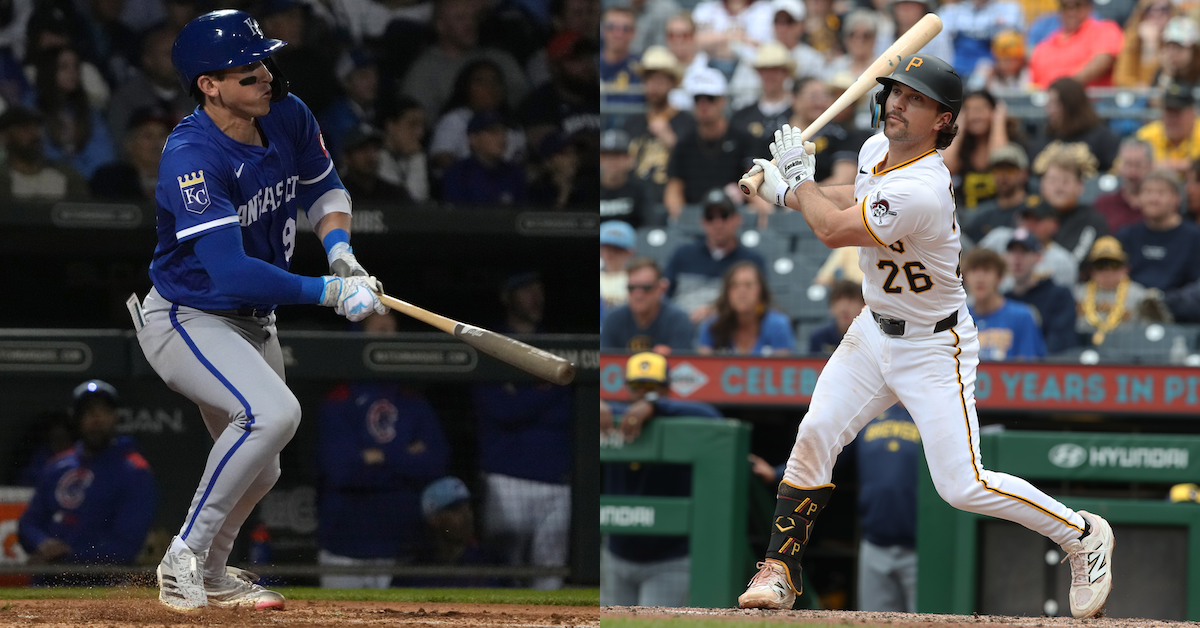
With the draft and the All-Star Game out of the way, the next waypoint on the baseball calendar is the trade deadline. In other words, it is officially Trade Season. And the Royals and Pirates kicked it off on Wednesday morning with the first deadline deal. I got a little excited; sometimes, when the Royals and Pirates make a deal, you end up with Sir Francis Drake’s invaluable contribution to the defeat of the Spanish Armada at the Battle of Gravelines in 1588.
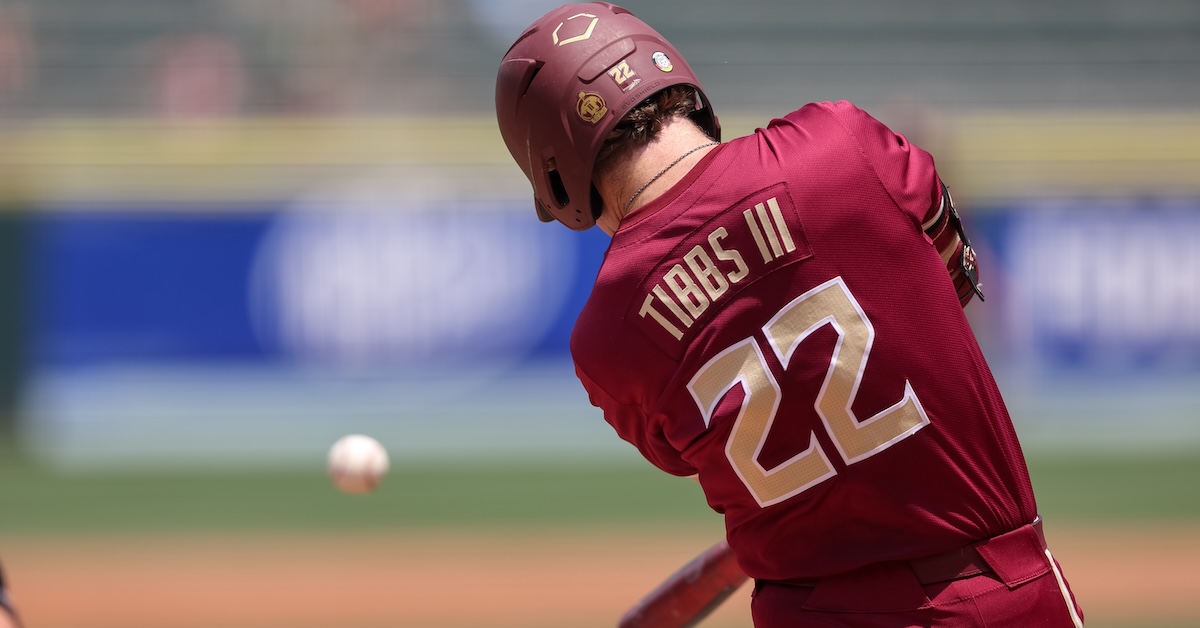
James Tibbs III might best be described as a hitting rat. Drafted 13th overall last year by the San Francisco Giants out of Florida State University, and subsequently shipped to the Boston Red Sox in last month’s blockbuster Rafael Devers deal, the 22-year-old outfielder lives and breathes baseball — particularly the part that entails standing in the batter’s box. From a young age, Tibbs has doggedly worked on honing his left-handed stroke.
An Atlanta native who attended high school in nearby Marietta, Tibbs excelled collegiately, slashing .338/.462/.685 over three seasons at the ACC school, with a 28-homer junior campaign further enhancing his profile. And he’s continued to hit in pro ball. He played just 26 games after inking a contract last summer, and his results were mixed; he posted a 153 wRC+ in nine games (42 plate appearances) in A-ball, earned a promotion, then went cold in High-A. Now in his first full professional season, he’s back to doing what he does best: bashing baseballs. Tibbs put up a 132 wRC+ with a dozen home runs in High-A prior to the trade, and since joining his new organization, he has logged a 107 wRC+ over 86 plate appearances while acclimating to Double-A.
Ranked 14th in what Eric Longenhagen called “the best farm system in baseball” when our Red Sox Top Prospects list was published in late June, the promising young outfielder was assigned a 45 FV, with raw power graded as his best hitting tool. Tibbs sat down to talk hitting prior to a recent Portland Sea Dogs home game.
———
David Laurila: You were drafted one year ago. Are you the same hitter now, or has anything meaningfully changed?
James Tibbs III: “I’m pretty much the same. It’s what’s gotten me this far, and I’ve kind of tried to replicate that as much as possible. I’ve never been one to try to make changes unless it’s absolutely necessary, because I play off of feel. I’ll make adjustments based off of that feel, but I’m doing it trying to get back to my base. My base has been pretty consistent for the last… three years? Two years? Something like that.
“I feel like I cover the plate well. I feel like I can see the ball well from where I stand and how I load. I feel like I use my body well in order to get to the spots that I can’t necessarily cover. So yeah, it’s been pretty consistent for the most part.”
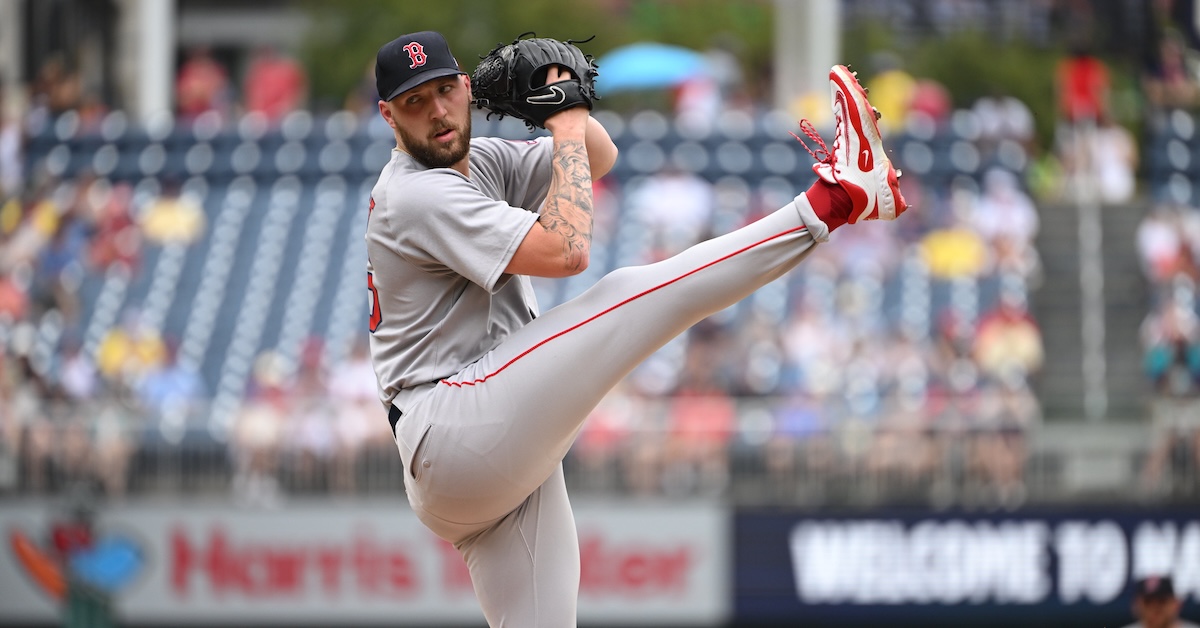
When you think of Garrett Crochet, you probably think of a lanky lefty flinging filthy fastballs past flummoxed hitters. Nearly half the pitches Crochet threw last year were four-seamers. The pitch averaged 97.1 mph, and according to Statcast’s run values, it was worth 21 runs, making it the fifth-most valuable pitch in the game, trailing estimable offerings like Emmanuel Clase’s cutter and the sliders of Dylan Cease and Chris Sale. Crochet’s other pitches were worth a combined -2 runs. Although he ran a 3.58 ERA while pitching in front of a porous White Sox defense, the four-seamer led him to a 2.38 xFIP and 2.75 DRA. Both marks were the best among all starters. Crochet has kept right on rolling in 2025. He’s running a 2.23 ERA with a 2.40 FIP, and his 4.3 WAR ranks second among all pitchers. It would be easy to glance at the top line numbers and assume that Crochet is the same pitcher he was last year, just in front of a better defense. But there have been some subtle changes under the hood, and his relationship with his fastball now looks very different.
When a trade brought Crochet to Boston in December, the reasonable assumption was that he’d back off the four-seamer at least a little. Under Craig Breslow and Andrew Bailey, the Red Sox became the most fastball-averse team in the history of the game, throwing four-seamers and sinkers just 36.8% of the time in 2024. No one expected Crochet to ditch one of the game’s greatest weapons, but it stood to reason that the Red Sox might tweak his usage just a little bit in favor of his sweeper, his cutter, and his new sinker, all of which looked like excellent pitches. Read the rest of this entry »
Longtime readers of this site might remember my tremendous affection for Pittsburgh relieverDavid Bednar. It’s OK if you don’t; I last wrote about him in May 2023, which is so long ago the Pirates were in first place at the time. Bednar was a rock back in the day, a top-class closer for a team that frequently disappointed. But from 2021 to the end of 2023, he was terrific: ERAs in the low-to-mid-2.00s every year, with strikeout rates in the high 20s and low 30s.
That trend stopped abruptly in 2024. Again, this wasn’t front-page national news; wise fans had by this point learned to ignore any Pirate shorter than 6-foot-6. But Bednar posted a 5.77 ERA, blew a career-worst seven saves, and saw his strikeout rate plummet to 22.1%, more than 10 percentage points from where it was two years earlier.
A sad development, but not an unforeseeable one. Relief pitchers, even good ones, even reliable ones, have a shorter shelf life than most condiments. But he’s back this year; in 36 games, Bednar has a 2.53 ERA, a career-high 34.6% strikeout rate, a 6.9% walk rate (his lowest since he joined the Pirates five years ago), a 2.02 FIP, and 13 saves out of 13 opportunities. Read the rest of this entry »
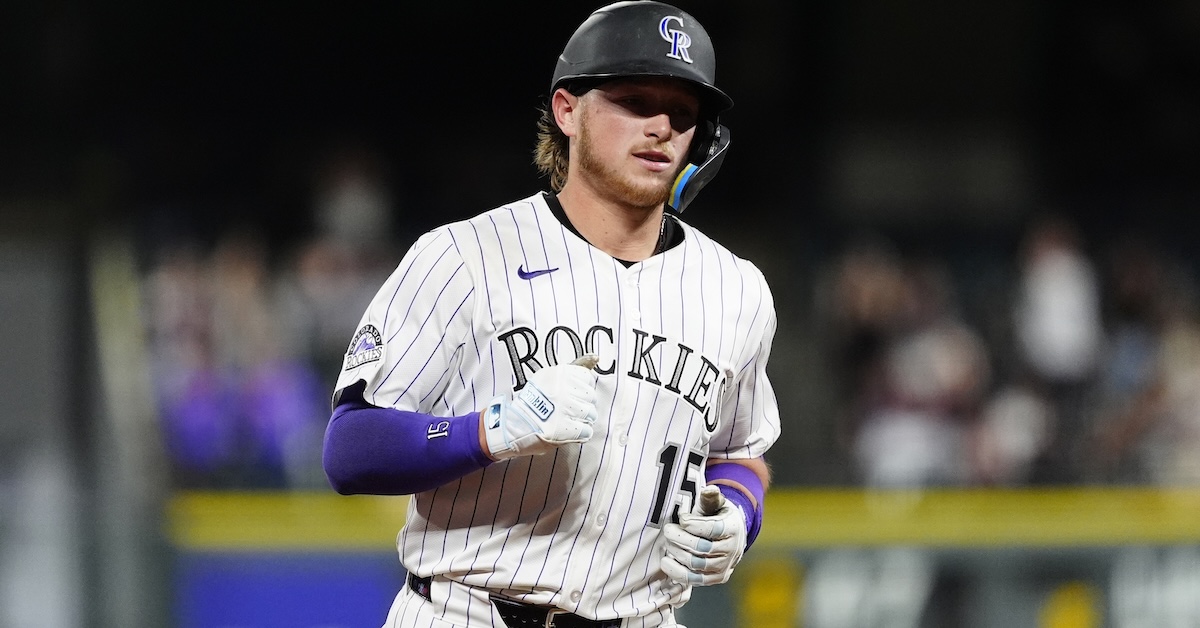
Hunter Goodman will represent the Colorado Rockies in tonight’s All-Star Game, and while he plays for the worst team in the majors, he is by no means a quota-filling selection. The 25-year-old catcher is slashing .277/.325/.517 with 17 home runs and a 120 wRC+ over 345 plate appearances. Moreover, his 52 RBI are the most among senior circuit backstops.
Three months before his All-Star selection, he was featured here at FanGraphs in an article titled Hunter Goodman Isn’t Choosy. When my colleague Davy Andrews penned the April 9 piece, Goodman had seen 63 pitches outside of the strike zone and swung at 33 of them, giving him a 54.1% chase rate. He also had a 66.1% overall swing rate.
As Davy wrote, “This is about as extreme as baseball gets.”
I brought up the article when the Rockies visited Fenway Park last week, and Goodman’s response was gold. Having read my colleague’s column, the young slugger replied, “That guy better not show up here.” He was kidding — the words came with a smile — after which he turned serious.
“Honestly, I was hitting pretty well at the time,” recalled Goodman, who then had a wRC+ just north of league average. “I was getting a lot of pitches to hit. But yes, I was swinging a lot. Starting the year, I was trying to be aggressive and trying to see where I was at. It’s like everything else; the more you get going, the more things start to calm down. Over the season, it’s gotten better. Being in the lineup every day has helped a lot with my timing.” Read the rest of this entry »
Happy Derby Day! At 8:00 p.m. tonight at Truist Park in Cobb County, Georgia, some of the largest human beings Major League Baseball has to offer will be hitting some of the longest home runs imaginable, and we get to watch. The cool kids will be tuned into the Statcast broadcast on ESPN 2, hosted by Kevin Brown (the current Orioles play-by-play man, not the former Orioles pitcher), Jessica Mendoza, and erstwhile FanGraphs contributor Mike Petriello. Petriello told me that he spent Friday crunching first-half stats and Derby results from 2016 to 2024 in order to create a prediction model, so if you want to see a baseball nerd being baseball nerdy on national television, make sure you catch the opening.
Although we never get to see all the stars we’d like in the Derby, this year may feel particularly bereft. We are missing out on A-listers like Aaron Judge and Shohei Ohtani, and Derby legends like Pete Alonso and Vladimir Guerrero Jr. We’re also going to be without most of the most prolific home run hitters of the season. Cal Raleigh and James Wood are the only participants who rank within the top nine in home runs. Only half the Derby contestants are even in the top 30. We have no repeat participants from the 2024 season. In fact, Matt Olson is the only one who has ever participated in the Derby before, and he lost in the first round in 2021. On the other hand, Raleigh leads the majors in home runs, and based purely on how far and hard these eight sluggers hit the ball, we may well have the most powerful field ever assembled. Read the rest of this entry »
Jose Altuve is having a Cooperstown-worthy career. Since debuting with the Houston Astros in 2011, the 35-year-old second baseman has logged 2,329 hits, including 246 home runs, while putting up a 129 wRC+ and 59.2 WAR. A nine-time All-Star who has won seven Silver Sluggers and one Gold Glove, Altuve captured MVP honors in 2017.
Turn the clock back to 2008, and the 5-foot-6 Puerto Cabello, Venezuela native was 18 years old and playing stateside for the first time. His manager with the rookie-level Greeneville Astros was Rodney Linares.
I recently asked the now-Tampa Bay Rays bench coach for his memories of the then-teenaged prospect.
“One guy that doesn’t get a lot of credit for Altuve is [current St. Louis Cardinals first base coach] Stubby Clapp, who’d been my hitting coach the year before,” Linares told me. “He always talked about Altuve, because he’d had him in extended spring. He was like, ‘You’ve got to watch this kid; this kid is going to be really good.’ I used to tell Stubby, ‘You think that because you’re small and played in the big leagues, anybody who is small can play.’”
Linares recalls the Astros organization’s wanting him to play 20-year-old Albert Cartwright at second, prompting him to tell Altuve ‘Go to short, go to third, go to left field. I’m going to make sure that you get your at-bats.” Read the rest of this entry »
Toward the end of May, I wrote about Pete Crow-Armstrong’s crimes of passion. When the Cubs win a game on a walk-off, Crow-Armstrong isn’t just the first one out onto the field to celebrate. He’s out on the field before the winning run has even scored. The game is still in progress, the ball is still in play, but there’s Crow-Armstrong sprinting across the third base line like a heat-seeking missile, breaking the rules and pulling the hero who just knocked in the game-winning run into the tightest hug imaginable. It’s a pattern; a jubilant, sensuous, illegal-but-not-actionable pattern that plays out over the rising strains of “Go Cubs Go.”
Well, in the past five weeks, the Cubs have walked off their opponents two more times, and Crow-Armstrong has not disappointed. In the bottom of the 10th inning on June 15, Ian Happ walked off the Pirates with a line drive single into right field. Crow-Armstrong was on deck at the time, which meant that he was busy warming up and thinking about hitting. It also meant that he was right next to home plate, so he ended up shadowing Vidal Bruján as he scored the winning run, and only then changing course and sprinting out onto the field to congratulate Happ. For these reasons, he didn’t actually enter the field of play until nearly a full second after the game had ended, but don’t worry. He was still the first Cub on the field and the first to wrap Happ in a big, shaggy hug. His love was so powerful that the energy surge temporarily overloaded the Marquee Sports broadcast system. Read the rest of this entry »
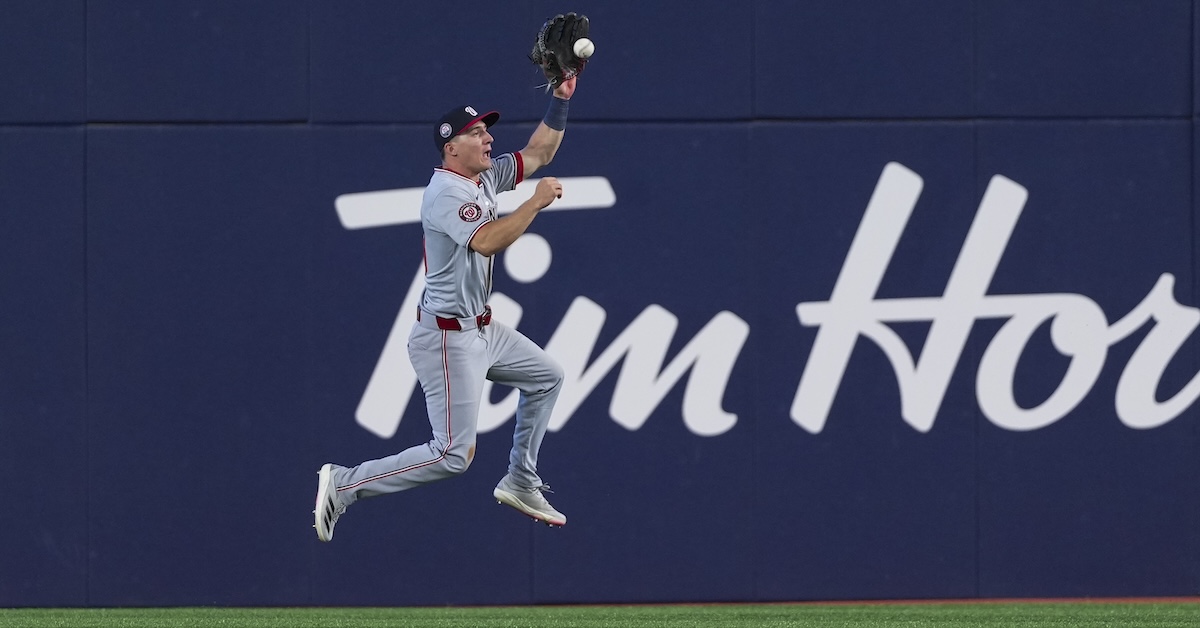
Last week, we received a mailbag question from a Jacob Young fan named David. Actually, it was a multi-part question, and the third sub-question was particularly fun: Are we now in an era of Peak Centerfield Defense? It seems like every team has a centerfielder that can go get it.
My gut reaction to this question was simple: Yes, we’re probably in an era of peak center field defense. I suspect the game has probably been in that era more often than not ever since integration, and that peak has kept on rising. I saved David’s other sub-questions for this Saturday’s mailbag, but for this particular one, I thought it might be fun to think it through and dig deeper than I could in the mailbag.
First, let me explain my gut reaction. More than any other position, center field rewards pure athleticism, and the athletes keep getting better. The player pool keeps expanding, and players (and humans in general) keep getting bigger, stronger, and faster. All of this means the bar to make it to the majors at all is that much higher. I’ve got baseball-specific reasons, too. The league keeps getting better at positioning defenders where the ball is more likely to go, allowing them to make even more of their superlative talents. And because we keep getting better at accurately measuring defensive contributions, we’re able to recognize and reward defensive value better than ever.
After saying all that, though, I have to admit the obvious: There’s no way to know the answer definitively. We have precious little Statcast data about Ty Cobb’s sprint speed or Duke Snider’s reaction time. Up until this century, play-by-play data is all we have to go on in evaluating defenders. Sean Smith analyzed that data to create a defensive metric called Total Zone, which is what informs the defensive grades on our leaderboards up until 2002, when more advanced defensive metrics like UZR, DRS, and FRV take over. Today’s metrics are nowhere near perfect, but take a moment to stop and think about how far we’ve come. Statcast can tell you exactly how much time every outfielder had to reach every ball, how far they traveled, how fast they ran, how efficient their route was, and how quickly they reacted as the ball came off the bat. That’s a long way from extrapolating from play-by-play data.
I realize that David wasn’t necessarily asking about the overall quality of center field play, but whether we’re living in a time when we’ve got a particularly high number of excellent defenders. It feels that way, right? Think of all the center fielders right now whom you’d classify as extremely good defenders. My list would definitely include Young, Pete Crow-Armstrong, Denzel Clarke, Ceddanne Rafaela, Victor Scott II, and Jose Siri, and I wouldn’t argue with anybody who also included Byron Buxton, Julio Rodríguez, Jake Meyers, Kyle Isbel, Michael Harris II, Daulton Varsho, Harrison Bader, or Myles Straw. I’m not sure what’s happened to Brenton Doyle, but before the season we would have put him on this list, as well. All of a sudden, we’ve got half the teams in baseball with an elite center field defender.
Now maybe it’s always felt that way. Just to pick a date out of a hat, if you go back to 1999, you’ve got defensive standouts like Andruw Jones, Mike Cameron, Carlos Beltrán, Steve Finley, Darren Lewis, and Kenny Lofton. If you go back to the 1950s, you’ve got Willie Mays, Mickey Mantle, and Duke Snider all in the same city. For that reason, I decided to see what I could do with the numbers available to me.
Even if we can’t know the answer definitively, we can have some fun with the data at our disposal. We have all these different numbers – TZ, UZR, DRS, DRP, OAA, FRV – but none of them matches up perfectly. They’re all working off different data sources. They’re all using different methods based on different philosophies. They’re looking at different eras with different styles of play. They’re all grading on different curves, judging players according to the league average in their particular year, which makes it very hard to compare players from different eras. It’s a glorious mess, but it means that we need to think of some other ways to analyze things.
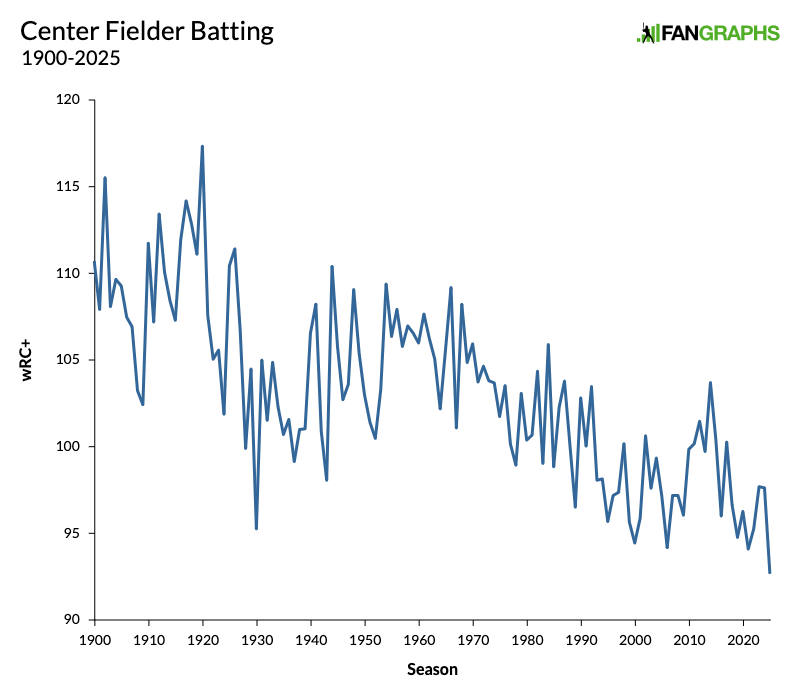
Let’s start by considering how center fielders are earning their playing time. If you’re not hitting well and you’re not fielding well, you’re probably not going to stay on the field. If you’re doing one well, you can get away with doing a worse job at the other. Now take a look at how center fielders have hit since 1900.
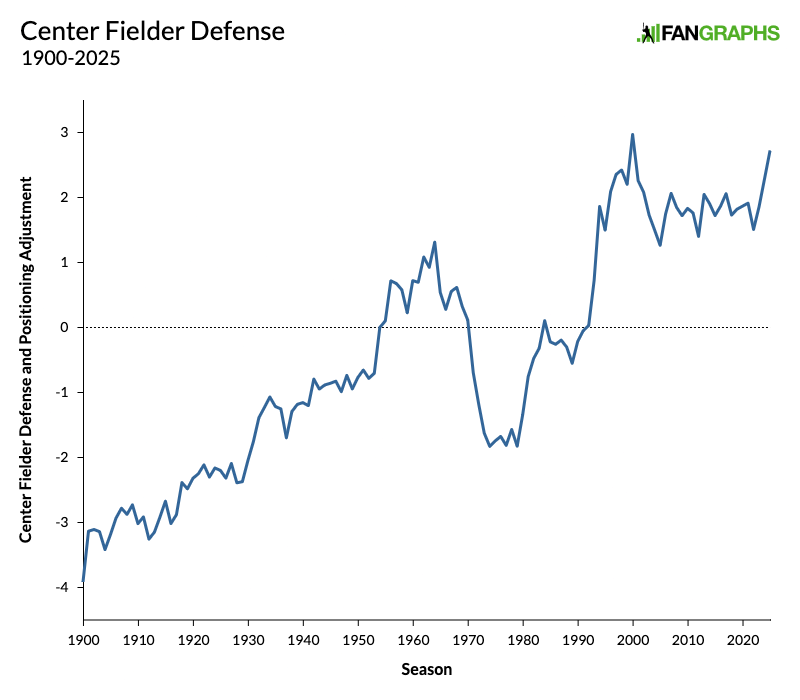
That graph is going nowhere but down, and it’s been on that trajectory since the beginning. This season, the league has a combined wRC+ of 92 at center field. If it holds, it would be the lowest mark ever recorded. However, center fielders aren’t worse players than ever. Here’s a graph that shows defensive run value per 600 plate appearances. This is just the Def column that you see all the way on the right of our main leaderboard. Before you look at it, let me warn you that I’m cheating a little bit by showing it to you.
Here’s how I’m cheating. Not everybody is playing center field all the time. It just shows players whose primary position is listed as center field. We stopped using total zone for these numbers in 2002, so the more recent numbers are based on an entirely different formula. But the overall trend is about as unambiguous as it gets. For the first half of baseball history, the numbers say that center fielders weren’t necessarily great defenders, but that changed in the late 1950s, then cemented itself in the late 1980s.
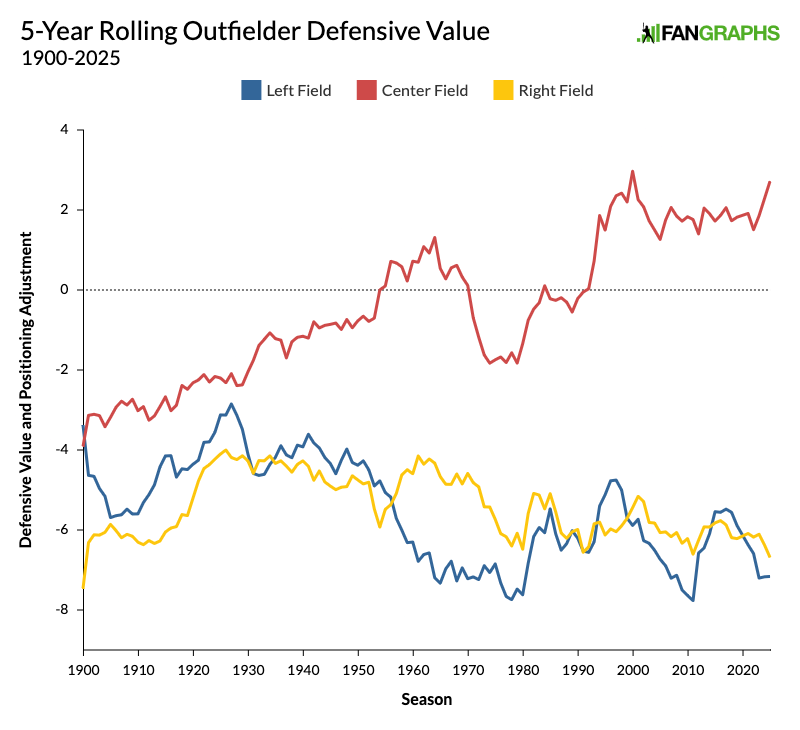
The big reason why this is cheating, though, is because these numbers include a positional adjustment. As you likely know if you’ve made it this far, positional adjustments give more credit to tougher defensive spots and take credit from easier ones. If you look at center field defensive metrics for any one year, they should be right around zero more often than not. However high the bar is, there will be good, average, and bad center fielders, and they’ll cancel each other out. This graph is saying that the bar has gotten higher over time, compared to other positions on the field. That’s all the more apparent if you look at the same graph with the corners included.
This shouldn’t necessarily be my persuasive argument. After all, I didn’t crunch the numbers and decide on the positional adjustments myself. I’m just showing you their effect on the way we value outfielder defense. However, when you view this alongside the decreasing wRC+ of center fielders, the conclusion is obvious. Defense has never been a more important part of the job, and the gap between defense in center field and the corners has never been higher.
Knowing all this, what makes me say that this very moment could be peak center field defense? For starters, players are just plain faster these days – and I don’t just mean faster than they were in the 1950s. We have 11 years of Statcast data tracking every player’s average sprint speed. For each year, I calculated the sprint speed of the average center fielder, prorating it by innings played (and ignoring any player who didn’t play enough to register a sprint speed). In the first three years, from 2015 to 2017, the average center fielder had a sprint speed of 28.4 feet per second. In the last three years, from 2023 to 2025, the average is 28.6. That may seem like a small change, but it’s also taking place over an awfully short timeframe. We can honestly say that center fielders are measurably faster today than they were just 10 years ago! It’s not hard to extrapolate further back in time.
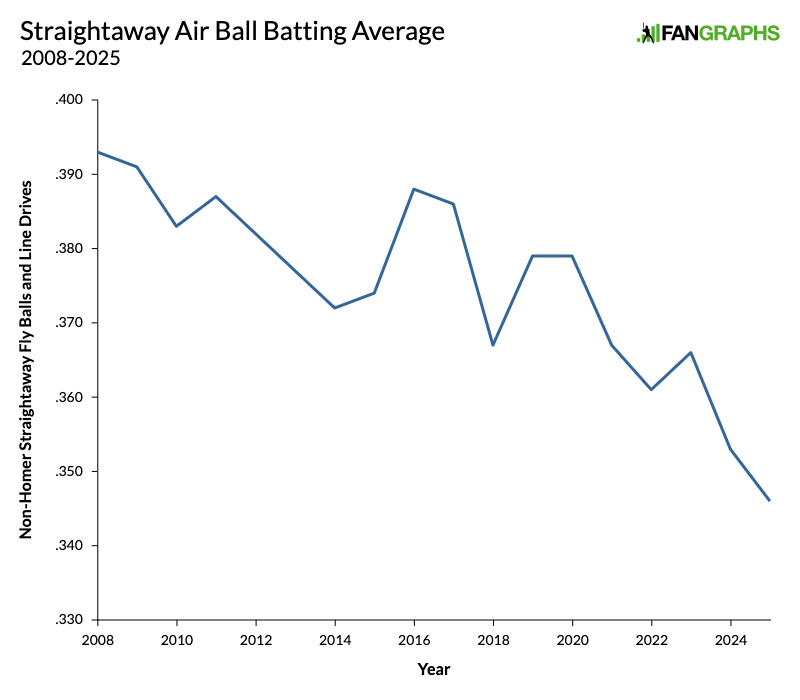
If we extend our gaze a bit to take in the entirety of the pitch-tracking era, we can see that balls just aren’t falling in the way they used to. The graph below goes back to 2008, and it shows the batting average for every ball classified as either a line drive or a fly ball hit straightaway (not including home runs). It starts at .393 and ends at .346. Nearly 50 points of average just disappeared into the gloves of center fielders.
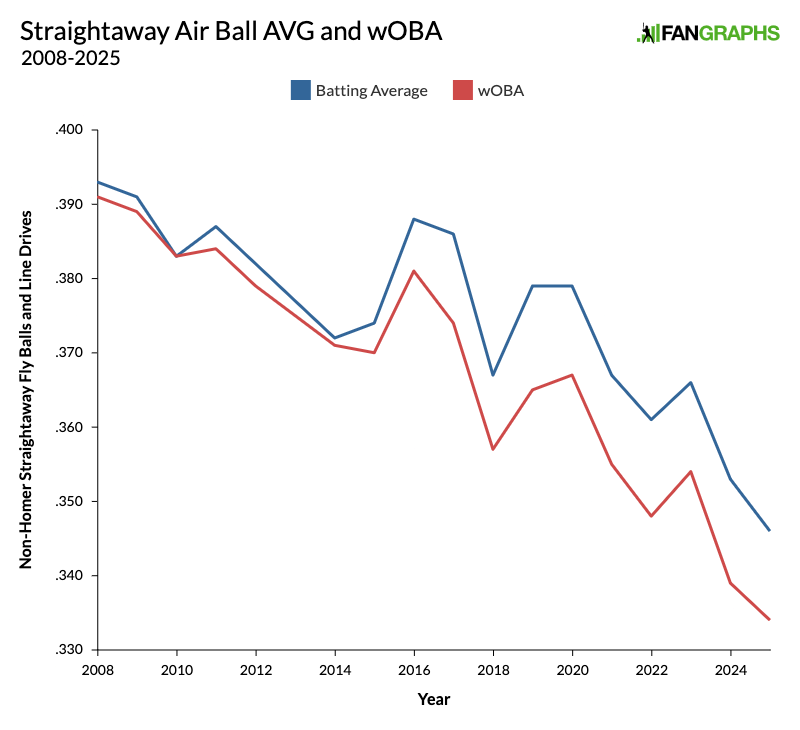
This is pretty stark, but even this graph is underselling the difference a bit. Here’s the same graph, but now it includes wOBA, too. The new red wOBA line falls even steeper than the blue line. Center fielders aren’t just robbing batters of more hits. They’re also better at holding batters to singles and preventing extra-base hits. That drop-off is nearly 60 points.
I think this is about as definitive as it gets. Since 2008, there’s never been a worse time to hit the ball to center field. So far as we can tell, defense has never been a more important part of a center fielder’s job, and center fielders have never been so much better than corner outfielders. In all, we’re probably at peak center field defense right now. And we’ll probably stay there.
Charlie Condon was drafted just last year, so unlike the previous installments in this series, the 22-year-old corner infielder isn’t exactly revisiting “an old scouting report” here. The observations and opinions he is responding to were written by Eric Longenhagen this past January, less than sixth months after Condon was drafted third overall by Colorado out of the University of Georgia. At the time, the young power hitter had only 109 minor league plate appearances under his belt in the High-A Northwest League.
Eric wasn’t as bullish on him as many other evaluators were when our 2025 Rockies Top Prospects list was published. Our lead prospect analyst ranked Condon second in what he described as a “talented but imbalanced system,” but Eric also gave him just a 45+ FV, citing last year’s poor performance during his first professional season as one of the reasons to be concerned; Condon slashed .180/.248/.270 with a 40 wRC+.
The 6-foot-6, 215-pound right-handed hitter is doing his best to dispel doubts that he can develop into an offensive force at the big league level. After recovering from a non-displaced fracture of his left wrist suffered in spring training, Condon put up a 131 wRC+ over 167 plate appearances with High-A Spokane this season and earned a promotion to Double-A. Since joining the Hartford Yard Goats at the beginning of this month, he’s gone 6-for-27 with a pair of two-baggers.
In a twist to our Old Scouting Reports series, here are Condon’s responses to excerpts from Eric’s January write-up.
———
“Condon went third overall, signed for $9.25 million, and then had a no good very bad pro debut at Spokane during which he hit .180 and struck out 31.2% of the time.”
“That’s just baseball, man, “ Condon said of his disappointing debut. “It’s part of the learning experience, and you have to be able to accept failure and take the positives out of it. I think I’ve learned since then. It’s a tough game.
“Some of it was timing,” the slugger said when asked to elaborate. “I was also getting a little big sometimes. I had to clean up some things with my bat path to help get ready for this year.”
“During instructs, Condon played defense but didn’t get at-bats, as if he was being given time away from the plate to reset.”Read the rest of this entry »