Archive for Featured

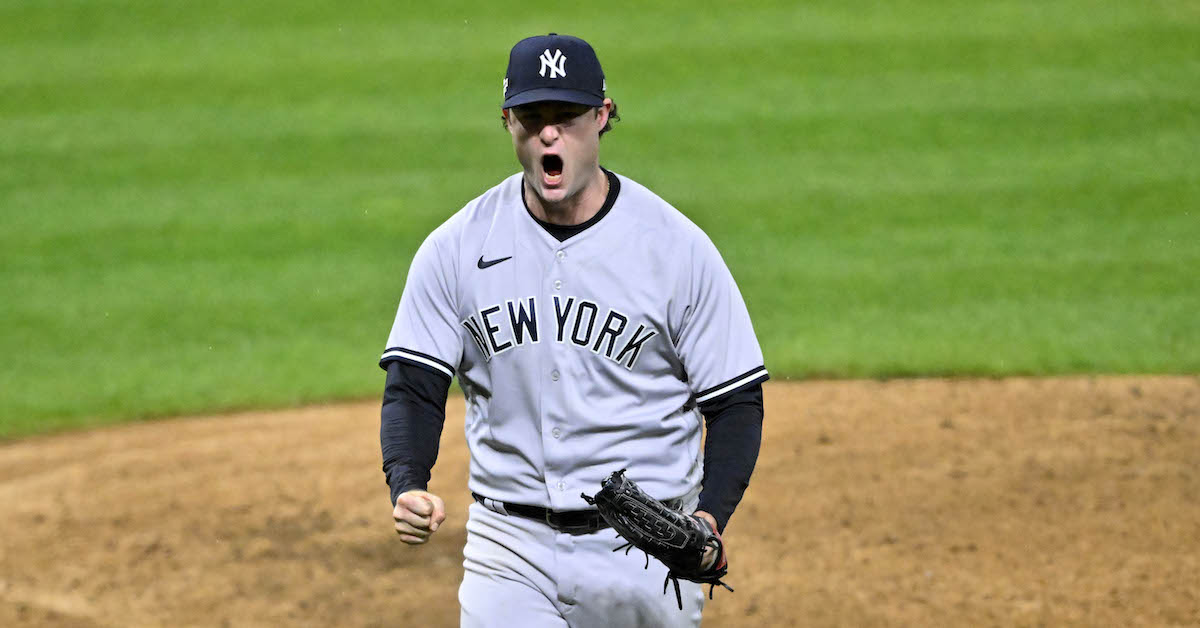
Gerrit Cole, Somehow Underrated

David Richard-USA TODAY Sports

I don’t like this title any more than you do. It just sounds so wrong. The guy with the largest contract signed by a pitcher in the history of the game is underrated? The New York Yankees ace isn’t being given his due? Preposterous! I might as well say no one watched the Super Bowl, or that we aren’t paying enough attention to weather balloons these days.

But uh… it’s true. I don’t have to like it and you don’t have to like it, but Cole is still one of the best pitchers in baseball, despite falling somewhat out of that conversation of late. He wasn’t even the most talked-about Yankee starter last year – that’d rightfully be Nestor Cortes. So consider this a Cole puff piece.

To begin, let’s consider our Depth Charts projections. These projections blend ZiPS and Steamer to produce rate statistic forecasts for every player. From there, Jason Martinez projects playing time, and those playing time projections cross with the rate statistics to produce overall projections. Cole sits in a tie for third place in projected WAR for 2023:

Top Pitching Projections, 2023
Pitcher IP ERA FIP WAR
Jacob deGrom 172 2.62 2.34 5.6
Corbin Burnes 196 3.08 2.90 5.2
Carlos Rodón 178 3.09 2.90 4.6
Aaron Nola 202 3.52 3.18 4.6
Gerrit Cole 199 3.15 3.02 4.6
Shohei Ohtani 171 3.08 3.06 4.3
Zack Wheeler 190 3.41 3.23 4.3
Max Scherzer 186 3.20 3.17 4.2
Justin Verlander 179 3.10 3.32 3.9
Shane Bieber 204 3.36 3.29 3.9
Sandy Alcantara 216 3.44 3.48 3.9

This shouldn’t be particularly surprising. He’s produced the ninth-most WAR among pitchers in the past two years, the ninth-most in the past three years, the third-most in the past four years, the third-most in the past five years… the point is, he’s consistently been one of the best in the game. While 2022 represented a down year, his overall body of work remains excellent.

What’s more, his 2022 swoon seems exaggerated to me. It represented his worst ERA since his Pittsburgh days, but luckily we have multiple statistics to describe pitching performance. I like to take a mosaic approach, looking at as many as I can and taking a rough average, and if you think of it that way, Cole’s 2022 looks pretty dang good. Read the rest of this entry »


Negro Leagues Data Is Now Available on FanGraphs!

We’re excited to announce that Negro Leagues data is now available on the FanGraphs player pages and leaderboards! In addition, Negro Leagues players now have FanGraphs player pages. All data is provided by The Seamheads Negro Leagues Database powered by Agate Type Research. Special thanks are due to Gary Ashwill and Kevin Johnson for their assistance as we incorporated the data into the site.

The seven Black baseball leagues included in our data mirror those at Baseball Reference and are consistent with the recommendations of SABR’s Negro Leagues Task Force and Major League Baseball’s announcement recognizing these leagues as being major leagues.

Negro Leagues Recognized as Major Leagues
League Abbreviation Years
Negro National League I NNL 1920-1931
Eastern Colored League ECL 1923-1928
American Negro League ANL 1929
East-West League EWL 1932
Negro Southern League NSL 1932
Negro National League II NN2 1933-1948
Negro American League NAL 1937-1948
SOURCE: Baseball Reference

Read the rest of this entry »


After a Breakout Season, Cristian Javier Earned Himself a Nice Extension

Cristian Javier
Eric Hartline-USA TODAY Sports

Depending on what your expectations were for the 2022 postseason, you likely saw Cristian Javier as the third or fourth starter for the Astros entering October. Dusty Baker agreed, as Javier didn’t get a start until the ALCS against the Yankees. But Javier clearly had different plans. When given the chance, he was dominant: in 12.2 innings, he pitched to a 0.71 era; in his two starts, he gave up a single hit across 11.1 innings facing the imposing lineups of the Yankees and Phillies. That performance plus his 3.4 fWAR in 148.2 regular-season innings put him on the map as one of the league’s best young pitchers. And last week, the Astros rewarded him as such by handing him a five year, $64 million extension.

After Houston announced the hiring of long-time Braves scouting executive Dana Brown as the team’s new general manager, I wondered if he would bring along his former organization’s tendency to extend players into their would-be free-agent years. It didn’t take long for that idea to come to reality. Javier was set to enter his three arbitration years in his age 26–28 seasons; those years have been bought out with salaries escalating from $3 million in 2023 to $7 million in ’24 and $10 million in ’25. His age-29 and 30 seasons will come at the price of $21 million per year, with an opportunity to escalate it from $500,000 to $2 million per year if he finishes at or near the top of the Cy Young ballot.

Even with free-agent departure after free-agent departure, Houston’s rotation remained strong due to the development of Framber Valdez and now Javier. But with the departure of Justin Verlander, the rotation looked like it was finally hitting a point of potential vulnerability. Extending Javier, then, provides the Astros some semblance of certainty beyond 2025. And with their entire starting lineup other than Martín Maldonado locked up through at least ’25, they needed to invest in their rotation. Read the rest of this entry »


As Fastballs Fade, Establishing the Fastball Rides On

Joe Camporeale-USA TODAY Sports

Last week, pitching prospect Grayson Rodriguez was asked a great question on The Baseball Barb-B-Cast. Rodgriguez is ranked third in an excellent Baltimore system, and as a player who was drafted in 2018, his tenure with the club spans both the Dan Duquette and Mike Elias eras. The question was: How has the organization changed over time?

Rodriguez started his answer with, “Everything about the organization changed but the name.” He touched on technology, pitch development, and the turnover in the coaching staff, but the part I want to focus on came right at the beginning, when he was describing the Duquette era: “Our pitching philosophy was, it was like, ‘Hey, you know, as a starter we’re going to go out in the first three innings and we’re just going to throw nothing but fastballs, and we’re going to see if that works.’ And, like, terrible. Terrible idea.”

Yup. That does indeed sound like a terrible idea. It also made me wonder whether teams are as focused on establishing the fastball as they once were. A reduction in first inning fastball rate would make sense for a couple reasons. First, fastball usage has dropped overall as teams have learned that pitchers should throw their best pitch more often, and fastballs themselves have become less effective:

Read the rest of this entry »


Sunday Notes: Approach Altered, Tigers Prospect Colt Keith is Looking To Loft

Colt Keith started to tap into his power last year. After going deep just twice in 2021 — his first professional season — the 21-year-old third baseman homered nine times in 48 games with High-A West Michigan before landing on the injured list with a dislocated shoulder in early June. Returning to action in October, Keith proceeded to hit three bombs in 19 Arizona Fall League games.

The increased power production by one of the top position-player prospects in the Detroit Tigers organization was by design.

“I changed my approach a little bit,” Keith told me during his stint in the AFL. “I started trying to hit balls out in front, and backspin them to all fields, looking for a little bit more power. A lot of people had told me I just needed to keep doing what I was doing, but looking at guys in the big leagues that I want to play like, they’re hitting 25-30 homers a year. I felt like I needed to move in that direction. At the same time, I want to keep my hit tool. Batting .300 with some home runs is what I’d like to do.”

That is what he did this past season. The 6-foot-3, 238-pound infielder — Keith has added meaningful size and strength since entering pro ball — augmented his regular-season round-trippers with a .301/.370/.544 slash line. In 2021, he’d slashed .320/.437/.422 with Low-A Lakeland before scuffling over the final month as a 19-year-old in the Midwest League. Read the rest of this entry »


The Baseball Players of the Super Bowl, and the Dilemma of the Multi-Sport Athlete

Jay Biggerstaff-USA TODAY Sports

For the past two weeks, the American sports landscape has been held in the thrall of the Super Bowl. It’s secular American Christmas. The event so indelibly planted in our cultural consciousness advertisers get around the trademark by calling it “the Big Game,” and everyone knows what they mean. The Chiefs and the Eagles (Go Birds!) testing their mettle for 60 minutes on the largest stage our country has to offer (interrupted periodically by commercials and musical interludes).

No, I haven’t suffered some kind of episode and forgotten that this site is devoted entirely to a different sport. Because, you see, if you watch the Super Bowl you’ll get to see some baseball players: Chiefs quarterback Patrick Mahomes and Eagles receiver A.J. Brown.

Mahomes affinity for baseball is well known, given that he is 1) one of the most famous athletes in the country 2) a minority owner of the Kansas City Royals and 3) the son and namesake of an 11-year major league veteran. In fact, two of the Chiefs’ three quarterbacks are sons of 11-year big league veterans; third-stringer Shane Buechele is the son of former Rangers and Cubs third baseman Steve. (Unfortunately, I don’t know what Chad Henne’s father’s profession is.) Read the rest of this entry »


Pittsburgh Pirates Top 43 Prospects

Jayne Kamin-Oncea-USA TODAY Sports

Below is an analysis of the prospects in the farm system of the Pittsburgh Pirates. Scouting reports were compiled with information provided by industry sources as well as our own observations. This is the third year we’re delineating between two anticipated relief roles, the abbreviations for which you’ll see in the “position” column below: MIRP for multi-inning relief pitchers, and SIRP for single-inning relief pitchers. The ETAs listed generally correspond to the year a player has to be added to the 40-man roster to avoid being made eligible for the Rule 5 draft. Manual adjustments are made where they seem appropriate, but we use that as a rule of thumb.

A quick overview of what FV (Future Value) means can be found here. A much deeper overview can be found here.

All of the ranked prospects below also appear on The Board, a resource the site offers featuring sortable scouting information for every organization. It has more details (and updated TrackMan data from various sources) than this article and integrates every team’s list so readers can compare prospects across farm systems. It can be found here. Read the rest of this entry »


The 2023 Start of Spring ZiPS Projected Standings: American League

© Jerome Miron-USA TODAY Sports

The 2023 ZiPS projections have all been incorporated into the site, and while there will be some additions (platoon splits), changes (there’s a weird RBI bug affecting a handful of very poor minor league hitters) and updates to come, the player pages now contain the projections for the upcoming season. Our Depth Charts also reflect ZiPS along with Steamer, enabling David Appelman to crank up all the dials and flick all the switches, and you to blame me as well as Steamer when a team’s projection doesn’t look right to you!

Spring doesn’t actually start in the Northern Hemisphere until March 20 this year, but the real spring, baseball’s spring training, kicks off in a week when pitchers and catchers report. While it’s unlikely that these are the precise rosters that will eventually start playing exhibition games, the vast majority of the significant shifts in player talent have already happened.

So where do we stand?

Naturally, I used the ZiPS projection system to get the latest run of team win totals. The methodology I’m using here isn’t identical to the one we use in our Projected Standings, meaning there will naturally be some important differences in the results. So how does ZiPS calculate the season? Stored within ZiPS are the first through 99th-percentile projections for each player. I start by making a generalized depth chart, using our Depth Charts as a jumping off point. Since these are my curated projections, I make changes based on my personal feelings about who will receive playing time as filtered through arbitrary whimsy my logic and reasoning. ZiPS then generates a million versions of each team in Monte Carlo fashion — the computational algorithms, that is (no one is dressing up in a tuxedo and playing baccarat like James Bond). Read the rest of this entry »


Arm Angle Analysis: The Pros and Cons of a Sidearm Shift

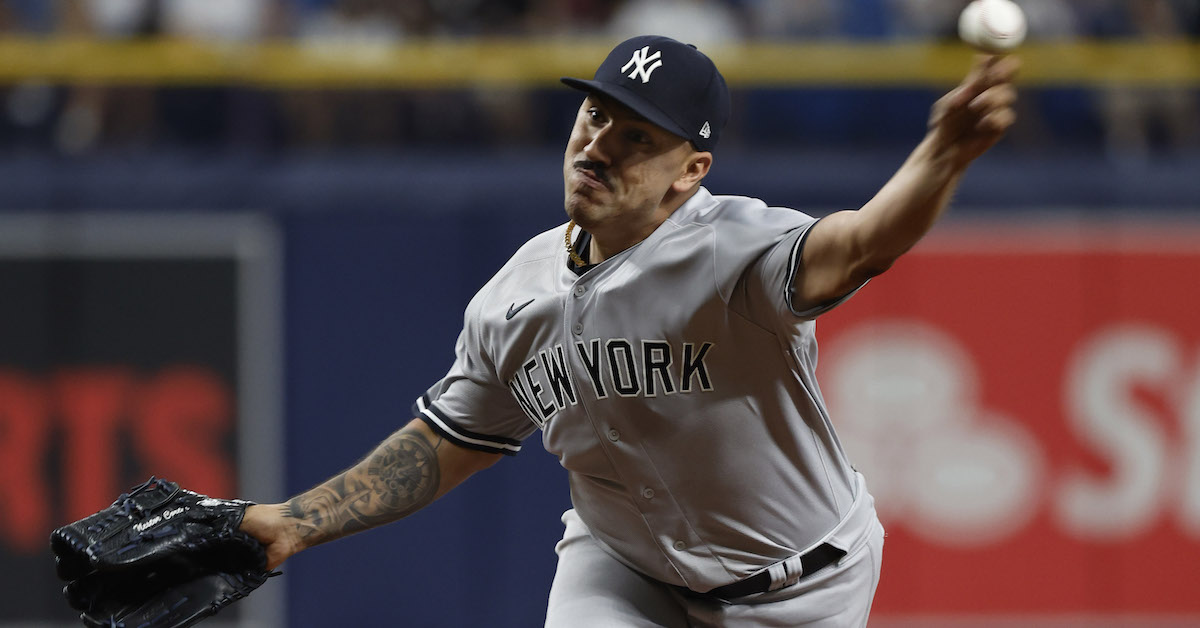
Nestor Cortes
Kim Klement-USA TODAY Sports

Originally a 36th-round pick in the 2013 draft by the Yankees, Nestor Cortes spent time with the Orioles and Mariners before returning to the Bronx and putting it all together toward the end of the 2021 season, his age-26 year. Even upon breaking out, he was dubbed an “everyman” by the New York Post, overlooked by scouts because he didn’t stand as tall as other hurlers and because he lacked overpowering velocity. Yet in 2022, Cortes mowed hitters down to the tune of a 2.44 ERA and 20.3% K-BB rate. Far from an everyman, he was a standout athlete.

The southpaw’s breakout wasn’t a product of a mid-career growth spurt. If anything, his emergence came in spite of his 5-foot-11 height; his 159 ERA+ in 2022 tied him for the 27th-best mark among sub-six-foot hurlers since the Live Ball era began in 1920. Rather, the most concrete reasons for Cortes’ improvements include a velocity jump in both 2021 and ’22 (though his velo is still below average) and the introduction of a cutter paired with a revamped slider. Yet despite the ambiguous impact it has on his game, what perhaps differentiates Cortes the most from other pitchers is his approach on the mound, including but not limited to his varying arm angles.

The hurler’s drop-down moves have been the subject of many an article, including Lucas Kelly’s piece on this very site. The discussion on arm angles more broadly, however, has been rather muted, save for Logan Mottley’s (now of Fanatics, previously of the Texas Rangers) post describing how they can be calculated from Statcast data and Ben Palmer’s piece for Pitcher List digging into the Mottley data.

Even in these articles, there is no mention of how stature might play into the effectiveness of certain arm angles. Instead, there seems to be an implicit assumption that if one arm slot proved more effective on average (which, to be fair, no one has concluded), it should automatically be utilized more, without regard for what might feel most natural for a given pitcher. What would happen if we tried to convert more pitchers to a sidearm slot, or at least push them to vary their arm slots a la Cortes? Using Mottley’s calculations, I took a crack at these questions myself. Read the rest of this entry »


You Can’t Fake Exit Velocity

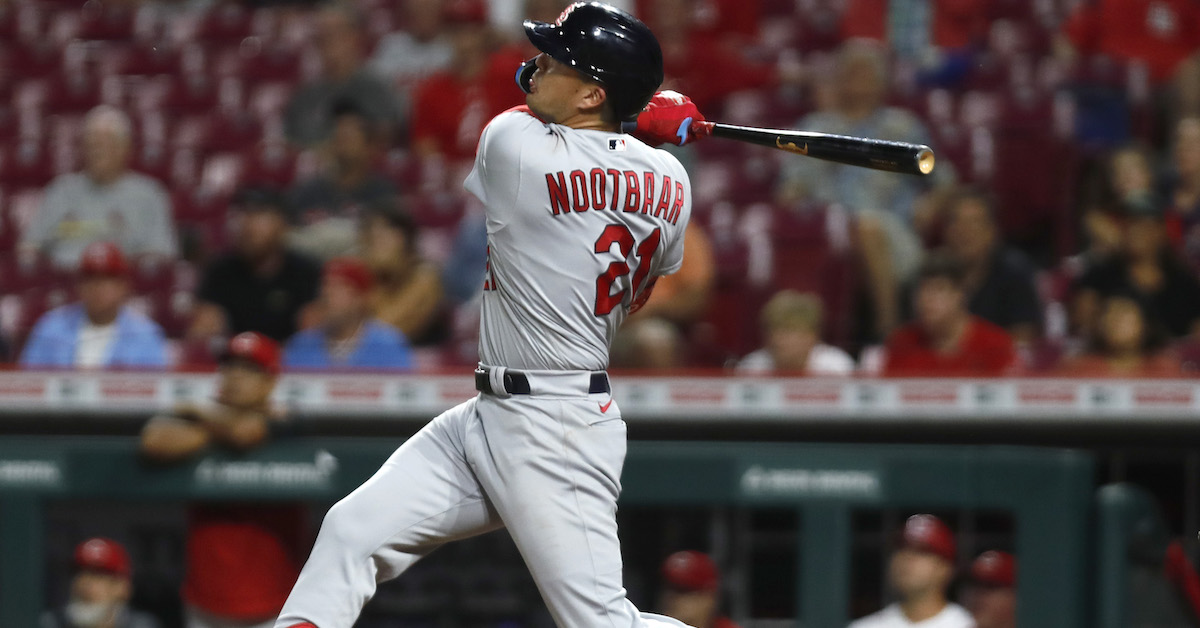
Lars Nootbaar
David Kohl-USA TODAY Sports

Last week, I spent a few articles idly hunting for hitter breakouts. I centered my search on players with admirable top-end power numbers but who reached that summit rarely. I found that when those players increased their contact rate, they improved their overall line significantly. I think that finding tracks with intuition in addition to having data to back it up, so I’m overall pleased with that research.

That said, all this downloading and scraping of exit velocity data made me wonder about the opposite side of this spectrum: can hitters add power and break out from the other direction? Hitters who make a ton of contact but don’t hit the ball with much authority feel somewhat capped offensively; in my head, Luis Arraez has a 0% chance of turning in a 20-homer season. I didn’t have the numbers behind that, though, so I gathered up the same pile of data I’d used before and started hunting.

The main thing I learned from the data is something that you’ve heard over and over again: maximum exit velocity (and 95th-percentile exit velocity, which I’m using) is sticky. How hard you hit the ball in one year does a great job of determining how hard you’ll hit the ball in the next year.

More specifically, I took a sample of players with at least 100 batted balls in two consecutive seasons. I sampled from 2015 to ’22, which gave me seven year-pairs, though the ones involving 2020 were light on qualifying players thanks to the abbreviated season. From there, I asked a simple question: how much did each player’s 95th-percentile exit velocity change from one year to the next? Read the rest of this entry »