Archive for Featured

World Series Game 6 Chat

7:50
Ben Clemens: Hey guys, thanks for chatting with us tonight. Meg and I will be here for all inevitable four hours of baseball. We’re going to let the chat queue fill up with a few questions, but I’ll throw in some links while you wait.

7:51
Ben Clemens: First, there’s an artisanally hand-crafted World Series preview that is, in my opinion, excellent:
https://blogs.fangraphs.com/postseason-preview-the-2019-world-series/

7:51
Ben Clemens: Craig Edwards wrote about how Stephen Strasburg is god*:
https://blogs.fangraphs.com/stephen-strasburg-is-a-postseason-god/

7:51
Ben Clemens: *not in a religious way or anything

7:52
Ben Clemens: And as a quick recap of how we got here, Jay Jaffe on Game 5:
https://blogs.fangraphs.com/road-warriors-again-astros-take-third-stra…

7:54
Ben Clemens: And if you aren’t interested in the World Series, well first of all, weird place to be if that’s the case! But second of all, here’s Dan Szymborski on the Texas Rangers, in case that’s more your speed:
https://blogs.fangraphs.com/the-texas-rangers-were-surprisingly-releva…

Read the rest of this entry »


Why Has the World Series Felt Boring?

Game 4 of the World Series started like gangbusters for the Houston Astros in Washington. A game-opening strikeout by Patrick Corbin against George Springer was followed with four straight singles, producing two runs to give Houston the first lead of the night. Corbin was able to leave the bases loaded in the top of the first to keep his side in the game, but when his pitcher opponent Jose Urquidy took the mound in the bottom half of the inning, he made quick work of the Nationals, inducing two foul pop-ups and stranding Anthony Rendon after his two-out single.

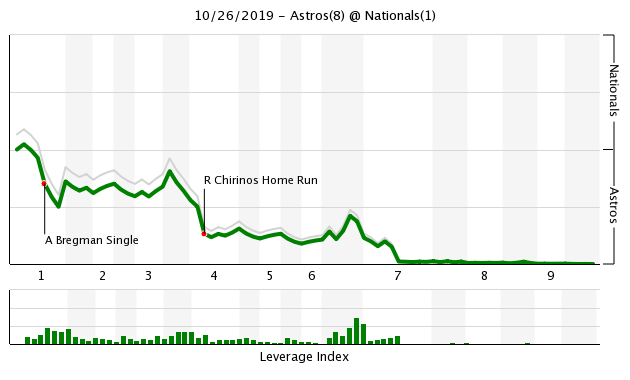
The rest of the game carried on, well, pretty much exactly like that. Each starter traded scoreless innings in the second and third innings, but then the Astros added on with a two-run homer by Robinson Chirinos in the fourth. Washington put up some fight by loading the bases with one out in the bottom of the sixth to bring Juan Soto up representing the tying run, but all Soto could do was bring in a single run with an otherwise harmless groundout. The Astros got their own bases-loaded opportunity the very next inning, and they didn’t miss it, with Alex Bregman crushing a grand slam to put the game out of reach. Houston got a lead early, and aside from a fleeting moment or two, never really seemed in danger of losing it, eventually tacking on enough insurance to make the Nationals’ final few at-bats little more than a formality. Here’s what the win probability chart looked like from that game:

After the fourth batter of the night, Washington’s win probability was never higher than 40%. After the sixth inning, it was never better than 15%. All told, it looked like a typical one-sided baseball game. There’s nothing wrong with that on its face, but when stacked up next to the other four games that have taken place in this World Series, there’s been a troubling trend. According to our calculations, the loser of Game 1, Houston, never had better than a 36.5% chance to win that game after the fifth inning. In Game 2, Houston’s odds of winning were below 2% entering the eighth. Washington’s highest odds of winning after the fifth inning of Game 3 were just 24.5%, and its odds of winning Game 5 after the fourth inning were never better than 13.2%. Read the rest of this entry »


When Should Teams Press the Advantage?

When the Nationals took an early lead in the World Series, there was a popular cry for the team to knock the Astros out while they could. Expend resources you were planning on saving for later in the series, turn Patrick Corbin into a reliever, maybe bring back some starters on short rest: what does it matter if you hurt your chances of winning Game 7, the thinking goes, if Game 7 never happens?

A softer version of this came up as the Cardinals walloped the Braves in Game 5 of the NLDS. The game was already decided. Why not pull Jack Flaherty so that he could pitch Games 1 and 5 of the NLCS rather than Games 3 and 7? It’s not an identical situation, but it relies on the same logic: earlier games happen more often, so get your pitchers into those.

Tomorrow night, there will be yet another version of this discussion. The Astros are a win away from ending the series. If the game goes into extra innings, say, or Justin Verlander gets knocked around but the offense keeps the team in it, would Houston use Zack Greinke in an attempt to end things right then and there? And should they?

While these questions are similar, they’re not identical. Does this reallocation of win probability matter? The answer, as it often is, is “it depends.” I believe the answers to these three questions are “not much,” “not at all,” and “more than you’d think,” respectively, and I’ll attempt to lay out why I think that is the case here.
Read the rest of this entry »


Road Warriors Again: Astros Take Third Straight in Washington

So much for home field advantage. The visitors won for the fifth straight time in this World Series, which means that after losing the first two games of this series to the Nationals, the Astros are up three games to two. They took advantage of Max Scherzer being scratched from his rematch with Gerrit Cole due to neck spasms, tagging emergency starter Joe Ross with a pair of two-run homers. That was more than enough run support for a dominant Cole, though Houston’s lineup tacked on three more runs in the late innings and won 7-1. During the three games in Washington, they walloped the Nationals by a combined 19-3 score, and they’re now one win away from their second championship in three seasons.

A few quick thoughts on the game, which also featured a shaky strike zone from home plate umpire Lance Barksdale, a pair of flashers behind home plate that distracted Cole, and a visit from Donald Trump that did not go as well as the president envisioned…

Pain in the Neck

The character of Sunday night’s Game 5 changed significantly before a single pitch was thrown. Three and a half hours before game time, the Nationals announced that Scherzer, who had allowed two runs in five innings in Game 1 opposite Cole, had been scratched due to spasms and nerve irritation in his right trapezius, problems for which he had begun undergoing treatment on Friday. Though he had been able to play catch on Saturday, Scherzer had woken up on Sunday in intense pain, and “completely couldn’t get out of bed… I had to basically fall out of bed and pick myself up with my left arm,” as he said during a pregame media session during which his pain and immobility were quite apparent.

“I’m as disappointed as I possibly can be not to be able to pitch tonight,” he said. “I’ve pitched through so much crap in my career that would be easy to pitch through at this point. This is literally impossible to do anything with.” He received a cortisone shot in the hopes of being available for a Game 7, if there is one. Read the rest of this entry »


World Series Game 5 Chat

7:52
Paul Sporer: Welcome to the chat, everyone! Ben and I will be with your for the evening. Brutal news for the Nats shortly before game time with Max Scherzer being scratched due to severe back spasms. An uphill battle against Cole gets even tougher now!

7:53
Paul Sporer:

Who ya got for Game 5?

Houston (79.4% | 85 votes)
 
Washington (20.5% | 22 votes)
 

Total Votes: 107
7:55
Sonny: So…not a great 48 hours for the Nats

7:55
This is Lude-i-cris: Wow! Ya gotta feel terrible for Scherzer. It’s only the biggest game of his life!

7:56
kershaws the GOAT: lets go nats!!!

7:56
Belli Flop: I never thought I would say this: Go Joe Ross!

Read the rest of this entry »


Sunday Notes: Red Sox Prospect Thad Ward Has a Chris Sale Slider

Thad Ward didn’t make our Red Sox Top Prospect List prior to this season. Baseball America wasn’t bullish on the 22-year-old right-hander, either. Their rankings went 30-deep, and Ward didn’t make the cut.

Next year will be a different story. Ward was a revelation in his first full professional season, fanning 157 batters, and allowing just 89 hits, in 126-and-a-third innings. Those numbers came between low-A Greenville and high-A Salem, where his cumulative ERA was a sparkling 2.14.

His slider is his best pitch.

“It’s a Chris Sale slider,” is how Red Sox pitching guru Brian Bannister described it to me in late September. “It’s a sweeping slider, with a similar shape to Jhoulys Chacin’s or Corey Kluber’s. It has that extra horizontal component to it.”

That’s long been the case, although Ward’s understanding of the how-and-why is recent. When he reported to spring training this year, the 2018 fifth-round pick out of the University of Central Florida got a crash course in Pitching Analytics 101. Read the rest of this entry »


World Series Game 4 Chat

8:05
Eric A Longenhagen: Howdy from Tempe, everyone. Hope your weekend started off well.

8:06
Meg Rowley: And hello from Seattle. I similarly hope you’ve all enjoyed your Saturday.

8:07
Eric A Longenhagen:

8:08
Meg Rowley: Who gets to write the World Series montage intros?

8:08
Meg Rowley: I feel like we’d be good at that. They should let us do it.

8:09
Eric A Longenhagen: Does the FCC have a pun cap?

Read the rest of this entry »


Astros Take Game 3 from Aníbal Sánchez and the Nationals 4-1

In a technical sense, Game 3 wasn’t a must-win for the Astros. In a practical sense, the odds of Houston winning four straight games against the Nationals are under 10%. The Astros needed the win, and they got it with a 4-1 victory. For those purists of the game who enjoy pitchers batting, Game 3 of the World Series highlighted one of the big differences in strategy between the American and National Leagues: pitchers as hitters.

Greinke’s Bunt

The first potentially important pitcher plate appearance occurred in the top of the second inning. Zack Greinke came to bat with one out and runners on first and third. Greinke’s season wRC+ of 123 doesn’t really represent his true hitting talent, but his career 60 wRC+ also understates his value in this situation. Greinke got down a successful bunt and advanced the runner to second, but the Astros’ win expectancy went down about five percentage points. If Greinke had done nothing, it would have only gone down a single percentage point more. While a double play would have dropped the win expectancy by about 10 percentage points, a sac fly would have moved the Astros up four percentage points, while a single would have moved them up six.

Greinke’s career wRC+ indicates he isn’t a particularly good hitter, but it’s mostly due to his inability to walk or hit for power. With a .225 lifetime average, he hits a decent number of singles, which is what the Astros needed in this situation. With a runner already on third, moving a single runner to second doesn’t help much when there are two outs. The expected situation is a Greinke out, which drops win expectancy by six. The bunt is only one percentage point so we’re really dealing with the chances of a double play versus the chances of a single. Given the large bump from a single compared to the expected out, versus the small drop from the bunt to a double play, the double play would have to have been much more likely than the single to make bunting the right choice. That isn’t in the case here, particularly with Aníbal Sánchez giving up a bunch of loud contact in the first few innings. George Springer followed the bunt with a groundball out to keep the game at a one-run deficit for the Nationals. Read the rest of this entry »


World Series Game 3 Chat

8:01
Avatar Dan Szymborski: Welcome to the Game 3 chat!

8:01
Avatar Dan Szymborski: This could be the penultimate chat of the 2019 season or possibly only the preantepenultimate chat!

8:04
Andrew: Let’s go, Nats!

8:04
Avatar Dan Szymborski: not let’s go Nats?

8:04
Avatar Dan Szymborski: Are you suggesting that you and the Nats should go somewhere? THERE’S AN IMPORTANT GAME STARTING

8:04
kevinthecomic: Walter Johnson throwing out the first pitch tonight?

Read the rest of this entry »


Patrick Corbin, Reliever

In Game 1 of the World Series, the Nationals found themselves with an interesting decision. They were up three runs on the Astros, but Max Scherzer had labored mightily to hold Houston to two runs. After five innings, he’d thrown 112 pitches. He wouldn’t be heading back out for the sixth.

The Nationals don’t really trust their bullpen. Sure, they could get innings from Sean Doolittle and Daniel Hudson, but they had four innings to cover. Tanner Rainey? Break glass in case of emergency only, and that still leaves an inning. Here is a list of all the relievers the Nationals had used this postseason (as of Game 1) who aren’t Rainey, Doolittle, or Hudson:

Slim Pickin’s
Player IP Reg Season ERA Reg Season FIP
Fernando Rodney 2.2 5.66 4.28
Hunter Strickland 2 5.55 6.3
Wander Suero 0.1 4.54 3.07

Yeesh. Strickland wasn’t on the World Series roster, Suero only made the NLCS roster as a replacement during Daniel Hudson’s paternity leave, and Fernando Rodney — well, we all know the Fernando Rodney Experience. Rainey is no great shakes, either — he was fine this season but uninspiring. Javy Guerra would later pitch an inning in Game 2, but the cupboard was pretty bare.

But Dave Martinez had an answer. Patrick Corbin stepped to the mound to start the sixth. He did his job admirably, striking out two Astros on his way to a scoreless inning, the only blemish a single to Yordan Alvarez. And then he was gone, replaced by Rainey.

Rainey wasn’t good (his four batters: homer, strikeout, walk, walk), but Hudson and Doolittle held on, recording four outs each as the Nationals won 5-4. Martinez squeezed just enough out of the bullpen to make it through the game. Corbin’s inning loomed large: the final margin was one run, and while it’s not automatic that a lesser pitcher would have given up a run in his place, his inning was important. Read the rest of this entry »