Archive for Research

When Do Players Retire?

Kyle Ross-Imagn Images

Most players grow up, not out.

When I wrote about Julio Rodríguez a few weeks ago, one of the points I made was that he has a “not-so-distant” shot at being the best player of Generation Z. My wording was intentional, a careful hedge illustrated by this plot:

The plot shows Rodríguez was the best player among Gen Z through his first two seasons and the second best through four seasons, behind only Bobby Witt Jr. This is a lie of omission. Rodríguez debuted when he was 21, and Witt debuted when he was 22; the plot compares them to Ronald Acuña Jr. and Fernando Tatis Jr., who each debuted when they were 20, and Juan Soto, who debuted at 19. Read the rest of this entry »


A Lukewarm Take on Ice-Cold Bats

Steven Bisig-Imagn Images

Batters swing slower in the cold, but I’m not sure that it matters.

Bat speed goes down when it’s cold, and it goes up when it’s hot. This is something that’s both literally true and curiously linear. We can see in the plot below that bat speed climbs bit by bit as temperature rises from chilly to toasty:

My first thought is this makes sense. It’s reasonable to assume batters don’t swing as fast when their muscles are stiff and their hands are numb. I’ve been cold before, and yeah, it’s difficult to perform tasks requiring fine motor skills.

My second thought is I’m skeptical. Notice the scale of the plot. All that movement amounts to about 0.6 mph from the coldest games to the warmest games. Lots of things other than temperature could be driving this relationship. Bat speed goes down with velocity. Velocity goes up with relievers. Relievers enter games late. Temperature goes down at night. You can see how this could get tricky.

Let’s build a model. Read the rest of this entry »


Let Me Upgrade You: Small Improvements With Big Playoff Implications

Mark J. Rebilas-Imagn Images

Last week, Dan Szymborski looked at how much a team’s fortunes can change in the first month of the season. That old truism – you can’t win the World Series in April, but you can lose it – turns out to, in fact, be true. Dan’s research found that even teams we think are good – those projected to win 90 or more games – had meaningfully worse results after a bad April, even if their actual talent remained the same.

In other words, those early losses really do count. But I like to look at things from a glass-half-full perspective, so my takeaway was that there’s still plenty of time to fix a bad start, because it’s still early in the season. But how to fix it? That’s a trickier question. Luckily, “that’s a tricky question” is just FanGraphs for “that’s a fun thing to write an article about,” so I’ve got answers for you. Read the rest of this entry »


What Do Hitters See, and When Do They See It?

Jay Biggerstaff-Imagn Images

One morning, about two weeks ago, a YouTube video made me feel like I was asleep at the wheel. Ethan Moore, a former analyst with the Rockies and the Reds, had posted a video titled “Every Baseball Analyst is Missing Something Important.” I’d like to consider myself a baseball analyst, and it sounded like I might be missing something important. And so I clicked to see what that might be.

Over the span of 36 minutes, Ethan broke down a total of three pitches, all of which were thrown by Nolan McLean to Pete Crow-Armstrong in the second inning of a late September game between the Mets and Cubs. He used this plate appearance to illustrate his central claim: There is so much happening in the handful of milliseconds between the release of the ball and the swing of a bat, and that the psychology of the hitter — conscious thoughts, subconscious expectations, muscle memories — dictates the decision of when to swing, and where, and how hard. As Ethan put it, “When the ball is in the air, on the way to the plate, what is actually happening in the mind and the subconscious brain of the hitter?”

It reminded me of another video I saw a bit earlier in the spring. It featured Vinnie Pasquantino, before he captained Team Italy in the WBC, wearing a microphone during a live batting practice session against his Royals teammate Steven Zobac. It’s meant to be a short and funny clip, and it is both of those things, but I just kept thinking about Pasquantino’s subconscious. Read the rest of this entry »


An Early, Nerdy Look At The Challenge System

Troy Taormina-Imagn Images

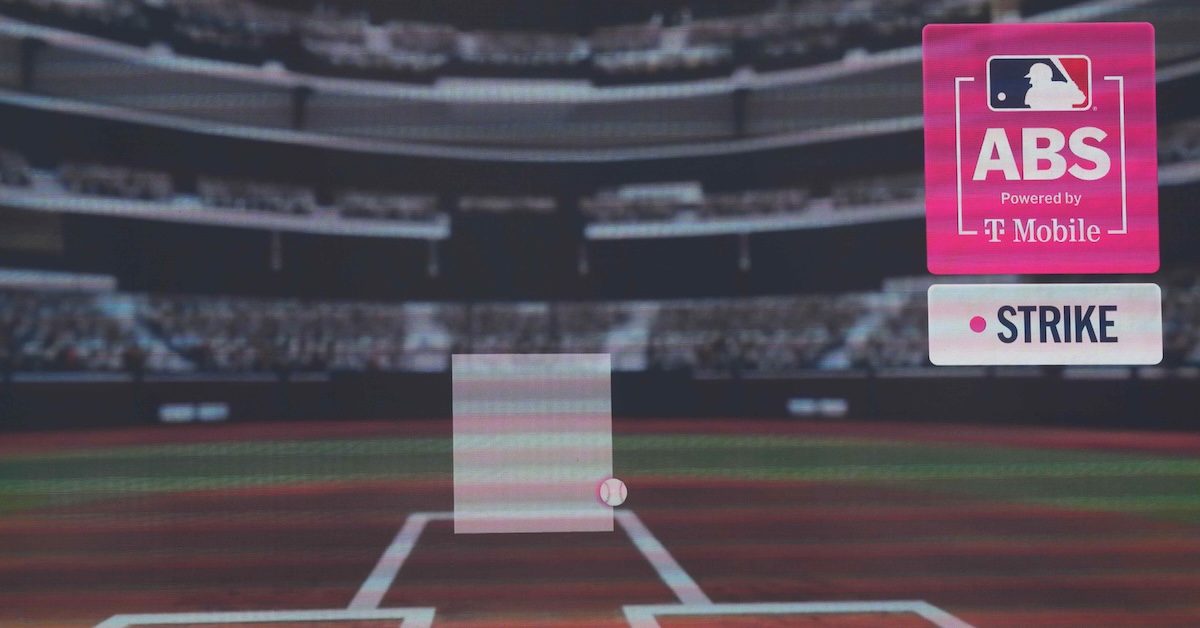
In the new season’s early going, the challenge system has been all the rage across the majors. If you don’t believe me, you can read ESPN’s coverage of it, or The Athletic’s, or MLB.com’s, or … well, you get the idea. The coverage has been extensive and positive, and I couldn’t agree with its enthusiasm more. I love the new system, and I’m also really excited to think about challenges in general. There are so many fun angles to consider. So here’s the math nerd’s take on what challenges have looked like so far, and what I’m most interested to learn about them moving forward.

How I’m Thinking About Challenges
Every time a strike or ball is called, there’s an opportunity for a challenge, at least so long as the relevant team has one remaining. That makes it easy to measure the prospective value of a challenge on any given pitch: It’s worth however much flipping the result of that particular pitch would change the game situation in the challenging player’s favor. All we have to do is figure out how many runs were likely to score in the inning in each case and compare the two. Read the rest of this entry »


Yes, Having Stars Matters In October

Kevin Sousa-Imagn Images

I’ve been doing a lot of looking at depth charts this week. All of us FanGraphs writers have – these positional power rankings don’t write themselves. When you look at the majors through this lens, you’ll naturally do a lot of thinking about floor and ceiling. The Yankees are playing who at third base? The Brewers are getting how much WAR by avoiding weak spots? The Red Sox have that many outfielders?

I’ve written some team overviews this winter. In them, I make the following claim: “Building a team that outperforms opponents on the strength of its 15th to 26th best players being far superior to their counterparts on other clubs might help in the dog days of August, when everyone’s playing their depth guys and cobbling together a rotation, but that won’t fly in October.” The converse of that claim – that stars matter disproportionately in October – is part and parcel of this depth argument. But is that true?

Some might say that the best time to answer this question is when the playoffs are just around the corner. I’d counter that those people haven’t just spent seven hours staring at a pile of acceptable-but-not-overwhelming third base and starting pitcher options and trying to write something about each one. So in the spirit of doing anything other than looking at power rankings, I decided to test out this assumption. Read the rest of this entry »


Hey FanGraphs, Your Math Isn’t Mathing… Or Is It?

Denis Poroy and Cary Edmondson-Imagn Images

If you spend some time poking around the nooks and crannies of FanGraphs, you’ll eventually encounter one weird thing. Go to our Depth Charts Team WAR Totals page, and you’ll see all 30 teams arranged by the amount of WAR we project them to accrue this season. Go to our Projected Standings page, and you’ll see the winning percentage we expect for each team. Sometimes, those two pages seem to be displaying the exact same information. Sometimes, they don’t quite line up.

Take right now, for instance. We project the Padres for 40.8 WAR, the Giants for 38.7 WAR, and the Diamondbacks for 38.2 WAR. Look at the projected standings, however, and we have the Padres down for a .490 winning percentage, the Giants at .504, and the Diamondbacks at .501. That doesn’t feel right. Shouldn’t the team with the most projected WAR also project for the best record? Well, buckle up, because to explain how this works, we’re going to have to do some math.

We’ll break this one down into two parts. First, what does a team WAR projection mean? Most basically, it’s the sum of each player on that team’s WAR projection, but we’ll have to get more specific than that. Our projection systems can spit out a WAR, but that’s not their real output. They project actual on-field baseball results. Manny Machado’s Depth Charts projection is for 644 plate appearances, 28 doubles, 26 homers, 127 strikeouts, and so on. The WAR part of it gets calculated after the fact. Read the rest of this entry »


More Musings on What Teams Are Paying for a Win in Free Agency

Rick Scuteri-Imagn Images

Earlier this week, I wrote about the cost of a win in free agency. I loved seeing the discussion of that article online and in the comments section, so I thought I’d set aside some time to consider a few of the questions readers had. Here are my answers to those questions.

What if We Used More Tiers?
If three tiers is good, would four be better? Five? Six? In my initial analysis, I ran all these variations in the background and decided that three was optimal for presentation and clarity. I also determined that the sample sizes would get vanishingly small as we expanded to more and more tiers. But as several readers asked for more granular looks, why not? Here is a four-tier version:

Dollars Per WAR in Free Agency, 2020-2026
WAR Tier $/WAR Players
0-1 $7.4M 406
1-2 $8.6M 236
2-3 $10.5M 83
3+ $12.3M 62

And a five-tier version:

Dollars Per WAR in Free Agency, 2020-2026
WAR Tier $/WAR Players
0-1 $7.4M 406
1-2 $8.6M 236
2-3 $10.5M 83
3-4 $11.1M 40
4+ $13.2M 22

Read the rest of this entry »


What Are Teams Paying For A Win In Free Agency? 2026 Edition

Mark J. Rebilas-Imagn Images

What are teams paying for a win in free agency? Earlier this month, I answered a FanGraphs Weekly Mailbag question about that very issue, outlining a rule I’ve been using in formulating my contract predictions. I left my explanation loose and vague because it was one of four questions in a mailbag, but to give you the general gist, I think about free agent salaries on a graduated scale, with role players being paid less per win above replacement than superstars. Today, I’d like to back up my argument with a bit more mathematical rigor.

One of the benefits of writing for FanGraphs is that smart baseball thinkers read the site. I woke up last Monday to a direct message from Tom Tango, MLB’s chief data architect. Tango had a few suggestions for further research, a method for adjusting past years of data for current payroll situations, and even a link to a discussion of the cost of a win with Sean Smith. Smith, better known as Rally Monkey, is the creator of Baseball Reference’s calculation of WAR – when you see rWAR, that actually stands for Rally WAR, not Reference WAR. In other words, I got help from some heavy hitters.

With Smith’s excellent article on free agency as a guide, I built my own methodology for examining the deals that free agents receive and turning them into a mathematical rule. I took every starting pitcher and position player (relievers are weird and should be modeled differently due to leverage concerns) and noted their projected WAR in the subsequent season, as well as the length and terms of their contract. I excluded players who signed minor league deals, were projected for negative WAR, or whose contract details were undisclosed. To give you a sense, applying this approach to the 2025-26 offseason leaves us with 89 players, from Kyle Tucker all the way down to Jorge Mateo. Read the rest of this entry »


The Relationship Between Framing and Blocking

Geoff Burke-Imagn Images

On Monday, Michael Rosen wrote a fun article about catcher blocking. He didn’t just write about it; he created his own blocking metric from scratch in order to grade every catcher in the game and to understand how much value a single block or passed ball can carry. The whole article is excellent, but one piece in particular caught my eye. Michael put together a supercut of Agustín Ramírez’s passed balls, all of which shared a theme. They weren’t the pitches in the dirt that you’d expect to end up as passed balls. They were normal pitches on the edges of the zone, ones that Ramírez tried so hard to frame them that he ended up missing them entirely. Michael drew the obvious inference: His framing focus, I believe, may have led to some of these inexcusable passed balls. At the risk of piling on, here are the pitches in question:

I’m so sorry, Agustín. This is brutal, and it makes Michael’s point very bluntly. It also makes me wonder about the relationship between the framing skill and the blocking skill. Does selling out to be a better framer hurt your blocking? Clearly, it can and at least sometimes does for Ramírez, but it still doesn’t strike me as a particularly likely hypothesis overall. Moreover, even if framing does hurt your blocking, the trade-off would certainly be worth it. Read the rest of this entry »