Archive for Astros

Postseason Preview: The 2019 World Series

On May 23, the Washington Nationals lost a matinee to the Mets in heartbreaking fashion, taking a lead 4-3 with a three-run eighth inning only to give up three runs of their own in the bottom of the frame. The loss dropped the Nationals to 19-31, a whopping 10 games back of the division-leading Phillies. They had been outscored by 40 runs on the season, and Dave Martinez’s seat was getting hot in only his second year as manager.

On Tuesday night, the Nationals will play in the World Series. It’s a change in fortune so extreme that it begs for explanation, and at first glance the explanation is easy. The Nationals have star power but lack depth, the exact kind of team “built for October.” Their starting lineup and top four starting pitchers are phenomenal; the less said about the backups and bullpen, the better. The kind of Nationals team losing 6-4 on a Tuesday afternoon in Queens is simply not the same team playing now.

That’s a convenient explanation, but it’s also wrong. Stephen Strasburg threw seven innings that day, and no regular had the day off. Wander Suero was the only reliever to pitch, and he wasn’t one of the relievers who weighed the Nationals down this year; he had a 4.54 ERA and 3.07 FIP over 71.1 innings, a solid season for a middle reliever.

No, the Nationals sent out their best, their co-ace starter backed by the A-squad, and they lost to a Mets team playing Adeiny Hechavarría, Carlos Gómez, and Juan Lagares all at once. That same team survived the Brewers, outlasted the Dodgers, and walked all over the Cardinals on their way to the first World Series appearance in franchise history. The convenient story isn’t always the right one. Washington simply started playing better.

After that bleak day in May, the Nations went 74-38 to finish the regular season. They outscored their opponents by 189 runs, scoring the most runs in the National League and allowing the third-least. The talent at the top of the roster shone through; the combined brilliance of Strasburg, Max Scherzer, Anthony Rendon, Juan Soto, and all the rest was so great that no amount of bullpen incompetence or lack of bench depth (36-year-old Howie Kendrick played the second-most innings at third base for them this year) could hold the team down.

Shockingly, that 74-38 record wasn’t the best in baseball. The Houston Astros, their World Series opponents, went 74-37 over the same stretch, a scant half-game ahead. They scored four fewer runs than the Nationals and allowed one more. The two hottest teams in baseball are facing off in the World Series, and if you don’t think about it too literally, you could even say they’re constructed from the same blueprint. Read the rest of this entry »
Houston Survives Late Inning Scare, Beats Yankees in Six

After what was otherwise a fairly quiet affair punctuated by the occasional home run, the Houston Astros won Game 6 of the American League Championship Series 6-4 on a walkoff home run from José Altuve. Houston takes the series four games to two, and avoids a high-stakes Game 7 that would have left Gerrit Cole unavailable in the World Series until the third game.

The evening got off to an inauspicious start for the Yankees as Houston’s first entrant in the bullpen battle, Brad Peacock, quickly dispatched DJ LeMahieu, Aaron Judge, and Gleyber Torres with seven pitches. Chad Green opened for New York and didn’t perform as well in his half of the inning as Peacock did in his. Green was perhaps fortunate to escape a rather pedestrian slider to Altuve with only a double, but he was less lucky with a high, very inside fastball to Yuli Gurriel, which the first baseman turned on for a home run to give the Astros an early 3-0 lead. That high, inside fastball isn’t usually that dangerous for a pitcher; there were only 13 home runs hit this year by right-handed hitters swinging at a four-seamer in Statcast’s inside and high-inside “chase” zones. Coincidentally enough, Gurriel had one of those home runs, comfortably turning on a sorta-fastball from Trevor Williams. This might have been one of the highest-leverage of those since Kit Keller’s.

Read the rest of this entry »


Yankees Stave Off Elimination and Send ALCS Back to Houston

NEW YORK — The Yankees may not win this year’s American League Championship Series. They may not become the 14th team to rally from a three-games-to-one deficit in a best-of seven, or the eighth to do so by finishing the job on the road — particularly against an Astros team with the majors’ best record and an historically powerful offense. But in the wake of a demoralizing Game 4 loss full of missed opportunities, sloppy defense, and the sudden end of CC Sabathia’s career, they met manager Aaron Boone’s immediate goal of sending the series back to Minute Maid Park with a 4-1 victory that featured strong work by starter James Paxton and a four-run first inning against Justin Verlander, featuring a pair of homers by DJ LeMahieu and Aaron Hicks.

“He’s got to go out and pitch well and set the tone for us,” Boone said of Paxton prior to the game, “because we’ve got to get on that plane and go back to Houston.”

The tone early on Friday evening was all too reminiscent of Thursday’s late-inning sloppiness. Second baseman Gleyber Torres, who made errors in each of the final two innings of Game 4, mishandled leadoff hitter George Springer‘s grounder, which had slipped under Paxton’s glove, though the ball was scored a single. Springer then took second on a passed ball by Gary Sánchez, advanced to third on Jose Altuve’s grounder, and scored on a wild pitch. It was an all-too-familiar story for Paxton, whose 29 first-inning runs allowed in 29 starts tied for the major league lead.

That was all the Astros would get from him, however. Both Alex Bregman and Yuli Gurriel scorched line drives to the outfield —  98.4 mph for the former to left, with Brett Gardner chasing it down, and 96.8 for the latter to center, but right at Hicks — and so Paxton escaped by allowing just one run. He’d failed to get ahead of any of the five batters he faced, gotten just one swinging strike on a total of 23 pitches, and his defense looked anything but sharp. With the Yankees desperately needing length given their plans for an all-bullpen Game 6, it was not an encouraging beginning. Read the rest of this entry »


Justin Verlander’s Innings Could Fill a Boat

As Justin Verlander takes the mound tonight, he’ll do so with 240.1 innings pitched this season between regular season and playoffs. In the last three seasons, Verlander’s 2019 campaign is just the second to go at least 240 innings; his 242.2 inning in 2017 is the other. Since 2011, there have been 26 seasons during which pitchers have thrown at least 240 innings. Verlander accounts for five of them. If he makes a decent start tonight and Houston advances to the World Series, he’ll likely be the first pitcher to go over 250 innings in a season since 2014, when James Shields, Madison Bumgarner, and David Price all eclipsed that mark. Verlander’s quality deservedly receives the bulk of the attention when analyzing the ace, but the quantity deserves accolades as well.

If we look a single player’s career and then compare his totals to his peers only during those seasons when he was active, it is bound to be misleading, as it cuts off the careers of others at the beginning and end where fuller comparisons are better made. For example, Justin Verlander’s 72 WAR is first among all pitchers since 2006 when he pitched his first full season. That Verlander was the best pitcher in baseball over that time is a defensible argument, but it should be noted that Clayton Kershaw is just seven wins behind Verlander and five years younger. If we looked at the leaders from 2006-2026, Verlander might not be first. Similarly, if we go back to 1996, we see Randy Johnson and Pedro Martinez jump ahead of Verlander. If we go back to 1986, Roger Clemens and Greg Maddux are more than 40 wins ahead of him, with Mike Mussina, Curt Schilling, John Smoltz, and Kevin Brown also in possession of a higher WAR. This isn’t to take away anything from Verlander — the other pitchers discussed are all great. But it is a reminder that selectively choosing seasons can skew the results. Read the rest of this entry »


How to Neutralize a Rookie Sensation

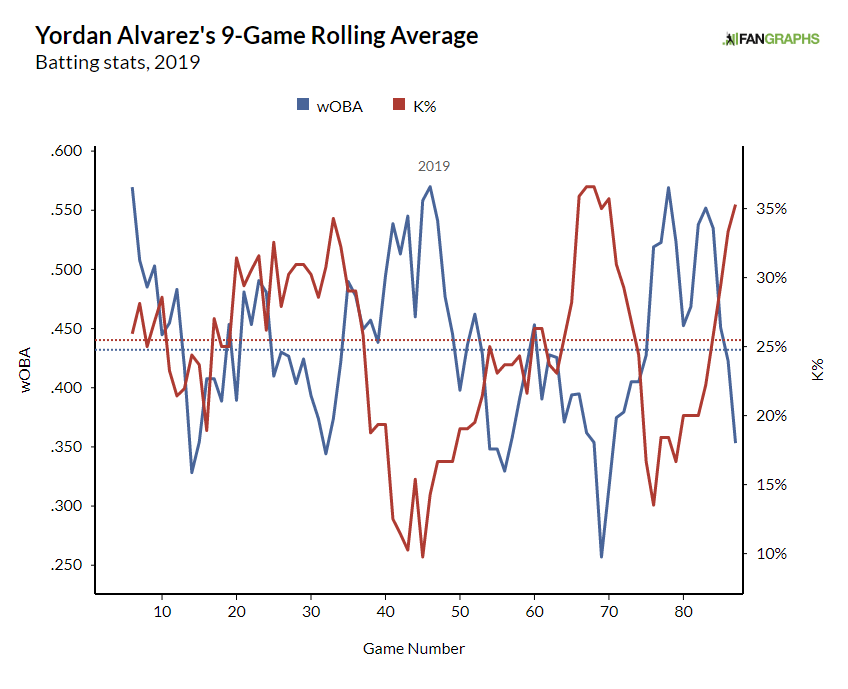
Yordan Alvarez is the favorite to win the AL Rookie of the Year Award. He completely demolished opposing pitching this year, first in Triple-A (170 wRC+), then in the majors (178 wRC+) after being called up in early June. Between the two levels, he launched 50 home runs while showing elite plate discipline. But this October, he’s been a non-factor for the Astros.

He showed some life against the Rays, going 6-for-19 with three doubles in that five game series. But against the Yankees, he’s been completely shut down. He collected his first hit of the Championship Series last night, a broken bat single off Chad Green. He’s reached base just three other times against Yankees pitching, drawing two walks and reaching on an error. Overall, he’s slashing just .206/.270/.294 in nine postseason games.

What’s even more concerning is his elevated strikeout rate. He struck out just over a quarter of the time he came to the plate during the regular season. That’s jumped up to 37.8% in the postseason. During the regular season, Alvarez never had a nine-game stretch as poor as this one.

There was a nine-game stretch ending on September 6 during which he posted a strikeout rate of 36.6%. But he also launched three home runs over that span, something he hasn’t been able to do during the postseason. Obviously small sample caveats apply here, but it appears as though both the Rays and the Yankees have found similar approaches to neutralizing the 22-year-old rookie. Read the rest of this entry »


The Astros Edge Toward the World Series

The Astros beat the Yankees 8-3 last night, moving within a win of their second World Series berth in three years, but the night didn’t have to turn out that way. The victory was comprehensive — Houston out-homered the Yankees, had more non-homer hits, struck out less than half as often, and committed three fewer errors. Five runs is an odd lead, but it’s also the first truly safe lead in baseball. The Astros could have spotted the Yankees a grand slam before the game and still come out ahead.

But baseball doesn’t really work that way. If the Yankees had started the game ahead 4-0, things would have gone differently. Batters wouldn’t have gotten the same pitches, different Yankees relievers would have thrown, A.J. Hinch would have been forced to manage differently; the things that happened last night weren’t deterministic, destined to play out in the same order regardless of circumstance.

So with that in mind, let’s look at a few places where the Yankees could have changed history. They might have lost anyway, and they might have won — but they had their chances to do something, and simply didn’t make the most of them.

Gary Sánchez Bats in the First
Gary Sánchez bats seventh for the Yankees, so when he appears in the first inning, something has gone very right. Not only that, but he came up with the bases loaded; Zack Greinke looked shaky, with three walks on the night already, and Sánchez had a chance to deliver a decisive blow early. Read the rest of this entry »


The Ball Threatens to Overshadow Baseball

With the postponement of Wednesday’s scheduled ALCS Game 4, the de-juiced baseball remained a hot topic of discussion, particularly in New York, where the Yankees appeared to catch a game-changing bad break on Didi Gregorius‘ fifth-inning fly ball that instead of becoming a three-run homer that would have swung the lead in their favor, was caught at the warning track. Players and managers are talking about it, fans are talking about it, analysts are talking about it — here in New York City, even on the 10 pm local news. Like it or not, it’s an issue that won’t go away, in part because of MLB’s stubborn insistence that nothing has changed, even in the face of evidence to the contrary, as well as the reality that the league actually owns about 25% of Rawlings, the manufacturer of the baseball (the other 75% is owned by Seidler Equity Partners, founded by Peter Seidler, the leading investor of the Padres). While none of this invalidates what the players on the field are accomplishing, everybody is suddenly playing or watching a very different game than we’d grown accustomed to during the regular season.

On Saturday, our own Craig Edwards reported that Cardinals manager Mike Shildt said that his team’s analytical department had noted that fly balls are traveling four-and-a-half feet less far than normal. ESPN’s Jeff Passan reported on Wednesday that officials from two unnamed teams (quite possibly those of the Astros and Yankees, since Passan was reporting from New York) “concurred that whatever batch of balls has been used during October is not performing the way the ones in the regular-season did.”

The change concerns the drag on the baseball, which according to the work of Baseball Prospectus’ Rob Arthur has increased sharply relative to the regular season, strongly suggesting that different balls are being used. Arthur estimated that 50% more homers would have been hit if the regular season ball were being used. On Thursday, Arthur published a new piece showing that the postseason baseballs are also affecting pitchers, producing slightly less vertical break (by about 0.4 inches) on curveballs, and that “Sliders are cutting across the zone a little less; sinkers staying a little more buoyant… [The changes] all seem to hover on the border between just large enough that baseball’s tracking system can detect them and just small enough that a major-league hitter probably wouldn’t care.” Read the rest of this entry »


The Astros Need to Solve Masahiro Tanaka’s Slider

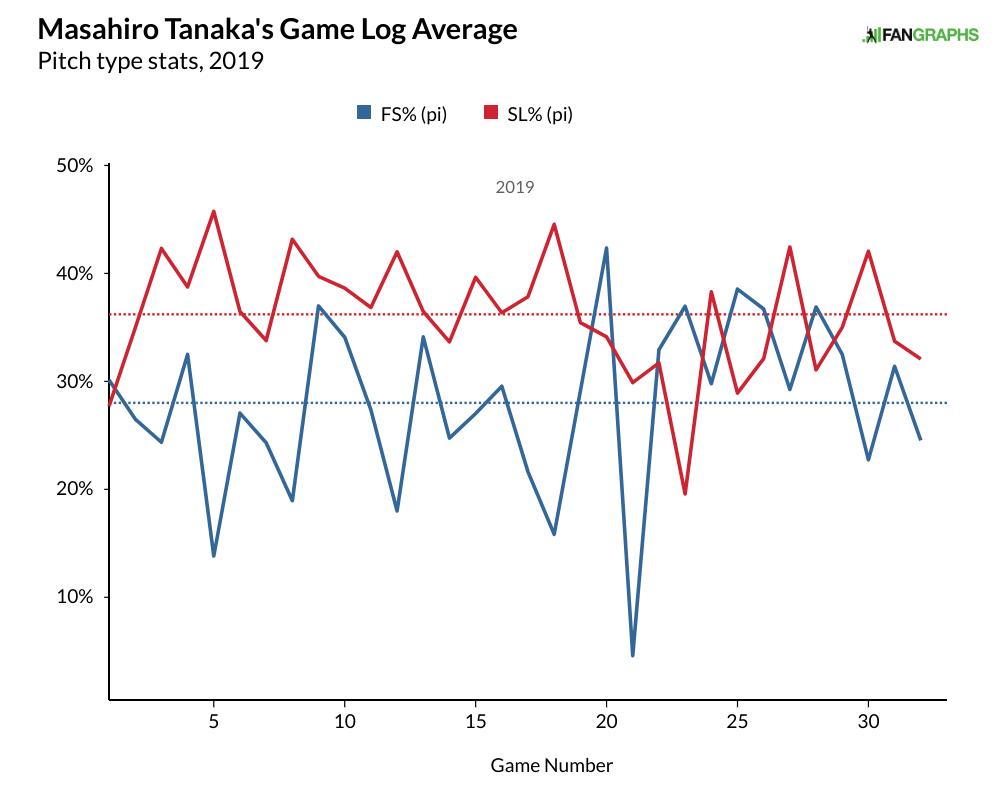
If Masahiro Tanaka has a signature pitch, it’s his slider. When he first came over from Japan in 2014, nearly half of his strikeouts came on the splitter despite throwing it only a quarter of the time. In his first three seasons in the majors, Tanaka threw his splitter more often than any other pitch and batters put up a feeble 37 wRC+ against it, while whiffing on the pitch 19% of the time. But in 2017, Tanaka used his slider more often than the splitter. In 2018, that trend continued; he got better results from his slider than he did with the splitter. This season the disparity in usage and effectiveness grew. Tanaka struggled with his splitter due to changes in the baseball, but even after re-configuring the splitter in July, his slider has remained his best pitch.

Against the Astros in Game 1 of the ALCS, Tanaka got eight swings and misses. Every single whiff came on the slider. Here’s how Tanaka’s usage of his slider has compared to that of his splitter this season:

Read the rest of this entry »


ALCS Rainout a Mixed Bag for Pitchers

The Yankees and Astros both won over 100 games in the regular season but nobody beats Mother Nature. When a rainstorm causes cool terms like “bomb cyclone” or “explosive cyclogenesis” to be bandied about, you know you’re not expecting a light drizzle. Yankee Stadium is currently dry, but with a system the size of the mid-Atlantic barreling up the coast, it didn’t make sense for MLB to pretend that tonight’s ALCS Game 4 was going to take place. Just look at the radar, courtesy of the National Weather Service:

Yikes. The rain provides the Yankees and Astros with an extra off-day now at the expense of losing an off-day between a possible Game 5 and Game 6. This isn’t a big deal for the hitters, but it will result in some revised pitching plans. In a five-game divisional series, teams can generally muddle through with a three-man rotation. Due to the 2-2-1 format, no team plays on three consecutive days, and while the Game 1 starter would have to pitch Game 4 on short rest, the Game 2 starter can pitch in a possible rubber match on normal rest. This extra rest gives teams the flexibility to either stretch their best three starters or, as the Nationals demonstrated, use starting pitchers in relief more aggressively.

But short of baseball going to some kind of impractical 2-2-1-1-1 format, that doesn’t quite work in a seven-game series. So unless you’re going to have your entire rotation do it 1930-style, you’ll need to use a fourth starter. That isn’t an ideal situation for either the Yankees or the Astros. From a pure projection standpoint, it’s actually doesn’t move the probabilities. The Astros get an immediate benefit in that they avoid a Bullpen vs. Bullpen Game 4; ZiPS takes bullpen depth into consideration and Yankees enjoy a significant projected edge in any such bullpen game. Before the rainout, ZiPS projected the Yankees to have a 56%-44% edge in a home bullpen duel, so it’s a nice game to delay if you’re Houston.

The problem you run into with this model is that the rainout doesn’t really add an extra day of rest, it simply moves it. Since there are only two days of rest for a Game 4 starter to pitch in Game 7 now, both teams end up repeating the dilemma of either using a fourth starter — particularly problematic for the Astros — or going with a bullpen game. Read the rest of this entry »


Houston Takes 2-1 ALCS Lead as Cole Escapes Jams, Astros’ Bats Reach Orbit

NEW YORK — The Yankees had their chances against Gerrit Cole on Tuesday afternoon, golden opportunities of the type few if any of the 29-year-old righty’s opponents saw this season — the type that can haunt a team if it fails to convert them. The Yankees could not, stranding nine baserunners through the first five innings and going 0-for-6 with runners in scoring position. Though less dominant than usual, the Astros’ co-ace wriggled out of jam after jam, and may have gotten the benefit of a de-juiced baseball when a fifth-inning Didi Gregorius drive that appeared destined to become a Yankee Stadium short porch special — a potential three-run homer that would have erased Houston’s 2-0 lead — died at the wall in right fielder Josh Reddick’s glove. Meanwhile, Reddick and José Altuve each homered off starter Luis Severino, helping to power the Astros to a 4-1 victory in Game 3 of the ALCS, giving them a two games to one lead.

As noted in my piece on Cole, throughout his otherwise incredible season, he was at his most vulnerable in the first inning, allowing 16 runs in 33 starts, a rate of 4.36 per nine innings. As the shadows stretched across the diamond in the Bronx, the Yankees were poised to add to that litany when leadoff hitter DJ LeMahieu singled up the middle on Cole’s fifth pitch, and Aaron Judge followed with a shift-beating single to right field. Through the entire season, Cole had given up just seven hits before recording his first out, and only once (April 20 against the Rangers) allowed back-to-back hits to start a game. Here he recovered to retire Brett Gardner on a routine fly ball and Edwin Encarnación on a popup, then walked Gleyber Torres on four pitches, producing just the ninth bases-loaded situation he faced all year. His first-pitch curve to Gregorius, however, produced a harmless groundout.

The Yankees had another chance in the second inning, when with two outs, Aaron Hicks — starting his first game since August 3 after suffering a right flexor strain that was believed to be season-ending — battled his way to a 10-pitch walk, and LeMahieu smacked the next pitch up the middle for a single. Cole escaped by fooling Judge with a mix of curves and sliders, striking the big slugger out chasing one of the latter, low and away. Eleven batters into his start, the pitcher who punched out 326 hitters this year finally recorded his first K of the day.

“I actually think the beginning of the game he had a hard time finding his stuff and finding his tempo, his rhythm,” said manager A.J. Hinch afterwards. “He was still getting through his outing, made some really big pitches, had some pressure on him.” Read the rest of this entry »