Archive for Giants

Top of the Order: It’s Holliday Season in Baltimore

Kim Klement Neitzel-USA TODAY Sports

Welcome back to Top of the Order, where every Monday, Wednesday, and Friday, I’ll be starting your baseball day with some news, notes, and thoughts about the game we love.

Finally, after what felt like the longest less than two weeks of our lives, the moment has arrived: The Baltimore Orioles are calling up shortstop Jackson Holliday, the top prospect in baseball. He will make his MLB debut with the Orioles as soon as Wednesday, sliding in at second base because Baltimore already has Gunnar Henderson, another former no. 1 overall prospect, at shortstop.

The 20-year-old Holliday exceeded even the rosiest of expectations in spring training, hitting .311/.354/.600 with two home runs in 48 plate appearances. But he didn’t make the Opening Day roster despite all that, with general manager Mike Elias citing Holliday’s performance against lefties in the minors and his need to further acclimate to the keystone as reasons to delay his big league career. But, with Holliday off to a bonkers start at Triple-A (.333/.482/.605 with a 189 wRC+) and the Orioles, at 6-4, in need of a jolt, now was the right time to bring him up.

Like both Adley Rutschman and Henderson before him, Holliday is great at everything but perhaps not truly elite at anything. No, he doesn’t have the raw power or speed of Wyatt Langford, the American League’s other tantalizing rookie, but Eric Longenhagen and Tess Taruskin grade Holliday as a future five-tool star with plenty of development still ahead of him.

Ben Clemens wrote that it would be the wrong decision for Baltimore to keep Holliday down past the Super Two deadline (typically 30 or so days into the season), not only because it would be a bad-faith gesture to Holliday, but also because it would be a terrible baseball move. With the Orioles’ offense looking more good than great in the early going, they’re making the right choice to call him up now: Holliday is simply better than the players he’s replacing; Jorge Mateo is best used as a super-utility man and Ramón Urías has struggled to start the season. Moreover, the O’s had little service-time incentive to keep him stashed in the minors; if he wins the AL Rookie of the Year award, they will be rewarded with an additional draft pick and Holliday will receive a full year of service, no matter how long he’s on the big league roster. Assuming he’s ready for the majors, the Orioles stand to benefit more from having him on the roster for as long as possible.

So now, and apologies for what you’re about to read… What a bright time, it’s the right time to call up Holliday.

Blake Snell Will Be Fine

From a results standpoint, Blake Snell’s Giants debut was not a good one. Facing the Nationals at home on Monday, he allowed three runs on three hits and two walks while striking out five, and it took him 72 pitches to get through three innings. But with his late signing, lack of a true spring training, and relatively quick ramp-up, San Francisco should consider the start a muted success. Sure, the Giants lost 8-1, but Snell got through the outing without injury — something that is hardly a guarantee for any pitcher, especially so far this season — and he should be built up for about 90 or so pitches his next time around. Overall, that’s encouraging.

Besides, it wasn’t all bad when you take a look under the hood. Snell’s stuff didn’t look too far off from the arsenal that won him his second Cy Young award last year. As you’d expect, his average velocity for all four of his pitches was down, but none alarmingly so: His fastball dipped just 0.1 mph, while his slider had the biggest velocity drop, at 1.1 mph. As a result, his spin rates also decreased, but again, this shouldn’t be concerning.

Additionally, Snell got 11 misses on 25 swings (44%), and 33% of his pitches resulted in either a called strike or a whiff; both rates were higher than his marks from last year. The quality of contact against him was anemic as well, with the seven balls in play averaging an exit velocity of just 80 mph. This is who Snell is: an elite contact suppressor and whiff-inducer who will more often than not run into high pitch counts because he avoids the middle of the plate.

As recently as a month ago, I was lamenting the state of the Giants rotation, but things are looking up now. Snell joins Logan Webb to give them a formidable frontline duo, one that is as strong as any other in baseball. Meanwhile, their decision to convert offseason acquisition Jordan Hicks into a starter has gone better than anyone could’ve expected, and they also have top prospect Kyle Harrison. And let’s not forget that San Francisco’s staff has more reinforcements on the way. Alex Cobb was initially on track to return from offseason hip surgery ahead of schedule, perhaps as soon as sometime this month, before he suffered a mild flexor strain; the setback will keep him out until early May. Lefty Robbie Ray, the 2021 AL Cy Young winner, could make at least a handful of late-season starts once he’s back from Tommy John surgery; and Tristan Beck and Sean Hjelle could be factors as well.

To be clear, this team still has flaws — its offense has been one of the worst in the National League and its relievers collectively were below replacement level entering Tuesday — but Snell and the starting staff will be just fine.

The Free-Swinging Giancarlo Stanton

I’m confident in saying Snell is the same player he was at last season’s peak, but I have no idea how to evaluate Giancarlo Stanton, the most enigmatic player in baseball. He is still hitting the crap out of the ball despite overhauling his conditioning in the offseason and coming to camp noticeably slimmer, and his surface-level numbers so far are good: .250/.268/.550 with three home runs and a 134 wRC+.

But as the OBP foreshadows, Stanton’s plate discipline has eroded, and I’m just not sure he can make this work. He’s chasing 45.7% of the pitches he sees outside the zone, which is the worst rate of his career by 15 points. His contact rate is also down, and his overall swing percentage is above 50% for the first time in his career. Stanton has always been streaky, but usually his plate discipline is indicative of where his results will be.

The concern here is that this solid start is nothing more than luck, that Stanton is flailing but essentially running into a few homers with guesswork. If that’s the case, it might be wise for pitchers to stop throwing him anything near the zone to see if he’ll keep chasing. In the meantime, it’s too soon to know what to make of Stanton.

The 40-Year-Old Legend

I really thought it might be curtains on Jesse Chavez’s career when he got rocked in his first spring training outing, and I really, really thought it was when the White Sox released him last month. After all, if he couldn’t crack the bullpen that sure looked like it was going to be the worst in baseball, whose would he join?

Well, of course, I discounted both the Braves connection and his apparent comfort pitching in Atlanta. Soon after being released, Chavez signed a minor league deal, and later had his contract selected to give him a spot on the Opening Day roster. And as he’s done whenever he’s worn an Atlanta uniform, he’s piling up outs.

The 40-year-old has allowed just one run in 6.1 innings across three appearances, helping to save the rest of the bullpen in each outing. Indeed, he’s still kicking in what’s set to be his last season, all while pitching with guile and a funky arm action (and wearing sunglasses no matter the lighting or time of day). Each outing brings him closer to retirement, but I’m convinced Chavez’s vibes will live forever.

Well, That Didn’t Last Long

Some quick finality on the Julio Teheran signing, which I wrote about on Friday: He was DFA’d after just one start, in which his former Braves squad trounced him for four runs on just eight outs, with six hits and a couple of walks to boot.

We’ve since learned that his $2.5 million contract is not, in fact, for the full $2.5 million, but that it’s rather a split contract that pays him at that rate in the majors but only $150,000 in the minors. Still, the MLB split makes it implausible that anyone claims him, and it also makes it a near-guarantee that he accepts an outright assignment to Triple-A, since he’d be forfeiting his right to earn that hefty rate if he’s needed back in the bigs again.


Jordan Hicks Is a Starter Now. How in the World Did He Pull That Off?

Kelley L Cox-USA TODAY Sports

In 2022, Jordan Hicks briefly converted from relieving to starting for the Cardinals. The experiment didn’t go particularly well. He made eight starts and lasted a combined 26.1 innings with an ERA of 5.47. He walked nearly 20% of the batters he faced, barely struck anyone out, and seemed to struggle to adjust from his old role. He threw sinkers or sliders 94% of the time, didn’t dial down his velocity much, and looked exactly how you’d expect a closer cosplaying as a starter to look. So much for that experiment; he promptly returned to late-inning duty.

When the Giants signed Hicks this offseason, rumors of his return to the starting ranks bubbled up, but I didn’t believe it. After all, we’d already seen this exact experiment before. But fast forward to today, and Hicks looks like a revelation. Through two starts, he’s thrown 12 innings and allowed a single earned run. His strikeout rate has barely budged from his career average, and he’s only issued two free bases (one walk, one HBP). It’s a remarkable turnaround, and one that I can’t help but dive into. How has he done it? Read the rest of this entry »


Top of the Order: Let’s Review Payrolls

Robert Edwards-USA TODAY Sports

Welcome back to Top of the Order, where every Monday, Wednesday, and Friday, I’ll be starting your baseball day with some news, notes, and thoughts about the game we love.

As I mentioned in my intro column on Friday, my main responsibility here at FanGraphs is updating the RosterResource payroll pages, which give a great overview of all 30 teams’ payrolls and where they stand in relation to the luxury tax lines. I like to view payrolls with the understanding that each team is going to have its own normal range; as such, I find it best to look at the 2024 Dodgers relative to the 2023 Dodgers and the 2024 A’s relative to the 2023 A’s. So, with that in mind, I put the teams into five buckets.

All payrolls listed below are the “real payroll” for the teams rather than their luxury tax payroll. Official 2023 payrolls have not yet been reported, so I’ve used the RosterResource payrolls for both 2023 and 2024.

The Big Gainers (at least 10% increase since 2023)

1. Orioles ($66M to $98M, a 48% increase)

The O’s had nowhere to go but up after running a bare-bones payroll for last year’s 101-win campaign. The big increases came from arbitration raises and trading for Corbin Burnes ($15,637,500).

2. Diamondbacks ($124M to $168M, a 36% increase)

Owner Ken Kendrick wasn’t kidding when he said he was willing to add payroll to keep the team in World Series contention. The Diamondbacks didn’t lose anyone significant in free agency, and new additions Eugenio Suárez, Eduardo Rodriguez, Joc Pederson, and Jordan Montgomery will combine to earn almost $60 million this season.

3. Dodgers ($236M to $314M, a 33% increase)

The Dodgers reined in spending in 2023 with an eye on having maximum flexibility for this season, and goodness did they flex it. They committed over $1 billion in free agency, 36% of the entire league’s total.

4. Royals ($91M to $116M, a 27% increase)

Kansas City’s big move was the mega-extension for Bobby Witt Jr., with free agency expenditures large in quantity (seven MLB free agents) but low in big splashes. (Seth Lugo’s $36 million contract was the largest.) Still, they look markedly improved.

5. Rays ($79M to $97M, a 23% increase)

The Rays were pretty quiet in free agency, but their payroll is up quite a bit even after trading away Tyler Glasnow and Manuel Margot. The large collection of arbitration-eligible players accounts for most of the gain here.

6. Pirates ($70M to $84M, a 20% increase)

This is similar to the Rays’ situation; Aroldis Chapman ($10.5 million) was Pittsburgh’s biggest free agent commitment. David Bednar’s arbitration years and Mitch Keller’s extension could keep the Pirates in the $80M+ range for a while.

7. Nationals ($109M to $130M, a 20% increase)

In the final year of his contract, Patrick Corbin is earning $11 million more than he did in 2023, and his raise accounts for over half of Washington’s increase.

8. Astros ($201M to $241M, a 19% increase)

This year, the Astros almost certainly will pay the luxury tax for the first time under owner Jim Crane. Josh Hader signed the biggest free agent deal for a reliever (by present value), and yet he has just the fifth-highest salary on the team.

9. Reds ($87M to $104M, a 19% increase)

Cincinnati had a very Royals-y offseason. Jeimer Candelario’s three-year, $45 million deal was the largest signing the Reds made, but add the $13 million he’ll earn this season with the salaries of newcomers Emilio Pagán, Frankie Montas, and Brent Suter and you get $37.5 million of fresh commitments to four players. That explains the increase in payroll even without Joey Votto on the team anymore.

10. Cubs ($190M to $224M, an 18% increase)

The Cubs waited awhile to strike in free agency, but they’ve now got four players earning over $20 million and another three above $10 million.

11. Braves ($205M to $230M, a 13% increase)

The Braves added more complementary players from the outside (Reynaldo López, Jarred Kelenic, Aaron Bummer) because their extension-heavy strategy creating few holes to plug. Austin Riley, Matt Olson, and Sean Murphy’s raises combine for $12 million in extra salary.

12. Yankees ($272M to $301M, an 11% increase)

Juan Soto’s hefty $31 million salary in his walk year explains the Yankees’ payroll jump, as the Marcus Stroman contract and arbitration raises are essentially negated by the salaries of Josh Donaldson, Luis Severino, and Frankie Montas (among others) coming off the books.

The Moderate Gainers (between 5% and 10% increase since 2023)

13. Giants ($196M to $208M, a 6% increase)

The Giants look significantly better on paper with Jung Hoo Lee, Blake Snell, Matt Chapman, and Jorge Soler, but they’re not actually that much more expensive. Joc Pederson, Brandon Crawford, Sean Manaea, Alex Wood, and Ross Stripling all underperformed in 2023 and are now playing elsewhere.

14. Rangers ($214M to $226M, a 6% increase)

The World Series champs did their big shopping in the two offseasons before last year, and many of the core contributors from the 2023 roster are still with the team. The largest contract Texas gave out this free agency was Tyler Mahle’s two-year, $22 million deal, leading to a minimal increase in payroll.

15. Blue Jays ($215M to $226M, a 5% increase)

After missing out on Shohei Ohtani, the Blue Jays had a low-key offseason. Yariel Rodriguez signed for $32 million but started out in the minors to get stretched out, and rather than making big expenditures the team will instead be relying on improvements from stars like Vladimir Guerrero Jr.

16. Athletics ($59M to $61M, a 5% increase)

Well, at least their relative change is actually qualifying as a moderate increase? By absolute change, this is essentially nothing; their highest paid player is Ross Stripling, who’s earning $12.5 million, but the Giants are covering $3.25 million of that, meaning the A’s themselves aren’t paying a single player eight figures.

Largely Unchanged (Within 5% of their 2023 payroll)

17. Cardinals ($178M to $181M, a 1% increase)

The Redbirds got most of their offseason shopping out of the way early, locking down Sonny Gray, Kyle Gibson, and Lance Lynn before the Winter Meetings. The Gray deal is heavily backloaded, though, keeping things steady.

18. Guardians (steady at $98M, a 0.4% increase)

The Guardians will look to bounce back from a sub-.500 year with largely the same personnel.

19. Phillies (steady at $246M, a 0.2% decrease)

The Phillies tend to allocate their contracts evenly and will run it back with essentially the same squad that brought them to within one win of their second straight NL pennant.

20. Mariners ($140M to $139M, a 0.7% decrease)

Seattle made plenty of moves without adding payroll because, as you might have expected, trader Jerry Dipoto’s swaps kept the ledger pretty balanced.

The Moderate Slashers (between 5% and 10% decrease since 2023)

21. Mets ($346M to $324M, a 7% decrease)

The Mets’ payroll remains stratospheric, but nearly $70 million is money paid to other teams for James McCann, Justin Verlander, and Max Scherzer. They’re projected to be all the way down to $159 million in commitments for 2025, with no huge arbitration raises set to add to that significantly.

22.Tigers ($121M to $109M, a 10% decrease)

Don’t confuse cheaper with worse. The Tigers should be a much better team this year; they just no longer have Miguel Cabrera’s $32 million on the books.

23.Red Sox ($199M to $178M, a 10% decrease)

Boston’s offseason was many things, but full-throttle it wasn’t. Adding injury to insult, the team’s big free-agent addition, Lucas Giolito, will miss all of 2024 after undergoing UCL repair surgery.

24.Marlins ($110M to $99M, a 10% decrease)

Peter Bendix had a quiet first offseason with the Marlins, with Tim Anderson ($5 million) being his only free agent expenditure.

The Big Slashers (at least 10% decrease since 2023)

25.Brewers ($126M to $110M, a 13% decrease)

Milwaukee traded Corbin Burnes, brought back Brandon Woodruff on a reduced salary, and signed Rhys Hoskins to a backloaded contract that adds only $10 million to the 2024 payroll. Even so, the Brewers are 3–0 to start the season and should still contend for the NL Central title.

26.Rockies ($172M to $147M, a 15% decrease)

Colorado’s payments for Nolan Arenado went down from $21 million last year to $5 million this year, creating almost the entire difference. The team’s only free-agent additions were Jacob Stallings ($2 million) and Dakota Hudson ($1.5 million).

27.White Sox ($177M to $146M, an 18% decrease)

With Liam Hendriks, Yasmani Grandal, Tim Anderson, Elvis Andrus, Aaron Bummer, Mike Clevinger, and Dylan Cease all gone, the White Sox are dealing with a drastic decline in payroll and talent — two roster attributes that could continue to crater next offseason, when both Yoán Moncada and Eloy Jiménez could become free agents.

28.Angels ($215M to $174M, a 19% decrease)

The Angels ducked under the luxury tax threshold by just $30,000 after letting five players go on waivers last August, and they won’t come anywhere close this year. Anthony Rendon and Mike Trout alone combine for nearly 45% of that.

29.Twins ($159M to $128M, a 20% decrease)

Owner Jim Pohlad said payroll would go down, and it certainly did, even as the Twins look primed to repeat as AL Central champs. Carlos Santana ($5.25 million) was Minnesota’s “big” free agent signing.

30.Padres ($255M to $167M, a 34% decrease)

The Padres followed through on plans to bring payroll down to a more manageable level to come into compliance with MLB’s debt-servicing rules, and they didn’t replace Juan Soto in any meaningful way, either.

…

To be clear, nothing I’m about to say is a dig on A’s fans. They’ve got what I would say is by far the toughest situation of any fanbase in the league, with their favorite team about to abandon them for three nomadic years in an unknown temporary home (Sacramento, perhaps? Salt Lake City?) before heading to a Las Vegas stadium that has been rendered on paper but entirely unclear in its real-life funding. (Nevada will chip in a hefty $380 million of what will be at least a $1 billion project.) With that all laid out, though, the A’s attendance has been nothing short of incredible, and I don’t mean that positively.

ESPN has a handy tracker for average team attendance, and the gap between the 15th-place A’s and 14th-place Marlins (remember, only 15 MLB parks have games during the opening weekend) is about 12,500 per game, nearly as large as the gap between the Marlins and the no. 10 Mariners. The boycotted Opening Day was actually the best attended of the three games, with over 13,000 tickets sold, though it would appear only a fraction actually went to the game. Instead, they bought tickets to access the parking lot for their protest.

Without protests and boycotts to artificially inflate attendance, the A’s may have a tough time cracking 10,000 fans at any point this season, and the team will exit Oakland with a whimper.

…

It appears as if Joey Bart will be on the move shortly, with his expected-all-spring jettisoning from the Giants’ roster finally coming with a DFA on Sunday. Bart hit well in spring training, with a .414/.526/.448 line in 38 plate appearances. He made the Opening Day roster as San Francisco’s third catcher, but he was never going to overtake Patrick Bailey and Tom Murphy on the depth chart so long as they stayed healthy.

Bart hit just .219/.288/.335 in 502 plate appearances with the Giants, and his -6 defensive runs saved in 156 games behind the plate don’t give any value back on the other side of the ball. That said, he was still the 2nd overall pick in 2018, and I don’t see him clearing waivers. Teams who could look to upgrade their backup catcher spot include the A’s, Diamondbacks, Braves, and Pirates.


Logan Webb Talks Pitching

Matt Kartozian-USA TODAY Sports

Logan Webb was my pick for NL Cy Young last season, and while the prediction didn’t come to fruition, the San Francisco Giants right-hander did come close to capturing the honor — this despite an 11-13 record. (We’ve come a long way, haven’t we?) He finished second in the voting to Blake Snell, who is now his rotation mate, and while Webb’s major league-leading 216 innings certainly captured the attention of the electorate, many of his other numbers stood out as well. He ranked fourth among qualified National League pitchers in both ERA (3.25) and FIP (3.16), and his 1.29 walks per nine innings was second to none. Moreover, his 62.1% groundball rate was the highest in either league.

He hardly came out of nowhere. Webb was already good, as his stats over the past three seasons attest. Since the beginning of the 2021 campaign, he has a 3.07 ERA and a 3.00 FIP, and his signature sinker-changeup combination has been responsible for a 59.9% groundball rate. A comparably humble 23.1% strikeout rate over that span (21.4% last year) notwithstanding, the 27-year-old worm-killing workhorse is one of the best pitchers in the game.

Webb sat down to talk pitching at San Francisco’s spring training facility earlier this month. He’ll be on the mound later today when the Giants open the regular season in San Diego.

———

David Laurila: How have you evolved as a pitcher since coming to pro ball?

Logan Webb: “I’ve changed probably four different times. I was a sinker guy when I first started. Then I had Tommy John, and when I came back, so did the velo — it was back to the reason why I was drafted.”

Laurila: You were drafted [by the Giants in 2014] because you threw hard? Read the rest of this entry »


Sweet Snell of Success

Orlando Ramirez-USA TODAY Sports

It was closer than a lot of us thought it’d be, but Blake Snell has found a job before the Second Coming. The reigning Cy Young winner, left unemployed past St. Patrick’s Day by the merciless vicissitudes of the market, has come to terms with the San Francisco Giants on a two-year, $62 million contract with an opt-out after the 2024 season. Snell’s compensation includes a $17 million signing bonus, payable in January 2026, and a $15 million base salary in 2024.

The contract itself is something of an anticlimax for a player who supposedly turned down a similar AAV over six years because he wanted the same annual compensation over nine. And it’s not the one-year megabucks prove-it contract I speculated about six weeks ago. It’s probably not even worth the eyes emoji he posted to Instagram last Sunday.

Snell’s agent, Scott Boras, ran out the usual playbook — leave it late, hold the line, appeal directly to ownership. Boras has gotten more players nine-figure contracts than most agents have in their email contacts, and this is how he does it. And at the risk of being a huge bummer about Snell getting a top-10 AAV ever for a pitcher, the plan seems to have backfired. Read the rest of this entry »


Szymborski’s 2024 Booms and Busts: Hitters

Gregory Fisher-USA TODAY Sports

With the start of the season just two weeks away, it’s time for one of my most beloved/hated/dreaded annual traditions: making my picks for breakouts and busts. For those of you who haven’t read one of these pieces in the past, these are my picks for the players who are the most likely to change the general consensus about them over the course of the 2024 season. And since we’re talking about generally low-probability outcomes — this isn’t a list of players with better or worse projections than last year — there’s no exercise with more potential to make me look super smart… or dumb. For every J.P. Crawford or Steven Kwan triumph, there’s an instance of Andrew Vaughn-induced shame.

As usual, let’s start with a quick table of the triumphs and humiliations of last year’s picks:

Szymborski Breakout Hitters – 2023
Player BA OBP SLG wRC+ WAR
Bryson Stott .280 .329 .419 101 3.9
Gleyber Torres .273 .347 .453 123 3.2
Seiya Suzuki .285 .357 .485 126 3.2
Oneil Cruz .250 .375 .375 109 0.3
Jesús Sánchez .253 .327 .450 109 1.3
Jordan Walker .276 .342 .445 116 0.2
Riley Greene .288 .349 .447 119 2.3
Andrew Vaughn .258 .314 .429 103 0.3

Szymborski Bust Hitters – 2023
Player BA OBP SLG wRC+ WAR
Paul Goldschmidt .268 .363 .447 122 3.7
Joey Gallo .177 .301 .440 104 0.7
Nick Castellanos .272 .311 .476 109 1.0
Yasmani Grandal .234 .309 .339 80 -0.1
C.J. Cron .248 .295 .434 82 -0.5
Josh Donaldson .152 .249 .418 78 0.0
Salvador Perez .255 .292 .422 86 -0.3
Christian Walker .258 .333 .497 120 3.8

It was about an average year. Vaughn and Christian Walker were the biggest misses, and Jordan Walker’s lousy defense kept him from being a win. Now on to this year’s picks.

The Breakouts

Spencer Torkelson, Detroit Tigers
Spencer Torkelson’s .233/.313/.446 line certainly didn’t knock any socks off, but he was a (relative) beast over the last two months of the season, hitting .244/.329/.526 with 16 homers. Now, I always warn folks to not read too much into monthly splits because there’s a tendency to think that splits coinciding with a good explanation are enough to overcome the small sample size issues, and because the endpoints are selective. The two-month split, however, isn’t why Torkelson’s here. Rather, there was a lot of evidence to suggest that he was underperforming his peripherals for most of the season up until that point. From the beginning of the season through August 8, Torkelson was the biggest zStats underachiever with significant playing time. Using only Statcast data with no information as to actual results, ZiPS thought that in that span Tork should have been an .868 OPS hitter; his actual OPS was .688. His OPS after that day? .921! Remember, Torkelson was a top-five prospect in baseball entering his rookie season in 2022, so even though his first year was a disaster, he’s not some 31-year-old beer leaguer coming out of nowhere.

Patrick Bailey’s Bat, San Francisco Giants
I can’t really call it a full breakout since Patrick Bailey already had an overall breakout season, thanks to defense that crushed even the loftiest of expectations. What puts him here is that people may be sleeping on his bat. No, I don’t think there’s any chance he starts hitting like Buster Posey, but Bailey’s otherworldly defense and lackluster bat (wRC+ of 78) appears to have pigeonholed him as a typical no-hit, all-glove backstop. I think that would be a mistake. Catchers have really weird developmental curves and I can’t stress enough how difficult it is for a catcher to nearly skip the high minors; he only played 28 games above A-ball before debuting in San Francisco. He hit .251/.351/.424 in the minors – again, not star quality but far from a total zero – and even without full developmental time offensively, he wasn’t completely destroyed by MLB pitching. In fact, he showed surprisingly solid plate discipline and power for a prospect with so little experience with the bat. Both ZiPS and our Depth Charts project Bailey to have an 82 wRC+, but I would not be shocked if he finished the season with a mark between 95 and 100, which, if his defense holds up, would make him an elite catcher overall.

Wyatt Langford, Texas Rangers
I don’t have a formal rule about it, but when ZiPS projects a player with little or no MLB experience to lead in a significant stat, I should take it very seriously since ZiPS doesn’t often go nuts about minor leaguers. The last player I can think of is Luis Arraez, who had a 21% chance of hitting .300 for his rookie season, according to ZiPS, which also projected him to have the highest batting average in baseball by 2020. ZiPS thinks Wyatt Langford is going to lead the majors in doubles and be one of the best offensive rookies in recent years. He was one of the few college hitters that ZiPS saw as nearly ready for the majors in 2023, and it liked him more than similarly advanced hitters Nolan Schanuel and Dylan Crews. Since ZiPS is my sidekick – or maybe it’s the other way around – I gotta have its back!

Anthony Volpe, New York Yankees
Anthony Volpe had a solid rookie season, but given his elite prospect status, it was a mild disappointment that he was only league average. Because of this, I think people are now underselling his offensive upside. He hit for a lot of power for a 22-year-old shortstop (21 home runs, .174 ISO). He also stole 24 bases on 29 tries, including successfully swiping each of his first 15 attempts, and was worth 3.5 base running runs. Two of his biggest problems were that he didn’t get on base enough (.283 OBP, 8.7 BB%) and struck out too much (27.8 K%), but these weren’t issues for him in the minors, and some of his fundamentals here are promising — he actually gets off to fewer 0-1 counts than most players with his strikeout rate. All of this suggests that he should figure things out with more major league experience. ZiPS also thinks he should have had a .312 BABIP given his Statcast data, instead of his actual mark of .259, which indicates that some of his woes were likely do to bad luck.

Keibert Ruiz, Washington Nationals
As with Volpe, I think Keibert Ruiz’s low BABIP, especially his .223 BABIP in the first half, made his season look a lot weaker than it was. ZiPS saw a .270 BABIP as a more reasonable number for him as a hitter in the first half, and that number continued to rise in the second half; he had a .285 zBABIP by the end of the season. Giving Ruiz back some of the batting average makes his actual .226/.279/.360 first-half line look a lot less abysmal and his .300/.342/.467 one in the second half look less like a fluke. In fact, except for a bit more power, most of the difference between his first half and second half was BABIP, so the halves weren’t quite as different as they appeared. Overall, his zStats line of .274/.330/.445 reflects a much more advanced hitter than we saw overall in 2023.

As I reminded people with Bailey, catchers tend to have a weird developmental pattern, and Ruiz has been no exception. Ruiz was a top prospect for a long time before hitting the Double-A wall, and his standing fell quite a bit in the eyes of prospect watchers. But he re-established himself as a top prospect to a degree that he was a huge part of Washington’s return when it traded Max Scherzer and Trea Turner to the Dodgers in 2021. I think people forget how young he still is at 25, and being older is not as big of a deal for a catching prospect than for someone at any other position.

Elly De La Cruz, Cincinnati Reds
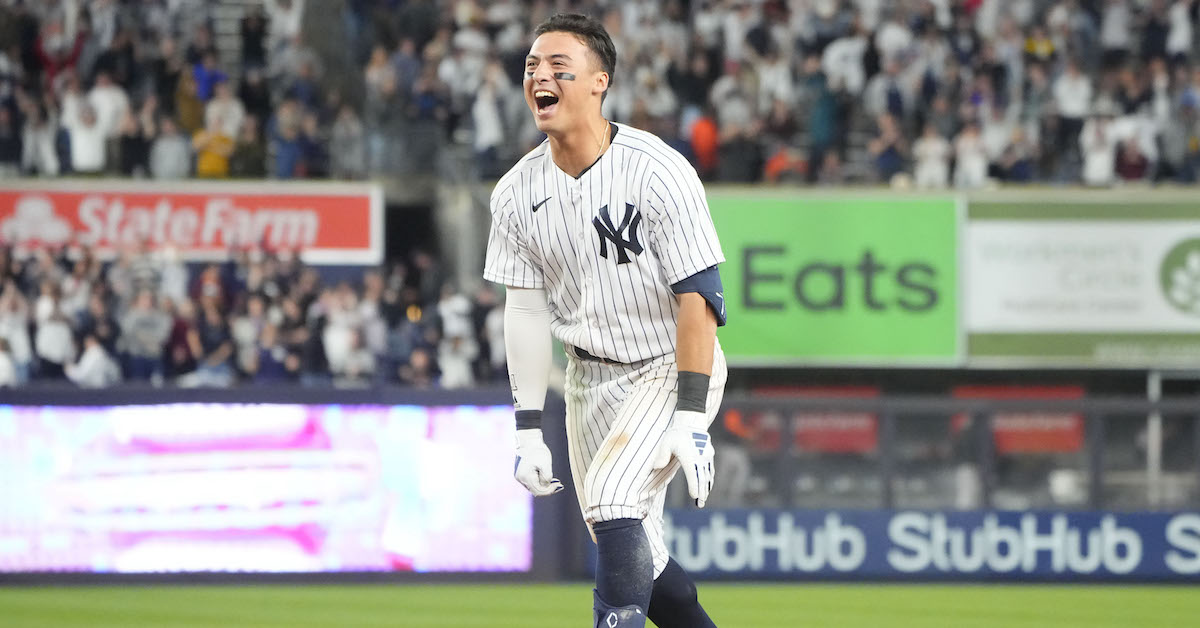
Elly De La Cruz is a common breakout pick for obvious reasons, but I’m including him here specifically because his plate discipline wasn’t as bad as it looks from the raw stats. ZiPS actually thought, from his plate discipline data, that his strikeout rate should have been more like 27% instead of nearly 34%, enough to knock off 27 strikeouts. And given that he should be a high BABIP player, because he was the fastest man in baseball last year, putting more balls in play would benefit him more than it would most players. Overall, his zStats line last year was .273/.323/.449, compared to his actual line of .235/.300/.410, meaning the holes in his game aren’t quite as deep as his reputation would suggest.

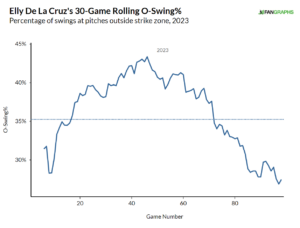
And if you don’t buy that, he did show better plate discipline as the season progressed. I’ll again warn of the dangers of storylines that coincide with splits, but things like offensive swing percentage stabilize very quickly, mitigating some of the sample size issues. I don’t think it’s a stretch to look at the graph below and conclude that De La Cruz got caught up in the hype of his initial success and became too aggressive. As a result, he started struggling before coming to realize that he had gotten away from the approach that made him such a dynamic player in the first place.

Dominic Canzone, Seattle Mariners
One should be suspicious of Pacific Coast League stats, but Dominic Canzone’s .354/.431/.634 line last year was good even by PCL standards, enough for a 151 wRC+ in the league. However, that success didn’t follow him to the majors. He probably doesn’t have a lot of upside, but the rate of his improvement over the last couple of years suggests that there’s a chance he could have a nice little Geronimo Berroa-esque run.

Tucupita Marcano, San Diego Padres
This one is kind of a stretch because I don’t see an obvious path for Tucupita Marcano to get much playing time. He hasn’t hit at all in the majors yet, but he’s also had a weird minor league career; he’s still just coming off his age-23 season and has made some progress at translating his minor league plate discipline to the majors. ZiPS isn’t in on him, but Steamer is, and if he can managed his 94 wRC+ Steamer projection, along with a decent glove (though more at second base than short) and his speed, he’ll at least be interesting. Gotta have one out there pick, no?

The Busts

Cody Bellinger, Chicago Cubs
I don’t think Cody Bellinger will fall anywhere near the depths of his brutal 2021 season, but there are reasons to be suspicious of last year’s resurgence. He changed some of his mechanics and altered his approach, especially in two-strike counts, to make more contact, and those adjustments should be sustainable. It’s the power numbers that are a bit preposterous, to the degree I can’t think of any comparable player who managed to maintain this amount of power with mediocre-at-best exit velocity numbers. Statcast’s expected slugging percentage knocks 88 points off his actual one, and the ZiPS version (zSLG) is 20 points meaner than that.

J.T. Realmuto, Philadelphia Phillies
This one hurts, especially for a player ZiPS was so excited about in 2015-2016 before his breakout. But the decline in J.T. Realmuto’s offensive numbers in 2023 is supported by the drop in his peripheral numbers; he was just a bit worse at everything last year. He’s also a catcher entering his mid 30s. This is a gut thing more than a projection thing, but I suspect any kind of a leg injury would be a bigger deal for a surprisingly quick player like Realmuto, whose offensive stats already reflect his speed, than for your typical catcher.

Isaac Paredes, Tampa Bay Rays
Isaac Paredes is a good hitter, but is he really a 140 wRC+ guy? In both Statcast and ZiPS, Paredes had an even larger disparity between his actual power numbers and his peripherals than Bellinger. That said, there’s some good news, because unlike Bellinger, Paredes has done this before. There were 20 hitters in 2022 that hit at least five more homers than zHR expected, and 18 of them went on to hit fewer home runs in 2023. Paredes was one of the two who hit more (the other was Pete Alonso). Because Paredes has such a low hard-hit percentage, I’m not completely on board yet.

Lane Thomas, Washington Nationals
One thing about Cinderella stories is that people tend to overrate them after the ball. Most of these stories don’t involve permanent stardom; Joey Meneses and Frank Schwindel are two example of people getting too excited about an older breakout guy. Unlike Schwindel, Lane Thomas is probably still a league-average player, on the level of his 2021 and 2022 seasons, but I’d be shocked to see him hit 30 homers again. He’s probably a stopgap center fielder/fourth outfielder type, and I’m seeing him surprisingly high in some fantasy rankings.

Dominic Fletcher, Chicago White Sox
I was pretty shocked to see the White Sox trade Cristian Mena for Dominic Fletcher, even with the assumption that ZiPS is being too exuberant about Mena in ranking him at the back of the top 50 prospects. If you evaluate him the way our prospect team does, a fourth outfielder for a 45 FV prospect is quite a rich gain. And it’s looking like the Sox will give Fletcher a pretty good chance at getting the majority of the playing time in right field. It’s not as bad as the team’s irrational excitement about Oscar Colás last year, but there’s just not a lot of support for Fletcher’s maintaining his .301/.350/.441 line from his brief stint in the majors. That’s ridiculously higher than his zStats slash line of .249/.290/.376, which works out to a difference of 125 OPS points.


Player’s View: What Is/Was Your Other Top Sport?

Bill Streicher-USA TODAY Sports

Almost all professional baseball players played at least one other sport growing up. Moreover, many of them were athletically gifted at a young age and thus excelled against their school-age contemporaries in their formative years, often all the way through high school. Fast forward to today, and many continue to play other sports in a recreational capacity — golf is prominent — especially in the offseason.

Watching other sports is also popular activity for ballplayers. Much as they tuned in to see their favorites on the family TV, they now do so as adults. Like the rest of us, they enjoy sitting on their couches, or hanging out with friends at sports bars, rooting for successful shots, goals, and touchdowns. Temporarily apart from the game they get paid to play, they get to be fans.

With those things in mind, I asked a dozen players about their “other” sport. Besides baseball, what did they most enjoy playing, and what do they now most enjoy watching?

———

Dansby Swanson, Chicago Cubs shortstop: “Basketball. I was pretty good. I could really shoot. My basketball game was somewhat similar to my baseball game. I kind of did the right things. I knew what to do. I knew where to go. I averaged around 15 points in high school. It was [a big school]. We had over 2,000 kids. There are a lot of big schools in Georgia.

“I grew up in very much a sports family. I love watching all sports, honestly. I love watching football. I love watching basketball. Obviously, I watch a lot of soccer; I watch my wife [Mallory Swanson, who plays for the Chicago Red Stars and the U.S. Women’s National Team]. Golf is on the TV. An underrated sport to watch is tennis. I have sports on TV all the time.”

———

Mike Trout, Los Angeles Angels center fielder: “I played basketball and football throughout high school. I’d probably say that basketball was my best other sport. I was a small forward and an OK player. Read the rest of this entry »


Patrick Bailey Is a Unicorn Pitch Framer

Stan Szeto-USA TODAY Sports

There are so many great defenders in the majors right now. In the infield, there are elite shortstops, like Francisco Lindor and Dansby Swanson. In the outfield, there are the dudes who don’t let anything drop, such as Brenton Doyle and Harrison Bader. But none of these players are projected to lead baseball in Def, according to ZiPS. That title belongs to San Francisco Giants catcher Patrick Bailey.

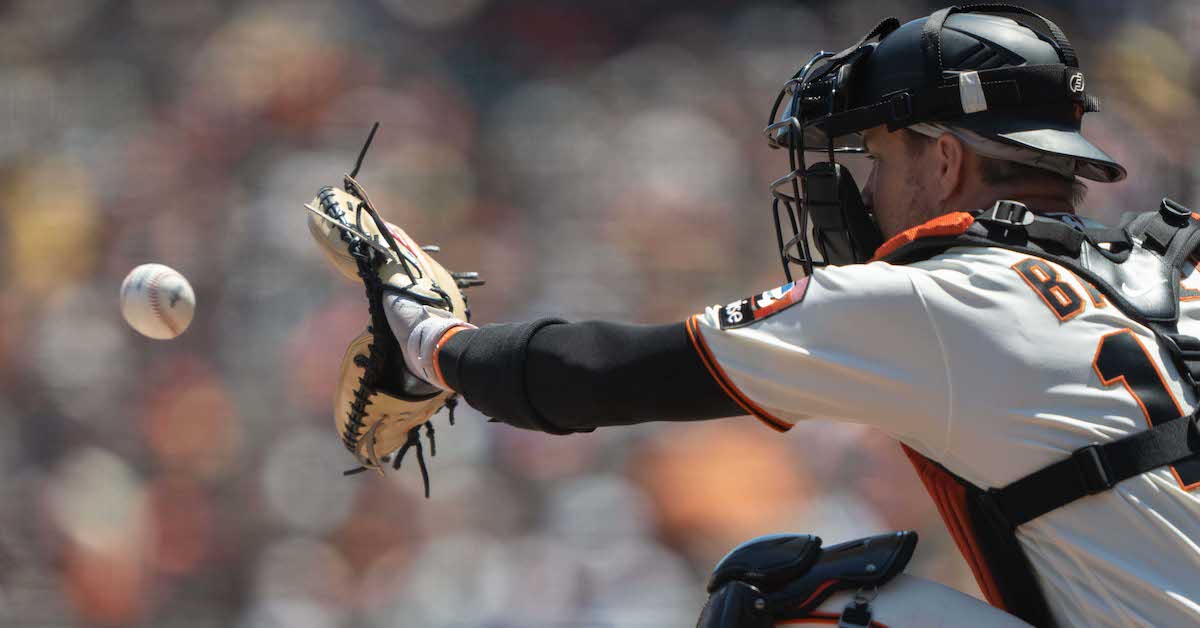
Last year, Bailey led all players in Def with 26.8 runs. On the Statcast side of things, he was second in Fielding Run Value with +18, behind Doyle. He is unquestionably one of the most valuable defenders in the game, and much of that is due to his elite framing. He accumulated +16 framing runs and recorded a 52.9% strike rate – both the highest marks in baseball.

If you look at the Statcast framing leaderboard, you’ll notice one color for Bailey: red. He is above average in all nine parts of the shadow zone. That is simply unheard of. Typically, for catchers to be elite in one area, they tend to sacrifice another part of the zone. Take Adley Rutschman, for example. He is elite at the top of the zone but slightly below average at the bottom. Sean Murphy has the opposite tendency. He steals at the bottom while losing some at the top. Bailey is a departure from the norm. He can steal strikes in any part of the zone without sacrificing elsewhere.

That’s an impressive skill that made Bailey stand out last season. It’s also the exact kind of statistical quirk that warrants a video deep dive to uncover how he does it. Before jumping in, let’s discuss the two things we’ll be paying attention to here: Bailey’s pre-pitch stances and glove turns. To be this efficient around the strike zone, catchers not only have to have multiple stances, but they also have to know when to use them. By understanding their pitching staff and their movement profiles, they know when to deploy what stance and how to best use their hands.

The following clips will display how Bailey switches up his approach depending on the pitcher and/or location. Let’s start with Logan Webb – the sinkerballer and command artist:

Sinker

Where Bailey sets up behind the plate dictates his stance. He favors his inside knee down most of the time, but there is some variance depending on the pitcher and pitch. More so than when he is catching other pitchers, he has no problem setting up closer to the edges of the plate for Webb.

The key difference between the two sinkers is how he uses his glove turn in preparation for the pitch. On the arm side sinker, he uses more of a straight down quarter turn. Whereas with the glove side sinker, you’ll notice a more deliberate rounded turn. As a catcher, matching the plane of the pitch leads to the smoothest reception. If you don’t alter the rotation of your glove as you catch the ball, it appears as natural as possible to the umpire, resulting in a better chance at a strike call. Bailey has a perfect understanding of this, which can also be seen when he receives sliders:

Slider

On the arm side, it’s pretty standard. The glove side is where the quarter turn sticks out. Pushing a breaking ball back toward the middle of the plate can often look forced. But if a catcher is already tracing that movement before he receives the ball, it appears natural and can lead to stolen strike calls. Additionally, Bailey’s ability to switch which leg is down lets him be as loose as possible with his movements after the pitch is released. This allows him to smoothly shift his positioning to ensure that he catches the pitch closer to the center of his body, which makes it look more like a strike to the umpire.

While the one-knee catching stance has swept through the league, it’s still not common for catchers to switch from knee to knee as often as Bailey does. It puts him in a better position to handle pitches coming in from different angles. When a catcher has his inside knee up, that leg can sometimes make it difficult for him to reach across his body. Since Bailey almost always has his inside knee down for horizontal moving pitches, that’s not a concern. But there are some situations in which Bailey will alter this approach, such as when Webb throws his changeup:

Changeup

He switched from his typical stance, with his outside knee up, when catching the changeup with the lefty-hitting Jonah Heim at the plate. Bailey is most likely more comfortable putting his right knee up when Webb throws his changeup because that pitch doesn’t get much horizontal movement, and his glove turn probably feels more natural when he has space on his glove side. However, he is forced to switch his stance when there is a runner on first and second base is vacant because he can’t make throws with his left knee down. But that isn’t an issue for him, because he is comfortable flipping his stance.

Now, let’s see how Bailey handles Camilo Doval, whose arsenal — 100 mph rising cutters, 98 mph sinkers, 90 mph sliders — is completely different than Webb’s repertoire. Bailey knows that, so he takes a slightly different approach:

There are a few things to note here. First, Bailey gets in a lower stance with the slider coming and a runner on third, which puts him in a better position to block anything in the dirt. His low glove turn also prepares him to either flip his mitt over to get into a blocking stance or quickly shift it for a backhand pick. With high velocity sliders, a pick can often be more effective than a traditional chest block because there isn’t much time for a catcher to drop to his knees and get in front of the pitch. Meanwhile, Bailey hardly moves his glove in preparation for the cutter. Doval probably needs the high target for a visual marker, and an exaggerated glove turn isn’t needed for high pitches anyways.

Watching Bailey handle all types of high pitches is one of his best skills as a framer. No matter if it’s a heater or breaker, he knows when to attack pitches and when to be more patient. Doval’s cutter is one example of that, but the way he receives high sinkers and high sweepers perfectly displays that dichotomy:

Sinkers

Sweepers

Since Bailey sets up on the edges, it’s important his glove gets to the spot where the sinkers are going before they arrive, so long as that location is within the width of his shoulders. Anything outside of his frame will clearly look like a ball to an umpire, and the whole point of framing is to be inconspicuous. So when he’s expecting a backdoor sinker from Taylor Rogers (top left), he receives the pitch in the middle of his body while slightly pointing his shoulders toward the batter, Corbin Carroll. The pitch was out of the zone but appeared right on the edge because of how Bailey presented it. On the pitch from Alex Wood (top right), Bailey knows to keep his posture high and eyes over the squared bunt. That lets him beat the pitch from going too far out of the zone while giving the umpire a clear look at it. It was a great mid-pitch adjustment that led to another strike on a borderline pitch.

His approach to sweepers is much more patient. This is a pitch that will keep moving as long as the catcher lets it. If it starts out of the zone, letting it travel as much as possible gives it a better chance to scratch the edge of the plate. Even if the pitch passes the plate out of the zone – like against Randal Grichuk (bottom left) – the catcher can let it get deep enough so that it still looks like a strike when he catches it behind the plate. This is a good time to refocus on Bailey’s stances. It’s more difficult for a catcher to let these pitches travel with his leg or knee in the way. Keeping the inside knee down lets him adjust his upper body as needed while giving his arm the space it needs to move freely. The more space for smooth movement, the better prepared he is to let the pitch get deeper into the zone.

It’s hard to consistently do what Bailey does when it comes to switching stances. Not all players have the mobility on both sides of their body. On top of that, Bailey demonstrates an advanced understanding of pitch movement and matching planes with glove turns no matter who is one the mound. It’s the full pitch framing package. With a full season of work, I’m excited to see how much defensive value Bailey can bring. We could be in store for one of the best defensive seasons in recent memory.


Sunday Notes: Orioles Prospect Coby Mayo Continues To Mash

Coby Mayo is No. 23 on our Top 100, and a power-packed stroke is a big reason why. Drafted by the Baltimore Orioles out of Parkland, Florida’s Stoneman Douglas High School in 2020, the 6-foot-5, 230-pound third baseman is coming off of a 2023 season where he bashed 29 home runs while logging a 156 wRC+ between Double-A Bowie and Triple-A Norfolk. Moreover, he did so as a 21-year-old.

His maturation as a hitter has been more nuanced than pronounced. When I talked to Mayo in March 2022, he told me that he doesn’t “like to think about hitting too much,” and has “always been a see-ball-hit-ball kind of guy.” For the most part, that hasn’t really changed.

“I try not to think too much when I get into the box,” Mayo said when reminded of those words. “That’s stayed the same. A lot of people will get into the box and start overthinking. They’ll try to manipulate their swings here and there. I just try to have a good approach, a game plan, and kind of let that take over.”

The promising slugger does feel like he has a better understanding of his swing than he did two years ago. When things are going well, he knows what he’s doing right. When things are going wrong, he understands why and can adjust accordingly. The swing itself has changed since we first spoke. Mayo explained that his load, hand placement, and bat path are all “a little bit different” — albeit in a subtle manner. As he put it, “You can’t really notice them with the naked eye.” Creating more loft and allowing him to better use the entire field have been the goals behind the tweaks.

One thing that hasn’t changed is what our lead prospect analyst Eric Longenhagen has descried as a “sometimes ugly looking cut, which has a strange, choppy stride… an odd look, but it works for him.” Read the rest of this entry »


Effectively Wild Episode 2134: Season Preview Series: Orioles and Giants

EWFI
Ben Lindbergh and Meg Rowley banter about the A’s Las Vegas ballpark renderings, Brayan Bello’s extension with the Red Sox, and MLB’s Spring Breakout games, provide an update on EW listeners’ MLB ballpark meetup events, then preview the 2024 Baltimore Orioles (28:59) with The Baltimore Banner’s Danielle Allentuck, and the 2024 San Francisco Giants (1:04:38) with The Athletic’s Grant Brisbee.

Audio intro: Harold Walker, “Effectively Wild Theme”
Audio interstitial 1: Liz Panella, “Effectively Wild Theme”
Audio interstitial 2: Ian H., “Effectively Wild Theme”
Audio outro: Alex Glossman and Ali Breneman, “Effectively Wild Theme”

A’s ballpark link 1
A’s ballpark link 2
A’s ballpark link 3
A’s ballpark link 4
A’s ballpark link 5
A’s ballpark link 6
A’s ballpark link 7
A’s ballpark link 8
Link to past renderings
Link to Rooker tweet
Link to Sphere story
Link to MLBTR on Bello
Link to MLBTR on Giolito
Link to Spring Breakout site
Link to Spring Breakout promo
Link to EW Episode 2111
Link to ballpark meetup forms
Link to meetup organizer form
Link to non-socializing
Link to Orioles offseason tracker
Link to Orioles depth chart
Link to MASN story
Link to Angelos story
Link to Sheehan on Kimbrel
Link to team injury days
Link to Ben on the O’s
Link to Danielle’s Banner archive
Link to Giants offseason tracker
Link to Giants depth chart
Link to Neil Paine post
Link to Baumann’s OF blog
Link to Kyle’s IF blog
Link to Kapler and Hoby
Link to story on Giants coaches
Link to Baggarly on the anthem
Link to post-Bonds LF streak
Link to Grant on trades
Link to story on Crawford
Link to Farhan story
Link to Grant’s record collection
Link to Grant’s Athletic archive

 Sponsor Us on Patreon
 Facebook Group
 Twitter Account
 EW Subreddit
 Effectively Wild Wiki
 iTunes Feed (Please rate and review us!)
 Get Our Merch!
 Email Us: podcast@fangraphs.com

1:49:38