Ed Szczepanski-USA TODAY Sports
The Oakland-for-now Athletics had themselves a roster shuffle on Friday, bolstering their pitching staff by adding right-hander Ross Stripling and officially announcing the addition of lefty Alex Wood. Wood joined the A’s on a one-year contract worth $8.5 million (with another million’s worth of incentives) after three years with the Giants. Now Stripling, too, is headed east across the bay, in a deal sending minor league outfielder Jonah Cox west to San Francisco (To make room for the pair, Oakland outrighted lefty Francisco Pérez and designated infielder Jonah Bride for assignment).
Wood and Stripling, who might have said something like “It’s not goodbye; it’s see you later” while packing up their lockers after the 2023 season, will be teammates for the fourth separate stint on three different California teams. They spent from 2016 to 2018 together on the Dodgers before Wood was dealt to the Reds, were reunited back in Los Angeles for the start of the pandemic-shortened 2020 season until Stripling was traded to Toronto, and then signed nearly identical two-year, $25 million free agent contracts with San Francisco a year apart from one another. Now, they’ll pair up again in Oakland and figure to factor into a starting rotation that was worth a league-worst combined 1.8 WAR in last season.
Both pitchers were available at a modest cost to the A’s after floundering in their only year together with the Giants. As Kyle Kishimoto wrote last week, Wood struggled to get hitters to swing at bad pitches and to miss whenever they did swing, falling to the 13th percentile in chase percentage and the 17th in whiff percentage. As a result, he struck out a lot fewer hitters and walked a whole bunch more. He also failed to stay healthy, with strains in his left hamstring and lower back sidelining him for the bulk of two months, and by late July, he was relegated to bullpen work as a sort of piggybacker and long relief option. He pitched better in this role, but it was far from what he and the Giants had hoped for when he signed his deal before the 2022 season. Still, Wood brings 10 years of big league service and a not-too-shabby 18.1 career WAR to Oakland, where he’ll try to right the ship. Read the rest of this entry »
David Bednar was an unproven San Diego Padres pitcher when he was first featured here at FanGraphs in March 2020. The burly right-hander had made just 13 big-league appearances, all in the previous season when he’d allowed eight runs in 11 innings of undistinguished work. A 35th-round draft pick four years prior, he’d been lightly regarded as a prospect.
Fast forwarding to today, Bednar is one of the most dominant closers in the game. Now pitching for his hometown Pittsburgh Pirates, the hard-throwing hurler is coming off of an All-Star season where he logged 39 saves, a 2.00 ERA, and a 2.53 FIP. Since being acquired in a three-deal in January 2021, he boasts a 2.25 ERA and a 2.56 FIP, as well as a hefty 31.2% strikeout rate.
How has the 6-foot-1, 250-pound reliever evolved since we first spoke? I asked him that question when the Bucs visited Wrigley Field in late September.
“I’m able to command all three of my pitches in the zone better,” said Bednar. “I also have a better idea of where my misses are. Another big thing is having the confidence to trust my stuff in the zone. I know it sounds redundant, but I’m just competing in the zone. When I attack guys and keep all of my lanes the same, good things happen.”
Bednar feels that his raw stuff is much the same as what it was before his breakthrough. Along with the aforementioned strides, how he sequences has gone a long way toward his success. A former teammate played a big role. Read the rest of this entry »
Brad Rempel-USA TODAY Sports
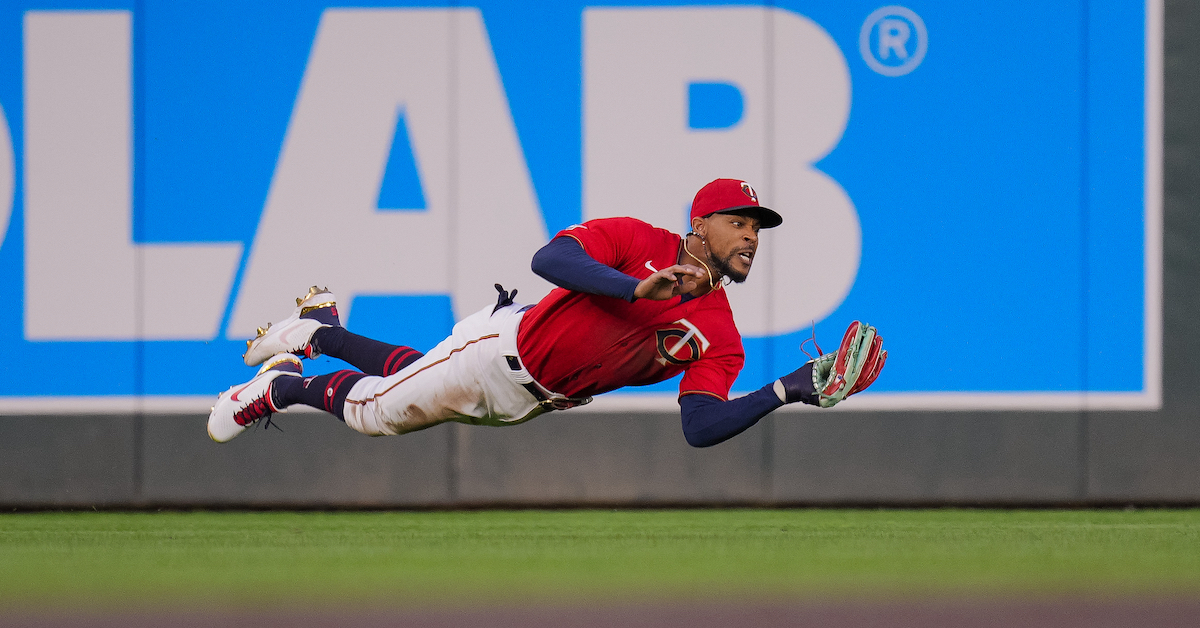
In a more just world — in a world without injury — Byron Buxton would need a lot more shelf space in his home. A five-tool player with a name that sounds like it should belong to a superhero, Buxton was drafted second overall in 2012, spent some time as our number one prospect, debuted at age 21, and went on to average nearly 4.6 WAR per 162 games. By all rights, he should have spent his 20s challenging Mike Trout and Shohei Ohtani to a game of hot potato with the American League MVP trophy. He should be on magazine covers. He should be a worldwide megastar nicknamed Lord Byron.
Instead, Buxton is a one-time All-Star who owns a Gold Glove, a Platinum Glove, and a Wilson Overall Defensive Player of the Year, all three awarded in 2017. He’s never finished better than 16th in the MVP race. You know the reason for this as well as I do. Buxton has never put up 4.6 WAR in a season because he’s never come close to playing in 162 games in one. He’s surpassed 92 games just once and he’s qualified for the batting title just once: in 2017, the year of the glove-shaped trophies. Over the nine seasons of his career, Buxton has played in roughly 4.5 seasons worth of games. The injury section of his Baseball Prospectusplayer page borders on some sort of macabre literary pretension, listing a blazon of injuries to his head, face, shoulder, back, ribs, wrist, hand, thumb, finger, hip, groin, hamstring, knee, shin, foot, and toe. There are fractures, hairline fractures, concussions, contusions, lacerations, dislocations, strains, sprains, soreness, inflammation, and tendinitis.
This morose lede is just a preamble though, because Buxton is back. Earlier this week at TwinsFest, he told everyone just that: “Oh yeah. I’m back.” After undergoing offseason surgery to excise a plica from his right knee, he is ready to play center field for the first time since 2022. “What makes me so sure? My body tells me that,” Buxton said. This is wonderful news. Anyone who loves baseball is rooting for him to get a shot at a full, fully healthy season. Anyone who loves baseball is excited to watch him roam center field once again, a human being so perfectly suited to that environment and the task before him that you can’t help but feel for just a moment like maybe the whole world makes sense after all.
Anyone who loves baseball is also tempering their expectations. Buxton is 30 and coming off a second straight season that ended with knee surgery. His offseason routine right now is equal parts physical therapy and baseball activities. The Twins have been honest about the fact that “back” might not mean exactly what we might want it to mean. They’re hoping that Buxton will be able to play 80 games in center field. For his part, Buxton chose not to put a number on it. “My body will tell me that,” he said.
Bodies are the worst. What the hell are you supposed to do with your hands? The same body that gives you the coordination and grace to play the game in such a way that it transcends the realm of sport and becomes art can then decide to break down frequently — so frequently that the fleeting chance to perform on that plane of existence serves as nothing more than a wistful reminder of what could have been.
How much health is a person entitled to? Everyone on earth has had their life limited to some degree by their health, and everyone knows people who have had it much worse. Injuries are a part of sports and a part of life. No one deserves to be injured, or to feel sick. In a more merciful world, we would all live healthy lives, achieving our potential (or not achieving it for all the other reasons that we don’t achieve our potential), and then one day the grim reaper would give us a friendly tap on the pristine shoulder and ask us to follow him, please.
It gets weirder when you’re a talent like Buxton. It’s his life, and he must be acutely aware of how differently things could have gone, of how much more he had to offer over the last nine years. But the rest of the baseball world feels robbed too, both on his behalf and on our own. We want to see his greatness for ourselves and for baseball as a whole.
How much health is a ballplayer entitled to? With the exception of Cal Ripken Jr., every baseball player alive could argue that they would have had a lot more to offer the game if only their body would have cooperated.
Buxton, though, is a different, more extreme case. Keep in mind that his 19.0 WAR during his nine major league seasons rank 60th among all position players. Keep in mind that every single one of the 59 players ahead of him has played in more games than his 670 in that span. (Ronald Acuña Jr. has the next fewest games played in the group, at 673, but he debuted three years after Buxton and has recorded 545 more plate appearances.) Keep in mind that 39 of those 59 players have made at least 1,000 more plate appearances than Buxton’s 2,487. Keep in mind that even when he has been on the field, Buxton hasn’t been at 100% all that often. Keep in mind that despite that fact, on a per-game basis, Buxton has been more valuable than 31 of those 59 players.
In 2023, battling through a rib injury, patella tendinitis, and a hamstring strain that combined to limit him to 85 games, Buxton ran a 98 wRC+. It was his worst offensive performance since 2018, when he played in just 28 games. Buxton was more aggressive on pitches in the zone and he made more contact, but that didn’t stop his strikeout rate from rising by a percentage point. His average exit velocity fell last year, and his EV50 (the average of the top 50% of his hardest hit balls, which Baseball Savant formerly referred to as best speed) has dropped in each of the past three seasons, from 104.7 mph to 103.8 to 102.5.
Even so, there were positive signs last season, too. His sprint speed was still a nearly elite 29.3 mph. He was still worth 4.8 runs on the bases, tied for 29th best in baseball among players with at least 300 plate appearances and his highest total since 2017. Although his power was down overall, Buxton was still capable of top-end exit velocity. He ripped three of the four hardest-hit balls of his career in 2023. That includes a career-high 116.9 mph double on Aug. 1, his last regular season game of the season.
Buxton has also made it clear that he’ll be more comfortable when he’s playing on both sides of the ball again. “I’m 29, I’m DHing, and I know I’m not supposed to be DHing,” Buxton said at TwinsFest. “You’re not buying into DH.” There’s bias in these numbers, because Buxton was usually relegated to DH when he wasn’t healthy enough to play the field, but since 2019, he has a 111 wRC+ as a DH and a 136 wRC+ as a center fielder. “What excites me? I’m going back to center,” he said. “As simple as that. Nothing makes me happier than playing the outfield.” He’s not alone. The Twins have been encouraged by videos of Buxton’s progress, seeing him move better than he has in years, watching him get into his legs at the plate and make the thunderous contact that he’s capable of making.
One of the joys of sports is that we get to witness greatness. Somewhere out there, at every human pursuit, someone is the best. If you’re one of the greatest accountants in the world, that gift will probably allow you to carve out a nice life for yourself, maybe even a luxurious one. But your gift will likely go unrecognized to some degree. How exactly do you judge that someone is the best in the world at accountancy? In sports, greatness shows up in the numbers, but it’s often obvious. It knocks you over the head. It’s miraculous to behold. Sometimes you see Shohei Ohtani at the plate, looking completely fooled by a pitch yet still able to reach flick it over fence, and you can’t help but laugh, because no other reaction seems appropriate. Buxton, too, is that type of player when he is on the field.
It would be truly magical to see Buxton at his best, and best health, for a whole season. He certainly deserves the chance. The rest of us will be hoping he gets that chance, too. But at the same time, we should not confuse hope with expectation. The sanguine quotes may have gotten the headlines, but Buxton gave another that summed up the situation a little more completely. “It’s different, I can feel it. It feels good,” he said. “Things feel back to … as close to normal as it’s going to get. You take the positive and run with it.”
Under John Angelos, son of Peter Angelos, who took the team to the verge of the World Series in the 1990s, the Baltimore Orioles have been hamstrung by a lack of investment, uncertainty over potential relocation, and a lawsuit over control of the family fortune that contains allegations straight out of the Book of Genesis. A 100-win team with a once-in-a-generation core of up-the-middle talent has had its wings clipped by an owner whose picture should be on the Wikipedia page for Hanlon’s Razor.
Well, the O’s are finally getting out of purgatory. Angelos has agreed to sell the team to a group fronted by billionaire David Rubenstein. The new owners will reportedly purchase 40% of the team now, with Rubenstein replacing John Angelos as the Orioles’ control person once the sale goes through. His group will then have the option to buy full control at a later date.
Late last night, the Milwaukee Brewers sent Corbin Burnes to the Baltimore Orioles for two 25-year-old players – left-handed pitcher DL Hall and infielder Joey Ortiz – as well as a Competitive Balance Round A pick in the 2024 draft (pick no. 34 overall). Milwaukee’s active roster is worse today without Burnes, who has been one of the best pitchers in baseball since moving into the rotation full-time in 2021. But the player portion of return for one year of Burnes, who is slated to hit free agency after the season, succeeds in threading the small market needle by providing both short- and long-term reinforcement to the big league club, as both players are major league ready and also under club control for the next six seasons. Burnes was unlikely to re-sign with Milwaukee, and the Brewers get a comp pick similar to the one they would have received had they extended him a qualifying offer after the 2024 season, plus two good, young players.
Let’s talk about those players, starting with Ortiz. A fourth rounder in 2019, Ortiz has a career .286/.357/.449 line in the minors and reached the big leagues in 2023. With so many other infielders, chiefly Gunnar Henderson and Jackson Holliday, also in the upper-level mix for playing time, the Orioles had a surplus of players like this in their system. Ortiz was a top 100 prospect last offseason and ended the 2023 season as my 57th overall prospect. His profile was initially rooted in his plus combination of defense and feel for contact, but in 2023, he traded some of that contact for meaningfully more power. Ortiz’s underlying contact quality took a leap across the board, most notably his hard-hit rate, which rose from 31% in 2022 to 46% in 2023. This was coupled with a noticeable shift in his physicality, as Ortiz looked bigger and stronger. Ortiz’s contact rates, both overall and in-zone, dropped a tad compared to 2022 and he’s a bit chase-prone, but his well-rounded offensive output should clear the relatively low bar for middle infielders. Read the rest of this entry »
Anne-Marie Caruso/NorthJersey.com/ USA TODAY NETWORK
Below is an evaluation of the prospects in the New York Mets farm system who readers should consider “imminent big leaguers,” players who might reasonably be expected to play in the majors at some point this year. This includes all prospects on the 40-man roster as well as those who have already established themselves in the upper levels of the minors but aren’t yet rostered. I tend to be more inclusive with pitchers and players at premium defensive positions since their timelines are usually the ones accelerated by injuries and scarcity. Any Top 100 prospects, regardless of their ETA, are also included on this list. Reports, tool grades, and scouting information for all of the prospects below can also be found on The Board.
You may be able to infer that is not a top-to-bottom evaluation of the Mets farm system. I like to include what’s happening in minor league and extended spring training in my reports as much as possible, since scouting high concentrations of players in Arizona and Florida allows me to incorporate real-time, first-person information into the org lists. In the Mets case, I’ll be heading to Florida in April for extended spring training to complete the entire list. Skimming the imminent big leaguers off the top of a farm system in the meantime allows time-sensitive information to make its way onto the site more quickly, better preparing readers for the upcoming season, helping fantasy players as they draft, and building site literature on relevant prospects to facilitate transaction analysis in the event that trades or injuries foist these players into major league roles. There will still be a full Mets prospect list that includes Ryan Clifford, Marco Vargas and all of the other prospects in the system who aren’t Top 100 guys and also appear to be at least another whole season away. As such, today’s list includes no ordinal rankings. Readers are instead encouraged to focus on the players’ Future Value (FV) grades. Read the rest of this entry »
It just didn’t make sense. There was no way that the Orioles were really planning on heading into the 2024 season with so little top-end pitching. I’m not saying Kyle Bradish, Grayson Rodriguez, and company are bad, but they were on the lighter side of potential playoff rotations, and that made very little sense to me given the composition of the rest of the team. It’s not every day that I take a team to task for something they didn’t do, but this one was just too illogical.
Vincent Carchietta-USA TODAY Sports
The San Diego Padres are falling apart a little, having divested themselves this winter of Juan Soto, Trent Grisham, Josh Hader, and (most likely) Blake Snell. But reinforcements are on the way, in the shape of Wandy Peralta, who on Wednesday agreed to a four-year, $16.5 million contract. Peralta might be the second-best active pitcher named Peralta, and the second-best left-handed pitcher in baseball history named Wandy, but he’s still a good reliever.
Peralta made 165 appearances over two and a half seasons with the Yankees, with a cumulative ERA of 2.82 despite pedestrian strikeout numbers. But in the age of heavy metal fastballs and sliders, Peralta is a little more refined and subtle. His most common pitch is a changeup, which is useful against lefties as well as righties, and it’s hard to square up. Read the rest of this entry »
Jayne Kamin-Oncea-USA TODAY Sports
A lot of my thoughts on hitting are rooted in my own experiences playing, for better or for worse. When I was in school playing ball, I was constantly working through a particular mechanical issue. Traditionally, it is called “getting stuck on the back side,” but I always said I got stuck on a pedestal. When I got to the highest point of my leg kick (which was moderately high), I sometimes transferred too much of my weight over my back foot – it was a swing path killer. Because of my extensive experience with it, I’ve always been keen on identifying hitters who have a similar issue.
Rotational movements like hitting and pitching have linear components, but hitters need to do more than just move on the coronal plane (from left to right or right to left) in order to have a deep entry into the hitting zone. A hitter has to rotate with his hips and/or spine while moving along that linear plane to create rotational power and an ideal bat path. In the case of pedestal hitters, they reach their peak leg lift while sometimes neglecting those other aspects of movement.
Take Will Smith, for example. He uses a high leg kick to create space in his swing and fell into the pedestal hitting habit during the second half of last season:
October 9th
September 22nd
September 7th
A few hittable pitches in the heart of the zone with no barrels to show for it. On the middle-middle heaters, his path was cut off and he only skimmed the bottom of the ball, rather than hitting it flush. That led to can-of-corn fly balls to right field instead of barreled line drives. This was a persistent issue for Smith throughout 2023 – the worst offensive season of his five-year career and the first with an ISO below .200.
When you transfer too much weight over your back foot, you either get stuck and create a path which leads to lazy fly balls to the opposite field or you fall too heavy on your front side and hit grounders like Smith did against Manaea. You lose depth in your bat path and can’t cover as much of the zone with your barrel. For Smith, that negatively impacted his wOBA on outer third pitches. For the bulk of his career, he has been able to cover those pitches, so this should be something he can fix. To do that, he’ll have to get back to his early 2023 swings where he was balanced and creating space for his bat to work through the zone.
April 30th
Smith is a good enough hitter that he still posted a 119 wRC+ last year despite his mechanical flaw. Not everyone has that much room for error, though. Enrique Hernández has had a wRC+ below 75 in consecutive seasons after running a 109 mark in 2021. Like Smith, he typically relies on a big leg kick to create space, rhythm, and timing in his swing. And while the size of his leg kick fluctuates more than Smith’s, it’s still a key driver in his process. Here are a few swings from 2023 before he was traded to the Dodgers:
April 11th
June 25th
July 2nd
Even if you want to cut Hernández some slack on the high quality changeup from Shane McClanahan, that swing is still a good example of how his lack of balance causes him to land heavily on his lead leg. The heavy landing is even more obvious in his swing against Jesse Scholtens in the second clip. With that swing in particular, his leg kick works straight up and down, which causes him to force a lead hip external rotation.
What do I mean by that? If you’re trying to explode your lead leg open, you would create the counter movement (internal hip rotation) first. That way, you’re creating a reciprocal pattern that leads to smooth external rotation. Staying neutral at the beginning of the swing creates an imbalance, causing the hitter to stand on the pedestal instead of rotating into and then out of it as he swings. Hernández has hyper mobile external rotation, which is seen by his tendency to stride open. To control it, he needs to create sufficient counter rotation with his hips. Unsurprisingly, when he went to Los Angeles, he made a clear change in his leg lift that allowed him to stack his center of mass over his midpoint instead of his back leg. Pay attention to the direction he works his leg kick:
August 19th
September 9th
His leg lift started working on an angle towards his back leg, which allowed him to have a controlled explosion and balanced swing. With the Dodgers, he had a 96 wRC+ – much more in line with his career 94 mark. Yes, it was over a sample of 185 plate appearances, but the movement quality improvement is undeniable.
The last example I’ll use to portray pedestal hitters is Guardians outfielder Steven Kwan. His case is a bit more complicated. In his rookie season, he splashed onto the scene with a 126 wRC+. However, his peripherals suggested there would likely be a regression – his .341 wOBA was considerably higher than his .312 xwOBA. In 2023, those numbers almost completely converged. He had a .313 wOBA and .318 xwOBA. From a mechanical point of view, this wasn’t completely surprising.
His big leg kick is a crucial component of his swing. It keeps him stable, which plays a key role in his great plate discipline. However, the movement also makes him heavily reliant on his hands to do most of the work to get on plane. Given his elite bat-to-ball skills, he can successfully do that more than other players, but he doesn’t have much room for error. If he gets stuck on his back side, his hands can only do so much. If he identifies a pitch too late, even just slightly, then he puts himself in a tough position to make flush contact. Here are a few swings showing that:
July 9th
August 30th
September 22nd
Each of these fastballs were thrown between 96 and 97 mph, but were right down the middle. Kwan couldn’t get his hands on plane despite the hittable locations. This was a trend for him all year. In 2023, he saw 190 four-seamers with a velocity of at least 96 mph and had a .155 wOBA against them. This is another example of why rotational hitters like Kwan, Hernández and Smith need to be on top of their mechanics at all times. Pedestal hitting gives batters even less margin for error than other hitters against high velocity.
Every hitter has his weakness, and for this trio of players, theirs is directly related to how they load with their leg kick. As I watch each of them in 2024, I’ll be looking for any potential adjustments they might have made over the offseason, or might make as the season progresses.
Kirby Lee-USA TODAY Sports
We’ve spent a fair deal of time the past few months discussing the AL West, producers of the past two World Series winners. There’s the reigning champion Rangers constructing a pitching staff built for next October, the always-potent Astros assembling a mega-bullpen to go along with their core of offensive talent, and the Mariners making a whole lot of trade as part of their perpetual roster churn. Each of these three teams won at least 88 games last year, and all three had a shot at the division crown entering the final weekend of the regular season. Their offseason moves reflect their hopes to contend again in 2024.
The same cannot be said for the two other teams in the division. The Angels spent most of the offseason bolstering their bullpen while doing nothing to fill the Ohtani-sized hole in their lineup. The 112-loss Athletics did even less. They signed reliever Trevor Gott, traded for Abraham Toro, and that’s about it. That is, until a few days ago, when Oakland signed lefty Alex Wood and Los Angeles added outfielder Aaron Hicks. The two players improve their new clubs along the margins, but it’s going to take more than them to turn things around.
Alex Wood Moves Across the Bay
Wood, 33, agreed to a one-year deal with Oakland over the weekend, though the terms of the contract have not yet been reported. He began his career as a highly effective starter on the Braves and Dodgers, posting a 3.29 ERA and 3.36 FIP through his first six seasons. Since then, he’s been more up and down. After injuries limited him to nine appearances combined in 2019 and 2020, he took a prove-it deal with the Giants on their miracle 2021 squad, parlaying a bounceback campaign into a two-year, $25 million contract, which didn’t work out as well. Wood had a 4.77 ERA across the two seasons and was nearly replacement level in 2023, looking nothing like the mid-rotation arm he once was.
Wood’s struggles in the first year of his second contract with the Giants were largely the product of batted ball luck; he outperformed his peripherals by about a run and a half. While his numbers in 2023 returned to nearly league-average levels, the under-the-hood numbers took a big turn for the worse. Take a look at his three-year run in San Francisco.
Alex Wood’s Giants Tenure
Season
O-Swing%
K%
BB%
SIERA
2021
32.2%
26.0%
6.7%
3.60
2022
33.5%
23.6%
5.4%
3.45
2023
28.9%
17.2%
9.8%
4.98
The numbers in 2021 and 2022 look remarkably similar, despite a vastly different ERA. But nearly everything fell apart last year. The drop in strikeout rate is significant, but what stands out most to me are the elevated walk rate and plummeting chase rate, signs of a loss in command. Part of the issue may be mechanical; Wood dropped his arm slot significantly upon joining the Giants, and his funky delivery almost resembles a shotput throw rather than a baseball pitch. But between 2022 and 2023, his vertical release point stayed about the same while his arm got about two inches less horizontal extension.
In terms of actual pitch locations, Wood often missed his spots high. I’m not just talking about intentionally-placed flat sinkers; his slider and changeup also had a generally upward drift – not an ideal outcome for someone who uses the lateral action on each of his offerings to induce ground balls. Indeed, last year he had the worst grounder rate of any full season in his career. These frequent misses made it easier for batters to lay off pitches just below the zone, an area where Wood has frequently generated value in the past, leading to a ballooning of his walk rate.
This signing is as much about Wood’s role as it is about his performance. A career starting pitcher, Wood was frustrated last year when the Giants made him a swingman. San Francisco’s decision to break down the traditional roles of starter and reliever gave jobs to rookie arms like Keaton Winn and Tristan Beck, but staff veterans certainly had to adapt to the unorthodox change. Wood averaged less than four innings a game in his dozen starts, while making relief appearances of between one and 15 outs. On one occasion, he tossed four innings and 70 pitches the day after a bullpen session and on short rest from his previous appearance.
Luckily for Wood, the A’s are the perfect team for a veteran to attempt a comeback in a consistent role. He joins fellow low-slot lefty JP Sears as the only members of the projected rotation to ever complete 120 innings in a big league season. The presence of “relative innings eaters” like Sears, Wood, and Paul Blackburn (who has topped at 111 innings) will allow a pair of young arms with big stuff in Luis Medina and Joe Boyle to pitch full seasons in the rotation with minimal risk of being overworked. They’ll also help take the load off Mason Miller, who touches 102 mph and projects as a top-five reliever by Steamer, but has spent the bulk of his professional career on the injured list. With this signing, both sides gain some stability, and if Wood pitches well, the A’s could trade him to a contender before the year is over. In the meantime, though, Wood gets a team willing to give him the ball every fifth day, while Oakland gets a live breathing man willing to pitch on a bleak-looking squad – the smallest of win-wins.
Aaron Hicks Comes to Anaheim
Once an everyday center fielder who received an MVP vote in 2018, Hicks has taken quite the fall from grace in recent years. He signed a seven-year deal worth $70 million with the Yankees after his ’18 campaign, when his combination of solid home run power and a disciplined approach made him a four-win player. But his subsequent issues with injuries and performance have sapped his value, and in May, he was released with nearly three years left on his contract. He played out the rest of 2023 with the Orioles and had a surprising return to form, though he did this in just a 65-game sample and outperformed his expected numbers considerably. The Yankees will now be paying Hicks over $8 million to play for the Angels as he attempts to rebuild his career.
First, there’s the health aspect of things. The season that prompted Hicks’ lengthy extension is, to date, the only time he’s qualified for the batting title, thanks to a laundry list of injuries that have afflicted pretty much every body part there is. These issues have had a considerable impact on his performance, most notably seen in his steady decline in power over the past half decade. Since his best season, his maximum exit velocity has declined by 4 mph, and his barrel and hard-hit rates have cratered. As someone who’s never excelled at spraying line drives, Hicks isn’t able to rely on soft flares that land in front of outfielders.
A switch hitter, Hicks tapped into his power with New York because of his ability to pull the ball in the air, a skill aided by the juiced ball era and Yankee Stadium’s short porch for left-handed hitters. The Yankees as a whole were successful in optimizing the batted ball profiles of many of their hitters, turning DJ LeMahieu and Didi Gregorius into 25-homer threats. During the peak juiced ball years of 2018 and ’19, Hicks hit nearly all of his homers to the pull side, especially taking advantage when stepping into the box as a lefty. Since then, his aerial contact has been considerably weaker. Combine that with a baseball that behaves in line with normal physics, and his entire source of power disappeared. From 2017-19, Hicks homered every 22 plate appearances; that rate has been slashed nearly in half over the past four seasons. Hicks is still likely a near-average hitter, but that value will be exclusively coming from his still-great walk rates, not through homers.
Exit Velocity on Line Drives and Fly Balls
Season
Exit Velocity
2018
93.3
2019
94.6
2020
93.2
2021
94.7
2022
92.1
2023
90.0
SOURCE: Baseball Savant
The addition of Hicks, now 34, complicates the Angels’ outfield situation a bit. They already have two clear everyday outfielders in Mike Trout and Taylor Ward, leaving just one spot and a fraction of DH time for Hicks, Mickey Moniak, and Jo Adell. Even without Hicks in the picture, allocating playing time is still a challenge. On a contending team, it would make sense to set up Moniak and Adell in a power-heavy (and OBP-light) platoon. But the Angels aren’t in such a situation. Rather, they should be prioritizing the out-of-options Adell in their plans, either to build up trade value or to give him a last chance at being a viable everyday player. Now with Hicks, a veteran and known quantity who can also be traded, in the picture, the playing time picture gets squeezed a bit more.
Because of the team’s outfield logjam, Hicks probably won’t see tons of playing time to start the year. But he certainly provides a much-needed insurance policy if things don’t go as planned. He can play center field if Trout gets injured or a corner if Moniak or Adell are waived or traded. And the positional shuffling in the case of an Anthony Rendon injury could open up time at DH for him to fill. Hicks certainly shouldn’t be stealing playing time, but especially at his price point, the Angels will be glad to have him if (or when) things go wrong.