I went to my first game of the season this past weekend: the Yankees hosting the Giants on a beautiful Saturday afternoon in the Bronx. In the bottom of the second inning, Anthony Volpe came up to the plate against Alex Cobb and hit an 0–2 slider into left field for his first career hit, drawing a standing ovation from the folks in attendance.
After his hit, Volpe got to moving on the basepaths. In 2022, he swiped 50 bags over 132 games between Double and Triple-A. The limited pickoffs rule and bigger bases aided him, but like any good base stealer, he took advantage of pitchers with slow deliveries and/or catchers with poor pop times whenever he could. As we’ve learned from the first week of games, the combination of those factors can create an ideal environment for aggressive runners. But there is one thing that Volpe does that makes him different from your normal base stealer: the vault lead. Read the rest of this entry »
Miguel Vargas couldn’t swing. I don’t mean that in the insulting way that little leaguers sometimes do — “hey batter, you’ve got nothing, you can’t even swing.” I mean that he was medically prohibited from swinging. That didn’t stop the Dodgers from playing him this spring, as Davy Andrews detailed for this very site last month. It did mean, however, that he had to watch every pitch thrown to him, ball or strike, and simply take it. Not exactly the way he expected to enter his first spring training with a big league job nailed down, I’m sure.
The pinky finger fracture that kept Vargas from swinging has healed, but you might not know it from his batting line so far this year, because it seems he took that lesson to heart. Five games into his 2022 season, he’s come to the plate 18 times. In nine of those plate appearances, he’s walked. That 50% walk rate is amazing on its own, and I’ll come back to that, but the way he’s gotten to it is downright stunning.
The key to walking a lot is not swinging at bad pitches, and Vargas is doing that to a fault. Per Statcast, he’s swung at four of the 50 pitches he’s seen outside the strike zone in 2023. That’s the best rate in the majors, which is impressive on its own; 205 batters have seen at least 25 pitches outside the strike zone already this season, and every single one of them has swung at them more frequently than Vargas. We’re talking all the various plate discipline geniuses already enshrined in the pantheon of good eye; they’re all looking up at Vargas’ extreme selectivity. Read the rest of this entry »
On Opening Day, when the Braves took the field after batting in the top of the first inning, everyone you’d expect ran out to their usual positions. Well, almost everyone. Taking his position as the starting shortstop was Orlando Arcia, the recipient of a three-year contract extension announced earlier that day. The deal is worth $7.3 million with a club option for a fourth year that includes a $1 million buyout and replaces the previous two-year contract extension he had signed after the 2021 season.
If you hadn’t followed the Braves’ shortstop saga over the offseason, seeing Arcia in the Opening Day lineup might have been a surprise. So let’s recap: Dansby Swanson, the everyday shortstop since his debut in August 2016, played out his final year under team control last year and entered free agency. Atlanta didn’t show much interest in re-signing him once he hit the open market, and he wound up inking a massive seven-year deal with the Cubs.
The heir apparent to Swanson was Vaughn Grissom, who had been called up midseason to fill in for an injured Ozzie Albies even though he hadn’t played above Double-A yet. He impressed with a 165 wRC+ through his first 100 plate appearances in the big leagues, but that mark slid to just 35 over his final 50 trips to the plate. His late swoon was so bad that the Braves ended up benching him in three of their four postseason games. Still, entering spring training, the expectation was that Grissom would get every opportunity to win the job for good.
For his part, Arcia had appeared in just 104 games for the Braves after they acquired him from the Brewers in April 2021. He played four different positions in the infield and outfield, essentially acting as a utility man for Atlanta — a pretty significant step backwards after beginning his career as Milwaukee’s starting shortstop. Through his first five seasons, he put up a .244/.295/.366 slash line (a 71 wRC+) and accumulated 1.9 WAR, and after joining the Braves, he spent a lot of time riding the shuttle between Triple-A and the majors. Still, he did show some improvement at the plate in Gwinnett, posting a 129 wRC+ in 322 PA with his best-ever ISO at .233.
Those improvements at the plate carried over to the next year, where Arcia spent nearly all of his time in the big leagues as the Braves’ utility man. In limited action, he posted a 104 wRC+, a career-high for him. The biggest difference for him was a jump in batted ball quality:
Orlando Arcia, Batted Ball Peripherals
Year
EV
FB+LD EV
Barrel%
Hard Hit%
GB%
ISO
wRC+
2016–20
87.0
91.1
3.3%
30.1%
52.0%
0.121
71
2021
88.2
90.7
3.2%
38.1%
50.8%
0.111
49
2022
90.7
93.7
7.5%
42.5%
45.9%
0.172
104
His hard-hit rate improved by more than four points, up to 42.5%, and his barrel rate reached 7.5%, both career highs. He also cut his popup rate to 5.6% and simultaneously increased his fly ball rate. By elevating his higher quality contact but avoiding mis-hits, he was able to generate much more productive results on his balls in play, with average exit velocities on his fly ball and line drive contact that were particularly notable. Instead of a light-hitting, defense-first shortstop, Arcia’s batted ball contact started looking a lot more dangerous.
His plate discipline also took a big step forward. With the Brewers, Arcia had developed a very aggressive approach at the plate which didn’t go well with his middling bat-to-ball skills. Last year, he reduced his swing rate to 44.7%, a drop of nearly eight points over the year prior, and easily a career low. His contact rate didn’t budge, but simply taking more pitches allowed him to run a 9.0% walk rate and maintain his decent strikeout rate.
Despite those improvements at the plate, it still came as a surprise to see Arcia win the Opening Day gig. Grissom had an excellent spring, and a surprise contender emerged in Braden Shewmake.
Braves Shortstops in Spring Training
Player
PA
H
K%
BB%
OPS
Orlando Arcia
47
14
19.1%
12.8%
1.011
Vaughn Grissom
40
13
10.0%
5.0%
.829
Braden Shewmake
35
10
17.1%
5.7%
.823
There’s only so much stock you can put into spring numbers, though there is some evidence that exit velocity improvements can be a little sticky into the regular season. Unfortunately, based on the limited number of Statcast tracked batted balls, Grissom struggled with the same issues that undercut his seemingly impressive debut last year. In 15 tracked batted balls, his average exit velocity was just 86.5 mph — slightly better than the 84.6 mph he put up in the big leagues last year, but still well below league average. (Arcia only had eight tracked batted balls this spring, but their average exit velocity was 94.2 mph.) The lack of high quality hard contact last year was a major red flag for Grissom, who only managed a 34.3% hard-hit rate and put nearly half of his batted balls on the ground. A lot of his success was BABIP-driven, which is why he crashed so hard in September when balls stopped finding gaps in the defense.
Then there’s the problem of Grissom’s defense. He wasn’t great at second base while filling in for Arcia, costing the Braves five outs and three runs per OAA and RAA. At the more challenging defensive position, it’s likely those numbers would only get worse. Grissom worked out with Ron Washingon, who helped turn Marcus Semien’s defense into a strength, for three separate weeks during the offseason. But while there was some improvement, it wasn’t enough to warrant handing him the job out of the gate.
Shewmake’s emergence may have complicated the picture a little, but he wound up getting sent back to Triple-A for more development time. A decent defender already, the thing holding him back has been his lack of production at the plate. He has a good feel for putting the bat on the ball but no power whatsoever and limited on-base skills. His improvements this spring had coaches buzzing, but ultimately, he needs to prove it in the minors before getting a shot in the big leagues, and his ceiling may be that of a utility infielder anyway. After both Grissom and Shewmake were sent down to the minors, it’s telling that the former lined up at shortstop for Gwinnett, with the latter shifting over to second base.
Despite all this drama surrounding the position this offseason, Grissom could end up being the Braves’ shortstop of the future anyway. The extension Arcia signed doesn’t preclude the Braves from calling up him or Shewmake if they break out in the minors this year. But Arcia is only 28 years old, and it’s possible he’s in the middle of a mid-career breakout after his change of scenery. The improvements he’s made at the plate are a move in the right direction, and his defense is another positive at a premium position. If Grissom does get called up at some point to take the starting role, having Arcia as a utility man isn’t the worst outcome for the Braves.
Once upon a time, a Clayton Kershaw–Madison Bumgarner matchup would have been a sight to behold. But when the two lefties squared off on Saturday evening in Los Angeles, it was a decidedly one-sided affair. Kershaw dominated the Diamondbacks, allowing one run and striking out nine over six innings; Bumgarner, meanwhile, was pummeled for five first-inning runs and lasted just four frames. It was the latest in a long line of disappointing performances since the former Giants ace joined the Diamondbacks.
Bumgarner was on the ropes from the beginning. He served up a double to Mookie Betts on his fifth pitch of the game, hit Max Muncy to load the bases with one out, walked the bases loaded after Chris Taylor’s sacrifice fly scored Betts, and gave up a grand slam to Trayce Thompson, who would later add homers off relievers Kevin Ginkel and Carlos Vargas.
By the time the dust had settled, Bumgarner had thrown 31 pitches and was down 5–0. The 33-year-old lefty did pull himself together enough to follow with three scoreless innings, allowing one baserunner in each, but he finished with four walks and four hits allowed, striking out just two and getting just five swings and misses. Including his 10 called strikes, his 17.6% CSW was his fifth-lowest mark from among his 66 starts as a Diamondback; his low was 15.2% (eight called strikes, two swinging strikes in 66 pitches) in a September 27, 2020 start against the Rockies, in which he at least posted five shutout innings, netting his only win of the pandemic-shortened campaign.
Saturday’s bad news went beyond that meager CSW rate. For one thing, old friend Eno Sarris suggested that Bumgarner and Ginkel were tipping pitches:
Looks like the D-backs were tipping pitches last night against the Dodgers. Some pictures: Kevin Ginkel slider (wrist curl, grass between arms), Kevin Ginkel fastball (no wrist curls, no grass) and Madison Bumgarner letting runner on second see right into his glove. pic.twitter.com/rd2H8C1TAL
Even if that hadn’t been the case, the average velocity of Bumgarner’s pitches was down by nearly two miles per hour relative to last year:
Madison Bumgarner Velocity Comparison, 2022–23
Year
4-Seamer
Cutter
Curveball
Changeup
Slider
2022
91.2
87.4
78.6
85.5
83.3
2023
89.1
85.8
76.7
83.7
84.4
Change
-2.1
-1.6
-1.9
-1.8
+1.1
SOURCE: Baseball Savant
You can safely ignore that positive bump on Bumgarner’s slider, as he threw just one on Saturday. Additionally, the spin on his four-seamer averaged just 2,041 RPM, down 162 from last year and 184 from his final start of the spring, on March 27 against the Guardians. The pitch also got 2.7 inches less horizontal break than last year’s model. The Dodgers didn’t actually do any damage off of Bumgarner’s four-seamer, though hitters last year destroyed it to the point that it was the majors’ second-least valuable pitch according to Statcast:
If all of this sounds like a pitcher who’s Physically Not Right, the thought crossed the minds of the Diamondbacks. On Sunday, the team sent the 33-year-old lefty back to Phoenix to be evaluated by team doctors, with manager Torey Lovullo telling reporters, “Bum was talking about fatigue postgame last night.” More via MLB.com:
“Information was kind of coming in slowly and we just thought it’d be the best thing for him to get back to Phoenix where our doctors can get a look at him. On the urgency scale, I don’t think it’s very high, but it’s all precautionary at this point.”
“There was nothing major from his standpoint,” Lovullo said Saturday night. “It was more just us asking questions and trying to find out if everything is OK. There was looseness to the breaking ball, and things just weren’t consistent. He’s always around the zone, but there were some big misses today. Red flags go up when we see that, our eyes tell us a story, but Bum was OK.”
Bumgarner underwent an MRI that showed no structural damage, and as Lovullo said before Monday night’s game, he’s on track to make his next start, likely Friday against the Dodgers at Chase Field. But even if he’s got the green light physically, that’s a long way from finding reasons to be particularly optimistic about his 2023 chances. The former World Series hero is coming off a season in which he pitched to a 4.88 ERA and 4.85 FIP in 158.2 innings and set full-season lows with his 16% strikeout rate and 9% strikeout-walk differential (he was 0.2 points lower in both categories in 2020). Meanwhile, his 9.8% barrel rate and 42.8% hard-hit rate were both full-season highs for the Statcast era. Though he made 30 starts for just the second time since 2016, his 0.5 WAR was the second-lowest among pitchers with 30 or more starts, ahead of only the Mariners’ Marco Gonzalez (0.1).
Since joining Arizona via a five-year, $85 million deal in December 2019, Bumgarner has put up a 5.06 ERA and 5.08 FIP in 350.2 innings, netting just 1.2 WAR. Highlighted by a seven-inning hitless outing that didn’t count as an official no-hitter, his best work came in 2021, when he pitched to a 4.63 ERA and 4.67 FIP in 146.1 innings en route to 1.5 WAR; he missed over six weeks that year due to shoulder inflammation, and while he pitched better after the injury than before, his career has continued its downward trajectory.
Indeed, as measured by Stuff+, the quality of Bumgarner’s pitches has been deteriorating:
Madison Bumgarner Stuff+, 2020–23
Season
Stf+ FA
Stf+ SI
Stf+ FC
Stf+ CU
Stf+ CH
Stuff+
2020
92
98
95
75
107
90
2021
86
80
105
102
57
94
2022
80
95
100
87
57
86
2023
66
—
102
76
72
82
Woof. Obviously you can take this year’s one-game sample with a grain of salt, but as Sarris, the model’s co-creator, wrote, the fastball Stuff+ does capture some signal at this level. Aside from his cutter, which he throws about 28% of the time, Bumgarner doesn’t have a pitch that’s consistently average or better, and at this point, one has to wonder what exactly he and the Diamondbacks, for whom former Astros pitching coach Brent Strom now works, are doing to reverse this rather dismal trend. In an age when pitchers reinventing themselves with new offerings or refinements of old ones seems like a constant, why is none of this is happening for Bumgarner?
On a team that aspires to break .500 for the first time since 2019 but that projects for just 78.4 wins via our preseason Playoff Odds, Bumgarner now stands out as one of the weak links. The Diamondbacks’ rotation placed just 23rd in our Positional Power Rankings, with six Arizona starters — staff ace Zac Gallen, veteran righties Zach Davies and Merrill Kelly, rookie Ryne Nelson, and prospects Brandon Pfaadt and Drey Jameson — all forecast to exceed Bumgarner’s projected 0.3 WAR, the last three of those each with 40–100 fewer innings. In other words, the case that he is one of the Diamondbacks’ best five starters relies upon some combination of reverence for his track record, a desire to justify a contract that looks like a sunk cost, and a need for prospects to get more seasoning. Bumgarner’s World Series exploits are the stuff of legend, but since spraining his AC joint in a 2017 dirtbike accident that cost him three months, he’s managed just a 100 ERA- and 108 FIP- and reached 30 starts only twice. Going by batted ball stats, he’s had an xERA of 5.53 or higher in every season with the Diamondbacks save for 2021.
Bumgarner is the Diamondbacks’ highest-paid player, owed $23 million for this year and $14 million for next year, but at best he looks more like a guy who can eat 140–150 innings at the back the rotation. It’s understandable why he’s begun the year in the starting five as Arizona breaks in Nelson, uses Jameson out of the bullpen, and farms out Pfaadt, who made just 10 starts at Triple-A Reno last year. But if the Diamondbacks are going to turn the corner, they’ll have to reckon with what the 2023 version of Bumgarner can give them. Right now, that doesn’t look like a whole lot.
Adam Frazier is off to a hot start with the Baltimore Orioles. Signed as a free agent over the offseason, the 31-year-old infielder/outfielder went 5-for-8 with three doubles, a home run, and a stolen base in his first series of the season. A National League All-Star in 2021 when he slashed .305/.368/.411 with the Pittsburgh Pirates and San Diego Padres, he is now in his eighth big-league season and his 11th in pro ball; Pittsburgh selected the left-handed hitter in the sixth round of the 2013 draft out of Mississippi State University.
Frazier had no idea what to expect on draft day. The erstwhile Bulldog — his teammates at the SEC school included Kendall Graveman, Hunter Renfroe, and Brandon Woodruff — had talked to scouts from most MLB teams and “didn’t really have a feel” for where he’d be going. It nearly ended up being Houston.
“We were in Virginia to play a Super Regional,” Frazier explained. “It was the day before the game, and the draft was going on during our practice. It was basically ‘have your phone on you and see what happens.’ My agent called. The Astros actually wanted to draft me, but they were offering under slot. I was like, ‘Tell them no, unless they want to do slot.’ I fell from there and ended up going to Pittsburgh.”
Houston, which had the first pick in the sixth round, ended up selecting Jacob Nottingham. The Pirates then took Frazier with the 13th pick. As an Oriole, he now has a tie-in to the could-have-been: Baltimore GM Mike Elias was in Houston’s front office at the time, as was assistant GM Sig Mejdal. Read the rest of this entry »
The actual process of cutting a major league baseball player on a guaranteed contract is easy enough in theory, but time-consuming in practice. The Mets designated Darin Ruf for assignment last Monday and had likely known he wouldn’t make the team for at least a couple weeks before that. But it wasn’t until this Monday that the 36-year-old former Creighton Blue Jay finally received his release. That ends the fifth act in Ruf’s career, one everyone would probably just as soon forget.
Ruf was one of several first base/DH types who passed through waivers just before the season, as teams weighed the potential for a bounceback against the downside of being on the hook for $3 million in his case, plus another $250,000 to buy out his club option in 2024 if things didn’t go well. Perhaps he’ll be more attractive at the league minimum or as depth in Triple-A if he accepts such an assignment, and we’ll see him in the majors again.
Even if this is the end of Ruf’s time as a major leaguer, he’s had a noteworthy career, spanning 561 games over parts of eight seasons across 10 years, on either side of a dominant three-year run in the KBO. I, for one, did not expect to be writing about Ruf in 2023, but he’s confounded my expectations and then some. Read the rest of this entry »
The 2023 season is only a handful of days old, but already another Cy Young winner is on the shelf. After Justin Verlander was placed on the injured list last Friday, Robbie Ray joined him the following afternoon. The Mariners lefty was removed from his season debut against the Guardians in the middle of the fourth inning, having thrown 91 pitches and given up five walks and five runs. It wasn’t clear his exit was injury-related at the time, but Ray later revealed he’d been feeling pain since the second inning. He was ultimately diagnosed with a left flexor strain, which will keep him out for four to six weeks.
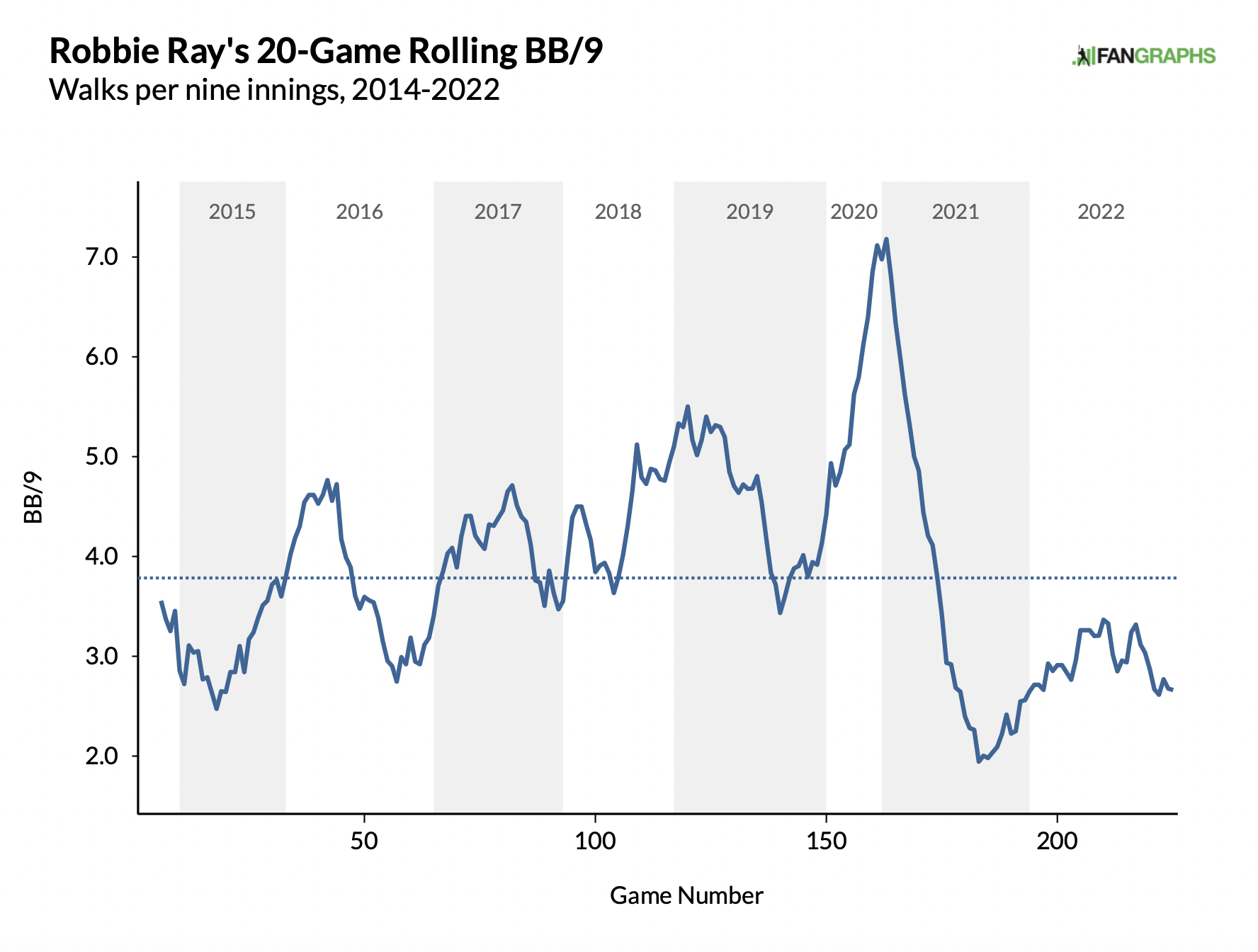
Even before Ray’s injury was diagnosed, the Mariners had cause for concern. For one thing, five walks in three-plus innings is certainly a worrisome sign. To make matters worse, two of those walks came in the first inning, before he began to feel sore. Ray has been notoriously wild in the past — he leads all active pitchers in five-walk games — but he had seemingly gotten his free passes under control the last two years:
In his second start of the 2021 season, Ray walked six batters in five innings of work. From that point onwards, he has posted a perfectly respectable 2.64 BB/9 (84 BB/9+). He needs to keep his walk rate in check to succeed going forward; hopefully his control will improve when his flexor strain heals. Read the rest of this entry »
When the Angels signed Anthony Rendon to a seven-year, $245 million deal in December 2019, the expectation was that he’d be a difference-maker, augmenting a lineup that already included Mike Trout and Shohei Ohtani and helping the Halos return to the postseason after a five-year absence. Though he played up to his capabilities in the pandemic-shortened 2020 season, Rendon’s last two years have been greatly limited due to injuries, and so far his ’23 season is off to a less-than-auspicious start.
On Opening Day, following a 2–1 loss to the A’s at Oakland’s Ring Central Coliseum, Rendon was involved in an altercation with a fan wearing an A’s hat as he exited the field. Apparently displeased by something the fan yelled, Rendon confronted him, reaching up and grabbing him by the shirt, then taking an open-handed swipe at him. In the video that circulated after the game, you can hear Rendon’s side of the story, not all of which is safe for work:
Whatever the fan said to Rendon isn’t part of either video, but even if it were, it’s unlikely to justify the third baseman’s actions; a player simply can’t mix it up in a physical altercation with a fan, period. Rendon is lucky he didn’t actually hit the man, because he’d almost certainly face a more severe fine and suspension than he might receive. As it is, both Major League Baseball and the Oakland Police Department are investigating the incident, with the latter saying it was investigating a battery:
When asked if Oakland Police Department was investigating the incident with Anthony Rendon, this is what the department said: pic.twitter.com/2If9BU23D6
The Angels and A’s were off on Friday. On Saturday, the team made Rendon available to the media prior to the game, but he repeatedly said that he couldn’t comment on an ongoing investigation. Manager Phil Nevin and general manager Perry Minasian made similar no-comments, with the former saying that “at some point” he would address the matter.
Beyond the altercation (and, if we’re being cheeky, including it), Rendon is so far hitless with a walk, a sacrifice fly and two strikeouts in eight plate appearances during this young season. He started in Saturday’s 13–1 win but was pulled in the sixth inning, having banged his left knee on the tarp in pursuit of a foul ball. He sat out Sunday’s contest after getting treatment; the 32-year-old third baseman said that he was well enough to play but that it was already a planned day off for him.
Rendon is coming off not one but two disappointing, injury-shortened seasons in a row, which makes it easy to forget just how he earned that big contract, which still has the fourth-highest average annual value ($35 million) of any position player besides Aaron Judge ($40 million), Trout ($35.54 million), and Carlos Correa ($35.1 million). From 2017 to ’19, Rendon hit for a 145 wRC+ (eighth in the majors) with 18.7 WAR (tied for fifth) and capped that by helping the Nationals win the World Series in 2019, driving in a series-high eight runs, including six (with two homers) in Games 6 and 7. After signing with the Angels, he hit a robust .286/.418/.497 in 52 games in 2020, placing seventh in the league with a 152 wRC+ and tying Trout for third with 2.5 WAR; unfortunately, terrible run prevention cost the Angels a playoff spot.
In 2021, Rendon was sent to the injured list by groin and hamstring strains as well as a knee contusion; he played in just 58 games, none after July 4, and while rehabbing from the hamstring injury suffered a bout of right hip impingement that necessitated season-ending surgery in August. He hit just .240/.329/.382 with six homers, setting career lows with a 94 RC+ and 0.1 WAR. Last year, he landed on the IL due to right wrist inflammation in late May and played just four games in mid-June upon returning before undergoing surgery to repair a subluxation of a tendon. The surgery was supposed to be season-ending, but Rendon healed more quickly than expected and was able to return near the end of the year. That allowed him to serve a five-game suspension for his role in a June 26 benches-clearing brawl with the Mariners and then play in two games, during which he went 0-for-4 with three strikeouts.
If Rendon’s season-ending coda wasn’t exactly impressive for its performance, it at least sent him home “just having the peace of mind of going into the winter and having a normal offseason,” as he said at the time. “It was good to show myself going into the offseason that I could play… It wasn’t the greatest playing those last few games, but just to have that in the back of your mind knowing that I had another three months knowing I could continue to get stronger.”
Following a normal offseason, Rendon hit a sizzling .500/.561/.806 in 41 PA of Cactus League play. Obviously, one can’t put a ton of stock in such numbers, but they at least back up his assertion that he was fully healthy. For what it’s worth, he averaged an exit velocity of 94.4 mph on the 11 balls he hit in parks equipped with Statcast. As Davy Andrews noted last week, there’s at least some signal within the noise when it comes to spring exit velos, albeit at the 15-batted ball level.
Rendon is rejoining what projects to be the strongest Angels squad in recent years, at least going by their preseason Playoff Odds projection of 83.5 wins, which translates to an 18.5% chance of winning the AL West and a 44.7% of reaching the postseason for the first time since 2014. With the offseason additions of free agents Brandon Drury and Gio Urshela, the Angels have upgraded their infield, notably adding some depth that seems designed to insure against another Rendon outage. With first baseman Jared Walshsidelined by headaches and insomnia, Drury is starting at first base instead of second, though hopefully that’s a short-term issue.
There aren’t a ton of small-sample positives to be taken from Rendon’s performances in the past two seasons, but a few things do stand out. Even while swinging and missing more than ever last year (7.1% swinging-strike rate), he remained an exceptionally disciplined hitter, chasing just 23.4% of pitches, walking 11.9% of the time and striking out 18.1% of the time (his highest mark since 2016). His 8.3% barrel rate was his highest since 2019 and would have placed in the 54th percentile; as it was, it exceeded his previous Statcast career mark by 0.9 points.
Considering that he missed well over 200 games over the past two seasons and will turn 33 on June 6, Rendon still projects to be a force if he’s healthy. His Depth Charts projection forecasts a .264/.359/.442 line in 131 games; his 128 wRC+ matches that of Manny Machado for the seventh-highest among third basemen, and his 3.8 WAR is tied for eighth. The systems don’t know any details about Rendon’s physical condition, but even while accounting for the significant outages of his past two seasons, they project him for something near a star-level contribution, which shouldn’t be too surprising given that he reached or exceeded 5.9 WAR four times from 2014 to ’19 and on a prorated basis would have cleared that as well in ’20.
With Ohtani and Trout coming off exceptional showings on the big stage of the World Baseball Classic, the Angels do have a certain aura of optimism surrounding them for a change. A healthy Rendon should be part of that, but we’ll have to wait and see whether his lapse of good judgment in Oakland costs him some playing time.
On Saturday, the Padres announced a seven-year extension with two-time All-Star Jake Cronenworth, a deal that will begin next season and is valued at $80 million over what would have been his final two years of arbitration and first five of free agency. For Cronenworth, a relative late-bloomer (at least among the crowd that goes on to sign $80 million contracts) who didn’t debut in the majors until he was 26 years old, it’s a day he admits he couldn’t have seen coming two or three years ago before distinguishing himself with a solid COVID-shortened rookie season, consecutive 4-WAR campaigns in 2021 and ’22, and a postseason resume that includes the hit that sent the Dodgers home last October.
It’s also likely the only way that Cronenworth was going to find himself with a deal of this size and length in his career. While a younger player might be hesitant to sign an extension and surrender an opportunity at free agency, Cronenworth is already 29, and this contract buys out five free-agent years he would have been selling at the age of 32. During the last four offseasons, the only players to sign five-plus-year deals at the age of 32 or older have been DJ LeMahieu in 2021 (coming off consecutive top-five MVP finishes) and Freddie Freeman in 2022 (coming off four straight top-ten MVP finishes) — which is to say, it isn’t easy.
For the Padres, it’s the latest in a series of long-term commitments to core members of their current club: Fernando Tatis Jr., Manny Machado, Yu Darvish, Joe Musgrove, Robert Suarez, and now Cronenworth. Despite handing out all those extensions, San Diego has left enough on the books (or maybe just set those books on fire) to bring in Xander Bogaerts, Michael Wacha, Seth Lugo, Matt Carpenter, and familiar face Nick Martinez. It’s a combination of the Braves’ readiness to commit to players within the organization who have proved to be a good fit and the Mets’ willingness to go longer and deeper into their pockets than their market competitors.
How has that worked? In the short term, it’s enough to give the Padres our second-highest odds of winning the World Series and make them the title favorite of our staff. The long term is a question mark, but find me a fan who wouldn’t want to spend a half-decade with the above group, not to mention MVP favorite Juan Soto, whose name you have to assume is at the top of the to-do list on A.J. Preller’s office white board. Read the rest of this entry »
We can officially stop worrying about Gary Sanchez: The two-time All-Star catcher has signed a minor league contact with the Giants. Ken Rosenthal broke the news on Friday, reporting that Sanchez will be heading to the team’s spring training facility in Scottsdale before being assigned to an affiliate (presumably Triple-A Sacramento). The deal is for $4 million, prorated for the amount of time Sanchez spends with the big club, and it includes an opt-out if he’s not called up by May 1.
Among the free agents who accrued at least 1.0 WAR last year, Sanchez is the last to find a home. He received interest from just a few teams during the winter and was unable to improve his stock while playing for the Dominican Republic in the World Baseball Classic, where he made just six plate appearances, going 0-for-5 with a walk and two strikeouts. It looked like he’d be left in limbo, waiting to sign with whichever team found itself in need of a catcher due to injury. Instead, Sanchez is heading to a San Francisco team that could certainly use some help behind the dish — one that ranked 27th at catcher in our Positional Power Rankings — but already has a very clear Plan A in mind: Joey Bart. Read the rest of this entry »