“What poor sucker is going to have to pitch in those games?” That’s what Meg Rowley asked last year on an episode of Effectively Wild after MLB announced a two-game series between the Giants and Padres in Mexico City. Those games happened over the weekend, and they lived up to those lofty expectations. Played at an elevation of 7,349 feet — more than 2,000 feet higher than Coors Field, in case you hadn’t been told several times already — they featured 15 home runs, including 11 in Saturday night’s 16–11 offensive explosion. Although Sunday’s game started with yet another home run, this time courtesy of LaMonte Wade Jr., the wind was blowing in, accounting for the paltry total of five homers. So far in the 2023 season, the average game has featured 2.26 home runs. By my calculations, that’s a whole lot less than 7.5 home runs per game. It was so wild that Nelson Cruz hit a triple yesterday. Let me rephrase that: The very nearly 43-year-old Nelson Cruz hit a stand-up triple yesterday. This was not baseball as usual.
All the same, it was extremely fun baseball. Robert Orr of Baseball Prospectus put it best, tweeting, “The game is being played on the surface of the moon.” The ball moved differently out of the pitcher’s hand, off the bat, and coming off the turf. In this article, I’ll be relying on Statcast data, so I should note up front that the stadium was working with a temporary TrackMan setup, rather than the permanent Hawkeye systems installed in all 30 MLB parks. It’s reasonable to expect that the numbers are not quite as reliable as they normally would be, but they’re still plenty convincing. Read the rest of this entry »
When the Rangers shocked the baseball world by signing Jacob deGrom to a five-year, $185 million contract in December, it was with the hope that the 34-year-old righty could steer clear of the type of injuries that limited him to a total of 26 starts in the 2021 and ’22 seasons. But since the opening of camps in February, it’s been a bumpy ride, and that’s carried over into the regular season. On Friday night, for the second time in three starts, deGrom took an early exit due to an arm issue; this time, he’s headed to the injured list, with a diagnosis of elbow inflammation. To call upon an oft-used metaphor: this fancy, expensive, high-performance sports car is once again in the shop.
Facing a Yankees lineup weakened by injuries — no Aaron Judge, no Giancarlo Stanton, no Josh Donaldson — on Friday night, deGrom cruised through the first three innings, retiring all nine hitters on a total of 28 pitches, striking out two and never reaching a three-ball count. He began to labor in the fourth, however. After a six-pitch groundout by DJ LeMahieu, he issued a five-pitch walk to Anthony Rizzo, then went to a full count against Gleyber Torres before getting him to fly out, and finally allowed a two-strike single to Willie Calhoun. Notably, deGrom’s last two pitches to Calhoun — a 96.6 mph fastball taken for a ball and then the 89.4 mph slider that he hit, both of which were several inches outside — were down about three miles per hour relative to their previous offerings of that type.
That sudden drop cued pitching coach Mike Maddux and the team trainer to visit the mound; Maddux soon tag-teamed with manager Bruce Bochy, who did little more than pat a dejected-looking deGrom on the shoulder and send him on his way.
After the Rangers finished off their 5–2 win, the team announced that deGrom had departed due to forearm tightness; the pitcher himself described it as “just some discomfort.” According to general manager Chris Young, an MRI taken the next day showed inflammation, but notably, he made no mention of structural damage, suggesting that whatever the team saw with regards to deGrom’s ulnar collateral ligament, flexor, and whatever else was, if not in mint condition, not a concern at this time. The Rangers elected to put him on the 15-day injured list, though Young downplayed the situation, saying, “[H]e came in today and felt OK, which was a positive, but given how important he is to us and our season, we’re going to play this very cautiously and see how he responds over the next several days to treatment. And then after seven to 10 days, we’ll have a pretty good idea of what the next steps are.” Read the rest of this entry »
If Matt Strahm wasn’t on your radar before this season, I can’t blame you. The left-hander put up increasingly worse results during his four years with the Padres, culminating in a 2021 season lost to injury. He bounced back the following year as a solid middle reliever for the Red Sox, but even so, he was hardly a free agent to watch this winter. He only made headlines because the two-year, $15 million deal he signed with the Phillies was more lucrative than anyone expected for him; an unnamed executive claimed that the contract “destroyed the market” for left-handed relievers.
A few years back, though, Strahm was a top-100 prospect and the most promising name in the Royals’ system. He earned his first feature here at FanGraphs in August 2016 in a piece that called him “a new relief weapon.” He was marvelous that season, posting a 1.23 ERA and 2.06 FIP across 22 innings for the reigning world champs. A year later, he earned another look from the FanGraphs staff, this time as the headlining return in the Trevor Cahill trade between the Royals and Padres. The summer after that, Strahm was once again the star of a FanGraphs story, this one about his work as an opener. Travis Sawchik looked at Strahm’s success and wondered if “Hader Lite” was an appropriate nickname. That’s high praise, indeed.
All this to say, Strahm isn’t just some guy, no matter how much his new nickname (Pastrami, i.e. “Pa-strahm-i”) makes him sound like the manager of an old-time Brooklyn deli or a kid from The Little Rascals. At the same time, he hasn’t been particularly relevant for several years, and as he entered his age-31 season, you might have thought the former top prospect was done making headlines.
Six games into his Phillies career, Strahm demands attention. He ranks 10th among National League pitchers (min. 20 IP) with a 2.31 ERA and among the top 10 in all the major ERA estimators: FIP, xFIP, xERA, and SIERA. The only other NL pitchers who can say the same are Spencer Strider, Zac Gallen, and Max Fried — arguably the early-season frontrunners for the National League Cy Young. Read the rest of this entry »
The Pirates, you might have heard, are in first place at the end of April. Not only that, they’ve played like a first-place team and then some, outscoring opponents by 48 runs in 29 games. Heading into Sunday, their pitching staff had the second-best ERA and FIP in the National League. Their offense had posted the second-best wRC+ in the NL as well; based on the first month of the season, the only thing fluky about them has been the names on the backs of their jerseys. Maybe they’ll cool off, maybe they won’t, but full credit to them for an exceptional first month of the season.
Heading into the season, Bednar was one of the few Pirates who it was safe to assume would be good. Carlos Santana and Andrew McCutchen are big names, but they’re getting up there in years. Bryan Reynolds would be good, most likely, but perhaps not in Pirates colors. But Bednar is a rock. He was an All-Star last year, for God’s sake. Read the rest of this entry »
Description:
As part of Baseball Systems, the Software Engineer will collaborate with the Player Development team to assist in developing our athletes. This position requires strong software development skills and experience, as well as a demonstrated ability for independent thought and the willingness to work within a team framework.
Core duties for this role include, but are not limited to:
Deliver highly dependable, easy to use software while being part of a fast-moving team.
Design and develop new features to deliver key athletic performance measures for the Player Development department while collaborating with Data Engineering, Tech Operations and Research & Development.
Collaborate with the Pitching, Hitting, and Defense coordinators on tools for evaluating player performance and delivering player feedback.
The ideal candidate will have:
created web apps using HTML, CSS and Javascript frameworks
experience developing APIs in C# or other similar languages
worked with relational databases
familiarity with Git version control software
A love of sports
Bachelor’s degree in Computer Science, Information Systems, or related field from four-year college or university; and up to 3 years related experience and/or training; or equivalent combination of education and experience.
Our Team:
Baseball Systems is the software backbone of Baseball Operations. We provide data and decision-making tools for analysts, coaches, and front office personnel to help win a World Series.
Our department consists of a team of data engineers and a team of software engineers who work across all different aspects of Baseball Operations providing support and tools relevant to each group.
We work directly with stakeholders in every department of Baseball Operations to ensure every project we work on drives value to the organization and helps us win more games on the field.
We help drive technical innovation to find new ways to solve baseball problems
What will you do each day?
Design and develop new features or maintain existing features in our internal web applications.
Squash bugs quickly.
Collaborate with Baseball Operations staff to plan new features and ensure requirements are met.
Develop walk-throughs for non-technical users to familiarize them with new features.
Watch baseball.
Our Pitch
You come here to make a difference. We are a purpose-led organization, focused on building an inclusive and engaging culture that fosters excellence, collaboration and ingenuity. We strive to be a model employer and cultivator of talent, empowering our teams to drive innovation through the inclusion of diverse thoughts, ideas and perspectives. We operate at the highest standard of excellence, investing in the development of our staff across all levels and embracing differences through a culture of respect and understanding.
We are proud to offer a highly competitive perks and benefits package including:
Exceptional health and dental rates, and fully covered vision package
401(K) match and an additional annual contribution from the Club
Unlimited vacation time
Paid parental leave
Collaborative recognition program and incentives
Leadership development programming
Online educational platform for personal and professional development
Employee Resource Groups
Paid time off for volunteering
Year-round diversity, equity and inclusion training and development
Brewers Home Game tickets, promotional giveaways and other discounts!
For more information about our Crew, other benefits and insight into our Club culture please visit our Careers Page.
Say this for the White Sox: They scored runs on Thursday. Sure, they were thrashed 14–5 by the Rays, which extended their losing streak to eight games, but they ended their scoreless streak at 25 innings, scored more runs than they had in the previous four games (three), and matched their total of hits from the previous three games (11). When you’ve lost 13 out of your last 15 games, this counts as progress.
Chicago’s current skid has dropped the team’s record to 7–19, the third-worst in the majors. There’s no ambiguity about whether the White Sox are bad: they also have the third-worst run differential and projected winning percentage, according to both PythagenPat and BaseRuns:
Bryson Stott began this season with a 17-game hit streak, marking a new Phillies franchise record to start a season. Eleven of those games were multi-hit efforts, culminating in 29 hits across his first 81 plate appearances. He’s added a handful of hits since his streak ended on April 18 and his overall line now stands at .339/.368/.459, good for a 126 wRC+. His early season success has been one of the few bright spots for the Phillies as they deal with a a variety of woes.
While Stott’s hot start is being at least partially driven by some fortunate results when he has put the ball in play — his BABIP currently stands at .417 — his success is also the culmination of a number of adjustments he’s made since making the Opening Day roster as a rookie last year. His initial exposure to the big leagues didn’t go very well. He collected just four hits across 31 plate appearances and was demoted to Triple-A on April 20 after playing in just nine games in the majors. Upon getting recalled on May 8, he continued to struggle until making an adjustment to his swing. Read the rest of this entry »
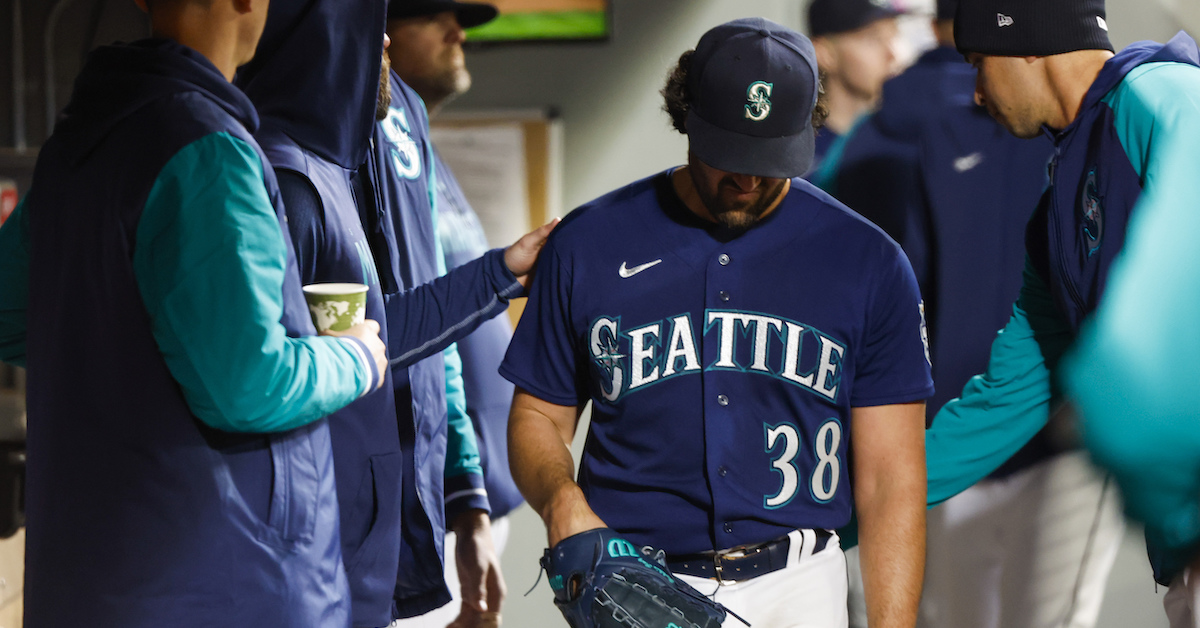
Robbie Ray did not replicate his 2021 AL Cy Young-winning form last year. In fact, he struggled down the stretch, but he did make a solid contribution as the Mariners ended their 21-year playoff drought. Alas, he won’t get to help them try to repeat that feat. On Wednesday, the Mariners announced that the 31-year-old lefty will undergo surgery to repair a torn flexor tendon and miss the remainder of the season.
After a promising spring training in which he restored some lost velocity to his four-seam fastball, Ray made just one start, and it wasn’t pretty. Facing the Guardians on March 31, he needed 26 pitches to complete the first inning, during which he issued back-to-back four-pitch walks to José Ramírez and Josh Bell before escaping by striking out Josh Naylor. His fastball velocity quickly diminished and he lasted just 3.1 innings, walking five and surrendering four hits and five runs (three earned).
In the immediate aftermath, Ray didn’t tell reporters that he had felt tightness in his forearm starting in the second inning, a problem that he attributed to the cold weather. After undergoing an MRI the next day due to lingering soreness, he was diagnosed with a Grade 1 flexor strain; only in discussing the injury with reporters did he reveal his discomfort. Read the rest of this entry »
After a fantastic run in the World Baseball Classic, Randy Arozarena has stayed red hot. Defensive metrics see him as a hair better in left field this year, and he’s also been slightly above average on the basepaths. That’s a big upgrade from the extremely entertaining but ultimately deleterious aggression he showed in 2022. Oh, and I should probably mention that he’s the eighth-best hitter in all of baseball right now, right behind some guy named Trout. Arozarena is running a 182 wRC+, up from his already very good career mark of 129. All three of the figures in his .348/.412/.584 slash line would be career-best marks over a full season. Put it all together, and Arozarena is currently on pace to double his career WAR total.
How is he doing all this? I’m not completely sure. Don’t get me wrong; the numbers tell a story, and there are some other convenient narratives at hand. I’m just not convinced of how everything fits together. That’s actually why I was so interested in writing about Arozarena. He’s way more fascinating than some guy named Randy has any right to be.
Let’s start with one thing we can be sure of: Randy Arozarena is absolutely hammering the baseball. He’s always been capable of posting eye-popping exit velocities, but this year he’s doing it consistently. Last year, his average exit velocity was 89.9 mph and his hard-hit rate was 40.7%, both solidly above average. This year he’s at 95.1 and 59.2%. That’s not just good; that’s Yordan Alvarez territory. In terms of contact quality, Arozarena has never had a stretch like this:
It’s not just that he’s hitting the ball harder than ever. He’s also avoiding mis-hits at a career-best rate. His 7% soft-hit rate is tied for seventh-lowest in the league, and none of the six players ahead of him has a higher hard-hit rate.
Arozarena is also lifting the ball more than ever. His line drive rate is at 20%, and his fly ball rate is at 38.6%. While both would be career highs over a full season, this isn’t completely unprecedented. Arozarena has had previous stretches with lower groundball rates, though combined with his elevated hard-hit rate, this one has led him to a career-best 16.9% barrel rate. What’s new is his launch angle tightness. Despite all this lift, his popup rate is at a career low. Arozarena’s average launch angle is up by 3.0 degrees, but the standard deviation of his launch angle is down by 3.3 degrees. He’s consistently hitting the ball where he can do the most damage, reaping all the benefits of an improved launch angle with none of the downside. Courtesy of Baseball Savant:
The last big change is that Arozarena is using right field like never before. Batters tend to elevate the ball more when they’re going the other way, but that’s not nearly enough to explain what’s going on here. His 36.6% opposite field rate is well above his 24% career average, and his pull rate is also at a career low. This is something entirely new. He’s now spraying the ball all over the field, and he’s never had a stretch where he’s gone the other way so frequently or pulled the ball so infrequently. Further, when he hits the ball to the right side, he’s hitting it with authority. His career average exit velocity on balls the other way is 88 mph. This year it’s 95.2 mph:
Randy Arozarena – Spray Angle Splits
Pull
Center
Oppo
Season
GB/FB
Hard%
wRC+
GB/FB
Hard%
wRC+
GB/FB
Hard%
wRC+
2019-22
2.97
35.2
206
1.42
34.6
183
0.53
27.5
189
2023
3.75
36
267
0.89
55
200
0.43
46.2
229
As you can see, Arozarena’s hard-hit rate is roughly unchanged when he pulls the ball. He’s hitting more grounders than normal to the left side, and he’s succeeding there partly by hitting the ball harder and partly through batted ball luck. However, on balls up the middle and to the opposite field, his hard-hit rates have skyrocketed and he’s hitting the ball in the air more than ever. In fact, the numbers indicate that his 229 wRC+ to the opposite field might actually be a bit lower than he deserves.
Arozarena’s profile has always been a little bit tough to parse. For example, take a look at the heat maps below. On the left is Arozarena’s career slugging percentage per ball in play. On the right is his contact rate:
Some of the pitches that Arozarena really crushes, like the ones at the top of the zone, are also the ones he swings through most often. In fact, if you take a closer look, you’ll notice that Arozarena also tends to have lower contact rates right in the middle of the plate, a trend that has continued this year. He’s capable of doing damage below the zone, or on pitches just off the plate outside.
I bring this up because this is the part of the article where I would normally dig into the underlying metrics and tell you that Arozarena is mashing the ball because he’s chasing less, getting ahead in the count, and taking advantage of meatballs in the zone. Or maybe that he’s just focusing on the pitches he can really crush. That’s how these things tend to work. And while Arozarena is in fact chasing less and seeing slightly more pitches in the zone, I don’t really think that explains the transformation in his batted ball profile.
Arozarena’s chase rate is 7.5 percentage points lower than it was last year. That’s a big drop, but it also leaves him right around his 2001 rate, and he wasn’t running a 180 wRC+ or a 60% hard-hit rate in 2021. He’s striking out a lot less and walking slightly more, but he’s also whiffing more often. In fact, he’s seen more strikes overall and spent a lower percentage of the time ahead in the count this year.
Arozarena’s overall contact rate is up slightly, though again, it’s not that simple. He’s making more contact in the zone and whiffing more when he chases. I don’t know how repeatable that is, but it’s a neat trick if you can pull it off. Combine it with a lower swing rate (particularly outside the zone), and all of sudden more of his batted balls come on pitches in the zone. But still, we’re only talking about an increase of 2.3 percentage points. That doesn’t sound like enough to explain a hard-hit rate that’s jumped nearly 20.
Here’s the bigger thing: Name a split, and within that split Arozarena is hitting the ball harder this year than he did last year. Ahead, behind, or even in the count? Randy Arozarena is hitting the ball harder. Inside or outside the zone? Randy Arozarena is hitting the ball harder. Heart, shadow, or chase zone. Fastball, breaking ball, or offspeed. Lefty, righty, home, away, fly ball, groundball, line drive; he’s even hitting his popups harder. His numbers are down just a hair on the inner third, which is certainly understandable given his new propensity to rip the ball the other way, but that’s really all I could find. The guy is just plain hitting the ball harder, and I’m not prepared to conclude that it all comes down to his swing decisions.
That brings us to our two tidy narratives. The first is something Adam Berry described somewhat bluntly on the Ballpark Dimensions Podcast. “He was openly not really looking into scouting reports,” Berry told Mike Petriello. “He would ask the hitting coach or the manager, whoever ‘What’s this guy’s fastball?’ That’s all he needed to know before he went up for a plate appearance. He even told us last year at one point he didn’t know other pitchers’ names. He knew his fellow Cubans, and he knew Gerrit Cole, and that was it.”
Joe Trezza gave a more nuanced picture at MLB.com. It’s not that Arozarena couldn’t be bothered, Trezza explained, “He eschewed data, preferring to stay in the moment and let his natural ability take over. Sometimes, he told teammates, he didn’t even want to know the opposing pitcher’s name.”
I am definitely willing to believe that more preparation has helped Arozarena. Lest we forget, this wouldn’t be the first time that Arozarena has decided to put in extra work to up his game and done exactly that. Arozarena is still chasing breaking stuff at almost exactly the same rate, but he is laying off more four-seamers above the zone and offspeed stuff below it. That could be due to having a better idea of how pitchers are attacking him. At the very least, it’s safe to say that incorporating new information into his gameplan hasn’t hurt.
The other thing that could tie our story up with a bow is that Arozarena has made some significant changes to his swing. Last year his stance was extremely upright. This year, he’s crouching a bit more, as he did in 2020. Last year, his hands were up above his ear and he kept his back elbow up, with his bat at a much flatter angle. This year, he’s lowered his hands to shoulder height, with his elbow less elevated and his bat nearly vertical. All of that is completely new. When he goes into his load, he’s rotating his body away from the pitcher less and keeping his shoulders much more level. 2023 is on the left and 2022 is on the right:
Last year, you could pretty much see all of the 56 on Arozarena’s back; this year, you can only see a small part of the six.
Unfortunately, I haven’t been able to find any information about Arozarena’s new stance. He was using it both in spring training and at the World Baseball Classic, so it’s clearly the result of offseason work. To my knowledge, no one has written an article about it. Andrea of Scout Girl Report was the only person I found who’s mentioned it on Twitter.
I don’t know whether Arozarena made these changes on his own, with outside coaches, or with Tampa Bay’s coaching staff, and I haven’t been able to track down a quote about what he hopes they’ll do for his swing. I assume that the desired effect of all these adjustments — deeper crouch, lower hands, less rotation pre-swing — is to make him quicker, starting out with the various parts of his body closer to where they need to be when he begins his swing. Shortening up in this way clearly hasn’t hurt his power. He even set a career exit velocity record last week by hitting a Levi Stoudt four-seamer 114.3 mph. It could also be that lowering his hands and staying more level were changes intended to help him elevate the ball, in which case they have been a soaring success.
So this is where I’m going to leave you. Randy Arozarena is off to a great start. He’s got a new swing. He’s studying scouting reports. He’s chasing less. Through some combination of these factors, he’s elevating the baseball, using the whole field, and hitting it very, very hard. Maybe that’s all we need to know.
Mason Montgomery is the highest-ranked left-hander in the Tampa Bay Rays’ pitching pipeline. No. 7 overall and with a 45+ FV, the 2021 sixth-round pick out of Texas Tech University is coming off his first full professional season, in which he logged a 2.10 ERA with 171 strikeouts in 124 innings between High-A Bowling Green and Double-A Montgomery. Back with the Biscuits to start the current campaign, the 22-year-old Austin native has a 3.38 ERA to go with 16 strikeouts in 13.1 innings.
Deception and ride are among the southpaw’s attributes. As our lead prospect analyst Eric Longenhagen wrote earlier this year, “His glove hand plays the role of the magician’s assistant, flying above Montgomery’s head and toward the hitter when, suddenly, the baseball appears… with a nearly perfect north/south arm slot, imparting the look of rise on his fastball.”
Montgomery discussed his M.O. on the mound, which includes aggressively pumping heaters down the middle, during spring training.
———
David Laurila: What is your approach on the mound? How do you get guys out?
Mason Montgomery: “Man, I think my go-to is just my fastball. It’s kind of got that carry to it, and I usually go to it as my finishing pitch. Sometimes I’ll go slider, too. But really, I just work ahead with the heater and then if I feel like they’re on that, I’ll throw some offspeed over the plate, either my slider or my changeup. That’s my full repertoire: four-seam, slider, and changeup.”
Laurila: How many inches of ride do you get on your four-seamer?
Montgomery: “It changes. At my best, I’ll get consistently 20, maybe 22. Sometimes it will be 17 to 19. So it just depends on the day. Some days I get behind it a little better than I do on others.” Read the rest of this entry »