Archive for Teams

Yasmani Grandal Gets His Multi-Year Deal

The White Sox announced Thursday that they agreed with free agent catcher Yasmani Grandal on a four-year contract worth $73 million.

Grandal was an easily recommendable hire by virtue of being almost certainly the best catcher available in free agency, with an argument for either Jason Castro or Travis d’Arnaud a rather tough one to make in this writer’s opinion. On our list of the Top 50 Free Agents for 2020, Grandal was ranked sixth overall. As J.D. Martinez decided not to opt-out from his deal with the Red Sox, Grandal is the first top 10 free agent to sign this winter.

I remain ambivalent about the White Sox as contenders in 2020 based on the state of the pitchers currently on their roster, but Grandal is both an immediate and long-term upgrade behind the plate. James McCann was a significant contributor in 2019, hitting .273/.328/.460 for 2.3 WAR, but he’s hardly established that level of play as his baseline expectation.

And while I’m skeptical that there has been any actual collusion in free agency the last two winters, if I were searching for a contract that smacked of that kind of behavior, it would be hard to not pick Grandal’s deal with the Brewers. Coming off a .241/.349/.466, 4.7 WAR season in 2018, his fourth consecutive four-win season, it seems ludicrous that he only landed a one-year, $16 million contract with a mutual option and a buyout. There were reports that Grandal turned down multi-year contracts, but those inevitably would have been for even less money per year.
Read the rest of this entry »


How Andrew Miller Can Return to Dominance

From 2014 to 2017, relief pitcher Andrew Miller was one of the most dominant arms to come out of a bullpen. Miller averaged 2.4 WAR during those four seasons, and in three of those four, he posted a sub-2.00 FIP. In fact, in 2016, Miller struck out nearly 50% of hitters he faced while walking just over 3%.

As we know, decline is inevitable for baseball players. Whether it’s due to playing over your head, the impact of aging, or just loss of ability, the equalizer comes for everyone at some point. By the time Miller landed with the St. Louis Cardinals in 2019, he was a little bit older and a shell of his former self. His walk rate rose to over 11%, his FIP ballooned over 5.00, and his home run rate became, to date, the highest it had ever been. Be it age or an impending decline, Miller doesn’t necessarily have to succumb to either just yet. Yes, he’ll turn 35 next May, but he might have something left in the tank.

Despite 2019 being one of the worst seasons in his career, Miller showed some flashes of returning to his mid-2010s form. During the month of July as well as the Cardinals’ October playoff run, Miller made a subtle but important adjustment to the pitch that made his career, the slider. It’s unclear if this slider adjustment was intentional, but it made a big difference in its effectiveness. If Miller can keep this particular change more consistent in 2020, the Cardinals could have one of the most dominant relievers in baseball. Read the rest of this entry »


With Dominic Leone DFA, Cardinals’ Kent Bottenfield Chain Is Over

Yesterday was the deadline for teams to protect players from the Rule 5 draft by adding them to the 40-man roster. But with those additions come removals. Oft-injured Jacoby Ellsbury was the most prominent roster casualty as he was let go by the Yankees. In a much quieter move, the Cardinals designated Dominic Leone for assignment. Leone was eligible for arbitration and the move wasn’t a complete shock as Leone struggled last season, but in a very important side note, Leone’s release ends the Kent Bottenfield trade chain, which began two decades ago and includes some of the most memorable moments and moves in Cardinals history.

For those unfamiliar with the Kent Bottenfield trade chain, or Kent Bottenfield himself, the big righty played for five teams from 1992 to 1997 bouncing between the rotation and in 364 innings accumulated 0.1 WAR. As a free agent after the 1997, the Cardinals signed him to a one-year deal with a team option. After putting up decent numbers between the bullpen and the rotation, the team moved Bottenfield to a starting role full-time in 1999 and he had his best season, putting up 2.3 WAR in 190.1 innings. Fortunately for the Cardinals and his trade value, Bottenfield’s average 4.75 FIP wasn’t known back then, and his 3.97 ERA and 18-7 win-loss record made him look great. Which led to… Read the rest of this entry »


JAWS and the 2020 Hall of Fame Ballot: Larry Walker

The following article is part of Jay Jaffe’s ongoing look at the candidates on the BBWAA 2020 Hall of Fame ballot. Originally written for the 2013 election at SI.com, it has been updated to reflect recent voting results as well as additional research, and was expanded for inclusion in The Cooperstown Casebook, published in 2017 by Thomas Dunne Books. For a detailed introduction to this year’s ballot, and other candidates in the series, use the tool above; an introduction to JAWS can be found here. For a tentative schedule and a chance to fill out a Hall of Fame ballot for our crowdsourcing project, see here. All WAR figures refer to the Baseball-Reference version unless otherwise indicated.

A three-time batting champion, five-time All-Star, and seven-time Gold Glove winner — not to mention an excellent base runner — Larry Walker could do it all on the diamond. Had he done it for longer, there’s little question that he’d already have a plaque in the Hall of Fame, but his 17 seasons in the majors were marred by numerous injuries as well as the 1994–95 players’ strike, all of which cut into his career totals.

Yet another great outfielder developed by the late, lamented Montreal Expos — Hall of Famers Andre Dawson, Vladimir Guerrero, and Tim Raines being the most notable — Walker was the only one of that group actually born and raised in Canada, though he spent less time playing for the Montreal faithful than any of them. He starred on the Expos’ memorable 1994 team that compiled the best record in baseball before the strike hit, curtailing their championship dreams, then took up residence with the Rockies, putting up eye-popping numbers at high altitude — numbers that hold up well even once they’re brought back to earth.

Read the rest of this entry »


The Braves Are Taking This Seriously

If re-signing Darren O’Day (on November 8) and then signing Will Smith (on November 15) wasn’t enough to persuade you that the Atlanta Braves are determined to ensure that a middling bullpen doesn’t hold them back in next year’s NL East competition, yesterday’s agreement with 33-year-old Chris Martin should be enough evidence to convince you that Alex Anthopoulos is taking 2020 seriously.

In one sense, it’s not a great sign for Atlanta that Anthopoulos feels he has to spend this heavily on his bullpen, rather than taking a run at a front-line starting pitcher to pair with Mike Soroka, or another big bat to help put an already-strong offense over the top (their .332 wOBA last year was third-best in the National League but behind both Los Angeles and, perhaps more importantly, Washington).

Signing Martin for two years and $14 million, as the Braves have just done, puts the 2020 Atlanta payroll at an estimated $119 million, which despite ranking solidly in the bottom third of National League clubs, is right around the upper limit of what ownership has been comfortable spending in recent years. Ideally, at least from a payroll perspective, a few more of the Braves’ recently-vaunted young pitchers would have transformed into quality bullpen arms (and not in the Sean Newcomb way), thereby freeing up dollars for other parts of the roster. Read the rest of this entry »


The Indians Forgot To Look Behind Them

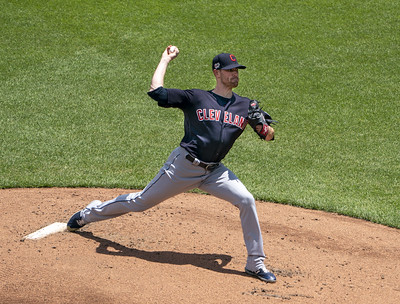
In 2019, ZiPS’ faith in Shane Beiber proved to be justified. (Photo: Keith Allison)

“Overconfidence is a powerful source of illusions, primarily determined by the quality and coherence of the story that you can construct, not by its validity.” – Daniel Kahneman

If the 2019 Indians thought they the lone contenders in the AL Central, the Minnesota Twins very quickly disabused them of that notion. Cleveland still fought their way to a 93-69 record, but after a quiet offseason, the loss of some key players, and a final run at the playoffs destroyed by a five-game losing streak, this is a team that ought to be haunted by their what-ifs. Much of the team’s core remains intact (at least for now), but with key contributors approaching free agency, these Indians may have peaked.

The Setup

If a baseball season is a marathon, the 2018 Indians were allowed to use a car. They grabbed first place in the AL Central in late April and never relinquished it. The Minnesota Twins ran afoul of the Regression Gods, and the rest of teams in the division were still firmly in the moribund section of their respective rebuilds. With the bullpen not rocking as it had in previous years, Cleveland traded top prospect Francisco Mejía to the San Diego Padres for Brad Hand and Adam Cimber, players who could reinforce the bullpen past 2018. Also added were Leonys Martin and Josh Donaldson, players the team believed could have upside for the playoffs. Read the rest of this entry »


What the Astros Might Deserve

There are many pieces detailing how the Astros appear to have cheated by using video to steal signs in real-time. Ken Rosenthal and Evan Drellich wrote a lengthy piece for The Athletic with quotes from former Astros’ pitcher Mike Fiers detailing the team’s practices in 2017. The basics are in that piece, but there are a several more that discuss what the team was reportedly doing and how they did it. We don’t yet know all the facts; it is still unclear precisely how long the team engaged in this practice, and who all of the responsible parties are. But what the evidence makes pretty clear is that the Astros stole signs with the aid of advanced technology and relayed those signs to hitters during games. That’s cheating.

What the Astros and their employees might receive in terms of punishment for engaging in that practice is less clear, though multiple precedents have been set to guide the league’s possible enforcement. Perhaps you’re of the mind that the consequences Astros deserve to suffer is to have won fewer games, including their 2017 World Series. But such an extreme result is unlikely. Astros wins and championship banners probably won’t be taken away or vacated like a farcical college athletics penalty. Even when players are caught cheating in the middle of games, the results aren’t vacated. So what might we expect? In looking to past scandals, we can get a glimpse at MLB and Rob Manfred’s approach. There are multiple factors that play into potential punishment, both for individuals and the franchise, but here are a few of the major ones:

  • Is this the first time a team has been penalized for breaking the rules?
  • Was the organization cooperative with MLB’s investigation?
  • How high up the organizational chain does the knowledge and activity go?

For the first factor, let’s consider the Boston Red Sox’s penalty for breaking the rules surrounding signing international free agents. After the club exceeded the allowable pool amount to sign Yoán Moncada, it were restricted from signing any amateur international free agents for more than $300,000. To get around those restrictions, the Red Sox signed less well-regarded players for $300,000 with the expectation that money from some of those lesser players would go to the better players who should have received higher bonuses and were represented by the same agents. When the Red Sox penalty for circumventing the rules came down in 2016, they were prohibited from signing any international free agents for a year, and the players involved were declared free agents, with Boston unable to recoup their signing bonuses, which remained with the players. It was the first time a team had been penalized in this fashion. Read the rest of this entry »


Has Jonathan Villar Played Himself Out of Baltimore?

The Camden Yards did not constitute what I would call a particularly inspiring work environment. The Orioles lost 108 games one season after it lost 115, with a pitching staff that set records for futility and an offense that was near the bottom of the majors as well. When the team initiated its rebuild in 2018, it did so by trading away its most sought-after talent — starting with Manny Machado, and later including Zack Britton, Brad Brach, Kevin Gausman, Darren O’Day, and Jonathan Schoop. Baltimore was finished pretending it could compete with the rest of the AL East and was going all-in on a scorched-earth plan in hopes to build the next 100-loss-team-turned-dynasty, giving away all the talent it could in the process. If you still found yourself on the Orioles’ roster at the start of the 2019 season, it’s probably because no contending team believed you could meaningfully improve their squad.

In many cases, those teams were right. They were right about Chris Davis and Mark Trumbo, and they were right about Dan Straily and Alex Cobb. There was good evidence to suggest those players, all of whom were once considered assets to teams trying to win, were not going to be of any value in 2019. Jonathan Villar, however, posed a more puzzling question. Contending teams might have seen his abysmal 2017 and continued struggles early in 2018 and concluded his skills were deteriorating. Instead, Villar then had the best season of his career.

Playing all 162 games for Baltimore, Villar finished with a .274/.339/.453 batting line with a career-high 24 homers, good for a 107 wRC+. He led the majors in baserunning runs with 10.5, and he stole 40 bases, good for third in baseball. All told, he finished the season with a career-best 4.0 WAR, ranking him fifth among all second basemen behind only Ketel Marte, DJ LeMahieu, Max Muncy, and Ozzie Albies. Read the rest of this entry »


How Much Did the Astros Really Benefit from Sign-Stealing?

With the offseason moving at it’s now customarily glacial pace, the story that’s dominated the baseball headlines for the past week has been the Astros sign-stealing scandal. Since the first story was published by Ken Rosenthal and Evan Drellich at The Athletic last Tuesday, we’ve seen bits of evidence confirming the Astros strategy: a crude system of live monitors and a trash can to relay the incoming pitch type to the batter. On Friday, Rob Arthur of Baseball Prospectus provided audio evidence from the TV broadcasts, on which the whacking of the trash can can be identified and analyzed. Rosenthal and Drellich followed up their post with another revelation that the Astros were exploring different ways to electronically steal signs. And then there’s the video evidence pulled from the 2017 Astros World Series documentary showing a computer — sometimes a monitor, sometimes a laptop — in the tunnel leading to the dugout with a trash can nearby.

MLB is still conducting its own investigation, but the evidence that’s been dug up publicly is pretty damning. Sign-stealing has always been part of the game, but the Astros crossed the line when they began using electronic means to relay information in real-time. And this isn’t the first time they’ve been accused of baseball skullduggery of some sort. There’s little doubt that some form of punishment will be handed down by the commissioner’s office once MLB wraps up its investigation. The only question is how harsh will the penalties be; will it be a slap on the wrist, or will the hammer come down hard to deter other teams who are likely exploring other ways to use technology to steal signs.

Gamesmanship and various forms of cheating are as much a part of the fabric of baseball as the unwritten rulebook, all in an effort to gain an upper hand against your opponent. But how much of a benefit does sign-stealing give to a batter? Knowing what type of pitch is incoming gives the batter a distinct advantage — more information is far better than just guessing — but they still need to translate that information into action, whether its a swing or a take. Since we have plenty of data to analyze, can we measure the effect of sign-stealing on the outcome of a pitch, play, or game? Read the rest of this entry »


A Plan for Helping Hunter Wood’s Fastball

Pitch movement isn’t as exciting as high velocity these days, especially when talking about four-seam fastballs. The harder you throw, the more attention you draw, and any additional cut, run/ride, or rise you produce is the icing on the cake. So what happens if you throw a fastball with average velocity and minimal movement?

There are a few pitchers who don’t rely on heavy movement and can compensate for unimpressive velocity with things like pitch command or control and being able to use their offspeed and/or breaking pitches with the fastball effectively. While looking at some 2019 four-seam movement data, I came across a few pitchers that produce minimal four-seam action. Since the fastball is essentially the foundation on which all other pitches thrive, I wondered about the capacity of their other secondary pitches working off of this somewhat linear-moving pitch.

I found Cleveland Indians relief pitcher Hunter Wood to be of interest to me. Only a half-win player in 2018, Wood took a small step backward in 2019 after a decent start to the season that went south just before the All-Star break. His HR/9 skyrocketed in that time, going from 0.68 from April to June to 2.84 in July and August, and his fastball was largely responsible for the degradation.

Eventually, Wood was dealt to the Indians in late July after spending his two and a half seasons with the Tampa Bay Rays. Per Wood’s scouting report, he possesses a good level of command. His pitches generally grade out as average, with exception given to his cutter.

Wood’s undeviating four-seamer averages a horizontal break of three-quarters of an inch with the tenth-highest rise of all fastballs thrown in 2019. Given the lack of expected drop to the pitch, hitters generated a fair number of fly balls, a lot of which left the various stadiums they were hit in. Thrown for league-average velocity with the 43rd-highest spin rate, it produced a .280 batting average and a 120 wRC+ against. Below are a couple of his typical fastballs: Read the rest of this entry »