Archive for Teams

A Look at Jordan Luplow, a Bright Spot in the Indians’ Lineup

Indians outfielder Jordan Luplow might not be a household name. But he has turned some heads in Cleveland with majestic home runs like this one:

That is quite the blast, but it’s clear the Indians’ Twitter account is being facetious. Luplow isn’t a legitimate Home Run Derby candidate, even with the All-Star Game being played in his home park in Cleveland. (Since 2013, at least one player from the hosting team participated in the Home Run Derby.) Francisco Lindor and Carlos Santana are much better options to serve as the hometown player.

Luplow has experienced something of a breakout this season. He is 25 years old and had just 190 plate appearances to his name prior to 2019. But, this season, he’s playing for an offense that has produced an 82 wRC+ team-wide, allowing him to serve as a bright spot in the order. In 120 plate appearances, Luplow has hit .248/.308/.523 with eight home runs and a 113 wRC+. His .275 ISO leads all Indians hitters, while also ranking in the top 10% of players with at least 100 trips to the plate. Read the rest of this entry »


Rangers Righty Pete Fairbanks on His Memorable Major League Debut

Pete Fairbanks had more than just a memorable major league debut on Sunday. He had a spectacular debut. The 25-year-old Texas Rangers right-hander entered a game against the Oakland A’s in the fifth inning and proceeded to fan the first three batters he faced. He then returned to the mound in the sixth and, with an E-5 sandwiched in between, induced a groundball out and an inning-ending double play. Not bad for a former ninth-round pick who began the season with the Down East Wood Ducks in the High-A Carolina League.

Fairbanks fashioned a 2.35 ERA, with 36 strikeouts in 23 innings between three levels prior to his call-up. The University of Missouri product is a power pitcher. His fastball topped out at 99 mph on Sunday, and his high-80s slider features good tilt. Health had held him back. Fairbanks missed all of last season while recovering from his second Tommy John surgery. He’d also gone under the knife in high school.

Fairbanks discussed his call-up, and the pair of overpowering innings that followed, prior to yesterday’s game at Fenway Park.

———

Pete Fairbanks: “I came into a game against Reno — we were in Reno — in the fourth inning. I threw 12 pitches, then I come out. I’m like, ‘Well, I sure wish I could have finished that inning.’ Our pitching coach walks by and says, ‘Hey, there’s a reason.’ I don’t think anything of it; I just go in the clubhouse and hang out for the rest of the game.

“I’m washing my hands, and Carlos [Olivas], our trainer in Triple-A, says, ‘Hey, come here.’ We walk into the office and he says, ‘Congrats man, you’re going up to the show.’ I’m like, ‘Are you sure?’ He says ‘Yeah, you’re going.’

“At 6:10 the next morning, I get on a flight to Arlington. I sit in a hotel from the time I get there until about five o’clock the next day, because I’m not activated yet. I’m there for a night game, and then for Game One of [Sunday’s] double-header. Around five they call and say, ‘We’re ready for you to come on over.’ I go over and introduce myself to everybody. Read the rest of this entry »


How Does Mike Soroka Do It?

Baseball has changed a lot in the last five years, so much so that watching a game from 2014 already feels like a blast from the past. Offense was low, sinking fastballs were everywhere, and groundballs and defense were the order of the day. 2019 hardly feels like the same game — unless you’re watching Mike Soroka, that is. Though Soroka is only 21 years old, he pitches like he’s from a previous era. In a time of four-seam fastballs, Soroka pitches off of his sinker — he’s throwing only 16% four-seamers this year and 46.3% two-seam fastballs. In a world of exciting high-velocity young aces, Soroka sits around 93 mph. In a world of home runs, he has allowed only one all year. In short, Mike Soroka doesn’t fit in 2019. How does he do it?

As is almost always the case with pitching, Soroka isn’t doing one specific thing that makes him dominant. If it were that straightforward, that easy to reverse engineer, everyone would be doing it. Still, dominant is an apt description of Soroka’s 2019 season. He’s posted a 1.38 ERA over ten starts. His FIP is nearly as jaw-dropping — fifth in baseball at 2.70. Has he been a little lucky that only 2.9% of fly balls hit against him have become home runs this year? Certainly. Still, though, his 3.5 xFIP is no slouch, 20th-best among qualified starters.

Great pitching is always interesting, but the way Soroka is doing it is what makes him unique. His 21.9% strikeout rate is below league average, not the kind of thing you can say about most excellent pitchers. His 6.5% walk rate is better than average, but not absurdly so — it’s merely 38th-lowest among qualified starters. In short, Soroka is an evolutionary Mike Leake, or 2019’s Miles Mikolas. He’s effective in a way that resists categorization, that belies the easy tropes of analysis. Why is Mike Soroka good? He’s good because he gets every little edge he can.
Read the rest of this entry »


The Very Surprising Texas Rangers

If the postseason started today, the defending champion Boston Red Sox would not be playing. The presumptive American League Central winner Cleveland Indians would not be playing. Instead, the Texas Rangers, projected to lose 90 games before the season began, would be squaring off against the Tampa Bay Rays for a spot in the Division Series if current results were to hold the rest of the way. Now, with 60% of the season left to go, current results are unlikely to hold the rest of the way. But 40% of the season isn’t an insignificant portion of the schedule, perhaps making the Rangers the most surprising team of 2019.

The Twins and Rays might have better cases for being the biggest positive surprises based on their record, but neither team was projected to be bad like the Rangers. The graph below shows every teams’ projected winning percentage before the season started, and their winning percentage through Sunday’s games:

Read the rest of this entry »


Chips Off the Ol’ Cooperstown Block

On Saturday, Blue Jays rookies Cavan Biggio and Vladimir Guerrero Jr. added another item to their set of historic firsts: the first sons of Hall of Famers to bat consecutively in a single game. The particular sequence of events could have gone better, though. Facing the Diamondbacks’ Zack Greinke, Biggio flew out. Then Guerrero smoked a first pitch slider (106.4 mph off the bat) 404 feet off the center field wall, yet only wound up with a long single after beginning his home run trot while rounding first base. The gaffe — the Jays’ first miscue in a game they lost 6-0 — didn’t escape the notice of manager Charlie Montoyo, who, in reference to Guerrero’s rookie mistake, told reporters afterwards, “You should always go hard.”

After a slow start following his belated arrival, Guerrero is hitting .248/.313/.445 (102 wRC+) with seven homers in 150 plate appearances overall, and .292/.352/.563 (142 wRC+) in his last 105 PA, starting on May 11. That’s not too shabby for a 20-year-old who might be the most hyped prospect in baseball history. No, he wasn’t a number one overall pick like Ken Griffey Jr., Stephen Strasburg, or Bryce Harper. But he’s the only consensus number one prospect to be the son of a Hall of Famer, which made his debut, forestalled by several months due to injuries and service time hanky panky, that much more hotly anticipated.

The sons of Craig Biggio and Vladimir Guerrero (who debuted on May 24 and April 26, respectively) are the first to be teammates within a group that numbers just 15 thus far. Only seven of those 15 reached the majors after their fathers were enshrined, which means that the rest of this group joined retroactively. Comparatively speaking, we’re in a boom time for such familial connections, given the activity not just of the two young Jays but also Giants pitcher Dereck Rodriguez, son of Ivan Rodriguez. The younger Rodriguez even has a Cooperstown-linked teammate himself, namely outfielder Mike Yastrzemski — not just the grandson of Carl Yastrzemski but the first grandson of a Hall of Famer to reach the majors. Read the rest of this entry »


Yuli Gurriel May Be Trying to Do a Little Too Much

Because his name is right there in the title of the piece, I won’t ask you to play that little game where I give you two anonymized batting lines and ask you to guess who they are, only to reveal that one is Yuli Gurriel and the other is the re-animated corpse of Ike Van Zandt or something like that. I’ll just give you two batting lines, both from Gurriel, and ask you to note the difference in quality between the two:

Yuli Gurriel’s Curious Slump
Seasons PA BB% K% wOBA
2016-18 1,274 3.9% 10.8% .329
2019 254 4.7% 10.2% .282

That 47-point drop in wOBA doesn’t really give you a sense of relative performance, so let me put this another way: Gurriel’s wOBA from 2016-18 fell into the 38th percentile among players with as many plate appearances over that span. Fine but hardly exceptional. His wOBA this year — again only among those players with as many trips to the plate — falls into the third percentile. Only José Ramírez (with a .262 wOBA) and Starlin Castro (.249) have done worse.

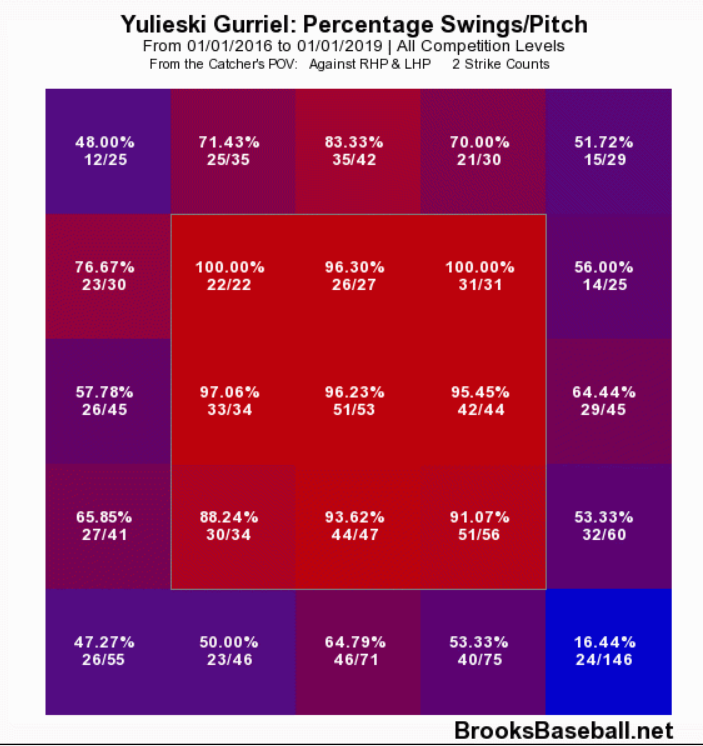
Curiously, though, Gurriel’s walk rate and strikeout rate have both improved — albeit modestly — even as his overall performance has suffered. Little else about his plate discipline numbers seems much different this year than last, either. Gurriel’s swing rate last year was 50.3%, and this year it’s 49.1%. Last year, he made contact 85.9% of the time. This year, he’s improved to 87.1%. The numbers don’t change much when you look inside or outside of the strike zone, either, and where they do change it’s often for the better. So what’s going on? I think a clue is in the kinds of strikeouts he’s getting. Here’s a chart that shows Gurriel’s swing rates on all the pitches he saw with two strikes from 2016-2018:

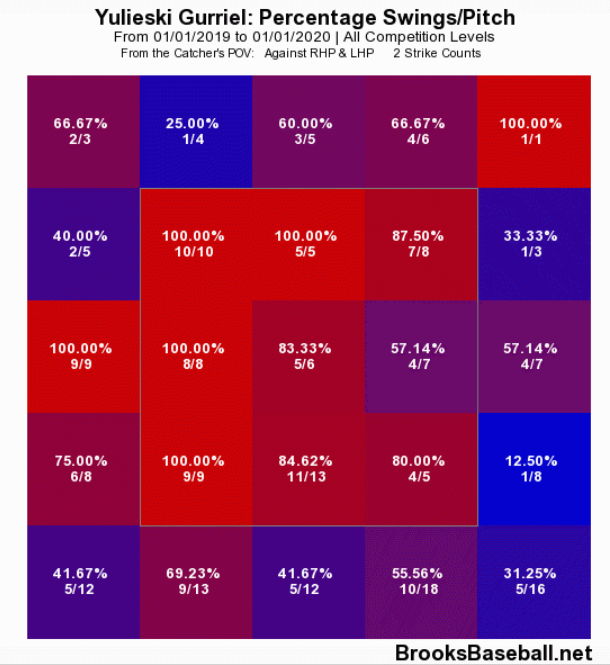
And here is that same chart, but from this season:

I’ll save you the effort of adding up the swing rates on all the pitches inside the strike zone and tell you that from 2016-18, Gurriel saw 348 pitches in the zone with two strikes and swung at almost all of them: 330, or 95%. Most of those were fastballs. Some of the time, he struck out. Other times, he made hard contact. This year, by contrast, Gurriel has swung at 63 of 71 such pitches, or 89%. That six-point drop might not seem like a huge deal, but it’s meant that a whopping 39% of Gurriel’s strikeouts this year have been looking, which is by far the highest figure of his four-year career (his career mark is 23.2%, and last year’s 29% figure was by 11 points a career high). It’s also meant that Gurriel has made less contact when behind in the count this year than ever before.

I’m not sure what to ascribe these changes to. One possibility could be a general discomfort at being called upon to play around the diamond more often due to injuries to George Springer, Carlos Correa, and José Altuve. On its face, that argument doesn’t make much sense: Gurriel played 46 games away from first base even last season, and put up perfectly acceptable offensive numbers, and he’s moved around the infield since his Cuban playing days. Perhaps, though, this season’s situation is different. This year, Gurriel is fielding different positions not because it’s the best matchup given the Astros’ opponents but because A.J. Hinch has to play him there due to injury. That could mean Gurriel is being put into game situations in which he’s not comfortable and to which he hasn’t been exposed before. And he’s perhaps thinking just a little bit too hard about what he has to produce there while his talented teammates recover from injury.

If that’s true, it could explain other changes to Gurriel’s game as well. Prior to 2019, Gurriels’ average launch angle sat right around 10 degrees, but that average masked a distribution that showed that about a quarter of his hits went straight forward on a line (a zero degree launch angle) while another quarter left the bat at about 20 degrees — just enough to get over the heads of the infielders and drop in for hits. This year, his average launch angle has increased — to 15.4 degrees — while the range of angles at which he hits the ball has narrowed. Almost gone are the balls hit straight on a line, and significantly diminished are the 20 degree knocks. More and more of Gurriel’s hits, as a percentage, are coming in that dangerous middle zone where balls in play are somewhat more likely to turn into outs. As a consequence, Gurriel’s .264 BABIP this season is the lowest of his career, even as his hard-hit and contact rates have stayed level.

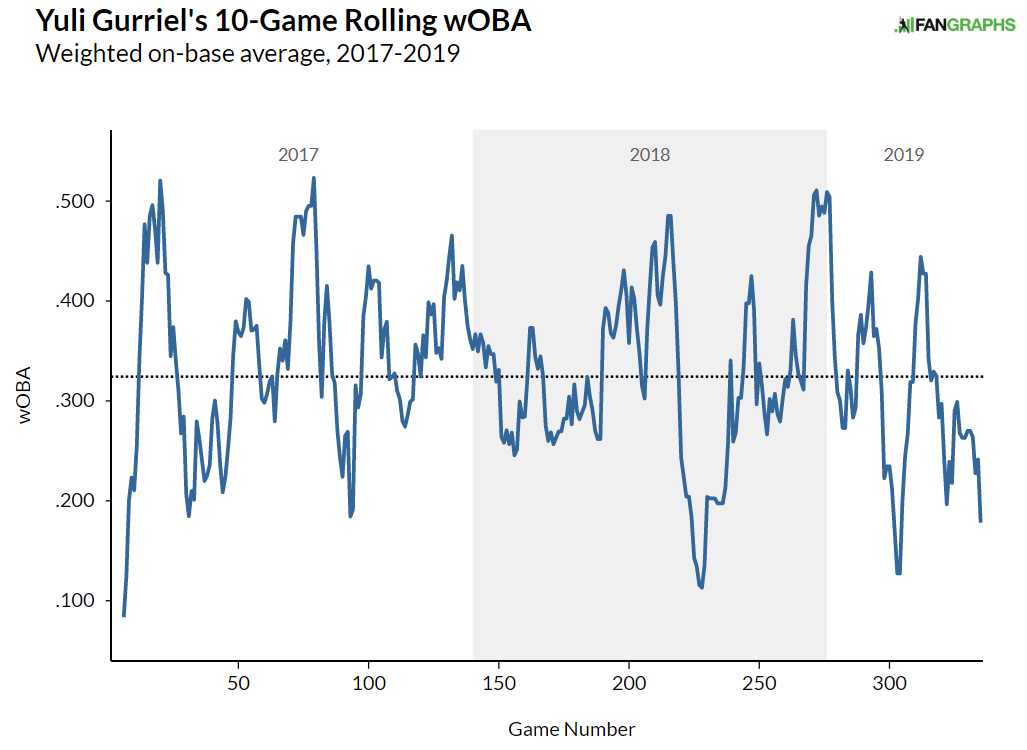
Whatever the cause, things can really only go up from here: Gurriel’s -0.4 WAR is among the 10 worst in the league among qualified players. And there are, despite the poor results, a lot of things going right for Gurriel. His hard-hit rate, contact rate, strikeout rate, and walk rate suggest that his eye at the plate and his ability to do damage to the ball when he makes contact are all working just fine. Perhaps he is trying to lift the ball a little more than is necessary to do damage at the plate, and perhaps that approach — combined with a newfound passivity possibly born of a little bit of overthinking — has turned Gurriel’s performance this year on its head. If that’s the case, it can be remedied: Gurriel’s wOBA has been as low as this before and still rebounded:

With a little perseverance, then — and perhaps a few more swings on strikes in the zone — he could be back to normal for the stretch run. And if this run of poor performance is the result of Gurriel trying to do a little too much at the plate? Well, maybe it’s all right to relax a little bit. All the evidence suggests that he and the Astros are going to be just fine.


Colten Brewer, David Hernandez, and Ryan Yarbrough on Coming Up With Their Cutters

Pitchers learn and develop different pitches, and they do so at varying stages of their lives. It might be a curveball in high school, a cutter in college, or a changeup in A-ball. Sometimes the addition or refinement is a natural progression — graduating from Pitching 101 to advanced course work — and often it’s a matter of necessity. In order to get hitters out as the quality of competition improves, a pitcher needs to optimize his repertoire.

In this installment of the series, we’ll hear from three pitchers —Colten Brewer, David Hernandez, and Ryan Yarbrough — on how they learned and developed their cutters.

———

Colten Brewer, Boston Red Sox

“It started happening in the [2016] offseason that I got Rule-5’ed to the Yankees. When I got to spring training, they said, ‘Hey, the reason we got you is that we noticed some cut on your fastball; we like that.’ I was like, ‘Oh, really?’ I’d been five years with the Pirates, and they didn’t really use that analytical side to baseball. As a result, I didn’t really know much about myself until I got with the Yankees.

“That offseason I’d worked out at a place called APEC, in Tyler, Texas. They were using a Driveline system. Going to a new team, I wanted to show up in spring training in the best shape possible, so I spent a month and half there. That’s where the wheels started turning.

“In the spring, I started throwing more balls in to lefties, and was watching the ball work. From then on I started having natural cut on my fastball. I said, ‘I’m going to use this.’ With the Pirates I’d been more of a sinker guy — I thought arm-side run was better — but after I got to the Yankees I started ripping fastballs as hard as I could, and they were cutting. Read the rest of this entry »


Sunday Notes: Nationals Prospect Rhett Wiseman Knows Baseball is a Business

Rhett Wiseman didn’t sign when he was drafted by the Chicago Cubs out of a Cambridge, Massachusetts high school in 2012. Instead, he attended Vanderbilt University. The reasons were twofold. Education was a priority — he’s since completed his studies and earned a business degree — and the new-at-the-time CBA had squelched any chances of his being coerced with a well-over-slot offer. As I wrote in the hours following that draft, Wiseman was viewed a second-to-fourth-round talent, and fell to the 25th round for just those reasons.

While signing was never a viable option, Wiseman did engage in dialogue with the Theo Epstein-led Cubs.

“We talked a little bit,” Wiseman told me recently. “I spoke to Theo, who I respect greatly, but just like the article you wrote at the time said, it was a situation where teams couldn’t come remotely close to the number that it would have taken to pull me away from the commitment to Vanderbilt. Looking back, I’m glad the slotting system changed in the way that it did, because it made my decision easy.”

The 24-year-old outfielder considers the three years he spent at Vandy “the experience of a lifetime,” but there were still dreams to chase. One year after being part of a team that won the 2014 College World Series, he was drafted by the Washington Nationals in the third round. This time he signed.

Pro ball has proven to be a challenge. Wiseman raked during his final collegiate season — 15 jacks and a .980 OPS — but he hasn’t come close to those numbers in the minors. There have been hot stretches, including this past April when he earned Eastern League player-of-the-month honors, but sustained success has eluded him. Even with his scalding start, he’s slashing .237/.325/.479 in the current campaign.

Wiseman knows as well as anyone that he needs to up his game if he hopes to reach the pinnacle of his profession. Baseball is, after all, a business. If you don’t perform, you’ll all too soon find yourself behind a desk, staring at a computer screen rather than at a man holding a baseball, 60 feet, six inches away.

In terms of truly understanding the ins and outs of the professional game, Wiseman might as well have been a million miles away when he turned down his first chance to sign.

“When you’re in high school, and looking at this whole process, it so isn’t what it seems,” said Wiseman. “You’re living at home and not playing every day. You have school commitments and are thinking about college. You’re still coming into full maturity. So even if you think you know what it’s like, you really don’t. It’s not until you’re in pro ball that you really understand how much of a business this is. It’s a livelihood, and it’s treated as such.” Read the rest of this entry »


Reds and Mets Game the MLB Draft System

Baseball teams continue to search for whatever edge they can find when it comes to bringing cheap, talented players into their organizations. The draft is one of the easiest ways for teams to accumulate talent, as clubs take turns picking the best amateur players in the country, and the Commissioner’s office, as authorized by the CBA between the players and owners, tells teams how much they are allowed to spend. Most amateur players have very little leverage, and generally sign for the recommended slot amount. Because individual draft picks receive a slotted amount, but teams are allowed to spend their entire draft pool in whatever manner they choose, money often gets moved around pick-to-pick, with those players with less leverage receiving much less than the slot amount for their pick while those players with some leverage getting quite a bit more. This year, the Reds, Mets, White Sox, and Marlins all appear to be moving significant money around in an effort to manipulate the draft system to their benefit. Is it worth it though?

While every team moves money around in the draft, these four clubs stood out for drafting hard-to-sign prep players in the early rounds, then taking college seniors with multiple picks later in the first 10 rounds. Presumably, the college senior picks will sign for amounts significantly under their slot value (you can find all the slot values here), meaning the savings can be used to sign the prep players who threatened to go to college if their bonus demands are not met. Here are the teams, players, slot amounts, and the number of senior signs for each team.

Potential Overslot Draft Picks
Team Player Pick Slot Senior Signs
White Sox Andrew Dalquist 81 $755,300 6
Reds Tyler Callihan 85 $710,700 3
Mets Matthew Allan 89 $667,900 7
Marlins Evan Fitterer 141 $390,400 7

All four players are likely to require more than their draft slot provides in order to sign a contract with their drafting teams. Tyler Callihan has reportedly agreed to a deal for $1.5 million. Allan is rumored to have an asking price of about $3 million, which might be why the Mets selected seniors with seven picks in the first 10 rounds. The slot for Evan Fitterer is pretty low, requiring the Marlins to make sacrifices with many of their subsequent picks. We don’t yet know exactly what it will take to sign all of the players listed, but we do have an idea of how much value teams gave up in later rounds, as well as the expected value of the players who were picked. Read the rest of this entry »


Dallas Keuchel Heads to Atlanta

The Atlanta Braves and Dallas Keuchel agreed to terms on a contract Thursday night, thus ending baseball’s short free agency burst following the conclusion of the MLB Draft. Keuchel’s one-year, $13 million deal will enable him to enter the free agent market after the 2019 season with a clean slate, without any qualifying offer compensation pick baggage to reduce his value to a new team (or offer an excuse not to sign him).

We’ve seen this short-term playbook before from the Braves before, so it’s unsurprising to see them commit to a one-year (in reality, four-month) contract for Keuchel. The offseason in Atlanta was quieter than expected, with the team — or more accurately Liberty Media, the ownership group — choosing not to try to splash cash in the direction of Manny Machado or Bryce Harper like some of the other Johnny-come-soonlys in baseball. The only significant signing the team made was a one-year deal with Josh Donaldson for $23 million.

The $13 million is $13 million straight-up, something that shouldn’t necessarily be taken for granted as these types of midseason contracts tend to be a bit strange. For example, when Roger Clemens signed a one-year contract worth $28,000,022 (the beer money at the end to match his uniform number), that figure represented what it would’ve been over an entire season; Clemens only made a little under $20 million, with the money starting to flow when he made his season debut for the Yankees in June.

The reasons the Braves signed Keuchel to a short-term contract are similar to those behind their Donaldson deal: the team has a very deep stable of prospects and doesn’t necessarily want to commit to Keuchel long-term any more than they wanted to with Donaldson.The long-term solution at third base was always Austin Riley, but with the team coming off an NL East crown and still very likely to be just as competitive in 2019, they wanted a safer short-term option. Enter Donaldson The exact pitcher for whom Keuchel is keeping a seat warm is unclear, but the Braves have enough interesting candidates that the assumption is the question will work itself out over time.

The issue for Atlanta was that that question was not working itself out as quickly as the team hoped. The Braves starters have combined for a 4.38 ERA (19th in MLB) and 3.6 WAR (also 19th) and while those numbers aren’t the worst among 2019’s contenders, the rotation clearly has not been enough of a positive asset. And obviously, this matters quite a bit, with the Braves looking up at the Phillies in the NL East by a two-game margin. Atlanta’s rotation as of this moment has more question marks than they did at the start of the season.

Kyle Wright, Sean Newcomb, Bryse Wilson, and Touki Toussaint have all had brief stints in the rotation, with all four losing those jobs quickly (the latter two after their first starts). You can make a pretty good argument that the Braves have perhaps been a bit impatient with some of these pitchers, but it’s hard to blame the team for their urgency.

Perhaps more rope would have been given if Mike Foltynewicz and Kevin Gasuman were meeting expectations.

Folty’s spring was marred by elbow problems and while his health doesn’t appear to be a question, his velocity and his slider have been. His velocity has recovered, with his fastball in recent starts in the 95-96 mph range, much closer to the 96-97 mph he showed throughout 2018 than the 93-95 he initially came back with in late April. But the slider is still missing bite and that’s a crucial pitch in his repertoire. The former Astro’s breakout 2018 was mostly due to his slider, which ranked fourth in our pitch values, behind only those of Patrick Corbin, Jhoulys Chacin, and Miles Mikolas. Batters only hit .106 against his sliders last year and only mustered a .183 slugging percentage. In just over a month of pitching, he’s allowed almost as many extra-base hits on sliders (9) as he did in all of 2018 (11). And looking at his Statcast data, he’s lost three inches of vertical movement and two inches of horizontal movement from last season.

Kevin Gausman’s ERA remains above six, a disturbingly high number considering that we’re now in June. Given that his FIP is a much better 4.03, Gausman’s poor bottom-line run prevention has some mitigating factors, including a .331 BABIP and a bullpen that hasn’t had his back (58% LOB compared to 72% league-average). But as with the Braves’ lack of patience with the young pitchers hitting roadblocks, Atlanta just doesn’t have the time to hang around and hope that Gausman turns his theoretical run-prevention back into actual run-prevention. Gausman’s done himself no favors by narrowing of his repertoire; he’s essentially been a fastball/splitter-only pitcher in 2019, with his slurve largely abandoned. He’ll likely end up in the bullpen for now, which may be a better fit for a two-pitch hurler still missing his former high-end heat.

Under the set of circumstances Atlanta is facing, not only is Keuchel a good signing, but the terms make it one of the best potential buys this year. It’s still strange to call $13 million nothing, but in terms of major league free agency, these are nanoscopic potatoes. You can’t spend as much as you want on amateur free agents or draft picks. You don’t have an unlimited supply of prospects to trade for short-term gains. But you can spend all you want on free agents, with the only limitation being the luxury tax threshold, which is still a softer roadblock than the severe penalties for overspending on other avenues of talent acquisition. That’s not a problem for the Braves, who could sign James Shields to a one-year, $50 million deal and still be short of the Danger Zone. (Warning: You should probably not sign James Shields for one year and $50 million.)

Having the opportunity to sign a legitimate free agent in midseason is pretty rare, but Keuchel’s unusual market afforded the Braves the chance to add a player who might not have seemed necessary for the team in January, but who addresses an obvious need now. One remaining question, perhaps one left unanswered and lost in time: did the Braves need to wait this long to sign Keuchel? After all, given how quickly they cycled through the pitching prospects, the team certainly understood how urgent the rotation issue was. It may not have been obvious in March, but the weakness was apparent certainly by mid-April. In terms of free-agent compensation, Craig Edwards estimated that signing Keuchel would have an additional cost of $4.7 million for Atlanta, hardly a crippling loss. What part of this late signing was the draft pick value (or a more general reluctance to spend on free agents) and what part was Keuchel and his agent preferring to have more teams in the bidding such as the Yankees ($10.6 million loss), Cardinals ($7.4 million), or the Cubs ($6.8 million)? If only houseflies on walls had tape recorders, or whatever the kids are calling those today.

ZiPS has been more of a fan of Keuchel, at least in 2019, than the other projection systems, so it’s unsurprising it gave a digital thumbs-up to this signing to go along with my analog one. The penalty used for his missing time is relatively tame as there’s no injury involved, and most players out voluntarily don’t return in as brutally an inept fashion as Kendrys Morales did after ending his 2014 hiatus. That history doesn’t suggest a huge penalty is hardly surprising, as most players don’t use that time sitting around eating cookies, playing video games, and watching reruns of Press Your Luck. Even I don’t eat that many cookies working at home in a decidedly non-athletic capacity.

ZiPS projects a 116 ERA+ and 1.6 WAR for Keuchel with the assumption that he needs a few weeks to be ready to pitch in a major league game. Atlanta will take that and honestly, probably be happy with less. Because if you’re not using money to sign Keuchel, your other options for signing pitchers using just money are Shields or Yovani Gallardo or Miguel Gonzalez, and so on. Keuchel adds just a hair over a win compared to the likely other options and in the NL East, that win might actually matter.

ZiPS Projected Standings, 6/7/19 (Pre-Keuchel)
Team W L GB PCT Div% WC% Playoff % WS Win% No. 1 Pick Avg Draft Pos.
Atlanta Braves 88 74 .543 51.1% 21.7% 72.8% 4.2% 0.0% 21.2
Washington Nationals 85 77 3 .525 22.9% 24.4% 47.3% 2.1% 0.0% 18.7
Philadelphia Phillies 85 77 3 .525 20.8% 23.6% 44.3% 1.9% 0.0% 18.4
New York Mets 80 82 8 .494 5.2% 10.1% 15.3% 0.5% 0.0% 14.9
Miami Marlins 59 103 29 .364 0.0% 0.0% 0.0% 0.0% 22.8% 2.3

ZiPS Projected Standings, 6/7/19 (Post-Keuchel)
Team W L GB PCT Div% WC% Playoff % WS Win% No. 1 Pick Avg Draft Pos.
Atlanta Braves 89 73 .549 60.1% 20.4% 80.6% 5.1% 0.0% 22.1
Washington Nationals 85 77 4 .525 18.8% 26.6% 45.3% 1.9% 0.0% 18.6
Philadelphia Phillies 85 77 4 .525 17.0% 25.5% 42.6% 1.7% 0.0% 18.3
New York Mets 80 82 9 .494 4.1% 10.2% 14.2% 0.5% 0.0% 14.8
Miami Marlins 58 104 31 .358 0.0% 0.0% 0.0% 0.0% 23.6% 2.3

Is adding a Keuchel a giant, season-changing move? Of course not, but those are more or less unicorns; situations like the Giants picking up Randy Winn midseason and getting 3.6 WAR in 58 games are highly unusual. From the projections, the Braves have turned about 20% of the scenarios in which they don’t win the NL East into NL East titles, and erased about 30% of their non-playoff finishes from the timeline. Without trading prospects or developing time travel technology, the Braves made as good an acquisition as you realistically can make in June. Of course, we could have said the same thing in May.