Archive for Teams

Houston Survives Late Inning Scare, Beats Yankees in Six

After what was otherwise a fairly quiet affair punctuated by the occasional home run, the Houston Astros won Game 6 of the American League Championship Series 6-4 on a walkoff home run from José Altuve. Houston takes the series four games to two, and avoids a high-stakes Game 7 that would have left Gerrit Cole unavailable in the World Series until the third game.

The evening got off to an inauspicious start for the Yankees as Houston’s first entrant in the bullpen battle, Brad Peacock, quickly dispatched DJ LeMahieu, Aaron Judge, and Gleyber Torres with seven pitches. Chad Green opened for New York and didn’t perform as well in his half of the inning as Peacock did in his. Green was perhaps fortunate to escape a rather pedestrian slider to Altuve with only a double, but he was less lucky with a high, very inside fastball to Yuli Gurriel, which the first baseman turned on for a home run to give the Astros an early 3-0 lead. That high, inside fastball isn’t usually that dangerous for a pitcher; there were only 13 home runs hit this year by right-handed hitters swinging at a four-seamer in Statcast’s inside and high-inside “chase” zones. Coincidentally enough, Gurriel had one of those home runs, comfortably turning on a sorta-fastball from Trevor Williams. This might have been one of the highest-leverage of those since Kit Keller’s.

Read the rest of this entry »


Sunday Notes: Giants Righty Tyler Rogers is Thriving as a Submarine-Style Sibling

Here’s the lowdown on Tyler Rogers: A 6-foot-5 right-hander from Littleton, Colorado, he’s the twin brother of a left-hander closer, he made his MLB debut this past August, and he’s a submariner. Moreover, he kills a lot of worms. The 1.02 ERA that Rogers put up in 17 games out of the San Francisco Giants bullpen was augmented with a 69.4% ground ball rate.

Unlike his traditional-arm-slot sibling, he’s not a power pitcher. Taylor Rogers — fittingly, a Minnesota Twin — features a 95-mph fastball and an 83-mph slider. Tyler features an 82-mph sinker and a 73-mph slider. The latter pitch, which the atypical hurler throws roughly a third of the time, is atypical in itself.

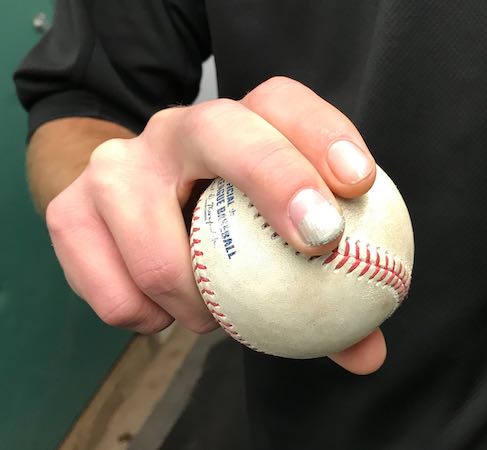
“I call it a slider, but it’s almost a curveball,” Rogers said in September. “I kind of curl it like people do when they throw a curveball overhand. It’s the same thing, I’m just bent over doing it. So yeah, basically it’s just a normal curveball grip that I throw from underneath.”

Rogers began dropping down his freshman year of junior college. He did so at the suggestion of a coach, and from there progressively got lower and lower. The transformation to an actual submarine-style delivery came after the Giants took him in the 10th round of the 2013 draft. Irony being what it is, the genesis of the more-extreme verticality was horizontal in nature. Read the rest of this entry »


Yankees Stave Off Elimination and Send ALCS Back to Houston

NEW YORK — The Yankees may not win this year’s American League Championship Series. They may not become the 14th team to rally from a three-games-to-one deficit in a best-of seven, or the eighth to do so by finishing the job on the road — particularly against an Astros team with the majors’ best record and an historically powerful offense. But in the wake of a demoralizing Game 4 loss full of missed opportunities, sloppy defense, and the sudden end of CC Sabathia’s career, they met manager Aaron Boone’s immediate goal of sending the series back to Minute Maid Park with a 4-1 victory that featured strong work by starter James Paxton and a four-run first inning against Justin Verlander, featuring a pair of homers by DJ LeMahieu and Aaron Hicks.

“He’s got to go out and pitch well and set the tone for us,” Boone said of Paxton prior to the game, “because we’ve got to get on that plane and go back to Houston.”

The tone early on Friday evening was all too reminiscent of Thursday’s late-inning sloppiness. Second baseman Gleyber Torres, who made errors in each of the final two innings of Game 4, mishandled leadoff hitter George Springer‘s grounder, which had slipped under Paxton’s glove, though the ball was scored a single. Springer then took second on a passed ball by Gary Sánchez, advanced to third on Jose Altuve’s grounder, and scored on a wild pitch. It was an all-too-familiar story for Paxton, whose 29 first-inning runs allowed in 29 starts tied for the major league lead.

That was all the Astros would get from him, however. Both Alex Bregman and Yuli Gurriel scorched line drives to the outfield —  98.4 mph for the former to left, with Brett Gardner chasing it down, and 96.8 for the latter to center, but right at Hicks — and so Paxton escaped by allowing just one run. He’d failed to get ahead of any of the five batters he faced, gotten just one swinging strike on a total of 23 pitches, and his defense looked anything but sharp. With the Yankees desperately needing length given their plans for an all-bullpen Game 6, it was not an encouraging beginning. Read the rest of this entry »


Justin Verlander’s Innings Could Fill a Boat

As Justin Verlander takes the mound tonight, he’ll do so with 240.1 innings pitched this season between regular season and playoffs. In the last three seasons, Verlander’s 2019 campaign is just the second to go at least 240 innings; his 242.2 inning in 2017 is the other. Since 2011, there have been 26 seasons during which pitchers have thrown at least 240 innings. Verlander accounts for five of them. If he makes a decent start tonight and Houston advances to the World Series, he’ll likely be the first pitcher to go over 250 innings in a season since 2014, when James Shields, Madison Bumgarner, and David Price all eclipsed that mark. Verlander’s quality deservedly receives the bulk of the attention when analyzing the ace, but the quantity deserves accolades as well.

If we look a single player’s career and then compare his totals to his peers only during those seasons when he was active, it is bound to be misleading, as it cuts off the careers of others at the beginning and end where fuller comparisons are better made. For example, Justin Verlander’s 72 WAR is first among all pitchers since 2006 when he pitched his first full season. That Verlander was the best pitcher in baseball over that time is a defensible argument, but it should be noted that Clayton Kershaw is just seven wins behind Verlander and five years younger. If we looked at the leaders from 2006-2026, Verlander might not be first. Similarly, if we go back to 1996, we see Randy Johnson and Pedro Martinez jump ahead of Verlander. If we go back to 1986, Roger Clemens and Greg Maddux are more than 40 wins ahead of him, with Mike Mussina, Curt Schilling, John Smoltz, and Kevin Brown also in possession of a higher WAR. This isn’t to take away anything from Verlander — the other pitchers discussed are all great. But it is a reminder that selectively choosing seasons can skew the results. Read the rest of this entry »


How to Neutralize a Rookie Sensation

Yordan Alvarez is the favorite to win the AL Rookie of the Year Award. He completely demolished opposing pitching this year, first in Triple-A (170 wRC+), then in the majors (178 wRC+) after being called up in early June. Between the two levels, he launched 50 home runs while showing elite plate discipline. But this October, he’s been a non-factor for the Astros.

He showed some life against the Rays, going 6-for-19 with three doubles in that five game series. But against the Yankees, he’s been completely shut down. He collected his first hit of the Championship Series last night, a broken bat single off Chad Green. He’s reached base just three other times against Yankees pitching, drawing two walks and reaching on an error. Overall, he’s slashing just .206/.270/.294 in nine postseason games.

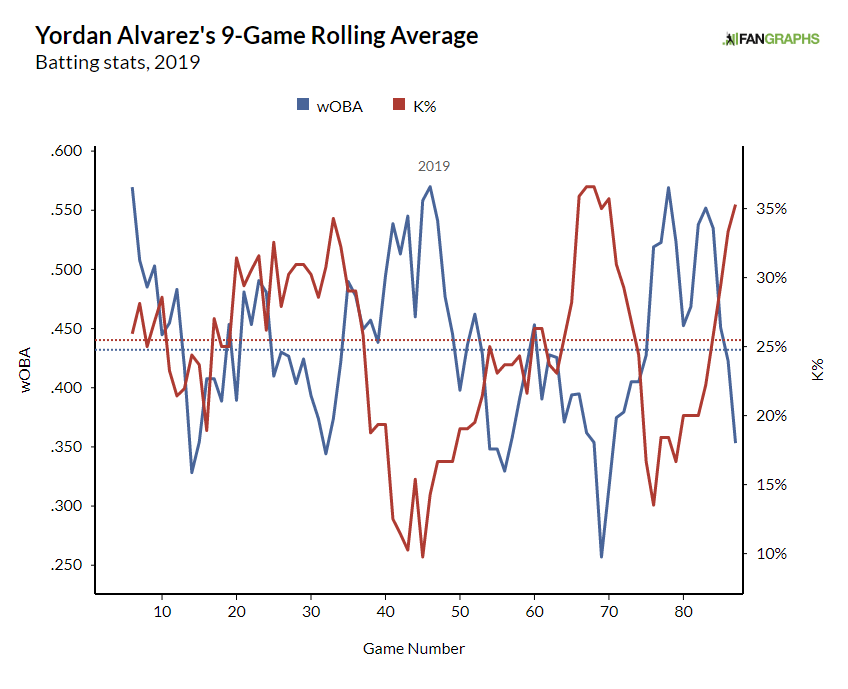
What’s even more concerning is his elevated strikeout rate. He struck out just over a quarter of the time he came to the plate during the regular season. That’s jumped up to 37.8% in the postseason. During the regular season, Alvarez never had a nine-game stretch as poor as this one.

There was a nine-game stretch ending on September 6 during which he posted a strikeout rate of 36.6%. But he also launched three home runs over that span, something he hasn’t been able to do during the postseason. Obviously small sample caveats apply here, but it appears as though both the Rays and the Yankees have found similar approaches to neutralizing the 22-year-old rookie. Read the rest of this entry »


CC Sabathia’s Storied Career Reaches a Rough Ending

The Yankees’ 8-3 loss in Game 4 of the ALCS did not eliminate them, but between their missed opportunities early (stranding five runners in scoring position in the first five innings) and their sloppiness late (four errors over the final four innings), the game had an air of finality about it. Nowhere was that more true than in the case of CC Sabathia, who departed due to a shoulder injury in what will stand as the final appearance of a 19-year major league career that may well be capstoned by a plaque in Cooperstown.

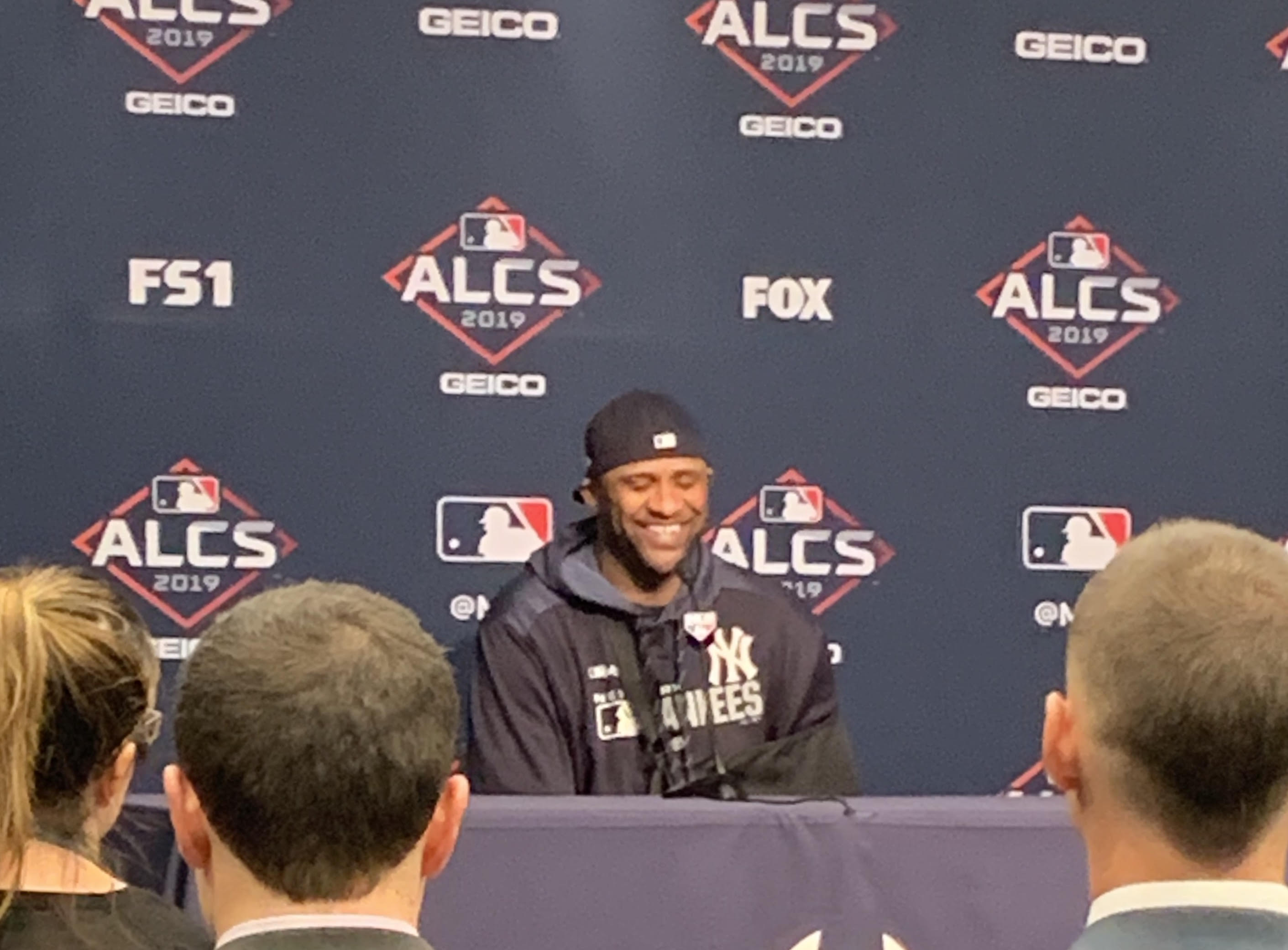
On Friday morning, the Yankees announced that Sabathia had experienced a subluxation of his shoulder joint and replaced him on the roster with righty Ben Heller. The move means that he would not be allowed to be reactivated for the World Series, almost certainly a moot point given the condition of his shoulder, to say nothing of the Yankees’ precarious position. Sabathia, who appeared to be in good spirits during a pregame press conference on Friday despite pain that he described as “pretty intense,” said that he would “maybe get an MRI after we get back from Houston” and that he doesn’t know yet whether he will need surgery.

Dropped into a difficult situation in his second relief appearance of the series and just the fourth of his career — runners on second and third with no outs in the top of the eighth, with the Yankees already down 6-3 — Sabathia was victimized by the first of Gleyber Torres‘ two errors when Yordan Alvarez’s chopper deflected off the second baseman’s right hand as he positioned himself to throw home; Alex Bregman scored on the play, and Alvarez was safe at first. After retiring Carlos Correa on a soft liner to right field, one in which Aaron Judge nearly doubled Yuli Gurriel off second base, Sabathia hit Robinson Chirinos on the left elbow with a pitch, loading the bases. He got Aledmys Diaz to pop up to shallow right, keeping Gurriel from scoring, but after missing inside on a 1-1 cutter to George Springer, Sabathia grimaced, and both manager Aaron Boone and head athletic trainer Steve Donohue came to the mound.

According to Sabathia, his shoulder popped during his last pitch to Diaz: “I just felt like when I released the ball, my shoulder kind of went with it.” In other words, he pitched through a partial separation when he faced Springer, throwing a first-pitch cutter that reached 91.2 mph.

After throwing one warm-up pitch to check if he could continue, Sabathia told Boone and Donohue, “I’m done,” shook his head, and then departed to a heartfelt ovation from the Yankee Stadium crowd as well as both dugouts. The FS1 broadcast showed both Springer and Gerrit Cole paying their respects, then a slump-shouldered Sabathia covering his face with his glove, understandably overcome with emotion but — and maybe this is just a scribe projecting — ever so slightly tipping his cap to the crowd even as he did. It wasn’t easy to watch, and you’re by no means obligated to, but here’s the whole scene: Read the rest of this entry »


The Yankees Still Need Adam Ottavino

Last offseason, the Yankees gave Adam Ottavino a three-year, $27 million contract, a move that added yet another high octane arm to their already-loaded bullpen. And unlike some reliever contracts, it has worked out quite well thus far.

Ottavino had a solid first year in New York. His 1.90 ERA was a career-best, as was his 2.5 RA9-WAR. His 3.44 FIP (74 FIP-) and 4.32 xFIP (94 xFIP-) suggested that he was probably quite a bit worse than his ERA indicated, due to a year-over-year strikeout rate that fell from 36% to 31% and a walk rate that ballooned from 12% to 14%. So, yes, Ottavino wasn’t nearly as dominant in 2019 as he was the year before, but that doesn’t mean he wasn’t useful in the Big Apple. His 1.3 WAR ranked 22nd among all relievers and second on the team.

We could dig deeper into Ottavino’s 2019 campaign if we so desired, but that’s not why he’s relevant right now. The 66 and third innings he pitched during the regular season were important, but they are not nearly as meaningful as the two and one-third innings he’s pitched so far this postseason. Ottavino has faced just 18 hitters this October, but the Yankees have already been ridiculed for “making a big mistake” in sticking with him.

Perhaps this is a fair argument; Ottavino’s October results certainly reflect the rationale behind the criticism. Of the 18 batters he has faced, seven of them have recorded hits, three more have walked, and just seven have made outs. The slash line against Ottavino is ugly: .467/.556/.800.

Read the rest of this entry »


Job Posting: Brewers Baseball Research and Development Analyst and Intern

Please note, this posting contains two positions.

Position: Baseball Research and Development Analyst

Location: Milwaukee, WI

Summary:
The Analyst – Baseball Research & Development will deliver research and tools to improve decision making across Baseball Operations. The position requires a person who has intellectual curiosity, is a self-starter and can communicate technical and analytical concepts effectively to non-technical people. Being passionate about using data, analysis and technology to improve decision making processes is also a key differentiator. Residence in Milwaukee is required.

Responsibilities:
Essential Duties and Responsibilities include the following. Reasonable accommodations may be made to enable individuals with disabilities to perform the essential functions. Other duties may be assigned.

  • Evaluate existing data sources and build predictive or explanatory models to aid in a variety of player acquisition, player development and gameplay decisions.
  • Investigate emerging data sources and identify potential for predictive value and actionable insights to improve decision making.
  • Develop visualizations and other mechanisms for disseminating analytical results to the front office, player development staff, and other baseball employees – including consideration for less technically and analytically inclined consumers.
  • Continually survey latest analytical methods and advancements in baseball and sports research to apply cutting-edge methods and data to problems.
  • Understand current decision processes and information systems and offer enhancements and improvements.
  • Answer ad-hoc requests for reports, visualizations and research projects.

Qualifications:
To perform this job successfully, an individual must be able to perform each essential duty satisfactorily. The requirements listed below are representative of the knowledge, skill, and/or ability required.

  • Understanding of statistics and modeling techniques, including probability, linear regression and logistic regression.
  • Proficiency with an analytical programming language required, R or Python preferred.
  • Proficiency with SQL and SQL databases required, Microsoft SQL or PostgreSQL preferred.

Education and/or Experience:
Bachelor’s degree (B.S./B.A.) or equivalent experience is required. Advanced degree or current pursuit of advanced degree is desirable.

Other Skills and Abilities:
The individual must be capable of working extended hours such as overtime, nights, and weekends, when necessary. Occasional travel to affiliates or conferences may be required.

To Apply:
To apply, please complete the application that can be found here.

Position: Baseball Research and Development Intern

Location: Milwaukee, WI

Summary:
The Intern – Baseball Research & Development will design and execute a strategic research project with the assistance of experienced mentors. The internship program is designed to give the candidate real-world experience in a Baseball Research & Development department, including exposure to development processes and best practices. Residence in Milwaukee is required.

Responsibilities:
Essential Duties and Responsibilities include the following. Reasonable accommodations may be made to enable individuals with disabilities to perform the essential functions. Other duties may be assigned.

  • Work closely with R&D mentor to define and outline a meaningful project.
  • Design approach to address chosen topics leveraging existing and new data sources to build predictive or explanatory models.
  • Develop and propose project solutions using various coding languages and/or database queries that adhere to coding best practices.
  • Collaborate with other interns, R&D team members and other front office staff on various projects and initiatives.
  • Participate in code reviews with members of the R&D staff as part of a robust development process.
  • Create reports, visualizations and other documentation explaining the project.

  • Present project results to members of the Baseball Operations Department.
  • Answer ad-hoc requests for reports, visualizations and research projects.

Qualifications:
To perform this job successfully, an individual must be able to perform each essential duty satisfactorily. The requirements listed below are representative of the knowledge, skill, and/or ability required.

  • Understanding of statistics and modeling techniques, including probability, linear regression and logistic regression.
  • Demonstrated experience with applied research required. Can be through a previous job role, schoolwork, or independent research and does not need to be baseball-related.
  • Proficiency with an analytical programming language required, R or Python preferred.
  • Proficiency with SQL and SQL databases required, Microsoft SQL or PostgreSQL preferred.
  • Deep knowledge of baseball rules, gameplay and player acquisition approaches.

Education and/or Experience:
Bachelor’s degree (B.S./B.A.) or current pursuit of Bachelor’s degree in a technical or scientific field, or equivalent experience is required. Advanced degree or current pursuit of advanced degree is desirable.

Other Skills and Abilities:
The individual must be capable of working extended hours such as overtime, nights, and weekends, when necessary. Travel to affiliates may be possible.

To Apply:
To apply, please complete the application that can be found here.

The content in this posting was created and provided solely by the Milwaukee Brewers.


The Astros Edge Toward the World Series

The Astros beat the Yankees 8-3 last night, moving within a win of their second World Series berth in three years, but the night didn’t have to turn out that way. The victory was comprehensive — Houston out-homered the Yankees, had more non-homer hits, struck out less than half as often, and committed three fewer errors. Five runs is an odd lead, but it’s also the first truly safe lead in baseball. The Astros could have spotted the Yankees a grand slam before the game and still come out ahead.

But baseball doesn’t really work that way. If the Yankees had started the game ahead 4-0, things would have gone differently. Batters wouldn’t have gotten the same pitches, different Yankees relievers would have thrown, A.J. Hinch would have been forced to manage differently; the things that happened last night weren’t deterministic, destined to play out in the same order regardless of circumstance.

So with that in mind, let’s look at a few places where the Yankees could have changed history. They might have lost anyway, and they might have won — but they had their chances to do something, and simply didn’t make the most of them.

Gary Sánchez Bats in the First
Gary Sánchez bats seventh for the Yankees, so when he appears in the first inning, something has gone very right. Not only that, but he came up with the bases loaded; Zack Greinke looked shaky, with three walks on the night already, and Sánchez had a chance to deliver a decisive blow early. Read the rest of this entry »


Job Posting: Nationals Baseball Research & Development Analyst and Data Engineer

Please note, this posting contains two positions.

Position: Analyst, Baseball Research & Development

Location: Washington, D.C.; West Palm Beach, FL

Summary:
The Washington Nationals are seeking a data analyst to join their Baseball Research & Development team. The role will focus on using the tools of data science to derive insights from baseball datasets to support decision making related to player evaluation, player development, roster construction, and in-game strategy. The analyst will work on projects both independently and collaboratively with other baseball R&D analysts and developers. Candidates should be passionate about both baseball and data analysis.

The Washington Nationals are committed to creating a diverse environment and is proud to be an equal opportunity employer. All qualified applicants will receive consideration for employment without regard to race, color, religion, gender, gender identity or expression, sexual orientation, national origin, genetics, disability, age, or veteran status.

Essential Duties and Responsibilities:

  • Build predictive models to answer baseball research questions and support organizational decision making.
  • Collaborate on projects with other analysts in baseball R&D and other stakeholders in baseball operations.
  • Perform analyses at the request of members of the baseball operations, player development, and advance scouting.
  • Design and build informative data visualizations for use in automated reports or internal web applications.
  • Write scripts for cleaning, processing, and summarizing datasets.
  • Review public research in baseball, statistics, and machine learning.

Requirements:
Minimum Education and Experience Requirements

  • Advanced degree or equivalent experience in statistics, computer science, machine learning or a related field.
  • Experience with analyzing datasets and training statistical models using R or Python.
  • Experience working with SQL databases.
  • Authorized to work in the United States.

Knowledge, Skills, and Abilities necessary to perform essential functions:

  • Independent worker with close attention to detail.
  • Creative and analytical thinker.
  • Ability to write and communicate clearly and effectively.
  • Enthusiasm for learning new skills related to programming, statistical modeling, data visualization, and using software tools.
  • Demonstrated passion for baseball and working in baseball operations.
  • Working knowledge of sabermetric concepts.
  • Uphold Core Values: Excellence, Performance, and Accountability. These core values set the tone in everything we do, help us succeed on and off the field, make a difference in the community and provide the best guest experience in sports. It is important that the person in the position commits themselves to these core values so that we can constantly move forward in the same direction – Together.

Physical/Environmental Requirements:

  • Office: Working conditions are normal for an office environment. Work may require occasional weekend and/or evening work.
  • Analysts are expected to attend at least half of the Nationals home games. Meals are provided to staff during the games.

To Apply:
To apply, please complete the application that can be found here.

Position: Data Engineer, Baseball Research & Development

Location: Washington, D.C.; West Palm Beach, FL; Remote

Summary:
The Washington Nationals are seeking a data engineer to join their Baseball Research & Development team. The role will focus on building solutions for importing, storing, and delivering datasets to support the work of data analysts and software developers in the baseball R&D group.

The Washington Nationals are committed to creating a diverse environment and is proud to be an equal opportunity employer. All qualified applicants will receive consideration for employment without regard to race, color, religion, gender, gender identity or expression, sexual orientation, national origin, genetics, disability, age, or veteran status.

Essential Duties and Responsibilities:

  • Maintain database systems to support the needs of data analysts, software developers, and front office staff.
  • Oversee the import of baseball datasets from various sources and ensure data quality and integrity.
  • Build solutions for integrating datasets from different sources.
  • Explore new technologies or possible improvements to our data infrastructure.

Requirements:

  • Minimum Education and Experience Requirements
  • Bachelor’s degree in computer science, computer engineering, information science, or related experiences.
  • 3+ years of experience working with SQL database systems (MySQL, MariaDB, PostrgreSQL). Understanding of relational database schema design.
  • Working knowledge of NoSQL database systems, such as MongoDB.
  • Fluent in a scripting language such as bash, Python, or R.
  • Experience working on Linux systems.
  • Familiarity with cloud computing platforms, such as AWS.
  • Authorized to work in the United States.

Knowledge, Skills, and Abilities necessary to perform essential functions:

  • Independent worker with close attention to detail.
  • Creative and analytical thinker.
  • Ability to write and communicate clearly and effectively.
  • Enthusiasm for learning new skills related to programming, databases, and using software tools.
  • Uphold Core Values: Excellence, Performance, and Accountability. These core values set the tone in everything we do, help us succeed on and off the field, make a difference in the community and provide the best guest experience in sports. It is important that the person in the position commits themselves to these core values so that we can constantly move forward in the same direction – together.

To Apply:
To apply, please complete the application that can be found here.

The content in this posting was created and provided solely by the Washington Nationals.