Archive for Teams

Jerry Blevins, Taylor Guerrieri, and Lance McCullers Jr. on Developing Their Curveballs

Pitchers learn and develop different pitches, and they do so at varying stages of their lives. It might be a curveball in high school, a cutter in college, or a changeup in A-ball. Sometimes the addition or refinement is a natural progression — graduating from Pitching 101 to advanced course work — and often it’s a matter of necessity. In order to get hitters out as the quality of competition improves, a pitcher needs to optimize his repertoire.

In this installment of the series, we’ll hear from three pitchers — Jerry Blevins, Taylor Guerrieri, and Lance McCullers Jr. — on how they learned and/or developed their curveballs.

———

Jerry Blevins, Mets

“The story starts as a kid. You start learning about curveballs, and the reason mine is big and slow is because I wanted to visualize it. A lot of those smaller breaking balls you don’t really see from the perspective of a pitcher. I wanted to see the big break. That’s why mine is how it is.

“Did anyone ever try to change that? All the time. Every step of the way, coming through the minor leagues. Even in high school and little league. They were always telling me, ‘Look, you need something tighter.’ I always fought against that, and I think it’s done me well.

Read the rest of this entry »


Elegy for ’18 – Texas Rangers

After entering the season as a question mark, Jurickson Profar leads the team in WAR.
(Photo: Keith Allison)

With the Texas Rangers, we get to the first team that’s actually rebuilding rather than Rebuilding™. While the prospect of contending at the same time didn’t exactly come to fruition — Texas is the sixth team in this series, after all — the Rangers are making a legitimate go at threading the needle between competing in the present and preparing for the future.

The Setup

Because they’re both based in Texas, it’s natural to think of the Rangers’ attempts to become relevant again in the context of the Astros’ own efforts. The two cases might not be precisely analogous, however: while Houston absolutely needed to take their own house down to the studs, Texas may be able to escape without going to such extremes. The Rangers had much higher payrolls baked into the cake in 2017 than Houston ever did, with little real hope of shedding most of those high-end costs. Texas has also never let the farm system sink to the levels of voiditude of those late Ed Wade Astros teams or recent rebuilders like the Orioles or Marlins.

Read the rest of this entry »


FanGraphs Book Club – Up, Up & Away

Jonah Keri’s history of his boyhood team was a national bestseller.

Hi everyone! Welcome to the second live chat of the FanGraphs Book Club! We’ll get started at 9 pm ET, and Jonah will join us at 9:30. That’ll give us all 30 minutes to talk about the book amongst ourselves, and line up some really great questions for him. So, I would say, don’t put questions in for Jonah now, let’s save those until he logs on to the chat.

I hope you all are as excited as I am to talk baseball books! As a reminder, if you want to join our Facebook Group you can do so here.

Chat transcript:

9:02
Paul Swydan: Hi everybody!

9:02
Andrea’s Fault: What’s the best beer to go with this chat–and I hope it’s not just Labatt’s or Molson.

9:03
Paul Swydan: How about a Molson 5X? You know Canadian beer is like moonshine.

9:04
Paul Swydan: So, I’m excited to chat about this book! I remember getting an early copy of this book to review it for The Hardball Times. It was pretty thrilling.

9:05
Paul Swydan: “The Extra 2%” was a good book, but I sort of knew the broad strokes, having been in the sabermetric world for most of the success part of the story. But the Expos? I didn’t know much about the Expos before they wanted to acquire Casey Fossum for Pedro Martinez.

9:07
Gabe: This book is so good it’s in the curriculum for a class I’m taking on baseball in Canadian culture.

Read the rest of this entry »


Orlando Arcia Bunted for a Double

During their Friday night game in Milwaukee, the Pirates wouldn’t have expected Orlando Arcia to be such a nuisance. Out of every batter this season with at least 250 plate appearances, Arcia ranks third from the bottom in wRC+. Taking a deeper look at expected wOBA, based on Statcast-tracked batted balls, Arcia ranks dead last. Furthermore, and more importantly, Arcia wasn’t even in the starting lineup. The Brewers had Jonathan Schoop at shortstop. Arcia only entered during a top-of-the-fifth double-switch.

But by the time the evening was over, Arcia had finished 3-for-3 at the plate. The first time he came up, facing Chris Archer, he tried his damnedest to injure Archer and knock him out of the game.

And then, the second time he came up, facing Steven Brault, he drove in a couple of runners. It’s not uncommon for two runs to score on a double. It is uncommon for said double to come on a bunt.

Read the rest of this entry »


Clayton Kershaw’s Disappearing Fastball

Clayton Kershaw is nearing the end of another very good season. For the third straight year, the left-hander will fail to record 30 starts or 180 innings, but his 3.05 FIP and 2.51 ERA, his 25% strikeout rate and 4% walk rate make him one of the 10-15 best starters in the game by rate — and still a top-25 pitcher after accounting for volume. That’s not quite the 2011-15, Cy Young-level Kershaw who averaged more than 7.0 WAR per season, but it’s still good enough that he’ll likely opt out of his deal with the Dodgers in favor of entering free agency.

As to why Kershaw is now only “really good” instead of “Death Star-level dominant,” the easy culprits are age and health. He’s 30 years old now and has spent time on the disabled list due to back problems in each of the last three seasons. Perhaps directly related to those issues has been the loss of velocity on the lefty’s fastball. The graph below shows average velocity by season and includes his slider for reference.

For a decade, Kershaw sat at roughly 94 mph with his fastball. Last year, he averaged 93. This season, that figure is closer to 91. In the meantime, Kershaw has slowly modified his slider to increase its velocity into the 87- to 88-mph range we see today. (If you want to read more about the evolution of that pitch, re-visit Jeff Sullivan’s post on the matter from back in 2014.) The point here is that the slider, while perhaps experiencing a bit of a dip relative to last year, has exhibited pretty much the same velocity this season as the past few, while the fastball has slowed down significantly. The slider has been a pretty consistently very good pitch since 2014, with whiff rates in the mid-20% range and swings on half of pitches outside the zone. The whiff rate is down to 15% and swings outside the zone are closer to 40%, but the pitch is dropping a bit lower and inducing grounders on 66% of batted balls. Due to a high infield-fly rate, only 9.3% of batted balls are flies that leave the infield. The result for Kershaw on the slider has been a 47 wRC+ consistent with his career numbers.

Read the rest of this entry »


How Culberson Became “Charlie Clutch” in Atlanta

Charlie Culberson isn’t enamored of the nickname he’s picked up this season. Complimentary as it may be, it’s a bit much for a humble utility player from Calhoun, Georgia — especially one who knows that the idea of “clutch” has largely been debunked. Which isn’t to say he’s been irrationally dubbed.

His overall numbers this year are solid, but they’re nothing to write home about. In 287 plate appearances, Culberson is slashing .280/.330/.494. It’s his flair for heroics that has led to the sobriquet “Charlie Clutch.”

“I had the couple of walk-off homers back in May and June, and people just kind of ran with that,” explained Culberson, who is in his first season with the Atlanta Braves. “It sounds good — it works well with the two Cs — but it’s not something I would give myself. I think you’re going to come off as a little conceited if you put ‘clutch’ next to your name. And if you think about it, it’s kind of a pressure thing. ‘Clutch’ is a pretty strong word, especially in sports.”

I pointed out to Culberson that the walk-off bombs aren’t the only impactful hits he’s had this season. In 71 plate appearances with runners in scoring position, he’s slashed a healthy .375/.437/.641. With two outs and runners in scoring position, those numbers — in a small sample size of 32 chances — are a stupendous .464/.559/.786.

Read the rest of this entry »


Could the Angels Really Give Mike Trout a Lifetime Contract?

Consider this your periodic reminder of how awesome Mike Trout is. Including Sunday’s games, the best player in baseball has recorded a 192 wRC+, a career-high that leads all qualified hitters. He’s in the top 10 in the major leagues in homers (T-9th), walk rate (1st), BABIP (6th), isolated power (1st), batting average (5th), on-base percentage (1st), slugging percentage (3rd), and WAR (T-1st). He just crossed the nine-win mark for the fifth time in his career. He only just turned 27.

Based on reports, it appears as though the Angels expect this kind of production to continue for a while longer. Consider:

It’s not difficult to see Anaheim’s logic here. Mike Trout may very well end up as the greatest player ever, and that’s the sort of player you want to keep around because, well, he’s better than everyone else.

Of course, when Heyman use the word “lifetime” what he really means is “until that point at which Trout retires.” The Angels, presumably, would like one of baseball’s best ever players to end his career having played only for their team. There’s probably some value in that. How much value is a question for a different time, but “some” is an adequate answer for the moment.

But what if we were to understand “lifetime” in a more literal sense. What if, hypothetically, the Angels wanted to sign Mike Trout to an actual lifetime contract? Could they legally employ Mike Trout until he shuffles off this mortal coil, likely having hit 20 homers in each year of his 80s?

Read the rest of this entry »


Sunday Notes: Trevor Story Hovers, Then Explodes

Trevor Story has always been a good hitter. He’s never been as good of a hitter as he is now. In his third big-league season, the 25-year-old Colorado Rockies basher is slashing .291/.346/.555 with 40 doubles, five triples, and 33 home runs. In short, he’s been a beast.

According to Story, he hasn’t changed all that much mechanically since the Rockies took him 45th overall in the 2011 draft out of an Irving, Texas high school. But he has changed a little.

“I think you’d see something very similar (if you compared then to now), but there are some differences,” Story told me earlier this summer. “I had more of a leg kick when I was younger, and I was kind of bouncing my hands instead of resting them on my shoulder. Outside of that, my movements are basically the same.”

Story felt that having a higher kick resulted in him getting beat by fastballs from pitchers with plus velocity, and as he “didn’t really need a leg kick to hit the ball far,” he changed to what he considers “more of a lift than a kick now; it’s almost more of a hover.”

Leg kicks — ditto lifts and hovers — are timing mechanisms, and as not all pitchers are the same, nor is Story always the same. The differences are subtle, but they’re definitely there. Read the rest of this entry »


The Arrival of the Tampa Bay Rays

Since the start of the season’s second half, the Rays have posted the third-best record in baseball. For fans of the team, it’s been fun, I imagine, but it also hasn’t mattered that much, since the A’s have run the single-best record in baseball. The Rays have gone 31-18 and lost ground in the wild-card standings, such that they’re only mathematically alive. They succeeded in catching up to the Mariners, but that won’t be enough to put them into the playoffs. It’s going to be another year without a World Series. It’s going to be another year without a postseason game.

You could say that the Rays are victims of circumstance. They’re 80-65 and almost irrelevant. That record, though, would ordinarily put them in a better spot. At this time last year, the Rays would be in possession of the first wild-card slot. The same would be true of 2016, and the same would be true of 2015. In 2014 and 2013, such a record would have given the Rays possession of the second wild-card slot. Most of the time, this would be a playoff contender. The Rays can’t help that the A’s are so good.

On its own, that’s somewhat encouraging. And yet there is so much more. From all appearances, the Rays are only just opening their competitive window. The talent-accumulation phase has guided them into an enviable position.

Read the rest of this entry »


How Xander Bogaerts Has Kept the Pace

This is Cat Garcia’s first post as part of her September residency. She is a freelance baseball writer whose work has appeared at The Athletic, MLB.com, the Chicago Sun-Times, La Vida Baseball, and Baseball Prospectus, among others. She is a Chicago native and previously worked at Wrigley Field before becoming a full-time freelancer. Follow her on Twitter at @TheBaseballGirl.

You have to feel for Xander Bogaerts. During a season in which he’s hitting .291/.362/.524 — good for a career-best 134 wRC+ and 4.8 WAR — he’s just the third-best position player on a Red Sox team stacked with young, homegrown talent. Throw in Chris Sale, arguably the American League’s best pitcher, and it is easy to understand how Bogaerts has managed to get a bit lost in the shuffle.

Before this season, Bogaerts put up a career line of .283/.339/.409, with a .326 wOBA, a 101 wRC+, and 16.8 total WAR. In 2018, Bogaerts has taken a step forward. I spoke to Red Sox hitting coach Tim Hyers about what he thinks has made the difference for Bogaerts this season.

“I think it’s just the consistency with his lower half,” Hyers said. “Last year, I think he felt he got a little too narrow, he was reaching for balls on the outer half and just didn’t have that stability. This year, he came in, he talked to me in the offseason and he said, ‘This is what I want to do, and I want to improve this because I hit too many ground balls last year. [I want to] have better posture,’ and from spring training on, he’s done that.”

Hyers is right. Take a look at Bogaerts’ batting stance from 2017.

Here is his stance in July of 2018.

Bogaerts is more closed off in the latter of those, which allows him to get into his legs more and maintain athleticism in his swing. According to Hyers, the adjustment has helped Bogaerts lay off pitches outside the zone and allowed him to be more selective.

Notice where Bogaerts’ legs are in this at-bat from 2017:
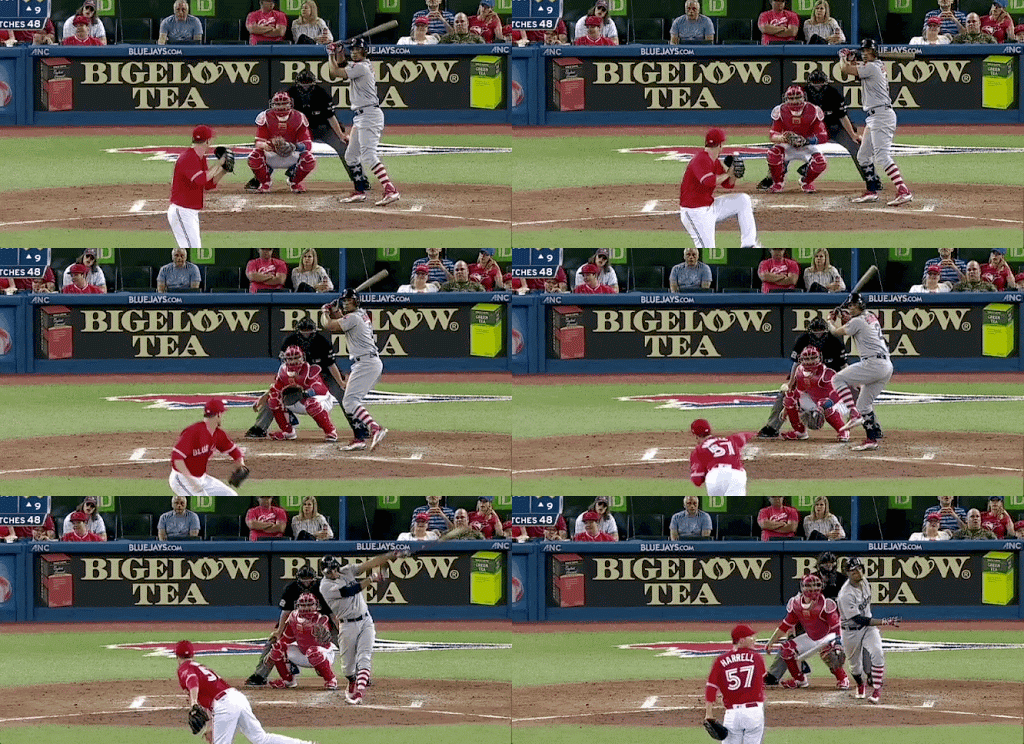
Now, look at his stance from this at-bat in 2018. His legs are much closer together and kept underneath him, as Hyers pointed out:

“I agreed that he needed to stay more upright,” Hyers said of what he felt Bogaerts needed to work on in the offseason. “I think when his legs got underneath him he stayed more upright, he had good posture so he could utilize the frame that he has… I think when you have that stability, it helps you see the ball better, and it’s kind of those simple-but-consistent cues he has that have helped him.”

And that wasn’t his only adjustment. “Last year, he got in the habit of chasing sliders away,” Hyers said. One scout who has seen Bogaerts mentioned that staying in an athletic position allows hitters to maintain balance, which is key versus offspeed pitches. That’s something Hyers said the two worked diligently on over the offseason. And the changes appear to have paid dividends: after years of posting swinging-strike rates of roughly 15% against the slider, Bogaerts has recorded a career-low mark of 12.1% in 2018.

“I think my motivation is the team that we have and trying to be as good as all the other guys on the team,” Bogaerts told NBC Sports in August. “You don’t want to stay back. I mean, we’ve got a couple guys, MVP [possibilities] on our team hopefully. That’s in the conversation, and I mean, you don’t want to be too far behind them.”

By WAR, Bogaerts is currently the third-best American League shortstop, behind only Francisco Lindor and Andrelton Simmons. Bogaerts is still only 25 years old and has the rest of a young career to continue his improvements. For now, though, he’s demonstrating progress, and the adjustments he made in the offseason appear to be working. If the trend continues, Bogaerts just might force us to pay him the attention we’ve so happily bestowed on his better-known teammates.
