Archive for Teams

Juan Soto Is the Fastest to Majors Since A-Rod

Since 1990 (in which year, Rich Garces represented the season’s only teenage debutante), only 14 hitters have debuted in the big leagues shy of age 20. With his appearance pinch-hit appearance on Sunday for the Nationals, Juan Soto just did it less minor-league time than nearly all of them. Soto’s 2017 season was buried under injuries (a fractured ankle, a broken hamate bone that required surgery, a hamstring issue), which limited him to just 32 games. When he stepped into the batter’s box this weekend, he did so having played just 122 minor-league games before his debut, the fewest for a teenage hitter since Alex Rodriguez debuted as an 18-year-old in 1994 after just 114 games.

Teenage Hitters to Debut Since 1990
Year Player Position Team Debut Age (Y.D)
1991 Ivan Rodriguez C TEX 19.205
1994 Alex Rodriguez SS SEA 18.346
1995 Karim Garcia OF LAD 19.308
1996 Andruw Jones CF ATL 19.114
1996 Edgar Renteria SS FLA 19.277
1998 Adrian Beltre 3B LAD 19.078
1998 Aramis Ramirez 3B PIT 19.335
2001 Wilson Betemit SS ATL 19.320
2003 Jose Reyes SS NYM 19.364
2004 Melvin Upton Jr. SS TB 19.347
2007 Justin Upton RF ARI 19.342
2011 Mike Trout CF LAA 19.335
2012 Jurickson Profar SS TEX 19.195
2012 Bryce Harper RF WAS 19.195
2018 Juan Soto RF WAS 19.207
SOURCE: Baseball-Reference

Edgar Renteria was pushed to the Midwest League as a 16-year-old and, by the time he was in the majors, had three times as many games under his belt than Soto. Justin Upton was drafted out of high school in 2005 and held out until January. (I guess there’s one good thing about the new CBA.) Then he tore through the minors and debuted in August of 2007 after seeing action in about 200 games. Trout signed quickly after he was drafted and played in the AZL that summer, then split his first full pro season at Low- and High-A, after which he was already at 175 games, and he needed 75 more and a Peter Bourjos injury the following year to debut.

Read the rest of this entry »


Top 30 Prospects: Minnesota Twins

Below is an analysis of the prospects in the farm system of the Minnesota Twins. Scouting reports are compiled with information provided by industry sources as well as from our own (both Eric Longenhagen’s and Kiley McDaniel’s) observations. For more information on the 20-80 scouting scale by which all of our prospect content is governed you can click here. For further explanation of the merits and drawbacks of Future Value, read this.

All the numbered prospects here also appear on THE BOARD, a new feature at the site that offers sortable scouting information for every organization. Click here to visit THE BOARD.

Twins Top Prospects
Rk Name Age High Level Position ETA FV
1 Royce Lewis 18 A CF 2020 55
2 Nick Gordon 22 AA SS 2019 50
3 Alex Kirilloff 20 A RF 2021 50
4 Fernando Romero 23 MLB RHP 2018 50
5 Stephen Gonsalves 23 AAA LHP 2019 50
6 Travis Blankenhorn 21 A+ 2B 2021 45
7 Wander Javier 19 R SS 2022 45
8 Brusdar Graterol 19 A RHP 2023 45
9 Mitch Garver 27 MLB C 2018 45
10 Brent Rooker 23 AA 1B 2020 45
11 LaMonte Wade 24 AA LF 2019 45
12 Akil Baddoo 19 A CF 2021 45
13 Jose Miranda 19 A 2B 2022 45
14 Yunior Severino 18 R 2B 2023 45
15 Blayne Enlow 19 A RHP 2022 40
16 Jaylin Davis 23 A+ RF 2020 40
17 Lewin Diaz 21 A+ 1B 2021 40
18 Jake Reed 25 AAA RHP 2018 40
19 Jake Cave 25 AAA CF 2018 40
20 Zack Littell 22 AAA RHP 2019 40
21 Landon Leach 18 R RHP 2023 40
22 John Curtiss 25 MLB RHP 2018 40
23 Gabriel Moya 23 MLB LHP 2018 40
24 Andrew Bechtold 21 A 3B 2022 40
25 Ryley Widell 20 R LHP 2022 40
26 Zack Granite 25 MLB CF 2018 40
27 Tyler Jay 23 AA LHP 2019 40
28 Lewis Thorpe 22 AA LHP 2019 40
29 Alex Robinson 23 A+ LHP 2019 40
30 Luke Bard 27 MLB RHP 2018 40

55 FV Prospects

Drafted: 1st Round, 2017 from JSerra HS (CA)
Age 18 Height 6’2 Weight 188 Bat/Throw R/R
Tool Grades (Present/Future)
Hit Raw Power Game Power Run Fielding Throw
30/55 50/55 25/50 60/60 45/55 55/55

Lewis was one of the best players on the summer showcase circuit in 2016, showing a rare combo of hit, power, and speed tools, though it was unclear if he fit better in the infield or center field. He had an up-and-down spring for his high school, with contact concerns caused by some mechanical changes, but he finished strong and the raw tools were still there, helping him go No. 1 overall in a year without a clear-cut top prospect.

Read the rest of this entry »


When Lance McCullers Stops McCullersing

This is Jake Mailhot’s third post as part of his May Residency at FanGraphs. A lifelong Mariners fan, Jake now lives in Bellingham, Washington, just a little too far away from Seattle to make it to games regularly, which is sometimes for the best. He is a staff editor at Mariners blog Lookout Landing. He can be found on Twitter at @jakemailhot.

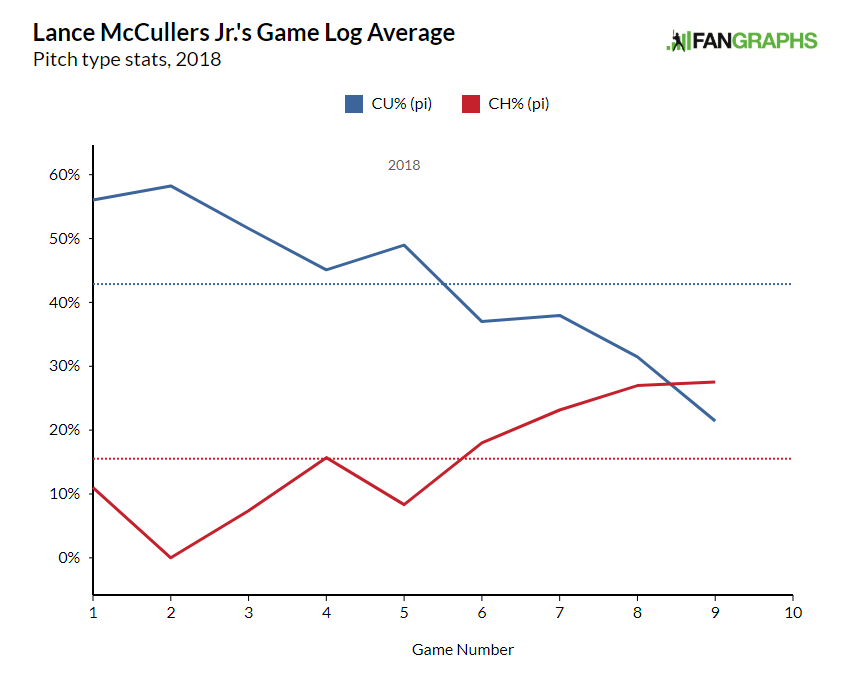
Earlier this year, Jeff Sullivan wrote a pair of articles, each about a pitcher who appeared to be McCullersing. That term, of course, is a reference to Lance McCullersJr., who in 2016 began throwing his excellent curveball more often than his fastball. He’s led all of baseball in curveball usage since then. He wound up throwing his curveball an astonishing 75% of the time in Game Seven of the ALCS last postseason. That appearance was peak McCullersing.

He started off this year throwing his curveball around the same amount as last year, 48% of the time. But when the calendar flipped to May, something changed. Just look at this graph of his secondary pitch usage in 2018.

That’s… interesting. In his start last night (not included here), McCullers threw his curveball around 40% of the time. That’s pretty normal for him. But it’s been less normal for him of late. In his start against the Angels last Monday, McCullers actually threw more changeups than curveballs, the latter pitch representing just 21.4% of his total count for the night. The last time his curveball usage fell below 30% was all the way back on August 3, 2015, during his rookie year.

Read the rest of this entry »


Sunday Notes: Brad Keller, Almost Once a Royal, is Thriving as a Rule 5 Royal

Brad Keller is having an impressive rookie season with the Kansas City Royals. Pumping fastballs with a bulldog mentality, the 22-year-old right-hander has appeared in 18 games and has a 1.96 ERA. He’s not afraid to challenge big-league hitters. Substantiating KC skipper Ned Yost’s assertion that he’s “been able to come in and bang strikes on the attack,” Keller has issued just five free passes in 18-and-a-third innings of work.

His path to the Kansas City bullpen was roundabout. In retrospect, it was also only a matter of time before he got there.

Drafted out of a Flowery Beach, Georgia high school by the Arizona Diamondbacks in 2013, Keller changed addresses twice in a 15-minute stretch during December’s Rule 5 draft.

“My agent called to say, ‘Hey, the Reds picked you up in the Rule 5,’” explained Keller. “I hung up the phone, called my parents, called my brother, and as soon as I hung up my agent called again. ‘Hey, you just got traded to the Royals.’ Then I had to pick up the phone and call everybody back.”

Keller’s next conversation was with the D-Backs — “they told me everything that was going down” — and soon thereafter Royals assistant GM Scott Sharp called to welcome him to his new organization. A similar call almost came four years earlier. Read the rest of this entry »


Diamondbacks Get Permission for New Stadium

Judges love it when litigants reach a settlement. Some judges love it so much that they give each side’s lawyer a token of appreciation for finalizing a deal. I’ve been in front of judges who handed out everything from stickers to candy bars. Last week, the Arizona Diamondbacks settled a lawsuit with Maricopa County. They got themselves a baseball stadium for their efforts.

But first, let’s back up a bit. The Diamondbacks have long wanted a new ballpark. Maricopa County, which owns the current park, wouldn’t let the team leave. So the team sued the county last year.

From Rebekah Sanders of the Arizona Republic:

The Diamondbacks’ lease with the county, which owns the stadium, prevents the team from talking with outside groups until 2024, and requires the team to play in its current home until 2028.

The Maricopa County Superior Court lawsuit is the latest twist in a long-running conflict over which party is responsible for as much as $187 million in repairs and upgrades to Chase Field. The team threatened to sue last year after negotiations with the county broke down.

The county argues that a portion of the upgrades are cosmetic and the team’s financial responsibility, and that the county will have enough money over the long term to meet its share of the obligations. The Diamondbacks counter that the county-run stadium district has not set aside enough money for needed upgrades and is risking safety.

The idea of a new stadium for the Snakes might seem, on the surface, to be ridiculous. After all, Chase Field was only just built in 1998. It’s younger than both Ronald Acuna and Gleyber Torres. That being said, the Team and County have been involved in a protracted legal battle, predating even that lawsuit, over the maintenance of the stadium. That’s because the stadium has had its share of maintenance misadventures in recent history, from burst pipes to failed HVAC systems. And each side blamed the other, with the team saying MLB would require them to move unless the county agreed to pay for repairs, while Maricopa County’s attorney, Cameron Artigue, had a more colorful response.

Read the rest of this entry »


Andrew Heaney Is Effectively Unusual

The Angels rotation is interesting for a number of reasons.

For starters, it houses Shohei Ohtani, who is living up to and even exceeding the unprecedented hype that surrounded his arrival to the major leagues. Then there is the six-man nature of the rotation, an experiment that is working to date — a point explored in some depth by Craig Edwards earlier this week. Angels starting pitchers rank fourth in the American League in WAR (3.5), fourth in ERA (3.77), fourth in FIP (3.90), fourth in xFIP (3.84), third in strikeout percentage (24.6%), and fifth in ERA- (90).

Along with Mike Trout and Andrelton Simmons, that rotation is a big reason why the Angels are just two games behind the Astros in the West and appear to be a Wild Card favorite at the moment, with roughly a 50% chance of reaching the postseason, a mark which trails only the three division leaders and Boston.

Ohtani has been pitching like an ace. Tyler Skaggs is giving us reasons to remember why he was a top prospect. Jaime Barria has a 51 ERA-. Garrett Richards is healthy and averaging 96 mph with his fastball. Nick Tropeano has managed to be effective with a low-strikeout, low-fly-ball approach.

And then there is the curious case of Andrew Heaney.

Read the rest of this entry »


Justin Verlander Finds Another Gear

Justin Verlander had himself a night in Anaheim on Wednesday, throwing his first complete-game shutout since August 26, 2015 and becoming the 33rd pitcher to notch 2,500 strikeouts. What’s more, he did it in a game where the Astros’ sole possession of first place in the AL West was on the line. It’s just the latest chapter of the now 35-year-old righty’s rebirth, one that has returned him to the upper echelon of the game’s starters and positioned him for a run at the Hall of Fame. The pitcher famous for finding another gear with his fastball late in the game has done just that with his career.

Verlander collected his milestone strikeout against none other than Shohei Ohtani, who foul-tipped a 96 mph heater in the ninth inning:

That was one of seven strikeouts Verlander notched on the night, and yes, he was still Bringing It late. He threw his six fastest four-seamers of the night, and nine of his top 11, in the eighth or ninth innings, all 97.5 mph or above according to Brooks Baseball.

Three of his strikeouts came against Ohtani (the second silver sombrero of his brief MLB career), who while avoiding a strikeout in the fourth inning — and even getting the call on this 87 mph slider — nonetheless wound up with his ankles repurposed into a pretzel, with Verlander supplying the mustard:

Read the rest of this entry »


The Fringe Five: Baseball’s Most Compelling Fringe Prospects

Fringe Five Scoreboards: 2017 | 2016 | 2015 | 2014 | 2013.

The Fringe Five is a weekly regular-season exercise, introduced a few years ago by the present author, wherein that same author utilizes regressed stats, scouting reports, and also his own fallible intuition to identify and/or continue monitoring the most compelling fringe prospects in all of baseball.

Central to the exercise, of course, is a definition of the word fringe, a term which possesses different connotations for different sorts of readers. For the purposes of the column this year, a fringe prospect (and therefore one eligible for inclusion among the Five) is any rookie-eligible player at High-A or above who (a) was omitted from the preseason prospect lists produced by Baseball Prospectus, MLB.com, John Sickels, and (most importantly) FanGraphs’ Eric Longenhagen and Kiley McDaniel* and also who (b) is currently absent from a major-league roster. Players appearing on any updated, midseason-type list will also be excluded from eligibility.

*Note: I’ve excluded Baseball America’s list this year not due to any complaints with their coverage, but simply because said list is now behind a paywall.

For those interested in learning how Fringe Five players have fared at the major-league level, this somewhat recent post offers that kind of information. The short answer: better than a reasonable person would have have expected. In the final analysis, though, the basic idea here is to recognize those prospects who are perhaps receiving less notoriety than their talents or performance might otherwise warrant.

*****

Austin Dean, OF, Miami (Profile)
Selected by Miami in the fourth round of the 2012 draft out of a Texas high school, Dean appeared — when Eric Longenhagen published the Marlins list in February of 2017 — to have fallen into a sort of prospect netherspace, possessing too little footspeed and athleticism for center field but too little offensive ability to sustain a corner-outfield role. The Marlins’ assignments appeared to indicate a lack of enthusiasm, as well: after passing all of the 2016 and -17 seasons at Double-A, Dean began the present campaign there, as well.

In this case, however, Dean quickly earned a promotion, producing a strikeout rate and isolated-power mark that still rank second and sixth, respectively, among the 97 total Southern League batters to record at least 80 plate appearances. The early returns at Triple-A have been promising for a player in his first exposure to a new level. In particular, Dean’s contact skills have translated well: among batters with 50 or more plate appearances, Dean’s strikeout and swinging-strike rates place in the 91st and 97th percentile. Meanwhile, he’s produced roughly league-average power numbers. While the offensive burden of a corner-outfield role remains high, Dean could probably survive with slightly less power on contact than most given his bat-to-ball skills.

Read the rest of this entry »


Odubel Herrera Is Chasing Derek Jeter’s Record

When a rebuilding club begins its transformation into playoff contender, one can usually identify certain players who emerged during the team’s lean years and made that transformation possible. In the case of the Cubs, for example, that player is Anthony Rizzo. For the Astros, that player is Jose Altuve. For the Phillies, that player might be Odubel Herrera. The former Rule 5 pick is now in his fourth year with Philadelphia, and he has a contract that could keep him with the team for another five seasons beyond this one. He’s been the best player — averaging 3.5 WAR per year — on Phillies teams averaging 95 losses. He might now be the best player on a team that appears to be reversing its fortune and contending for the first time in a half-dozen years.

It would be fair to call Herrera’s 2017 campaign — despite an average offensive season, solid defense, and three wins at 25 years old — a disappointment. After two seasons during which he flirted with four wins, a drop in what should be his prime might have been slightly concerning. However, Herrera really just had a poor two months to start the year. As the calendar turned to June, Herrera was hitting .218/.262/.326 with a 48 wRC+ in 206 plate appearances. The rest of the way, he slashed .318/.361/.526 with a 130 wRC+ in 357 trips to the plate. Even including a couple rough weeks to end last May, Herrera has a 126 wRC+ over the past calendar year and 4.4 WAR, ranking 28th among position players and including a rolling mark that is likely to rise over the next few weeks.

Read the rest of this entry »


Aaron Judge Is Hitting Better with an Even Worse Strike Zone

We know the Aaron Judge story. He was a prospect whose contact ability was questioned. Would his 80-grade power play in games? After working on a swing adjustment in the winter of 2016-17, however, he dramatically improved his contact rate, posting a remarkable 173 wRC+ last season while nearly winning the AL MVP award.

In the 21st century, there have been only 31 completed or ongoing seasons with a wRC+ better than Judge’s mark. And what’s remarkable is that one of those — though, just a partial season — is Judge’s 2018 campaign, in which he has a wRC+ of 178.

After making one of the most dramatic year-to-year improvements in major-league history, Judge has actually improved through the first quarter of this season, which is amazing in a different way. While making gains is one thing, consolidating them is another, with the wealth of scouting information available.

Read the rest of this entry »