Archive for Pirates

Oneil Cruz Is Starting To Damage Low Pitches

Kiyoshi Mio-Imagn Images

When I first started writing this piece, it began something like this: The results had yet to come for Oneil Cruz. But after a week of hitting lasers all over the park, Cruz’s wRC+ is up to 126, the highest mark of his career outside of his brief 2021 call-up. The 6-foot-7 outfielder’s titanic bat speed and explosiveness ignite stretches of truly incredible performance. His current hot streak and season-long numbers are a glimpse into what he can do with his talent, and they stand in contract with last season, when he had a 110 wRC+ and posted underwhelming numbers in the lower third of the strike zone for such a long limbed and powerful guy.

Back in January, I examined Cruz’s greatest strength: his ability to pound pitches at the top of the zone. Players with such long levers aren’t normally as productive at the top of the zone as Cruz was last season. His .496 xwOBA ranked third in all of baseball! If you left a pitch up there against him, you were vulnerable to some real pain. But being locked in in one part of the zone often means making sacrifices in another. It’s difficult to be versatile enough to command both the upper and lower thirds, and Cruz only ran a measly league average xwOBA in the bottom third (.319). That’s odd, though, because these are the types of pitches you’d expect somebody with his stature to drop their barrel under the ball with ease. When I wrote my January piece, one obvious conclusion was that if Cruz could preserve his upper-third excellence while doing more damage in a part of the zone that should mesh well with his physical abilities, then his batted ball profile would be fully unlocked. It’s still early, but Cruz’s .367 xwOBA in the lower third so far this season is a big improvement. Read the rest of this entry »

Another Way To Think About Pull Rate

Eric Hartline-Imagn Images

Every time I watch Oneil Cruz hit, I end up thinking about pull rate. It seems like he’s always using his long arms to yank a ball into right field even though the pitch came in all the way on the outside corner. I’m not quite right, though. According to our leaderboards, Cruz ranks 35th among all qualified players in pull rate. According to Statcast, he’s at 55th, not even in the top third. Maybe it’s just that seeing someone do something as bonkers as this can warp your perspective:

But there is more than one way to think about pull rate. Sometimes you get jammed. Sometimes you have to hit the ball where it’s pitched. Sometimes the situation demands that you shorten up and sell out for contact. Those three examples might tell us a bit less about the intent behind your swing, because you didn’t get to execute your plan. We have ways to throw them out. Today, we’ll look into players whose overall pull rate is notably different from their pull rate when they square up the ball. As a refresher, Statcast plugs the respective speeds of the ball and the bat into a formula to determine the maximum possible exit velocity, and if the actual EV is at least 80% of that number, it’s considered squared up.

I pulled numbers from 2023 through 2025 for each player who has squared up at least 250 balls during that stretch. As you’d expect, the numbers are mostly pretty similar. Of the 219 players in the sample, 165 of them have a difference between their overall pull rate and their squared-up pull rate that’s below three percentage points. No player has a pull rate when squaring the ball up that’s more than 6.5 percentage points off their overall pull rate, but there are a few interesting names here. Read the rest of this entry »

Five Things I Liked (Or Didn’t Like) This Week, May 16

Brad Penner-Imagn Images

Welcome to another edition of Five Things I Liked (Or Didn’t Like) This Week. Actually, the title is a misnomer today. A week of baseball is great, but you know what else is great? A single game of baseball. Monday night, Paul Skenes and the Pirates took on the scalding-hot Mets. It was one of the most exciting matchups we’ll get all regular season, pitting my pick for the best pitcher in baseball against one of the top offenses in the game. This being baseball, the best pregame matchups don’t always lead to the most exciting events. This time, however, the hype was warranted, and the game was both delightful and delightfully weird. So with apologies to Zach Lowe for changing the format he created, let’s try this again: Welcome to Five Things I Liked During The Mets Pirates Game From Monday.

1. My Skenes vs. Your Team
It’s downright crazy how good Skenes is. He’s so fun to watch, at least as long as he isn’t making your team look silly. He throws everything, and all of it is nasty. He drew swinging strikes on five different pitch types, and some of them left batters baffled:

Juan Soto doesn’t look like that very often. But that’s because pitchers like Skenes also don’t come around very often. Seriously, this pitch was 94 miles an hour?! This is unfair:

The Mets hassled Skenes repeatedly throughout his six innings. He surrendered six hits, tying a career high, and walked three. But when there were runners on base, Skenes found another gear. Five of his six strikeouts came with men on. He threw harder, pitched for whiffs, and generally flummoxed his opponents. He’s not always going to allow only one run, but despite the Mets finding occasional cracks in his armor, one earned run felt like a fair result. When Skenes is on the mound, the other team starts at a disadvantage. Read the rest of this entry »

The Pirates Are Sailing Without a Map

Charles LeClaire-USA TODAY Sports

It’s been one week since the Pirates fired manager Derek Shelton and replaced him with former major league utilityman and Pittsburgh native Don Kelly, who served as Shelton’s bench coach for the entirety of his managerial stint. Firing the manager is one of the first moves made by an underperforming or flat-out awful ballclub, so there’s nothing surprising about Shelton getting the axe after a 12-26 start. But a manager’s record is only as good as the players on his roster and the money spent to build that roster, and Pittsburgh was deficient in both for Shelton’s entire tenure, which spanned five-plus seasons. During that time, the team posted a 308-441 record.

Now with Kelly at the helm, the Pirates are still on a ship that’s at best treading water; they are 3-3 in their six games since he took over, with five of them being decided by just one run. Perhaps Pittsburgh will be better with Kelly managing than it was under Shelton. After all, this is a team that at least has Paul Skenes and Oneil Cruz. However, there is only so much that Kelly can do here. The core problems in Pittsburgh can only be solved with a drastic shift in organizational philosophy, and that starts with owner Bob Nutting and the person tasked with executing that strategy, general manager Ben Cherington. Read the rest of this entry »


Sunday Notes: Ty France Is Back To Being The Good Ty France

Ty France went into last season trying to be something he’s not, and the results reflected that. Over 535 plate appearances split between the Seattle Mariners and Cincinnati Reds, he slashed .234/.305/.365 with 13 home runs and a 93 wRC+. Statistically speaking, it was the worst year of his career.

Now with the Minnesota Twins after inking a modest $1M free-agent deal in mid-February, France went into yesterday with numbers more in line with what he did from 2019-2023. A month-plus into the campaign, the 30-year-old first baseman has a 118 wRC+ and a .271/.341/.407 slash line.

How has he rediscovered the better version of himself?

“My swing is simple and compact right now,” France told me prior to an 0-for-4 Friday night that included his being robbed on a diving catch and lining an at-em ball at an infielder. “Instead of trying to do too much, I’m just trying to get in my best position and take a good swing.

“Guys are getting paid for homers and doing damage, so a lot of my training last offseason was geared toward trying to hit the ball in the air and drive the ball,” France added. “I kind of lost touch with what I was best at, which is using the right side of the field just collecting hits. This past offseason was about getting back to the basics and rediscovering who I am as a hitter.” Read the rest of this entry »


Justin Lawrence Finds Success Among Smaller Mountains

Albert Cesare/The Enquirer/USA TODAY NETWORK via Imagn Images

Over the 30-plus years that I’ve been following baseball, it seems like a collection of newfangled stats comes out every couple years. WAR, DiPS, wOBA, UZR, exit velocity, spin rate — America’s most rigorously empiricized sport has gone from scribblings in Henry Chadwick’s notebook to having more inscrutable acronyms than the Department of Defense.

My default position on new stats is one of interested skepticism. As a public-facing analyst, I don’t want to stake my reputation on a new metric that might still have serious flaws. It usually takes months or even years for people smarter than me — or at least, people who did more than barely pass their graduate statistics class — to iron out the kinks and figure out how to read and utilize the trendy new stats.

One example: I waited for ages for Justin Lawrence to be good. Read the rest of this entry »


Oneil Cruz Isn’t a Center Fielder Yet

David Dermer-Imagn Images

It wasn’t supposed to go down this way. Oneil Cruz is 26 years old and still has as much talent as just about any player in baseball. Here’s what I wrote back in August, when the Pirates moved him to the outfield and I eulogized Oneil Cruz the Shortstop: “Cruz is still just 25. I do think it’s more likely that he’ll be fine in center, and possibly even great. Quite simply, there’s more margin for error in the outfield. He’ll take some bad routes and make some bad reads, but he’ll be able to make the most of his speed…” The early returns are not exactly making either Cruz or me look great.

Cruz spent 23 games in center to end the 2024 season, and the results were mixed. His best grades came from Statcast, which had him putting up a very encouraging 2 OAA and 1 FRV. However, Cruz was credited with -3 DRS and -2.1 DRP. On a per-inning basis, the latter number made him one of the worst center fielders in baseball. Still, all those numbers included two errors, which loomed very large in such a small sample size. Outfielders tend not to make that many errors, but Cruz was brand new to the position. He was fast. He had a rocket arm. Even if all he did was cut out the errors, he’d be at the very least a decent center fielder. It was reasonable to assume that he would only get better out there.

He has not yet gotten better out there. Cruz is currently sitting on -8 DRS, -2 OAA and FRV, and -0.1 DRP. Among all outfielders, those numbers respectively rank worst, third worst, fourth worst, and fifth worst. The advanced defensive metrics work on different scales and they often disagree, but on this point they are unanimous: Cruz has been one of the very worst outfielders in all of baseball this season. According to DRS, Cruz is the least-valuable defender in baseball, full stop. Read the rest of this entry »


Five Things I Liked (Or Didn’t Like) This Week, April 11

Charles LeClaire-Imagn Images

Welcome to another edition of Five Things I Liked (Or Didn’t Like) In Baseball This Week. I was at a wedding this past weekend, a generally fun event for a baseball writer. That’s because strangers ask me what I do, and then I get to say, “I’m a baseball writer.” That plays a lot better than, “I work in accounting/finance/tech,” no offense to any of you in those fine fields. But this weekend, someone inquired deeper. “Oh, like sabermetric stuff?” “Yeah! Kind of. Also I make GIFs of dumb and/or weird plays. And bunts, lots of bunts.” Yes, it’s a strange job being a baseball writer, but also a delightful one, and this week delivered whimsy and awe in equal amounts. So unlike guests milling around at a wedding, let’s get straight to the point – after the customary nod to Zach Lowe of The Ringer for the inspiration for this article format.

1. Not Reaching Home
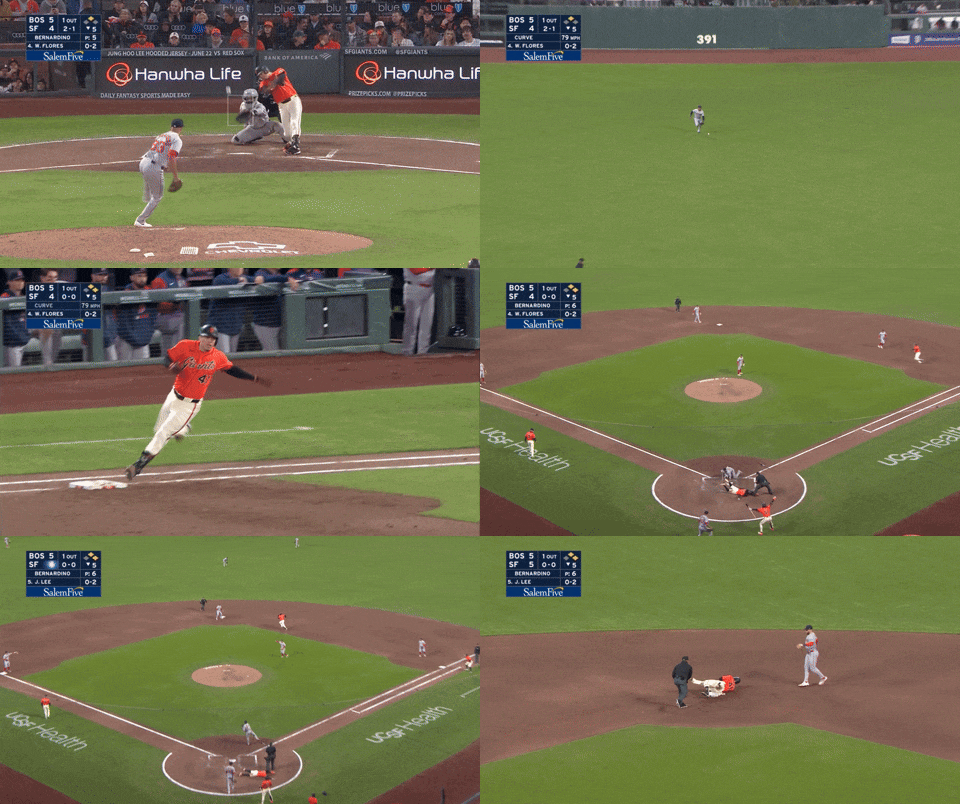
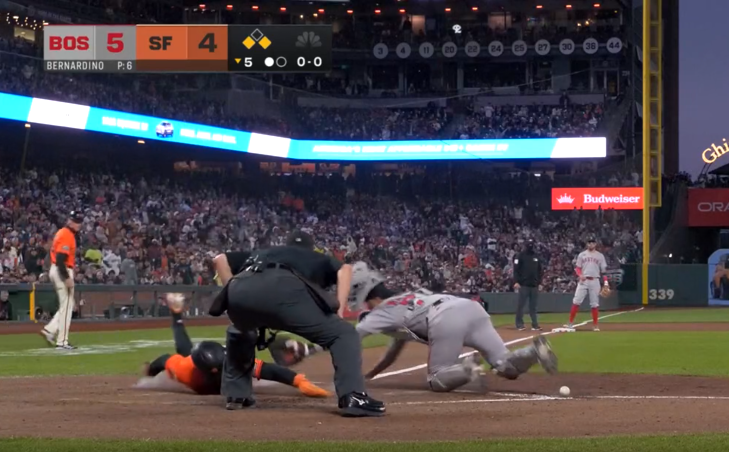
The third time a runner was tagged out at the plate in Wednesday’s Cardinals-Pirates clash came at a pivotal moment. Locked in a scoreless tie in the bottom of the 11th, Pittsburgh finally looked like it would break through when Joey Bart singled to right. But, well:

That was a good throw by Lars Nootbaar and a clean catch by Pedro Pagés, and that combination turned a close play into a gimme. I mean, how often are you going to be safe when the catcher already has the ball in his glove and you’re here:


Read the rest of this entry »


What Can Peter, Paul and Mary Teach Us About Roster Construction?

Geoff Burke-USA TODAY Sports

We have all kinds of fantastic stats for tracking player performance, metrics that are descriptive, predictive and somewhere in between. Today, I would like to introduce a descriptive stat for the folks on the team who do not wear spikes. Think of this as an attempt to measure the performance of management by trying to quantify the work of the front office and coaching staff using a folky metaphor.

Oh, Puff the magic dragon lived by the sea
And frolicked in the autumn mist, in a land called Honah Lee

Baseball is a game for kids. The best of the best get to frolic in the autumn mist in a Honah Lee called the World Series. Baseball has many reasons to favor youth, some structural to the game as a business and others more existential, like Peter, Paul and Mary sing about.

Team control and the aging process conspire to make young, developing players the most valuable to the ballclub. Their income constraints mean that youngsters can rack up surplus value if they hit their ceiling, and are an inexpensive sunk cost at worst. The best baseball exists in the sweet spot between the physicality of youth and the skill earned through repetition. Not exactly revolutionary, but my stat builds from the logic that you want to play guys who can either contribute to wins this season or might develop into contributors in the future. Additionally, I am assuming that playing time at the major league level is far better for evaluation and development than the upper minors due to the quality of competition as well as the availability of data, scouting tools and other resources, though obviously that might vary depending on the org and the player. Here is where Peter, Paul and Mary, darlings of the Greenwich folk scene of the 1960s, come into play. Read the rest of this entry »


The Name’s Bonding, Team Bonding: National League

Joshua L. Jones-USA TODAY NETWORK via Imagn Images

Every year, most teams hold some sort of team bonding, social event during spring training. The specifics of the event vary from team to team, but frequently they include renting out a movie theater and showing some cloying, inspirational movie like The Blind Side, Cool Runnings, Rudy, or better yet, a documentary like Free Solo. Regardless of the team’s outlook on the year, the goal is to get the players amped up for the season and ready to compete on the field, even if the competition in question is for fourth place in the division.

But what if instead of taking the clichéd route, teams actually tried to select a movie that fits their current vibe, one that’s thematically on brand with the state of their franchise? They won’t do this because spring training is a time for hope merchants to peddle their wares, even if they’re selling snake oil to sub-.500 teams. But spring training is over now, the regular season has begun, and it’s time to get real. So here are my movie selections for each National League team, sorted by release date from oldest to newest.

If you’re interested in which movies I selected for the American League teams, you can find those picks here. Read the rest of this entry »