Archive for Pirates

Shane Baz Addresses His December 2017 FanGraphs Scouting Report
Brian Fluharty-Imagn Images

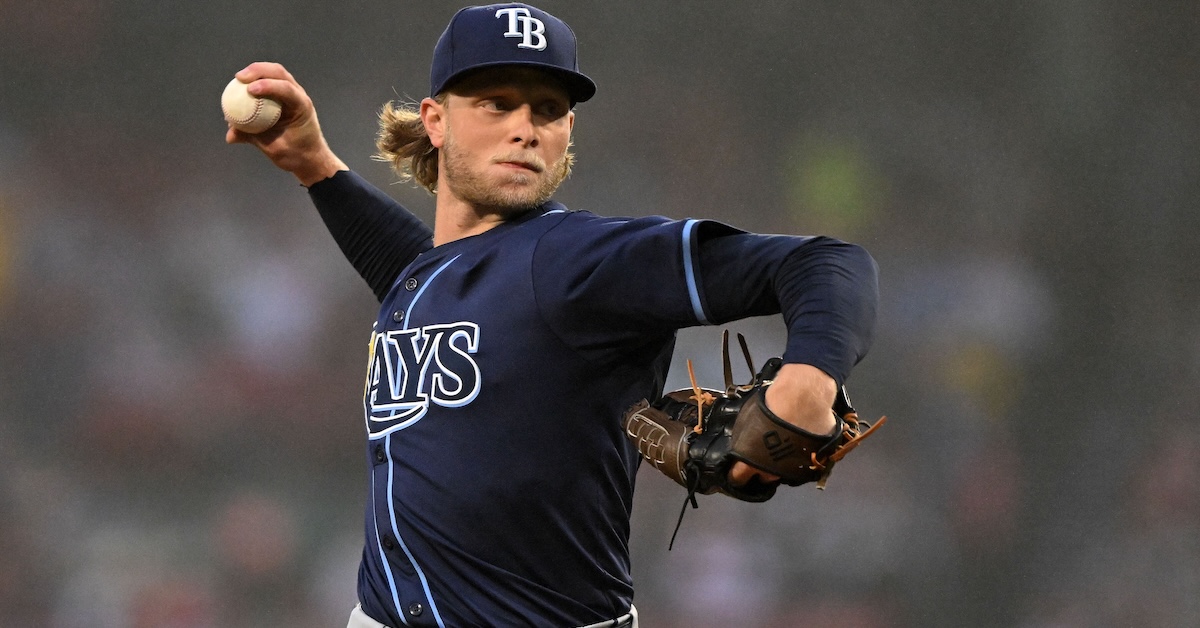
The path Shane Baz took to Tampa Bay’s starting rotation was anything but uneventful. He was drafted 12th overall in 2017 by the Pirates out of Concordia Lutheran High School in Tomball, Texas, where Ke’Bryan Hayes, Glenn Otto, and Adam Oller also played. The following summer, he was dealt to the Rays in a trade Pirates fans are loathe to remember. The Bucs acquired Chris Archer, while the Rays received Baz, Tyler Glasnow, and Austin Meadows.

Baz went on to make his major league debut in September 2021, and six months later he topped our 2022 Tampa Bay Top Prospects list. Then his elbow began barking. The right-hander subsequently underwent Tommy John surgery, and didn’t toe the rubber for the Rays between July 2022 and July of last year. He’s been solid since returning from his two-year recovery. Over 162 innings — including 82 2/3 this season — Baz has an 11-6 record to go with a 3.94 ERA.

What did Baz’s scouting report look like when he ranked third on our 2018 Pittsburgh Pirates Top Prospects list, which was published the previous December? Moreover, what does he think about it all these years later? Wanting to find out, I shared some of what Eric Longenhagen wrote and asked Baz to respond to it.

———

“Baz had among the most electric stuff in the 2017 draft. He was up to 98 in the spring, sitting in the mid-90s for most of his starts while also producing the best fastball spin rates in the draft class.”

“That was the big thing at the time,” replied Baz, who has made 15 starts and won seven of 10 decisions — albeit with a 4.79 ERA and 4.83 FIP — in the current campaign. “Everybody was talking about spin rate. I didn’t really know much about it, so I definitely wasn’t worried about it. I was mostly worried about trying to get the ball over the plate. But I do feel like I had good stuff when I got drafted. I was up to 97-98 [mph] and trying to live around 94-96. It was mostly about honing it in.”

“Baz can also spin a power breaking ball and throw a nasty cutter.”

“Yeah, I had a cutter at the time,” the righty recalled. “That’s a pitch I’ve kind of put in the back pocket, but it was a go-to back then, more so than my curveball was. My cutter kind of turned into a bigger slider, and now I’m throwing the curveball more.

“That happened more post-surgery,” Baz added. “I started throwing my curveball so hard that the two pitches were kind of running together. You want the one with more movement, so I stuck with the curveball.”

“Some scouts noted his heater was more hittable than they anticipated given its velocity.”

“At the time, probably,” the righty responded. “I mean, I don’t really remember how I pitched my first year of pro ball. It was awhile ago, so I don’t really know.”

“Baz is a tightly wound, but athletic, 6-foot-3 with a good build and room for more weight as he ages.”

“Yeah, I would say that trying to put on weight was a big thing at the time,” Baz said. “That and get stronger. I feel I’ve done a good job of that. I was probably 180 pounds when I came out of high school, and now I’m around 205 or 210. Another thing I was trying to do was working on making my delivery simple.”

“His head-whacking delivery toes the line between explosive and erratic, and he sometimes struggles to throw strikes.”

“That’s not too far off,” the Houston-born hurler said. “It’s gotten a lot better. Obviously, the more consistent you can make your delivery, the more you’re going to command the ball. So yeah, I would say that was accurate at the time. I did have [a head whack]. Back then, I just wanted to throw as hard as I could. I didn’t care about things like longevity, consistency, or the delivery.”

“That will need to improve for Baz to avoid an eventual move to the bullpen… Even if that’s where Baz ends up, his stuff is such that he’s a likely late-inning arm.”

“I think any way I could have gotten to the big leagues, I would have done it,” Baz said. “I was a catcher as a sophomore. I mean, growing up I was always told to try to help the team win in any way I can. That’s how I’ve always looked at it.”

“Baz also played the infield in high school.”

“I was told that as a position player I could go somewhere around rounds three to five,” recalled Baz, who bypassed a commitment to Texas Christian University to sign with the Pirates. “I didn’t know what I wanted to do. I was going to go to college as a two-way player. I don’t know where I would have ended up playing. I mostly played infield in high school, but with the arm and the speed, I probably would have ended up in the outfield.

“I took the two-way thing seriously. It was back before [Shohei] Ohtani and [Michael] Lorenzen — guys like that who could do both — but I definitely thought about it. But not a lot of teams wanted both, even to try doing both, so I decided to just stick to pitching. Would I do it now? I think that ship has sailed at this point.”

——

Previous “Old Scouting Reports Revisited” interviews can be found through these links: Cody Bellinger, Matthew Boyd, Dylan Cease, Matt Chapman, Erick Fedde, Kyle Freeland, Max Fried, Lucas Giolito, Randal Grichuk, Ian Happ, Jeff Hoffman, Tanner Houck, Matthew Liberatore, Sean Newcomb, Bailey Ober, Matt Olson, Austin Riley, Joe Ryan, Max Scherzer, Marcus Semien.



Oneil Cruz Looks Like a Center Fielder Now

Philip G. Pavely-Imagn Images

Two months ago, I checked in on Oneil Cruz, the center fielder. Things weren’t exactly going well. The Pirates shifted Cruz from shortstop to center at the end of the 2024 season, and the early returns were so discouraging I felt the need to write about the experiment just 17 games into the 2025 season. Here’s where the numbers stood at that point:

Cruz is currently sitting on -8 DRS, -2 OAA and FRV, and -0.1 DRP. Among all outfielders, those numbers respectively rank worst, third worst, fourth worst, and fifth worst. The advanced defensive metrics work on different scales and they often disagree, but on this point they are unanimous: Cruz has been one of the very worst outfielders in all of baseball this season. According to DRS, Cruz is the least-valuable defender in baseball, full stop.

There’s great news, though. Last week, reader AJ wrote into our newly introduced mailbag to ask for an update, because Cruz’s stats look totally different now. I decided the turnaround was worthy of a full article instead of a few paragraphs. I’ve broken everything down with my first article as the dividing line. There’s a chasm between Cruz’s first 17 games and his last 48.

Oneil Cruz’s Defensive Turnaround
Date DRS DRP OAA FRV
Through April 17 -8 -0.1 -2 -2
Since April 18 +3 +0.5 +4 +5
Season Total -5 +0.4 +2 +3

Deserved Runs Prevented is inherently more conservative than the other defensive metrics, but all of the advanced numbers agree Cruz has completely turned things around over the past two months. He hasn’t just stopped racking up negative numbers, he’s dug himself all the way out, grading as a net positive in every metric except Defensive Runs Saved. Over the past two months, they pretty clearly see him as one of the better defenders in the league. Put that together with career-best hitting and baserunning numbers, and Cruz is on pace for a career year. Read the rest of this entry »


When War Comes Easier Than Wins

Charles LeClaire-Imagn Images

The Pirates beat the Phillies 2-1 on Sunday, and near as I can tell everyone was pissed about it. The Phillies, a would-be World Series contender, had just gotten swept by a team they’d been hoping to do some damage against, and dropped to 1-9 in their previous 10 games. The Pirates, for their part, had just gotten one over (three over, actually) on their intrastate rival, but Paul Skenes didn’t get the win.

The biggest, scariest pitcher in the league had gone 7 2/3 innings, allowing only one unearned run, but had left the game while it was tied in the top of the eighth. That left the NL Cy Young frontrunner with an ERA of 1.88 in 91 innings, but a record of just 4-6. Is it important for Skenes to get the win? Not exactly. But the incongruity between record and performance was just another reminder of how little support this disappointing team is giving the generational talent that had fallen into its lap.

Skenes is the class of the Pirates rotation, but he’s not the only talented pitcher the Bucs have. Even with Jared Jones and Johan Oviedo in the shop getting their elbows worked on, Mitch Keller is having a solid season. Keller is top 25 in the league in innings and WAR, and despite some indifferent strikeout numbers, he’s kept the ball in the yard and scratched out a 4.13 ERA — that’s a 100 ERA- on the dot — with a 3.27 FIP. Read the rest of this entry »


Job Posting: Pittsburgh Pirates – Director Baseball Systems

Director – Baseball Systems

The Pirates Why
The Pittsburgh Pirates are a storied franchise in Major League Baseball who are reinventing themselves on every level. Boldly and relentlessly pursuing excellence by:

  • purposefully developing a player and people-centered culture;
  • deeply connecting with our fans, partners, and colleagues;
  • passionately creating lifetime memories for generations of families and friends; and
  • meaningfully impacting our communities and the game of baseball.

At the Pirates, we believe in the power of a diverse workforce and strive to create an inclusive culture centered in Passion, Innovation, Respect, Accountability, Teamwork, Empathy, and Service.

Job Summary
We are seeking a Director of Baseball Systems to lead and inspire a team of talented software and data engineers responsible for building and enhancing our internal baseball decision-making platform. This web-based system is a critical resource for players, coaches, analysts, and executives, driving people across the organization to make better decisions.

Responsibilities:

  1. Lead the development and evolution of our internal baseball systems, ensuring they are intuitive, reliable, and impactful.
  2. Lead a cloud data migration effort to build robust, reliable, and responsive data platforms.
  3. Build and maintain an effective product development process that fosters innovation, agility, and user-centered design.
  4. Manage and grow a team of software and data engineers with diverse expertise in front-end and back-end development, database management, cloud architecture, and system design.
  5. Collaborate closely with key stakeholders, including data scientists, analysts, coaches, and front-office personnel, to understand needs and align technological solutions with organizational goals.
  6. Drive technical strategy, ensuring the architecture and design decisions support scalability, performance, and future growth.
  7. Act as a champion for effective communication, collaboration, and knowledge sharing within the team and across departments.
  8. Maintain a focus on delivering features and improvements that directly support the team’s competitive edge.

Key Traits We’re Looking For:

  1. Baseball Curiosity and Knowledge: You have a deep interest in baseball and understand how data and technology can influence strategy, player performance, and game outcomes.
  2. Technical Mastery: You have demonstrated experience in more than one of the following:
    • Front-end technologies (React, Angular, or similar frameworks).
    • Back-end development (Node.js, Python, etc.).
    • Database design and management (SQL, NoSQL, etc.).
    • Cloud architecture (AWS, Azure, or Google Cloud).
    • System design, UX/UI principles, and software lifecycle management.
  3. Leadership & Management: You have a proven track record of mentoring, inspiring, and empowering teams to do their best work.
  4. Process Management: You have established and maintained a robust, repeatable product development process that balances innovation with efficiency.
  5. Communication & Collaboration: You have translated complex technical concepts for non-technical audiences and foster strong relationships across departments.
  6. Vision & Strategic Planning: You have a demonstrated knack for thinking ahead and aligning short-term projects with long-term goals, driving forward-looking innovation.

Requirements:

  1. Authorized to work lawfully in the United States.
  2. Bachelor’s degree in Computer Science, Information Systems, or a related field (or equivalent experience).
  3. Demonstrated experience building and supporting full-stack web applications, ideally in a sports or data-driven environment.
  4. A demonstrated passion for problem-solving, with a user-centered approach to product design.
  5. Demonstrated familiarity with Agile or similar development methodologies.

Equal Opportunity Employer
This employer is required to notify all applicants of their rights pursuant to federal employment laws. For further information, please review the Know Your Rights notice from the Department of Labor.

To Apply:
To apply, please follow this link.

The content in this posting was created and provided solely by the Pittsburgh Pirates.


Oneil Cruz Is Starting To Damage Low Pitches

Kiyoshi Mio-Imagn Images

When I first started writing this piece, it began something like this: The results had yet to come for Oneil Cruz. But after a week of hitting lasers all over the park, Cruz’s wRC+ is up to 126, the highest mark of his career outside of his brief 2021 call-up. The 6-foot-7 outfielder’s titanic bat speed and explosiveness ignite stretches of truly incredible performance. His current hot streak and season-long numbers are a glimpse into what he can do with his talent, and they stand in contract with last season, when he had a 110 wRC+ and posted underwhelming numbers in the lower third of the strike zone for such a long limbed and powerful guy.

Back in January, I examined Cruz’s greatest strength: his ability to pound pitches at the top of the zone. Players with such long levers aren’t normally as productive at the top of the zone as Cruz was last season. His .496 xwOBA ranked third in all of baseball! If you left a pitch up there against him, you were vulnerable to some real pain. But being locked in in one part of the zone often means making sacrifices in another. It’s difficult to be versatile enough to command both the upper and lower thirds, and Cruz only ran a measly league average xwOBA in the bottom third (.319). That’s odd, though, because these are the types of pitches you’d expect somebody with his stature to drop their barrel under the ball with ease. When I wrote my January piece, one obvious conclusion was that if Cruz could preserve his upper-third excellence while doing more damage in a part of the zone that should mesh well with his physical abilities, then his batted ball profile would be fully unlocked. It’s still early, but Cruz’s .367 xwOBA in the lower third so far this season is a big improvement. Read the rest of this entry »


Another Way To Think About Pull Rate

Eric Hartline-Imagn Images

Every time I watch Oneil Cruz hit, I end up thinking about pull rate. It seems like he’s always using his long arms to yank a ball into right field even though the pitch came in all the way on the outside corner. I’m not quite right, though. According to our leaderboards, Cruz ranks 35th among all qualified players in pull rate. According to Statcast, he’s at 55th, not even in the top third. Maybe it’s just that seeing someone do something as bonkers as this can warp your perspective:

But there is more than one way to think about pull rate. Sometimes you get jammed. Sometimes you have to hit the ball where it’s pitched. Sometimes the situation demands that you shorten up and sell out for contact. Those three examples might tell us a bit less about the intent behind your swing, because you didn’t get to execute your plan. We have ways to throw them out. Today, we’ll look into players whose overall pull rate is notably different from their pull rate when they square up the ball. As a refresher, Statcast plugs the respective speeds of the ball and the bat into a formula to determine the maximum possible exit velocity, and if the actual EV is at least 80% of that number, it’s considered squared up.

I pulled numbers from 2023 through 2025 for each player who has squared up at least 250 balls during that stretch. As you’d expect, the numbers are mostly pretty similar. Of the 219 players in the sample, 165 of them have a difference between their overall pull rate and their squared-up pull rate that’s below three percentage points. No player has a pull rate when squaring the ball up that’s more than 6.5 percentage points off their overall pull rate, but there are a few interesting names here. Read the rest of this entry »


Five Things I Liked (Or Didn’t Like) This Week, May 16

Brad Penner-Imagn Images

Welcome to another edition of Five Things I Liked (Or Didn’t Like) This Week. Actually, the title is a misnomer today. A week of baseball is great, but you know what else is great? A single game of baseball. Monday night, Paul Skenes and the Pirates took on the scalding-hot Mets. It was one of the most exciting matchups we’ll get all regular season, pitting my pick for the best pitcher in baseball against one of the top offenses in the game. This being baseball, the best pregame matchups don’t always lead to the most exciting events. This time, however, the hype was warranted, and the game was both delightful and delightfully weird. So with apologies to Zach Lowe for changing the format he created, let’s try this again: Welcome to Five Things I Liked During The Mets Pirates Game From Monday.

1. My Skenes vs. Your Team
It’s downright crazy how good Skenes is. He’s so fun to watch, at least as long as he isn’t making your team look silly. He throws everything, and all of it is nasty. He drew swinging strikes on five different pitch types, and some of them left batters baffled:

Juan Soto doesn’t look like that very often. But that’s because pitchers like Skenes also don’t come around very often. Seriously, this pitch was 94 miles an hour?! This is unfair:

The Mets hassled Skenes repeatedly throughout his six innings. He surrendered six hits, tying a career high, and walked three. But when there were runners on base, Skenes found another gear. Five of his six strikeouts came with men on. He threw harder, pitched for whiffs, and generally flummoxed his opponents. He’s not always going to allow only one run, but despite the Mets finding occasional cracks in his armor, one earned run felt like a fair result. When Skenes is on the mound, the other team starts at a disadvantage. Read the rest of this entry »


The Pirates Are Sailing Without a Map

Charles LeClaire-USA TODAY Sports

It’s been one week since the Pirates fired manager Derek Shelton and replaced him with former major league utilityman and Pittsburgh native Don Kelly, who served as Shelton’s bench coach for the entirety of his managerial stint. Firing the manager is one of the first moves made by an underperforming or flat-out awful ballclub, so there’s nothing surprising about Shelton getting the axe after a 12-26 start. But a manager’s record is only as good as the players on his roster and the money spent to build that roster, and Pittsburgh was deficient in both for Shelton’s entire tenure, which spanned five-plus seasons. During that time, the team posted a 308-441 record.

Now with Kelly at the helm, the Pirates are still on a ship that’s at best treading water; they are 3-3 in their six games since he took over, with five of them being decided by just one run. Perhaps Pittsburgh will be better with Kelly managing than it was under Shelton. After all, this is a team that at least has Paul Skenes and Oneil Cruz. However, there is only so much that Kelly can do here. The core problems in Pittsburgh can only be solved with a drastic shift in organizational philosophy, and that starts with owner Bob Nutting and the person tasked with executing that strategy, general manager Ben Cherington. Read the rest of this entry »


Sunday Notes: Ty France Is Back To Being The Good Ty France

Ty France went into last season trying to be something he’s not, and the results reflected that. Over 535 plate appearances split between the Seattle Mariners and Cincinnati Reds, he slashed .234/.305/.365 with 13 home runs and a 93 wRC+. Statistically speaking, it was the worst year of his career.

Now with the Minnesota Twins after inking a modest $1M free-agent deal in mid-February, France went into yesterday with numbers more in line with what he did from 2019-2023. A month-plus into the campaign, the 30-year-old first baseman has a 118 wRC+ and a .271/.341/.407 slash line.

How has he rediscovered the better version of himself?

“My swing is simple and compact right now,” France told me prior to an 0-for-4 Friday night that included his being robbed on a diving catch and lining an at-em ball at an infielder. “Instead of trying to do too much, I’m just trying to get in my best position and take a good swing.

“Guys are getting paid for homers and doing damage, so a lot of my training last offseason was geared toward trying to hit the ball in the air and drive the ball,” France added. “I kind of lost touch with what I was best at, which is using the right side of the field just collecting hits. This past offseason was about getting back to the basics and rediscovering who I am as a hitter.” Read the rest of this entry »


Justin Lawrence Finds Success Among Smaller Mountains

Albert Cesare/The Enquirer/USA TODAY NETWORK via Imagn Images

Over the 30-plus years that I’ve been following baseball, it seems like a collection of newfangled stats comes out every couple years. WAR, DiPS, wOBA, UZR, exit velocity, spin rate — America’s most rigorously empiricized sport has gone from scribblings in Henry Chadwick’s notebook to having more inscrutable acronyms than the Department of Defense.

My default position on new stats is one of interested skepticism. As a public-facing analyst, I don’t want to stake my reputation on a new metric that might still have serious flaws. It usually takes months or even years for people smarter than me — or at least, people who did more than barely pass their graduate statistics class — to iron out the kinks and figure out how to read and utilize the trendy new stats.

One example: I waited for ages for Justin Lawrence to be good. Read the rest of this entry »