Archive for White Sox

Squeezed Out of Seattle, Luis Castillo Lands With the White Sox

William Liang-Imagn Images

Pre-deadline trades generally follow a template, with contenders filling needs by acquiring players from teams outside of the playoff races. Not every late July or early August deal fits into that pattern, however, and Saturday night brought a less common variety of trade, one between two American League teams striving for spots in the postseason field. The Mariners, who spent most of June atop the AL West but are now trying to claw their way back to the top of the division or at worst into a Wild Card slot, sent right-hander Luis Castillo to the AL Central-leading White Sox in exchange for reliever Seranthony Domínguez, outfielder Nolan Jones, and catching prospect Boston Smith.

While the players switching teams in this deal might fill some clear needs in their new locations, none of them offers a strong guarantee. Domínguez and Castillo both have high ERAs and messy peripherals this season, and Jones has been stashed in Triple-A all year after sub-replacement level performances in 2024 and ’25. Perhaps the most interesting aspect of this deal is that the White Sox are absorbing all of the money remaining on Castillo’s contract, which runs through the end of next season. The Mariners not only freed up some cash, which they may very well reallocate in the coming days, but they potentially opened up a spot in their rotation for Kade Anderson, the top pitcher on our recently updated Top 100 Prospects list, and added a prospect to their system. The ability to do so, while leaving behind an all-homegrown rotation that already includes three former first-round picks, speaks well of their vaunted pitching development program.

That said, it’s not hard to understand why Mariners fans might view this deal with some amount of cynicism and disappointment. After coming within one win of the franchise’s first trip to the World Series last October, the Mariners are 54-58, third in the AL West, three games behind the Astros (57-55), a game and a half behind the Rangers (55-56), and two games out of the third AL Wild Card spot, where seven teams — including the Tigers, who traded Tarik Skubal to the Dodgers on Saturday night — are within three and a half games. Our Playoff Odds put them at 47.7% at this writing, but if they don’t repurpose some of the savings from offloading Castillo’s salary, or come away from the deadline without something more exciting than middle relief and a prospect for their trouble, this will be remembered as a salary dump or even a white flag, not to mention an abrupt and bitter finish to a stretch in which the Mariners finally ended their postseason drought. The Mariners acquired Castillo from the Reds in a five-player blockbuster ahead of the 2022 traded deadline, and he not only helped them reach the playoffs after a 21-year absence but signed a a five-year, $108 million extension that was supposed to bring more glory than just one more trip to October. Read the rest of this entry »


The 2026 Replacement-Level Killers: Right Field

Brett Davis and David Frerker-Imagn Images

In years past, I’ve generally addressed the teams receiving less-than-acceptable production in one corner outfield spot or the other within the same post, but this year’s batch of right fielders is disproportionately large, mandating a separate entry that led me to combine the left and center field lists instead. There’s still some crossover between most teams’ pools of right fielders and the positions I covered in the previous post, with a couple teams from this group landing on both lists. As they look to upgrade, there’s some fluidity as well, with teams willing to test the defensive limitations of their outfielders in order to shoehorn better bats into the lineup.

While still focusing on clubs that meet the loose definition of contenders (a .500 record or Playoff Odds of at least 10%), and that have gotten about 0.6 WAR or less out of a position thus far (which prorates to 1.0 WAR over a full season), I’ve also incorporated our Depth Charts’ rest-of-season WAR projections into the equation for an additional perspective. Sometimes that may suggest that the team will clear the bar by a significant margin, but even so, I’ve included the club here because its performance is worth a look.

As noted previously, some of these situations are more dire than others, particularly within the context of the rest of a team’s roster. As always, I don’t expect every team here to go out and track down upgrades before the August 3 trade deadline, but these are ones to keep an eye on. Read the rest of this entry »


The 2026 Replacement-Level Killers: Introduction & Catcher

Brad Penner and Kyle Ross-Imagn Images

In a race for a playoff spot, every edge matters. Yet all too often, for reasons that extend beyond a player’s statistics, managers and general managers fail to make the moves that could improve their teams, allowing meager production to fester at the risk of smothering a club’s postseason hopes. In Baseball Prospectus’ 2007 book, It Ain’t Over ‘Til It’s Over, I compiled a historical All-Star squad of ignominy, identifying players at each position whose performances had dragged their teams down in tight races: the Replacement-Level Killers. I’ve revisited the concept numerous times at multiple outlets and have adapted it at FanGraphs in an expanded format since 2018.

When it comes to defining replacement-level play, we needn’t hew too closely to exactitude. Any team that’s gotten less than 0.6 WAR from a position to this point — prorating to 1.0 over a full season — is generally in the ballpark, though my final lists also incorporate our Depth Charts rest-of-season projections, which may nose them over the line. Sometimes, acceptable or even above-average defense (which may depend upon which metric one uses) coupled with total ineptitude on offense is enough to flag a team. Sometimes a club may be well ahead of replacement level but has lost a key contributor to injury; sometimes the reverse is true, but the team hasn’t yet climbed above that first-cut threshold. As with Supreme Court Justice Potter Stewart’s definition of hardcore pornography, I know replacement level when I see it. Read the rest of this entry »


The Early Shift: Backyard Baseball

Kyle Ross-Imagn Images

Hello. While on paternity leave, I kept a journal about baseball and my daughter, who is not named Derek Jr., but who will henceforth be referred to as Derek Jr. You can read all of the entries here.

May 17
Yesterday, when Derek Jr. was fussy, my wife played a Black Eyes Peas song on her phone and bounced our daughter on a yoga ball. Today it became clear that she considered this to be a successful experiment and that it will be a thing in our household going forward. The baby is fussy. Let’s bounce her to that Black Eyed Peas song. On repeat. Day after day. The Black Eyed Peas playing in our home. This was not a path I could have foreseen. This is not a path I would have chosen. This already seems like it will not be a path I can escape.

While I’m feeding Derek Jr. in the evening, I catch the ninth and 10th innings of the Cubs and White Sox. The 10th inning is one of the most exciting I’ve seen in a while. The Cubs start with Pete Crow-Armstrong as the zombie runner, which already makes it must-see TV. The White Sox broadcast is apparently having some sort of kids’ day celebration, and all of the graphics have a distinctly Backyard Baseball feel to them. If you’ve never played the Backyard Sports games, then this will go right over your head, but as I watch, a realization washes over me: The speedy, lanky, left-handed, red-haired Pete-Crow Armstrong is Major League Baseball’s version of the speedy, lanky, left-handed, red-haired Pete Wheeler. I mean, come on:

Jamie Sabau-Imagn Images
Read the rest of this entry »


To Challenge, or Not To Challenge — That Is the Question

Darren Yamashita-Imagn Images

On April 15, Zach Neto was at the plate with one out and nobody on in the top of the fifth inning of the Angels’ game in the Bronx, where his team trailed the Yankees, 3-2. The first two pitches, a low changeup and a high slider, were nowhere near the zone, and Neto laid off easily. The 2-0 pitch from Luis Gil was another slider, this one about belt high and bending away from the right-handed Neto, who kept the bat on his shoulder and watched as the pitch appeared to clip the outside edge of the zone. Home plate umpire Lance Barksdale held up his hand. Strike one. Neto tapped his helmet immediately to challenge the call.

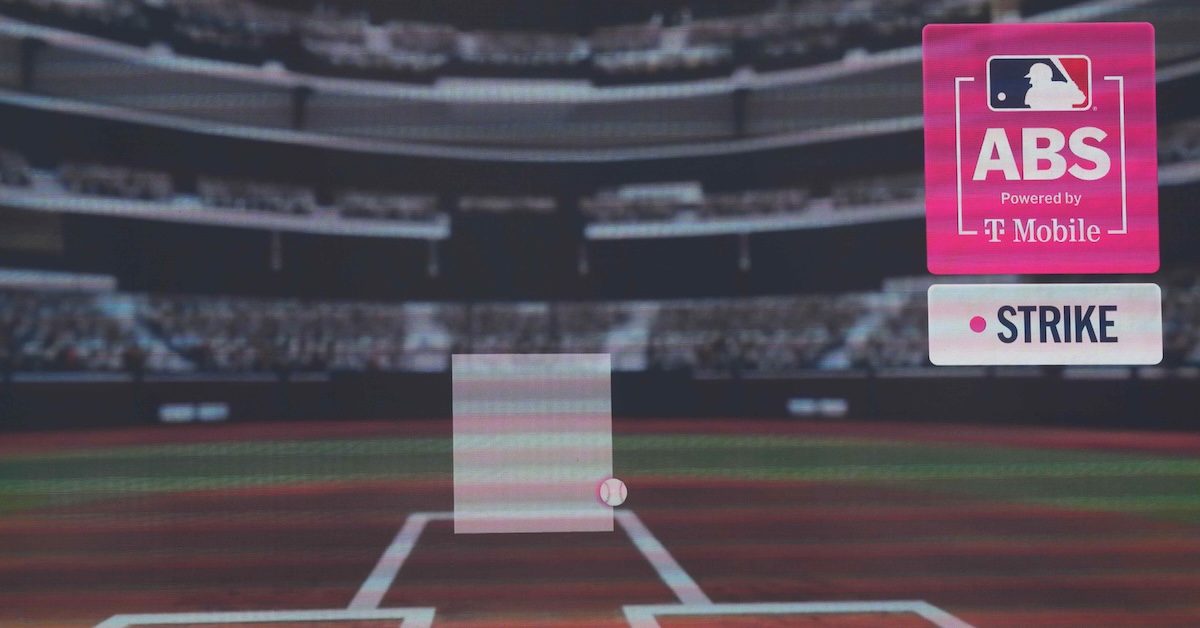
The graphic on the gigantic video board in center field showed that the pitch had missed by 0.4 inches. The call was overturned; the count was now 3-0. Neto walked on the next pitch. Mike Trout stepped in, took a fifth straight ball from Gil, then let a four-seam fastball over the heart of the plate get deep on him. He unloaded, clobbering the cookie 383 feet into the right field seats for a go-ahead two-run blast.

The no-doubt Trout clout would have been the decisive blow in an Angels win if not for a misplayed popup and a Jordan Romano meltdown. The Yankees walked it off on a José Caballero single, relegating Neto’s challenge to a footnote in that night’s game story, if it was mentioned at all. Even so, the gamble was an early example of how the new automated ball-strike challenge system can make the difference between winning and losing a game. Read the rest of this entry »


The White Sox Are in the Midst of An Impressive Turnaround

Matt Marton-Imagn Images

In 2024, the White Sox set a single-season record by losing 121 games, and last year, they went 60-102 under rookie manager Will Venable — their third straight season with at least 100 losses. Yet now, more than a third of the way into the 2026 season, the White Sox are one of only five AL teams with a record of .500 or better. At 34-31, they currently occupy the second Wild Card spot and are just 1.5 games behind the Guardians in the AL Central race.

Our projection systems certainly didn’t see this turnaround coming, as the White Sox were forecast for a 67-95 record — worst in the AL by almost five full wins — with just a 1.1% chance of making the playoffs. In our preseason Positional Power Rankings, their starting pitching, all three outfield spots, and designated hitter all ranked among the majors’ bottom three. As of mid-April, the Sox appeared to be fulfilling their destiny of another forgettable season, having skidded to a 6-13 start while scoring just 3.16 runs per game and hitting a cringeworthy .195/.286/.316 (71 wRC+), worst in the majors across the board. Even newcomer Munetaka Murakami was hitting just .167/.346/.417 (111 wRC+) with five home runs and a 21.8% walk rate but not much else. However, since that point, the team has hit .260/.343/.451 (121 wRC+) with 73 homers, leading either the AL or the majors in all of those categories while going 28-18 (.609) for the league’s second-best record over that span, behind only the Yankees (29-17, .630). Unfortunately, the last eight of those games have been without Murakami, who suffered a Grade 2 hamstring strain running out an infield grounder on May 29 and landed on the injured list; more on him below.

While there’s a long way to go in the 2026 season, at their current pace the White Sox could post this century’s second-largest improvement in winning percentage among the teams that lost at least 108 games two years prior:

Largest Improvement Two Years After Losing at Least 108 Games
Team Season W L WL% Season W L WL% Dif Playoffs
Orioles 2021 52 110 .321 2023 101 61 .623 +.302 Won AL East
White Sox 2024 41 121 .253 2026 34 31 .523 +.270
Astros 2013 51 111 .315 2015 86 76 .531 +.216 Won ALWC
Diamondbacks 2021 52 110 .321 2023 84 78 .519 +.198 Won NLCS
Tigers 2019 47 114 .292 2021 77 85 .475 +.183
Tigers 2003 43 119 .265 2005 71 91 .438 +.173
Athletics 2023 50 112 .309 2025 76 86 .469 +.160
Diamondbacks 2004 51 111 .315 2006 76 86 .469 +.154
Orioles 2018 47 115 .290 2020 25 35 .417 +.127
Orioles 2019 54 108 .333 2021 52 110 .321 -.012
Rockies 2025 43 119 .265 2027 — — — —

Read the rest of this entry »


A Slug-ish Start for Andrew Benintendi

Joe Nicholson-Imagn Images

The homers have yet to arrive for Andrew Benintendi.

My great, big, bold prediction for FanGraphs this year was that Benintendi would hit 30 home runs. It’s now the second week of June, and he has six. If he keeps this pace, he’ll finish with 15. Somehow, I think that means I’m off by 100%.

My reasoning at the time was flawless, of course. Benintendi the last two seasons had quietly reinvented himself. He’d always hit the ball in the air, but rarely with oomf, and almost always to left or center field. He averaged just 12 home runs per 600 plate appearances over the first eight years of his career, with sometimes good, sometimes not-so-good results.

But he clubbed exactly 20 homers in each the last two seasons. How? He simply took his existing contact-in-the-air profile and changed its direction to the pull side. He wasn’t hitting the ball farther; he was simply aiming shallower. This is the thing to do in baseball right now, unless you’re the Rays. Read the rest of this entry »


Miguel Vargas Has Been Abducted and Replaced by a Replicant. I Hope the Old Version Never Comes Back.

Kamil Krzaczynski-Imagn Images

One of my favorite sticks to beat the White Sox with (and over the past few years, there have been plenty) has been the Erick Fedde trade of 2024.

You know the one: Chicago was en route to a record-breaking number of losses, and with the season in the tank, GM Chris Getz flipped three of his best-performing players — Michael Kopech, Tommy Pham, and Fedde — in a three-way deal with the Cardinals and Dodgers. The 2024 White Sox were enduring a lost season that redefined the term; trading those guys was obviously the right thing for Getz to do. My objection was the return.

The headliner for the White Sox was Miguel Vargas, who at the time was the Dodgers’ second-best utility infielder named Miguel, behind a 35-year-old for whom the Marlins had no need. The Dodgers not only got Kopech, they managed to finagle Tommy Edman, the best player in the deal, as well. Kopech immediately slotted in as a leverage reliever, Edman won NLCS MVP, and the Dodgers won the World Series. Read the rest of this entry »


The Continuously Variable Davis Martin

William Purnell-Imagn Images

You’ve probably heard of Davis Martin, or someone like him. Martin is a 6-foot-2 right-handed pitcher out of Texas Tech. But he’s not Tyler Davis, a 6-foot-2 right-hander who played at Sam Houston State. Davis is Martin’s teammate. Neither is he Corbin Martin, a 6-foot-2 right-hander out of Texas A&M. Corbin Martin plays for the other Chicago team.

Davis Martin is also not Caleb Kilian, his college teammate, who stands 6-foot-4 and plays for the Giants. Kilian played at Texas Tech with 6-foot-2 right-hander Clayton Beeter, now of the Nationals, and 6-foot-1 right-hander Caleb Freeman. Freeman and Davis Martin both pitched for the White Sox last year, but they’re not the same guy. Chris Martin is easier to remember: Texan and right-handed, but too tall and too old. Austin Davis is a lefty. Austin Martin is a position player. OK, I think we’re out of the woods now. Read the rest of this entry »


Munetaka Murakami, as Advertised

Peter Aiken-Imagn Images

The book on Munetaka Murakami was pretty straightforward when he hit the market this winter. Phenomenal cosmic power – itty bitty contact rate. While acknowledging recent injuries, our writeup noted his contact rates against good velocity (63%) and secondary pitches (50%) as red flags in his profile. And these weren’t little red flags, either. As Eric and James put it, “…if Murakami is only ever the quality of contact hitter we’ve seen the last three years, with no changes or improvements, he basically can’t be a good MLB hitter.”

Through a month of play, Murakami has been a very good MLB hitter, with a 153 wRC+ driven by a 21.5% walk rate and eight homers. But he’s struggled with contact, and that’s putting it mildly. He’s striking out a third of the time so far, with the fourth-lowest contact rate in baseball through Sunday’s action. So what can we say about that? One answer is that it’s too soon to say – either his contact rate will go up or his production will go down. But that’s pretty unsatisfying. To be fair, it’s probably right, but that doesn’t make it satisfying. So let’s break his game down more granularly to see where the whiffs are coming from, where the power is coming from, and how the two are related.

We’ll start with the “can’t hit secondaries” part of the scouting report. In the early going, that has been abundantly clear. Sixty-six batters have swung at 25 or more sliders this season. Murakami’s 59.3% whiff rate is the third highest, behind Max Muncy The Younger and James Wood. If you broaden that out to all secondaries, 201 batters have offered at 50 or more secondary pitches this year. Murakami’s 53.3% whiff rate is the third highest of that group, behind only Matt Wallner and Daniel Schneemann. Read the rest of this entry »