Monday offered a rare sighting, as Chris Sale took the mound in a game for the first time since last July 17 — even if it was only a Grapefruit League game against the Tigers. Limited to just 11 starts over the past three seasons due to injuries, the soon-to-be-34-year-old lefty took his first step towards both reestablishing his spot among the game’s top pitchers and helping to support a promising but rickety rotation that may be the Red Sox’s best hope for respectability this year.
Once upon a time, Sale ranked among the game’s most durable pitchers. From 2012-17, only Max Scherzer, R.A. Dickey and Jeff Samardzija threw more innings than his 1,230. Sale was limited to 27 starts in 2018 due to left shoulder inflammation, though he wobbled through the postseason while helping the Red Sox win the World Series. It’s been downhill ever since, as he pitched to a 4.40 ERA and missed the last seven weeks of the 2019 season due to left shoulder inflammation, then tore his ulnar collateral ligament the following spring and had Tommy John surgery. The Red Sox took a slow, deliberate approach to his rehab. He didn’t return to the majors until August 14, 2021, nearly 17 months after his surgery and two years and a day since his last regular season outing.
Sale made nine starts with mostly good results in 2021, posting a 3.16 ERA and 3.69 FIP while striking out 28.4% of hitters, but hopes that that performance would carry over into 2022 didn’t last long. About a week after the lockout ended, the Red Sox revealed that Sale had suffered a stress fracture in his right rib cage while throwing batting practice at Florida Gulf Coast University in mid-February; he wasn’t allowed to tell the team until the lockout ended. He finally made his first of four rehab starts on June 20, and returned to the Sox after a frustrating five-walk outing that was capped by him destroying a television and other equipment in what he later called “a 7-year-old temper tantrum.” On July 12 he finally took the mound for Boston, throwing five shutout innings against the Rays, but five days later, he didn’t make it out of the first inning against the Yankees, as a 106.7-mph Aaron Hicks line drive hit his left hand, fracturing his pinky. Around three weeks later, while the pinky was still healing, he broke his right wrist in a bicycle accident and needed season-ending surgery. Woof. Read the rest of this entry »
With the World Baseball Classic in progress this week, now feels like a good time to steal an idea from another sport. In baseball, the international game is a bit vestigial. There has never been a consistent international best-on-best tournament on par with the FIFA World Cup or Olympic ice hockey, in which players desire success with the national team as much as they would success with their club teams.
Baseball hasn’t had that; the Olympics, taking place as they do within the MLB regular season, never featured best-on-best competition. And that’s when the Olympic program includes baseball to begin with. The World Baseball Classic hasn’t been around long enough to gain the kind of legitimacy the World Cup has, and it’s administered in part by Major League Baseball.
The biggest obstacle to a serious international game in baseball is pitcher usage. Pitcher workloads are so tightly monitored, few players and even fewer teams are willing to loan out a fragile and valuable arm to a tournament that’s widely viewed as an exhibition. The second-biggest obstacle is the lack of a powerful independent governing body for the sport; for most of the history of baseball, MLB has been its driving force. Even as various major leagues popped up around the world and the sport flourished at the amateur level, baseball has been centralized in the way hockey, soccer, and basketball never were, and the WBSC isn’t powerful enough to dictate a truly independent prestigious international competition. Read the rest of this entry »
Andrew Baker has some of the best raw stuff in the Philadelphia Phillies system. He also has one of the best backstories. A 22-year-old right-hander with a high-octane heater and a breaking ball that’s arguably better, Baker converted from catcher to pitcher in junior college and initially hated it. Moreover, he’d once been scared to take the mound.
Baker — an 11th-round pick in 2021 who finished last year in Double-A — is currently in big-league camp with the Phillies. He discussed his atypical path to prospect prominence over the weekend.
———
David Laurila: You were a high school catcher and didn’t become a pitcher until college. Is that correct?
Andrew Baker: “Yes. I did the full switch at the beginning of my freshman year in 2019, so I’ve really only been pitching seriously for about four years.” Read the rest of this entry »
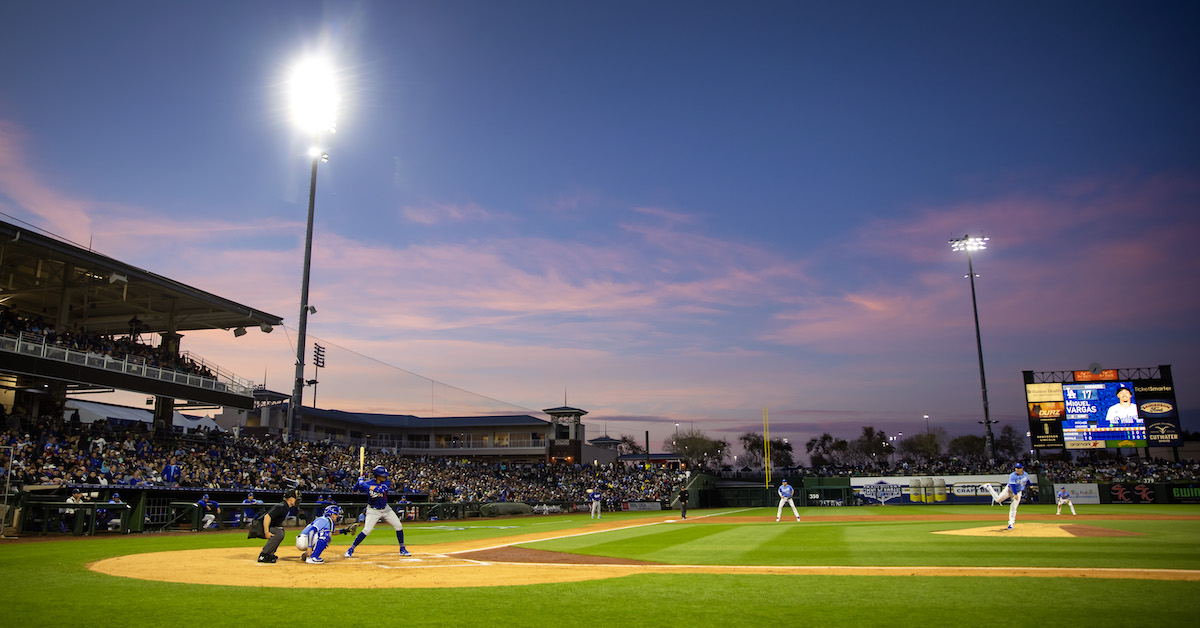
Miguel Vargas will take his first swing of spring training today. That wouldn’t be that notable, except that Vargas has already played in six spring training games and had 11 spring training plate appearances. He just hasn’t swung yet. That’s been necessary because of a hairline fracture in his right pinkie he suffered while taking groundballs. Vargas is the Dodgers’ fifth-ranked prospect, and with Gavin Luxout for the season and Messieurs Turner and Turner off to Boston and Philadelphia, Los Angeles needs him at second base. The Dodgers want Vargas getting game reps at the keystone and seeing live, competitive pitches. So there he is, playing despite the fact that he’s not medically cleared to swing the bat in a game.
Just seeing pitches is plenty important. You don’t need to swing to track pitches and work on your timing. Take Kyle Schwarber, whose heroics in the 2016 World Series came after a horrific knee injury cost him most of that season. After acing his six-month checkup and being cleared to hit, Schwarber flew out to the Arizona Fall League, where he could see as many pitches as possible before the Series. He played in two real games and two simulated ones, but the real work happened in the cage, much of it with the bat on his shoulder. Per Tom Verducci, “Schwarber hit or tracked 1,300 pitches in four days — many out of a pitching machine that fired major-league quality breaking pitches, some from two Class A pitchers the Cubs brought in to pitch to him in the simulated games and some from coaches.” Read the rest of this entry »
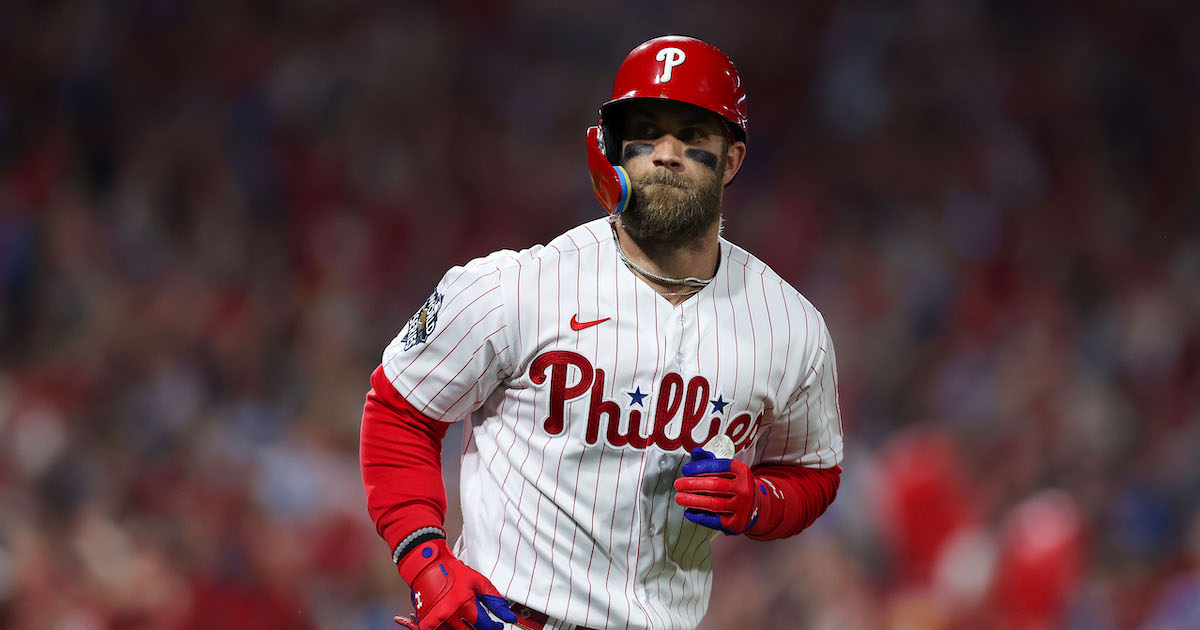
Today is the day that Bryce Harper reports to spring training. While it’s certainly fun to anticipate Harper’s return from reconstructive elbow surgery, his grand entrance into the heart of the Phillies lineup will have to wait a few months. He has been “dry swinging” as part of his rehab, taking swings without hitting a baseball, and his return to the active roster isn’t expected until sometime around the All-Star break. Defense will wait even longer, with Harper not expected to really be ready to play the field until the end of the regular season. That will mean many simultaneous servings of Kyle Schwarber and Nick Castellanos in the outfield, something the FDA would surely stridently oppose if asked for an opinion.
The Phillies did some good things this offseason. By far the team’s biggest move was signing former Dodgers shortstop Trea Turner to a monster deal totaling $300 million over 11 years. I was a fan of the signing because it recognized that despite finishing 2022 just two wins short of a World Series title, the Phillies were also a third-place team that finished 14 games behind its divisional competition. With no expectation of a collapse from the Braves or the Mets, it was important to aggressively improve the roster where possible. Signing Turner allows incumbent shortstop Bryson Stott to slide into Jean Segura’s vacated role at second base, upgrading both positions.
But I haven’t been a fan of how the Phillies have managed the Harper situation from a roster standpoint. This is a team that should have been motivated to upgrade its outfield even in the alternate universe where Harper never requires Tommy John surgery. As currently constituted, the team’s outfield depth, which is basically Jake Cave and Josh Harrison, would have a great deal of trouble even replacing Brandon Marsh, let alone the 2021 MVP. Dalton Guthrie and Símon Muzziotti are unlikely to be answers either; not a single projection system housed here at the site has either of them with even a 90 wRC+ in 2023. That the team did nothing to address this issue after knowing that Harper would be unavailable for a significant chunk of the season is either perplexing or maddening, depending on whether you root for the Phils.
The team has yet to commit to a DH plan, at least publicly, and it appears likely that players will rotate through the position to keep them fresh. But rotating isn’t the same thing as replacing since that same motley crew of backups will play other positions when they aren’t DHing. None of the reserves/minor leaguers named above or Edmundo Sosa is likely to be even replacement level at designated hitter. The closest thing the Phillies have to a viable offensive option is Darick Hall, who showed power in his brief 2023 stint, but also poor plate discipline and a meager contact rate. ZiPS is easily the most optimistic of the FanGraphs projection systems here and even it only pegs Hall for a .225/.299/.434 line and a 103 wRC+, rather below average for a starting DH. Nor does it seem like the Phillies are content (at least not yet) to just plug him into the position for three months, which may be the least damaging in-house solution.
In terms of projected wins, the Phillies are right in that band where adding a win is the most valuable. Win number 110 or 60 has basically no effect on a team’s playoff fate, but wins number 86 and 87 certainly do. A four-win player (Harper’s projection) losing half a season is two wins. Two wins is about what acquiring an MVP candidate at the trade deadline will get you, something teams give up significant value to do. So how big a deal is Philadelphia’s curiously lax approach? Let’s start with the ZiPS projection, which currently assume 75 games for Harper. Here are the updated projected standings with that assumption:
ZiPS Mean Projected Standings – NL East
Team
W
L
GB
Pct
Div%
WC%
Playoff%
WS Win%
Atlanta Braves
94
68
—
.580
47.1%
39.6%
86.6%
12.1%
New York Mets
94
68
—
.580
42.6%
42.1%
84.6%
11.0%
Philadelphia Phillies
85
77
9
.525
9.8%
37.5%
47.2%
2.6%
Miami Marlins
75
87
19
.463
0.6%
7.0%
7.6%
0.1%
Washington Nationals
65
97
29
.401
0.0%
0.2%
0.2%
0.0%
That’s similar to the projection I ran a few weeks ago — not much has changed — and leaves the Phillies as essentially a coin flip to make the playoffs, with a real chance to upset and win the division, though they’d need a number of dice to roll their way. Now, here are the same projections, but with a few different totals for the number of games Harper is able to play at DH. The first column is the default 75-game projection from above:
ZiPS NL East Playoff Probs by Bryce Harper Games Played
Team
Div%
0
18
36
54
72
90
108
126
144
162
Atlanta
47.1%
48.9%
48.7%
48.3%
47.7%
47.2%
46.7%
46.1%
45.5%
44.8%
44.0%
New York
42.6%
44.4%
44.0%
43.4%
43.1%
42.6%
42.0%
41.6%
41.1%
40.4%
39.7%
Philadelphia
9.8%
5.9%
6.7%
7.6%
8.6%
9.5%
10.7%
11.7%
12.9%
14.3%
15.8%
Miami
0.6%
0.7%
0.7%
0.7%
0.6%
0.6%
0.6%
0.5%
0.5%
0.5%
0.5%
Washington
0.0%
0.0%
0.0%
0.0%
0.0%
0.0%
0.0%
0.0%
0.0%
0.0%
0.0%
Team
Playoff%
0
18
36
54
72
90
108
126
144
162
Atlanta
86.6%
88.0%
87.7%
87.4%
87.1%
86.7%
86.5%
86.1%
85.8%
85.4%
85.1%
New York
84.6%
86.1%
85.8%
85.5%
85.0%
84.7%
84.3%
84.0%
83.6%
83.3%
82.9%
Philadelphia
47.2%
36.9%
39.3%
41.7%
44.1%
46.7%
49.4%
51.9%
54.5%
57.1%
59.6%
Miami
7.6%
8.5%
8.2%
8.1%
7.9%
7.6%
7.4%
7.1%
6.9%
6.8%
6.6%
Washington
0.2%
0.2%
0.2%
0.2%
0.2%
0.2%
0.2%
0.2%
0.2%
0.2%
0.1%
Team
WS Win%
0
18
36
54
72
90
108
126
144
162
Atlanta
12.1%
12.6%
12.5%
12.4%
12.3%
12.2%
12.0%
11.9%
11.8%
11.6%
11.5%
New York
11.0%
11.5%
11.4%
11.3%
11.2%
11.0%
10.9%
10.8%
10.7%
10.6%
10.4%
Philadelphia
2.6%
1.6%
1.8%
2.0%
2.3%
2.6%
2.9%
3.2%
3.5%
3.9%
4.3%
Miami
0.1%
0.2%
0.2%
0.1%
0.1%
0.1%
0.1%
0.1%
0.1%
0.1%
0.1%
Washington
0.0%
0.0%
0.0%
0.0%
0.0%
0.0%
0.0%
0.0%
0.0%
0.0%
0.0%
In the worst case scenario, where something goes wrong with Harper’s rehab and he misses the season, ZiPS estimates that the Phillies would lose 10.3 percentage points of playoff probability. To put that in context, when I did a similar exercise last year with everyone in the National League as of late June, only Corbin Burnes had more of an effect on his team’s playoff chances. Indeed, of the million simulations of the 2022 season I ran, 40% of the ones that saw the Phillies pull a Rocky II and make the second time the charm would have disappeared into the aether if Harper had failed to return.
At the time of Harper’s surgery, the Phillies had myriad options, even if you ignore the unrealistic ones (like signing Aaron Judge or tricking someone into picking up Castellanos’ contract) or the fun, ambitious ones (like signing Brandon Nimmo out from under the Mets’ noses and playing him in right, then shifting him to center when Harper returned). Brandon Drury at DH projects as a superior option to any of the Phillies reserves and would have been a better flex option than Harrison. Wil Myers signed a one-year deal with the Reds for relative peanuts. Trey Mancini’s two-year, $16 million deal was costlier (macadamia nuts?), but he’s both a better hitter and would provide an emergency option if Rhys Hoskins leaves after 2023. Even the most pessimistic projection for J.D. Martinez (Steamer’s in this case) forecasts him for a 111 wRC+, and he signed with the Dodgers for one year and $10 million. Jurickson Profar remains a free agent; he could pick up DH reps against lefties and provide supersub value elsewhere the rest of the time. Given Harper’s likely eventual return, the Phillies might not have been the front-runners for all of those players, but better options were seemingly available.
The Phillies aren’t likely to make the playoffs winning just 85 games. Indeed, the scenarios in which they make the playoffs are generally those where they exceed their projections. Digging through a million sims, 87 wins only got a team the third Wild Card spot half the time, with the over/under to grab the NL East the highest in baseball at 98.4 wins.
ZiPS Playoff Table – 2023 National League
To Win
10%
20%
30%
40%
50%
60%
70%
80%
90%
NL East
91.1
93.5
95.4
96.9
98.4
100.0
101.5
103.5
106.1
NL Central
84.8
87.2
89.1
90.8
92.3
93.9
95.6
97.8
100.7
NL West
89.4
91.7
93.3
94.8
96.2
97.5
99.1
100.8
103.4
NL Wild Card 1
88.9
90.5
91.7
92.8
93.8
94.8
95.9
97.3
99.3
NL Wild Card 2
85.6
87.1
88.2
89.1
89.9
90.8
91.8
92.9
94.5
NL Wild Card 3
83.1
84.5
85.5
86.3
87.2
88.0
88.9
89.9
91.4
If the team was to change course at this point, it would likely need to involve a trade. Now, I certainly wouldn’t send Andrew Painter or Mick Abel out of town for a bat, but is there anyone else in the system who is really untouchable in exchange for some high-leverage wins? ZiPS had the organization with two prospects between no. 101 and no. 200 on its Top 100 (Griff McGarry at no. 106) and Hao-Yu Lee at no. 158), and I can’t imagine hanging onto them if the right trade opportunity became available.
In the quest to finish last year’s unfinished business, the Phillies lost one of the league’s most valuable players and chose not to really replace him. Phils fans better hope that Harper is as good at healing at he is at crushing fastballs a mile. If not, the team’s lax approach may prove fatal to its playoff hopes.
It’s World Baseball Classic time! Over the next two weeks, we will see players from all over the world represent their countries in the hopes of bringing home a title. We’ll be lucky enough to see MLB superstars like Shohei Ohtani, Mike Trout, and Juan Soto play for their respective countries, but viewers will also be introduced to some names and faces they might not have seen play stateside. Baseball is played all over the world, after all, and there are hundreds of players who could prove to be impactful for their teams in this tournament.
With games starting today, I wanted familiarize you with a few players who either aren’t yet household names in MLB or have no experience in MLB at all. I’ve selected each of these players because they have a chance to be standouts on their respective teams. Read the rest of this entry »
Jay Jaffe: For tomorrow I’m working on something about Chris Sale’s return
2:02
Jay Jaffe: Today: just chat, so pitter-patter let’s get at ‘er
2:04
Farhandrew Zaidman: True or false: the best Team Japan WBC pitcher not named Shohei Ohtani is Yoshi Yamamoto.
2:05
Jay Jaffe: I honestly don’t know much about Yamamoto but I know there’s a large contingent who would point to Roki Sasaki, who struck out 35.3% of all hitters last year and walked just 4.7%. I’ve seen clips but looking forward to watching him pitch
In the last week, over 300 MLB-affiliated players have started to leave camp to join their countries’ teams for the first World Baseball Classic in six years and the fifth in the tournament’s history. For some veterans and well-established big leaguers, a hiatus from Grapefruit or Cactus League action isn’t something to be concerned about. Playing in the Classic won’t cost them a chance to hit quality live pitching, or pitch to quality live hitters, and while any game action comes with some risk of injury, these types can afford a two-week sabbatical without jeopardizing their job security. Other players, though, are in the midst of big league roster battles, trying to distinguish themselves during camp and earn a spot come Opening Day. As much as we discount the stats generated in spring exhibitions, for some players, this time represents much more than a chance to get into game shape – it’s also an opportunity to change the course of their career.
For these players, the WBC is perhaps not ideally timed. If you’re trying to secure the final bench or bullpen spot, departing camp for a while isn’t exactly a surrender, but these are valuable weeks to make your abilities known. Tony Andracki of Marquee Sports Network has reported that a number of Chicago Cubs on the roster bubble are forgoing participation in the WBC in order to continue their efforts to make the club, and they likely aren’t alone. Here I’ll also note that the absence of some big league regulars opens the door for prospects and other fringe roster types to make a strong impression on their club with more trips to the plate and batters faced. Still, the WBC is a well-appreciated opportunity to represent one’s country, and that so many players jockeying for a roster spot choose to take the time to do so is a testament to what that opportunity means. Read the rest of this entry »
Japan has a long history of baseball in its popular culture. From the organized cheers for NPB players and teams to the summer Koshien high school tournament, baseball serves as not just a spectator sport but a way of life for many people. As a result, Japanese players put great emphasis on their national team’s success in international competitions to showcase the country’s best. In recent memory, Samurai Japan has dominated on the international stage, winning each of the first two World Baseball Classics in 2006 and 2009. Daisuke Matsuzaka claimed MVP in both tournaments, winning all six of his decisions, while hitters like Ichiro Suzuki and Kosuke Fukudome led the way offensively. In 2013 and 2017, they reached the semifinals before ultimately being eliminated, but they remain the only team to place in the top four in each iteration of the WBC. More recently, Japan claimed the gold medal at the 2020 Olympics, shutting out the United States in the championship game. Samurai Japan hopes to continue this run of international success, fielding a largely similar group of players from their Olympic title squad.
Much of Japan’s on-base skill comes from the outfield, led by current Red Sox outfielder Masataka Yoshida. Previously a member of the Orix Buffaloes, Yoshida has one of the best combinations of contact skills and plate discipline in recent memory. A two-time batting champion, Yoshida walked twice as much as he struck out over the past three years and just finished his best season to date with a 201 wRC+. While he doesn’t have monster exit velocities, he puts so many balls in play that eventually a good number go over the fence; he has averaged 23 homers over the past five seasons. Yoshida is a bit defensively limited in left field, but he won’t be able to spend time at DH in the WBC like he did with the Buffaloes because a little-known player on the Angels already has claim to that spot.
Another member of Samurai Japan who wears a red MLB uniform is Lars Nootbaar (who might have the coolest middle name of all time). A batted ball data darling, Nootbaar had a great rookie year with the Cardinals, producing plus exit velocities, a refined plate approach, and 2.7 WAR in just 347 plate appearances. Nootbaar will likely play center field for Japan despite being a corner guy in MLB, but his above-average speed and arm strength should make the transition to center relatively smooth. Nootbaar and Yoshida are joined by Kensuke Kondoh (whose Fukuoka Softbank Hawks don’t wear red, unfortunately). While he doesn’t have much thump in his bat, maxing out at 11 homers in a season, his plate discipline makes him one of the most talented offensive players in Japan. He’s consistently run chase rates in the 18-19% range (second best among NPB hitters), and just finished his sixth consecutive season with an OBP of .400 or higher. Read the rest of this entry »
I first learned about joint dislocation in 2003 after Derek Jeter slid into a nasty collision at third base. When I heard that Jeter had suffered a dislocated shoulder, my five-year-old brain naturally conjured up an image of a disembodied arm lying on the infield dirt. You can imagine my surprise when the Yankees shortstop returned six weeks later, both arms firmly secured in their sockets.
As horrifying as dislocation sounds, and as painful as I’m sure it is, a dislocated shoulder isn’t always a serious injury. Fernando Tatis Jr. dislocated his shoulder several times during the 2021 season and still managed to play 130 games and put up 7.3 WAR en route to a third-place finish for NL MVP. Brandon Inge once dislocated his shoulder mid-game and popped it back in place on the field; the very next inning, he smacked a go-ahead RBI single.
Thus, when Brendan Rodgers landed awkwardly on his shoulder last Tuesday, there was no cause for panic straight away. Manager Bud Blackdescribed the incident as “a pretty classic thing,” while Matthew Ritchie of MLB.com wrote that Rodgers might be “a tad delayed.” Unfortunately, the injury appears to be far more significant than your run-of-the-mill dislocation, with reports suggesting Rodgers might need surgery to repair the damage. If he goes under the knife, the Rockies second baseman could miss most, if not all, of the upcoming season. Read the rest of this entry »



 Jay Jaffe

