It’s been a strange season for Mike Trout, one that’s featured a hot start, an epic slump that accompanied the worst losing streak in franchise history, and a diagnosis of a long-term back injury followed by an absence of 30 games. The good news is that since returning to activity on August 19, he’s gradually recovered his form, and this past week he set a career best by homering in six straight games.
Trout began his streak on September 4 with an eighth-inning homer off the Astros’ Brandon Bielak — the only run the Angel scored in a 9-1 loss — but his next three came against the Tigers (Tyler Alexander, Eduardo Rodriguez, and Will Vest), all in wins. He continued the streak with a homer off the Astros’ Lance McCullers Jr. in a loss on Friday night, but his three-run second-inning shot off José Urquidy on Saturday helped power the Halos to a victory.
In the annals of Halos history, that last home run lifted Trout past Bobby Bonds, who homered in five straight games for the Angels from August 2–7, 1977. The streak additionally pushed Trout past the Rangers’ Corey Seager (July 8-12) for the longest of this year. Trout had already surpassed his personal best of homers in four straight games, set in 2017 (May 12–15) and matched in ’19 (April 4–7). Read the rest of this entry »
Last week, we at FanGraphs came up with a fun idea: we simulatedAaron Judge’s remaining games a million times to figure out if and when he’s likely to hit some milestone home runs: numbers 60, 61, and 62. At the time, the takeaway was clear: Judge was most likely to hit each of those milestone home runs during the Yankees’ series in Toronto on September 26–28.
Since that article was published, Judge has played six games and hit only one home run. That changed the odds significantly. More specifically, per my simulation, here are his odds of reaching at least 60, 61, or 62 homers, both now and six games ago:
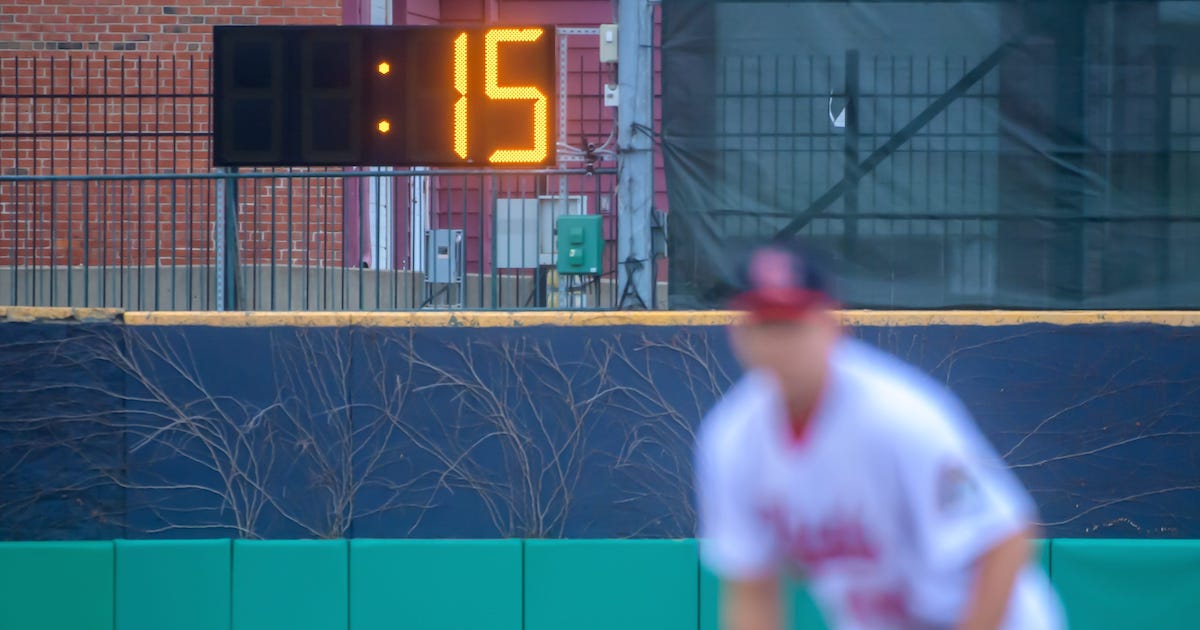
After more than a century of a deistic laissez-faire attitude toward the sport, Major League Baseball made a remarkable announcement on Friday: Next year, for the first time, baseball will have a clock. The introduction of a pitch clock at the highest level of the game is merely one gourd in a cornucopia of rule changes approved late last week by the league’s competition committee, but it could revolutionize the sport. You can find the full list here, but rather than delve into the minutiae, I want to give a brief précis of the most important highlights and deliver a remarkable conclusion. Read the rest of this entry »
The English Premier League postponed this weekend’s slate of games following the death of Queen Elizabeth on Friday. Some of you may not have known that — soccer isn’t everyone’s cup of tea — but at the same time, a lot of you did. For many FanGraphs readers, pouring a cup of coffee and watching a Saturday or Sunday-morning match is part of your routine. More often than not, it’s as a supporter of a particular Premier League team.
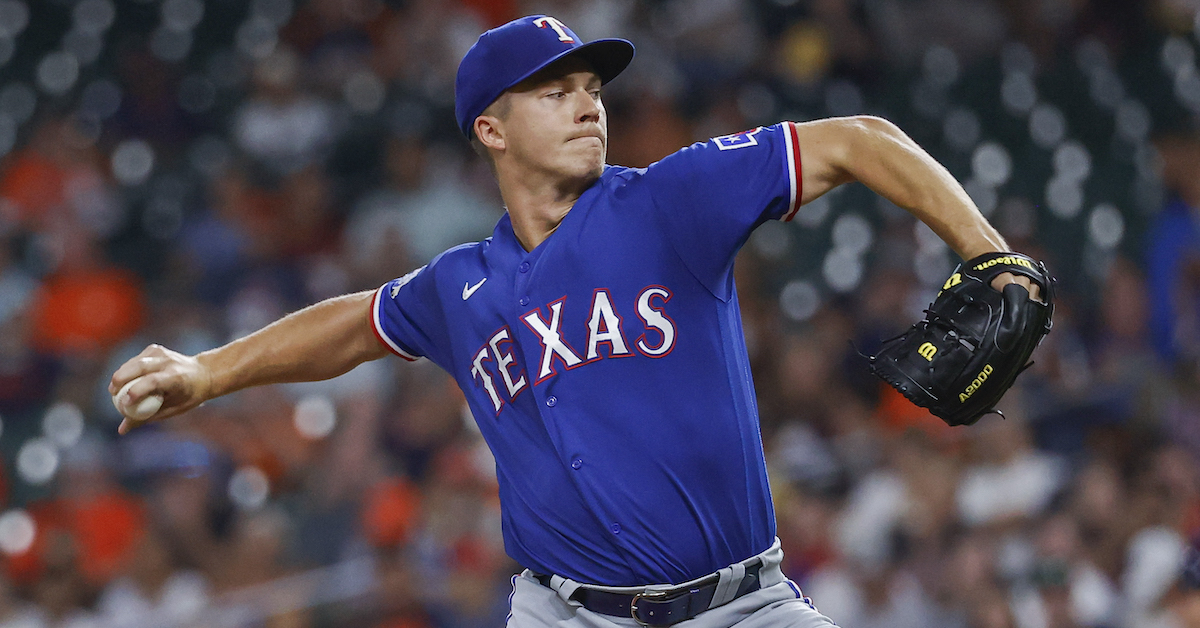
Brad Miller does exactly that. An ardent Manchester City fan, the Texas Rangers infielder “dove into European soccer” head-first while on the injured list a handful of years ago. What started as a diversion has turned into a passion. Miller not only keeps a keen eye on Premier League and Champions League matches, he assesses strategies and follows transfer rumors.
Style of play is a big reason he adopted Man City.
“They’re obviously really good, and I feel kind of bad admitting that,” Miller said of his initial attraction. “But they’re also a well-oiled machine. There was a documentary on Amazon, ‘All or Nothing,’ where they followed the team. That definitely had me intrigued, just watching the way they play.
“I kind of compare them a little bit to the Dodgers,” continued Miller. “They have a great market, great financial backing, and also a great infrastructure — their player-development system, scouting, medical staffs, and all that. The haven’t poured money into just purchasing players, they’ve poured it into a sustainable model.” Read the rest of this entry »
Ben Lindbergh and Meg Rowley banter about how the White Sox have played in Tony La Russa’s absence, then discuss the benefits and drawbacks of the rules changes coming to MLB in 2023: a pitch clock, restrictions on pickoff attempts and the shift, and bigger bases (with asides on a new WAR, Zack Greinke’s front-office acumen, and Ben’s hiccup cure). Then (52:40) they’re joined by historian Richard Hershberger for an in-person Past Blast from 1901, plus a long-term perspective on responses to times of rapid change in baseball, the sport’s cyclical nature, and more.
Audio intro: Phoenix, “1901” Audio outro: Ryan Bingham & The Dead Horses, “Change Is”
Jay Jaffe: Bear with me for a moment as my lunch just arrived…
2:05
Guest: Thoughts on the new rule changes reported yesterday? I’ve wanted pitch clocks for awhile but actually looking at the rule there’s 50 different ways that the batter or the pitcher can break the rule. I’m worried it’s gonna feel ridiculous when the Sox lose to the Twins because Aaron Bummer forgot how many times he stepped off the rubber or whatever.
You could be forgiven for having given up on the Rays. Four weeks ago, they lost to the Orioles at Tropicana Field, knocking their record to 58–53 and sending them down to fourth place in the AL East, half a game behind the O’s, two games behind the Blue Jays, and 12 games behind the Yankees. Injuries had gutted their lineup. Yet since that point, they’ve been as hot as any team in baseball, even the Braves. What’s more, Wander Franco is slated to return from a two-month absence on Friday, just in time for the surging squad to face the Yankees — now leading the division by just 4.5 games — in the Bronx.
The 21-year-old Franco topped our Top 100 Prospects lists in both 2020 and ‘21 before putting together a stellar rookie season last year but has played just 58 games this season, hitting a modest .260/.308/.396 for a 104 wRC+. He landed on the injured list on May 31 due to a right quad strain and missed most of June, then played just 13 games before returning to the IL on July 10 due to a fractured hamate in his right hand, which required surgery.
Franco began a rehab stint with Triple-A Durham on August 16 but made just two plate appearances before discomfort in his right wrist forced him from the game; later that week, the Rays pulled him from the assignment due to lingering soreness. He finally returned to action on September 4 and went 6-for-11 with a double over a three-game span. Tampa planned for him to stay with Durham through Saturday, but his 3-for-5 performance while playing nine innings at shortstop on Wednesday led the team to accelerate his timetable.
While Franco’s slash stats don’t measure up to last year’s numbers, his Statcast data in several key categories is practically the same:
Wander Franco Statcast Hitting
Season
BBE
EV
LA
Barrel%
HardHit%
AVG
xBA
SLG
xSLG
wOBA
xwOBA
2021
245
88.2
9.7
4.9%
37.6%
.288
.276
.463
.407
.348
.329
2022
204
88.1
6.6
4.4%
37.7%
.260
.291
.396
.416
.305
.334
Franco’s average exit velo and hard-hit and barrel rates are almost identical from year to year, but this year he’s hitting more grounders and fewer fly balls (note the lower average launch angle and the increase in his groundball/fly ball ratio from 1.32 to 1.66). What’s more, he’s hit just .188 and slugged .229 on grounders this year, compared to .252 and .306 last year. Where hitting the ball in the air helped him to outperform his expected stats last time, that hasn’t been the case this year, though he’s still produced a wRC+ nine points above that of the major league mark for shortstops (95). It’s also 39 points above that of fill-in Taylor Walls, who has “hit” an anemic .176/.267/.282 (65 wRC+) in 408 PA accompanied by a wide divergence in his defensive metrics at shortstop (-0.3 UZR, -4 RAA, and 12 DRS). By our measure, he’s been 0.4 wins below replacement, but via Baseball Reference, he’s been worth 2.3 WAR. Go figure.
While the truth of Walls’ value probably lies somewhere in between, the larger truth is that the Rays are a better team with Franco, and they’re getting him back at a critical time. The team entered Friday having gone 19–5 (.792) since August 12, tied with the Braves for the majors’ best record, and with the best Pythagorean record (.793) in that span as well. In that time, they’ve overtaken the Orioles (which took just a day) and the Blue Jays, cut the slumping Yankees’ AL East advantage to 4.5 games, and taken over the top spot in the AL Wild Card race. Here’s a snapshot of their odds change:
Rays Playoff Odds Change
Split
W
L
Win%
GB
Div
Bye
WC
Playoff
WS
August 12
58
53
.523
12
0.3%
0.3%
41.7%
41.9%
1.4%
September 9
77
58
.570
4.5
6.2%
6.2%
92.1%
98.3%
4.4%
Change
19
5
.792
-7.5
+5.9%
+5.9%
+50.4%
+56.4%
+3.0%
The Rays began that 19–5 run by taking the next two games form the Orioles and then two of three from the Yankees, though they have benefited by playing a fairly soft schedule thereafter: four games apiece against the Royals and Angels, six against the Red Sox, two against the Marlins, and three more against the second-half edition of the Yankees, who have gone just 19–27 as everybody not named Aaron Judge has either stopped hitting, gotten hurt, or both. Read the rest of this entry »
Yesterday, I took a look at a few starters who have changed their pitch mix after being traded halfway through this season. Today, I’m finishing the set. Here are the relievers who have changed their pitch selection the most in the month after joining new teams. One note: since relievers throw fewer pitches, the variability in their mix is greater; a few extra sliders to get the feel for them in a random game can tip the percentages meaningfully. I’m focusing on five relievers who made interesting changes, but you could add others to the list.
The Change: -12% Four-Seamer, -6% Changeup, +8% Cutter, +14% Slider
Trivino is a rarity, a legitimate five-pitch reliever. He’s thrown his changeup, slider, sinker, cutter, and four-seamer each at least 10% of the time this year, and mixed in an occasional curveball for good measure. The Yankees are working to change that.
Since donning pinstripes, Trivino is down to three pitches he uses at least 10% of the time: sinker, slider, cutter. His slider is new this year, one of the sweeping types that are all the rage these days, and he’d already taken to the pitch in Oakland, using it nearly 20% of the time. He’s using it even more in New York; a third of the pitches he’s thrown as a Yankee have been sliders. Read the rest of this entry »
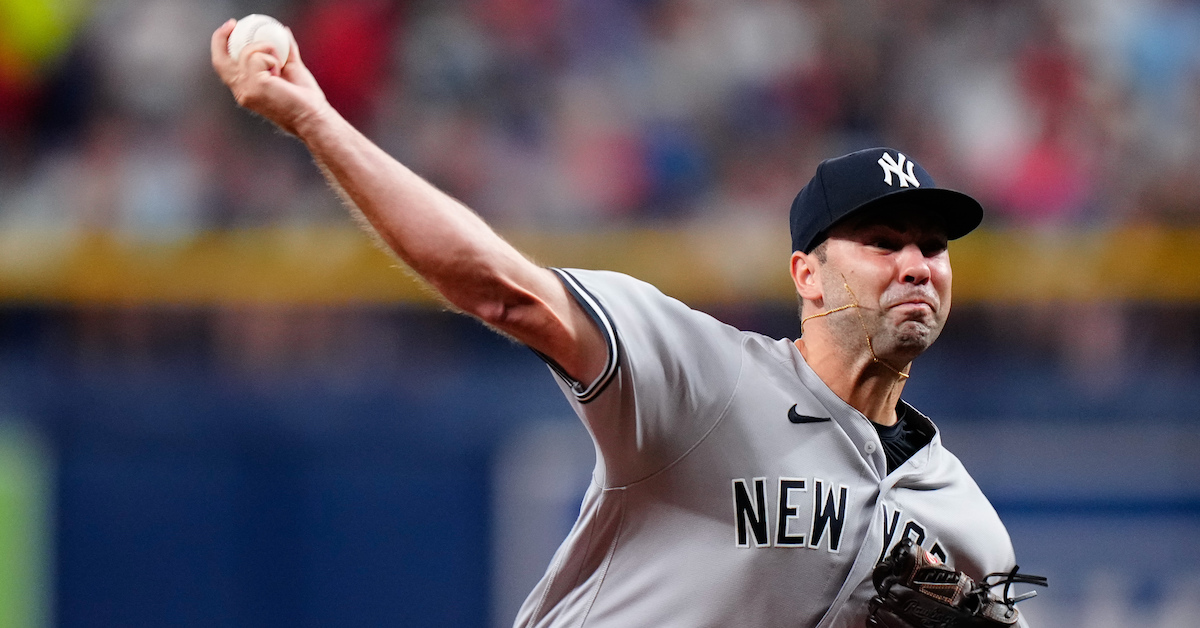
Glenn Otto is a different pitcher than the one the New York Yankees took in the fifth round of the 2017 draft out of Rice University. Acquired from his original organization by the Texas Rangers as part of last summer’s Joey Gallo deal, the 26-year-old right-hander not only has a better understanding of his craft, he’s attacking hitters with an expanded arsenal. Moreover, his five-pitch mix is directionally diverse. Augmented by an occasional bridge pitch, Otto’s offerings are designed to go north, south, east, and west.
Otto discussed his repertoire, and the education he’s received while building it, when the Rangers visited Fenway Park last weekend.
———
David Laurila: In what ways have you grown since coming to pro ball? Having played at a high-profile program, I assume you already had a good idea of how to pitch.
Glenn Otto: “I honestly really didn’t. I was a reliever in college and pretty much relied purely on stuff. I had a mid-90s fastball and a really good curveball, which was all I used back then. Once I got into pro ball and became a starter, it was about going as deep as I can, commanding the fastball to all four quadrants, developing a changeup — a pitch which has kind of come and gone for me — and I’ve also made some adjustments mechanically. Read the rest of this entry »
There are not many subjects that baseball teams agree on, outside of not paying minor leaguers much money. One thing that 29 teams do share is an enormous amount of regret that they didn’t convince Shohei Ohtani to come join their franchise after the end of the 2017 season. (OK, 28 teams since the Orioles bizarrely refused to make a presentation on philosophical grounds, but I’d wager that the current front office would not have operated the same way!) In any case, major league teams and fans who pay attention regularly covet the biggest stars in NPB (Nippon Professional Baseball), and a small but steady flow of talent comes to the United States and Canada from overseas. So I wanted to take a look at two Japanese players who, while they may not be the next NPB stars to come to MLB due to the vagaries of the posting system, are the most exciting young players in the league right now: Tokyo Yakult Swallows third baseman Munetaka Murakami, and Chiba Lotte Marines righty Roki Sasaki.
It would be difficult to overstate how dominating Murakami has been at age 22, but I’m going to try my best to do so. Called up for a cup of coffee at 18 years old in 2018, he quickly became one of Japan’s best hitters, slugging 36 round-trippers at age 19 and putting up OPS figures of 1.012 and .974 in the two years since. Like MLB, NPB is at a fairly low offensive environment these days, though it’s unlikely the underlying causes are similar. The Central League — pretty much the last bastion if you like seeing pitchers hit — is only scoring 3.64 runs per game, its fewest since 2015. That hasn’t kept Murakami from not just finding another gear in 2022, but enough extra gears that it looks like he emptied out a bicycle shop.
At 52 homers, Murakami is not merely at the top of the standings; he is the standings. Only a single player in Japan, Hotaka Yamakawa, has even half the home run total (38). There are only two players within 300 points of his 1.229 OPS: Yamakawa (.988) and Masataka Yoshida (.952), and that’s while using a fairly generous plate appearance requirement (250 PA). In recent weeks, Murakami also set an NPB record by hitting home runs in five consecutive plate appearances.
This type of home run dominance is rare, and Aaron Judge may be the first hitter in nearly a century to beat the runner-up by as large a margin as Murakami’s current one. OPS dominance to this degree is just as rare, even using the same liberal 250 plate appearance threshold rather than the official 3.1 plate appearances per team game, with only Babe Ruth and Barry Bonds matching Murakami’s current edge. Read the rest of this entry »





 Sponsor Us on Patreon
 Subscribe to Stathead
 Facebook Group
 Twitter Account
 EW Subreddit
 Effectively Wild Wiki
 iTunes Feed
 Get Our Merch!
 Jay Jaffe