The 2023 season is underway and we’ve already seen some history made. With a little over two weeks worth of regular season data, it’s time to start assessing how teams have played to begin this year. It’s way too early to draw any definitive conclusions, but there are some surprises among the best teams, some teams that have shown real improvements so far, and a few others that have fallen flat despite lofty expectations.
A reminder for how these rankings are calculated: first, we take the three most important components of a team — their offense (wRC+), their pitching (a 50/50 blend of FIP- and RA9-, weighted by starter and reliever IP share), and their defense (RAA) — and combine them to create an overall team quality metric. I also add in a factor for “luck,” adjusting a team’s win percentage based on expected win-loss record. The result is a power ranking, which is then presented in tiers below.
Tier 1 – The Rays
| Team |
Record |
“Luck” |
wRC+ |
SP- |
RP- |
RAA |
Team Quality |
Playoff Odds |
| Rays |
14-2 |
0 |
149 |
54 |
83 |
2 |
178 |
92.3% |
The Rays won their first 13 games of the season, tying the modern era major league record. You can talk all you want about the quality of their opening schedule — they steamrolled over the Tigers, Nationals, A’s, and Red Sox, with three of those four series at home — but it’s still really hard to string together that many wins in a row. Of course, their win streak came to an end as soon as they ran into a tougher opponent, losing two of three to the Blue Jays over the weekend. Still, those 13 wins are in the bank and they give Tampa Bay a huge advantage in the extremely competitive AL East. Unfortunately, they’ve already started to suffer some injury attrition — Jeffrey Springs and Zach Eflin have hit the IL, with the former expected to miss multiple months with an elbow injury.
Tier 2 – The (Almost) Best of the Best
| Team |
Record |
“Luck” |
wRC+ |
SP- |
RP- |
RAA |
Team Quality |
Playoff Odds |
| Brewers |
11-5 |
0 |
106 |
83 |
75 |
5 |
154 |
71.1% |
| Braves |
12-4 |
2 |
116 |
89 |
75 |
-1 |
151 |
96.9% |
| Yankees |
10-6 |
-1 |
103 |
76 |
66 |
-1 |
144 |
85.0% |
The Brewers entered the season with a roster in flux. Christian Yelich and Willy Adames remained as anchors in the lineup, but they added three new regulars and were planning on running out two rookies to start the season in Garrett Mitchell and Brice Turang. So far, their bet on the newcomers and youth has worked out. Mitchell has mashed the ball despite still struggling with strikeout issues and Turang has been solid at the plate while providing elite defense at second base. A shoulder injury has sidelined Brandon Woodruff for an extended period but Freddy Peralta looks healthy and is pitching extremely well, helping to cover for that hole in the rotation.
The Braves won all six of their games last week, sweeping the Reds and the Royals. That streak has helped them get back on the right track after losing three of four to the Padres last weekend. Ronald Acuña Jr. is crushing the ball again, and Matt Olson and Sean Murphy are keeping the offense rolling. Atlanta is getting Max Fried back from his early season injury today and recently recalled Vaughn Grissom to cover for injured starting shortstop Orlando Arcia; Grissom has already collected hits in all three games he’s played in the big leagues this year.
Tier 3 – On the Cusp of Greatness
| Team |
Record |
“Luck” |
wRC+ |
SP- |
RP- |
RAA |
Team Quality |
Playoff Odds |
| Dodgers |
8-8 |
-2 |
113 |
85 |
101 |
1 |
148 |
70.8% |
| Cubs |
8-6 |
-1 |
106 |
86 |
81 |
-3 |
124 |
21.6% |
| Rangers |
9-6 |
0 |
97 |
89 |
80 |
-1 |
112 |
43.7% |
| Mets |
10-6 |
1 |
102 |
113 |
91 |
2 |
110 |
79.1% |
| Blue Jays |
10-6 |
2 |
110 |
115 |
86 |
-3 |
109 |
76.6% |
| Twins |
10-6 |
0 |
83 |
67 |
79 |
0 |
102 |
70.1% |
The Cubs’ veteran reclamation project seems to be paying off so far. Cody Bellinger, Trey Mancini, and Eric Hosmer are all contributing on offense, though they’re not necessarily playing up to their previous standards. The team just extended Ian Happ and activated Seiya Suzuki from the IL over the weekend. But the real reason they’ve looked so good early this season is a better-than-expected pitching staff. Their rotation has been solid despite some early season hiccups from Hayden Wesneski, and their bullpen is a lot deeper than it looked on paper.
The Blue Jays managed to take down the undefeated Rays over the weekend, winning two of three. Matt Chapman has been leading the offense, with Vladimir Guerrero Jr. and Bo Bichette playing important supporting roles. The Blue Jays’ problem has been a pitching staff that has looked pretty shaky during the first few turns through the rotation. Thankfully, four-fifths of their starters turned in excellent starts last week, though Alek Manoah was torched for seven runs by the Rays on Sunday. He’s carrying a 6.98 ERA and a 7.04 FIP through four starts, and those struggles are beginning to become a real concern.
Tier 4 – Solid Contenders
| Team |
Record |
“Luck” |
wRC+ |
SP- |
RP- |
RAA |
Team Quality |
Playoff Odds |
| Mariners |
8-8 |
-1 |
96 |
80 |
95 |
2 |
115 |
30.2% |
| Astros |
7-9 |
-2 |
100 |
84 |
102 |
4 |
128 |
66.7% |
| Angels |
7-8 |
-2 |
102 |
96 |
89 |
2 |
123 |
37.3% |
| Orioles |
9-7 |
0 |
124 |
128 |
85 |
-6 |
107 |
16.6% |
The Mariners clawed their way back to .500 after struggling through the first few weeks of the season. The man currently steering the ship? None other than Jarred Kelenic, who looks to be finally delivering on all that promise he had as a top prospect. He’s currently in the midst of a 10-game hit streak, blasted four home runs in consecutive games last week, and is now running a 220 wRC+ in 52 plate appearances. And while he’s unlikely to sustain that level of production, it’s a very encouraging sign for the M’s, who were counting on a breakout season from their young outfielder.
The Orioles have gotten off to a strong start behind their young and athletic lineup. They’re running all over the opposition behind strong showings from Adley Rutschman and Ryan Mountcastle. Uber-prospect Gunnar Henderson has been slow to get his rookie campaign off the ground, but he is walking in nearly a quarter of his at-bats. With that kind of plate discipline, the hits will eventually follow. Baltimore finally called up Grayson Rodriguez, too. He’s gotten off to a decent start to his big league career, with his eight strikeouts against the White Sox yesterday a highlight.
Tier 5 – The Melee
| Team |
Record |
“Luck” |
wRC+ |
SP- |
RP- |
RAA |
Team Quality |
Playoff Odds |
| Phillies |
6-10 |
-1 |
115 |
90 |
143 |
0 |
131 |
33.6% |
| Cardinals |
7-9 |
0 |
109 |
114 |
82 |
-2 |
115 |
58.9% |
| Pirates |
9-7 |
2 |
93 |
109 |
82 |
1 |
92 |
7.8% |
| Diamondbacks |
9-7 |
1 |
84 |
102 |
113 |
5 |
81 |
17.2% |
| Guardians |
9-7 |
1 |
90 |
94 |
89 |
-6 |
67 |
42.0% |
| Giants |
5-9 |
-1 |
108 |
91 |
141 |
2 |
124 |
36.8% |
| Padres |
8-9 |
0 |
96 |
102 |
88 |
-1 |
87 |
80.0% |
| Red Sox |
8-8 |
0 |
99 |
131 |
80 |
-4 |
77 |
20.1% |
The first base position in Philadelphia must be cursed. After losing Rhys Hoskins for the season during spring training, his replacement Darick Hall tore a ligament in his right thumb, sidelining him for months. Now, the Phillies are preparing Bryce Harper to play first to expedite his return from Tommy John surgery. If they value his health, they might be better off sticking with their original plan to keep him at designated hitter for the entire season. Beyond the thinning of their lineup, the Phillies are also working to overcome a disastrous start to the season from their bullpen. The exception is José Alvarado, who has already collected 16 strikeouts in just 6.1 innings pitched.
Except for maybe the Cubs, no team has outperformed their preseason expectations more than the Pirates. They just completed an extremely hard fought split with the Cardinals over the weekend, Bryan Reynolds is leading the offense, and Andrew McCutchen looks revitalized in Pittsburgh yellow and black. Unfortunately, their exciting young shortstop Oneil Cruz broke his ankle on a play at the plate last week and will be out of action until late in the summer at the earliest. That definitely puts a damper on their early success.
It’s certainly surprising to see the Padres this low in the rankings after coming into the season as one of the favorites in the National League. After winning three of four in Atlanta last weekend, they struggled against the Mets and Brewers, losing five of seven. They’ll get both Fernando Tatis Jr. and Joe Musgrove back this week, which should give their offense and rotation a much needed boost.
Tier 6 – No Man’s Land
| Team |
Record |
|
wRC+ |
SP- |
RP- |
RAA |
Team Quality |
Playoff Odds |
| Marlins |
8-8 |
3 |
87 |
97 |
112 |
-2 |
60 |
24.4% |
| Reds |
6-9 |
-1 |
92 |
104 |
91 |
-4 |
66 |
1.6% |
| White Sox |
6-10 |
0 |
100 |
109 |
145 |
-5 |
68 |
16.2% |
| Royals |
4-12 |
-1 |
64 |
94 |
118 |
5 |
72 |
1.4% |
| Nationals |
5-11 |
-1 |
84 |
119 |
102 |
-1 |
47 |
0.1% |
No team has outperformed their expected win-loss record more than the Marlins so far. They aren’t doing it with clutch hitting or a lockdown bullpen. They’re simply winning all of the close games they’re playing and getting blown out when they lose. That skews their run differential, but the wins they’ve secured are in the bank. Yesterday was just the second time this season Luis Arraez has been held hitless, finally dropping his batting average below .500. Their starting rotation has been as good as advertised, with Jesús Luzardo looking like he’s finally putting everything together.
Speaking of pitchers putting things together, there’s something happening in Kansas City. With a new development group brought on board by new general manager J.J. Picollo, the Royals pitching staff has rarely looked better. Before going down with a strained flexor in his throwing elbow over the weekend, Kris Bubic put together a handful of promising starts. Brad Keller has a revamped repertoire as well; he’s also gotten off to a strong start. Aroldis Chapman is throwing harder than he has in years. Unfortunately, their offense has been dismal to start the season, and they were just swept by the Braves at home over the weekend to drop them to 4-12.
Tier 7 – Hope Deferred
| Team |
Record |
|
wRC+ |
SP- |
RP- |
RAA |
Team Quality |
Playoff Odds |
| Tigers |
5-9 |
1 |
66 |
126 |
133 |
0 |
32 |
1.8% |
| Rockies |
5-11 |
0 |
72 |
114 |
97 |
-9 |
35 |
0.0% |
| Athletics |
3-13 |
0 |
95 |
179 |
150 |
-3 |
38 |
0.1% |
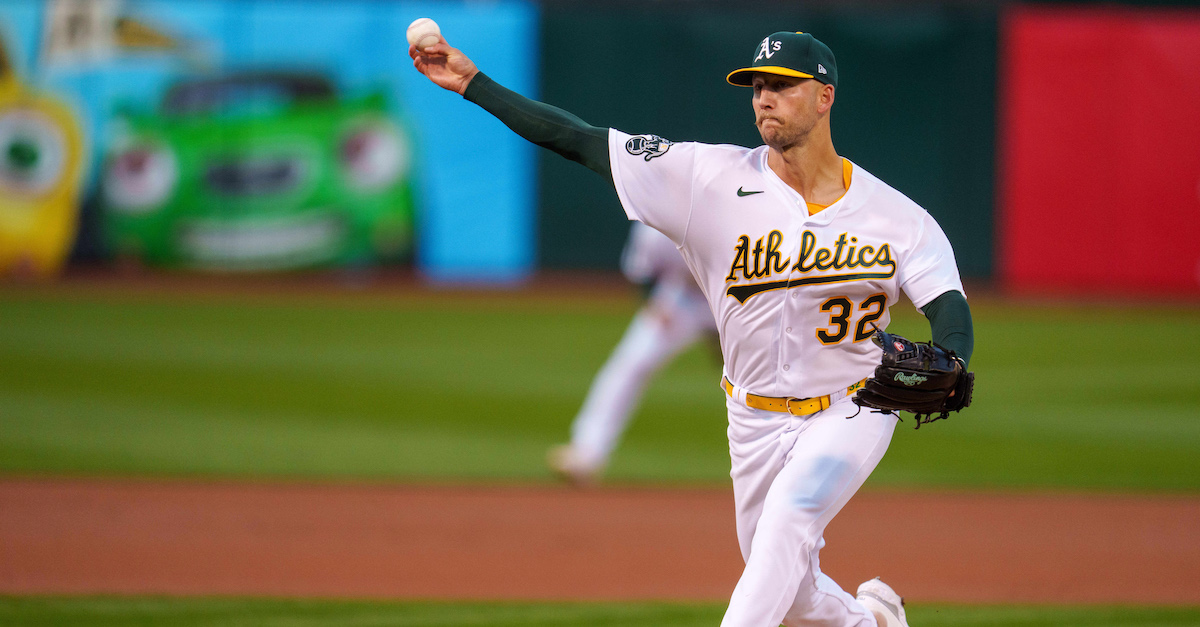
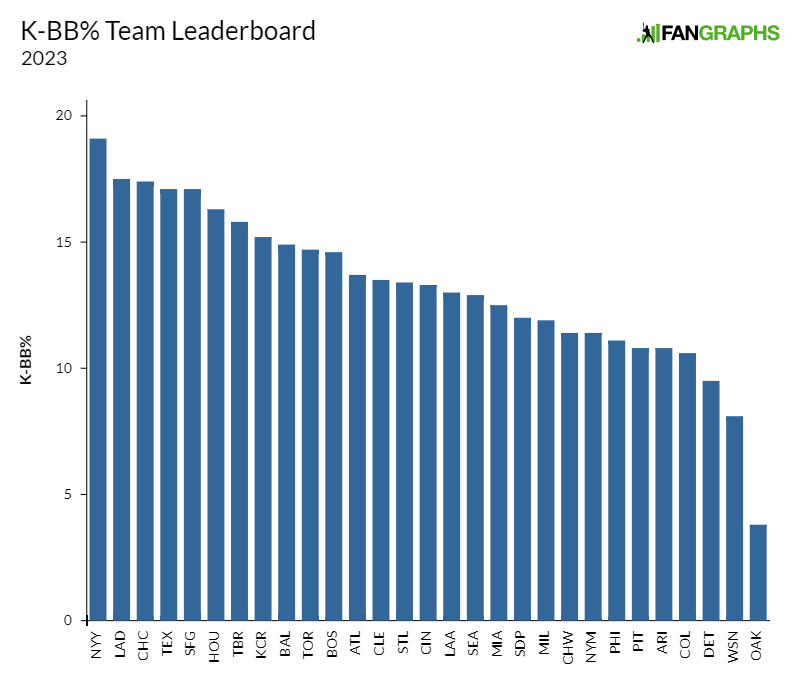
The A’s have already allowed a whopping 125 runs this year. The major league record for runs allowed in a 162-game season is 1,103 by the 1996 Tigers; at this rate, Oakland is going to shatter that record. They made history on Friday, allowing 17 walks to the Mets, which led to two separate innings with six or more runs allowed on just a single hit. That’s the wrong kind of history they want to be making in Oakland.
…
Overall Power Rankings
| Rank |
Team |
Record |
“Luck” |
wRC+ |
SP- |
RP- |
RAA |
Team Quality |
Playoff Odds |
Δ |
| 1 |
Rays |
14-2 |
0 |
149 |
54 |
83 |
2 |
178 |
92.3% |
7 |
| 2 |
Brewers |
11-5 |
0 |
106 |
83 |
75 |
5 |
154 |
71.1% |
13 |
| 3 |
Braves |
12-4 |
2 |
116 |
89 |
75 |
-1 |
151 |
96.9% |
-2 |
| 4 |
Yankees |
10-6 |
-1 |
103 |
76 |
66 |
-1 |
144 |
85.0% |
-2 |
| 5 |
Dodgers |
8-8 |
-2 |
113 |
85 |
101 |
1 |
148 |
70.8% |
2 |
| 6 |
Cubs |
8-6 |
-1 |
106 |
86 |
81 |
-3 |
124 |
21.6% |
17 |
| 7 |
Rangers |
9-6 |
0 |
97 |
89 |
80 |
-1 |
112 |
43.7% |
10 |
| 8 |
Mets |
10-6 |
1 |
102 |
113 |
91 |
2 |
110 |
79.1% |
-3 |
| 9 |
Blue Jays |
10-6 |
2 |
110 |
115 |
86 |
-3 |
109 |
76.6% |
-5 |
| 10 |
Twins |
10-6 |
0 |
83 |
67 |
79 |
0 |
102 |
70.1% |
1 |
| 11 |
Mariners |
8-8 |
-1 |
96 |
80 |
95 |
2 |
115 |
30.2% |
3 |
| 12 |
Astros |
7-9 |
-2 |
100 |
84 |
102 |
4 |
128 |
66.7% |
-6 |
| 13 |
Angels |
7-8 |
-2 |
102 |
96 |
89 |
2 |
123 |
37.3% |
-3 |
| 14 |
Orioles |
9-7 |
0 |
124 |
128 |
85 |
-6 |
107 |
16.6% |
6 |
| 15 |
Phillies |
6-10 |
-1 |
115 |
90 |
143 |
0 |
131 |
33.6% |
-3 |
| 16 |
Cardinals |
7-9 |
0 |
109 |
114 |
82 |
-2 |
115 |
58.9% |
-7 |
| 17 |
Pirates |
9-7 |
2 |
93 |
109 |
82 |
1 |
92 |
7.8% |
7 |
| 18 |
Diamondbacks |
9-7 |
1 |
84 |
102 |
113 |
5 |
81 |
17.2% |
3 |
| 19 |
Guardians |
9-7 |
1 |
90 |
94 |
89 |
-6 |
67 |
42.0% |
-6 |
| 20 |
Giants |
5-9 |
-1 |
108 |
91 |
141 |
2 |
124 |
36.8% |
-2 |
| 21 |
Padres |
8-9 |
0 |
96 |
102 |
88 |
-1 |
87 |
80.0% |
-18 |
| 22 |
Red Sox |
8-8 |
0 |
99 |
131 |
80 |
-4 |
77 |
20.1% |
-6 |
| 23 |
Marlins |
8-8 |
3 |
87 |
97 |
112 |
-2 |
60 |
24.4% |
-1 |
| 24 |
Reds |
6-9 |
-1 |
92 |
104 |
91 |
-4 |
66 |
1.6% |
3 |
| 25 |
White Sox |
6-10 |
0 |
100 |
109 |
145 |
-5 |
68 |
16.2% |
-6 |
| 26 |
Royals |
4-12 |
-1 |
64 |
94 |
118 |
5 |
72 |
1.4% |
-1 |
| 27 |
Nationals |
5-11 |
-1 |
84 |
119 |
102 |
-1 |
47 |
0.1% |
3 |
| 28 |
Tigers |
5-9 |
1 |
66 |
126 |
133 |
0 |
32 |
1.8% |
-2 |
| 29 |
Rockies |
5-11 |
0 |
72 |
114 |
97 |
-9 |
35 |
0.0% |
-1 |
| 30 |
Athletics |
3-13 |
0 |
95 |
179 |
150 |
-3 |
38 |
0.1% |
-1 |
Δ shows change from Opening Day ranking.