Maui Ahuna isn’t a high profile prospect, but he is one of the more intriguing infield bats in the San Francisco Giants system. Drafted in 2023 out of the University of Tennessee, the 23-year-old shortstop is coming off a season where he slashed .269/.370/.453 and posted a 123 wRC+ over 274 plate appearances spread across the Arizona Complex League (a rehab stint), Low-A San Jose, and High-A Eugene.
Injuries have been an issue. Seen as a potential first rounder going into his final collegiate season, Ahuna slid to the fourth round after landing on the shelf with a stress reaction in his back. He subsequently had Tommy John surgery in 2024, keeping him out of action until this past May. Making up for lost reps, he finished the year in the Arizona Fall League, playing in 11 games for the Scottsdale Scorpions.
When I caught up to Ahuna in Arizona, the first thing I asked him about is the frequent comparisons he gets to former Giant Brandon Crawford. Much as I expected, the Hilo, Hawaii native appreciates the comparison, yet prefers to just be himself. Read the rest of this entry »
Michael Soroka is getting another chance to start. Bright and early on Monday morning, Jesse Rogers and Jeff Passan of ESPN kicked off the Winter Meetings with news that the right-handed former sinkerballer has agreed to a one-year deal with the Diamondbacks. Nick Piecoro of the Arizona Republic reported that the deal is for one year and $7.5 million, along with up to $2 million in incentives. Soroka slots into a new team as a starter for the second year in a row after struggling in the rotation and then pitching better out of the bullpen. He’ll now do so for a Diamondbacks team in desperate need of starting pitching, as both Zac Gallen and Merrill Kelly have entered free agency. It’s a small gamble on a pitcher whose upside isn’t necessarily set in stone.
Still just 28, Soroka has already walked a long road. The Braves’ first-round pick out of high school in 2015, he debuted in 2018 at the age of 20. He dominated in 2019, going 13-4 with a 2.68 ERA and 3.45 FIP, and finishing second in the Rookie of the Year voting and sixth in the Cy Young voting. A sinkerballer by trade, he ran a 51% groundball rate and allowed just 0.72 homers per nine innings. He was one of the most promising young arms in the game. Then he tore his Achilles tendon in both 2020 and 2021 and followed those up with shoulder injuries. From 2020 to 2023, he made just 10 major league appearances, missing the 2021 and 2022 seasons entirely. Read the rest of this entry »
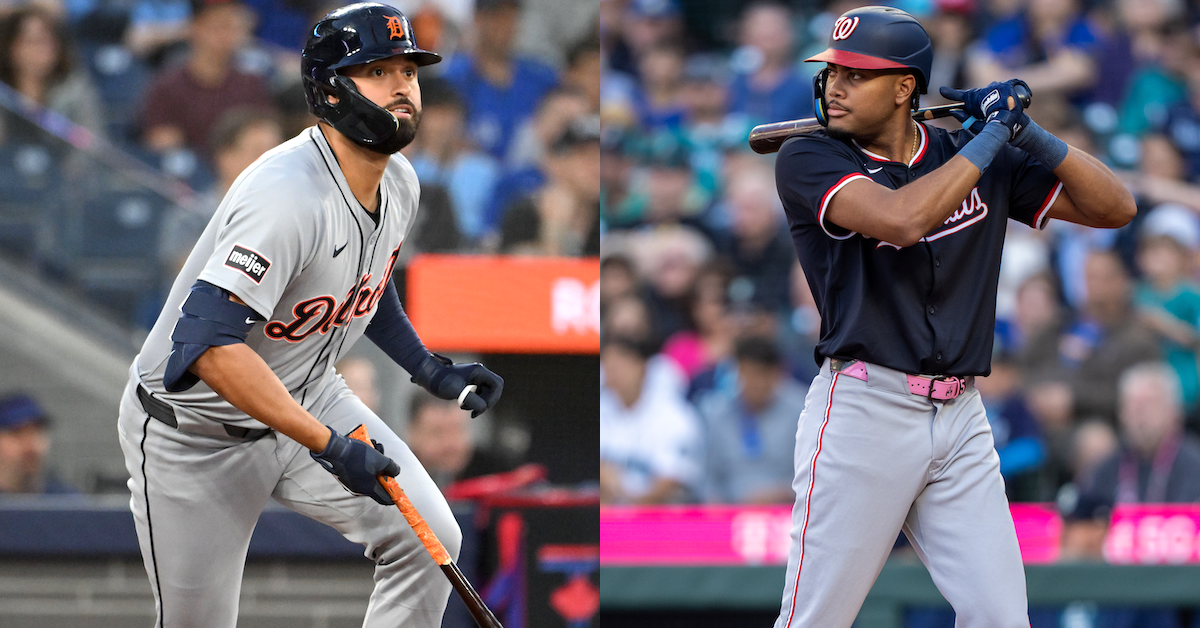
Many were surprised when Zach McKinstry outpolled Kansas City’s Maikel Garcia and New York’s Ben Rice to win this year’s American League Silver Slugger Award at the utility position. That’s understandable — McKinstry’s numbers weren’t as good as those put up by his co-finalists — but the honor was nonetheless deserved. For one thing, he was a true utility player. Not only did McKinstry start 20 or more games for Detroit at each of third base (69), shortstop (27), and right field (20), he was stationed everywhere besides center field and catcher. Conversely, Garcia started just 21 games at positions other than third base, while Rice’s only action came as a catcher and a first baseman.
And it’s not as though the Tiger didn’t have solid numbers of his own. Over 511 plate appearances, McKinstry slashed .259/.333/.438 with a 114 wRC+. Moreover, he logged 23 doubles, 11 triples, 12 home runs, and 19 stolen bases. Amid little fanfare, the 30-year-old erstwhile Central Michigan University Chippewa was one of the more valuable players on a team that went on to play October baseball.
By most accounts, McKinstry is an overachiever. Exactly one thousand players were chosen before him in the 2016 draft, and he ranked as just the 28th-best prospect in the Los Angeles Dodgers organization when he made his MLB debut in 2020. When the Tigers subsequently traded for him in March 2023 — he was by then a Chicago Cub — he had appeared in 121 big-league games to the tune of a 79 wRC+ and 0.8 WAR. Read the rest of this entry »
Alan Arsenault/Special to the Telegram & Gazette-USA TODAY NETWORK via Imagn Images
The Red Sox and Pirates made a roster-balancing deal Thursday night as a prologue to Winter Meetings, with a five-player swap headlined by outfield prospect Jhostynxon Garcia (who heads to Pittsburgh) and pitchers Johan Oviedo and Tyler Samaniego (who head to Boston). Here’s the complete trade:
Pittsburgh receives:
OF Jhostynxon Garcia
RHP Jesus Travieso
A lot has happened since we launched the 2026 version of the We Tried tracker a few weeks ago. With the Winter Meetings about to kick off, we’ve seen 14 We Trieds from 10 different teams concerning eight different free agents. (As always, you can keep track of them all at this link.) That may sound like a lot this early in free agency, but it’s worth noting that 10 of our Top 50 free agents are already off the board (though three of those players accepted the qualifying offer, which means nobody had the chance to try). I suspect we’re a bit behind last year’s pace. Hopefully more news about teams’ pursuits will leak out in the coming months. The big number we’re shooting for here is 100: Last year, the offseason closed with 99 We Trieds. Let’s make it to triple digits!
More will certainly come. Raisel Iglesias is currently leading the pack with four We Trieds, but don’t be surprised if Ryan Helsley overtakes him. Multiple reports said that fully half the teams in the league were interested in Helsley, but we only have two actual We Trieds so far, and one came from Helsley himself. Helsley told reporters that the Tigers were particularly interested in signing him as a starting pitcher, which isn’t a surprise, but his phrasing was particularly fun. He said the Tigers were “in on me heavy.” Honestly, I don’t have any jokes here. It’s just a slightly odd grammatical construction that I will probably think about twice a day for the next few years of my life. Before this week, you could be in on something. You could maybe even be heavily in on it. But now you can be in on it…heavy. Sometimes language evolves just like lifeforms, one mutation at a time. Read the rest of this entry »
Happy Friday, and welcome to this offseason’s first installment of the Matrix Reloaded column. There has already been plenty of activity ahead of the 2025 Winter Meetings, which kick off this Sunday in sunny (well maybe, I haven’t actually checked the weather yet, and also it doesn’t matter because I won’t be going outside) Orlando, Florida. Since this is my first roundup of the winter, let’s start with a refresher on how the Matrix works.
My precious, color-coded spreadsheet has plenty of tabs for your perusal, but my bread and butter is the main FA Matrix tab, which includes a self-explanatory summary of signings at the top and a somewhat less self-explanatory color-coded summary of rumors concerning unsigned players further down. The FA Legend tab right next door will be helpful in decoding it, but here I’ll note that what I classify as a rumor is fairly subjective, as the lines between things like “interested in,” “kicking the tires,” “have looked into,” and “believed to be interested in” are pretty blurry. All rumors are linked to each colored cell, and I encourage reading them for further context beyond how I’ve bucketed them into groups.
With all that out of the way, let’s get into the deals that actually have been completed in the last week or so. For larger moves, I’ll be hitting on three key points: how the deal affects the signing team; how it affects other teams; and how it affects similar players. For smaller deals, I’ll be more rapid-fire and talk only about the signing team; other teams aren’t going to react too strongly to a $2 million bench player inking a new deal. Read the rest of this entry »
Eric A Longenhagen: Good afternoon from my mom’s breakfast nook in Port Charlotte! I fly to Florida a few days early to see family before trekking up to Orlando for Winter Meetings. I can’t wait to do Disney character voices for my peers.
12:17
Eric A Longenhagen: I expect chat will be closer to 45 minutes today because I have to wrap up my analysis of last night’s Pirates/Red Sox trade.
12:17
Eric A Longenhagen: SO let’s get to it.
12:18
AB: Curious to know if you have anything on Seojun Moon that the bluejays signed earlier?
12:19
Eric A Longenhagen: Yeah, really well-built Korean kid sitting about 93. Prototypical 6-foot-3 frame, good-looking delivery, command is kind of erratic. Probably would have been a top three pick in the KBO draft, looks like a million dollar arm to me. Maybe got a little more because late-market guys tend to, not a terrible consolation prize for being the Roki runner up.
12:19
AB: Wondering if you know anything about the Florida bridge league, any Jays standout and how was Jojo Parker?
The Tampa Bay Rays have signed outfielder Cedric Mullins, late of the Mets and Orioles, to a one-year contract worth $7 million. This deal makes a lot of sense if you look at Mullins’ overall numbers from 2025: 17 home runs, a 10.0% walk rate, and a 94 wRC+ from a guy who can run well enough to play center.
That sounds like a pretty good player, and for just $7 million. Inflation’s so bad these days that $7 million is reliever money on the free agent market — not even good reliever money — and for that the Rays got themselves a fringe-average center fielder. Read the rest of this entry »
It’s been a busy December for free agent relievers. Ryan Helsley and Devin Williams, two of the most interesting names on the market, eachsigned with new clubs, and they each got multi-year guarantees despite shaky 2025 results. The next shoe to drop wasn’t quite as heralded of an option, but he too got multiple years and beat market consensus. The signing in question: Emilio Pagán and the Reds agreed to a two-year, $20 million deal, with an opt out after the first year.
Pagán was a far more effective reliever in 2025 than either of the two splashier names ahead of him. He had one of the best seasons of his career at age 34, in fact: 68 2/3 innings pitched, a 2.88 ERA and 3.72 FIP in hitter-friendly Cincinnati, and 32 saves in his first full-time closing job since 2019. He bounced back from an injury-interrupted 2024 with better fastball velocity and better pitch shape across the board, and got richly rewarded for it with a 30% strikeout rate. Is he homer-prone? You bet, thanks to a 0.51 GB/FB ratio. But a .200 BABIP and a solid HR/FB% (10.8%) meant that he actually allowed fewer homers per nine innings (1.31) than his career mark (1.51), and not by a small amount, despite pitching in a launching pad.
When things are going well for him, Pagán makes everyone think they can hit a home run, then pulls the rug out. He runs his four-seamer high and spots a heavy splitter off of it, a classic fly ball pitcher mix. It’s one of those strategies that looks awful when it isn’t working, and yet seems to come through most of the time anyway. More specifically, Pagán went through a three-year stretch of terrible form from 2020-2022, posting a 4.61 ERA and 4.71 FIP. Then he broke out in 2023 and has been solid since. The weirdest part of it all? His stuff and command metrics barely budged between those two wildly different stretches.
Reversals like that go a long way toward explaining why reliever performance is so difficult to predict. When Pagán has it, he’s a worthy late-inning reliever. His ERA- was 40th among relievers last year, and it’s 60th over the past three years, even with his ineffective 2024 in the mix. He’s pitched like you’d expect a closer or setup man to, in other words. His FIP tells a broadly similar story, and I’m willing to believe that pitchers with his extreme tendencies outperform their FIP in the long run. If you get good Pagán, he’s a very useful bullpen piece, the kind any team would love to have in the bullpen and many fringe contenders would love to have as a closer.
That’s the calculus from the Reds’ perspective. They’ve managed their payroll tightly in the early years of Elly De La Cruz’s team control window, hovering around the $100 million mark with wiggle room in either direction. With that budget constraint in mind, the top five or so relievers in this free agency class were presumably off the board. The next tier down is a mixture of interesting pop-up arms, aging closers, and reclamation projects. Would you rather have Kenley Jansen or Pagán? Seranthony Domínguez? Kyle Finnegan? Phil Maton? Maybe Drew Pomeranz? I think I’d take Pagán or Jansen over the field – I ranked them that way in my Top 50 Free Agents list – and as an added bonus, he’s already familiar with Cincinnati. I’d take Raisel Iglesias over him – rankings, again – but he signed for one year and $16 million, probably outside of this team’s price range. The Reds probably could’ve gotten some solid lefty specialists for the $10 million or so annual salary that they gave Pagán, but that’s not what they were in the market for this winter. They needed a bankable closer, and in the aisle they were shopping in, there weren’t that many options.
This team really does need relief arms. The Reds didn’t have to cover many bullpen innings in 2025, but even then they struggled to piece it all together. Pagán, Tony Santillan, and Graham Ashcraft formed an effective three-headed monster at the top, but the rest of the pen was ineffective even in limited time. With a bandbox for a home stadium, it’s hard to expect a similarly limited need for relief pitching in 2026. This was the path of least resistance for a team that really does need to do something to challenge for the NL Central title in 2026 and build on its surprising 2025 Wild Card berth.
Now, the risks? They’re real. It was only a year ago, after his down 2024 performance, that Cincinnati fans were lamenting Pagán’s decision to pick up his player option for 2025. More innings and a .200 BABIP turned that frown upside down, but it’s not like it’s impossible to imagine an ineffective Pagán. Would you be shocked if he had an uneven, homer-prone 55 innings in 2026 and then picked up his option? I certainly wouldn’t be. We just saw that!
That leaves me in the situation of liking this deal more for Pagán than for the Reds, and yet I’d make this offer if I were in their shoes anyway. Figuring out which relievers will be good in a year’s time is incredibly difficult. If it were easy to solve, the Dodgers wouldn’t have signed Tanner Scott and Blake Treinen last winter and then spent this entire October hiding them. Despite that difficulty, relievers are integral to a contending club. If you aren’t winning the close games, it’s hard to make the playoffs. The Reds likely wouldn’t have done that last year if not for Pagán.
With that backdrop, what were the Reds supposed to do? Sign a different, similar guy for slightly less? Sign two reclamation projects on one-year, $5 million deals? It’s not even like the second year is that much of a disaster; in a year’s time, they’re going to be contending with a core built around De La Cruz and looking for relievers, and I don’t think the market rate is likely to plummet in the meantime or anything. Sure, you might get bad Pagán in 2026 and then have him opt in, but the inherent volatility of relievers means that even that isn’t a tragedy. It worked out last time!
There’s some chance that Cincinnati could have waited longer, negotiated more stingily, and reached a slightly more team-friendly deal with him. So far, Pagán is the early signing whose market has most outstripped my projections. But who cares? What were the Reds going to do, save a million dollars or two? From their perspective, the risks were greater, because if they dragged their feet in negotiating with Pagán and he signed elsewhere, they’d suddenly be sifting through a variety of relievers they’re presumably less interested in with a strong need to find a deal. I’d prefer to overpay slightly for a guy I’m comfortable with than hunt for unknown bargains to fill an essential role, and it seems the Cincinnati front office thinks similarly.
I’m not convinced that this is a great long-term way to run a team. It certainly wouldn’t be my preference in a vacuum; I’m a Rays/Dodgers/Brewers-style bullpen guy at heart. I love reclamation projects and throwing a lot of relievers at the wall to see what sticks. I love betting on guys with elite stuff and seeing if they can figure out how to throw strikes, or betting on guys with elite command and seeing if they can figure out how to throw harder.
I’m also not running the Reds, staring at two superstars in De La Cruz and Hunter Greene and trying to make the playoffs again after a miracle run. Sure, it would be great to build an incredible pitching development system from the ground up. But it’s December, and the season starts in four months, and that’s not enough time to overhaul an entire organization, not even close. The Reds needed a reliever. They got a guy they’re comfortable with at a rate that won’t force them to cut back elsewhere. Maybe it’s a slight overpay, and maybe he’s more volatile than his 2025 results would suggest, but for the Reds? He’s just what they needed.
When the Red Sox traded forSonny Gray, they knew they were getting an old-school starter with seven pitches. He’s got a sinker and a four-seamer. He’s got a cutter, a traditional slider, and a sweeper. He’s got a curveball and a changeup. The traditional slider is the only one of the seven that Gray doesn’t throw regularly; the others all saw at least 15% usage against righties or lefties in 2025. Gray is 36 years old. He’s a three-time All-Star with 330 starts and 125 wins under his belt, and a career ERA of 3.58. At this point, you might assume that he’s about as finished a product as you could find, but you’d be wrong, and that seems to be part of the reason he’ll be pitching in Boston next year.
In 2024, the Red Sox made waves for throwing fastballs just 36.6% of the time, the lowest mark ever recorded and almost certainly the lowest mark of all time. That number went up in 2025, in large part because they added Garrett Crochet, who owned a brand-new sinker to go with a four-seamer that was one of the very best pitches in baseball 2024. But it wasn’t just Crochet. Brayan Bello brought back the four-seamer he’d ditched in 2024. A finally-healthy Lucas Giolito threw four-seamers at his highest rate since 2020. With Aroldis Chapman replacing Kenley Jansen, the closer role saw fastballs replace cutters. In all, the Red Sox finished the season with a fastball rate of 48.3%, the 11th-highest in the league. That’s quite a bounce-back. The Red Sox were very explicitly trying to get away from fastballs, but as the 2025 season showed us, the broader goal was to have their pitchers throw their best pitches more often.
That brings us to Gray, who throws the kitchen sink but still throws fastballs 40% of the time. In 2025, he led with his four-seamer against lefties and his sinker against righties, throwing both pitches 29% of the time in those situations. Shortly after the trade went through, Boston’s chief baseball officer Craig Breslow discussed it with reporters. MLB.com’s Ian Brown published a quote: “It will be a great match for Bails [pitching coach Andrew Bailey] and the rest of the pitching group and the philosophies they have in terms of leaning into strength and potentially away from slug and pitching away from fastballs when you have secondaries as your best pitch.” Read the rest of this entry »