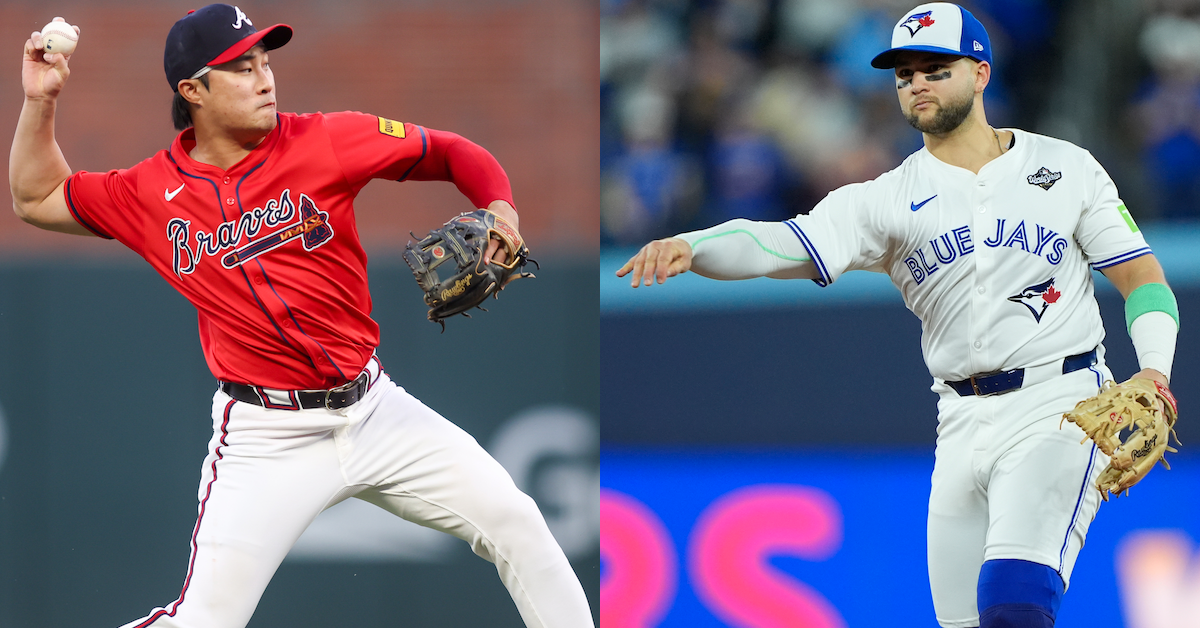
Shortstop is one of the hardest positions on the diamond to fill, especially if you want anything resembling useful offensive production from the position. Nevertheless, it has been one place where help is usually available on the free agent market.
In the four full offseasons that either straddled or succeeded the last lockout, eight different teams have signed a free agent shortstop to a contract worth $140 million or more. This includes the Rangers, who did it twice in the same winter. Read the rest of this entry »
The General Managers Meetings are currently taking place in Las Vegas, and as always, FanGraphs is on hand to report on what the executives have to say. We’ll hear from a number of them this week, beginning with a trio of National League execs, Matt Arnold of the Brewers, Paul DePodesta of the Rockies, and Chaim Bloom of the Cardinals.
———
MATT ARNOLD — MILWAUKEE BREWERS
Brewers hitters had both a low strikeout rate and a relatively high walk rate this season; they ranked top five in both metrics. How was that achieved, and to what extent was it a focus?
“I think it was achieved by Murph letting people know, ‘You better put the ball in play and you better not chase,’” Arnold replied, crediting National League Manager of the Year Pat Murphy. “He’s relentless about that. Those are good things that we were able to execute this year, and it’s easier said than done. It starts with the players buying in and Murph enforcing that in the dugout, making sure our guys have that as a focus: the ball-strike, the ball in play. Having those types of skills in your pocket can lead to better at-bats and better outcomes.”
Needless to say, it’s not all Murphy. Milwaukee’s hitting coaches play a role as well.
“It’s a combination of all of them,” Arnold agreed. “Our coaches do a really good job of that. They want our guys to focus on getting a good pitch to hit, and again, while it’s easier said than done, we’ve done a good job of that. We try to focus on it as much as we can in our [minor league system] Marrying your scouting and player development is also super important. We try to communicate it with both of them.”
Jackson Chourio had a perfectly acceptable 20.5% strikeout rate, but also a 5.1% walk rate that ranked lowest on the team. How does he take the next steps to better fit that mold?
“He’s so young, and so athletic, and so talented,” Arnold said of the team’s 21-year-old phenom. “He’s got every ingredient to do it. He’s already doing it at a pretty high level. Whatever he does beyond this is even more special. The sky is the limit for this kid.”
———
PAUL DEPODESTA — COLORADO ROCKIES
Colorado’s new top executive is inheriting a team whose hitters had both a high strikeout rate (second-worst in the majors) and a low slugging percentage (tied for sixth worst). If he had to pick one or the other, which is more in need of improvement?
“I would say it’s not the combo we want,” said DePodesta, stating the obvious. “And it won’t ultimately be one or the other. I said earlier what we want our identity to be, in Colorado especially, but… put it this way: If that’s a dial from one to the other, it’s not necessarily going to be one or the other. We need to find the right combination for us.”
Following up, I asked the well-traveled exec if he has an idea of which direction that combination might trend.
“I do, but I probably won’t share it,” he replied. “For us, it’s how we go about scouting and developing, or even setting up a major league roster. So yeah, ultimately it will be proprietary, what we feel is going to work well for us.”
And then there is the organization’s longest-standing question: What is the best way to pitch effectively in Colorado? Is there an actual answer to be found?
“We’ll find out,” DePodesta said. “I’m encouraged. There have been plenty of successful teams in Colorado. When I was in San Diego in 2007, 2008, 2009, and obviously the teams that Buddy [Black] had in 2017 and 2018, those teams were very successful. There were teams that had winning records on the road.
“My approach, at least as of today, is that I know it’s not impossible,” he added. “It’s been done. Are there things we have to consider that other teams don’t? Probably so. Are there adjustments we’re going to have to make that will look a little different than everybody else? Probably yes, but I’m confident that it’s not impossible. We’re going to figure something out.”
One more follow-up seemed in order. Given the Rockies’ reputation of lagging behind other organizations in terms of analytics, are there maybe things that have been overlooked?
“That I don’t know,” said DePodesta, who has spent the last decade working in the NFL as the chief strategy officer of the Cleveland Browns. “I’m looking forward to diving in deeper to the organization and figuring out all the things they have tried. I have a handful of ideas right now, but I would imagine they’re pretty naïve. Coors Field has been around since 1995 [and] they’ve tried a lot of things. I don’t have to reinvent the wheel. I want to understand what all of those things were and what they felt worked, and what didn’t. I don’t want to try things a second time if they’ve already tried them.”
———
CHAIM BLOOM — ST. LOUIS CARDINALS
Cardinals pitchers didn’t strike out a lot of batters this year; they were second worst in the majors. How much of a concern is that?
“It’s definitely a concern,” replied Bloom, who succeeded John Mozeliak as St. Louis’ president of baseball operations at the conclusion of the regular season. “It’s not the only thing that matters, but it does matter. Having stuff that can beat people in the strike zone, that can miss bats — both in and out of the strike zone — is really important. It’s hard to have an elite staff without being able to do that. It’s not something you want to chase at the expense of throwing strikes — you’re not trying to put people in positions where they can’t succeed, or stay healthy — but it’s super important.”
How close is Liam Doyle to helping out in that respect?
“He’ll tell us that as the season unfolds,” Bloom said of the 21-year-old southpaw whom the Cardinals drafted fifth overall this year out of the University of Tennessee. “We gave him a little taste of [pro ball] at the end; he got his feet wet a little bit. Obviously, a first full season will tell you a lot. A first full season in and of itself is a big developmental step for guys, because they haven’t been asked to pitch that regularly for that long. But he came in and showed everything you want to see. He got after his work. He showed openness, a desire to get better, a willingness to listen. There is obviously some work to do before we can call him a big leaguer, but we’re really happy with the pitcher we got.
“The player will move himself,” added Bloom. “The player tells you where he should be. If you try to force something that’s not there, you usually end up paying a price. You might end up picking the pieces up from that for quite some time. When a player is ready and you give him that opportunity, he can carry it. It’s really just what the game is telling us, letting the player’s performance and his progress on the mound carry the day.”
Balls in play are less of an issue when you have a strong defense, which St. Louis largely had in 2025. Just how strong depends on the numbers you favor. I asked Bloom if he could explain how the Cardinals led all teams in Outs Above Average, yet were well below average in Defensive Runs Saved.
“That is a bigger conversation than one we could have here today,” Bloom said. “There are some differences between those metrics, some differences in [how they] get calculated that might disproportionally help or hurt certain types of players. Sometimes those things… they usually will even out year over year. I’ve seen specific players where that might not be the case, because of certain things that the player does or doesn’t do well that some metrics favor — or don’t — but typically over the course of time, they tend to [even out].”
What does it say about the 2025 Cardinals specifically?
“I’d be hesitant to draw too much of a big picture about specific players or player seasons,” Bloom responded. “If it persists over two or three years, then we can look at it as a trend and see if there is something underlying.”
As soon as one story in baseball ends, another begins. And so, with the 2025 season dissipating into silence as the champions hoist the World Series trophy, its remnants seed the next phase of the sport’s existence out from the quantum foam. The four months between now and Opening Day feel like an interminable gap, but we have the Hot Stove League to keep the MLB baseballmatic universe rolling. That means, as has been the case for nearly a quarter of a century now, it’s time for me to start rolling out the ZiPS projections for next season.
For those new to my projections, ZiPS is a computer projection system I initially developed in 2002–04. It officially went live for the public in 2005, after it had reached a level of non-craptitude I was content with. The origins of ZiPS are similar to Tom Tango’s Marcel the Monkey, coming out of discussions I had in the late 1990s with Chris Dial, one of my best friends (our first interaction involved Chris calling me an expletive!) and a fellow stat nerd. ZiPS quickly evolved from its original iteration as a reasonably simple projection system, and it now both does a lot more and uses a lot more data than I ever envisioned it would 20 years ago. At its core, however, it’s still doing two primary tasks: estimating what the baseline expectation for a player is at the moment I hit the button, and then estimating where that player may be going using large cohorts of relatively similar players.
So why is ZiPS named ZiPS? At the time, Voros McCracken’s theories on the interaction of pitching, defense, and balls in play were fairly new, and since I wanted to integrate some of his findings, I decided (with his blessing) that the name of my system would rhyme with DIPS (defense-independent pitching statistics). I didn’t like SIPS, so I went with the next letter in my last name. I originally named my work ZiPs as a nod to CHiPs, one of my favorite shows to watch as a kid, but I mis-typed ZiPs as ZiPS when I released the projections publicly, and since my now-colleague Jay Jaffe had already reported on ZiPS for his Futility Infielder blog, I chose to just go with it. I never expected that all of this would be useful to anyone but me; if I had, I would surely have named it in less bizarre fashion. Read the rest of this entry »
In just about any sport you can name, offense is king. If you’re the one who scores the goals, the points, the runs, the whatever they call it in polo – the biscuits, maybe? – you’re going to get the plaudits. Who’s the greatest defenseman in the history of hockey? It’s Bobby Orr, of course, because he was the first great offensive defenseman. This pattern very much holds when it comes to baseball.
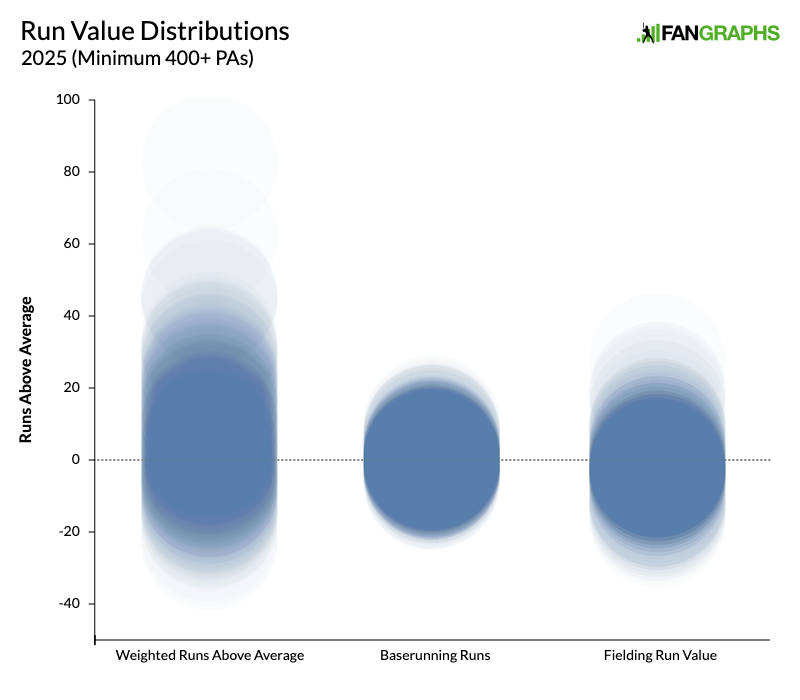
Among other things, the sabermetric revolution helped us codify the value of hitting relative to the other facets of the game. To wit, according to weighted runs above average – and we’re using that particular stat because, like standard baserunning and defensive metrics, it’s a counting stat that compares a player to the performance of an average player – the most valuable hitter during the 2025 season was one Aaron Judge. Judge created 82.5 more runs than the average hitter. That’s 21 runs more than any other player, and an astonishing 36 more than any other player not named Shohei Ohtani. Judge was the best offensive performer in the game by a mile, which makes him the frontrunner for the American League MVP award, even though he put up negative value as a baserunner and, depending on which metric you trust, his defense graded out somewhere between pretty good (DRS, FRV) and really bad (DRP). The best defender was Patrick Bailey, who put up 30 fielding runs, and the best baserunner was Corbin Carroll, who finished with a measly 10.3 baserunning runs. Offense is just more valuable than defense and baserunning. Here’s the distribution of values for the three portions of the game:
Dustin May is a free agent. And not because he got non-tendered; he’s passed six years of service this season, and hits the open market at the tender age of 28.
I admit this one snuck up on me. May, a highly touted Dodgers prospect, stormed into prominence when he joined the L.A. pitching staff in 2019 at the age of 21. He pitched for the Dodgers in the playoffs that October and started 2020 as the no. 14 prospect in all of baseball, and spent most of the year in the rotation, garnering a few Rookie of the Year votes and making seven appearances during the Dodgers’ run to the World Series. Read the rest of this entry »
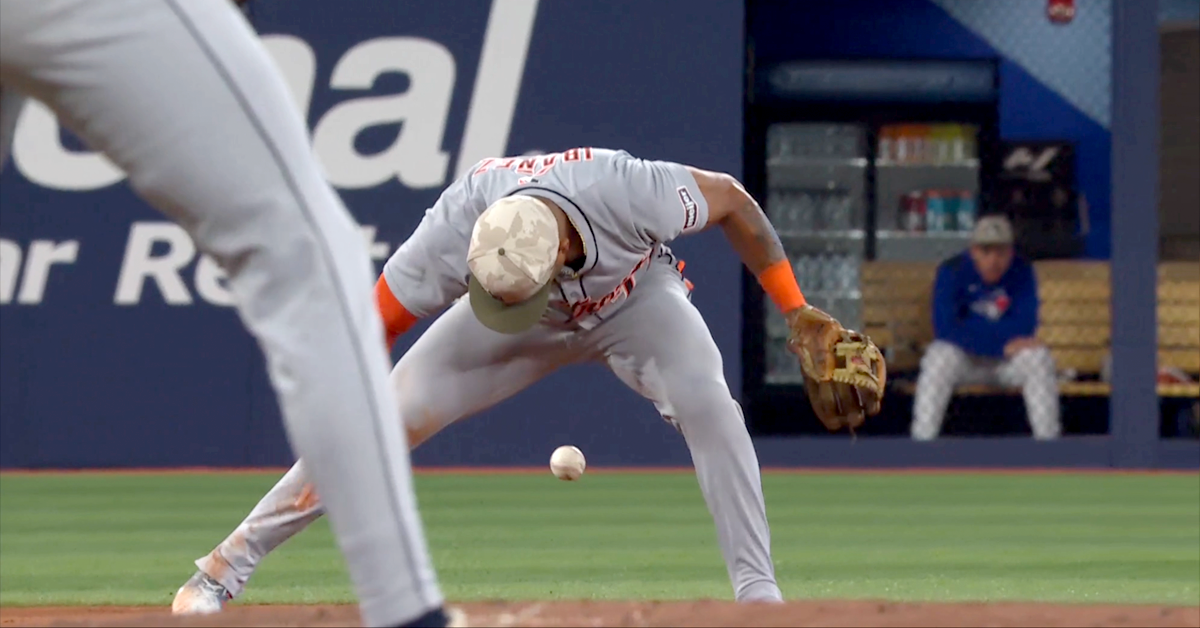
I found this in my notes last week. I have no idea how long it’s been there. It says: “How many times this season has an infielder let the ball go right between their legs?” I had no idea whatsoever. I couldn’t recall the last time I’d seen it. Probably in a highlight from the 1986 World Series.
Baseball is the ultimate scorekeeping sport, and thanks to sites like ours, when you ask how many times any particular event has happened, the answer is usually easy to find. How often does a righty hit a home run off a lefty in the top of the eighth inning with the tying run in the on-deck circle? It took me twice as long to type that question out as it did to look up the answer: It has happened five times in each of the last three years. Easy. But so far as I know, nobody keeps a count of grounders that go right through the wickets.
Errors get classified in certain ways. Our leaderboard tracks fielding and throwing errors. The play-by-play notes on Baseball Savant add in missed-catch errors. Other sources differentiate between reached-on-error errors and runner-advanced errors. But that’s about it. Because they represent arguably the most embarrassing way to commit an error, between-the-legs errors are special in a human sense, but nobody splits them out into their own column because there’s nothing particularly special about them in a baseball sense. At least, you wouldn’t think so initially. Read the rest of this entry »
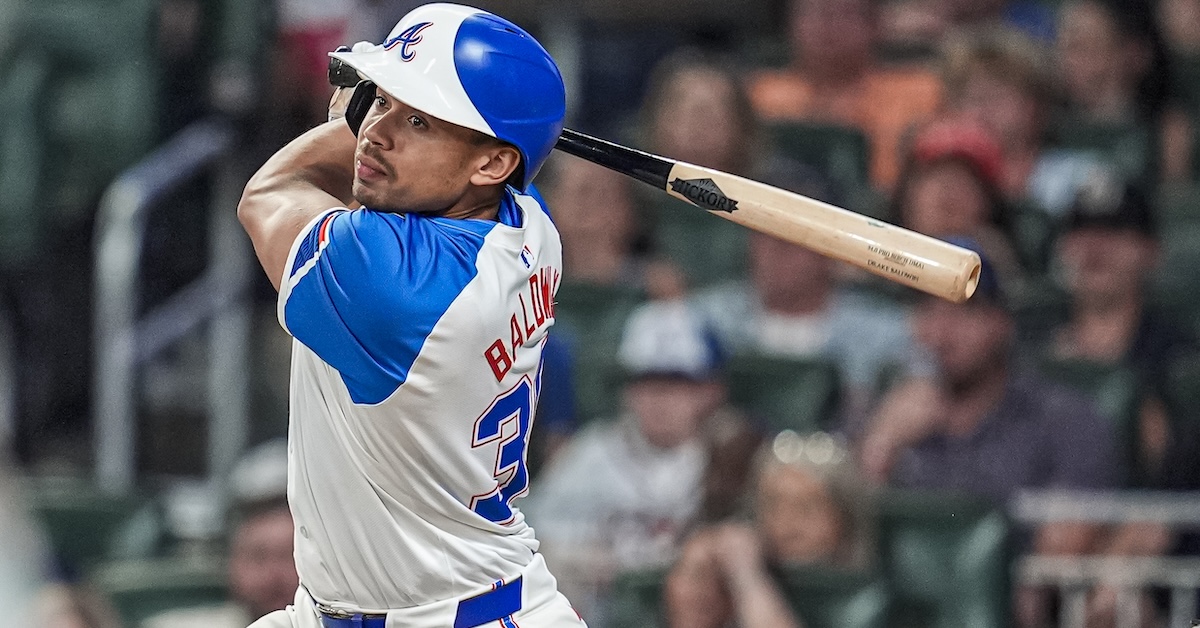
Just in time to push back the withdrawal symptoms from the lack of baseball, it’s awards week! We started, as usual, with the Rookie of the Year awards, and in the National League, Drake Baldwin earned the hardware, finishing with 21 first-place votes to Cade Horton’s total of nine. Baldwin was the only candidate to appear on all 30 ballots. Horton finished second, followed by Caleb Durbin, Isaac Collins, and Daylen Lile.
Did the BBWAA members entrusted with this task make good picks? That’s for you to decide. I’m here for my usual task of explaining/justifying/defending how I voted in my award this year, the NL Rookie of the Year award. I like to think I do a pretty good job, but I personally feel my responsibility for addressing my vote ought to go beyond the confidence I may have in my own competence. This is ostensibly an expert panel, not a federal election, so a vote here isn’t a question of my right to have one but my duty to exercise it thoroughly. People in the baseball community, from the most casual fans to the players themselves, ought to know why I voted for someone and not others. This is especially true when many disagree with me, such as my past first-place votes for Jackson Merrill last year and Trevor Rogers in 2021. Read the rest of this entry »
Hello, my name is Brendan Gawlowski. I could do the Troy McClure thing and list all of my previous bylines, but I’d prefer to just say that it’s a pleasure returning to FanGraphs after nearly four years away. Back in early 2022, I took a job as a pro scout for the Pittsburgh Pirates and I’ve been scouting minor leaguers ever since. In a few cases, I had a role in bringing players to Pittsburgh. It was a blast and I am grateful for the experience.
But for as much fun as I had, the job wore on those around me. I spent more than 80 nights on the road last year, a grueling schedule that’s rough on families in any situation and was increasingly unreasonable in mine. When I joined the Pirates, I was 30, childless, and ready to stretch my legs after two years of lying low and masking up. In the intervening years, a series of significant events made it hard to balance my passion for scouting with my responsibilities at home. My wife and I had a baby. A year later, we found ourselves facing a cancer diagnosis and long-term treatment. Our parents started battling their own medical problems. Through it all, I tried to be around as much as I could, but the realities of my schedule led to stressful compromises. The logistics of doing the job while being more than a replacement-level family member were hard to manage. This past July, I pulled an all nighter and drove from Corpus Christi to Houston to catch a 6 AM flight back home to Seattle, stepped inside for a quick shower, and then bolted two hours north to Bellingham for a birthday party. During that last stretch, my wife made her annual gentle suggestion that another path was possible.
And what a path this is. FanGraphs’s reputation as a leader in baseball analysis is well earned, particularly in the prospect space. For as long as he’s been at it, Eric has done an incredible job of covering the landscape. From my perspective, the breadth, depth, and nuance of his analysis is worth the price of a Membership all by itself. I learned plenty from him before, during, and after our time working together in my first stint here. The listing for this position came at the perfect time and I applied with gusto: I loved working as a scout, but the opportunity to join Eric in a full-time capacity, to continue evaluating baseball players while also getting another couple of months at home, was too enticing to pass up. Read the rest of this entry »
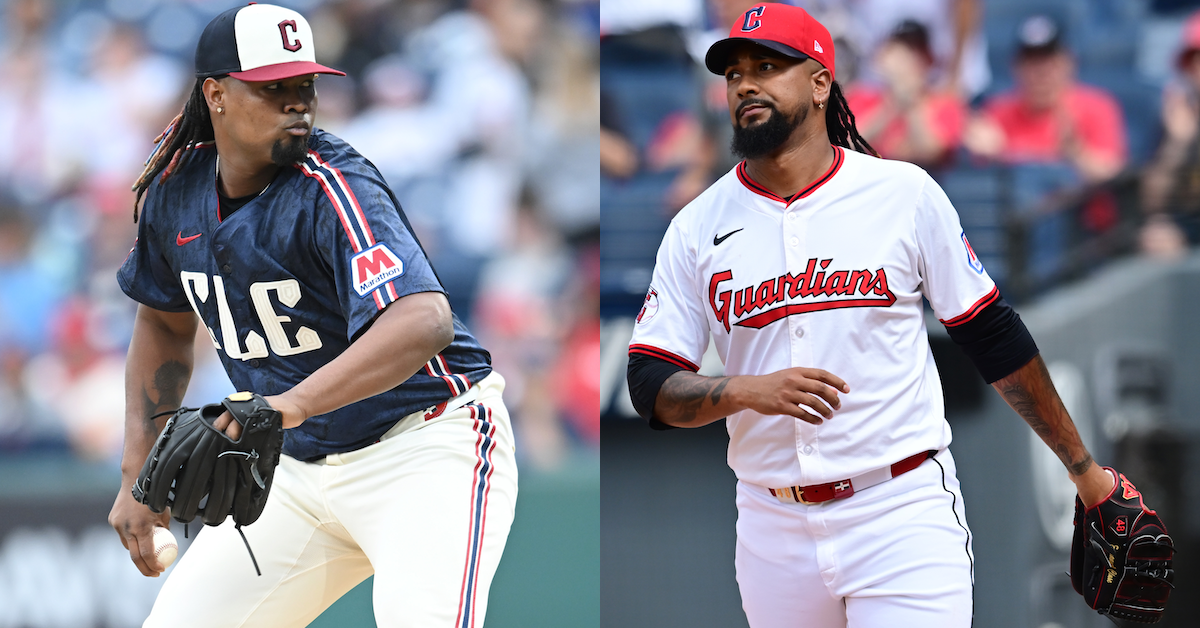
Guardians pitchers Emmanuel Clase and Luis Ortizhave been on non-disciplinary paid leave since July, as Major League Baseball investigated the two men’s involvement in a prop betting scandal. The allegation was that Ortiz had intentionally thrown at least two pitches outside the strike zone after tipping off bettors that he would do so. Armed with this advance knowledge, Ortiz’s confederates had profited in extremely specific prop bet markets.
Clase soon joined Ortiz on the sidelines, though the specifics of his supposed wrongdoing were not made public at the time. Both pitchers spent Cleveland’s terrific stretch run, and its playoff series against Detroit, in limbo.
Well, the other shoe dropped on Sunday, and what a shoe it is. The United States Attorney for the Eastern District of New York indicted the two pitchers on four counts: wire fraud conspiracy, honest services wire fraud conspiracy, conspiracy to influence sporting contests by bribery, and money laundering conspiracy. The first three counts come with a maximum penalty of 20 years imprisonment, each. Money laundering conspiracy has a five-year maximum. Ortiz was arrested in Boston on Sunday morning, and his attorney maintained his client’s innocence in advance of a scheduled Monday court appearance. Clase is not in custody as of this writing, but his attorney says he “is innocent of all charges and looks forward to clearing his name in court.” Read the rest of this entry »