Archive for Featured

Zack Wheeler Keeps Quietly Improving

Zack Wheeler signed a big contract before the 2020 season, and if we’re being honest, the Phillies paid for potential. That’s not to say Wheeler wasn’t an effective starter with the Mets, but his career numbers — a 3.77 ERA, a 3.71 FIP, a 22.8% strikeout rate, and an 8.5% walk rate — didn’t scream ace.

His stuff, on the other hand, spoke loudly. An upper-90s fastball and lower-90s slider invite comparisons with Jacob deGrom, and his curveball prevents batters from sitting on a single breaking ball. If you could design a pitcher in a lab — well, fine, you might come up with deGrom or Gerrit Cole. But if you ended up with Wheeler, you’d certainly be happy with your work.

When a pitcher’s results — and again, they were good results — fall short of what you’d expect from their stuff, any stretch of better outcomes feels like a tantalizing glimpse at what a breakthrough might look like. At this point, however, it’s not a glimpse: Wheeler has fully broken out into the ace the Phillies hoped for when they signed him.

Consider this: since leaving the Mets, Wheeler has the 10th-best ERA in baseball. It’s not some fluky sequencing effect, either. He has the eighth-best FIP in the game over that time frame, the 17th-best xFIP, and the 17th-best SIERA, another advanced ERA estimator. He’s done all of that while throwing the third-most innings in the game, behind only Shane Bieber and Aaron Civale. That combination of skill and volume puts him sixth among all starters in WAR over that time frame, in a virtual tie with Cole. Read the rest of this entry »

Introducing the RosterResource Lineup Tracker!

The Lineup Tracker is the latest addition to our RosterResource collection at FanGraphs. This newest feature is an extension of our “Projected Go-To Lineups vs RHP” on the RosterResource depth charts, allowing readers to pick up on trends by providing a regularly updated look at where every player has batted in the order and lined up defensively throughout the season. The link to this feature can be found in the RosterResource drop-down menu under “In-Season Tools”.

I’ll be explaining the Lineup Tracker in detail on today’s episode of The RosterResource Show, which will air live at 4:30 PM PT/7:30 PM ET on Twitch and the FanGraphs homepage. It will be the first topic covered.

As has been the case with the last few RosterResource additions, including the Closer Depth Chart, Transaction Tracker, and Injury Report, we have several ideas that would improve this feature once we circle back around for upgrades. We have only one remaining feature to build — the Schedule Grid/Probable Starting Pitchers — that had been part of the RosterResource website prior to joining FanGraphs. Read the rest of this entry »


2021 Draft Notebook: Setting the Odds for 1-1

With six weeks until the draft, things are more muddled than ever at the top. If anything, the range of possibilities is continuing to widen. There is still an entire college postseason left to go, as well as what are sure to be some difficult signability discussions that move individual needles significantly. In a dramatic turn of events, it suddenly looks as if the Pittsburgh Pirates are focused on positions players over pitchers with the first pick in the draft. Instead of doing a mock this early (we’ll have one soon, though more to share information than to try to pull a Kreskin with so much time until Day One), I decided to set the current odds for the first overall pick.

The Odds

Marcelo Mayer, SS, Eastlake HS (CA): 3-1

“Marcelo Mayer or Jordan Lawlar?” is the most pressing question for those considering the first pick in the draft, and when I polled top scouts and executives, there was a nearly 50/50 split in their responses. “Mayer should be 1-1, and I don’t think it should really be a conversation,” said one scouting executive. “In terms of pound-for-pound talent, he’s the number one guy. Left-handed, good stick, future power, and plays up the middle.” Among his detractors, there are some questions concerning the up-the-middle aspect of Mayer’s game. While he makes every play and at times can be a flashy defender with plus hands, smooth transfers, a well above-average arm and excellent instincts, he’s also a big-framed kid with below-average run times coming out of a slightly awkward gait. For scouts concerned about this, Mayer becomes a future third baseman; for those who believe in all of the defensive tools beyond the twitch, he’s more comparable to Carlos Correa or Corey Seager. Read the rest of this entry »


Scoring This Year’s No-Hitters

We’ve still got a week to go in May, a month that has included four no-hitters, including two last week on back-to-back days — the Tigers’ Spencer Turnbull against the Mariners on Tuesday, and then the Yankees’ Corey Kluber against the Rangers on Wednesday, plus two that were just two days apart earlier this month. That brings this year’s total to six no-hitters of the nine-inning variety, plus a seven-inning one by Madison Bumgarner that The Man doesn’t want you to count. Particularly because the major league batting average of .237 is in a virtual tie for the all-time low mark set in 1968, these remarkable achievements are threatening to lose some luster.

That’s a shame, because the experience of actually watching a no-hitter from start to finish, rather than just flipping over to rubberneck for the final three or six outs, is still one of the most gripping in all of sports. The dawning of the possibility at some point in the middle innings — individually, we all have our thresholds for when our antennae go up — and then the batter-by-batter, pitch-by-pitch suspense, knowing that this gem could disintegrate either though one bad pitch or one bad break, makes a no-hitter a thrill to watch. Every single one of them is meaningful to its participants; for the pitcher and probably the catcher as well, it’s the pinnacle of performance. It takes a heart of coal not to be moved by the likes of Turnbull or Carlos Rodón having that one day of untouchability after years of ups and downs.

That said, some no-hitters are more impressive than others, with strikeouts galore and maybe just a walk or two separating them from perfection. Particularly given the current conditions, under which three teams have been no-hit twice — Cleveland, Texas, and Seattle — it’s obvious that there are varying degrees of difficulty when it comes to opponents as well. No-hitting the Mariners, who entered Sunday with a team batting average of .198, isn’t the same as doing it to the Rangers (.236), and neither of those are the equal of, say, Sean Manaea no-hitting the 2018 Red Sox, who hit .271. Read the rest of this entry »


More Data About Sliders

Last week, I laid out some broad categorizations of what makes a slider effective, when viewed in the aggregate. As a quick recap: The most important single characteristic is hitting the corners of the strike zone. If you have a slider with plus horizontal movement, it’s also okay to miss over the middle of the plate. The middle of the plate is a great location early, but a poor location late in counts. There’s more, but those were the key findings.

That analysis left some additional factors out, because there are only so many tables you can fit into an article before it all starts to look the same. Additionally, some of those factors are beyond the scope of this analysis. Sequencing and tunneling, for example, are too complex to reduce to a two-dimensional grid. Deception might be even more confusing; I’d struggle to quantify it at all, let alone simplify it into a few buckets for analysis.

Today, I’d like to look at the rest of the factors I found easy to quantify and analyze. First, let’s talk about pitch movement. Last week, I looked at horizontal movement, because that’s the classic action we associate with a slider. It’s not the only type that pitchers throw, however. Sliders are such a broad category of pitch that they encompass pitches that mostly break sideways, mostly break down (at least, relative to a fastball), or have some mixture of the two.
Read the rest of this entry »


Sunday Notes: Adam Frazier Eyes More Walks Than Ks (a Batting Title in Sight)

Adam Frazier has an admirable goal, one that few of his contemporaries would even contemplate trying to attain. At a time when hitters are going down by way of the K more frequently than at any time in history, the Pittsburgh Pirates second baseman aspires to walk more than he strikes out.

He might actually do it. With Memorial Day right around the corner, Frazier has a 9.6 K% — fourth-best among qualified hitters — and 16 free passes to go with 19 strikeouts. Moreover, he’s been putting barrels on baseballs. To scant acclaim — par for the course when you play in Pittsburgh — Frazier is slashing an eye-opening .337/.399/.466.

Asked about his stated goal, the 29-year-old Mississippi State University product admitted that it won’t be easy.

“Guys today throw harder and harder, with nastier stuff,” said Frazier. “[Hitting] continues to get more difficult. I’ve always felt I have a pretty good eye, it’s just a matter of being able to put the bat on the ball.”

Frazier has fanned twice in a game three times this season, on each occasion punching out against a starter and a reliever. There are no walks in the park in today’s game. From first inning to last, power arms are everywhere you turn.

Whom has he faced that stands out as being especially nasty? Read the rest of this entry »


Willy Adames is Headed to Milwaukee

Since before the start of the season, the Rays have telegraphed their willingness to move Willy Adames. It wasn’t so much in what they said — in that they didn’t say much of anything — but two factors made it a nearly foregone conclusion. First, the Rays are *loaded* at shortstop in the upper minors. Second, the Rays don’t compete by letting surplus talent rot on the vine. Adames will be eligible for arbitration after this year, so his presence on the major league roster blocked those cheaper minor leaguers.

It was just a matter of getting past the Super-Two deadline and some team meeting their asking price. On Friday, both of those factors lined up: the Rays have traded Adames and Trevor Richards to the Brewers in exchange for Drew Rasmussen and J.P. Feyereisen, as MLB.com’s Mark Feinsand first reported.
Read the rest of this entry »


Pitcher zStats at the Quarter-Mark

Not everyone is interested in projecting the future, but one common thread in much of modern analytics in this regard is the attempt to describe a volatile thing, such as a play in baseball, using something less volatile, such as an underlying ability. This era arguably began with Voros McCracken’s DIPS research that he released 20 years ago to a wider audience than just us usenet dorks. Voros’ thesis has been modified with new information, and people tend to say (mistakenly) that he was arguing that pitchers had no control over balls in play, but DIPS and BABIP changed how we looked at pitcher/defense interaction more than any peripheral-type of number preceding it.

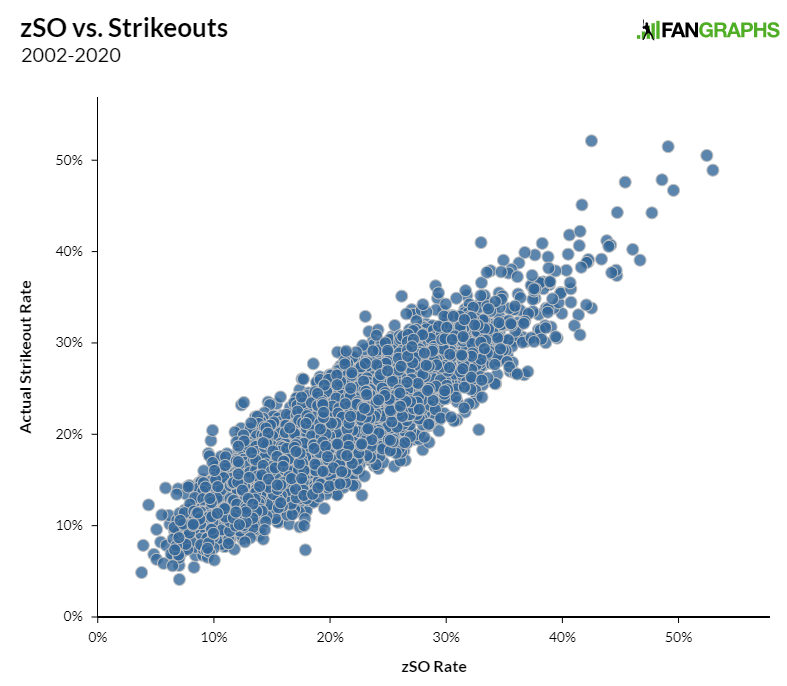
One of the things I want to try to project is what types of performance lead to the so-called Three True Outcomes (home run, walk, strikeout) rather than just tallying those outcomes. For example, what type of performances lead to strikeouts? I’m not just talking about velocity and stuff, but the batter-pitcher interactions at the plate — things like a pitcher’s contact percentage, which for pitchers with 100 batters faced in consecutive years from 2002 has a similar or greater r^2 to itself (0.53) than either walk rate (0.26) or strikeout rate (0.51) does. Contact rate alone has an r^2 of 0.37 when comparing it to the future strikeout rate.

As it turns out, you can explain actual strikeout rate from this synthetic estimate quite accurately, with an r^2 in the low 0.8 range.

Statcast era data works slightly better; the version of zSO which has that data is at 0.84, and the one that predates Statcast data is at 0.80. Cross-validating using repeated random subsampling (our data is limited, as there’s no “other” MLB to compare it to) yields the same results.

Like the various x measures in Statcast, these numbers shouldn’t be taken as projections in themselves. While zSO projects future strikeout rate slightly more accurately than the actual rate itself does, a mixture of both gets a better r^2 (0.59 for the sample outlined above) than either does on its own. Looking at zSO alone as a useful leading indicator, however, gives us an idea of which players may be outperforming or underperforming their strikeout rates so far this season. All numbers are through Wednesday night.

Read the rest of this entry »


Another Unique and Wondrous No-Hitter, Just Like Yesterday

For the better part of five years, Corey Kluber was borderline unhittable. At his double-Cy-Young peak, he was a one-man dead ball era, putting up a 2.85 ERA even as offensive numbers exploded across the league. Though he never closed the deal, he felt like a threat to pitch a no-hitter every time he started.

Kluber isn’t the same pitcher he once was. His walk rate is nearly double where it sat in those halcyon years; his strikeout rate has declined. His fastball doesn’t always crest 90 mph anymore. But he still has that same vicious cutter/slurve combination that powered his ascent, and let’s be honest with each other: This year, nearly every pitcher feels like a threat to throw a no-hitter every time out.

Kluber no-hit the Rangers last night, a capstone achievement that will forever feel slightly out of place with the arc of his career. That’s not to discount the moment: He was excellent last night. He worked off of his slurve rather than vice versa; he threw 31 of them and only 23 sinkers. From the start of the game, he was placing the pitch exactly where he wanted it, befuddling the Rangers’ lineup:

Kluber’s ceaseless desire to fill up the zone worked in his favor last night. He drew a whopping 25 called strikes, a number he hadn’t surpassed since his glory days. Batters step in against him wondering which breaking ball he’ll embarrass them with, which is a truly awful mindset to take into at-bats against a strike-throwing machine, but that’s always been his unique gift: He throws so many pitches that break at so many strange angles, putting batters at a disadvantage right from the jump.
Read the rest of this entry »


Ryan Thompson and Tyler Rogers Explain Their Weird Jersey Numbers

This season, two sidearm relievers – the Rays’ Ryan Thompson and the Giants’ Tyler Rogers – are leaving hitters dumbstruck with their unusual pitching styles. Besides releasing the ball near their shoe tops, though, Thompson and Rogers have another thing in common.

Both pitchers wear jersey numbers far above what most baseball players would consider traditional. Thompson, who proudly wears No. 81, rocks a number that would fit in better with the Tampa Bay Buccaneers than the Rays. Meanwhile, Rogers has been the best pitcher out of the San Francisco bullpen with No. 71 on his back, and says that he likely would have ditched it had he not been so fortunate on the mound.

Thompson and Rogers discussed the process behind getting their numbers, how important they are to them now, and all of the strange experiences that have come from boldly wearing a number that so many others will not. Read the rest of this entry »