Archive for Featured

Dodgers Sign Alex Wood, Human Lottery Ticket

On July 5, in his last start before the All-Star game, Alex Wood was dealing. The Diamondbacks couldn’t touch him with a thirty-nine-and-a-half foot pole. Over seven dominant innings, he struck out 10 batters, walking only two in a scoreless outing. Wood didn’t start the All-Star game, but he could have; his 2.04 FIP, 30.9% strikeout rate, 1.67 ERA, and 10-0 record had something for every stripe of fan. As he walked off the mound, the crowd at Chavez Ravine roared.

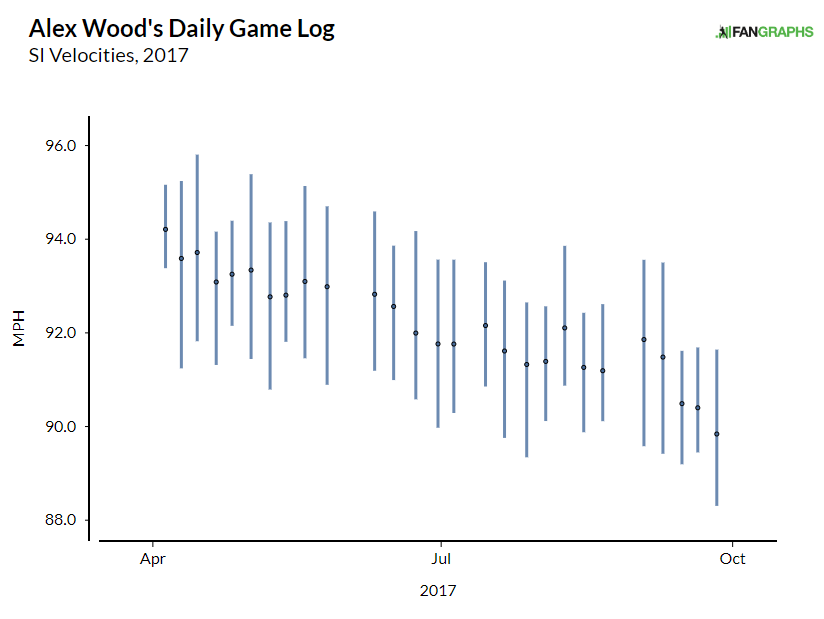
Wait — Chavez Ravine? Oh. Yeah. I left something out. That was July 5, 2017. It’s been a minute since Alex Wood was at his world-devouring best. In the second half of that season, he was ordinary, potentially sub-ordinary. His strikeout rate fell 12 points, his FIP more than doubled, and the Dodgers started managing his workload. The culprit? It can often be hard to pin one down, but in this case, well:

Not what you like to see. The Dodgers skipped his spot in the rotation once, hoping he’d recover, but never put him on the IL. He averaged 90.4 mph on his fastball in the playoffs, and while he was mostly effective, the early-season magic never came back. Read the rest of this entry »


Five Things We Learned from Arbitration Deadline Day

Last Friday was the deadline for all 155 arbitration-eligible players who have been tendered contracts to either agree to terms with their teams, or file desired salary figures ahead of an arbitration hearing. At the hearing, an arbitrator chooses either the figure submitted by the player or by the team; they cannot choose any other dollar amount. Those hearings will take place in the coming weeks. It might not be the most exciting day of the offseason, but it is a very necessary one as we move toward spring, and it certainly results in a high volume of transactions. By our count, 140 players reached agreements; you can see them all in our Offseason Tracker. Just click on the player to find out the amounts. Here’s what we learned from the contracts that did — and did not — get signed last Friday.

Some Clarity Emerged Surrounding Potential Trades

Trade rumors continue to circle Mookie Betts, Kris Bryant, and Francisco Lindor, and determining an official salary number for 2020 could be useful in setting up potential trades. Teams aren’t going to let a few million dollars stand in the way when negotiating the trade of a superstar, but knowing that Mookie Betts will make exactly $27 million (breaking Nolan Arenado’s final-year arbitration record of $26 million) provides some clarity. It also ensures that any team that trades for him would not have to go through the arbitration process with a player they just acquired. Francisco Lindor is still two years away from free agency and his $17.5 million salary is a bargain for Cleveland, just as it would be for any team looking to trade for him. Kris Bryant’s $18.6 million figure is an exception here. While we now know what he’ll be making in 2020, his grievance against the Cubs for service time manipulation has yet to be decided, and the chance that Bryant could be a free agent after 2020 instead of 2021 will likely continue to prevent meaningful negotiations.

File and Trial Produces Settlements and Unnecessary Arbitration

Several years ago, teams began to adopt an arbitration strategy where they would elect not to negotiate single-season salaries once arbitration figures had been exchanged. This strategy, called File and Trial, meant that any agreement needed to come before the arbitration deadline. Exchanging figures was no longer another step in an attempted settlement prior to a hearing, but instead, effectively ended negotiations. The strategy was designed to spur early settlements and extract lower figures from players, as they needed to ensure that they submitted a figure likely to result in an arbitrator siding with them in a hearing. The strategy has been successful, but its utility will come into question over the coming weeks. Read the rest of this entry »


Sunday Notes: Jerry Dipoto Contemplates His Spreadsheet as the Mariners Rebuild

Seattle Mariners GM Jerry Dipoto said the following when I spoke to him in November:

The best we can do is lay out a game plan, a quality game plan, and then track our success. In this game, everything can be tracked.

That includes trades, and it’s no secret that Dipoto has made a lot of them since he was hired to replace Jack Zduriencik following the 2015 season. The exact number — this based on a perusal of transaction logs — is a whopping 106, which works out to more than two dozen annually. The subject broached, Dipoto acknowledged that “it’s a long spreadsheet.”

What does the spreadsheet show in terms of wins and losses? The plethora of deals precludes a detailed response to such a question, but the 51-year-old executive did provide an overview when asked. Read the rest of this entry »


Top 31 Prospects: New York Mets

Below is an analysis of the prospects in the farm system of the New York Mets. Scouting reports are compiled with information provided by industry sources as well as from our own (both Eric Longenhagen’s and Kiley McDaniel’s) observations. For more information on the 20-80 scouting scale by which all of our prospect content is governed you can click here. For further explanation of the merits and drawbacks of Future Value, read this.

All of the numbered prospects here also appear on The Board, a new feature at the site that offers sortable scouting information for every organization. That can be found here.

Mets Top Prospects
Rk Name Age Highest Level Position ETA FV
1 Ronny Mauricio 18.8 A SS 2023 55
2 Andres Gimenez 21.4 AA SS 2020 50
3 Mark Vientos 20.1 A 3B 2022 50
4 Brett Baty 20.2 A- 3B 2022 45+
5 Matthew Allan 18.7 A- RHP 2023 45+
6 Francisco Alvarez 18.1 R C 2023 45+
7 Thomas Szapucki 23.6 AA LHP 2021 45
8 David Peterson 24.4 AA LHP 2020 45
9 Franklyn Kilome 24.5 AA RHP 2020 40+
10 Shervyen Newton 20.7 A SS 2022 40
11 Junior Santos 18.4 R RHP 2023 40
12 Josh Wolf 19.4 R RHP 2024 40
13 Endy Rodriguez 19.7 R C 2023 40
14 Kevin Smith 22.7 AA LHP 2021 40
15 Jaylen Palmer 19.4 R 3B 2023 40
16 Adrian Hernandez 18.9 R CF 2022 40
17 Robert Dominguez 18.1 R RHP 2024 40
18 Jordany Ventura 19.5 R RHP 2023 40
19 Carlos Cortes 22.5 A+ LF 2021 40
20 Joshua Cornielly 19.0 R RHP 2023 40
21 Jordan Humphreys 23.6 A+ RHP 2021 40
22 Alexander Ramirez 17.0 R CF 2025 40
23 Ali Sanchez 23.0 AAA C 2020 40
24 Will Toffey 25.0 AA 3B 2020 40
25 Freddy Valdez 18.1 R RF 2023 35+
26 Ryley Gilliam 23.4 AAA RHP 2021 35+
27 Desmond Lindsay 23.0 A+ CF 2020 35+
28 Walker Lockett 25.7 MLB RHP 2019 35+
29 Tylor Megill 24.4 AA RHP 2021 35+
30 Joander Suarez 19.9 R RHP 2023 35+
31 Michel Otanez 22.5 A- RHP 2022 35+
Reading Options
Detail Level
Data Only
Full
Position Filter
All

55 FV Prospects

Signed: July 2nd Period, 2017 from Dominican Republic (NYM)
Age 18.8 Height 6′ 3″ Weight 166 Bat / Thr S / R FV 55
Tool Grades (Present/Future)
Hit Raw Power Game Power Run Fielding Throw
25/50 45/55 20/50 50/50 45/50 55/60

Similar to the way Andres Gimenez skipped over short season ball (though, he also skipped over the GCL), the Mets pushed Mauricio to Low-A after he had spent just a year on the complex. He was three and a half years younger than the average Sally League player and was still hitting an impressive .283/.323/.381 before he had a lousy August. The exciting physical characteristics — a lanky, projectable frame, the sort you typically see on the mound, the hands, actions, feet, and arm strength for short, precocious feel to hit — shared by Mauricio’s franchise-altering shortstop predecessors, the stuff that had us deliriously excited about him before he even signed, are still present.

The explosiveness and physicality of cornerstone, power-hitting shortstops still percolates beneath the surface, which is fine because Mauricio will be 18 until April and it isn’t reasonable to expect that he’d already have grown into impact power. When most players his age are either in the midst of their freshman season of college or getting ready to start Extended Spring Training, he might be in the Florida State League. Because he’ll be so young and in a pitcher-friendly league, it’s very likely that a year from now, we’ll be ignoring a pretty lousy statline for contextual reasons. With another full year of data to consider, we now know Mauricio is a little swing-happy and that, even if that explosion arrives, he either needs to develop feel for lift or tweak the swing if all the power is to actualize. Hopefully we’re not living in the timeline where Mauricio outgrows shortstop and those two things remain issues. Switch-hitting shortstops with power, uh, don’t really exist. That Mauricio has a chance to be one means he may one day be the top overall prospect in baseball, and several outcomes short of that ideal are still very, very good.

50 FV Prospects

Signed: July 2nd Period, 2015 from Venezuela (NYM)
Age 21.4 Height 5′ 11″ Weight 165 Bat / Thr L / R FV 50
Tool Grades (Present/Future)
Hit Raw Power Game Power Run Fielding Throw
45/55 40/45 30/40 60/55 50/55 55/55

We now have what you could say is a softer 50 on Gimenez. Defensively, at either short or second, Gimenez’s wide array of skills, especially his range (it’s less important than it used to be because of improved positioning, but Gimenez can really go get it) is going to make him a strong middle infield defender.

On offense, even though Gimenez spent 2019 all the way up at Double-A Binghamton, things are less clear. He looked physically overmatched against Double-A pitching, which is fine because he was only 20, but he was also chasing a lot and seemed doomed if he fell behind in counts because of it. The all-fields spray (lots of oppo doubles) that comes when Gimenez targets more hittable pitches is very promising. We’re not optimistic that any kind of impact power will ever come (he’ll golf one out to his pull side once in a while), but the hit tool and doubles would be plenty to profile everyday on the middle infield if Gimenez learns to be more selective.

Drafted: 2nd Round, 2017 from American Heritage HS (FL) (NYM)
Age 20.1 Height 6′ 4″ Weight 185 Bat / Thr R / R FV 50
Tool Grades (Present/Future)
Hit Raw Power Game Power Run Fielding Throw
30/45 60/70 35/60 40/35 35/45 55/60

The way Vientos’ strikeout/walk rates trended in 2019 combined with continued skepticism regarding his ability to stay at third base led some of our sources to express trepidation about where we had him on our 2019 summer top 100 update. But he also put up an above-average statline in full-season ball as a teenager and he has some of the most exciting, frame-based power projection in all the minors. He’s tied for the highest average exit velo among hitters on this list and he has room for another 20 pounds on the frame, which is likely to come since Vientos was one of the younger prospects in his draft class and is younger than 2019 first rounder, Brett Baty. Because we’re talking about a corner bat with strikeout/walk rate yellow flags, Vientos is a high-risk bat but the power gives him middle-of-the-order potential.

45+ FV Prospects

4. Brett Baty, 3B
Drafted: 1st Round, 2019 from Lake Travis HS (TX) (NYM)
Age 20.2 Height 6′ 3″ Weight 210 Bat / Thr L / R FV 45+
Tool Grades (Present/Future)
Hit Raw Power Game Power Run Fielding Throw
35/55 65/65 30/60 45/40 45/50 50/50

In an age when more and more teams are taking model-driven approaches to building a draft board, Baty’s age was such a unique trait that precedent couldn’t inform one much: he was 19.6 on draft day while some other Day One prospects were as young as 17.6. A player’s age relative to his peers is a predictive variable for pro success (younger is better) and Baty is older than a lot of 2018’s high school draftees, against whom we had pro performance to judge while Baty only had high school stats on draft day.

Baty compares quite closely to Cardinals 2018 first rounder and top 100 prospect Nolan Gorman: he’s big, strong, and has huge power and advanced feel to hit. He may not be an athletic fit at third base, especially long-term, and is at risk of moving to first, but his quicker-than-expected feet (he’s a standout hoops player as well) could help delay that. Baty essentially held serve in his first taste of pro ball and his 2020 season will go a long way to dictating his value, as another half-season of pro performance will wipe out all the pre-draft considerations.

5. Matthew Allan, RHP
Drafted: 3rd Round, 2019 from Seminole HS (FL) (NYM)
Age 18.7 Height 6′ 3″ Weight 210 Bat / Thr R / R FV 45+
Tool Grades (Present/Future)
Fastball Curveball Changeup Command Sits/Tops
55/60 55/65 45/55 35/45 93-96 / 97

Allan was one of the top pitchers in the 2019 prep class over the summer, then took a big step forward in the spring, touching the high-90s in every start after peaking in the mid-90s over the summer. His fastball and breaking ball were both anywhere from 60 to 70 grade pitches during the spring depending on the day and scout, while his changeup was a 55 at times over the summer, when he also sometimes flashed average command. If you put together the best elements from both versions of Allan, there’s a potential ace, but the worry is that either one or the other will the the actual outcome, which is still a solid mid-rotation type.

He’s not projectable and is an average athlete, so there are some limits on his upside. He had a rumored $4 million price tag in the draft, which many thought would push him to college, but he ended up changing his asking price and signing for $2.5 million in the third round after throwing a much higher number out to clubs that almost took him at multiple spots in the first. Mets brass are thrilled with their first draft under the new regime and some specifically think Allan is already the best prospect of the group. He could be a top 100 prospect by midseason if he continues his current streak of good health and performance, as his TrackMan figures are very strong.

Signed: July 2nd Period, 2018 from Venezuela (NYM)
Age 18.1 Height 5′ 11″ Weight 220 Bat / Thr R / R FV 45+
Tool Grades (Present/Future)
Hit Raw Power Game Power Run Fielding Throw
25/55 50/55 25/50 45/40 45/55 55/55

Young catchers are notoriously slow to develop as they adjust to the physical and mental demands of the position, which often stymies their offensive production. But Alvarez’s first pro season was statistically impressive. He only played in 42 games, but he hit .312/.407/.510 (mostly in the Appy League) while playing very good defense and appearing more svelte and conditioned than he had as an amateur.

His swing (his front foot is down very early) could stand to be a little more athletic to take advantage of his movement skills, but he rotates hard anyway and his hitting posture enables him to lift pitches in various locations. The receiving, lateral mobility, and arm strength are all promising on the defensive side, too. Teen catchers are risky and often take forever to develop, but Alvarez’s track record of hitting extends back to amateur play, so we’re a little more comfortable here. We view him very similarly to the way we viewed Miguel Amaya a few years ago, except Amaya’s frame was more obviously projectable.

45 FV Prospects

Drafted: 5th Round, 2015 from Dwyer HS (FL) (NYM)
Age 23.6 Height 6′ 2″ Weight 190 Bat / Thr R / L FV 45
Tool Grades (Present/Future)
Fastball Curveball Changeup Command Sits/Tops
45/50 60/60 45/50 40/45 90-94 / 96

Working back from a year and a half of Tommy John rehab, both Szapucki’s in-game pitch count and velocity climbed as the summer burned on. He worked in 20 to 30-pitch stints for the first several weeks of the year before rounding into more traditional starter form late. His sinker and changeup have similar movement, which will benefit the change (which is just fine in a vacuum). The curveball, though, the pitch that enabled Szapucki’s earlier breakout, remains excellent. We’re hoping more mechanical consistency in season two back from TJ will yield better command, but even if this iteration of Szapucki is where things settle, that’ll still be a strong multi-inning relief piece if not a No. 4/5 starter.

Drafted: 1st Round, 2017 from Oregon (NYM)
Age 24.4 Height 6′ 6″ Weight 240 Bat / Thr L / L FV 45
Tool Grades (Present/Future)
Fastball Slider Curveball Changeup Command Sits/Tops
45/45 50/50 45/45 50/55 50/55 89-91 / 93

Peterson was a known prep prospect as an underclassman in Colorado due to his 6-foot-6 frame and ability to touch 90 mph from the left side at an early age. Then he had two decent years at Oregon before he dominated as a junior, striking out 140 hitters and walking just 15 in 100 innings. He has never had a plus pitch, nor does he project to have one, and instead works in the low-90s with tough angle and great extension, and several other pitches. He doesn’t have high spin rates on his breaking stuff and pitches more to weak contact with a sinking, sometimes cutting changeup, looking like a steady, durable, No. 4/5 starter who we’ll see in the big leagues this year.

40+ FV Prospects

Signed: July 2nd Period, 2012 from Dominican Republic (PHI)
Age 24.5 Height 6′ 6″ Weight 215 Bat / Thr R / R FV 40+
Tool Grades (Present/Future)
Fastball Curveball Changeup Command Sits/Tops
60/60 55/55 45/50 40/40 92-94 / 96

Tommy John surgery late in the fall of 2018 meant Kilome didn’t pitch at all last year, though he was throwing with effort in the bullpen late in September. He has shown a starter’s mix of pitches, especially during his brief time with the Mets (he was acquired from Philly for Asdrúbal Cabrera ahead of the 2018 deadline) when his strike throwing and changeup improved. Prior to that, he had been pretty raw for a pitcher his age and had begun to look like a bullpen arm, an outcome that became more likely due to the injury and his presence on New York’s 40-man. There’s a chance Kilome looks really good in the spring and the Mets decide to let him start while managing his workload, but we expect to see mid-90s heat and a great curveball out of the bullpen sometime in 2020.

40 FV Prospects

Signed: July 2nd Period, 2015 from Netherlands (NYM)
Age 20.7 Height 6′ 4″ Weight 180 Bat / Thr S / R FV 40
Tool Grades (Present/Future)
Hit Raw Power Game Power Run Fielding Throw
30/40 55/65 30/50 50/50 40/50 55/55

As we sourced for this org list, we spoke with a scout who saw Newton play terribly for a week and still thought he belonged high on this list because his physical talent is so remarkable. This is an extreme risk hit tool prospect, the kind who sometimes tricks us into thinking relevant adjustments have been made and performs at upper levels only to flail at big league pitching (see: Brinson, Lewis), but also sometimes becomes Aaron Judge.

Newton is built like an SEC wide receiver, he already has sizable power and will likely grow into more, while also staying on the left side of the infield. He has a shot to be what we have Mauricio projected to be; a switch-hitting shortstop or third baseman with impact power. But Newton has run two consecutive years of strikeout rates up around 32% and the quality of his at-bats is wildly variable. He’s still growing into his body, so perhaps more reliable bat-to-ball skills will arrive once he does. Even if he cuts the K’s down to the 25% range, we could be talking about a valuable everyday big leaguer.

11. Junior Santos, RHP
Signed: July 2nd Period, 2017 from Dominican Republic (NYM)
Age 18.4 Height 6′ 8″ Weight 218 Bat / Thr R / R FV 40
Tool Grades (Present/Future)
Fastball Slider Changeup Command Sits/Tops
50/60 45/50 40/50 35/50 89-93 / 95

A slight dip in velo and a strike-throwing regression isn’t enough to slide Santos down the pref list at this point, not as his age, nor at his size, and especially not when you consider both. This is a giant teenager with a good arm and some breaking ball and changeup feel (for creating movement, not for locating) who was pushed hurriedly to an affiliate when he was still 17. The arm action looked a little less fluid and was a bit compromised last season, but we’re still on Santos as a long-term projection arm with an elite frame.

12. Josh Wolf, RHP
Drafted: 2nd Round, 2019 from St. Thomas HS (TX) (NYM)
Age 19.4 Height 6′ 2″ Weight 175 Bat / Thr R / R FV 40
Tool Grades (Present/Future)
Fastball Curveball Changeup Command Sits/Tops
55/60 50/60 40/50 40/50 92-95 / 97

Wolf was a lower-end follow after the summer showcase circuit, then popped up during his draft spring as a high school senior. When making the rounds in Texas, Kiley ran into him with no background; Wolf sat 94-97 with plus life and a plus curveball while there were a couple dozen scouts in the house who were trying to double Wolf up with eventual first round pick Jackson Rutledge (both are based in the Houston area). Wolf’s frame and delivery aren’t ideal for a 200 inning type, but the stuff is loud, the arm is fresh, the velo is new, and there’s no track record of any trouble in the way of injuries, overuse, or walk rate, so at some point we’re just nitpicking.

Signed: July 2nd Period, 2018 from Dominican Republic (NYM)
Age 19.7 Height 6′ 0″ Weight 170 Bat / Thr S / R FV 40
Tool Grades (Present/Future)
Hit Raw Power Game Power Run Fielding Throw
25/60 35/45 20/40 45/40 45/60 50/50

Rodriguez lost some time to a hamstring strain last year and it may have masked his real athleticism for a while during an otherwise stellar first summer in the states. This is a very athletic, switch-hitting catcher with advanced feel for contact, and a few of the sources we spoke with about Rodriguez were actually most excited about his defense. The movement, receiving, and catch-and-throw skills are fine, but Rodriguez has also seen time at first base and in the outfield, so he might be a very interesting, multi-positional player. We have him valued where we had Rafael Marchan and Gabriel Moreno at the same stage.

14. Kevin Smith, LHP
Drafted: 7th Round, 2018 from Georgia (NYM)
Age 22.7 Height 6′ 5″ Weight 200 Bat / Thr R / L FV 40
Tool Grades (Present/Future)
Fastball Slider Changeup Command Sits/Tops
45/45 50/55 45/50 45/50 87-90 / 92

Smith was a seventh rounder in 2018 out of Georgia. He’s a big lefty who sits around 90 with a three-pitch mix, but he was used in a number of roles in college, so nobody was really pounding the table for him. Well, maybe they should have been: he carved up Low-A after being drafted, then did the same to High-A and before pitching well at Double-A as a 22-year-old in his first full season. The stuff still isn’t great, but his slider flashes above average, his fastball has a solid spin rate and overall characteristics to go along with some deception and the feel to get the most out of his stuff. The intangibles seem to be driving the success here and the tools aren’t bad, so a big league look in 2020 or 2021 now seems likely.

15. Jaylen Palmer, 3B
Drafted: 22th Round, 2018 from Holy Cross Academy HS (NY) (NYM)
Age 19.4 Height 6′ 3″ Weight 195 Bat / Thr R / R FV 40
Tool Grades (Present/Future)
Hit Raw Power Game Power Run Fielding Throw
20/40 50/60 25/50 50/40 40/45 55/55

This is one of, if not the highest variance prospects in the entire system. Unearthed in the Mets’ backyard as an overslot Day Three pick, Palmer surprised the industry by going to Kingsport and performing well above what was expected of him. We think there’s a gap between the contact performance (Palmer hit .250) and actual skill at this point, but that’s okay for such a lanky, cold-weather, out-of-nowhere high school prospect.

The measurable power Palmer generates on contact is shocking. He’s tied with Mark Vientos and Brett Baty for the highest average exit velo on this list and he’s arguably more physically projectable than either of them. His long-term defensive profile is still unclear, and Palmer’s ability to make contact and recognize offspeed stuff is raw. It’s possible he becomes a whiff-prone corner outfielder and falls off the list in two years, but he may also stay on the dirt and develop passable feel to hit and huge raw power.

Signed: July 2nd Period, 2017 from Dominican Republic (NYM)
Age 18.9 Height 5′ 9″ Weight 210 Bat / Thr R / R FV 40
Tool Grades (Present/Future)
Hit Raw Power Game Power Run Fielding Throw
20/45 50/55 25/50 50/55 40/50 50/50

Like Desmond Lindsay, who is a ways down this list, Hernandez is muscular, explosive, tightly-wound, and suffered a severe soft-tissue injury (a torn hamstring) that cost him most all of 2019. And so, the scouting report remains the same as it did on last year’s list: Hernandez runs well enough to stay in center field and he has sizable raw power for a teenager. The cement on the bod is pretty dry, and while we think that means limited power projection, it also probably means Hernandez stays in center. The exit velos on THE BOARD for both Hernandez and Lindsay are from the 2018 season, when they were healthy enough to generate sufficient data.

Signed: July 2nd Period, 2019 from Venezuela (NYM)
Age 18.1 Height 6′ 4″ Weight 200 Bat / Thr R / R FV 40
Tool Grades (Present/Future)
Fastball Curveball Changeup Command Sits/Tops
55/60 50/60 40/45 35/50 93-96 / 99

Dominguez was a known, and not all that highly-regarded, pitching prospect at the beginning of 2019. He was then a 17-year-old Venezuelan righty with some effort who sat 90-93, which is typically a $10,000 to $25,000 bonus pitcher. He was then 94-97 at an event in the summer, and teams sat up straight to reconsider him, but some clubs wanted to see it another time or two to make sure it wasn’t an anomaly. The Mets moved quickly, though Dominguez’s bonus, which we were told was $95,000, reflected that level of uncertainty.

Between when Dominguez was waiting for his contract to be approved and the end of Dominican instructs, he continued to sit in the mid-90s and hit 99, flashing a plus breaking ball at times. A scout who saw him during this period told us he would “blow the doors off” of the GCL this time next summer. He’s only thrown a handful of times since the velo spike and not even all of the Mets upper level decision makers have seen him yet, but the talent level is on par with a compensation or second round pick. There’s just significantly more uncertainty and less track record than even later-developing players taken in that range, like Josh Wolf.

18. Jordany Ventura, RHP
Signed: July 2nd Period, 2017 from Dominican Republic (NYM)
Age 19.5 Height 6′ 0″ Weight 165 Bat / Thr R / R FV 40
Tool Grades (Present/Future)
Fastball Slider Changeup Command Sits/Tops
45/55 50/55 40/50 40/50 91-94 / 95

Ventura began the summer in the DSL but had reached Kingsport by August. He doesn’t have the big frame to dream on but he’s very athletic, can spin it, his fastball has life, he already throws pretty hard, and he’ll show an occasional plus slider. You can go kind of wild projecting on his command because of the athleticism, but realistically he could be a No. 4/5 starter.

Drafted: 3rd Round, 2018 from South Carolina (NYM)
Age 22.5 Height 5′ 8″ Weight 200 Bat / Thr L / S FV 40
Tool Grades (Present/Future)
Hit Raw Power Game Power Run Fielding Throw
30/45 60/60 35/55 40/40 40/45 45/45

Cortes is unique in that he’s a switch-thrower who stood out early in his high school career and pitched along with playing all over the diamond, including an attempt at catching. He had plus bat control at that stage but his body has thickened and he’s lost some of his athleticism as he’s aged, though he still has good feel for the bat. He’s played a passable second base and otherwise would fit in left field or maybe at first, but the defensive value is minimal regardless. The calling card is plus raw power and feel to hit from the left side. There isn’t much else there, so a role as a Frank Catalanotto/Matt Stairs style platoon player or bench bat seems to be the most likely outcome.

Signed: July 2nd Period, 2017 from Venezuela (NYM)
Age 19.0 Height 6′ 2″ Weight 175 Bat / Thr R / R FV 40
Tool Grades (Present/Future)
Fastball Curveball Changeup Command Sits/Tops
40/45 40/50 45/55 40/55 88-93 / 95

While he isn’t your typical, huge-framed teenage arm, Cornielly has a lot of starter traits. He’s a plus athlete with a squeaky clean delivery, and advanced changeup feel and fastball command. The breaking ball needs work, but it’s a shape problem more than a raw spin one, and we think Cornielly is athletic enough to develop in this area. He has a realistic shot to be a No. 4/5 starter down the line, and a non-zero chance to develop a premium change, command, or both, and be more.

Drafted: 18th Round, 2015 from Crystal River HS (FL) (NYM)
Age 23.6 Height 6′ 2″ Weight 223 Bat / Thr R / R FV 40
Tool Grades (Present/Future)
Fastball Slider Changeup Command Sits/Tops
45/50 55/55 45/50 45/50 91-95 / 96

Humphrey’s Tommy John rehab started and stopped (more of the latter) last summer before he threw during the Fall League, where he sat in the low-90s on about a week’s rest. He showed a rare changeup but mostly worked off an 82-85 mph slider otherwise. He looked like a potential backend starter before the UCL blew out and all the setbacks started, but looked more like a “maybe” reliever in the fall. We like his chances of bouncing back but he’ll need to show it early in the spring and stay healthy.

Signed: July 2nd Period, 2019 from Dominican Republic (NYM)
Age 17.0 Height 6′ 3″ Weight 175 Bat / Thr R / R FV 40
Tool Grades (Present/Future)
Hit Raw Power Game Power Run Fielding Throw
20/50 40/55 20/55 55/55 40/50 50/55

This Alexander Ramirez and the Angels recently-signed Alexander Ramirez are going to be conflated with one another for the next several years because they have almost identical builds. They’re each classic, big-framed, power projection outfielders. This Ramirez runs well enough to try center field for a while, though we expect he’ll move to a corner eventually due to his size. Lever length may be an issue here.

23. Ali Sanchez, C
Signed: July 2nd Period, 2013 from Venezuela (NYM)
Age 23.0 Height 6′ 0″ Weight 196 Bat / Thr R / R FV 40
Tool Grades (Present/Future)
Hit Raw Power Game Power Run Fielding Throw
45/50 40/40 30/30 30/30 55/55 55/55

Added to the 40-man during the offseason, Sanchez projects as a glove-oriented backup.

24. Will Toffey, 3B
Drafted: 4th Round, 2017 from Vanderbilt (OAK)
Age 25.0 Height 6′ 2″ Weight 205 Bat / Thr L / R FV 40
Tool Grades (Present/Future)
Hit Raw Power Game Power Run Fielding Throw
40/50 50/50 30/40 50/50 50/55 70/70

Toffey was a notable player on the national stage all the way back to high school and has been a similar guy for those last seven years. He’s got solid feel to hit and works counts with mediocre raw power and ordinary bat speed. He’s made offensive adjustments at each level but has excelled only once he’s been on the old side for prospects at each level, so the low-end regular chance has mostly dried up now. He’s a solid defender with a plus arm who probably fits best as a lefty platoon corner bat and is still on schedule to be that at some point in 2020 or 2021.

35+ FV Prospects

25. Freddy Valdez, RF
Signed: July 2nd Period, 2018 from Dominican Republic (NYM)
Age 18.1 Height 6′ 3″ Weight 215 Bat / Thr R / R FV 35+
Tool Grades (Present/Future)
Hit Raw Power Game Power Run Fielding Throw
25/50 50/55 20/55 40/30 40/45 45/45

Valdez got a big bonus as part of the 2018 class and is a beefy power guy who we were a little skeptical of athletically, but he performed in the DSL and was pushed to the GCL last summer. The exit velos are a little lower than we expected given how big and strong Valdez is already.

26. Ryley Gilliam, RHP
Drafted: 5th Round, 2018 from Clemson (NYM)
Age 23.4 Height 5′ 10″ Weight 170 Bat / Thr R / R FV 35+
Tool Grades (Present/Future)
Fastball Curveball Command Sits/Tops
55/60 55/55 40/45 92-94 / 96

Gilliam was the ace starter for one of the most prospect-laden prep teams in the country in 2015, Kennesaw Mountain High School, which also had current top 100 prospect Tyler Stephenson (Reds) and center fielder Reggie Pruitt (Blue Jays), who got a $500,000 bonus in the 24th round. Gilliam could’ve received a low-to-mid six figure bonus out of high school, but instead went to Clemson, where he mostly relieved, a role that agreed with his aggressive approach and fastball/curveball combination. He has two above-average offerings rather than a true plus out pitch, which is why he’s in this tier rather than the 40 FV one.

Drafted: 2nd Round, 2015 from Out of Door Academy HS (FL) (NYM)
Age 23.0 Height 6′ 0″ Weight 200 Bat / Thr R / R FV 35+
Tool Grades (Present/Future)
Hit Raw Power Game Power Run Fielding Throw
30/40 60/60 40/50 60/55 45/50 50/50

A torn hamstring cost Lindsay virtually all of 2019, a familiar refrain in an injury-riddled pro career, which has included several hamstring issues. Lindsay has big tools, but he struggles with contact and hasn’t had the in-game reps to remedy it.

28. Walker Lockett, RHP
Drafted: 4th Round, 2012 from Providence HS (FL) (SDP)
Age 25.7 Height 6′ 5″ Weight 225 Bat / Thr R / R FV 35+
Tool Grades (Present/Future)
Fastball Curveball Changeup Command Sits/Tops
45/45 50/50 55/55 45/45 90-93 / 95

A slight velo dip (92-95 in 2018, 90-93 last year) now has Lockett projecting as more of a spot starter or swingman rather than a sinkerballing No. 5.

29. Tylor Megill, RHP
Drafted: 8th Round, 2018 from Arizona (NYM)
Age 24.4 Height 6′ 7″ Weight 230 Bat / Thr R / R FV 35+
Tool Grades (Present/Future)
Fastball Slider Command Sits/Tops
50/50 55/55 40/45 90-93 / 95

Megill has a similar profile to his older brother, Trevor, who was a recent Rule 5 pick by the Cubs from the Padres. They’re both giant and throw hard and pitched at Loyola Marymount, while Tylor later ended up at Arizona. Tylor has made notable improvements in pro ball to his breaking ball after going in the eighth round as a senior sign in 2018. One source described Tylor as a potential Robert Gsellman or Seth Lugo due to his high-octane stuff, spin rates, and multi-inning potential. Given his age, he could get to the big leagues in 2020 with continued refinement.

30. Joander Suarez, RHP
Signed: July 2nd Period, 2017 from Venezuela (NYM)
Age 19.9 Height 6′ 3″ Weight 180 Bat / Thr R / R FV 35+
Tool Grades (Present/Future)
Fastball Slider Changeup Command Sits/Tops
45/50 50/55 40/50 40/50 91-94 / 95

There are some elements of Suarez’s delivery that need to be ironed out if he’s going to locate consistently enough to start, but he’s strong of build, has a loose arm, and can spin a two-plane slider from his current three-quarters arm slot. He’s an interesting developmental follow for now.

31. Michel Otanez, RHP
Signed: July 2nd Period, 2016 from Dominican Republic (NYM)
Age 22.5 Height 6′ 3″ Weight 215 Bat / Thr R / R FV 35+
Tool Grades (Present/Future)
Fastball Slider Command Sits/Tops
55/60 45/50 35/40 90-97 / 99

Just a body/arm strength lottery ticket for now, Otanez should continue starting for a bit in order to refine his breaking ball. If that comes along, he’ll be a middle reliever.

Other Prospects of Note

Grouped by type and listed in order of preference within each category.

Younger Developmental Types
Stanley Consuegra, RF
Blaine McIntosh, CF
Sebastian Espino, SS
Federico Polanco, 2B
Robert Colina, RHP
Benito Garcia, RHP

Consuegra would be above Valdez on the main list on tools and long-term physical projection but he missed all of 2019 with a torn ACL. McIntosh was a multi-sport high schooler committed to Vanderbilt who the Mets got done on Day Three of the 2019 draft. He’s toolsy, but raw. Espino is a contact-oriented shortstop who lacks bat control when he takes big hacks, and bat speed when he’s under control. Polanco was a DSL All-Star; he’s a little more compact but twitchy. Both will need to have contact-driven offensive profiles since they lack power projection. Colina is a loose teenage arm up to 93 with positive spin axis traits. Garcia is the oldest player in this cluster at 19.8 (McIntosh and Espino are the youngest at 18.6) and sits 90-93 with above-average spin.

Depth Arms and Luis Carpio
Reyson Santos, RHP
Dedniel Nunez, RHP
Tony Dibrell, RHP
Christian James, RHP

Santos, 21, has been up to 96 but the breaking ball is still a work in progress. He’s a relief-only sort. Nunez is older (23) but also up to 96 with nearly pure backspin. He had a 15% swinging strike rate on his heater last year, but it was at lower levels. Dibrell and James are spot starter types.

System Overview

This group is a bit thinner at the top because of Pete Alonso’s graduation and the Marcus Stroman trade (and, of course, there’s no Jarred Kelenic or Justin Dunn), but a tier of teenagers (mostly arms) in the lower levels of the system have emerged to make it deeper.

Both recent agents-turned-GM, the Mets’ Brodie Van Wagenen and ex-Diamondback Dave Stewart, were a little cavalier with dealing away prospects early during their tenures. If you care about surplus value, then the Robinson Canó deal was instant highway robbery for Seattle. If you don’t, it’s probably starting to look that way. But the Keon Broxton trade, in which the Mets surrendered three prospects for a player who was DFA’d by Baltimore less than a year later, was another, almost immediate example.

Decision-makers deserve time to adjust the same way players do. The Mets beefed up the analytics department last year. We’re still waiting to see if they start scouting the lowest levels of the minors, but if their goal is to compete right now, then they’re not likely to acquire that type of player anyway. How the international department sustains its recent level of excellence in the absence of departed Chris Becerra will be a key to continuing to stock a system that looks better than we anticipated when we began sourcing.


Is the Cost of a Win in Free Agency Still Linear?

It’s no secret that free agency has changed over the last decade. As more teams have embraced analytics by focusing on paying for future, rather than past, performance, and owners have pinched pennies, we’ve seen slower winters, and in the case of last offseason, teams paying significantly less for a win on the open market. This offseason has seen a welcome return of activity, with good players receiving top-dollar contracts. When we consider the health of free agency for players, the big deals seem to grab a lot of attention, as with Gerrit Cole, Anthony Rendon, and Stephen Strasburg‘s this season, and Manny Machado and Bryce Harper’s a year ago. Mega-deals create the impression that all is well, and the size of those deals can have an outsized affect when calculating dollars per win, as in my piece yesterday on the cost of a win in free agency. But the players who don’t receive those big contracts deserve a bit more attention because it is possible that as free agent spending has shifted, the money teams are paying for wins may no longer be linear.

When we talk about the linear cost of a win, we’re talking about there being a uniform amount teams are generally willing to pay per win on the free agent market; if the cost of a win is $9 million, a three-win player gets $27 million, a two-win player gets $18 million, and a one-win player receives $9 million. And while we recognize the three-win player doesn’t actually receive a one-year deal worth $27 million, when the money is spread over a multi-year deal and the presumed decline from aging is factored in, the wins paid for over the life of the contract come out in roughly that manner. For example, Hyun-Jin Ryu is projected to be roughly a three win player in 2020. But over the course of four seasons, he is likely to be worth closer to nine wins; he signed a contract for $80 million, which comes out to right around $9 million per win. Not every case fits so neatly, but Ryu is one example.

The question now is whether the above is still true. In 2017, Matt Swartz examined the seasons through 2016 and found that the cost of a win was still linear. Since then, a narrative has emerged of slightly lesser players getting squeezed. Heading into the 2017 season, Travis Sawchik discussed baseball’s embattled middle class as players appeared to be getting frozen out of free agency. He followed that up in 2018 after another slow winter provided more evidence of a market in dire straights. Providing further support, the crowdsourced contract estimates our readers provide as part of our annual Top 50 Free Agents exercise have generally overshot free agent contracts under $40 million the last few years. Read the rest of this entry »


MLB’s Current Sign-Stealing Saga Carries Echos of the Game’s PED Problems

A new avenue to pursue a competitive advantage, a gray area as to whether it’s considered cheating, a paper ban that goes unenforced, bad behavior spreading around the league through player movement, executives shocked — shocked! — that such behavior is happening on their teams, a commissioner sounding out of touch as he publicly downplays the severity of the problem, once-celebrated achievements now tainted… if the outlines of baseball’s current sign-stealing scandal sound familiar, it’s because they’ve followed a pattern similar to that of the performance-enhancing drug problem that enveloped the game in the 1990s and early 2000s. Of course, there are key differences between the two, but both found Major League Baseball well behind the curve and struggling both to catch up and regain credibility on the issue.

That thought came to mind on Tuesday, as the sign-stealing saga took a new turn when The Athletic’s Ken Rosenthal and Evan Drellich reported that in 2018, the Red Sox used their video replay room in an attempt to decipher opponents’ sign sequences, a practice that proliferated after instant replay reviews were introduced in 2014, one that was broadly prohibited but generally unenforced until 2018. Three members of the 2018 Red Sox told The Athletic that multiple teammates used the team’s video room, which was just a few steps from the home dugout, to break down opponents’ signs. Unlike the bang-on-a-trash-can system Rosenthal and Drellich reported the Astros having used in 2017, the Red Sox did not directly communicate to batters what pitch was coming, instead relaying that information through the dugout to the baserunner and then to the hitter.

While the efficacy of either system is still murky, both the Astros and Red Sox flouted the rules, and both went on to win the World Series in the year they did so, coincidentally beating the Dodgers. While rumors have circulated regarding other teams’ usage of replay rooms and other means to steal signs electronically, thus far the substantiated allegations have been limited to those two clubs, who share a common denominator: Alex Cora, who as bench coach of the Astros in 2017 is said to have played a key role in their sign-stealing system, and who left following that season to manage the Red Sox, a job he still holds. Read the rest of this entry »


The Cost of a Win in Free Agency in 2020

After a few cold, dreary, quiet hot stove seasons, free agency picked up its pace this winter. While Manny Machado and Bryce Harper got $300 million deals last offseason, it took until nearly spring to get those contracts finalized. This offseason, we’ve seen Gerrit Cole, Stephen Strasburg, Anthony Rendon, and Zack Wheeler sign for more than $100 million, and with the new year just eight days old, only a handful of decent free agents remain. While large deals and total spending near $2 billion have captivated us this offseason, it’s worth exploring what has made this winter different from years past. Is it just timing? Is it this class of free agents? Have teams changed their spending habits? Is the cost of a win still linear? A useful tool when examining those issues it to try to determine how much teams are paying for a win above replacement in the free agent market.

While putting dollar figures on players isn’t the most feel-good task, it’s helpful for framing conversations about costs in free agency. From the front office perspective, it helps to determine which free agents are good values and a worthy investment of resources compared to other free agents and veteran players. It also helps frame the value of younger players who have yet to reach the full six years of service time necessary to hit the market by showing the alternative cost to obtaining similar production. On the player side, these types of valuations tend to show how underpaid players are prior to reaching free agency, given the low cost of their tremendous on-field value compared to similarly productive free agents.

There are a variety of ways to go about determining how much teams are paying per win on the free agent market. Matt Swartz, having found that projections tended to overweight free agent player production and playing time when considered in the aggregate, instead considered actual production of past results to determine how much teams were paying for a win. He also used all players with at least six years of service time to account for players aging over the course of a contract. He acknowledged that there might be issues with including players on extensions. To be clear, Swartz wasn’t wrong about the way he formulated his dollars per win, but another approach can be helpful, and, if we are to look at the current offseason, necessary. Read the rest of this entry »


The Count Is King (Even After Accounting for Batter Skill)

Here’s a big, boring truism you surely don’t want to read an article about: as a pitcher, it’s better to be ahead in the count than behind. Good, great, fine. Thanks for the information, Ben, but let’s move along. We all know that, there’s no need to further prove it.

But wait! Here’s another truism that complicates the first one. Better hitters get ahead in the count more often. Mike Trout gets to 1-0 a lot more frequently than Billy Hamilton does — in roughly 48% of his plate appearances, as compared to a mere 36.8% for Hamilton.

So here’s a fact presented without context: major league hitters, as a whole, had a .363 wOBA after 1-0 counts and a .270 wOBA after 0-1 counts. Get ahead, hit better. But here’s some context, which at least slightly confuses the issue. The average wOBA of a batter reaching a 1-0 count was .322. In contrast, the average wOBA of 0-1 batters was .317. Better batters, in other words, really do reach advantageous counts more often. If you don’t account for that, you’ll probably end up over-valuing getting ahead in the count. Read the rest of this entry »


Top 40 Prospects: Houston Astros

Below is an analysis of the prospects in the farm system of the Houston Astros. Scouting reports are compiled with information provided by industry sources as well as from our own (both Eric Longenhagen’s and Kiley McDaniel’s) observations. For more information on the 20-80 scouting scale by which all of our prospect content is governed you can click here. For further explanation of the merits and drawbacks of Future Value, read this.

All of the numbered prospects here also appear on The Board, a new feature at the site that offers sortable scouting information for every organization. That can be found here.

Editor’s Note: Brandon Bailey has been added to this list at No. 30 following his return from the Baltimore Orioles subsequent to the Rule 5 Draft. Cal Stevenson has been removed following a trade to the Tampa Bay Rays.

Astros Top Prospects
Rk Name Age Highest Level Position ETA FV
1 Forrest Whitley 22.5 AAA RHP 2020 60
2 Jose Urquidy 24.9 MLB RHP 2020 50
3 Abraham Toro 23.2 MLB 3B 2020 45+
4 Freudis Nova 20.2 A 3B 2022 45
5 Bryan Abreu 22.9 MLB RHP 2020 45
6 Cristian Javier 23.0 AAA RHP 2020 45
7 Brandon Bielak 23.9 AAA RHP 2021 45
8 Korey Lee 21.6 A- C 2023 40+
9 Hunter Brown 21.5 A- RHP 2023 40+
10 Jairo Solis 20.2 A RHP 2021 40+
11 Jeremy Pena 22.5 A+ SS 2022 40+
12 Jose Alberto Rivera 23.1 A RHP 2021 40+
13 Enoli Paredes 24.5 AA RHP 2020 40+
14 Tyler Ivey 23.8 AA RHP 2020 40+
15 Angel Macuare 20.0 A- RHP 2022 40+
16 Jordan Brewer 22.6 A- CF 2023 40
17 Colin Barber 19.3 R CF 2024 40
18 Grae Kessinger 22.5 A SS 2022 40
19 Luis Garcia 23.2 A+ RHP 2021 40
20 Luis Santana 20.6 AA 2B 2022 40
21 Jojanse Torres 24.6 A+ RHP 2022 40
22 Carlos Sanabria 23.1 AA RHP 2020 40
23 Cionel Perez 23.9 MLB LHP 2020 40
24 Ronnie Dawson 24.8 AAA CF 2020 40
25 Dauri Lorenzo 17.4 R SS 2025 40
26 Manny Ramirez 20.3 A RHP 2023 40
27 Rogelio Armenteros 25.7 MLB RHP 2020 40
28 Nivaldo Rodriguez 22.9 A+ RHP 2021 40
29 Garrett Stubbs 26.8 MLB C 2020 40
30 Brandon Bailey 25.4 AA RHP 2020 40
31 Chas McCormick 24.9 AAA RF 2020 40
32 Blake Taylor 24.6 AAA LHP 2020 35+
33 Shawn Dubin 24.5 A+ RHP 2022 35+
34 Peter Solomon 23.6 A+ RHP 2021 35+
35 Jairo Lopez 19.3 A- RHP 2022 35+
36 Brett Conine 23.4 AA RHP 2021 35+
37 Juan Pablo Lopez 21.1 A LHP 2022 35+
38 Julio Robaina 19.0 A LHP 2022 35+
39 Bryan De La Cruz 23.2 AA RF 2021 35+
40 Diosmerky Taveras 20.5 R RHP 2023 35+
Reading Options
Detail Level
Data Only
Full
Position Filter
All

60 FV Prospects

Drafted: 1st Round, 2016 from Alamo Heights HS (TX) (HOU)
Age 22.5 Height 6′ 7″ Weight 225 Bat / Thr R / R FV 60
Tool Grades (Present/Future)
Fastball Slider Curveball Changeup Cutter Command Sits/Tops
60/60 55/55 60/60 60/60 55/55 35/45 93-97 / 99

Two consecutive tumultuous seasons — a 2018 stimulant suspension, lat and oblique issues, then 2019 shoulder fatigue, control problems, and what looked like a conditioning regression — have us a little down on Whitley, but not too much, because his stuff is still quite good. He wields one of the deepest repertoires in all of the minors and, though the elite-looking changeup he showed during the 2018 Fall League was not present in 2019, all of his stuff is still above-average or better, both visually and on paper.

The strike-throwing hiccup isn’t great, but Whitley clearly knows where his stuff plays best (fastballs up, the cutter and slider to his glove side, and the curveball beneath the zone — a well-designed mix nearly ubiquitous in this system) and he works in those locations pretty loosely. Inefficiency might limit Whitley’s inning totals, but it’s unlikely to prevent him from starting. Ideally, Whitley shows up to camp in better shape than he appeared to be in during the Fall League; he underwent a much more drastic athletic metamorphosis in high school (which coincided with his pre-draft velo spike), so it seems very possible. The top of a rotation ceiling that seemed possible a year ago would now require a bit of a bounce back in stuff and a quantum control/command leap. That seems unlikely, but a mid-rotation/All-Star ceiling still exists.

50 FV Prospects

2. Jose Urquidy, RHP
Signed: July 2nd Period, 2014 from Mexico (HOU)
Age 24.9 Height 6′ 0″ Weight 190 Bat / Thr R / R FV 50
Tool Grades (Present/Future)
Fastball Slider Curveball Changeup Command Sits/Tops
55/55 50/50 50/50 60/60 60/60 92-95 / 97

Urquidy made last year’s Astros list as an Other of Note, projecting as a spot starter because of his plus changeup and command. He sat 89-93 in 2018, then found a few more ticks of velo and a second breaking ball in 2019, all while retaining the command and change. Both breaking balls will play because of where Urquidy locates them (the slider, especially, needs to miss away from hitters), and his changeup action works against both handed hitters, so he’s a promising rotation piece who we project as a 2.5 WAR-ish starter.

45+ FV Prospects

Drafted: 5th Round, 2016 from Seminole State JC (OK) (HOU)
Age 23.2 Height 6′ 1″ Weight 190 Bat / Thr S / R FV 45+
Tool Grades (Present/Future)
Hit Raw Power Game Power Run Fielding Throw
50/55 55/55 45/50 60/60 40/45 60/60

It’s rare for evaluations of a player as seasoned as Toro to be as divisive as his are, all the way down to the bones of his tool grades. Running is simple to evaluate using home to first times, but there’s even disagreement over Toro in this area. But let’s start with the most important stuff: the offense. Toro is short-levered and tightly-wound, not the loose, rotational athlete most scouts like. But he muscles balls into both gaps and has solid barrel control, enough to spoil tough pitches and grind out tough at-bats. It’s a pretty well-rounded contact/doubles power/OBP profile even though Toro presents an atypical look.

The same is true of Toro’s defense. When he has the time to really step into a throw, he uncorks rockets, but he’s not the kind of athlete who can make strong throws in tough situations. He’s okay at third base, but there are teams and individual scouts who prefer him at either first or in the outfield corners, and some are really intrigued by the latter possibility because of Toro’s long speed. He’s not a graceful runner, but he can really move once he gets going and his swing has a natural jailbreak, so he’s fast to first. A diverse defensive role seems logical considering how crowded Houston’s 1B/3B situation is, unless Toro gets traded. He has a shot to be an average everyday player if he gets an opportunity, but otherwise should play a valuable, switch-hitting corner role.

45 FV Prospects

Signed: July 2nd Period, 2016 from Dominican Republic (HOU)
Age 20.2 Height 6′ 1″ Weight 190 Bat / Thr R / R FV 45
Tool Grades (Present/Future)
Hit Raw Power Game Power Run Fielding Throw
30/50 50/60 35/55 50/45 40/50 70/70

There are several higher-probability prospects in this system (most of them pitchers) but Nova remains one of the few with everyday upside (or better) because of his bat speed. He takes questionable at-bats, but the frame/power projection and likelihood that Nova stay on the dirt, probably on the left side of the infield, give him a shot to be an impact regular. Despite an Epicurean approach, Nova has a three-year track record of statistical success, including a nearly average line as a 19-year-old in the Midwest League last year, which featured 25 extra-base hits in just 75 games.

5. Bryan Abreu, RHP
Signed: July 2nd Period, 2013 from Dominican Republic (HOU)
Age 22.9 Height 6′ 1″ Weight 175 Bat / Thr R / R FV 45
Tool Grades (Present/Future)
Fastball Slider Curveball Changeup Command Sits/Tops
60/60 60/60 70/70 40/45 35/40 93-96 / 97

Because he has premium arm strength and both of his breaking balls are nasty benders from hell — they’re roughly the same velocity but have clearly different shapes — Abreu has elite reliever ceiling. His complete lack of fastball control forces him to work with those breaking balls early in counts, which impacts hitters’ willingness to offer at them later in at-bats as they’ve already seen a couple. Because he has options left, a wild spring from Abreu might mean he spends 2020 up and down from Round Rock, but he might also be Houston’s closer by the end of the summer.

Signed: July 2nd Period, 2014 from Dominican Republic (HOU)
Age 23.0 Height 6′ 1″ Weight 170 Bat / Thr R / R FV 45
Tool Grades (Present/Future)
Fastball Slider Curveball Changeup Cutter Command Sits/Tops
55/55 50/50 60/60 45/50 45/45 35/40 89-94 / 95

It’s odd to consider someone with such lowly control a “pitchability” arm, but Javier is exactly that. He manipulates the shape of his breaking balls, pitches backward, and will double and triple up on his changeup when he’s behind in the count, all in an attempt to get to two strikes so he can try to sneak his fastball past hitters. And he does. Javier has fringe velocity but his fastball garners swings and misses more than 17% of the time. Even though he struggles with walks, his career WHIP is just a shade over 1.00 because hitters can’t touch his stuff. It may be in a 90 or 100 inning bullpen role, but Javier projects to be a core piece of Houston’s staff.

Drafted: 11th Round, 2017 from Notre Dame (HOU)
Age 23.9 Height 6′ 1″ Weight 210 Bat / Thr R / R FV 45
Tool Grades (Present/Future)
Fastball Slider Curveball Changeup Command Sits/Tops
50/50 50/55 55/60 45/50 50/60 92-94 / 95

Bielak’s 2019 ERA was inflated by a bad three-start stretch in June, including a nine-run spanking in Vegas, where that kind of thing is fairly common. He had some rashes of wildness early in the year, but over the final two months of the summer, Bielak was his characteristic, strike-throwing self. He can pitch backwards and consistently locates both of his breaking balls to his glove side; Bielak often sets up one with the other. There’s a starter’s repertoire depth and pitch quality here, along with a starter’s command and good raw spin, and he performed against Triple-A hitters late in the season. He’s a high-probability No. 4/5 starter.

40+ FV Prospects

8. Korey Lee, C
Drafted: 1st Round, 2019 from Cal (HOU)
Age 21.6 Height 6′ 1″ Weight 205 Bat / Thr R / R FV 40+
Tool Grades (Present/Future)
Hit Raw Power Game Power Run Fielding Throw
30/45 55/55 30/50 45/40 40/50 55/55

A stocky, athletic catcher with a good arm and surprising bat speed and power, Lee hit .320/.420/.626 as a junior at Cal and emerged as a Day 1 talent. Teams with draft models that more evenly weight multiple seasons weren’t on Lee as much before the draft because he didn’t perform like that as an underclassman. Lee didn’t catch much pro-quality stuff at Cal, so that part of his skillset remains somewhat unclear, but we think he’s athletic enough to improve if it’s an issue initially. He looked ground down last summer after he signed, and was less balanced at the plate. He has everyday tools, but catchers are high risk and this one has a relatively short track record of performance.

9. Hunter Brown, RHP
Drafted: 5th Round, 2019 from Wayne State (HOU)
Age 21.5 Height 6′ 2″ Weight 203 Bat / Thr R / R FV 40+
Tool Grades (Present/Future)
Fastball Slider Changeup Command Sits/Tops
55/60 45/55 40/50 35/45 92-95 / 97

Brown was a late-rising arm for Division-II Wayne State in Michigan, with high level scouts running in for looks after a breakout outing at a Florida tournament in early March. He had buzz as high as the second round, but ended up slipping to the fifth on draft day, with some buzz that a rookie agent (since fired) vetoed what would’ve been a higher bonus in the third. Early returns are very positive on Brown in pro ball: up to 97, mixing in an above average slider and a usable changeup, with a workhorse frame with starter traits.

10. Jairo Solis, RHP
Signed: July 2nd Period, 2016 from Venezuela (HOU)
Age 20.2 Height 6′ 2″ Weight 160 Bat / Thr R / R FV 40+
Tool Grades (Present/Future)
Fastball Curveball Changeup Command Sits/Tops
55/60 55/65 45/55 35/45 92-95 / 97

Solis had Tommy John late in the summer of 2018, meaning he didn’t pitch at all last year, so his FV and scouting report are the same as they were in 2019. Among the non-Top 100 types of arms in this system, he not only has one of the better chances of remaining a starter but also has the best stuff among those who do, led by a plus-flashing curveball that he has great feel for locating. Solis also has a great arm for a 19-year-old, and may still throw harder as he matures, with his fastball already sitting in the viable low-to-mid 90s. There’s some changeup feel here, too, and teams think Solis has mid-rotation ceiling so long as his command continues to progress.

The Astros will need to make a Rule 5 protection 40-man decision on him after the 2020 season, a decision that will be made easier if Solis hits the ground running after rehab.

11. Jeremy Pena, SS
Drafted: 3rd Round, 2018 from Maine (HOU)
Age 22.5 Height 6′ 0″ Weight 180 Bat / Thr R / R FV 40+
Tool Grades (Present/Future)
Hit Raw Power Game Power Run Fielding Throw
30/45 45/45 30/40 55/55 55/60 50/50

We tabbed Pena as a potential breakout candidate last season (he had added about 20 pounds of muscle during the winter) and he did have a pretty good 2019 split between Low- and Hi-A, levels too low for us to really buy in based on stats alone. We think he’ll continue to hit for doubles power while playing a terrific shortstop. Some clubs have him evaluated as a low-end regular, others as a utility player (he’s played some second and third), which we think is more likely.

Signed: July 2nd Period, 2016 from Dominican Republic (HOU)
Age 23.1 Height 6′ 3″ Weight 170 Bat / Thr R / R FV 40+
Tool Grades (Present/Future)
Fastball Curveball Splitter Command Sits/Tops
70/70 55/55 50/55 40/45 93-97 / 99

Perhaps the loosest, most fluid on-mound athlete in the system, Rivera struck out just shy of 30% of opposing hitters for the second straight year in 2019. He began the season in Extended before joining Low-A Quad Cities in a piggyback role, usually working three or four innings per outing, mostly with his monster fastball and power breaking ball, from which he adds and subtracts when he’s trying to get back into counts. The longer arm action, mostly two-pitch mix, fringe control and age/level/40-man timeline funnel Rivera toward the bullpen, and he might be very scary if his heater has another gear in single innings.

13. Enoli Paredes, RHP
Signed: July 2nd Period, 2014 from Dominican Republic (HOU)
Age 24.5 Height 5′ 11″ Weight 165 Bat / Thr R / R FV 40+
Tool Grades (Present/Future)
Fastball Slider Curveball Changeup Cutter Command Sits/Tops
65/65 50/50 60/70 45/55 50/50 35/40 93-97 / 99

Any of the several, hard-throwing relievers you’re about to read about could end up pitching at the back of a bullpen one day, and Paredes might have the best shot. He is arguably the best athlete in this system, and it’s incredible that he’s able to stay balanced over his landing leg despite taking a gargantuan, max-effort stride toward home. So deep is the bend in Paredes’ landing leg, so low to the ground is he at release, that his fastballs approach hitters at a very flat angle that they seem to struggle with. He throws really hard, up to 99 with explosive life, and mixes in several semi-consistent secondary offerings of varying shape and quality. He’s worked as a starter or in three-inning jaunts out of the bullpen, and the pitch mix supports continued usage of this sort.

14. Tyler Ivey, RHP
Drafted: 3rd Round, 2017 from Grayson County JC (TX) (HOU)
Age 23.8 Height 6′ 4″ Weight 195 Bat / Thr R / R FV 40+
Tool Grades (Present/Future)
Fastball Slider Curveball Changeup Cutter Command Sits/Tops
55/55 45/50 60/60 45/50 40/45 45/50 90-92 / 95

Ivey’s violent head whack, some minor injury stuff, and the lack of innings foundation — caused partially by a 2019 suspension, the official reason for which was undisclosed, though it came out after he was caught using a foreign substance — push him toward the bullpen, but he has starter’s stuff. His fastball plays well at the top of the zone. Even last year, when he wasn’t throwing quite as hard as the year before, Ivey’s fastball hummed past upper-level hitters. His curveball is the headliner, though. It’s a gorgeous, old-school, 12-to-6 yakker that freezes hitters. He also has a cutter/slider and a changeup, the latter of which shows flashes of bat-missing movement. Unless the mid-90s heat comes back, we prefer Ivey in a multi-inning relief role, but he’ll probably be given at least one more year of starts just to see what happens since he doesn’t have to be on the 40 until next winter.

15. Angel Macuare, RHP
Signed: July 2nd Period, 2016 from Venezuela (HOU)
Age 20.0 Height 6′ 2″ Weight 188 Bat / Thr R / R FV 40+
Tool Grades (Present/Future)
Fastball Slider Curveball Changeup Command Sits/Tops
50/60 45/50 55/60 40/45 45/55 89-91 / 94

He’s not as lanky and projectable as most teenage arms, but Macuare has very advanced feel for pitching (toss out his two, walk-happy starts before Houston shut him down for a few weeks) and his fastball has monster vertical movement. He’ll flash a plus curveball, which he can dot on the corners, but the changeup feel is a little behind. It looks like a potential backend starter on the surface but the fastball might play way better than that, enabling Macuare to be closer to a true No. 4.

40 FV Prospects

Drafted: 3rd Round, 2019 from Michigan (HOU)
Age 22.6 Height 6′ 1″ Weight 195 Bat / Thr R / L FV 40
Tool Grades (Present/Future)
Hit Raw Power Game Power Run Fielding Throw
20/40 55/55 20/45 70/70 40/50 60/60

In the 2019 draft, Brewer was an outfielder for College World Series finalist Michigan and arguably had the best raw tools in the draft. But he lasted until the back of the third round due to his rawness at the plate, underlined by his 56 strikeouts to 24 walks. He was draft eligible in 2018 at Lincoln Trail JC in Illinois and went undrafted, but emerged in his season at Michigan due to his huge tools: solid average raw power, plus-plus speed, plus arm strength and good instincts on the bases.

At the plate, Brewer’s pitch selection is below average and his swing can get long, so the prototypical profile of the below average contact platoon center fielder, like a Jake Marisnick, is the reasonable upside since Brewer is already 22.

17. Colin Barber, CF
Drafted: 4th Round, 2019 from Pleasant Valley HS (CA) (HOU)
Age 19.3 Height 6′ 1″ Weight 185 Bat / Thr L / L FV 40
Tool Grades (Present/Future)
Hit Raw Power Game Power Run Fielding Throw
20/45 45/50 20/40 60/60 40/50 50/50

The late-rising NorCal prep center fielder grew on us (and, it seems, teams) as the draft approached. Barber has plus speed, so he should stay in center, and we think he has the athleticism to project his hitting ability to progress. He’s a high-effort player, somewhat stiff, but his bat is quick, and the swing is compact. There are some tweener bench outfield traits, but a good contact/up-the-middle foundation.

Drafted: 2nd Round, 2019 from Ole Miss (HOU)
Age 22.5 Height 6′ 2″ Weight 195 Bat / Thr R / R FV 40
Tool Grades (Present/Future)
Hit Raw Power Game Power Run Fielding Throw
25/45 50/50 20/40 50/50 45/50 55/55

Kessinger is the next in a line of prep shortstops who are raw enough at the plate to get to college, but who have the instincts to potentially turn into everyday big leaguers if the right offensive adjustments are made in their early 20s. Brandon Crawford and Dansby Swanson are some of the more notable successes, Jordy Mercer is a middle tier outcome, and Connor Kaiser (Pirates) along with Connor Walsh (Ole Miss) are two in-progress candidates along with Kessinger. Kessinger also has big league bloodlines: his grandfather (Don) played 16 seasons in the big leagues in the 1960s and 70s, his father (Kevin) played a summer of pro ball in 1992, and his uncle (Keith) got a big league cup of coffee in 1993.

Grae stood out on the summer showcase circuit in high school as a glove-first athlete with the tools to succeed offensively but middling performance against top pitching; that mostly held through his three years at Ole Miss, though he made solid progress. Kessinger’s approach steadily improved and he got to more of his power, leading to a pro debut at age 21 spent mostly in Low-A, where he performed almost as well as he did in college. His swing complexity and effort were reduced in college to make more contact, and he’s a swing change candidate in pro ball, as this type of hitter can benefit from mechanics that free up his athleticism. Kessinger was an above average defender in high school but bulked up a bit in college and lost a bit of quickness. Any kind of step forward offensively would give him a big league role of some consequence.

19. Luis Garcia, RHP
Signed: July 2nd Period, 2017 from Venezuela (HOU)
Age 23.2 Height 6′ 1″ Weight 216 Bat / Thr R / R FV 40
Tool Grades (Present/Future)
Fastball Slider Curveball Changeup Command Sits/Tops
60/60 60/60 45/45 40/45 40/40 92-94 / 97

This guy is built like a tank, he has an ample and enviable lower half and electric arm that generates mid-90s velo (one source saw Garcia crest 100 but we can’t find another who’s seen over 98), and a plus slurve. We’d like to see a third pitch before bumping Garcia into a late-inning relief FV tier.

20. Luis Santana, 2B
Signed: July 2nd Period, 2016 from Venezuela (NYM)
Age 20.6 Height 5′ 8″ Weight 175 Bat / Thr R / R FV 40
Tool Grades (Present/Future)
Hit Raw Power Game Power Run Fielding Throw
35/60 40/45 30/35 40/40 40/45 50/50

Santana had a fine year in the Penn League as a 20-year-old, and we still really like his feel for contact, but for a thick, projectionless guy his exit velos are concerningly low. He needs to be a 60 or 70 bat to profile as a second baseman because he’s unlikely to hit for power or be a very good defensive player.

Signed: July 2nd Period, 2017 from Dominican Republic (HOU)
Age 24.6 Height 6′ 2″ Weight 175 Bat / Thr R / R FV 40
Tool Grades (Present/Future)
Fastball Slider Command Sits/Tops
70/70 55/55 35/35 94-97 / 99

Torres signed with Milwaukee back in 2015 but his deal was voided due to identity falsification. He re-emerged in 2018 with Houston and had a breakout 2019. While he has one of the harder fastballs in this entire system, Torres throws his slider about 60% of the time because he can put it in the zone more consistently than his heater. His command will limit him to a bullpen role, and he has an outside shot to pitch in high-leverage innings.

Signed: July 2nd Period, 2013 from Venezuela (HOU)
Age 23.1 Height 6′ 0″ Weight 165 Bat / Thr R / R FV 40
Tool Grades (Present/Future)
Fastball Slider Curveball Changeup Command Sits/Tops
60/60 45/45 50/50 50/55 30/35 92-96 / 99

We still have some sources who think Sanabria can start, but he’s been wild two of the last three years and his body has backed up a bit. His arm strength has not. Sanabria was up to 99 last year, sitting 94-96 much of the time. He has a four-pitch mix (the slider is 84-87, the curveball is in the low-80s) that he doesn’t control, so we have him in relief.

23. Cionel Perez, LHP
Signed: July 2nd Period, 2016 from Cuba (HOU)
Age 23.9 Height 5′ 11″ Weight 170 Bat / Thr L / L FV 40
Tool Grades (Present/Future)
Fastball Slider Changeup Command Sits/Tops
60/60 55/55 40/45 40/40 92-96 / 98

The Astros stuck Perez in the bullpen after he returned from a six-week IL stint brought on by a forearm issue. This, combined with his regressed strike throwing, makes it likely he just ends up in Houston’s bullpen long-term, even though they arguably have some rotation spots up for grabs. While his starter pedigree makes Perez more likely to assume a multi-inning role than some similarly talented arms a little further down the list, we saw a more scant repertoire from him in his 2019 big league outings, which perhaps means that kind of role has become less likely.

Drafted: 2nd Round, 2016 from Ohio State (HOU)
Age 24.8 Height 6′ 2″ Weight 225 Bat / Thr L / R FV 40
Tool Grades (Present/Future)
Hit Raw Power Game Power Run Fielding Throw
30/35 55/55 45/50 55/55 50/50 40/40

Dawson had a disappointing 2019 if you look at his surface-level stats, but a putrid-looking .212/.320/.403 line was actually good for a 105 wRC+ in the Texas League. Dawson’s arm strength limits him to left and center (where he’s willed himself into becoming a passable defender) but he has sizable raw thump, he walks at an above-average clip, he lifts the ball, has good makeup and is an above-average athlete. He looks like a viable fourth outfielder or platoon option.

25. Dauri Lorenzo, SS
Signed: July 2nd Period, 2019 from Dominican Republic (HOU)
Age 17.4 Height 6′ 1″ Weight 165 Bat / Thr S / R FV 40
Tool Grades (Present/Future)
Hit Raw Power Game Power Run Fielding Throw
25/55 40/50 25/45 50/50 45/50 50/50

Switch-hitting middle infielders are hard to come by, and Lorenzo is short to the ball and his swing has lift, which is also rare. He’s somewhat projectable and his arm might push him to second base, but the bat may carry him.

26. Manny Ramirez, RHP
Signed: July 2nd Period, 2017 from Dominican Republic (HOU)
Age 20.3 Height 5′ 11″ Weight 170 Bat / Thr R / R FV 40
Tool Grades (Present/Future)
Fastball Curveball Changeup Command Sits/Tops
55/60 50/60 40/50 35/50 92-95 / 97

Ramirez was so wild early in the year that the Astros had to send him back to Extended Spring Training to be re-deployed at a short season affiliate later in the summer. He still ended up walking more than a batter per inning, and he’s likely a bullpen piece long-term, but his velo and breaking ball give him considerable ceiling. He’s arguably the riskiest player on this list.

Signed: July 2nd Period, 2014 from Cuba (HOU)
Age 25.7 Height 6′ 1″ Weight 215 Bat / Thr R / R FV 40
Tool Grades (Present/Future)
Fastball Slider Changeup Command Sits/Tops
40/45 45/50 60/60 50/55 87-90 / 92

Armenteros struck out a batter per inning at Triple-A last year but his stuff was actually down, the fastball living in the 87-91 range more so than the 91-94 we’d grown accustomed to. If his fastball bounces back, we like him as a No. 4/5 starter thanks to his command and plus changeup. If it doesn’t, he might struggle to stay on the roster.

Signed: July 2nd Period, 2015 from Venezuela (HOU)
Age 22.9 Height 6′ 1″ Weight 170 Bat / Thr R / R FV 40
Tool Grades (Present/Future)
Fastball Slider Curveball Changeup Command Sits/Tops
45/45 50/50 55/55 45/50 50/55 89-92 / 94

Added to the Houston 40-man this offseason, Rodriguez doesn’t have the kind of arm strength found throughout most of the rest of this system, but his fastball has traits that help it play (spin axis, vertical movement) and he’s a more reliable strike-thrower than his upper-level peers with sexier stuff. He’s going to work in on the hands of lefties with his stuff, even the breaking ball, which he has above-average command of.

Drafted: 8th Round, 2015 from USC (HOU)
Age 26.8 Height 5′ 10″ Weight 185 Bat / Thr L / R FV 40
Tool Grades (Present/Future)
Hit Raw Power Game Power Run Fielding Throw
50/55 40/40 30/30 50/50 55/55 55/55

Stubbs finally began to see time at other positions in 2019 (the outfield and some second base) and he projects in an interesting 26th man role, which may help keep him healthy and more productive at the plate than he would be if asked to catch everyday.

Drafted: 6th Round, 2016 from Gonzaga (HOU)
Age 25.4 Height 5′ 10″ Weight 175 Bat / Thr R / R FV 40
Tool Grades (Present/Future)
Fastball Slider Curveball Changeup Cutter Command Sits/Tops
50/50 45/50 55/55 60/60 50/50 40/40 89-93 / 94

One of the earlier pitch design guinea pigs, Bailey’s arsenal is robust for a reliever. Houston traded Ramon Laureano to Oakland for Bailey, then lost him to Baltimore for nothing in the 2019 Rule 5 draft. Now, he’s very likely to stick on the Orioles’ 25-man next year. Like most pitchers who’ve been touched by Astros player development, Bailey’s fastball plays at the top of the strike zone, and it helps set up an above-average, 12-to-6 curveball. His changeup will flash plus and he can vary his breaking ball shape to look like a slider or cutter to give hitters different looks. All of these components allow Bailey to strike out lots of batters without big velocity (91-94, touch 96), but his approach to pitching is not conducive to efficient strike-throwing, so he’s likely a multi-inning relief piece or swing man.

Drafted: 21th Round, 2017 from Millersville (HOU)
Age 24.9 Height 5′ 0″ Weight 190 Bat / Thr R / L FV 40
Tool Grades (Present/Future)
Hit Raw Power Game Power Run Fielding Throw
50/50 55/55 45/50 50/50 55/55 50/50

McCormick is a potential small school late bloomer. The Pennsylvania State Athletic Conference’s all-time hits leader has tweaked his swing over the course of two full seasons (his stance and stride direction have changed), and he now only hits the ball on the ground about a third of the time, instead of half. He’s now performed statistically up through Triple-A amid some pretty aggressive promotions. Scouts have some trepidation about it working at the big league level, but McCormick has at least become an intriguing, tradable prospect.

35+ FV Prospects

32. Blake Taylor, LHP
Drafted: 2nd Round, 2013 from Dana Hills HS (CA) (NYM)
Age 24.6 Height 6′ 2″ Weight 220 Bat / Thr L / L FV 35+
Tool Grades (Present/Future)
Fastball Curveball Changeup Command Sits/Tops
55/55 55/55 50/50 40/40 90-95 / 96

Taylor is a vertical arm slot, fastball/curveball reliever. Houston acquired him as part of the Jake Marisnick deal with the Mets.

33. Shawn Dubin, RHP
Drafted: 13th Round, 2018 from Georgetown College (HOU)
Age 24.5 Height 6′ 1″ Weight 170 Bat / Thr R / R FV 35+
Tool Grades (Present/Future)
Fastball Slider Curveball Changeup Command Sits/Tops
55/55 60/60 50/50 45/45 40/45 92-95 / 97

Dubin enjoyed a velo spike in 2019 and dominated low-level competition with mid-90s heat and a good slider. He’s a wispy 155 pounds, which has caused some consternation among scouts about his ability to hold the velo spike over multiple seasons (one source put a Mike Stutes comp on him), but it’s middle relief stuff now.

34. Peter Solomon, RHP
Drafted: 4th Round, 2017 from Notre Dame (HOU)
Age 23.6 Height 6′ 4″ Weight 200 Bat / Thr R / R FV 35+
Tool Grades (Present/Future)
Fastball Slider Curveball Changeup Cutter Command Sits/Tops
55/55 50/50 55/55 40/45 40/45 40/45 90-94 / 95

Solomon missed almost all of 2019 due to Tommy John surgery. He projects as a multi-pitch reliever.

35. Jairo Lopez, RHP
Signed: July 2nd Period, 2017 from Venezuela (HOU)
Age 19.3 Height 5′ 11″ Weight 150 Bat / Thr R / R FV 35+
Tool Grades (Present/Future)
Fastball Slider Curveball Changeup Command Sits/Tops
50/55 55/60 50/55 45/50 40/50 91-94 / 95

Lopez has a long, somewhat violent arm action and he’s small, but he’s a plus athlete with a really quick arm and advanced pitchability for his age. He has a shot to be a No. 4/5 starter and has a realistic bullpen fallback due to the arm strength.

36. Brett Conine, RHP
Drafted: 11th Round, 2018 from Fullerton (HOU)
Age 23.4 Height 6′ 3″ Weight 210 Bat / Thr R / R FV 35+
Tool Grades (Present/Future)
Fastball Slider Curveball Changeup Command Sits/Tops
50/50 55/55 45/50 40/45 45/55 90-93 / 96

Conine spent 2019 carving up low-level hitters with a well-located breaking ball and a sneaky, low-90s heater. His could pitch his way into a backend rotation role, but he’s more likely a spot start, up and down type.

Signed: July 2nd Period, 2016 from Mexico (HOU)
Age 21.1 Height 6′ 4″ Weight 170 Bat / Thr L / L FV 35+
Tool Grades (Present/Future)
Fastball Slider Changeup Command Sits/Tops
45/50 45/50 45/55 40/55 90-93 / 94

A pitchability lefty with more physical projection than most pitchers this age, Lopez has backend starter ceiling.

38. Julio Robaina, LHP
Signed: July 2nd Period, 2017 from Cuba (HOU)
Age 19.0 Height 5′ 11″ Weight 170 Bat / Thr L / L FV 35+
Tool Grades (Present/Future)
Fastball Curveball Changeup Command Sits/Tops
40/45 50/55 45/50 40/55 89-92 / 94

Another potential backend starter, Robaina has the vertical arm slot and accompanying spin axis, but he’s less projetable than Lopez even though he’s two years younger.

Drafted: null Round, 2013 from Dominican Republic (HOU)
Age 23.2 Height 6′ 2″ Weight 175 Bat / Thr R / R FV 35+
Tool Grades (Present/Future)
Hit Raw Power Game Power Run Fielding Throw
45/50 50/50 35/40 50/50 55/55 50/50

We think De La Cruz has a shot to be in someone’s outfield mix eventually, just probably not Houston’s. He mashes lefties and plays an above-average corner, but he could use a swing change to get to more of his average raw power.

Signed: July 2nd Period, 2017 from Dominican Republic (HOU)
Age 20.5 Height 6′ 3″ Weight 180 Bat / Thr R / R FV 35+
Tool Grades (Present/Future)
Fastball Slider Curveball Changeup Command Sits/Tops
60/65 45/50 40/45 40/50 20/40 94-97 / 98

Taveras is an arm strength lottery ticket who walked more than a batter per inning in the AZL last year.

Other Prospects of Note

Grouped by type and listed in order of preference within each category.

Younger, Higher Variance Types
Enmanuel Valdez, 2B
Roilan Machandy, CF
Nathan Perry, C
Deury Carrasco, SS
Yohander Martinez, 3B
Alfredi Jimenez, RHP
Luis Vega, RHP

Valdez, 21, is a stocky, slower twitch infielder with limited range. He has good hands and actions and some feel to hit. He performed with the bat until a mid-year promotion to Hi-A. He could be a bat-first infield role player. Machandy, 18, is a speedy DSL center fielder from Cuba who needs a long-term look because of his tools. Perry is a 20-year-old, well-built catcher with an athletic lefty swing, and his defense is improving. The exit velos are in the 40/45-grade area right now, but he’s still pretty young. Carrasco barely played in 2019 and was bad when he did, but he only turned 20 in September. We liked him as a speed/glove/versatility bench piece last year. Yohander Martinez was a DSL All-Star. He’s well-built and has a plus arm; his swing has some length but it also has lift. Jimenez is a 20-year-old lower slot guy up to 95. Vega is an 18-year-old pitchability righty with a bunch of average pitches.

Older, Potential Role Players
Matthew Barefoot, OF
Ralph Garza, RHP
Leovanny Rodriguez, RHP
Alex McKenna, OF
Tommy DeJuneas, RHP
Ross Adolph, OF
Osvaldo Duarte, INF
Ronel Blanco, RHP

Barefoot is a swing change candidate with present speed and defense. He hit really well with wood on Cape Cod but flopped in a short Penn-League run last summer. He’ll be 22 all next year. Leovanny Rodriguez, 23, is a three-quarters slot righty who sits 91-95 in relief. He has good numbers up through Hi-A. McKenna, Adolph, and Barefoot are all tier two or three college center fielders who performed as amateurs. They have tweener traits and had down statistical seasons in 2019. De Juneas is up to 97, Blanco up to 96. They’re both well into their mid-20s and have control problems. Duarte has bench utility ceiling.

Mashers
Taylor Jones, 1B
Joe Perez, 3B
J.J. Matijevic, 1B
Rainier Rivas, 1B

This is pretty self-explanatory. Jones, 26, is on the 40-man, he averaged 91 mph off the bat last year, and hit 48% of his balls in play 95 mph or above. He might be a corner bench piece because of the power. Perez has big raw power and also has huge arm strength, so we wonder if he might be moved to the mound if he doesn’t hit again in 2020. Rivas was acquired from the Angels for Max Stassi. He is only 18 but still averaged exit velos above 92 mph last year. He’s wholly unprojectable and positionless, but there’s real power. Matijevic whiffs too much to be a 40 FV first base fit.

Unique Looks
Willy Collado, RHP
Kent Emanuel, LHP
Kit Scheetz, LHP
Brayan De Paula, LHP
Dean Deetz, RHP

Collado was close to being on the list even though he only touches 92 on occasion. He’s a side arm sinker/slider relief prospect with bat-missing tail on an upper-80s fastball. He’s 21 and has reached Double-A. Emanuel is 27, he’s now on the 40-man, and has been maximized for sink. Scheetz was undrafted out of Virginia Tech and is now 25, but he doesn’t have to be on the 40-man until next winter. He’s a funky, junk-balling lefty who has performed up through Triple-A. He’s great bullpen injury insurance for 2020. De Paula is 20, he’s pretty projectable, and has real arm strength (up to 95) but poor control. We’ve written about Deetz the last few seasons, but his control regressed last year.

System Overview

As always, this system is loaded with homegrown pitching, some of which has come out of nowhere during the last 12 months. This list is a Rule 5 draft and a Greinke trade away from being a half dozen names longer, and while part of Houston’s draft strategy as it pertains to hitters (targeting measurable power) has seemed cookie cutter-ish, they’ve either been able to flip some of those types in deals or turn them into viable pieces.

Some of this may be caused by the vacuum created in the upper minors by Houston’s lack of minor league free agent signings. While GM Jeff Lunhow was in St. Louis, the Cardinals began de-emphasizing the signing of minor league free agents, and in Houston, that’s been taken to an extreme. The upper-level players other teams bring in are replaced by overachieving recent draftees who the org pushes up the ladder quickly as a way of stress-testing their skills; once in a while, you end up with Josh Rojas because of this. And rival teams who use a model-heavy approach to pro scouting can be misled by this strategy. Player promotion rate is almost certainly a variable in some models, and if not, is a way to flag players for re-evaluation. Houston promotes an artificially high number of their prospects to fill spots unoccupied by the minor league free agents they don’t sign, so this can be more noise than signal at times.

And depending on how MLB decides to discipline the org, fallout from the big league club’s trash can whacking might impact next year’s draft pick situation in a class that looks a little deeper than usual.



JAWS and the 2020 Hall of Fame Ballot: One-and-Dones, Part 3

The following article is part of Jay Jaffe’s ongoing look at the candidates on the BBWAA 2020 Hall of Fame ballot. For a detailed introduction to this year’s ballot, and other candidates in the series, use the tool above; an introduction to JAWS can be found here. For a tentative schedule and a chance to fill out a Hall of Fame ballot for our crowdsourcing project, see here. All WAR figures refer to the Baseball-Reference version unless otherwise indicated.

Batch three of my completist series features a pair of Dominican-born sluggers whose unorthodox paths to the majors stand in stark contrast to those of their countrymen — not better or worse, just different, and eye-opening. Both players beat long and circuitous paths around the majors and had power galore, topping out at 46 homers apiece, but their approaches at the plate were night and day, as were their secondary skills.

2020 BBWAA One-And-Done Candidates, Part 3
Player Pos Career WAR Peak WAR JAWS H HR SB AVG/OBP/SLG OPS+
Carlos Peña 1B 25.1 24.1 24.6 1146 286 29 .232/.346/.462 117
Alfonso Soriano LF 28.2 27.3 27.8 2095 412 289 .270/.319/.500 112
SOURCE: Baseball-Reference

Carlos Pena

Dominican-born but American-raised, Carlos Peña was a first-round pick who struggled to live up to that billing, passing through the hands of five teams in eight years before landing in Tampa Bay. While he joined a cellar-dwelling club that had known no previous success, he played a key part in their turnaround while establishing his own foothold in the majors. For a few years, he ranked among the league’s top sluggers, and among its most patient. Read the rest of this entry »