Archive for Featured

Sunday Notes: Yankees Talk Football, and Other Screwball Stories

Luke Voit is a huge football fan. In recent years, he’s been a huge football fan without an NFL team to support. A Missouri native, Voit grew up rooting for the Rams, but the franchise relocated from St. Louis to Los Angeles while he was climbing the minor-league ladder in the Cardinals system. A void was thus created.

That jilted-lover experience is now safely in the rearview, and he has a new allegiance in mind. Voit recently bought a Sam Darnold jersey and is flirting with the idea of becoming a New York Jets fan.

“Because I’m playing for the Yankees now,” was the sturdily-built slugger’s response when I asked why that is (the Jets have gone 14-34 over the past three seasons). “I think it would be a fun connection to have. I want a team, and being in New York — I have a place there — I’ll be able to go to a game or two.“

His younger brother excelled on the gridiron. John Voit was a defensive lineman at
Army for four years, serving as a co-captain and earning the team’s prestigious Black Lion Award. Luke likely would have played collegiately himself had he not blown out his shoulder in high school. It was at that point that he devoted his full attention to baseball.

Upon learning that he’s been a linebacker, I asked Voit if he liked to hit people. His smiling response was, “Oh, yeah.” Read the rest of this entry »

Lucas Giolito Is by Far This Season’s Most Improved Pitcher

It takes incredible talent just to be a fringe major leaguer, and even more talent to be a first-round draft pick and a top 10 prospect, as Lucas Giolito was earlier in this decade. Yet last year, the 6-foot-6 righty was The Worst, at least among the 57 pitchers who threw enough innings (162) to qualify for the ERA title. While good health and the White Sox’s commitment to rebuilding allowed him to take the ball 32 times and throw 173.1 innings, Giolito finished his age-23 season with the highest ERA (6.13) and FIP (5.56), and the lowest strikeout-walk differential (4.5%) and WAR (-0.1), of any qualifier. Ouch.

This year, it’s been an entirely different story, as Giolito has pitched like an ace, posting a 3.20 ERA and 3.30 FIP in 157.1 innings en route to 4.7 WAR, good for fourth in the league. When I set out to adapt my “Most Improved Position Players” methodology to starting pitchers, I strongly suspected that the now-25-year-old righty would come out on top, just as Cody Bellinger did in that exercise. He not only did, he was the runaway winner, scoring points in eight of the nine categories I chose to measure. In three of them, he had the largest improvement of any pitcher, and in four others, he ranked among the majors’ top four.

For those unacquainted with my previous foray, its basis is our handy but somewhat obscure Season Stat Grid, introduced just over a year ago. The grid allows the user to view up to 11 years worth of data in a single category, and to track and rank year-to-year totals and changes based on thresholds of plate appearances and innings. Echoing what I did for the position players, and some of the feedback I received (thankfully no tar or feathers), I chose nine statistical categories where we might look for significant, skill-driven changes. To qualify, pitchers needed to have thrown just 80 innings last year, and 120 this year; for the position players, I used 400 plate appearances last year and 300 this year, but in retrospect realized that some very improved players, such as Christian Vázquez, had slipped through the cracks. With pitchers such as the Yankees’ Domingo Germán (who didn’t even crack my top 20) in mind, time I loosened the pitcher thresholds a bit. For the top 20 pitchers whose changes went in the right direction (lower ERA, FIP, walk and home run rates on the one hand, higher WAR and strikeout, first-pitch strike, groundball, and chase rates on the other), I awarded 20 points for first place, 19 for second, and so on. I went 30 deep on the position players, but found that among the pitchers, often the 25th- or 30th “best” change might be a negligible improvement or even a step in the wrong direction. Read the rest of this entry »


Time Has Come Today

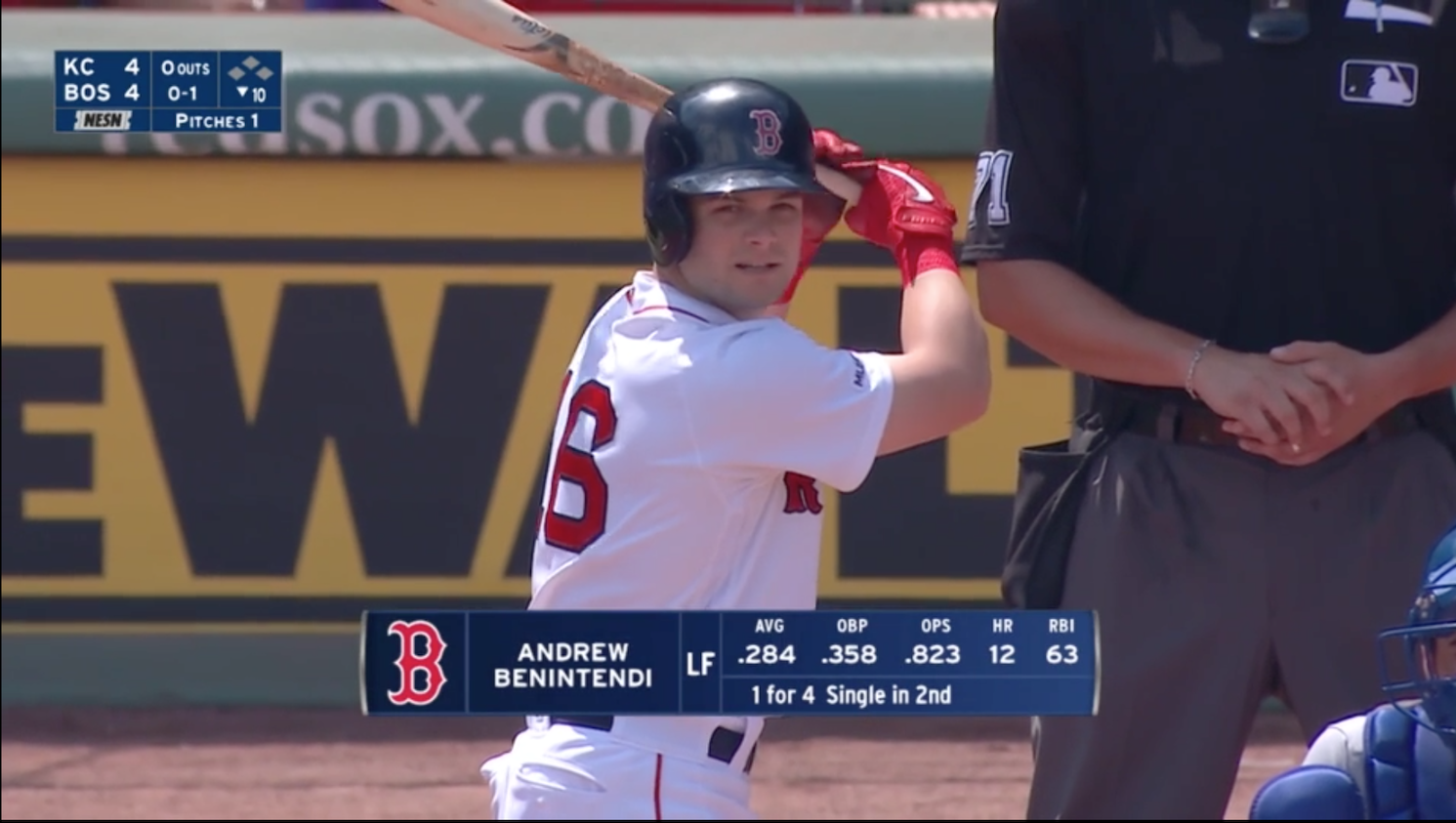
Last Thursday, the Red Sox and Royals resumed a game from August 7 that had been previously suspended due to rain. The original contest took its pause knotted up 4-4; it resumed in a 2-1 count in the top of the 10th. It was a strange viewing experience. With the game still tied in the home half of the inning, Andrew Benintendi came up to bat. The chyron showed his season stats entering this day, August 22, but marked his batting line from a day when he was two full weeks younger:

It was a testament to a few things — the surprising rigidity of baseball’s schedule, the allure of a chance, however small (entering the day, our playoff odds had the Red Sox with a 1.7% shot at playing October baseball), the grip of a discounted hot dog on the hearts of children. But the whole ordeal also made me think about how we think about time — how we sometimes consider it banked, or free, or very precious, or, when we’re mad, or tired, or perhaps inconvenienced, something we’d just like to hurry along. The Red Sox played the Royals for about 12 minutes, and in that span, they showed us time in four different states. These are those four. Read the rest of this entry »


2019 Arizona Fall League Rosters Announced, Prospects on THE BOARD

The 2019 Arizona Fall League rosters were (mostly) announced today, and we’ve created a tab on THE BOARD where you can see all the prospects headed for extra reps in the desert. These are not comprehensive Fall League rosters — you can find those on the AFL team pages — but a compilation of names of players who are already on team pages on THE BOARD. The default view of the page has players hard-ranked through the 40+ FV tier. The 40s and below are then ordered by position, with pitchers in each tier listed from most likely to least likely to start. In the 40 FV tier, everyone south of Alex Lange is already a reliever.

Many participating players, especially pitchers, have yet to be announced. As applicable prospects are added to rosters in the coming weeks, I’ll add them to the Fall League tab and tweet an update from the FanGraphs Prospects Twitter account. Additionally, this tab will be live throughout the Fall League and subject to changes (new tool grades, updated scouting reports, new video, etc.) that will be relevant for this offseason’s team prospect lists. We plan on shutting down player/list updates around the time minor league playoffs are complete (which is very soon) until we begin to publish 2020 team-by-team prospect lists, but the Fall League tab will be an exception. If a player currently on the list looks appreciably different to me in the AFL, I’ll update their scouting record on that tab, and I may add players I think we’re light on as I see them. Again, updates will be posted on the FanGraphs Prospects Twitter account, and I’ll also compile those changes in a weekly rundown similar to those we ran on Fridays during the summer.

Anything you’d want to know about individual players in this year’s crop of Fall Leaguers can probably be found over on THE BOARD right now. Below are some roster highlights as well as my thoughts on who might fill out the roster ranks.

Glendale Desert Dogs
The White Sox have an unannounced outfield spot on the roster that I think may eventually be used on OF Micker Adolfo, who played rehab games in Arizona late in the summer. He’s on his way back from multiple elbow surgeries. Rehabbing double Achilles rupturee Jake Burger is age-appropriate for the Fall League, but GM Rick Hahn mentioned in July that Burger might go to instructs instead. Sox instructs runs from September 21 to October 5, so perhaps he’ll be a mid-AFL add if that goes well and they want to get him more at-bats, even just as a DH. Non-BOARD prospects to watch on this roster include Reds righties Diomar Lopez (potential reliever, up to 95) and Jordan Johnson, who briefly looked like a No. 4 or 5 starter type during his tenure with San Francisco, but has been hurt a lot since, as have Brewers lefties Nathan Kirby (Thoracic Outlet Syndrome) and Quintin Torres-Costa (Tommy John). Dodgers righty Marshall Kasowski has long posted strong strikeout rates, but the eyeball scouts think he’s on the 40-man fringe. Read the rest of this entry »


The Dodgers Get Shifty

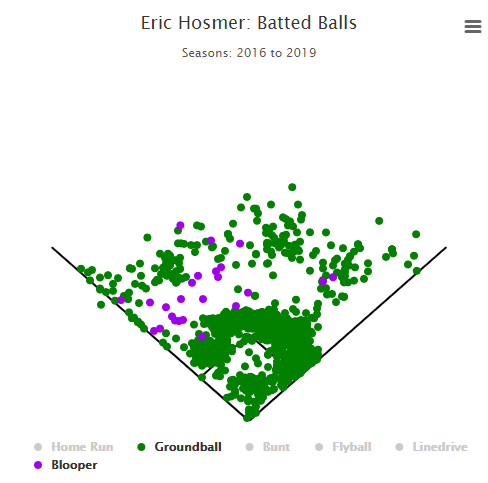
Eric Hosmer is a hard man to shift against. Though he fits the two main criteria for an overshift (namely: he’s left-handed and plays baseball), that’s where his list as an ideal candidate ends. If ever anyone was going to poke a groundball the opposite way, it would be Hosmer — his groundball rate is perennially among the league’s highest, and he hits a fair number of them to the opposite field. Teams generally agree — he’s faced a shift in fewer than half of his bases-empty plate appearances this year, and only 40.7% overall. Both place him in the bottom third of left-handed batters when it comes to the defensive alignment.

You don’t have to dig into his groundball numbers for long to work out why. The reasoning behind a shift is simple; hitters pull groundballs. League-wide, a whopping 55.5% of groundballs have been pulled, against only 12.1% hit the opposite way. The split is the same regardless of handedness, but first base is conveniently located on the lefty pull side of the field, which makes shifting a left-handed batter a high-percentage move.

For some reason, though, Hosmer doesn’t fit that mold. In 2019, he’s pulled only 46.4% of his groundballs, almost exactly equivalent to his career average of 46.3%. He’s at 16.3% opposite-field groundballs for his career over a whopping 2,263 grounders. His pull rate is in the bottom 20% of batters this year, and was in the bottom 3% last year, the bottom 10% two years ago, the bottom 15% for his career — you get the idea.

This isn’t to say there’s no merit to shifting against Hosmer — you’d need a more detailed mapping of infielder speeds and groundball exit velocity to work the math out perfectly. But look at his groundball (and blooper) distribution from 2016 to 2019 and tell me you want to shift against this:

Read the rest of this entry »


Vladimir Guerrero Jr. Accelerates to the Finish

Guillermo Martínez is 34 years old, last played pro ball eight years ago for the independent Grand Prairie (now Texas) AirHogs, and never made it above High-A in affiliated ball. He is also the rookie major league hitting coach for the Toronto Blue Jays. There’s a long history of men who never achieved much in their playing careers becoming outstanding in second acts as coaches, and in his responsibility for the offensive success of Toronto’s much-vaunted youth movement (the average age of their hitters, 26.2, is the youngest in the American League), Martínez has more than enough raw material to make his mark in his first season in the role.

Last week when the Blue Jays came to Seattle to take on the Mariners (dropping two out of three), I sat down with Martínez to talk about his first year of coaching in the majors, and in particular his first year of coaching another, much more famous, rookie: Vladimir Guerrero Jr.

After making his debut for Toronto late in April at the precocious age of 20, Guerrero has had an up-and-down — or, more accurately, a down-and-then-up — season for a middling Toronto club that is nonetheless understandably optimistic about the cohort of young hitters of which Guerrero is a part. First, the down: Through the end of June, across 226 big-league plate appearances, Guerrero had posted a wOBA of just .317, and — even more worryingly — was striking out far more (19% of the time) and walking less often (9% of the time) than at any previous level.

Some regression was to be expected, of course, upon facing big-league pitching for the first time. But it wasn’t just that the results that were underwhelming. It was that they matched up with the story told by the eyes. Read the rest of this entry »


The Cubs’ Road Woes Threaten Their Playoff Perch

With three losses in a row against the Nationals at Wrigley Field this past weekend, the Cubs (69-61) slipped out of first place in the NL Central. They’re now three games behind the Cardinals (72-58), the furthest they’ve been from first since May 1, and just one game ahead of the Phillies (68-62) and two games ahead of the Mets (67-63) in the race for the second NL Wild Card spot. They’ll face the latter in an important three-game series starting today, but the bad news for them is that they’ve had to pack their suitcases to head to Citi Field. At 25-39, the Cubs own the major’s eighth-lowest winning percentage on the road (.391), and the lowest of any contender by 44 points (the Mets are 30-39 at .435 on the road).

In a race for a playoff spot, that’s quite a handicap, of course. In fact, in the Wild Card era, no team has ever won less than 40% of its games away from home and still reached the playoffs. Just a small handful of teams has won less than 45% and done so. Here’s the bottom 10:

Lowest Road Winning Percentages of Playoff Teams Since 1995
Rk Team Year W L W% Postseason
1 Astros 2015 33 48 .407 Won AL WC, Lost ALDS
2 Cardinals 2006 34 47 .420 Won NL Central, Won WS
3T White Sox 2008 35 46 .432 Won AL Central, Lost ALDS
3T Braves 2010 35 46 .432 NL WC, Lost NLDS
5T Dodgers 2008 36 45 .444 Won NL West, Lost NLCS
5T Astros 2005 36 45 .444 WC, Lost WS
5T Padres 2005 36 45 .444 Won NL West, Lost NLDS
8T Braves 2005 37 44 .457 Won NL East, Lost NLDS
8T Pirates 2014 37 44 .457 Lost NL WC
8T Dodgers 2015 37 44 .457 Won NL West, Lost NLDS
SOURCE: Baseball-Reference

Of the 10 teams above, the 2006 Cardinals, who won the World Series despite finishing with just an 83-78 record — the low-water mark for any World Series champ — and the 2005 Astros at least made it to the big dance, but aside from the 2015 Astros winning the AL Wild Card game, the 2008 Dodgers were the only other team from the above group to advance in the postseason.

I limited that list to 10 because beyond that, the rankings get pretty bunched up, with three teams at .458 (from the strike-shortened 1995 season), six at .469, 11 at .481, and so on. In all, 43 of the period’s 206 postseason teams (20.9%) had sub-.500 records on the road; if you’re a stickler for a full 162-game schedule, it’s 40 out of 198 (20.2%). Just 10 of those teams won a pennant, and only three — the aforementioned 2006 Cardinals, and the 1997 and 2003 Marlins, because of course — won the World Series. It’s not a particularly viable route to dog-piles and champagne showers. Read the rest of this entry »


JT Chargois, Brad Keller, and Adam Ottavino on Developing Their Sliders

Pitchers learn and develop different pitches, and they do so at varying stages of their lives. It might be a curveball in high school, a cutter in college, or a changeup in A-ball. Sometimes the addition or refinement is a natural progression — graduating from Pitching 101 to advanced course work — and often it’s a matter of necessity. In order to get hitters out as the quality of competition improves, a pitcher needs to optimize his repertoire.

In this installment of the series, we’ll hear from three pitchers — JT Chargois, Brad Keller, and Adam Ottavino — on how they learned and developed their sliders.

———

JT Chargois, Los Angeles Dodgers

“I was having trouble getting one to spin — to turn over — so my high school coach showed me a spike. Over the years I’ve manipulated where I hold my [pointer finger] on the ball, but it’s still a spiked-curveball grip. I just throw it like a heater. Instead of getting out front and pulling it like a curveball, I stay true on it as though it was a heater.

“When I get in trouble — maybe it’s backing up on me — and I need to make an adjustment, I tend to change my mindset to more of a curveball, to more of a downer-pitch. I want it to have two planes, as opposed to just moving horizontally.

“It was actually taught to me as a curveball. Then I started throwing harder as I got older. I got stronger and was literally trying to throw the crap out of it. That’s kind of how it migrated into a slider. As opposed to having more of a wrist-turn to get a bigger break, [a slider] is more about the manipulation of your hand position at release point. Read the rest of this entry »


Losing Seasons Don’t Have to Be Lost Seasons

For a losing team, the Cincinnati Reds have been busy. It’s not just trading players either, as Cincinnati made one of the biggest deadline moves while many contenders slumbered in near-stasis, picking up Trevor Bauer with an eye towards retooling for the 2020 season. Only three of the eight players in Wednesday’s lineup were also in the lineup on Opening Day: Tucker Barnhart, Eugenio Suárez, and José Iglesias. Chief among the new additions is the recently called-up Aristides Aquino, a big slugger lurking far back from the head of the team prospect lists coming into the season. After a fairly unimpressive minor league career, Aquino has feasted on the major league bouncy ball in 2019, slugging 28 homers in 294 AB in the formerly pitcher-friendly International League and then a shocking 11 homers in just 20 major league games.

Aquino was not some elite prospect finally being called up. The Reds have only received the benefit of getting a look at Aquino because they decided to use their ABs in a now-lost season in a productive way. If the team hadn’t dropped Matt Kemp or traded Yasiel Puig, choosing to go with the known quantity in a mistaken attempt to goose attendance (there’s no evidence this actually works), there wouldn’t have been as many opportunities to assess Aquino or Josh VanMeter or Phil Ervin in the majors. They now have more information on these players — how they’ve played at the big league level — and that information can have a positive effect on the decisions they make on how to win the NL Central or a wild card spot in 2020. Even picking up veteran Freddy Galvis, a 2.0 WAR player, for free has a value to a team like the Reds given his one-year, $5-million option for 2020. Scooter Gennett was always likely to be gone, but Galvis may not be, and now the Reds have another player who they can choose to start in 2020 or trade over the winter.

The Reds have been fortunate in these decisions, but I would have been in favor of this calculus even if Aquino/VanMeter/Ervin had been terrible. My fundamental belief is that among hitters and pitchers, teams have roughly a combined 12,000 plate appearances/batters faced to work with every year, and as many of them should be devoted to trying to win games as possible. Maybe they’re not 2019 wins — maybe they’re wins in 2020 or 2023 or 2026. But even players not working out gives you information; if Aquino came to the majors and hit like Lewis Brinson, it would still give the Reds data they didn’t have before. You don’t acquire that kind of knowledge when you’re a 90-loss team still penciling Billy Hamilton or Chris Davis into the lineup on a daily basis. Read the rest of this entry »


Sunday Notes: Logan Morrison is Cherishing the Present While Looking Beyond MLB

It’s Logan Morrison’s birthday today. Now 32 years young, “LoMo” is in his tenth big-league season… albeit just barely. He’s seen action in just seven games this summer, having toiled exclusively in Triple-A prior to being called up by the Phillies on August 14. Two years removed from a 38-home-run campaign with the Tampa Bay Rays, Morrison has essentially morphed from a bona fide slugger into a player barely hanging on.

His winter had been a waiting game. A free agent as of Halloween, Morrison received a few non-roster invites, but coming off of hip surgery he didn’t want to risk “showing up and then getting cut from camp.” In search of more security, he bided his time.

Morrison eventually signed with the Yankees in mid-April, joined Triple-A Scranton Wilkes-Barre in early May, and played there until July 1. At that point, with his chances of a promotion seemingly scant — this despite a healthy .999 OPS — he executed the opt-out clause in his contract. He then hooked on with the Phillies following the All-Star break.

Never a shrinking violet when it comes to expressing an opinion, LoMo was candid when addressing the limited interest he received over the offseason. Read the rest of this entry »

