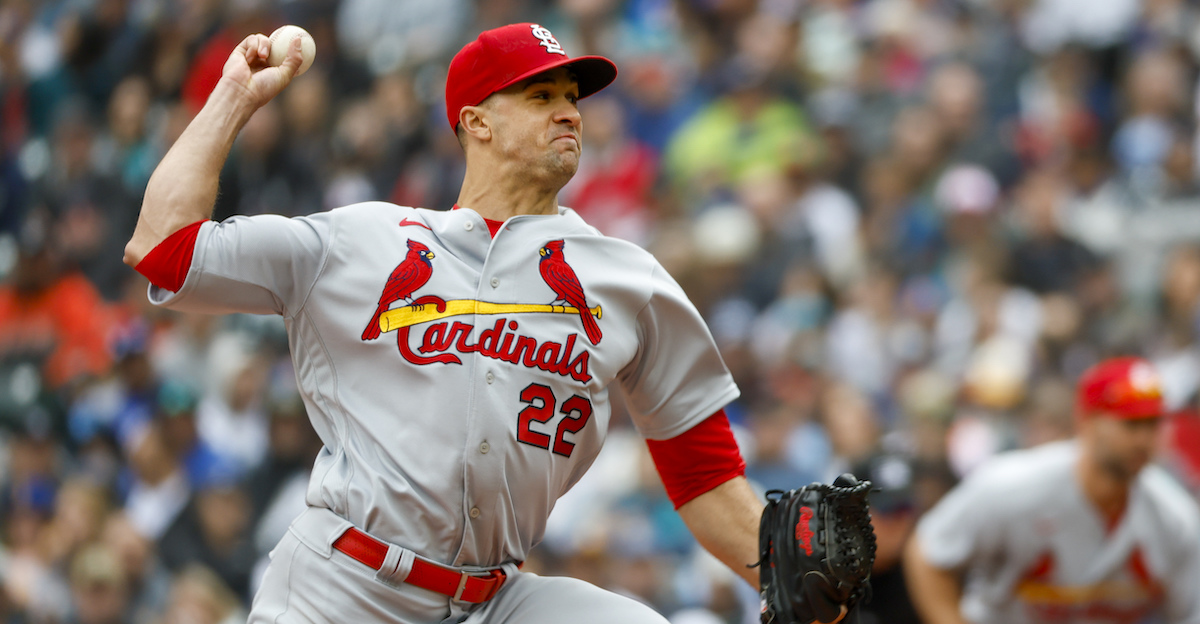
Adam Wainwright rose to the occasion. Summoning vintage form to pitch like the staff stalwart he’s been for the better part of the past two decades instead of the palooka he’s been for most of this season, the 42-year-old righty tossed seven shutout innings against the NL Central-leading Brewers at Busch Stadium. Thanks to a solo homer by catcher Willson Contreras and two more scoreless innings from his bullpen, Wainwright collected the 200th win of his career, and provided some long-awaited cheer and relief for the Cardinals and their fans in an otherwise dismal season.
If you haven’t been paying attention, most of what you need to know about how hard-won this milestone was is right there in Wainwright’s ERA: his seven scoreless frames lowered his mark from 7.95 to 7.40. You’re not going to notch many victories allowing runs at that clip, and in most organizations, you wouldn’t get many opportunities to keep trying, particularly when the underlying numbers do nothing to mitigate that ugly top line. The Cardinals, now 67-83 and en route to their first sub-.500 season since 2007, have continued sending him out there nonetheless, at times seeming to do so out of a sense of loyalty to a player who’s been a vital part of 10 playoff teams, two pennant winners and one champion rather than a clear-eyed judgment of his current abilities.
For one night, all that was put aside. Facing a team that began the day 18 games ahead of the Cardinals in the standings, and lacking even the pedestrian fastball velocity he could summon earlier this season, Wainwright nonetheless kept the Brewers off balance while working into and out of trouble in the majority of his innings. His one-out, first-inning walk to William Contreras was erased by a 4-6-3 double play off the bat of Carlos Santana. After retiring the side in order in the second, he induced Contreras to hit a slow chopper to Paul Goldschmidt to escape a two-on, two-out jam to end the third. In perhaps his most impressive sequence of the night, after serving up a two-out double to Willy Adames, he struck out Rowdy Tellez to end the fourth via a well-placed 87-mph sinker, that after the slugger had fouled off three curveballs and a cutter. He ended the sixth erasing another single by Contreras with another double play at the expense of Santana, who hit a 98.8-mph hot shot straight up the middle but right at shortstop Masyn Winn, who stepped on second and threw to first. After Mark Canha smacked a leadoff single on an 87.6-mph sinker — his fastest pitch of the night — then took second on a grounder and stole third with two outs, Wainwright stranded him, as Lars Nootbar chased down Josh Donaldson’s fly ball into the left-center gap. Read the rest of this entry »
Gavin Williams came as advertised when I saw him pitch earlier this month. The 24-year-old rookie right-hander’s fastball topped out at 99.3 mph, while his slider sat in the mid-80s and occasionally topped 90. Allowing one hit and a lone run over five rain-delayed innings against the Minnesota Twins, Williams was all about power.
He also came as advertised when I spoke to him on the day preceding his outing. I was told that the 6-foot-6, 255-pound Cleveland Guardians hurler is a man of few words, and that was pretty much the case. While accommodating, Williams was anything but verbose. No matter. I largely got what I was looking for: a self-appraisal of what he brings to the table.
“Most people know me for my fastball, really,” the righty replied when I asked for a self scouting report. “That’s the main thing people know me as, and it’s what I know myself as.”
The Fayetteville, North Carolina native first hit triple digits during his freshman year at East Carolina University, and as meaningful as that milestone was to his identity on the mound, he recognizes that retiring big-league hitters takes more than pure velocity.
“I don’t think 96 to 100 is that big of a difference,” Williams said. “If it’s down the middle it can get hit. Putting it where you want to is a bigger thing. It also matters how it moves.” Read the rest of this entry »
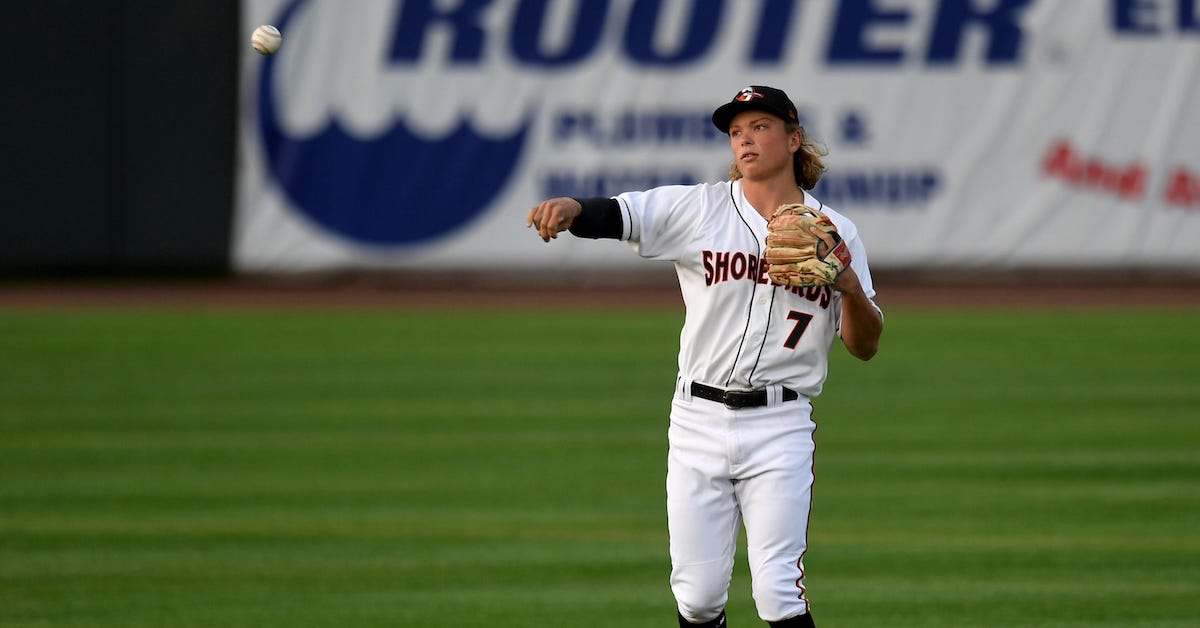
Lauren Roberts/Salisbury Daily Times / USA TODAY NETWORK
With Instructional League underway in Arizona (casts look of disappointment toward Florida) and Fall League rosters likely about two weeks out, the time has come to line the coffers with data and re-worked scouting reports in preparation for another round of farm system audits. Especially at the up-the-middle positions, defense is both very important and also a bit of a black box for readers, as there aren’t many publicly available minor league defensive stats and so much of evaluating defense is visual. I’ve recently been working on a video deep dive on the position players currently graded as 50 FV prospects or better, specifically to evaluate their defense in detail. Here I’ve taken a pass at the shortstops, providing video supplements for the prospects who I’ve evaluated in the 55 FV tier and above. I’ve made changes to their defense and arm tool grades over on The Board as a result of this exercise, and highlight the instances where this has caused a change to the player’s overall FV grade in the analysis below.
I’ve cut the videos in such a way that you can see each shortstop making similar plays one right after another. The videos feature plays to their left where I want to see them flip their hips and throw, plays that show the extreme end of their range, backhand plays in the hole to their right, plays coming in on the grass, and double play attempts. The fewest balls in play I watched for an individual player was 36 (Colson Montgomery and Dyan Jorge) and the most was closer to 70 (Jackson Holliday, Carson Williams and Marcelo Mayer). Read the rest of this entry »
There haven’t been a lot of bright spots in St. Louis this year. The Cardinals are 14 games below .500, owners of the second-worst record in the NL. The bottom has fallen out for the franchise in a way that hasn’t happened in 30 years. I’d hardly blame fans for being a bit checked out; it’s hard to look for silver linings when the rain cloud is this dark.
If you’re so inclined, though, there are always things to be optimistic about. The obvious one: the Cardinals’ offense has performed at a high level despite the poor results. They have an aggregate 111 wRC+ on the year, the fifth-best in baseball, and underlying statistics that match that. As always in St. Louis, it’s an ensemble affair, but three stars stand out atop the WAR leaderboard: Nolan Arenado, Paul Goldschmidt, and Lars Nootbaar.
Wait, Lars Nootbaar? I know what you’re thinking: I’m the chairman of the Nootbaar Nutbar fanclub, and my preposterously biased take should be ignored. But the leaderboards don’t lie: He’s tied with Arenado for the most WAR on the team, and that’s despite a 100-PA deficit caused by early-season injury issues. He has the best wRC+ on the squad. It’s not just smoke and mirrors; Statcast thinks he deserves the vast majority of his production.
In fact, let’s take it just one step further. Nootbaar has flown under the radar on a lot of broad sweeps of the best players in baseball because of two things: he’s not playing at a best-in-game level, and he’s missed a lot of time with injury. That puts him in the vicinity, WAR-leaderboard-wise, with guys who play more but aren’t as good on a rate basis. He’s tied with Luis Arraez, Christian Walker, and Bryson Stott, just to name a few, for 2023 WAR, but he’s played less than any of those guys. So let’s ignore health, just for a minute. Read the rest of this entry »
The Orioles entered Tuesday with the American League’s best record at 65-41 thanks to a rebuilding effort that’s finally paying off. Nonetheless, the team made just one move to shore up its major league roster in the final week ahead of the trade deadline, acquiring righty Jack Flaherty from the Cardinals in exchange for a trio of prospects, infielder César Prieto, lefty Drew Rom, and righty Zack Showalter.
It’s hardly a high-impact move, particularly given that the Orioles were reportedly among the frontrunners to land Justin Verlander and could deal from strength thanks to their well-stocked minor league system. Yet Verlander — who to be fair could have used his no-trade clause to block a move to Baltimore if it weren’t to his liking — instead wound up being traded back to the Astros. What’s more, aside from Verlander and former Mets co-ace Max Scherzer, who was traded to the Rangers on Saturday, this wasn’t a market where frontline starters changed teams. Instead the moves were centered around rentals such as Lucas Giolito and Lance Lynn, whose new teams are hoping they’ll rebound with a change of scenery, while moves for better performers, and pitchers under club control, were generally stifled by the high asking prices. Notably, the Rays, who entered Tuesday a game and a half behind the Orioles, were one team willing to bite the bullet for a better-performing starter by trading for the Guardians’ Aaron Civale.
The 27-year-old Flaherty, who can become a free agent for the first time this winter, fits into the bounce-back group. The former 2014 first-round pick, who had spent his entire career with the Cardinals, made an impact in his first few seasons, placing fifth in the NL Rookie of the Year voting in 2018 (his age-22 season) and then fourth in the Cy Young voting (and 13th in the MVP voting) the following year. For those two seasons combined, he pitched to a 3.01 ERA and 3.64 FIP with a 29.8% strikeout rate and 6.9 WAR in 347.1 innings. Whether it was his workload, which included 196.1 innings at age 23 (plus another 17 in the postseason), or just bad luck, his availability has only been sporadic since then. He’s totaled 264.1 inning since the start of 2020, and didn’t throw more than 78.1 in any season from ’20–22 due to an oblique strain and recurrent shoulder woes, which combined to send him to the 60-day injured list three times. Read the rest of this entry »
Jack Flaherty hasn’t quite looked himself since 2019, but the Cardinals were still able to get three prospects for a few months of his services from the Orioles at the trade deadline. The prospect return on the way to St. Louis — whose other deals are covered here, here and here — is made up mostly of near-ready players who should be able to play a role in what we’ve assessed as an attempt to rebuild quickly. The three prospects are Cuban infielder César Prieto, lefty Drew Rom (both of whom were at Triple-A Norfolk), and 19-year-old righty Zack Showalter, who was promoted from the Complex level to Low-A toward the end of June.
While playing pro ball in Cuba, Prieto broke Kendrys Morales‘ rookie hits record and the Serie Nacional’s hit streak record (40 games) in 2020, striking out just six times in 250 plate appearances. The rate of player defections from Cuba significantly diluted the quality of pitching in pro ball down there, so it was difficult to gauge his hit tool with precision. He defected from the Cuban National Team not long after arriving in Miami for an Olympic qualifier in May of 2021 (there’s a riveting Sports Illustratedstory that details his “extraction”), and he signed a $650,000 deal with Baltimore at the beginning of the 2022 international signing period.
After torching High-A for a few weeks, Prieto was promoted and spent most of his first minor league season with Double-A Bowie, where he struggled, slashing .255/.296/.348 in 90 games. He halved his strikeout rate when he was sent back to Bowie at the start of 2023, slashed a BABIP-aided .364/.406/.476 and was promoted to Triple-A Norfolk. In about a month prior to the Flaherty trade, he was hitting .317/.365/.471, again with a high BABIP.
Prieto can actually hit. His short levers make him extremely difficult to beat in the strike zone, and he can let the baseball travel deep before striking it the other way, generating doubles power pole-to-pole. His big issue is his propensity to chase, which he did at a 36% clip in 2022 and at a 40% rate so far in 2023, hindering the quality of his contact as well as his ability to reach base. But lefty sticks who make this much contact (91% Z-contact% as of the trade!) tend to carve out some kind of role, especially if they can play multiple positions.
Prieto is a below-average infield athlete and presents a stiff, non-traditional look at both second and third base. He also plays shortstop, but that is not something he’s remotely capable of doing at the big league level. I was hopeful that another full year with pro athletic training facilities and another season of seeing pro-quality pitching after he had access to neither for such a long time would help enable adjustment in these areas, but they’ve continued to be issues. I think the Eric Sogard comp I’ve had on him since his amateur days still holds water. He’s a flawed part-time player, but guys who can hit like this tend to play for a long time.
The other player who should provide a quick turnaround is Rom, an over-slot 11th-round high schooler from the 2018 draft who has slowly climbed through the minors with a cutting low-90s fastball. Especially when he was very young, he looked like he had a chance to break out if he could throw harder as he matured. That hasn’t really happened, and he’s still sitting mostly 90–92 mph, but his fastball still punches above its weight, and he’s managed to strike out more than a batter per inning throughout his pro career. While that likely won’t continue at the big league level because his stuff isn’t nasty enough, he throws enough strikes with his four pitches (if you count his four-seamer and sinker as two different offerings) to project as a depth starter. Already on the 40-man, Rom joins the mix of starters I mentioned in the analysis of the Jordan Montgomery deal as a candidate for the 2024 rotation.
Finally, there’s Showalter, another over-slot 11th-round high schooler, to round out the Cardinals’ return. It took a $440,000 bonus to buy him out of a commitment to USF after last summer’s draft, and he has made a strong pro debut. He generated some scout buzz during Extended Spring Training, then made only a few Complex starts before being promoted to full-season ball a little over a month before the deadline. Showalter works usually three or four innings per outing and sits 93–95 with uphill angle and tail. His delivery is of the open-striding drop-and-drive variety; he keeps his arm action very short and tucked close to his body as he motors toward the plate. It helps keep his release consistent and allows him to hide the baseball well. But he isn’t a fantastic athlete and lacks balance over his landing leg, which is often an indication of relief risk. I’m not yet ready to toss him on the main section of the updated Cardinals prospect list, but he’s a solid low-level arm with a mean outcome of a fastball/slider reliever. Prieto (40 FV, a 1-WAR annual performer who I expect will get 350–400 PA in his best years) and Rom (35+ FV, a spot starter) do make the cut.
This return isn’t enough to alter what I outlined in the Montgomery piece. The Cardinals still have a below-average farm system but have filled up the upper levels during this mini-rebuild and should have the pitching depth to compete for the NL Central next year if their core of hitters stays healthy and performs as expected. As a return for the Jack Flaherty who looked like one of the better pitchers in the NL for a little while, it feels light. But for the recently vanilla, free-agent-to-be Jack Flaherty, it makes sense for St. Louis to have received a few lesser prospects.
About 12 hours after Bo Bichette left Monday night’s game with a right knee injury, the Blue Jays found his possible replacement, acquiring shortstop Paul DeJong and cash considerations from the Cardinals on Tuesday afternoon for minor league reliever Matt Svanson.
DeJong being relevant again might make you think that you’ve warped back to pre-2020 days, but hang on before you load up on masks and toilet paper; he’s actually had a nice little 2023 season. I don’t think anyone would argue with me if I said the Cardinals were having a season with a stunning lack of pleasant surprises, but DeJong’s year has been one of those rarities. While a triple-slash of .233/.297/.412 won’t get you to many All-Star Games, it’s a much prettier line than his .196/.280/.351 collapse from 2020 to ’22, reaching a nadir with a ’22 season in which DeJong needed a telescope just to see the Mendoza line. He still plays solid defense at shortstop, and his bat has rebounded enough that there’s once again a significant role for him on a major league roster. The only reason he was even in St. Louis this year was the six-year contract he signed before the 2018 season.
The #BlueJays are sending minor-league reliever Matt Svanson, 24, in return for Paul DeJong and cash considerations. DeJong, who's in the final year of a six-year, $26 million contract, earns $9M this year with a $12.5M option or $2M buyout in 2024.
While this piece has the “2023 trade deadline tag,” that’s actually kind of a lie; this is a regular ol’ injury replacement trade that just happened to coincide with the deadline. The full extent of Bichette’s injury probably won’t be known before the trade market closes up shop for the fall, so the Jays had to act quickly unless they wanted to try to replace him in-house. And while they had options in the organization, all of them had at least one seriously concerning issue. Santiago Espinal is more an emergency shortstop than a starter, and Cavan Biggio only has two professional innings at short. And neither is providing enough offense to make you want to take that defensive risk. In the minors, Addison Barger has suffered through elbow problems this season and isn’t a natural shortstop either, and Orelvis Martinez just debuted at Triple-A. Ernie Clement turning into a weird plate discipline deity is interesting, but more for a bad team in search of an upside play, not a team in a tight, crowded pennant race that needs some certainty.
ZiPS Projection – Paul DeJong
Year
BA
OBP
SLG
AB
R
H
2B
3B
HR
RBI
BB
SO
SB
OPS+
DR
WAR
RoS 2023
.220
.297
.433
141
19
31
6
0
8
21
13
45
2
100
2
0.9
2024
.221
.294
.421
399
53
88
17
0
21
62
36
127
5
96
6
2.2
2025
.220
.295
.420
381
51
84
16
0
20
57
35
122
4
97
5
2.0
ZiPS 2024 Projection Percentiles – Paul DeJong
Percentile
2B
HR
BA
OBP
SLG
OPS+
WAR
95%
26
33
.269
.338
.551
138
4.4
90%
24
30
.259
.329
.525
131
4.0
80%
21
27
.245
.316
.483
119
3.4
70%
20
25
.235
.307
.456
109
2.9
60%
18
22
.227
.301
.436
102
2.5
50%
17
21
.221
.294
.421
96
2.2
40%
16
19
.214
.286
.403
91
1.9
30%
15
18
.205
.279
.386
84
1.5
20%
13
16
.195
.271
.367
78
1.1
10%
11
13
.181
.256
.340
65
0.5
5%
10
11
.171
.244
.322
60
0.1
DeJong’s options are now a little more complicated. At $12.5 million and $15 million, I imagine the Cardinals would have declined them as they did with Kolten Wong after a solid 2020 season. He has a $2 million buyout for 2024, and there may be a scenario in which the Jays pick it up if Bichette’s injury turns out to be fairly serious one. Is $10.5 million (since $2 million is baked into the cake either way) minus whatever the Cardinals are sending with him not worth it for them to keep DeJong as the starting shortstop for an undetermined part of next season before making him a utility infielder?
There was no reason to expect the Cardinals to get a haul of prospects for DeJong. Svanson is having a bit of a breakout season in the minors as a reliever, but you can’t ignore the fact that it’s as a 24-year-old in High-A ball. My colleague Eric Longenhagen has his two-seamer at 92–94 mph and his slider at 84, and that he would be an honorable mention in the Jays prospect list but would not make the main rankings. ZiPS turns Svanson’s 1.23 ERA/2.55 FIP into a 4.30 ERA translation with the Cardinals in 2023 because, well, 24-year-old in High-A ball. But if he advances quickly — and he will need to in order to have any kind of career in the majors — he could show up at the back of the big league bullpen.
Toronto would much prefer that Bichette’s knee is a minor issue that resolves quickly, but they’ve rightly formulated a solid Plan B here. There’s literally no time like the present.
*****BREAKING NEWS UPDATE EMERGENCY SIREN JAZZ HANDS*****
There’s no serious damage to Bichette’s knee, though it’s not determined whether or not he will need to head onto the IL. At the very least, we might see Bichette play more DH as they work him back into the lineup, whenever it is, and DeJong still remains a quality Plan B in the case of a setback. Bichette’s injury not being a serious one does reduce the chance that the Blue Jays will pick up one of DeJong’s options.
As everyone has seen by now, an MRI showed there is no structural damage in Bo Bichette’s right knee, per #BlueJays manager John Schneider, who described it as best case scenarios. Bichette isn’t in the lineup today but he’s day to day. Still determining if an IL stint is needed
The Cardinals are officially engaging in a moderate short-term rebuild, tradingJordan Hicks to Toronto for pitching prospects Sem Robberse and Adam Kloffenstein, and Jordan Montgomery to Texas for righty Tekoah Roby, infielder Thomas Saggese, and reliever John King. Each of these players could suit up for the Cardinals in the big leagues within the next 12 months, especially King (already a big leaguer) and the two pitchers coming back from Toronto, who will likely be added to the 40-man roster after the season. Roby and Saggese have spent their 2023 seasons at Double-A Frisco and are within range of the majors even though they don’t have to be put on the 40-man until after the 2024 slate. You can see where each of the newly-acquired prospects falls on the Cardinals list over on The Board.
Let’s start by going over the Montgomery return, since the most significant prospect acquired by the Cardinals comes over in that deal. Roby, 21, moved onto the Top 100 prospects list when I updated the Rangers system a couple of weeks ago, and he would have been even higher if not for his current shoulder injury, which shelved him in early June. Before he was shut down, Roby was consistently working with four plus pitches. He was sitting 94–95 mph with riding life, bending in one of the nastier curveballs in the minors, tilting in a similarly shaped slider in the mid-80s, and turning over a tailing low-80s changeup, all of which were capable of missing bats. He looked like a contender’s four-pitch, mid-rotation starter, like a less physical Hunter Brown.
Roby’s delivery does have some violence, but he’s always thrown strikes in spite of this. He is slightly undersized (but well-built) at 6-foot-1 and has now had arm injuries in two of his three pro seasons, so there’s definitely relief risk here despite his strike-throwing track record. From a stuff and pitch execution standpoint, he is where Jack Leiter was expected to be when he was drafted. On upside, Roby is a huge get for the Cardinals and could be the big league club’s best starting pitcher within a year or two. Once healthy, he has a chance to kick down the door, though shoulder issues can be particularly scary and destabilizing to a young pitcher’s career. Read the rest of this entry »
2023 has been a rough year for the St. Louis Cardinals. They’re used to living in the NL Central penthouse, looking askance at whatever team happens to battle them for supremacy in a given season. Sometimes they lose those battles – the Cubs put together a nice run in the mid-2010s, the Reds had their time in the sun before that, and the Brewers have been a thorn in St. Louis’ side in recent years. But this kind of collapse – 47-60 and last place in the division – is unheard of.
The silver lining? The Cardinals had a ton of expiring contracts coming into the season, which means they have a ton of players to trade. With the deadline quickly approaching, they’re starting to turn those players into prospects. In two deals on Sunday, the Cardinals sent out Jordan Montgomery, Jordan Hicks, and Chris Stratton. Montgomery and Stratton are headed to the Rangers; meanwhile, better hope Hicks has a passport, because he’s now a Blue Jay. Eric Longenhagen is covering the prospects who are coming back to the Gateway City in a separate piece. Here, I’m just going to focus on how these three fit with their new teams, and the Cardinals’ general strategy from here on out.
Let’s start with the Rangers. This one is pretty straightforward: Montgomery slots into a hilariously deep Texas rotation. After acquiringMax Scherzer on Saturday, their playoff rotation looked solid. Now it looks even better. Scherzer and Nathan Eovaldi (health permitting) are an above-average top duo, Montgomery is overqualified as a third starter, and after him there’s a whole grab bag of guys I wouldn’t feel either great or terrible about as my last playoff starter. Dane Dunning, Jon Gray, Andrew Heaney, and Martín Pérez are all cromulent options, and the three who don’t draw a rotation assignment might play up out of the bullpen. Read the rest of this entry »
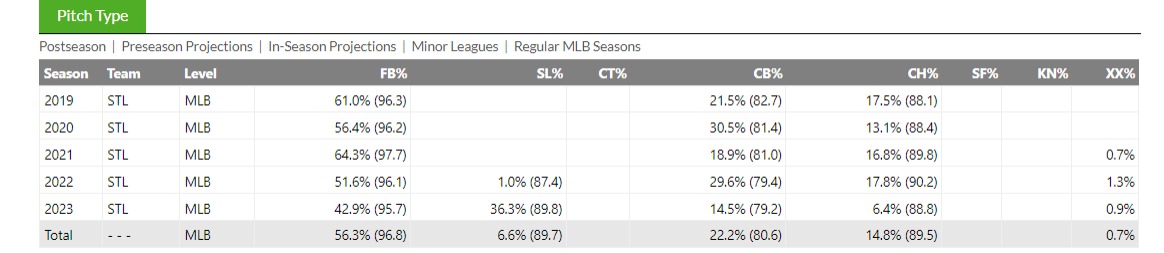
Génesis Cabrerachanged feathers on Friday, as he was traded from St. Louis to Toronto for teenage catching prospect Sammy Hernandez a few days after Cabrera was designated for assignment. The hard-throwing 26-year-old southpaw had spent parts of five volatile seasons with the Cardinals. While he has enjoyed a significant bat-missing rebound in 2023 compared to last season (he’s back into the 26% K% area, up from 16.5% in 2022), Cabrera was in the midst of yet another rocky, homer-prone year before he was DFA’d. He introduced an upper-80s slider/cutter to his repertoire this year and has been using it a ton (36%), while his fastball velocity has slipped a bit. All of Cabrera’s non-fastball pitches generate above-average swinging strike rates, while his mid-90s heater tends to get shelled even though he and the Cardinals made changes to it this year. Perhaps a change of scenery and new outside intervention will lead to another tweak in this area: