Archive for Cardinals

Jordan Walker’s Breakout Continues With Home Run Derby Title

Eric Hartline-Imagn Images

Jordan Walker was down to his last swing. Then he got another, and another, and another. When he finally stopped swinging, he was the Home Run Derby champ.

The Cardinals right fielder won the 2026 Home Run Derby in Philadelphia on Monday with five straight do-or-die swings. Hometown favorite Kyle Schwarber led off the final round and hit 11. That brought Walker to the plate under a chorus of boos from fans at Citizens Bank Park — boos that persisted and only grew stronger with every home run.

Walker tallied just eight homers in his 15 allotted swings for the final round, but new Derby rules this year did not allow rounds to end on a home run, so batters could keep swinging so long as they kept going yard. And so Walker kept swinging — and kept going yard. He launched his ninth and 10th long balls before crushing a 450-foot shot to left center to tie Schwarber. Walker took a brief pause to catch his breath, then took one last swing to end it. Read the rest of this entry »


FanGraphs Weekly Mailbag: June 27, 2026

RVR Photos-Imagn Images

The first thing to know about the firing of Carlos Mendoza is that nobody in the Mets’ clubhouse believes their poor performance is the former manager’s fault. Not David Stearns, the president of baseball operations. Not Francisco Lindor, the franchise shortstop. Not Bo Bichette, the big offseason acquisition. Not Andy Green, the farm director-turned-interim manager. Mendoza did not lose the clubhouse, Stearns said at a press conference Friday afternoon, less than six hours after the team announced the dismissal, while Lindor said he and the players failed Mendoza.

It would be easy to point to the embarrassing series the Mets just played against the Cubs at Citi Field, the low point coming in the second game of Wednesday’s doubleheader. Each of the four infielders made at least one error; that hadn’t happened since Sept. 8, 1962. New York recorded six defensive miscues in total. But the truth is, neither one game nor one series did Mendoza in. The only thing surprising about his firing is that it didn’t happen sooner. The Mets went 34-47 (.420) under Mendoza this season, making them the third-worst team in the National League. On June 12, 2025, the Mets held the best record in the majors. As of Friday morning, they had a record of 72-102 (.414) since that high-water mark. This is a team in free fall, and the descent has lasted for longer than a full calendar year. During the offseason, Stearns and the Mets cleaned house of most of their veteran players and brought in a new group of guys. That hasn’t worked through the first 81 games of the season, and so the next thing to do was fire the manager. Stearns said during his press conference on Friday that his own job is safe, that he has the support of ownership. The thing is, so did Mendoza — until he didn’t.

Jay Jaffe will take a more detailed look at Mendoza’s firing and the Mets in a story early next week, so that’s the last I’ll say about the news in this week’s mailbag. Instead, we’ll be answering your questions about the unwritten rules of ABS challenges, what would happen if a team were made up of nine Frank Thomases, the amount of money a player would make from spending just 24 hours on a big league roster, and more. But first, I’d like to remind you that this mailbag is exclusive to FanGraphs Members. If you aren’t yet a Member and would like to keep reading, you can sign up for a Membership here. It’s the best way to both experience the site and support our staff, and it comes with a bunch of other great benefits. Also, if you’d like to ask a question for an upcoming mailbag, send me an email at mailbag@fangraphs.com. Read the rest of this entry »


To Challenge, or Not To Challenge — That Is the Question

Darren Yamashita-Imagn Images

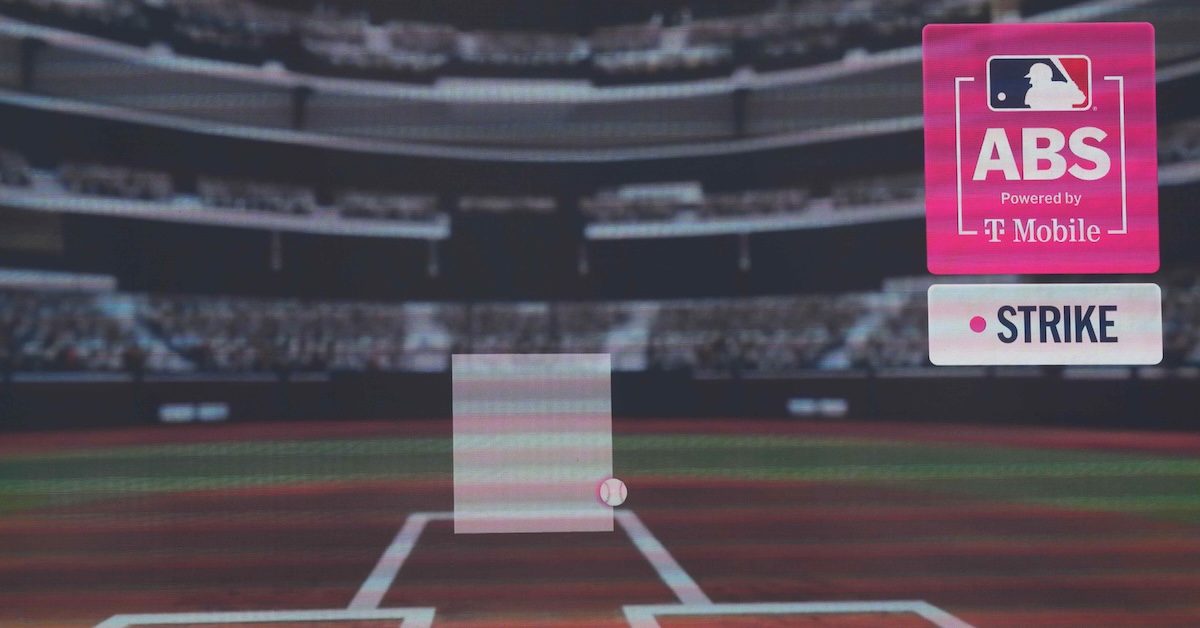
On April 15, Zach Neto was at the plate with one out and nobody on in the top of the fifth inning of the Angels’ game in the Bronx, where his team trailed the Yankees, 3-2. The first two pitches, a low changeup and a high slider, were nowhere near the zone, and Neto laid off easily. The 2-0 pitch from Luis Gil was another slider, this one about belt high and bending away from the right-handed Neto, who kept the bat on his shoulder and watched as the pitch appeared to clip the outside edge of the zone. Home plate umpire Lance Barksdale held up his hand. Strike one. Neto tapped his helmet immediately to challenge the call.

The graphic on the gigantic video board in center field showed that the pitch had missed by 0.4 inches. The call was overturned; the count was now 3-0. Neto walked on the next pitch. Mike Trout stepped in, took a fifth straight ball from Gil, then let a four-seam fastball over the heart of the plate get deep on him. He unloaded, clobbering the cookie 383 feet into the right field seats for a go-ahead two-run blast.

The no-doubt Trout clout would have been the decisive blow in an Angels win if not for a misplayed popup and a Jordan Romano meltdown. The Yankees walked it off on a José Caballero single, relegating Neto’s challenge to a footnote in that night’s game story, if it was mentioned at all. Even so, the gamble was an early example of how the new automated ball-strike challenge system can make the difference between winning and losing a game. Read the rest of this entry »


Is Andre Pallante Good? I Still Can’t Tell.

Gregory Fisher-Imagn Images

Andre Pallante starts for the Cardinals on Tuesday, and if he beats Michael King and the Padres, he’ll move into a tie for the National League lead in wins.

I know we’re not supposed to care about wins, but it gives me a chance to talk about a pitcher I’ve had a hard time understanding over his five seasons in St. Louis. I should be more specific, because Pallante’s game is pretty straightforward. That I understand just fine. I just can’t figure out if he’s any good or not. Read the rest of this entry »


Dustin May Is Finally Having His Day

Vincent Carchietta-Imagn Images

Dustin May’s 2026 season did not begin in auspicious fashion. He was chased in the fourth inning in each of his first two starts with the Cardinals, facing the Rays at home on March 29 and then the Tigers in Detroit on April 4. On the heels of his rough 2025 season, it was fair to wonder if St. Louis had grossly miscalculated by signing the 28-year-old righty to a one-year, $12.5 million deal. Since then, however, May has gone on a roll, putting together perhaps the best run of his injury-wracked career and placing himself among the game’s top starters during that span.

On Tuesday at Citi Field, May spun six scoreless innings against the Mets, holding them to four hits and one walk while striking out six. It was his first scoreless start since last August 12 while with the Red Sox, and with it, he collected his first win since April 21. Though he’d averaged a crisp six innings with a 3.86 ERA and a 3.03 FIP over his previous seven starts, the Cardinals had scored just 19 runs and posted a 2-5 record in those games.

Undoubtedly, the most frustrating of those strong outings was on May 27 in Milwaukee. May had held the Brewers hitless for seven innings, striking out nine and allowing only two baserunners; he hit Jake Bauers with a pitch in the second inning, and catcher Pedro Pagés interfered with Sal Frelick in the fourth. May had thrown just 72 pitches to that point, giving him a real shot at finishing the job without too much concern about pitch count. Alas, Garrett Mitchell led off the eighth with a double just over the head of left fielder Bryan Torres as he raced into the left-center gap, and then Luis Rengifo bunted for a base hit before manager Oliver Marmol called for the bullpen. The Brewers, who trailed 1-0 at the time, plated both runs against reliever JoJo Romero, and held on to win 2-1. Read the rest of this entry »


FanGraphs Weekly Mailbag: May 23, 2026

Joe Puetz-Imagn Images

It’s hard to know what to expect from a pitcher returning from a serious injury. In addition to velocity and spin rate, pitching is also about rhythm and feel, and that can take time to come back after a long layoff. But there was little rust for Gerrit Cole to shake off when he made his season debut Friday night at Yankee Stadium. In his first major league start since undergoing Tommy John surgery on March 11, 2025, Cole silenced the first-place Rays, allowing just two hits and three walks while striking out two across six scoreless innings. His only real trouble came in the first inning, when he gave up a leadoff single to Chandler Simpson and walked Junior Caminero to put two on with nobody out. After a Jonathan Aranda fly out, Cole picked the speedy Simpson off second base and then struck out Yandy Díaz looking at an inside fastball to end the inning. From there, he got in a groove. He averaged 96.1 mph with his four-seamer, and he threw 50 of his 72 pitches for strikes.

Cole left the game with the lead, but the Rays scored four runs in the top of the eighth inning to take the first game of the series, 4-2. They now lead the Yankees in the AL East by 5.5 games. Watching the Rays play Friday night, I couldn’t help but think about how annoying they would be to play against. They pitch well, put the ball in play, and are aggressive on the bases. One Yankee told me before the game that they remind him of last year’s Blue Jays because of their pesky bottom of the lineup and refusal to strike out. I’m still not sure how good the Rays are, but I get the feeling that they are always going to be better than I think.

In this week’s mailbag, we discuss another surprising team over the first two months of the season. We’ll also answer your questions about how many players in baseball have the ability to win MVP, how good Randy Johnson and other all-time-great starting pitchers would’ve been as closers, and why the 9-9-9 challenge beers are so small. But first, I’d like to remind you that this mailbag is exclusive to FanGraphs Members. If you aren’t yet a Member and would like to keep reading, you can sign up for a Membership here. It’s the best way to both experience the site and support our staff, and it comes with a bunch of other great benefits. Also, if you’d like to ask a question for an upcoming mailbag, send me an email at mailbag@fangraphs.com. Read the rest of this entry »


Jordan Walker Is Trending Up

Charles LeClaire-Imagn Images

Since the start of the year, I’ve been watching Jordan Walker mash the ball as I try to figure out something to say about it. As a card-carrying Walker booster – I’ve got a Top 50 Trade Value ranking to prove it – I’m very willing to believe in Walker’s promise. But as a sometime Cardinals fan – being a professional baseball writer makes fandom complicated – I’m afraid of getting burned. Walker has already gone from one of the most heralded prospects in the game to one of its worst-performing full-time players. Now he’s one of the best-performing players? Being a little skeptical is just a matter of self-preservation.

Now that we’re a month and a half into the season, though, I can’t keep myself from investigating. Walker hasn’t had stretches this productive since his rookie year. He hasn’t had stretches where he’s hit the ball on the ground this rarely as a major leaguer, period. He’s been 14.5 runs above average offensively in 2026 – after being 13 runs below average offensively for his entire career before now. If that isn’t screaming for an article, I don’t know what is.

If you know two things about Walker, they’re probably these: He swings hard, and he can’t get the ball off the ground. That makes it easy to think through how he might improve: keep swinging hard and stop hitting it on the ground. When I designed the Squared-Up Explorer for the FanGraphs Lab, Walker was actually one of my favorite examples to use. Look at where his best swings are, compared to another guy who swings very hard:

The bubble size represents frequency, and being further right means more squared-up contact. Before 2026, Walker squared up the ball most frequently on grounders, and he hit a ton of them. For his part, Judge isn’t squaring the ball up every time he hits it or anything, but he’s following a simple recipe. He swings really hard, he gets the ball in the air a lot, and then he profits. The harder you swing, the more valuable hitting the ball flush becomes; Judge doesn’t need to hit it pure every time to clobber dingers at a historic rate. Read the rest of this entry »


Sunday Notes: David Morgan Picked Up His Sinker in the Dugout Between Innings

When David Morgan was profiled in last year’s rankings of the San Diego Padres’ top prospects, it was pointed out that the 26-year-old right-hander had joined the organization as a non-drafted free agent in 2022. Moreover, he’d barely taken the mound. A two-way player at Hope International University — an NAIA school in Fullerton, California — Morgan had thrown just nine-and-a-third innings. At the time he signed, he was playing for the Portland Pickles in the summer collegiate West Coast League (for which Rob Neyer is the commissioner).

Morgan’s backstory sets him apart him from his MLB brethren, but what about from a pitch-specific standpoint? Are there any differentiating characteristics?

“My ability to pick stuff up and kind of run with it is probably the most unique thing about me,” said Morgan, who made his big-league debut last May and has since logged a 3.41 ERA and a 4.15 FIP over 52 appearances comprising 60-and-two-thirds frames. “Last year, when I had to throw a sinker, it wasn’t really a learning process. It was in-between innings. I came into the dugout, grabbed a new grip, and threw it the next inning.”

The outing, his sixth in the majors, came on June 10 with the Padres holding a commanding late-inning lead against the Los Angeles Dodgers. When Morgan returned to the dugout after working the eighth, pitching coach Ruben Niebla pulled him aside and asked if he’d ever thrown a sinker. The answer was yes and no. Morgan had toyed around with one, but that was about it.

With the game not in doubt — San Diego led 11-1 — Niebla “gave [him] a grip and said to go out and throw it next inning.” Morgan did, the pitch “danced around a little bit,” and the rest is history. By season’s end, he’d thrown his sinker at a 21.5% clip, and this year the usage is up to 34.7%. Read the rest of this entry »


Five Things I Liked (Or Didn’t Like) This Week, May 1

Junfu Han-USA TODAY NETWORK via Imagn Images

Welcome to another edition of Five Things I Liked (Or Didn’t Like) In Baseball This Week. This column isn’t running every week this year, which means the title is more of a suggestion than a rule. There are some plays from last week, some plays from this week, and future editions will probably break that convention even a little more. I can’t imagine that’s all that big of a deal. After all, “I Liked” is a bigger part of why I enjoy writing this series than “This Week.” So sit back, relax, and check out some of the most delightful baseball happenings of the second half of April. And of course, thanks again to Zach Lowe of The Ringer, the progenitor of the “X Things I Liked This Week” format and my inspiration for this column.

1. Inevitability
If you tune into a baseball broadcast with a runner on third base and less than two outs, you’re liable to hear a discussion of an “undefendable play.” That play is some variation on a safety squeeze: The batter bunts, the runner gets down the line as far as he can safely and waits to see where the bunt is headed before committing, and the defense has very little hope of making a tag play in time. Batters have attempted 24 of these bunts in 2026, and defenders have only retired the lead runner four times. Safety squeezes were equally hard to stop in 2025, this hilarious double play notwithstanding. But maybe they’re even better than those success rates would imply. Maybe there’s some kind of supernatural force that makes safety squeezes work. How else do you explain this nonsense?

Taylor Walls is the most prolific safety squeeze bunter in baseball, and he tried it in extras against the Pirates last week:

Read the rest of this entry »


Riley O’Brien, Best of Both Worlds

Jeff Curry-Imagn Images

In pitching, there’s a fundamental tension between the two best results you can obtain: strikeouts and grounders. Strikeouts are obviously the best, but grounders are incredible too. Batters put up a .232 wOBA when they hit the ball on the ground, as compared to .462 in the air (popups are another category of good batted ball, but I’m lumping them in with aerial contact today for simplicity’s sake). The thing is, the pitches that induce strikeouts tend not to induce grounders, and vice versa. Sinkers don’t miss bats, and four-seamers don’t keep the ball on the ground. It’s quite the bind.

There are, of course, pitchers who can do both. Nolan McLean springs to mind. There’s peak Zack Britton, Framber Valdez at his curve-spinning best, some good Cristopher Sánchez games perhaps. For the most part, though, it’s really hard to do both. I came up with a simple rule to measure how good pitchers were at it last year: divide grounders by two, add strikeouts, subtract walks, and divide by total batters faced. Aroldis Chapman, Jhoan Duran, and Andrew Kittredge paced the league in it last year, with Shohei Ohtani and Mason Miller rounding out the top five. Those guys were all incredibly effective.

It’s early in the season, of course, but do you know who’s leading baseball in this ratio in 2026? Well, it’s Mason Miller. Oops. I guess breaking baseball will do that. If you’re striking out 70% of the guys you face, of course you’ll lead this measure. But the only other player above 50%? That’d be Riley O’Brien, the new Cardinals closer, who has been one of the best stories in baseball so far this year. Read the rest of this entry »